#Culture
Far Away [Part 29] – Kurdish Killers and Stolen Gold
A troubled Darius is comforted by Ahmed, confronts a prince, and meets a pair of fearsome Kurdish mercenaries.

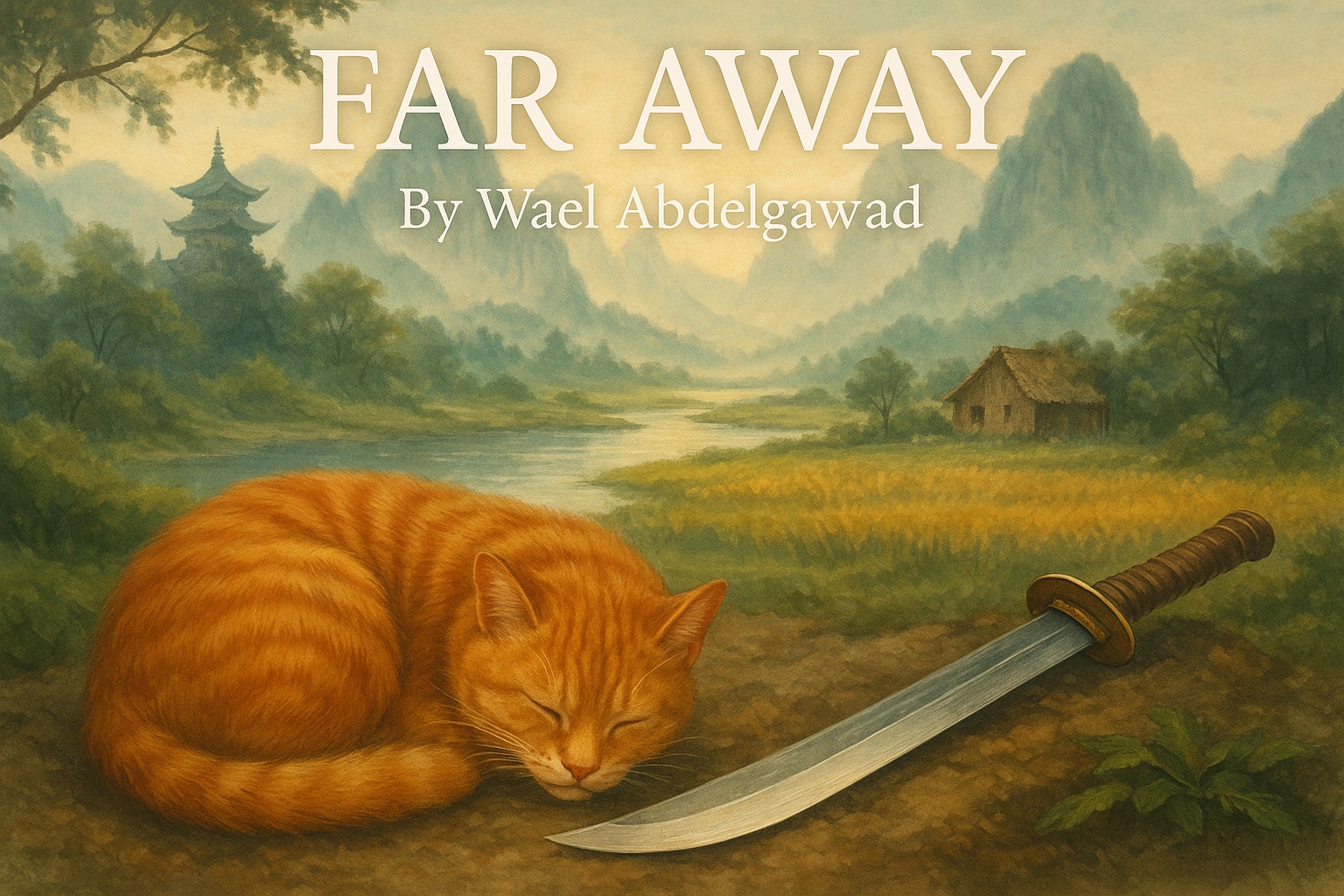
A troubled Darius is comforted by Ahmed, confronts a prince, and meets a pair of fearsome Kurdish mercenaries.
Read Part 1 | Part 2 | Part 3 | Part 4 | Part 5 | Part 6 | Part 7 | Part 8 | Part 9 | Part 10 | Part 11 | Part 12 | Part 13 | Part 14 | Part 15 | Part 16 | Part 17 | Part 18 | Part 19 | Part 20 | Part 21 | Part 22 | Part 23 | Part 24 | Part 25 | Part 26 | Part 27 | Part 28
* * *
Take Care of Him
Keep supporting MuslimMatters for the sake of Allah
Alhamdulillah, we're at over 850 supporters. Help us get to 900 supporters this month. All it takes is a small gift from a reader like you to keep us going, for just $2 / month.
The Prophet (SAW) has taught us the best of deeds are those that done consistently, even if they are small. Click here to support MuslimMatters with a monthly donation of $2 per month. Set it and collect blessings from Allah (swt) for the khayr you're supporting without thinking about it.
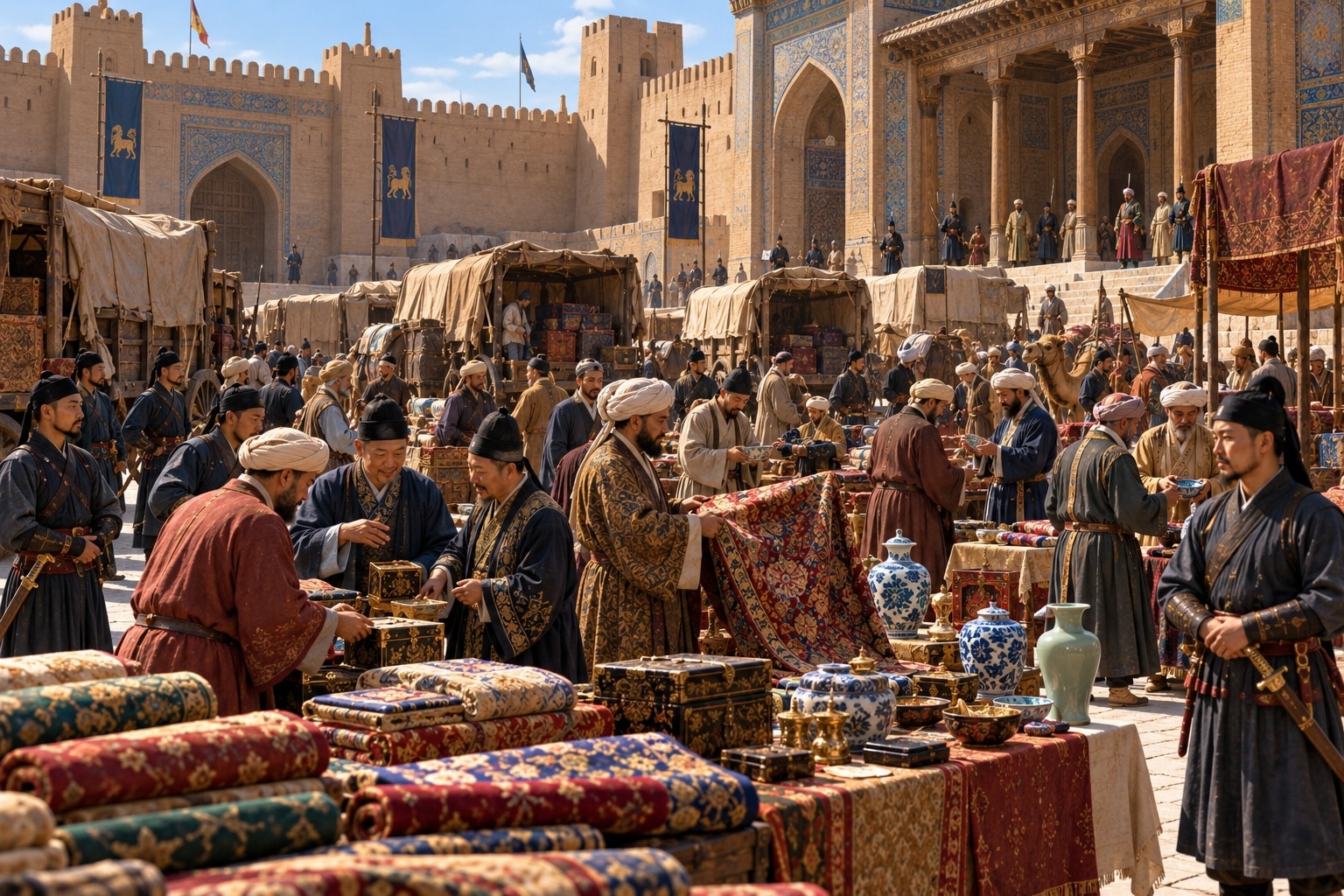
At the caravan, Persian merchants were everywhere. Some climbed into wagons to inspect goods while others stood beneath awnings examining samples of precious and luxurious Chinese goods laid out on blankets and tables. Bolts of cloth were unrolled, jars opened, boxes lifted and weighed. Five Star merchants talked animatedly with their Persian counterparts, pointing, arguing, laughing and gesturing with their hands. Other Persians had brought samples of their own goods, and knots of men gathered around them. Karim and the guards stood quietly among all this activity, watching the visitors and keeping an eye on the wagons.
The boy’s head turned constantly. He stared at the walls, the soldiers, the horses, the courtyards and the richly dressed men moving through them.
I had become accustomed to Five Star. I had forgotten what it must look like to someone seeing it for the first time.
Captain Karim was speaking to a merchant. He saw us approaching and frowned. “Who’s this, then?”
“I found him in District Nine.”
Karim’s frown deepened. “You found him?”
“The kid needs a job. And you said we need guards. He’s strong, he works hard, and he’s honorable. I tried to give him a gold coin and he wouldn’t take it.”
Karim looked at Ahmed.
Ahmed nodded. “That’s all true.”
Karim rubbed his forehead. “I sent messengers to caravan recruiters to request experienced guards. I didn’t expect you to snatch someone off the street.”
I was about to object but he shut me down with a wave of the hand. “Evaluations are tomorrow afternoon. Until then, take care of him. Feed him, bathe him, get him clean clothes – not a uniform, just regular clothes – and find him a place to rest.”
“Me? I can’t even speak his language.”
Karim raised an eyebrow. “You brought him.” Then he turned back to the merchant.
I looked at Ahmed, who grinned. “I told you it would be interesting.”
I glanced at the boy. A provisions seller had rolled in, and was unloading large quantities of vegetables, fruits, bread and fresh meat. It took a lot of food to feed a caravan this size. The boy was watching this with wide eyes. I was sure he had never seen so much food in his life. Maybe never even imagined it.
I chewed on my lip. I was tired. I wanted to take care of Belly and rest, not spend a day and a night babysitting a kid I couldn’t talk to.
“Who among us speaks Persian?”
“The Captain,” Ahmed replied. “Me. Longwei. Chen.”
“Chen? Little Chen? The one who always talks about fishing and sits around carving lures?”
“Yes. His father was an ambassador stationed in Isfahan.” Ahmed studied me with narrowed eyes. “Why are you smiling?”
“No reason. Gotta go. See you later.”
Captain’s Orders
I found Chen relaxing with his back against one of the wagons, carving a tiny fish.
“Chen, I have an assignment for you.”
Chen looked up. “What?”
I pointed to the boy. “Feed him, clean him up, get him some civilian clothes and find him somewhere to sleep. Captain’s orders.”
Chen looked at the boy, then at me. “Who is he?”
“Prospective guard.”
“Him?” Chen’s tone was incredulous. “Unbelievable. The Captain said I should do this?”
“He just gave the order five minutes ago. Take care of him, he said.”
Chen put away his knife. “Fine. What’s his name?”
I blinked. For the first time I realized that I hadn’t even asked the kid’s name. “I dunno.”
Chen rolled his eyes, then asked the boy in Persian, and the kid replied, “Ardeshir Parvizi.”
“There you go.” I walked away, leaving young Ardeshir in the care of the very competent Chen. Or so I hoped.
Glad You’re Here
I was exhausted, but Belly had carried me all morning and his needs came before mine. I led him to water and let him drink, then walked him slowly for a few minutes before watering him again. When I was satisfied, I removed the saddle and bridle, gave him his feed and began wiping the sweat and dust from his coat while he ate.
I brushed him slowly, working from his neck along his back and flanks. Belly was busy eating, his jaws grinding steadily. The familiar routine felt good. When I finished, I put the brush aside and wrapped my arms around his neck. His coat was warm beneath my cheek.
“Today was a hard day for me, Belly,” I said softly. “I saw some things.”
Belly continued chewing.
I closed my eyes and held him tighter. “But I’m glad you’re here.”
Eventually I left him to his food and went to Hakim Yusuf’s wagon. The early afternoon sun was still bright, but I spread my bedroll beneath the wagon where the shade was deep, and lowered myself carefully. My back hurt, my ear hurt, and exhaustion had settled into my bones. I closed my eyes and waited for sleep.
Instead I saw two thin brown legs extending from beneath a white cloth.
I rolled onto my side, then onto my back. Around me the caravan went on with its business. Merchants bargained, horses snorted, men laughed, wagon boards creaked beneath footsteps. I closed my eyes again, but the little girl’s bare feet were still there.
The Girl
Someone nudged my foot. I opened my eyes to see a compact fortyish man with a touch of gray in his neat beard, and a gentle set to his eyes.
“Since when do you sleep all afternoon?” Ahmed asked.
I sat up and rubbed my face. “I don’t feel good.”
He studied me for a moment. “Come. Walk with me.”
It was hard to say no to Ahmed. He could be no-nonsense, but he was also wise and kind. I crawled out from beneath the wagon and we strolled into the palace garden, where we wandered without speaking. Eventually we came to a tiled fountain surrounded by flowers, and sat on its wide stone rim. Water spilled softly from one basin into another. Bright little birds hopped among the branches overhead.
Ahmed watched the water. “Is it the dead girl?”
I chewed my lip. “Yeah.”
“Yes.”
“Because she was young?”
“Her legs.” I swallowed. “Her bare legs sticking out from the kafan. When I close my eyes, they’re there. She starved to death while people inside the citadel were eating a mountain of food. I don’t understand why that can happen.”
Ahmed put an arm around my shoulders. It felt patronizing, and the muscles in my back bunched. I could feel the hard muscles of his arm like stones beneath his skin.
“I’m not one of your fifteen children, you know.”
Ahmed laughed. “It’s nine, not fifteen. And yes, I know you’re not.” Yet he did not remove his arm, and I didn’t ask him to, and after a moment I felt myself relaxing. I watched the water tumble into the basin. I thought Ahmed would say something wise or comforting, but he did not.
“Don’t you miss them?” I asked.
“Every moment of the day. I do this work to provide for them. But this is my last run. Before we leave I’m going to use all my savings to buy a load of Persian carpets to sell back home. I’ll use the profits to set up a shop.”
“Really?” It made me smile to think of Ahmed running a rug shop, with all his kids around him.
We sat there long enough for shadows to lengthen, still with Ahmed’s arm around my shoulders.
“Break yourself of that habit,” Ahmed said suddenly, pointing to the ring in my hand. “Or one day someone will cut your throat for that thing.”
I hadn’t even realized that I had brought the ring out and was stroking it with my thumb. I put it away.
The sound of someone shouting came from deeper in the gardens. At first I thought someone was giving orders, but the sound came again in a steady rhythm, many male voices answering one another. There was a thump, then another, then several together.
I stood. “I want to see what’s going on.”
Ahmed smiled. “Of course you do.”
Training Soldiers
We followed the chanting through the gardens and found perhaps two dozen Persian soldiers training in a paved courtyard surrounded by rose bushes. They wore loose clothing and swords on their hips, and stood in rows, moving together as a very large man paced before them and called the cadence.
I recognized him immediately. After all, how many giants could there be in the citadel? It was the soldier I had fought, teaching a fighting class. His nose was wrapped in a bandage, and dark bruises had spread beneath both eyes.
I stayed to watch.
“Yek!” the giant shouted.
The men threw a jab, cross and rear-leg front kick. Their movements were synchronized and precise.
“Do!”
Jab, cross, draw the sword, horizontal cut, vertical cut, thrust. Sheath.
“Se!”
And so on. The hand and foot strikes remained simple, but the sword combinations were fast and fluid, and grew in complexity as the drill went on.
Suddenly I understood. I had thought the big soldier’s empty-hand fighting was limited. It was, but that was the point. He did not train martial artists. He trained soldiers. The punches and kicks were there to keep a man alive long enough to draw his sword, or to give him a fighting chance if he lost the weapon.
Most of the Five Star guards were the same, actually. Meilin could use a sword with terrifying skill, and Memdooh could put an arrow where he wanted it, but neither of them could match me empty-handed. I was an anomaly. A freak, created by a father who’d had nothing else to offer me, and had therefore poured his prodigious ability into me before he died. I didn’t think that made me better than anyone else. Being good at fighting was one thing only, and did not make me more important or praiseworthy than a healer, engineer, poet, imam or a Persian soldier. I was poorly educated in many ways. But I knew what I was good at.
When the soldiers stopped to rest, I approached their instructor.
“I’m sorry about your nose. I didn’t realize I hit you that hard.”
Ahmed translated. The big man smiled and clapped me on the back hard enough to nearly knock me over. He said something to Ahmed.
“He wants to know if you would fight him again.”
I waved my hands emphatically. “No. No, no. Thank you. Once was enough.”
No translation was needed. The soldier roared with laughter, and so did his men.
People Are Dying
I wasn’t magically cured, but I felt a lot better. The adhaan for Maghreb sounded. We prayed, and afterward I waited until Farhad was free, then approached him.
“May I speak with you?”
Farhad smiled. “Of course. Always.”
“I’ve been to District Nine.”
His eyebrows rose. “Alone? And why?”
“People are dying of hunger.”
His mouth turned down. It wasn’t surprise tugging at his face, but guilt. “It’s bad there, yes.”
“What are you doing about it?”
Farhad stared at me for a moment. “You know, people don’t usually speak to me like this.”
I said nothing.
He sighed. “I’m doing my best, Darius. I cannot solve every problem in the Guarded Domains.”
“I think you could do better.” For a moment I wondered if I had gone too far. Then Farhad nodded slowly.
“Very well. I will send ten wagonloads of rice into Darbi Malik tomorrow morning. Will that satisfy you?”
“It’s a start.” It didn’t escape my attention that he had called the district by name. Darbi Malik. It wasn’t just District Nine. That meant something.
Farhad laughed softly and shook his head. “I wish you had chosen to stay.”
I held out my hand. “So do I. A little.”
We shook hands.
Still No
Dinner was served after Maghreb. I took a plate of rice, lamb and vegetables, then carried it back to my favorite spot near Hakim Yusuf’s wagon. I sat with my back against a wheel and ate slowly, enjoying the quiet.
I had nearly finished when someone stopped in front of me.
Weili carried a plate of her own, and held a small book in her hand. Without asking, she sat across from me. The bandage was gone from her cheek. I tried not to stare, but there was no pretending I didn’t see it. The flesh of her left cheek was puckered and uneven, drawn into strange contours by the burn. It looked almost as if the skin had melted and hardened again. The scar ran from beneath her eye almost to the corner of her mouth.
She saw me looking, and her mouth tightened. “I’m hideous, I know.”
I had not intended to speak to her again. But I said, “No. You’re not.”
“Don’t lie,” she said bitterly.
“I’m not. It gives you an air of gravity. Makes you look older. You’re still lovely, though.”
Her eyebrows rose. “Older?”
I shrugged.
Weili extended the book toward me. “This is for you. I found it in the suq, in a shop called East West books. I know how much you love to read.”
The title, to my surprise, was in Mandarin. It said “One Thousand and One Nights,” and was subtitled, “A Famous Collection of Stories.” I stared at it, wondering what fascinating tales lay within. My mouth actually watered at the prospect of reading it. Then I shook my head and said, “No, thank you.”
Weili stared at me for a long moment, then withdrew the book and began eating her dinner. Around us, the evening business of the caravan continued. Somewhere a group of merchants burst into laughter.
“I’m sorry I slapped you,” Weili said.
I did not reply.
She tried again: “That’s a big deal about the ring. Everyone is talking about it.”
I wanted to tell her that I still couldn’t believe it myself. It would be so pleasant to sit and make ordinary conversation with her, just like the old days. My jaw tensed as if the words were about to come out. But they didn’t.
Weili sighed, picked up her plate and rose. “Good night, Darius.”
I watched her walk away. Later, when the adhaan for Ishaa sounded, I made wudu and prayed alone. Afterward I returned to my bedroll, pulled my blanket over myself and closed my eyes. This time, sleep came.
Candidates
At Fajr the next morning, Farhad approached me. “I am sending men into the city,” he said, “to buy the rice and transport it to Darbi Malik. Do you want to go along to verify?”
I shook my head, embarrassed. “No need. I trust you.”
Farhad nodded and ruffled my short hair, which might have been annoying from anyone else, but from Farhad it felt brotherly.
After breakfast, those of us who had been selected to evaluate the guard candidates assembled with the prospects in an empty section of the courtyard. There were twenty candidates: seventeen men and three women. Most looked to be in their twenties or thirties, though there were a few older veterans with weathered faces and old scars. Several had brought their own swords and bows.
One of the women stood out. She was about my height, with light brown eyes the color of Persian tea, and chestnut hair that was braided and hung down her back, with a red and white checked scarf partly covering it. Her clothing was unlike that of the other candidates. She wore loose trousers tucked into sturdy leather boots, with a long shirt beneath a short, coarse jacket that looked as though it had been woven from goat hair. A broad cloth sash was wrapped several times around her waist, and thrust through it was a curved short sword. On her back she wore a recurved bow and a quiver of arrows.
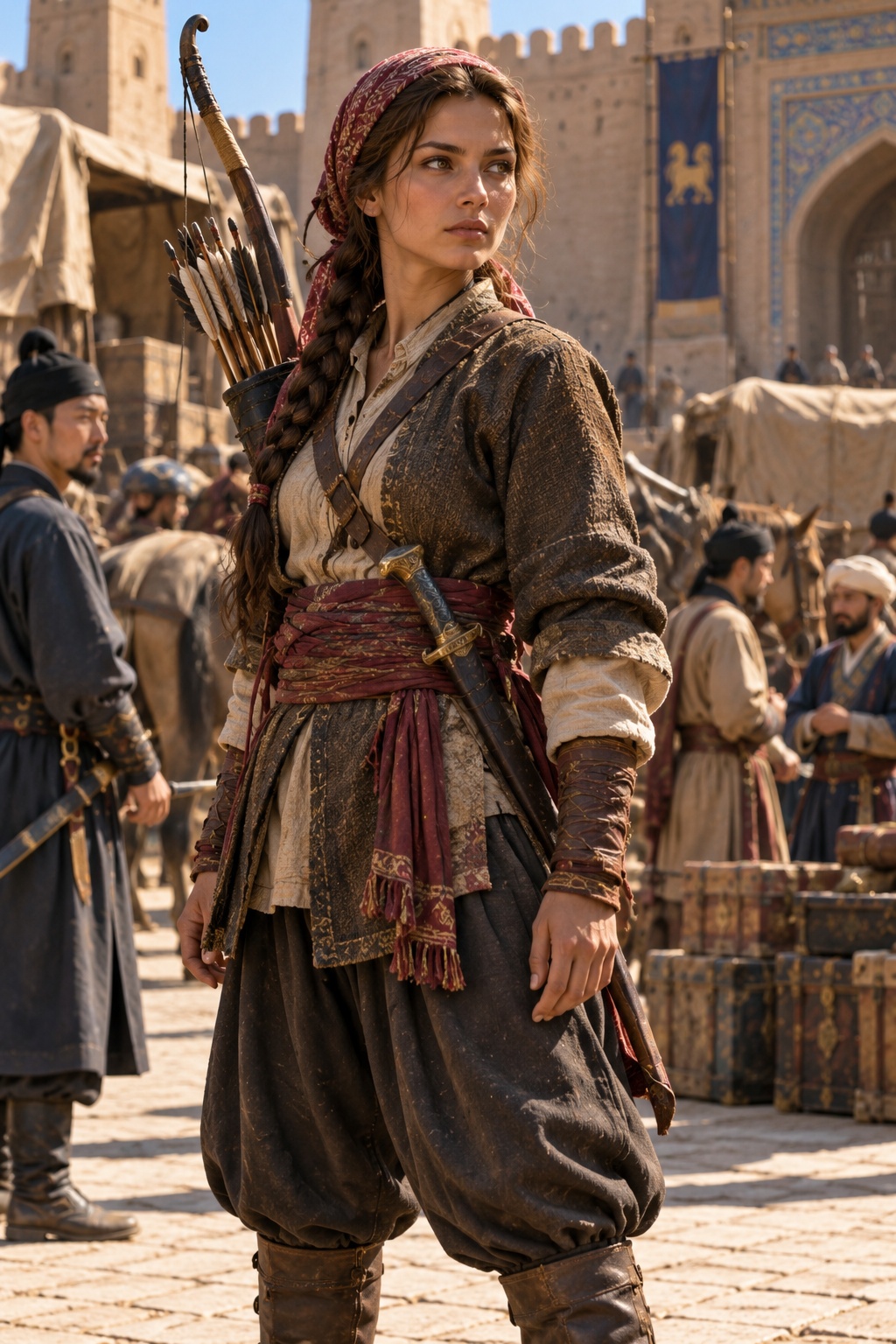
She looked ready to take on an army, and carried herself with confidence. Not the swagger of someone trying to look dangerous, but the easy assurance of someone who already knew what she could do. While some of the candidates watched us evaluators nervously, she seemed to be evaluating us.
Then I noticed the man beside her. He was larger than she was, but had the same eyes, the same nose and strong jaw, even the same way of standing. He carried a massive, front-heavy sword on his hip. I’d never seen one like it.
I leaned toward Ahmed. “What’s the deal with those two?”
He followed my gaze, then consulted the list Captain Karim had given him.
“They’re Kurds. Shireen and Cotan, brother and sister. Experienced mercenaries, apparently.”
“They look like killers.”
Ahmed pursed his lips. “Hmm. Is that good or bad?”
“I don’t know.”
Then there was Ardeshir, skinny as a stick and younger than everyone else. He did not look nervous or afraid. Rather, he looked perpetually amazed, as if everything and everyone around him were figures from a dream.
Evaluations
We stood facing all the candidates: Corporal Bao, Kuangren, Ahmed, Meilin and me. After a brief discussion we divided the candidates into five groups of four. Bao would test strength, fitness and endurance. Kuangren would test archery. Meilin would handle swordsmanship. I would evaluate empty-hand fighting. Ahmed had been assigned character, which seemed to me the hardest thing of all to measure.
“How are you going to test character?” I asked. “You can’t see it.”
Ahmed smiled. “Watch and learn.”
The sun climbed above the citadel walls and beat down on the courtyard stones. Within an hour everyone’s clothing was dark with sweat. Bao had his first group running laps, sprinting back and forth across the courtyard, carrying sacks of grain or holding them at arm’s length until their arms trembled.
Bao had told me before we started that he wasn’t interested only in strength. He wanted to see what happened after they became tired. Would they keep going? Would they encourage one another or care only about themselves?
Meanwhile, the caravan was busy with trading. I glanced toward it a few times, and noticed that the Persian buyers had been replaced with sellers. Apparently the Five Star merchants had sold all their Chinese goods, and were now buying Persian goods for the trip home. Seeing that, I smiled. Half the job was done. All we’d been through had been worth it. This was actually happening!
Stolen Gold
A shout from the other side of the courtyard interrupted us.
“My gold! Captain Karim, my gold!”
Everyone stopped. Bao’s exhausted candidates lowered their sacks and turned to look.
The merchant who was shouting was named Zabit. He owned a wagon that had borne mostly high-quality porcelain, and several bolts of exceptionally fine silk brocade. The porcelain had been packed very well in straw, but on the bumpiest parts of the road it still rattled, and Zabit would cry out, “Slow down, slow down. My teapots!” We guards had started calling the wagon the Teapot.
Meilin pointed out, however, that we would not be laughing at the man when we reached Persia.
“Why not?” Memdooh wanted to know.
“Because,” Longwei explained, “his cargo is worth a fortune. He’ll be a wealthy man.”
Now, Zabit was shouting at the top of his lungs. “I demand that the thief be apprehended!”
“You all take a break,” Ahmed told the candidates, and the five of us walked toward the Teapot.
“My lockbox was forced open,” Zabit was telling Karim. “Ten gold coins are gone.”
“When did this happen?”
‘How should I know? I haven’t opened it in months. I only noticed now. These coins were not from yesterday’s trading. I brought them from China. They’re all specially marked.”
The merchant was speaking loudly enough that half the courtyard could hear him. Many of the Persian guards had gathered around as well.
“It must have happened the night we arrived,” one of the other merchants said. “When all the Five Star guards went to the banquet. Only the Persian palace guards were watching the caravan.”
Zabit nodded vigorously. “One of these damned Persian Shiah thieves must have taken it. You know they’re not civilized like us.”
“Hey!” Karim’s expression hardened. “I’ll have none of that.”
“Who else could it have been?”
“Come with me.” Karim took the merchant firmly by the arm and led him away. The man continued protesting, but Karim spoke to him in a low voice. After a moment the merchant stopped arguing, but still looked unhappy. Karim said something else, and the merchant glanced toward the Persians who were still watching.
“Never mind!” Zabit called. “It was a misunderstanding.”
He stalked away with his companions. Karim noticed the rest of us watching, and shouted, “What are you all looking at? This isn’t a Beijing opera. Get back to work.”
* * *
Come back next week for Part 30 – The Parthian Shot and the Rock Splitter
Reader comments and constructive criticism are important to me, so please comment!
See the Story Index for Wael Abdelgawad’s other stories on this website.

Wael Abdelgawad’s novels – including Pieces of a Dream, The Repeaters and Zaid Karim Private Investigator – are available in ebook and print form on his author page at Amazon.com.
Related:
Keep supporting MuslimMatters for the sake of Allah
Alhamdulillah, we're at over 850 supporters. Help us get to 900 supporters this month. All it takes is a small gift from a reader like you to keep us going, for just $2 / month.
The Prophet (SAW) has taught us the best of deeds are those that done consistently, even if they are small. Click here to support MuslimMatters with a monthly donation of $2 per month. Set it and collect blessings from Allah (swt) for the khayr you're supporting without thinking about it.





Far Away [Part 29] – Kurdish Killers and Stolen Gold

When The Shaykh Never Spoke – Deepfakes, Synthetic Scholars, And The Coming Crisis Of Religious Trust

Criticism For Canada’s Conflation Of Anti-Zionism With Anti-Semitism

Invisible Heroes: Muslim Immigrants And Refugees In Our Community

CAGE, Muslim Leadership, And Imran Khan: The Silence Test
Far Away [Part 26] – Shaytan Is A Liar
Far Away [Part 25] – To Save A Prince

From a Syrian Prison to the UN: The Case of Bilal Abdul Kareem

[Podcast] 50k Mahr, Hiding Money, & Who Pays for the Wedding? | AML Finance

Long War Without End: A Quarter-Century Since The War On Terror

The Best Actions for Eid al-Adha [Imam Dawud Walid]

Coming Full Circle: Who Are You Now? | Night 30 with the Qur’an

Running Away From Who We Are | Night 29 with the Qur’an

Building From the Ground Up: Week 4 Recap | Night 28 with the Qur’an