#Culture
The Stirring Of A Muslim Population In Japan: The Story Of Yusuke Fujitani


Seeing Rural Japan Through a Single Prefecture: Hyōgo
Rural Japan is living through two forms of population decline at once, and Hyōgo Prefecture distills the whole structure into a single frame.
The first is the aging of business owners. Across Japan, hundreds of thousands of small firms are run by owners over seventy who have no successor—the so-called “2025 problem”—and when these businesses close, it is not only long-cultivated craft that disappears but managerial resources and infrastructure as well.1Small and Medium Enterprise Agency (中小企業庁), “M&A of Small and Medium Enterprises: Current Status and Issues” (2019). Roughly 1.27 million firms—about a third of all Japanese businesses—are projected to have owners over seventy with no successor by 2025; were all to close, an estimated 6.5 million jobs and ¥22 trillion in GDP could be lost. https://www.chusho.meti.go.jp/koukai/kenkyukai/hikitugigl/2019/191107hikitugigl03_1.pdf Hyōgo, a manufacturing prefecture of the first order, is home to numerous local industries—Banshū textiles, Miki hardware, Awaji roof tiles—and this concentration of handwork faces the same wave. Craftsmen grow old, no one comes to take their place, and the fires of the production centers go out, one after another.
The second decline is the drying-up of the workforce that keeps these sites running. Young people flow out to the cities, and manufacturing, seafood processing, and elderly care fall into chronic labor shortage. What fills this void is foreign labor—and the source that has surged most sharply in recent years is workers from Muslim-majority countries, chief among them Indonesia, home to the world’s largest Muslim population. Ironically, it is the countryside, rather than the cities, that most needs hands, and so the concentration of Muslim workers advances in rural areas. The Harima region of Hyōgo—above all Himeji, where the steel and machinery industries cluster—is one such typical point of reception.
Keep supporting MuslimMatters for the sake of Allah
Alhamdulillah, we're at over 850 supporters. Help us get to 900 supporters this month. All it takes is a small gift from a reader like you to keep us going, for just $2 / month.
The Prophet (SAW) has taught us the best of deeds are those that done consistently, even if they are small. Click here to support MuslimMatters with a monthly donation of $2 per month. Set it and collect blessings from Allah (swt) for the khayr you're supporting without thinking about it.
Once a certain number of people come to live in the same area, a place for prayer is called for. Halal food shops open, prayer rooms are set up—one was installed near JR Himeji Station—and eventually the movement turns toward building a mosque. The growing number of mosques in provincial cities is less a matter of faith spreading than the inevitable consequence of an economic structure that fills labor shortages with migrant workers.
And yet the very local governments that ought to receive all this are themselves growing financially threadbare. Hyōgo’s finances have edged toward crisis under the long tail of debt from the Great Hanshin-Awaji Earthquake reconstruction, and should revenue be devoured by debt repayment, the measures that support coexistence with foreign residents—and the support for vanishing local industries and traditional culture—may be the first to be cut.
Thus Hyōgo has become a land where three transformations—vanishing local industry, newly rooting migrant communities, and thinning municipal finances—overlap all at once. A Miki hardware craftsman shuts down without an heir; people who came from Indonesia keep the Himeji factories running; the town is shaken over where their place of worship should be; and beneath it all the prefecture’s finances edge toward collapse. These are not separate events, but different cross-sections of a single shift in population and economic structure.
And it is into this landscape—of vanishing trades, arriving workers, and communities feeling their way toward a place of their own—that one young man has stepped, not as a migrant but as a guide: the first Japanese to lead Japan’s oldest mosque.
Yūsuke Fujitani (Yusuf), Kobe Mosque’s First Japanese Imam — From Question to Faith
A young man raised in a household with no ties to religion, who, taking as his thread a plain question that arose one day in a nursing-studies classroom, traveled through three countries—Pakistan, Malaysia, and Saudi Arabia—and eventually became the first Japanese leader of Japan’s oldest mosque. Yūsuke Fujitani, Muslim name Yusuf, thirty-three years old. His path is less a drama than a sustained chain of reflection, and it holds many suggestions for anyone thinking about how Islam is received in contemporary Japan and about what the front lines of multicultural coexistence actually look like. To trace his history is to read the story of one believer, and at the same time to hold up a mirror to the social change now quietly advancing in the provincial cities of Japan.
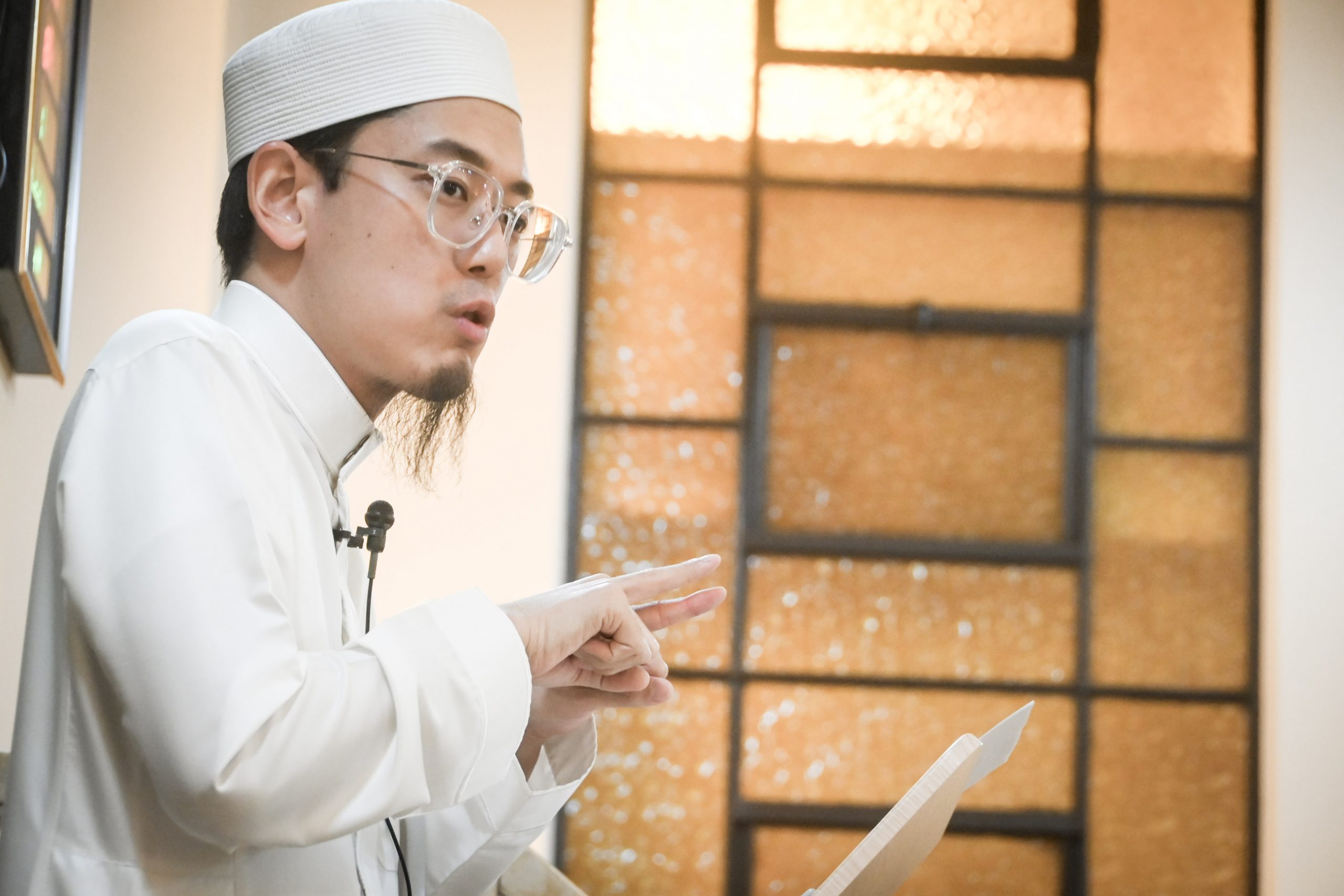
Patiently, insistently: Fujitani preaches at Friday prayers, the work at the heart of an imam’s daily life. (Photo: Tomohiro Oshima)
“Who Laid Down This Rule?”
Fujitani was born in Takarazuka, Hyōgo Prefecture. He was close to his mother’s family, visited the graves with his grandparents at Obon, made the New Year’s shrine visits, and celebrated Christmas—in his own words, a “quintessentially Japanese,” entirely ordinary Japanese household in which no particular faith was ever consciously held. Islam, let alone religion itself, lay outside the concerns of daily life. The first thing that turned him toward faith was, unexpectedly, in a university nursing-department classroom.
Pathology, anatomy, microbiology, maternal nursing. As he studied the workings of the human body in specialist depth, Fujitani found his eyes drawn to the intricacy of life. The human being has twenty-three pairs of chromosomes, forty-six in all; let even a single autosome be added or subtracted, and a child is born bearing some illness. The period of gestation is not a neat half-year or full year, but nine months—an oddly in-between figure. Why nine, and not twelve or six? A fertilized egg—sperm and egg, each no more than a liquid—joins together, repeats its cell divisions, and turns at last into an individual furnished with hands and feet. A microscopic living thing, visible only through a lens, becomes, before one knows it, a human. Confronted with the ATCG genetic information written into that process, he came to a halt.
“Where in the world did this meticulous set of rules come from?” The textbook teaches the mechanism in detail. But nowhere is it recorded who laid down the rule. Chance or mere drift seemed hard to credit. A smartphone, a pair of glasses—each has someone who designed it, someone who gave it the mechanism to function. If so, must there not be, behind a human body governed with such precision, some greater power, some being that ordained it—that is to say, God? That the sun rises in the east and sets in the west; that out of a hundred million people, he was born from this particular combination of parents and no other—these were not things he had chosen for himself. They could only be understood as ordained. And so he began, self-taught, to compare the world’s three great religions.
Comparing Three Religions, and Being Convinced by Islam
Fujitani had been, since high school, a young man who liked to read the international pages of the newspaper. Leaning now on library materials and the internet, he examined Buddhism, Christianity, and Islam one by one.
When he looked into Buddhism, he found that its teaching had originated in India and, in the course of reaching Japan, had passed through the syncretism of gods and buddhas before branching into some thirteen schools—Sōtō, Shingon, Rinzai, and the rest. Supposing the teaching of the founder, Śākyamuni, to be a hundred percent correct, there was nowhere in Japan a school that had inherited it in a pure, unaltered form. Were Śākyamuni sitting beside him, might he not say, “That is not what I taught”? Distorted and altered by human hands—feeling this, Fujitani did not go so far as to take the tonsure.
With Christianity, he unrolled the history of how the doctrine of the Trinity was established. Through successive councils—the first in 325, the second in 381—the Trinity was fixed, the minority Arian position pushed aside, and it spread with the sanction of the emperor of the day. If so, then the believers before 325, and Jesus himself, could not have believed in the Trinity. In a doctrine that ought to be the very core of the faith, he could find no historical unity. Here, too, he stopped.
Islam was different. Its scripture, the Qur’an—from the first chapter to the last—is used unaltered, one and the same. The object of worship is the invisible One God, Allah
, holding no idol. This single point—that there is no idol-worship—struck Fujitani as decisive. Buddhist statues and household kamidana, images of Mary—all are made by human hands, and when they break, people put their palms together and restore them. Whether one believes or not, they become objects of worship and are made over again; that absence of any guarantee of permanence had long troubled him. It overlapped, too, with his memory of the Great Hanshin-Awaji Earthquake. To prostrate himself before an unseen One God gave him not the slightest hesitation. It also matched his sense that human beings need not grovel before one another—yet to prostrate oneself before God is natural.
 , holding no idol. This single point—that there is no idol-worship—struck Fujitani as decisive. Buddhist statues and household kamidana, images of Mary—all are made by human hands, and when they break, people put their palms together and restore them. Whether one believes or not, they become objects of worship and are made over again; that absence of any guarantee of permanence had long troubled him. It overlapped, too, with his memory of the Great Hanshin-Awaji Earthquake. To prostrate himself before an unseen One God gave him not the slightest hesitation. It also matched his sense that human beings need not grovel before one another—yet to prostrate oneself before God is natural.
On June 27, 2014, the twenty-one-year-old Fujitani passed through the gate of the Kobe Mosque alone, with no reservation and no appointment. No one had solicited him; he had no acquaintance among the believers beforehand. It was all a walk-in visit, arrived at at the end of self-teaching. He had meant only to look around, but as he spoke of his own reflections in answer to why he wished to enter, he made his declaration of faith (shahada) on the spot.
More Than Six Years of Study Across Three Countries
His life of faith began not as a dramatic change but quietly. Unable to tell his parents right away, he started simply by holding back from the ham and bacon at Sunday breakfast—”the flavor’s too heavy,” he would say. Pork dishes and alcohol, he let go of little by little.
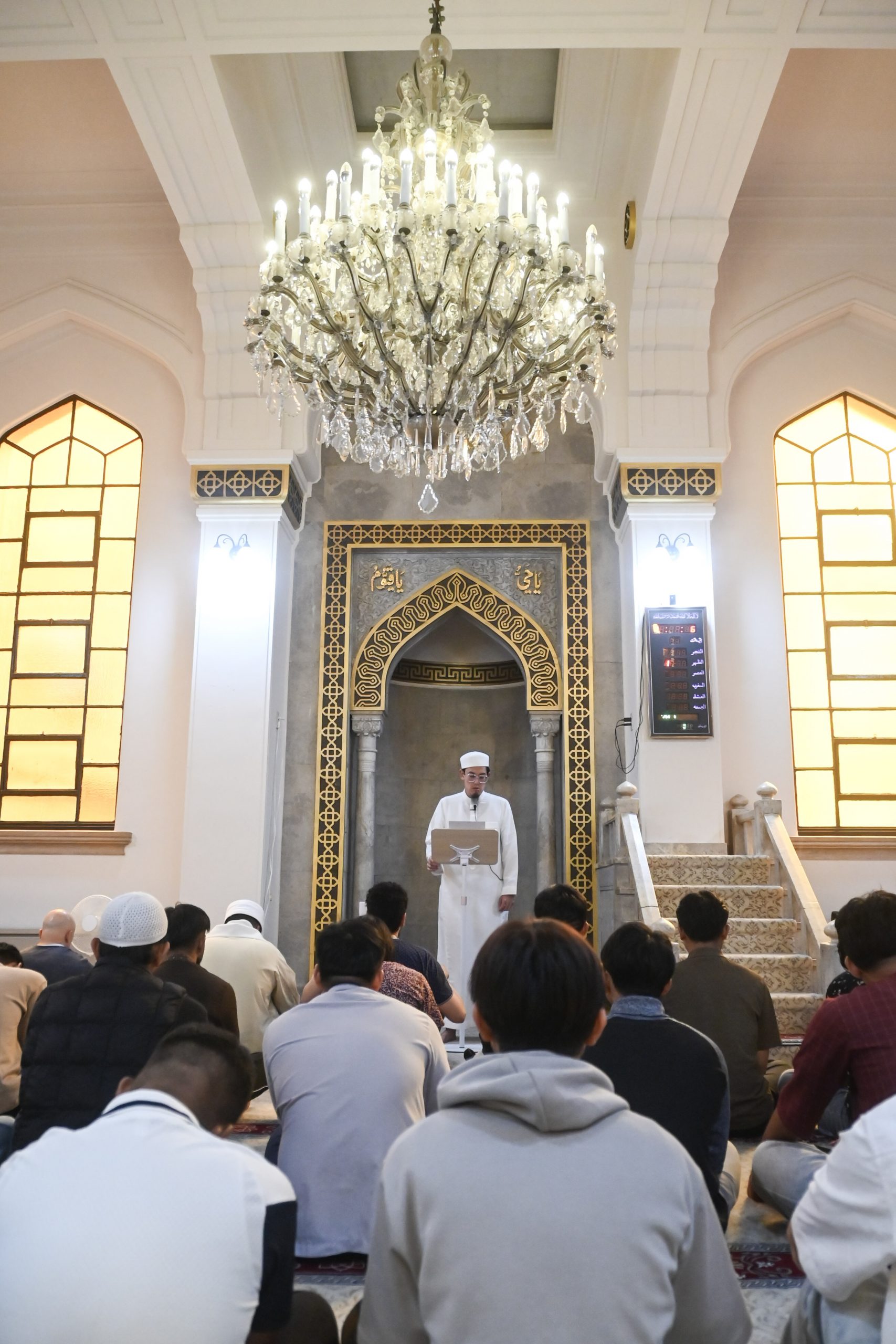
Fujitani delivers the Friday sermon (khutba) from the minbar of the Kobe Mosque, before a congregation drawn from across the Muslim world—students, engineers, and self-employed traders among them. (Photo: Tomohiro Oshima)
Before long he set out on the road of serious study. For five months, from November 2015 through March of the following year, he crossed to Pakistan. Joining the Islamic revivalist movement known as the Tablighi Jamaat, he moved from mosque to mosque across the region, calling the local people to the night prayers and, through the dawn and midnight prayers, turning to face God himself. He was put on an IV three times for food poisoning, ran fevers, and endured the misery of things coming out from above and below alike—yet he never once thought of going home. In Japan there was scant place or occasion to study Islam. Here was a learning found nowhere else.
Next, for a year and three months from August 2016, he entered an Islamic seminary (a boarding school) in Malaysia and shored up the fundamentals, Arabic among them. In fact, he had already applied to the Islamic University of Madinah in Saudi Arabia beforehand, but on hearing that a decision would take two or three years, he chose the path to Malaysia as preparation for it. Then, in November 2017, his name appeared among the admitted on the university’s homepage.
In September 2018, the study abroad became real at last—with the exhilaration of finally standing at a campus he had gazed at again and again on Google Maps. The first two years were an Arabic course; the following four were Sharia (Islamic jurisprudence), all studied in Arabic. Multiple-choice, written work, reports, and the term examinations—all in Arabic. Under a rule by which failing the same subject twice meant, in principle, expulsion, tension ran through him at every exam. A grant-type scholarship provided roughly twenty thousand yen a month, and out of that he managed food and book costs alike. Getting in was comparatively easy; graduating was hard. He watched friends fail the same subject three times and depart.
This university gathers students from more than 170 countries. Burundi, Bosnia-Herzegovina, Laos, Sierra Leone, The Gambia, Senegal, Somalia, Sudan—seated beside classmates from countries where he had never imagined there were Muslims, Fujitani’s horizons opened wide. A classmate said to be Laos’s first convert is a friend of his still. Dormitory life had its moments too, such as when he raised his voice at a roommate making a video call in the dead of night because of the time difference. In June 2024, he graduated safely—the fifth graduate ever from Japan, a rarity that fits within the fingers of one hand. Graduation from this university, known as a prestigious institution in the Muslim world, became a great source of pride for him.
As the First Japanese Imam of Japan’s Oldest Mosque
With graduation ahead, Fujitani had been pursuing a job search in Japan in parallel. Putting on a suit for an online interview, he received an offer from a certain Osaka company that trades with the Middle East. He was to be valued as a user of Arabic. But he was asked to take part in drinking parties with business partners, and unable to come to terms with the handling of prayer times and such gatherings, he declined.
As if in its place, four mosques—Kobe, Sapporo, Nagoya, and Okinawa—called for him to come as a Japanese imam. He had been seeking a path to employment within Saudi Arabia as well, but it did not go as he wished. What he finally chose was Kobe, the place of his own entry into the faith and deep in ties for him. In this place, where believers he had trusted for ten years gather, they know one another well. In September 2024, Fujitani took up the post of imam at the Kobe Mosque.
Built in 1935 (Shōwa 10), this is Japan’s oldest mosque, and in its long history it is the first time a Japanese has become its leader. Full-time imams who are Japanese through and through number, together with the one at the Asakusa Mosque, only two in the whole country.
The heart of his work lies in receiving visitors. University students, company employees, people who want to open a halal shop, groups aiming at multicultural coexistence, firms taking on technical intern trainees—in two years he has exchanged business cards with more than two hundred people. He deals as well with government bodies—the Kobe city and ward offices, the police, the tourism bureau—and requests from universities, high schools, and junior high schools never cease. Those who gather at the Kobe Mosque are varied, from international students at Japanese-language schools to self-employed used-car traders to engineers; compared with the mosques of Osaka there are somewhat fewer of Indonesian background and a conspicuous layer of the self-employed—a regional character of its own. Many are people who came relying on a brother who had already started a business in Japan.
To the resident Muslims he keeps patiently preaching: do not loiter on the streets, refrain from cigarettes and noise, sort your garbage. To liken it to an all-school assembly at a junior high or high school, nine in ten listen, while one in ten do not—and that, he says, is not a matter of foreigners alone; the Japanese are the same. What matters is that precisely because there is a node called the mosque, a caution can be delivered to the whole community at once after the Friday prayer. Were there no mosque, people would scatter like lone wolves, and the friction that arises from differences of culture could burst out here and there, beyond any control.
Against the backdrop of the labor shortage in provincial cities, workers from the Islamic world keep increasing. In Himeji and elsewhere, there are movements to build new mosques. As residents grow in number, a place is needed to bind them together and to connect them with Japanese society. Fujitani is aware that there are voices uneasy about the growing number of mosques. And it is precisely for that reason that he devotes himself—quietly, but surely—not to excluding foreigners, but to building, as fellow human beings, a relationship of “we’re all in this together.” The faith of one young man, begun from a question, has now borne fruit as a firm role sustaining the front lines of Japan’s multicultural coexistence.
Related:
– Undecided Nation: How A Mosque In Kamagasaki Fills Japan’s Immigration Gap – A Photo Story
– When Azara Long Found Islam In A San Francisco Linen Shop : A Story From America’s Muslim History
Keep supporting MuslimMatters for the sake of Allah
Alhamdulillah, we're at over 850 supporters. Help us get to 900 supporters this month. All it takes is a small gift from a reader like you to keep us going, for just $2 / month.
The Prophet (SAW) has taught us the best of deeds are those that done consistently, even if they are small. Click here to support MuslimMatters with a monthly donation of $2 per month. Set it and collect blessings from Allah (swt) for the khayr you're supporting without thinking about it.



The Stirring Of A Muslim Population In Japan: The Story Of Yusuke Fujitani

Far Away [Part 27] – The Prince’s Ring

[Podcast] Faith, Motherhood, and the Call to Gaza | Dr. Samaiya Mushtaq

Long War Without End: A Quarter-Century Since The War On Terror

[Podcast] 50k Mahr, Hiding Money, & Who Pays for the Wedding? | AML Finance
Far Away [Part 26] – Shaytan Is A Liar
Far Away [Part 25] – To Save A Prince

When The Bed Walked Away [Part 2] – Primordial Muck

[Podcast] Muslim Money Matters: Do You Know How to Halal Hustle? | Adam Taufique

From a Syrian Prison to the UN: The Case of Bilal Abdul Kareem

The Best Actions for Eid al-Adha [Imam Dawud Walid]

Coming Full Circle: Who Are You Now? | Night 30 with the Qur’an

Running Away From Who We Are | Night 29 with the Qur’an

Building From the Ground Up: Week 4 Recap | Night 28 with the Qur’an

The Muslim You Are Becoming | Night 27 with the Qur’an
MuslimMatters NewsLetter in Your Inbox

Sign up below to get started