
#Culture
Far Away [Part 20] – Among the Afghans
Amid the hospitality of the Afghans, Longwei tells a story, and Darius’s duel with Meilin ends with an unexpected trip to the Hakim’s wagon.

Amid the hospitality of the Afghans, Longwei tells a story, and Darius’s duel with Meilin ends with an unexpected trip to the Hakim’s wagon.
Read Part 1 | Part 2 | Part 3 | Part 4 | Part 5 | Part 6 | Part 7 | Part 8 | Part 9 | Part 10 | Part 11 | Part 12 | Part 13 | Part 14 | Part 15 | Part 16 | Part 17 | Part 18 | Part 19
* * *
A New Recruit
Keep supporting MuslimMatters for the sake of Allah
Alhamdulillah, we're at over 850 supporters. Help us get to 900 supporters this month. All it takes is a small gift from a reader like you to keep us going, for just $2 / month.
The Prophet (SAW) has taught us the best of deeds are those that done consistently, even if they are small. Click here to support MuslimMatters with a monthly donation of $2 per month. Set it and collect blessings from Allah (swt) for the khayr you're supporting without thinking about it.
Arslan asked permission to accompany the caravan to Persia. He said he’d always dreamed of seeing the great cities of Isfahan and Shiraz. From there, according to him, he would visit Al-Quds, then he would go south to see Makkah and Madinah – his lifelong dream.
Sergeant Karim replied with an annoyed wave of the hand. “We are not a taxi service.”
Weili jumped in. “You misunderstand, Sarge. He will work for his passage. He will be one of the guards. You’ve seen his ability with the bow. He can shoot farther than anyone here. That could be a great defensive asset.”
Karim regarded the young man. “You follow my commands. Learn our rules, and abide by our discipline. If you want to know what happens when you break the rules, ask Kuangren.”
Arslan must have already heard about Kaungren, for he swallowed nervously, then nodded his head. “I be good in fight. I work.” He switched into a language I didn’t know, and Karim replied in the same language.
Ahmed leaned in and whispered in my ear. “He says he can speak Persian. Boss says fine, the kid is hired, but only to Isfahan. One way.”
“So you speak Persian too?” I whispered back.
“Persian, Arabic, Uzbek, Mandarin, some Cantonese.”
I was impressed by Ahmed’s knowledge. But I didn’t much like this development with Arslan. It had been fine when he was merely a handsome local that Weili had met, and who would soon be left behind. This was different. Why should we take him along? He wasn’t one of us. He hadn’t been trained like us, he hadn’t earned it. But I knew my place, and I kept my mouth shut.
We proceeded into Afghanistan. The green plain gradually gave way once more to stone.
For several days the caravan wound through the valleys of Afghanistan, following ancient roads worn smooth by countless horses and wagons before ours. Villages clung to the hillsides wherever water could be found, their homes built of rough stone and sun-dried brick, blending so naturally into the mountains that one sometimes did not notice them until smoke began rising from their chimneys.
The people proved as varied as the land itself.
As we passed by one village a man came out to welcome us warmly. He wore shalwar kameez, pointed leather shoes and a huge turban, and spoke Persian. He was, it turned out, the clan chief and the Imam. Before long, women appeared carrying baskets of flatbread still warm from their ovens, bowls of yogurt, dried apricots, steaming kettles of tea, and fresh goat cheese. The villagers brought goods for trade as well. Our merchants eagerly unpacked bolts of silk, porcelain, spices, and steel tools, and traded some for good quality wool, walnuts, honey, carved bowls, and sturdy mountain ponies.
The little girls, who all wore headscarves, seemed fascinated by Weili. No doubt they had never seen a woman who looked like her, tall and dressed like a man, carrying weapons and letting her hair hang free. Before long they had surrounded her, giggling as they tucked tiny wildflowers into her long black hair and carefully braided them among the strands. Weili laughed so freely that I scarcely recognized her. Meilin got some attention too, but not like Weili.
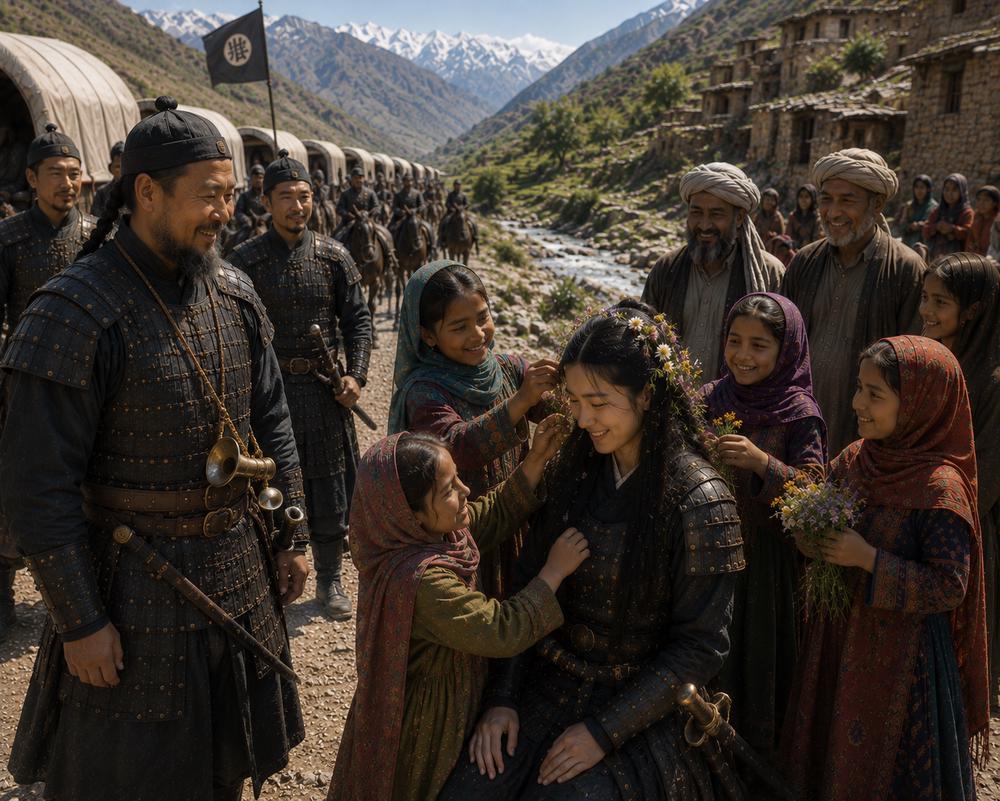
When the girls stepped back to admire her work, Weili and Meilin both bowed their heads solemnly as though they had just been adorned by a queen.
We all prayed Maghreb together, with the village Imam leading the salat. He recited part of Surat Al-Rahman, which I recognized but did not know by heart, then Al-Ikhlaas, which of course I did know. Once again I was amazed at the universality of Islam. Here I was, thousands of leagues from home, yet these people prayed as I did, and recited the same Quran I did. These men and women whose language I did not speak, yet we spoke the same language. We saw the world in the same way – more or less – and believed in the same things. They were total strangers to me, yet not strangers at all. We were children of one mother, for brother Ahmed had said one night that the word “ummah” – the universal body of Muslims – came from “umm,” mother, because we were all one family.
After salat the men made a huge fire to warm us against the chill night air, and everyone gathered around it. Someone made coffee, and served the guests. Sergeant Karim called for Longwei.
“Entertain us with one of your stories.”
Longwei’s Tale
Longwei smiled and settled himself beside the fire, extending his hands toward the flames.
Ahmed translated to Persian as Longwei spoke.
“Several years ago,” he began, “I was returning from Calicut on the southwestern coast of India with a small caravan of five wagons. Our merchants had purchased pepper, cardamom, cinnamon, and fine cotton cloth. I’d done a little trading of my own and had earned seven gold coins, which was all the wealth I owned in the world. I was happy. We had crossed most of the Indian peninsula without incident and thought ourselves blessed by Heaven.”
He sighed dramatically.
“That was our first mistake.”
Several of the Afghans exchanged knowing smiles. There was some muttering.
“They say,” Ahmed translated, “that they’d rather march to the gates of Jahannam than through South India.”
Longwei nodded. “Indeed. We entered a stretch of jungle where the trees grew so thick that even the sun seemed afraid to enter. One man was bitten in the eye by a snake hanging from a tree, and died in minutes. Another was swarmed by huge ants, and survived three days in terrible pain before dying.The road narrowed until two wagons could scarcely pass one another. Then we heard drums.”
He paused. “Not one drum.”
He looked slowly around the circle. “Hundreds.”
The listeners leaned closer.
“Are you sure,” Meilin interrupted, “that all of this didn’t happen in your imagination in a tea shop in Delhi?”
Our guards, used to Meilin’s sharp tongue, laughed, but the Afghan men frowned.
“Quite sure,” Longwei replied dryly. “It happened exactly as I say. The drums suddenly ceased. Men came pouring from the forest like ants from a broken hill. Men with painted faces, wild hair, and scarcely any clothing. They carried spears, bows, axes…” He shrugged. “…and very unpleasant expressions. We guards looked at one another. Their chief shouted a demand. No one understood him, but the meaning was clear. Our boss decided that living was preferable to dying.”
A ripple of laughter passed around the fire.
“We surrendered.” Longwei spread his hands. “They made every one of us climb down from our horses.”
He stood to demonstrate, climbing awkwardly to his feet before pretending to step down from an imaginary horse.
“Then they took our swords.” He handed an invisible weapon to an invisible bandit.
“They took our purses.” Another invisible handoff.
“They took our boots and our tunics.” By now everyone was laughing. Even Karim’s shoulders were shaking slightly.
“And then…” Longwei said gravely, “…they ordered us to remove every stitch of clothing.”
The Afghans around the fire erupted.
“No!”
“They did?!”
Longwei nodded solemnly. “I assure you, they were most thorough. We stood there, thirty respectable merchants and guards, as naked as newborn babies.”
The laughter became louder still.
Brother Ahmed wiped tears from his eyes as he translated into Persian.
One elderly Afghan slapped his knee so hard that he nearly toppled backward. More than a few men spilled their coffee.
“I’m glad I missed that scene,” Meilin commented.
Longwei gave her an annoyed glance. “Woman, you wish you had been there to see my beautiful body.”
I laughed at this. Beautiful was not a word I associated with Longwei.
The Hiding Place
“If I may continue? They searched every garment. Every saddle. Every wagon. Every bundle.”
He spread his hands. “They found everything.” He lowered his head mournfully. “Or so they believed.”
The laughter subsided.
“They left?”
“They left,” Longwei affirmed. “Very pleased with themselves.” He mimed watching them disappear into the jungle.
“When they were finally gone, we all began putting our clothes back on. There was much complaining.”
“‘My boots!'”
“‘My silver!'”
“‘My wife’s necklace!'”
“‘My pepper!'”
He acted out each complaint in a different voice until everyone around the fire was grinning.
“I dressed myself in silence. Then…” He closed his fist and shook it back and forth gently. “I jiggled my seven gold coins in one hand. Clink… clink… clink… I shall never forget that beautiful sound.”
No one laughed. Instead they stared at him in confusion.
Ahmed frowned. “But… they searched you.”
He nodded knowingly. “They searched our clothing and purses.”
“Then where did you hide the coins?”
Longwei grinned. Then he stood, placed both hands upon his generous stomach, and lifted it with considerable effort.
Beneath it he tapped the front of his waistband.
“Under my belly.”
For a heartbeat there was silence. Then the camp exploded. The Afghan merchants laughed the loudest of all. Several bent forward until their foreheads nearly touched the ground. One man actually rolled onto his back, pounding the earth with both fists.
Brother Ahmed laughed so hard he rolled too close to the fire. His shirt caught on fire, and he beat it out hastily, which only made the others laugh more.
Karim covered his face with one hand, shaking his head.
“So that,” Longwei said with perfect dignity as the laughter continued around him, “is one unexpected advantage of growing fat.”
A Duel
When all the excitement died down, one of the Afghan elders pointed to Meilin and asked a question. Ahmed said something and shook his head.
“What?” Meilin demanded. “What did he say?”
“It’s not important.”
Meilin stood. “Tell me.”
Ahmed sighed. “He wants to know what an impertinent little woman like yourself is doing dressed as a guard.”
Meilin’s face flushed with anger, but Karim held up a hand to forestall her. He called to one of the men: “Bring two training swords.”
The man hurried back with the swords. Karim called me over and handed one to me. These were very much like real swords in their size and weight, but they were wooden, with dull edges that could not cut. Karim handed me one then whispered in my ear: “Make her look good.”
I understood. He wasn’t asking me to play clumsy or go slow, but to play to Meilin’s strengths. She might be short and slightly heavyset, with a broad face that made her look more like a farmer’s wife than a caravan guard, but Meilin was astonishingly quick. I had seen her vault onto a horse without touching the stirrup, and once, when a wagon axle snapped, she had flipped clear before the wagon even hit the ground. I would not have been surprised to learn that she had grown up in a wushu school.
We saluted one another and began to circle.
Meilin eyed me seriously. I felt like a frog being visually dissected by a healer’s apprentice. “I’ll try not to bruise your pride,” she said.
I smiled. “Okay.”
She sprang forward.
I barely caught the first blow. The second rapped smartly against my shoulder before I could turn it aside, sending a sharp sting through my arm. Even with a wooden sword, a solid strike could leave a bruise that lasted for days.
The Afghan men murmured with surprise. Whatever they had expected from a woman of her build, it was not this.
Meilin pressed the attack without giving me time to recover. Her feet seemed almost to skim the earth as she darted from one angle to another, striking high, then low, then high again. Twice I saw clean openings that would have given me victory. I ignored them, giving ground instead.
She did not miss the hesitation. Her eyes narrowed.
A third opening appeared as she overextended herself on a downward cut. Instinct screamed at me to step past her and put the sword to the back of her neck. Instead I let the moment pass.
The next instant her sword cracked against my ribs hard enough to drive the breath from my lungs.
The villagers gasped.
I managed to smile through clenched teeth.
“You’re getting slower,” she observed.
“So I’ve been told.”
She came again, relentless now. She caught me off guard when, amid a flurry of sword strikes, she threw a kick. I tried to parry the kick with my left hand but her foot struck my fingers. My middle finger bent sideways from the middle knuckle, clearly broken. Meilin did not stop. I wondered whether Karim appreciated just how difficult his order to “make her look good” really was.
She ran at me and cut to her left. This was a standard tactic against a right handed fighter like myself. You moved left to flank the opponent and put yourself in a safer spot. I pivoted and began to raise my blade into a roof block to parry the expected strike. However, Meilin did not go left. The entire thing was a fake. Instead she leaped right, putting herself directly in front of me. This was almost never done, and my instincts told me it was tactically unsound. Yet I was unable to capitalize on it, for in an instant she parried my blade with her own and headbutted me, striking my chin with the crown of her head, stunning me. At the same time she wrapped my sword arm with her free arm, then tripped me. I crashed to my back, and she sat on me with her sword against my throat. My own weapon had gone flying.
The audience was utterly silent.
I raised my hands.
“I yield.” As if it wasn’t obvious.
For a heartbeat no one moved. Then the Afghan men burst into applause. Several nodded approvingly. The elder who had questioned Meilin’s place among us grinned broadly and said something to Ahmed.
“He says,” Ahmed translated, “that any caravan with women like her should fear no bandits.”
The old man stepped forward and bowed respectfully to Meilin. She returned the bow with quiet dignity.
Longwei folded his arms and looked at her with pride. “And that,” he declared, “is why I love her.”
The words escaped before he seemed to realize what he had said. Longwei’s face turned the color of a ripe pomegranate.
“I mean…” he stammered. “That is why I… greatly admire her swordsmanship.”
Brother Ahmed coughed suspiciously into his sleeve, while Karim became intensely interested in the contents of his coffee cup.
For just an instant, Meilin’s stern expression softened. Then she sniffed. “You’d better keep admiring my sword,” she said. “It’s the only thing of mine you’ll ever touch.”
The camp erupted in laughter once more, and Longwei accepted it with as much dignity as a blushing poet could manage.
Give Your Best
As the gathering broke apart, I felt someone seize my sleeve.
“Come here.” It was Meilin.
She led me behind one of the wagons, out of earshot of the others. When she turned to face me, her cheeks were red with anger.
“Don’t ever do that again,” she hissed.
I blinked.
“You let me win.”
“I—”
“Don’t insult me. I have spent years proving I belong among these guards. I don’t need charity from you.”
“It wasn’t charity.”
I looked down at the bruises already darkening on my arms, and my broken finger.
She followed my gaze and I saw surprise in her eyes. “Your finger. I didn’t realize.” Her gaze hardened again. “You deserve it. Don’t ever give less than your best.”
I nodded. “Yes ma’am. If it’s any consolation, you really got me at the end. I didn’t fake that.”
She shook her head in disgust. “You need to learn how to talk to a woman. Forget it, go see the Hakim.”
I watched her walk away. My middle finger had begun to swell, and it sat at an angle that fingers were never intended to assume. I was deeply dismayed. This would seriously affect my ability to perform my duties. It wasn’t even about holding the dao – this was my left hand after all, and not my primary weapon hand. But I had to be able to hold Belly’s reins. I had to be able to load and unload crates from the wagons when we stopped at trading locations. Not to mention cleaning myself after… you know.
I would have gone to Weili for sympathy, but she was nowhere to be found. I’d seen less and less of her lately. When I did see her, she was often in Arslan’s company. She’d smile and greet me, but it wasn’t the same.
Feeling suddenly exhausted, I trudged to Hakim Yusuf’s wagon. Every step was a painful effort.
Hakim Yusuf
Yusuf ibn Rashid, who we called Hakim Yusuf, or sometimes just “the Hakim,” was in his early sixties, lean rather than frail, with a neatly trimmed white beard, alert brown eyes, and hands that seemed permanently stained with herbs and oils.
Unlike the merchants’ wagons, the Hakim’s clinic smelled of vinegar, camphor, dried herbs, lamp oil, and medicines whose names I did not know. Bundles of roots hung from the ceiling beside neatly labeled jars and little cloth packets tied with string. Mortars, pestles, knives, splints, rolls of linen, and shelves crowded with bottles occupied nearly every available space.
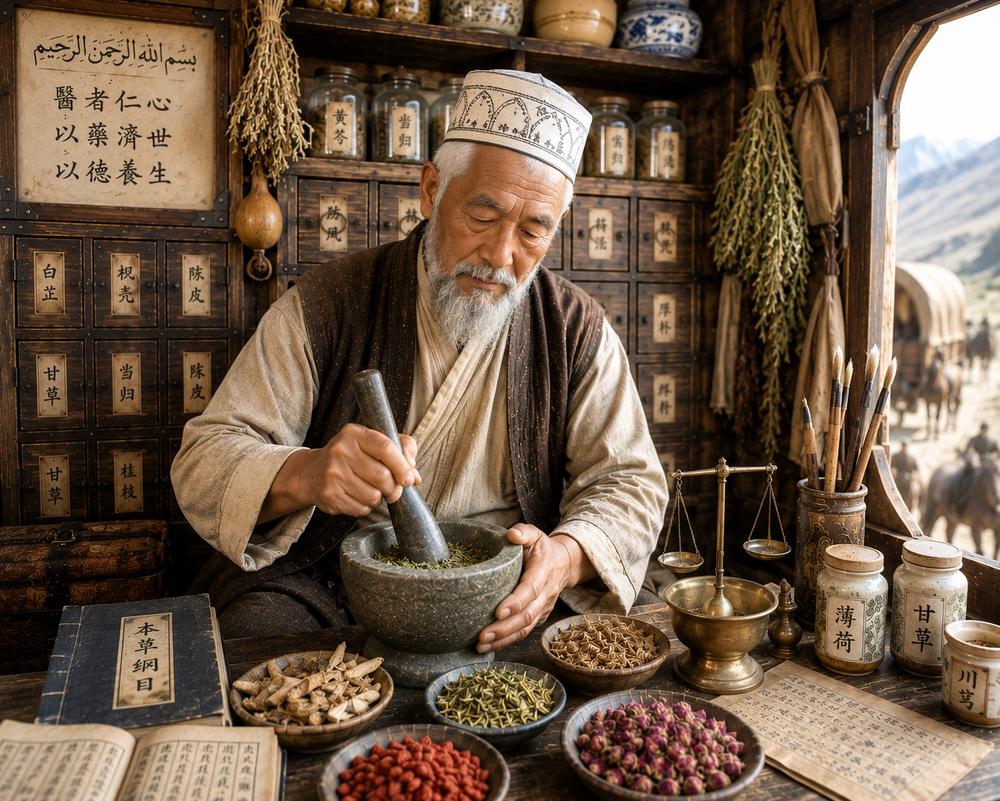
The familiar scents washed over me like a forgotten memory. For a moment I was back on Zihan Ma’s farm, sitting on a low stool while my uncle brewed a medicinal broth. I could hear the donkeys braying outside, smell Lee Ayi’s cooking, and see the afternoon sunlight falling through the paper windows of his treatment room.
“You’ve come after all.” Hakim Yusuf’s voice brought me back. He was seated beside a small lantern, grinding herbs with a stone pestle.
“I got hurt.” I held up my hand.
“Oh.” His mouth was a flat line when he looked up. “I thought you were here to keep your promise.”
“What promise?”
“After Kuangren’s punishment, you offered to assist me in the future.”
“Oh, right.”
“Then you vanished.”
I shrugged helplessly. “Hakim Yusuf, there hasn’t been a raid. No one’s been hurt.”
He took my hand in his and turned it over, studying it. His manner was gentle, and his confidence was reassuring.
“I broke it sparring with Meilin,” I explained.
“No, you didn’t.”
In spite of the pain, which was less severe than I would have expected, I smiled. “I think I would know how I broke it.”
He wrapped one hand around my wrist and took hold of the bent finger with the other. Before I could ask what he planned to do, he gave one quick pull. There was a sharp pop, and Hakim Yusuf immediately realigned the finger.
“I meant,” he said, “that you didn’t break it.”
I blinked. “It doesn’t hurt anymore.”
He smiled. “It’s remarkable what happens when things are put back where Allah intended them to be. It was dislocated. Try moving it.”
I curled my hand into a fist.
“It works.”
“That is the preferred outcome.”
My relief was so strong, I felt like I’d just ridden Belly for two days without pause, and was now relaxing in the cool water of a desert oasis. I was still sad and lonely, but suddenly it felt bearable.
Hakim Yusuf began preparing a salve for my bruised ribs and arms. He looked up over the rim of the little clay bowl.
“Darius… do you imagine I spend my days waiting for someone to be stabbed?”
I opened my mouth.
He raised one finger to silence me. “This morning I treated a merchant whose gums are swollen from rotten teeth, a muleteer with an infected blister, a guard with fever, three horses with saddle sores, and another guard who was convinced he had contracted a terrible disease.”
“What did he have?”
“An overactive imagination.”
I laughed. “Was that Longwei?” The big man always seemed to think there was something wrong with him.
Not answering, the Hakim continued stirring the salve. “Battle wounds are a small part of my work.” He spread the cool ointment gently across my bruised ribs. “When you helped me with Kuangren, I noticed something.”
“What?”
“You paid attention.”
“I just followed your instructions.”
“More than that.” He wrapped a bandage around my torso, tied it snugly and sat back. “You observed and anticipated. You asked sensible questions. Those qualities are difficult to teach.”
“My uncle is a healer. I have assisted him.”
He nodded. “Now it makes sense.”
Growing Up
I looked around the wagon once more.
It felt strangely peaceful here. Outside were guards laughing around the fire; merchants discussing politics, prices and the news of the war back home; and horses stamping in the darkness. Inside there was only the quiet clink of glass bottles and the comforting smell of herbs. The wagon was the oasis I’d been wishing for. It was familiar and comfortable.
Someone rapped twice against the side of the wagon, and Sergeant Karim ducked through the doorway, his broad shoulders filling most of the opening. His eyes immediately went to my bandaged hand, then to the bruises already darkening along my ribs.
“That was nicely done.”
I smiled despite myself.
“I didn’t know,” he said, “that she’d be that hard on you.”
“She knew I was holding back. That’s what made her angry.”
He scratched thoughtfully at his beard. “I should have known she’d see it.” For a moment he stood in silence, considering the matter. Then he nodded to himself. “You know what? I’ll confess to her that it was my idea. I’ll take the heat off you.”
“No.” The answer escaped my mouth before I had even thought about it.
Karim looked genuinely surprised. “Why not?”
I searched for the right words.
“Because right now she just thinks I’m a stupid boy who doesn’t appreciate how talented she is.” I smiled faintly. “Which, if I’m being honest, was true until tonight. But if you tell her it was your idea…” I hesitated. “It will hurt her.”
He looked at me thoughtfully. “Explain.”
“You’re her sergeant. She looks up to you. She needs to feel that you believe in her.” I glanced toward the open doorway, where the sounds of laughter still drifted from the campfire. “We all do.”
The wagon fell quiet. Karim looked at me for a long moment. At last he reached out and rested one heavy hand on my shoulder, giving it a gentle squeeze. “You’re growing up, Darius.”
Without another word he stepped down from the wagon and disappeared into the night.
An Oasis or a Prison?
“You’re not a typical caravan guard,” Hakim Yusuf commented.
I didn’t know what to say to that.
“So?” The Hakim folded his hands inside his sleeves. “I could use an assistant.”
“I don’t know if I’m typical or not, but I am a caravan guard. I already have duties.”
“There are many men,” Hakim Yusuf said quietly, “who know how to make holes in other people. “But you have hands capable of healing. Don’t waste that.”
Panic came up out of my gut like acid. It rushed up from nowhere, leaving me feeling constricted. The sense of this place as an oasis vanished. Suddenly it felt like a prison. I looked toward the wagon door as if it were an escape. My breath was shallow and rapid.
“I can’t go through this again,” I said. “I’ve been through this.”
“What do you mean?”
“Being pressured to choose between medicine and the sword. You can’t force me to choose! If I’m good at one thing and the other, then so be it, that’s who I am. My father taught me to fight from the time I could walk. He crammed it down my throat, he made me bleed and cry, but it was all he had to give, and he gave it, and now it’s mine. Not you or anyone else will take it away. I am sick of people trying to decide for me what I should be.” I stood quickly, snatched up my shirt, and put it on. In my haste it caught on my finger, and I groaned in pain.
“Easy, Darius.” Far from being offended, Hakim Yusuf’s manner was calm and soothing. “Of course it’s your decision. I’m not forcing you to choose. I just thought you might come assist me for a few hours a day, that’s all.”
“Oh.” I looked at the floor, feeling ashamed. “I don’t know if Sergeant Karim would like that.”
Hakim Yusuf put a hand on my chest and rubbed gently. “Get some rest. Think about my offer. If you decide you want to do it, I’ll talk to the Sergeant. I have some influence. And if not, it’s okay son. I’ll never bring it up again.”
I put a hand to my forehead and rubbed it. “I’m sorry, Hakim.”
“Don’t be silly. All is well. Now listen. The finger will be tender for several days. Be careful.”
“I’ll try.”
Far Away
Most of the camp had settled into silence. Here and there a few lanterns still glowed beside the merchants’ wagons, and somewhere in the darkness I could hear someone laughing at one last joke before turning in for the night. I walked with one arm pulled tightly to my side because my ribs hurt less that way.
I found Belly standing where I had left him, patiently chewing his hay as though the affairs of men had never been any concern of his. He lifted his head when he heard my footsteps and gave a low, questioning whicker.
“I’m alright,” I assured him. “Or I will be.”
I checked his feed bucket. He’d eaten all the oats and mash, and the bucket was empty.
“Good.”
His water trough was nearly empty as well, so I carried another bucket from the nearby stream and filled it. Belly plunged his nose into the water at once, drinking noisily until great drops ran from his whiskers.
“I suppose you worked as hard as I did today.”
He nosed my pockets. I smiled. “Sorry,” I told him. “It’s not Eid anymore. I’ll get you a few carrots in the morning.”
I fetched the curry comb and began working it through his thick black coat. Dust and loose hair came away beneath the brush in little gray clouds. Belly leaned into it contentedly, half-closing his eyes.
“I met with Hakim Yusuf tonight.”
One ear turned toward me.
“He wants me to become his assistant.” The words sounded strange spoken aloud.
“I don’t think he means instead of being a guard. At least… I hope not.”
I paused to work a burr from his mane.
“He says there are plenty of men who know how to make holes in other people, but not enough who know how to close them.” I smiled faintly. “That sounds like something Zihan Ma would say.”
When I finished brushing him, I put a thick blanket over him, as the night was cold. Then I crouched carefully and examined each hoof in turn. Belly shifted his weight obligingly as I cleaned away packed dirt and a few small stones.
“Good boy.”
I patted one sturdy leg before moving to the next hoof.
“You know…” I said after a while, “you’re my only friend now.” The words escaped before I had a chance to stop them.
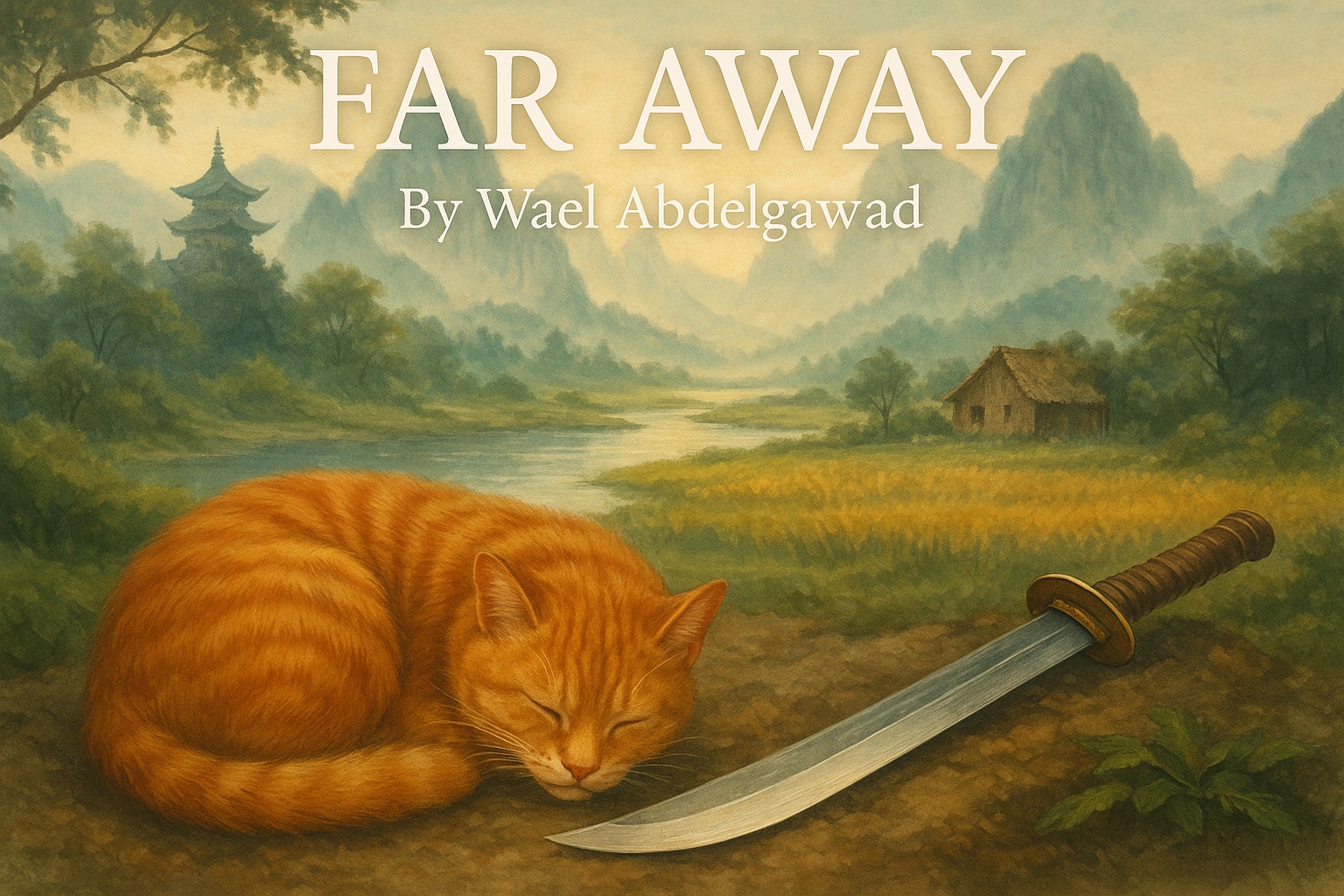
I rested one hand against his shoulder, feeling the steady warmth beneath his coat. “You and my cat back home.” I laughed softly. “His name is Far Away. Isn’t that funny? Because he’s so far away now.”
Belly turned his head and nudged my shoulder, nearly knocking me off balance.
“It’s okay, I told you. I’m okay.”
For a long moment neither of us moved. The mountains stood black against a sky crowded with stars, and the camp around us had become so quiet that I could hear the soft grinding of Belly’s teeth as he returned to his hay.
“But it’s alright,” I said at last, scratching him beneath the mane where he liked it best. “I’ll take care of you, and you’ll take care of me.”
I looked up at the stars.
“And Allah will protect us both.”
Belly snorted softly, as if entirely satisfied with that arrangement.
I smiled, spread my blanket beside his picket line, and before long the sounds of the camp faded into sleep.
* * *
Read Part 21 – Opium
Reader comments and constructive criticism are important to me, so please comment!
See the Story Index for Wael Abdelgawad’s other stories on this website.

Wael Abdelgawad’s novels – including Pieces of a Dream, The Repeaters and Zaid Karim Private Investigator – are available in ebook and print form on his author page at Amazon.com.
Related:
Keep supporting MuslimMatters for the sake of Allah
Alhamdulillah, we're at over 850 supporters. Help us get to 900 supporters this month. All it takes is a small gift from a reader like you to keep us going, for just $2 / month.
The Prophet (SAW) has taught us the best of deeds are those that done consistently, even if they are small. Click here to support MuslimMatters with a monthly donation of $2 per month. Set it and collect blessings from Allah (swt) for the khayr you're supporting without thinking about it.





[Podcast] Wait, Muslims Have Been Here HOW Long?! | Hassam Munir

Far Away [Part 30] – The Rock Splitter And The Parthian Shot

Maryam: The Story Of The Muslim ‘Virgin’ Mary

Is It Ever Too Early To Prepare For Ramadan? Reflections On Rifq, Forgiveness, And Healing The Heart

Lessons From The Battle Of Badr: A Personal Transformation Perspective

Long War Without End: A Quarter-Century Since The War On Terror

[Podcast] Faith, Motherhood, and the Call to Gaza | Dr. Samaiya Mushtaq

When The Shaykh Never Spoke – Deepfakes, Synthetic Scholars, And The Coming Crisis Of Religious Trust

The Stirring Of A Muslim Population In Japan: The Story Of Yusuke Fujitani

CAGE, Muslim Leadership, And Imran Khan: The Silence Test

The Best Actions for Eid al-Adha [Imam Dawud Walid]

Coming Full Circle: Who Are You Now? | Night 30 with the Qur’an

Running Away From Who We Are | Night 29 with the Qur’an

Building From the Ground Up: Week 4 Recap | Night 28 with the Qur’an

The Muslim You Are Becoming | Night 27 with the Qur’an
-

 #Culture1 month ago
Far Away [Part 26] – Shaytan Is A Liar
-
#Culture1 month ago
Far Away [Part 25] – To Save A Prince
-
#Current Affairs1 month ago
From a Syrian Prison to the UN: The Case of Bilal Abdul Kareem
-
#Life1 month ago
[Podcast] 50k Mahr, Hiding Money, & Who Pays for the Wedding? | AML Finance




Angela Mrazek
July 19, 2026 at 9:30 AM
I love that animals are such a big part of Daruis’ life and companionship. I saw a lot of rahmah in this section of the story, I really appreciated it. We love reading along. Jazak Allahu khairan brother Wael.