
#Culture
Far Away [Part 27] – The Prince’s Ring
A dinner and a duel in the Persian citadel bring Darius face to face with wealth, power, and an opportunity beyond anything he ever imagined.

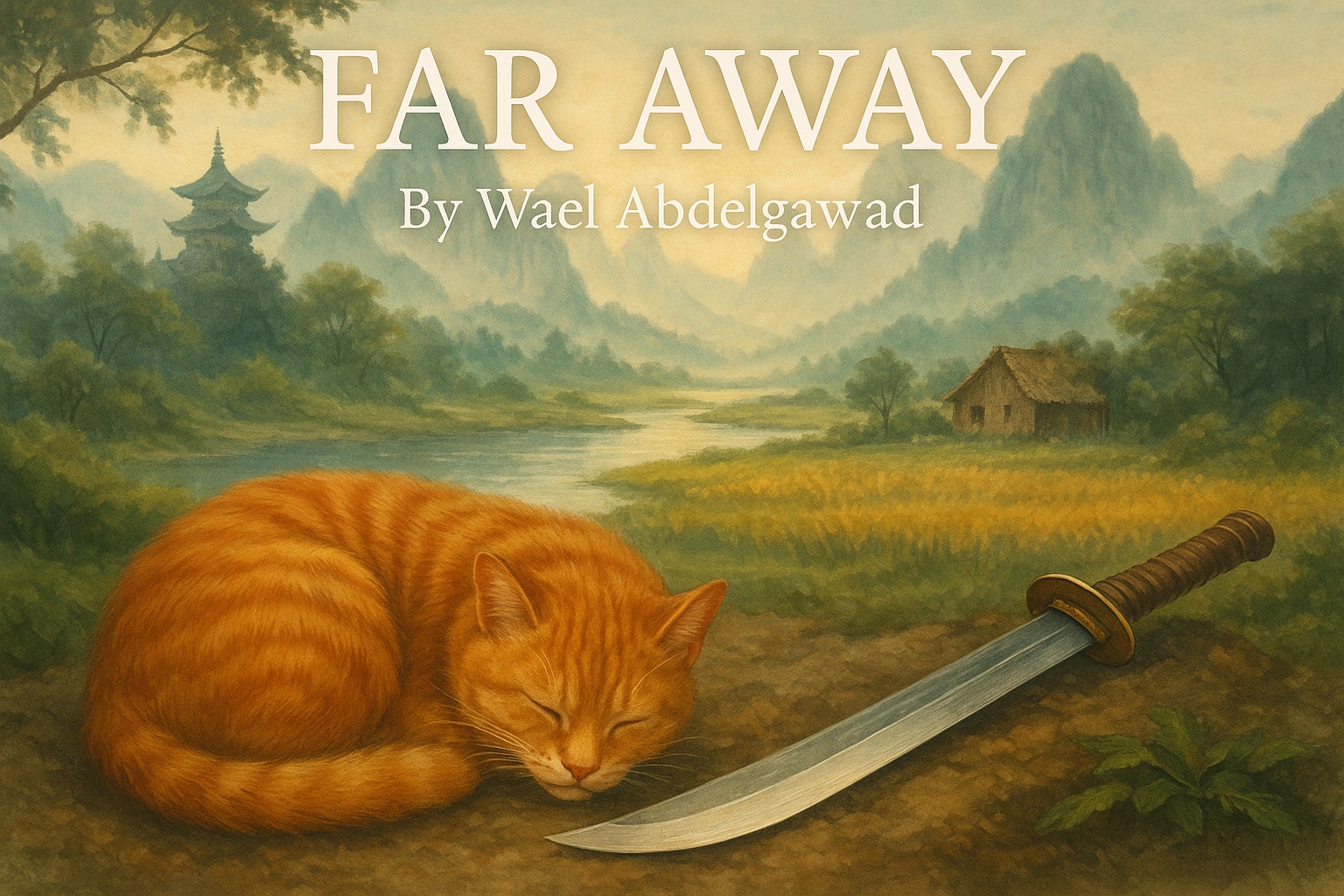
A dinner and a duel in the Persian citadel bring Darius face to face with wealth, power, and an opportunity beyond anything he ever imagined.
Read Part 1 | Part 2 | Part 3 | Part 4 | Part 5 | Part 6 | Part 7 | Part 8 | Part 9 | Part 10 | Part 11 | Part 12 | Part 13 | Part 14 | Part 15 | Part 16 | Part 17 | Part 18 | Part 19 | Part 20 | Part 21 | Part 22 | Part 23 | Part 24 | Part 25 | Part 26
* * *
Fish in a Pond
Keep supporting MuslimMatters for the sake of Allah
Alhamdulillah, we're at over 850 supporters. Help us get to 900 supporters this month. All it takes is a small gift from a reader like you to keep us going, for just $2 / month.
The Prophet (SAW) has taught us the best of deeds are those that done consistently, even if they are small. Click here to support MuslimMatters with a monthly donation of $2 per month. Set it and collect blessings from Allah (swt) for the khayr you're supporting without thinking about it.
By late afternoon, the heat had begun to fade. I had submitted to Hakim Yusuf long enough for him to wash my back, change the dressings and complain about everything I had done since waking. Afterward I put on a clean Five Star uniform, hung the brass horn around my neck, and went outside to find most of the other guards getting ready. Men who had spent months sleeping beside wagons and washing themselves from buckets were suddenly concerned with stains on their tunics, dust on their boots and whether their hair looked presentable.
At least I didn’t have that last problem.
A Persian officer arrived, accompanied by two soldiers. Ahmed spoke with him for a few moments, then turned to us.
“His Highness will receive us after Maghreb. Until then, he has invited us to tour the palace gardens, if we wish.”
Excited exclamations rippled among the guards.
We followed the Persians through an arched passageway and emerged into a garden larger than some villages we had passed on the road. Stone channels carried clear water between rows of cypress and fruit trees. Roses grew along the paths, and grapevines climbed wooden trellises overhead, creating tunnels of green shade. Pomegranate trees were heavy with fruit, and somewhere nearby I could smell jasmine. Fountains splashed into tiled pools where orange and white fish drifted lazily beneath the surface.
After months of dust, snow, mountains and mud, the place seemed almost impossible.
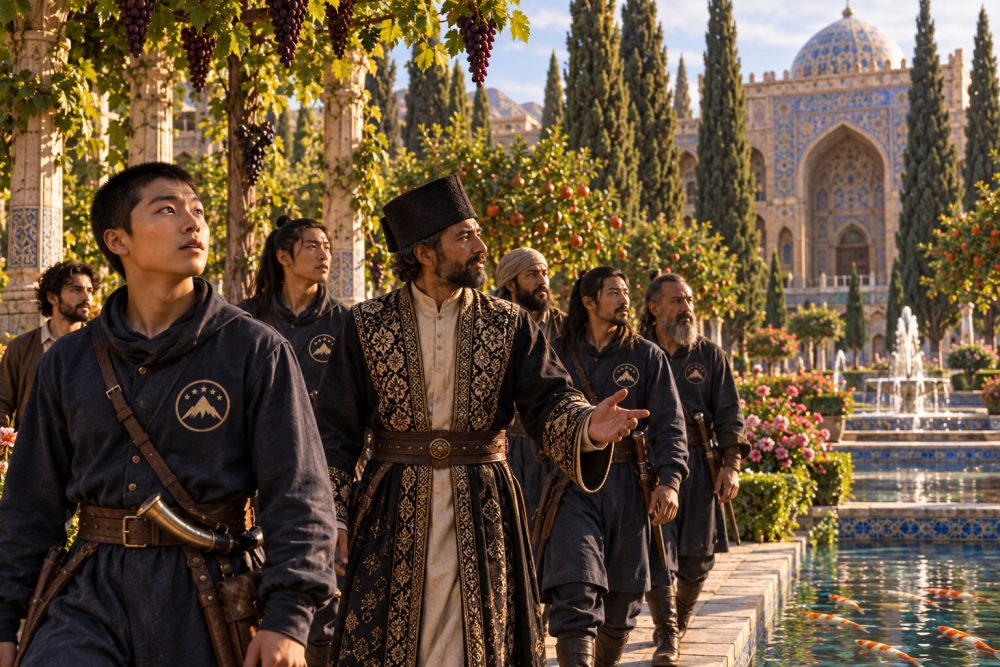
Looking at the fish in the pool, I remembered a day that seemed like forever ago, but in reality was only four years, perhaps. My father had already gone to the army. I went into town to sell my peanut crop, then to the Mayor’s house to collect my father’s pay. After that I entered the local temple, drawn by curiosity and a desire to pay reverence, or a feeling that there had to be something greater in this world. There was a stone-lined pool in the temple courtyard. I gazed at the orange carp for a long time. Their lives were peaceful but confined. Did they resent the conditions of their existence? Did they think? Did they feel? I had no idea.
How desperate and lonely I was back then. I might have died of heartbreak, if not for Far Away and Lady Two. In spite of all the sadness and violence I had experienced since then, I realized now that Allah was good to me. He was shepherding me, caring for me, and constantly giving me new opportunities.
Back then, gazing at the fish in the temple pond, I thought my life was like theirs, but now I saw things differently. I was a free man, a Muslim, a fighter. I was stronger than anyone around me guessed. I knew that. My strength did not come from the edge of the dao, however. “Be an agent of light, or an agent of darkness,” my father had said in the dream.
These thoughts were too big for me. My heart was trying to say something, but my mind didn’t know what it was. Looking up, I saw that the tour had moved on, and I hurried to catch up.
Birds Stuffed With Birds
We were passing beneath a trellis of grapevines when Longwei spoke. Hands clasped behind his back like a lecturer, he nodded toward the palace buildings beyond the trees.
“Enjoy this, boys. But this is nothing. Wait until we get inside.”
The men regarded him warily. Meilin had barely spoken to him since his bitter outburst at the campfire, and more than once I had noticed men who normally sought out his company choosing somewhere else to sit.
But this was Longwei. He had a certain charm and charisma that was irresistible.
“What do you mean?” Memdooh asked.
Longwei smiled, and guards drifted closer. “Persian princes are served thirty dishes at every meal.”
Memdooh blinked. “Thirty? What kinds?”
“Rice cooked with saffron. Lamb with nuts and fruit. Chickens stuffed with pigeons. Pigeons stuffed with… smaller birds.”
“What kind of smaller birds?” Bao asked.
“Hummingbirds. A true delicacy. You’ll talk about this night for the rest of your lives. No one back home will believe it.”
More of the men gathered around.
“I thought,” Ahmed said pointedly, “that our world back home would be overrun and destroyed. That we should all quit and run. Your words.”
Longwei waved this away. “I’m an old man. My body aches and I get in a bad mood. I was stupid. I apologize for that.”
Bao clapped him on the back. “It’s alright. Tell us more about the princely ways.”
“They serve everything on solid gold plates,” Longwei continued. “And the cups are carved from crystal. There’ll be musicians playing while we eat, and beautiful girls dancing.”
That produced considerable interest, and a derisive snort from Meilin.
“What else?” someone asked.
“Fountains of rosewater. Servants carrying trays of sweets. Incense burning everywhere. And every guest has his own servant standing behind him with a great peacock feather, like this.” Longwei swept both arms back and forth behind Memdooh’s head. “Keeping you cool while you eat.”
I looked at the palace through the trees. “Where do they get that many peacocks?”
Longwei gave me a pitying look. “Darius, when you are a prince, people bring you peacocks.”
Meilin finally turned around. “Dear.”
Longwei cocked an eyebrow. “Yes?”
Before Meilin could fire whatever missile her tongue had prepared, we passed through a part of the garden where a group of richly dressed men sat on a blanket on the grass, listening as another man recited poetry. The tour guide made a motion to Longwei, and he fell silent.
What Sort of Prince
The adhaan for Maghreb rose while we were still in the gardens, and only then did I realize there was a masjid within the citadel grounds. The adhaan was different from the one I was used to. It did not surprise me, as Karim had actually given us a talk about it:
“We are entering a land where the people practice Shiah Islam. We do not care about that. The world is vast, and whether you consider their practice right or wrong, it is for Allah to judge, not us. The Persians are our trading partners, and you will be nothing but gracious toward them.”
In spite of Karim’s talk, I was shocked to hear, “Ashhadu anna ʿAliyyan waliyyullah.” But I kept my mouth shut. I was in someone else’s homeland, not mine.
We followed others to the masjid, made wudu at a row of stone basins outside, and entered. Beside the door was a wooden rack holding rows of small, flat pieces of reddish clay. I noticed that every man who entered took one, so I did the same. I turned it over in my hand, wondering what it was for. I had the sudden terrifying thought that maybe someone would be stoned for a crime of some kind.
Feeling anxious, I followed the others into the prayer hall. As the lines formed, the men placed the pieces of clay on the floor before them. I breathed a sigh of relief and did likewise, still not knowing what it was for. Perhaps it was a tiny plate? And food would be served on it after salat? A few dates, maybe?
The masjid was filling with soldiers, servants, clerks and other men who worked within the palace.
Prince Farhad entered a few minutes later. Men made way for him, and I expected him to walk to the front and lead the prayer. Instead, he simply took his place in the first row. The lines formed, shoulder to shoulder, but everyone waited.
At last an elderly man in a black turban entered. He went directly to the front, and nodded to a man who called the Iqamah. Then he began the salat. I noticed that most of the men around me stood with their arms at their sides, as Karim had told us they would.
When we went down into sujood, I understood what the little clay tablets were for. The men around me placed their foreheads upon them. This made me uncomfortable, as I had never encountered it before. When we rose again, I quietly picked mine up and slipped it into my pocket.
After the prayer, Farhad exchanged a few words with the Imam and left. He did not come over to greet us or even acknowledge the Five Star guards. I watched him go, wondering what sort of prince he was.
The Prince’s Table
After the prayer, we were led through another courtyard, into a vestibule where we shed our shoes, then into a broad hall overlooking the gardens. Carpets covered the floor from wall to wall, and cushions had been arranged around rectangular white cloths on the floor. Servants moved quietly, setting out cups, pitchers of water, small dishes of herbs and bowls of yogurt.
Persian officials directed us to our places, with eight people at each cloth – four on a side. The Five Star men were mostly seated together, while Persian officers, nobles and palace functionaries occupied other cloths.
Captain Karim, Ahmed, Corporal Bao and I were directed to one of the cloths, and my eyes widened when I saw who sat opposite us. Prince Farhad was there, dressed in a fine white robe and turban, no jewelry whatsoever, and with a long, curved sword strapped to his back.
Beside him was the imam who had led Maghreb. There was also a broad-shouldered Persian officer who I recognized from the polo field as the chief of security, and an aloof middle-aged man named Reza Mirza who acknowledged us with a slight inclination of his head and nothing more.
With Ahmed translating, Farhad welcomed us and asked about the caravan. This pleased Karim, who launched into a description of our goods, including silk, porcelain, tea, medicines, lacquerware and other things that had survived the journey.
Farhad asked what we hoped to carry home from Persia.
“Carpets,” Karim said immediately. “Metalwork. Glassware, if we can pack it safely. Spices that are difficult to obtain in China. Anything from the Arab lands or the Ottoman territories that will fetch a good price in the east.”
Farhad nodded. For a prince, he seemed well versed in international commerce.
Servants began bringing the meal. Large platters of saffron rice were placed before us, followed by roasted lamb and chicken, stewed vegetables, flatbreads, herbs and bowls of thick yogurt.
There were no birds inside birds, however. Nor did I see gold plates, musicians, dancing girls or peacock feathers. I glanced across the room at Longwei. He happened to look up at that moment, saw me watching him, and immediately turned his attention to his rice.
A Strange Boy
I had never seen so much food in my life, and that was no exaggeration. I gave Longwei credit for telling the truth on that score. As I bit into a firm pastry stuffed with spiced beef, I suddenly remembered the day that I won the martial arts tournament, and how I returned to the bridge dwellers with a basket of steamed beef buns.
I remembered Teardrop, the delicate and sad young woman who used to watch people’s packs. Dragontop, the big old war veteran with one cloudy eye and three missing fingers, who always used to clap me on the back and tell me what a good boy I was. Ying Yue, the young widow with two small children, who told them stories at night to distract them from their empty bellies. And the brothers and sisters, some young and some old, who formed ranks and prayed the salat below the bridge. Were they still there, hungry and damp, and burning trash to stay alive on winter nights? Had some died of illness or neglect? No one was coming to help them. There were no banquets for them.
Ahmed turned to me. “His Highness says you seem deep in thought.”
I took a deep breath and let it out. “Before I became a guard I lived under a bridge in Deep Harbor. I was thinking of the people there. Hungry, cold, trying to survive. This food would save their lives.”
Ahmed translated, and Farhad gazed at me for a long moment, then spoke.
“He says,” Ahmed translated, “that you are strangely tender-hearted for a killer of assassins. And that if more of us were like you, the world would be a better place.”
I rubbed my short hair with one hand. “I don’t know.”
The Imam said something, and Ahmed translated: “Those people under the bridge, Allah sees them. He knows them. Society might forget them, but Allah does not. Their sabr will be rewarded beyond measure.”
I nodded at the Imam. I appreciated those words.
Farhad spoke, and again Ahmed translated: “He asks how you managed to kill the two men who attacked him.”
“I got lucky.”
Bao nearly choked on his food. “Lucky my ass. Ahmed, tell them how he killed nine men in the raid in Afghanistan and saved the entire rear of the caravan.”
“No, no.” I waved a hand at Ahmed. “Don’t tell that.”
Ahmed paused.
Karim looked at me. “Why not?”
“Because…” I made a helpless gesture. “I’m not proud of it. It just had to be done.”
Ahmed shrugged. “As you wish. I won’t tell.”
Farhad studied me for a moment, then asked another question.
Ahmed grinned. “He wants to know about your hair. If cutting it close and removing the eyebrows is a custom of your family.”
Bao burst out laughing.
“He got his hair burned off pulling two people out of a fire,” Karim said. “And then I whipped him.”
Ahmed and Farhad spoke for a minute. “He wants to know why you didn’t tell your captain sooner about the opium smokers.”
Everyone at our dinner setting was looking at me. Even Reza Mirza, who until then had shown about as much interest in me as he might have shown in a passing ant.
I swallowed. “One of them was a girl.”
Nobody said anything.
“I…” My face was getting hot. “I didn’t want her to get in trouble.”
Understanding appeared on Farhad’s face. He did not laugh, however. His gaze traveled across the hall toward the Five Star guards.
“That one?” Ahmed translated.
I did not look. It could only be Meilin or Weili, and I doubted Farhad would think it was Meilin. I nodded quickly.
Farhad smiled.
I stared down at my food and wished the ground would open and swallow me whole.
After that, the prince’s interest in me seemed to wane. He spoke extensively to Karim about the caravan, and promised to ensure the success of our mission. The caravan would remain here at the citadel. The top merchants in Herat would come to see our goods, and would bring samples of their own wares. Karim was extremely happy with this arrangement.
At one point he pointed to Shah, whose plate held the detritus of the huge quantity of food he had consumed. “Who’s the giant?” Farhad asked. “He might bankrupt me if you stay for too long.”
“Senior guard,” Ahmed told him. “He fought heroically when we were raided in Afghanistan. Killed many of the enemy.”
Farhad nodded thoughtfully.
Dessert was a sweet saffron rice pudding scattered with pistachios and scented lightly with rosewater, along with bowls of fresh grapes and sliced melon. I finally got my pistachios! If only I could take some for Belly. I took one spoonful of the pudding, then another, and wondered whether it would be terribly rude to ask for the entire bowl.
By the time I was done I thought I might pass out and sleep another three days, not from pain this time but from pleasure.
Nuts and fresh fruits were brought. I could not eat another bite, but I selected a beautiful green pear for Belly and put it in my pocket.
Not only were there no dancing girls at any point, but when the dessert trays were cleared, the Imam stood and gave a short sermon, in which he thanked Allah for guiding us to the worship of Him alone. He praised the shining example left to us by the Messenger of Allah, whose life exemplified sacrifice and courage. He spoke of Ali ibn Abi Talib, and his great love for Fatimah, and called for blessings upon them and their descendants.
It was a good speech, and I had no problem with any of it.
The Private Meeting
After that, we all began to rise and return to the caravan to sleep. The prince offered to give us quarters within the palace, but we were caravan guards. Our place was beside the wagons.
Before I could leave, however, the prince drew me and Karim aside, and asked us to accompany him to a private chamber. This seemed strange to me. Who would translate? Captain Karim’s Persian was passable but weak.
Saleh Azeri, the broad-shouldered chief of security, accompanied us, as did Reza Mirza. The latter had hardly spoken all evening, and I still had no idea who he was or why he was included in everything.
We were taken to a smaller room furnished with carpets and cushions, with a low table in the center. A servant brought a pot of tea and a plate of small round cookies, poured for each of us, then withdrew.
Farhad sat across from me, holding his cup in one hand. For what seemed like a very long time, he simply studied me. Finally he set down his cup. “The horse that threw me has been examined,” he said in perfect Mandarin Chinese. “It was poisoned.”
I stared at him. “You speak our language!”
Farhad smiled. “Apparently.”
“How?”
“When I was a boy, there was a Chinese Muslim at my father’s court. Master Ma. He was a scholar and physician. He remained with us for several years and became my tutor. He taught me your language, Eastern philosophy, and martial arts. But I have had few opportunities to speak the language since Master Ma returned home.”
Karim leaned forward. “No doubt the assassins hoped you would break your neck in the fall. And if not, you would offer a stationary target for the archers.”
Farhad nodded. “That is our analysis as well.” He looked at me. “What do you think, Darius?”
“Why did they do it? Do you have enemies?”
For some reason the prince burst out laughing. When he stopped, he merely said, “Yes.”
He drank some tea, then regarded me thoughtfully again. “I understood what they said about the raid, that you killed nine men. Why didn’t you want me to know?”
I fidgeted uncomfortably. “Because killing is not something to brag about.”
He nodded. “So. You can fight with a sword. Can you fight without one?”
The way of my people was false modesty. I was supposed to say, “No, I am useless, I have no skill.” But my father hadn’t been like that. My father had been proud, rough, and disdainful of weakness. Perhaps I took after him more than I liked to admit, because all I said was, “Yes.”
The Duel
Farhad raised his eyebrows. “Would you spar with me? A friendly match.”
I gaped in horror. “What? No!”
“What if I promise no repercussions if you win?”
I shook my head. “The thing is, Your Highness… You would not win.”
Karim was looking into his teacup, but I could see the corner of his mouth twitching.
“Is that so?” Farhad said. “Such confidence.” He gestured toward Saleh Azeri. “What about my chief of security, then?”
Saleh was older than Karim, perhaps, and heavily built, with thick arms and shoulders. There was nothing soft about him. But there was something proud in the way he held himself, his back perfectly straight and his chin tilted slightly upward.
I hesitated. “I would not want to embarrass anyone.”
Farhad stared at me for half a heartbeat, then threw his head back and laughed.
Saleh’s face turned red.
“How about a soldier, then?” Farhad asked.
I considered this. “All I care about is the success of the caravan.”
The prince’s expression hardened. “Then it would behoove you to do as I wish.”
Karim patted my knee. “It’s okay.”
I nodded. “Very well. Although my stomach is still very full.”
“Preparing your excuses already, I see.” Farhad clapped his hands and called an order toward the door. A few minutes later a Persian soldier entered and bowed. He was perhaps thirty years old, and huge. He stood a head taller than me, and bulged with muscle. If I’d seen his footprints in the mud, I would have thought they belonged to a mythological creature.
Equally important, I could tell he was a skilled fighter. He had the efficient, graceful walk of a man who knew exactly where and how to place his feet. When Farhad explained what he wanted, the big soldier looked at me and smiled.
I smiled back, and it wasn’t false. I hadn’t had a genuinely exciting hand-to-hand duel since the tournament. At least, not one where the other guy wasn’t trying to kill me.
“Hold on,” Farhad said. He clapped his hands again and said something.
“He called for pudding,” Karim whispered to me.
Pudding? What on earth? Maybe all those muscles required hourly helpings of food.
Indeed, a large bowl of pudding was brought. Farhad gave a command, the bowl and a spoon were given to the soldier, and the man began to eat. We sat there like brainless grinning Buddhas and watched as the man ate the entire dessert.
“There,” Farhad said. “Now both your stomachs are full. Level playing field.”
We went to another part of the palace, where there was a large empty room with a polished wooden floor. Saleh spoke briefly to the soldier, who removed his outer garment and sword. I took off my horn and jacket and handed them to Karim. As an afterthought, I removed the pear from my trousers pocket. “Hold this too.”
The soldier and I faced one another. Farhad clapped his hands.
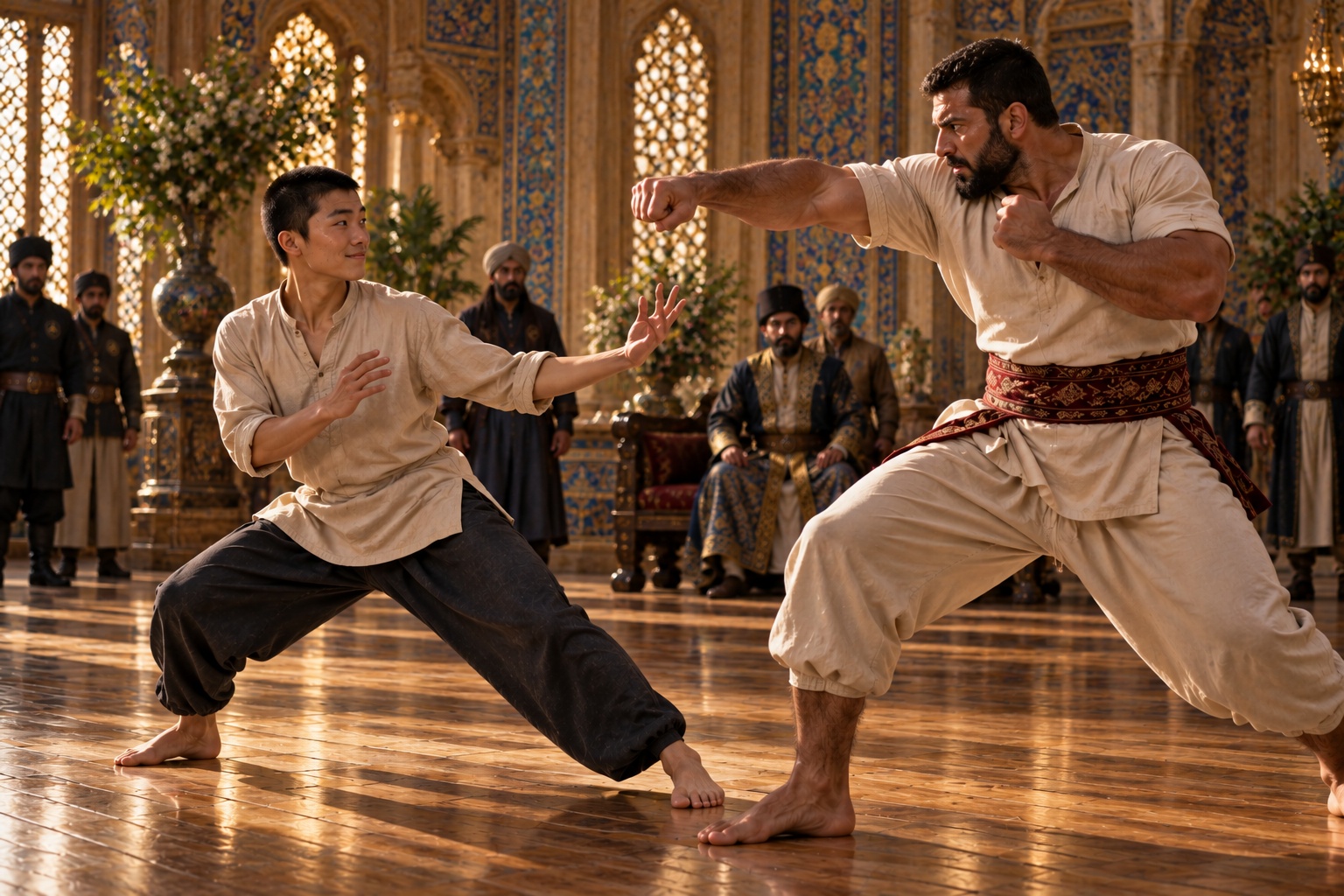
The Persian leaped forward as if he had wings, and came at me with a punch as fast as the beak of a heron when it snatches a fish from the river. I would not have thought such a big man could move so fast. His fists and feet came in powerful combinations.
But he was limited. His style of striking – at least so far – consisted of closed-fist punches and kicks, nothing more. Furthermore, his attacks were sequential. I was more versatile. I could hurt a man with my elbows, knees, forehead, fingers – even my shoulders. And because my empty hand fighting was based on the movement of the sword, I flowed from one technique into another without pause.
I could have finished it quickly. Instead I passed up opportunities to counter. I didn’t know how far I was expected to go. I wanted to see what level of force the soldier would bring to bear.
It was as if I had learned nothing from my duel with Meilin, for the man realized that I was holding back. His eyes tightened and his face flushed. He launched a kick at my stomach and I dropped an elbow to block, but at the last second he turned his hip and altered the trajectory of the kick, bringing his foot around and into the side of my head.
It was like being clubbed. I saw stars, and I stumbled. I heard Karim say something, but I didn’t know what.
So that was what we were doing. A not-so-friendly match. Okay.
The soldier held back, smiling triumphantly, perhaps thinking that the match was over.
He was wrong. I straightened up, took a deep breath, and fell into River Flow. My shoulders relaxed, and my arms were as light and loose as the wind. My feet were planted firmly on the ground, but ready to dart or leap. I did not see the soldier’s face anymore. I only saw shoulders, hips, knees… Pivot points, and targets.
He stepped forward and threw another kick, but this time I drove it sideways with the heel of my palm, then with the same hand flowed into a backfist to his nose. His head snapped back. I followed with an elbow to the sternum that would have collapsed most men.
He took one step backward. Blood trickled from his nose. He wiped it away and grinned.
Alright then. He’s a tough one.
The man launched himself into the air and threw a switch kick, where he faked with one leg then fired the other. I barely managed to slip to the side as the huge foot whizzed past my ear. I countered with a hard punch to his liver, sinking my weight and putting everything I had into it.
It was like punching a wall. The soldier gave a little grunt, then stood up straight.
He was simply too big. I could keep hitting him, but sooner or later one of those enormous fists was going to find me. There were some things, however, that muscle could not protect. No matter how big a man was, his brain needed blood.
I slipped inside his next punch, slid one arm beneath his armpit and wrapped it around his neck. I cinched my hands, and before he understood what I was doing, I had locked the arm triangle choke around his neck and shoulder.
The soldier stood up straight, which lifted me right up off the ground. Then the lunatic proceeded to charge across the room with me hanging on. He probably intended to smash me into the wall. Feet dangling, I maintained the choke and used the soldier’s movement to tighten it, eliminating the gaps. Just before we hit the wall, I swung my legs around to the side, taking myself out of the way. The soldier crashed into the wall himself. The man fell and I followed him down, tightening the hold further and driving my weight into his neck. This was crocodile style, not one of my primary styles but something my father had practiced occasionally. The soldier clawed at my arm, twisted violently, then went limp.
I released him and stood, then walked back to stand in front of the prince. I was still in River Flow, and I spoke almost dreamily.
“Crocodile smothers its prey.”
Saleh shot to his feet and hurried over. He knelt beside the soldier, put two fingers against his neck, then glared at me and growled something in Persian.
The prince was staring at the unconscious soldier. “That man,” he said in Mandarin, “is the best fighter in the division. He is a combat trainer.”
I looked down at the soldier. “Yes… He’s not bad.”
Farhad stared at me.
The security chief removed his weapons and threw them to the ground, then gave me a beckoning gesture with his hands. His intent was obvious. He wanted to fight.
In River Flow, nothing troubled me, and I felt no fear. I looked to Farhad. “Please tell the honorable Chief that he is a strong and capable man, but I was trained to fight from the time I could walk. I can see a man lift a teacup, and know his ability relative to mine. I will fight him if he wishes, but I will win.”
Farhad gazed at me incredulously. He translated.
The soldier on the floor was coming to. The man sat up and rubbed his eyes as if he’d just awakened from a beautiful sleep. Chief Azeri saluted the prince, snatched up his belongings, then departed without a word.
The Same Family
We returned to the carpeted meeting room and sat. Farhad poured himself another cup of tea.
“Lee Darius. Tell me about your family.”
It impressed me that he knew to say my names in the proper order. But I hesitated in answering his question. What was my family? I didn’t know where to start.
“Your father and mother,” Farhad clarified. “Brothers and sisters.”
“Oh. My mother died when I was young. My father joined the army and never returned. I have no siblings.”
“What of your father’s family?”
“A respectable Hui Muslim family. My aunt and her husband own a large safflower farm.”
He nodded. “Farming is the lifeblood of any nation. And your mother’s family?”
“The Shahs. No offense.” I knew that Shah meant king in Persian.
Farhad smiled. “No relation to the famous Shahs of the Five Star Trading Company, I imagine?”
“Yes. The very same.”
Farhad’s eyes narrowed. “And you are, what… A distant cousin?”
I shook my head slowly. “Shah Zheng, master of Five Star, is my grandfather.”
Farhad leaned back against the wall. “I don’t understand. Your status is very high. Why are you a caravan guard?”
“The Shahs didn’t know I existed until a year ago. I don’t think they know what to do with me.”
His eyebrows went up. “Such situations can be perilous. Believe me, I know. Any insights, Captain Karim?”
Karim looked at the ground and shifted uncomfortably in his place.
“What?” I demanded.
He cleared his throat. “I am not a Shah family insider, understand. But I know Shah Suliman fairly well. There is a possibility… I mean, this is speculation. But there is a possibility that you could be in danger when we return home.”
I frowned. “What do you mean? From whom?”
Karim pursed his lips. “From the Shahs. That’s all I can say. I don’t know any more, truly.”
I remembered something. “Zihan Ma never took me into Starling for Jum’ah. He always left me behind. He only ever took me to Jum’ah in Deep Harbor.”
Karim gave the tiniest nod.
Farhad broke in. “If I may. Darius, what do you inherit from your mother?”
I shrugged. “Nothing, I guess. I have no idea.” I knew how childish I must sound. I had never given much thought to this question before. I remembered Shah Suliman telling me that I should go back to the farm and forget everything. But I never understood his intentions.
“Then I suggest you find out.”
The adhaan for Ishaa’ sounded from somewhere in the palace.
“We’ll pray right here,” the prince said.
I needed to perform wudu’, and was shown the way to a chamber with a stone basin and a flow of water that poured constantly from the mouth of a stone peacock.
The five of us prayed with the mysterious Reza Mirza as imam. He recited Surat Al-Insan, and his voice was soft and melodious. His recitation of the Quran was the first time I’d heard him speak.
The Offer
After salat we sat once again. The prince looked at Reza and tilted his head questioningly. Reza nodded.
“I would like to make you an offer,” the prince said.
I waited.
“I want you to remain here in Herat and join my personal guard. You will be well paid. A tutor will teach you Persian. You will be trained in personal protection protocols and techniques. You will be an employee, not a mawla. You can leave anytime you wish. But I think you will find the experience extremely rewarding.”
I stared at him. I realized my mouth was open, and I shut it.
Karim cleared his throat to speak, but Farhad held up a hand to forestall him. “I know he is a trusted employee. I will compensate you in exchange for releasing him from his contract.”
“I don’t know what to say, Your Highness,” I managed.
Farhad dismissed this with a wave of his hand. “You may cease the ‘Your Highness’ formalism in private. In any case, only Allah is the Most High. And speak your mind. I value directness.”
I took a breath. “Why me?”
Farhad seemed surprised by the question. “You saved my life.”
“I didn’t even know who you were.”
“Precisely. I have hundreds of men who will defend me because I am a prince,” Farhad said. “You ran toward two armed assassins when I was merely a stranger who had fallen from his horse. You had nothing to gain.”
I rubbed my chin, still baffled. “But I’m sixteen years old, I’m Chinese, and I’m a caravan guard.”
“You will grow older. As for being Chinese, I consider that an advantage. You have no family here. No tribe, clan, old alliances. No Persian noble whispering in your ear. If I give you an order, I need not wonder whose interests you are serving.”
“As for being a caravan guard,” he continued, “you have demonstrated extreme physical aptitude and courage. There is something else. This man whipped you.” The prince indicated Karim. “Yet here you sit with him, and I sense no resentment. Only respect. I like that.”
I pulled my head back in alarm.
“Not that I would whip you!” The prince waved a hand. “I’m just saying, I value that kind of… Well, I don’t know. It just seems very mature.”
“Loyalty,” Reza said softly. Aside from his recitation in salat, it was the first word I’d heard him speak. “Loyalty is everything. All else can be taught or paid for. But loyalty must come from the heart, and must be freely given. Loyalty is the beginning and the end of service. Nothing matters more.”
“Yes!” Farhad smiled and sat back against the cushions. “Loyalty. Oh, and one more thing. You are Sunni.”
“I don’t understand why that matters.”
“Herat is not Isfahan. Nor are the lands beyond it. Many of the people in the eastern part of the empire are Sunni. Afghans, Uzbeks, merchants from Central Asia, tribes whose loyalty to Persia has never been simple. For too long, men in authority in my country have treated some of these people like enemies. There have been… brutalities against the Sunni population. Kandahar is a particularly bad case in point. As a result, the Afghans are always on the edge of rebellion.” He held up a finger. “I am completely against these inequalities. If a man pays his taxes, obeys the law and does not take up arms against us, why should I turn him into an enemy because he folds his hands when he prays?”
This was interesting, but I still did not see what it had to do with me.
Farhad set his cup down. “I need Sunni Muslims in my service. Not as ornaments. Not so I can point to them and boast of my tolerance. If I promise a Sunni village that its masjid will be protected, they hear the promise of a Safavid prince. If they see honorable Sunni Muslims serving beside me, perhaps they will believe what I say.”
“It seems to me,” Karim said, “that doing what you say will cause them to believe what you say.”
Farhad gave him an annoyed look. “True enough, but it’s not always so simple.” He tapped his teacup with one manicured fingernail. “There are other problems. Governors who collect more than the treasury ever sees. Soldiers who wait months for their pay. Officers appointed because of their fathers rather than their abilities. Villages squeezed until the people have nothing left, then everyone is astonished when those people rebel.”
“Corruption,” Karim commented. “There’s plenty of it back home as well.”
“You’re a prince,” I said. “Can’t you just order it?”
Farhad laughed softly. There was no amusement in it. “That is what people who have never been princes imagine. There are powerful people who oppose my ideas.”
I thought of the poisoned horse. “The people who tried to kill you.”
Farhad nodded.
“Do you know who they are?” Karim asked.
“That is not a matter to be discussed with outsiders, Captain.”
“I’m an outsider,” I pointed out.
“If you entered my service, you would not be. What do you say?”
I chewed my lip. The prince’s offer was astonishing. It painted a picture of a life I could never have imagined. Persia was beautiful. What Farhad wanted to accomplish seemed good. I could learn a new language, see wondrous places, and, apparently, be paid well.
“Can I speak to my Captain in private?”
“Of course.” The prince stood. “I have a few matters to tend to anyway.” He and Reza departed.
Your Friend, and Your Captain
I turned to Karim. “What should I do?”
“I can’t answer that.”
“I’m asking your opinion.”
Karim rubbed his beard. “If you are asking me as a friend, I would tell you that this is an extraordinary opportunity. You would learn Persian, make powerful connections and receive training that few men from our homeland could obtain. Ten years from now, you might return home a wealthy man. It’s the break of a lifetime.”
I nodded. That sounded good. “But?”
Karim looked at me. “If you are asking Captain Karim of the Five Star Trading Company, then my answer is different.”
“What is it?”
“I need you.”
I tipped my head back. I had not expected that.
“We have lost men,” Karim said. “We have lost two wagons, and we still have thousands of li ahead of us. You are one of the best fighters I have. More importantly, you see things other men don’t. You make mistakes, sometimes stupid ones, but when everything goes wrong, you are the man I want there.”
I stared at him.
Karim sighed. “That’s it. As your friend, I advise you to take the prince’s offer. As your captain, I want you on the caravan.”
No one had ever said anything like that to me before.
“You need me?”
Karim frowned. “I just said so.”
“I know. I wanted to hear it again.”
“Don’t be annoying.”
Far Away
We sat in silence, drinking tea and eating biscuits with pistachios. Yet another reason to stay in Persia. Pistachios! But somewhere in my mind I saw Far Away asleep in a patch of sunlight. Was he dreaming of me? Did he miss me? I wondered if he had ever caught a fish in the stream behind the property. Could cats catch fish?
“What are you thinking about?” Farhad asked.
I nearly jumped. I hadn’t noticed his return. He and Reza sat in front of us.
“I’m thinking about my cat back home. I miss him.”
Farhad stared at me. “I offer you the world, and you’re thinking about your pet cat? I don’t know whether to laugh, or be offended.”
I tipped my head to one side. “He followed me. He ran away on the journey to my uncle’s farm. I traveled many days without him. Yet somehow he followed me. He showed up in the middle of the night, almost dead, and I nursed him back to health.”
The prince raised a palm questioningly. “And?”
“Loyalty,” Reza Mirza said. “The boy speaks of loyalty.”
I nodded slowly. “I guess you’re right. You, sir -” I nodded at Reza – “said that loyalty is the beginning and the end. Well, I am loyal to Five Star. More specifically, I am loyal to this man.” I looked at Captain Karim. “I am loyal to Memdooh, Kuangren, Gulnur, Meilin, and even Longwei who resents me. I am loyal to Deng Weili, who toyed with me. I am loyal to Hakim Yusuf, Corporal Bao, and Corporal Jian who died in front of me, and whose horn I wear around my neck.” I lifted the horn for Farhad to see. “I am loyal to my horse Belly, who has saved my life three times, and that is not an exaggeration. Maybe I’m an idiot. I wonder sometimes. But I came this far with all of them, through snow, fire and blood, and I will return home with them. After that, I do not know.”
My breath was heavy, and my heart full of emotion. My eyes flicked from one man to the next. Karim was watching me, and I could almost have sworn that he had a tear in the corner of one eye.
As for Farhad, his face broke into a wide grin.
“I see,” he said, “that I did not estimate your value highly enough. Well.” He rubbed his hands together. “There is nothing more to say. However, I still owe you, for you saved my life. If I cannot compensate you with the job of your dreams, then I will give you something else.”
The Prince’s Ring
Farhad reached inside his robe and drew out a silver chain that hung around his neck. A large, glittering ring dangled from the end. He slipped the chain over his head and held the ring out on his palm.
It was silver, set with a huge, deep red stone, surrounded by a row of smaller green stones. There was writing engraved on the silver band, but it was Persian and I could not read it.
“This belonged to my great-grandfather,” Farhad said. “He had these words engraved upon it, and they became the motto of our branch of the family. Justice is the foundation of kingship. It passed from him to my grandfather, then to my father and to me.”
I stared at the ring. “It’s beautiful. I’ve never seen anything like that.”
“Obviously not. Hold out your hand.”
I did so, and he set the ring on my open palm. It was warm with his body heat. “It’s so heavy,” I said, and studied it closely. “Now I can tell my friends I held a prince’s ring.” I extended my hand to return it.
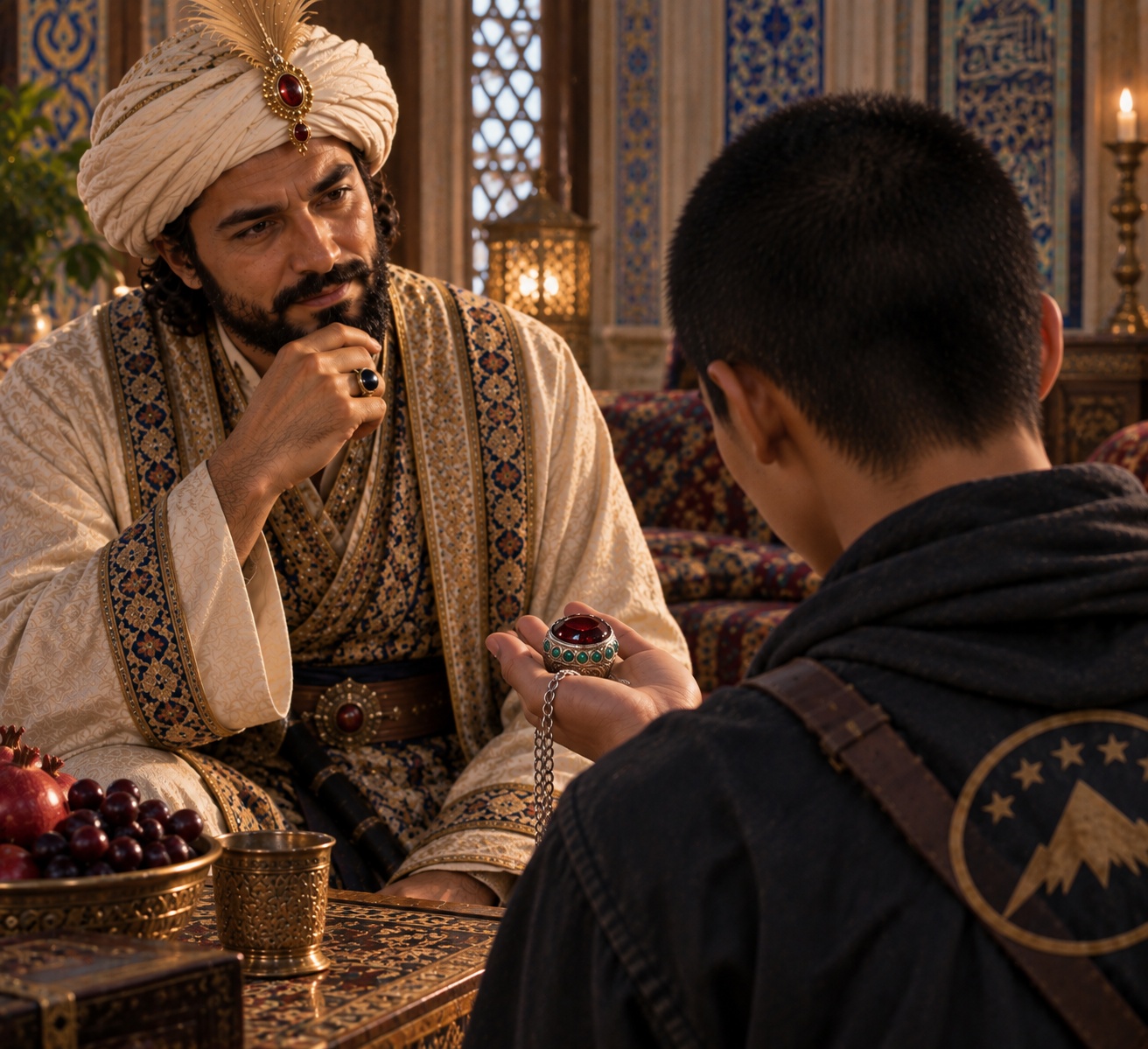
“No, Darius. I’m giving it to you. It’s yours.”
I blinked several times. I was stunned.
I knew what I was supposed to say. I should refuse. I should tell him that such a gift was too valuable, that saving his life had been my duty before Allah, that I could not possibly accept a treasure that had belonged to his family for generations.
But I wanted it. Not for what it was worth, but simply because I had never possessed anything so lovely.
I made a token attempt to refuse. “I can’t. It must be worth a fortune.”
“It’s not.”
I was confused. “Really?”
“It’s not worth a fortune, because it has no price. How can you put a price on a symbol that represents generations of continuity, service, dedication, and yes, power? How can you put a price on a token that will open doors anywhere in the world that my family is known and honored?”
Farhad reached out and closed my fingers around the ring. I could hear the sound of my breath in my own ears.
“Thank you seems an inadequate thing to say,” I told him.
“No more inadequate than me thanking you for saving my life.”
I hung the chain around my neck and slipped the ring into my tunic. It felt strange against my skin. I imagined that I could feel it beating like a tiny heart, whispering to me of the great opportunity I had given up, and the dangers that – I was sure – still lay ahead.
* * *
Read Part 28 – Death In District Nine
Reader comments and constructive criticism are important to me, so please comment!
See the Story Index for Wael Abdelgawad’s other stories on this website.

Wael Abdelgawad’s novels – including Pieces of a Dream, The Repeaters and Zaid Karim Private Investigator – are available in ebook and print form on his author page at Amazon.com.
Related:
Keep supporting MuslimMatters for the sake of Allah
Alhamdulillah, we're at over 850 supporters. Help us get to 900 supporters this month. All it takes is a small gift from a reader like you to keep us going, for just $2 / month.
The Prophet (SAW) has taught us the best of deeds are those that done consistently, even if they are small. Click here to support MuslimMatters with a monthly donation of $2 per month. Set it and collect blessings from Allah (swt) for the khayr you're supporting without thinking about it.




Far Away [Part 30] – The Rock Splitter And The Parthian Shot

Maryam: The Story Of The Muslim ‘Virgin’ Mary

Is It Ever Too Early To Prepare For Ramadan? Reflections On Rifq, Forgiveness, And Healing The Heart

Lessons From The Battle Of Badr: A Personal Transformation Perspective

Taliban Tale: How Afghan Militants Survived Campaigns In 2006-2016
Far Away [Part 26] – Shaytan Is A Liar

[Podcast] 50k Mahr, Hiding Money, & Who Pays for the Wedding? | AML Finance

Long War Without End: A Quarter-Century Since The War On Terror

[Podcast] Faith, Motherhood, and the Call to Gaza | Dr. Samaiya Mushtaq

What The Makkah Agreement Is Missing

The Best Actions for Eid al-Adha [Imam Dawud Walid]

Coming Full Circle: Who Are You Now? | Night 30 with the Qur’an

Running Away From Who We Are | Night 29 with the Qur’an

Building From the Ground Up: Week 4 Recap | Night 28 with the Qur’an




Tawfiq
September 15, 2026 at 2:57 AM
Broooooo. Darius just casually beat the BEST FIGHTER IN THE PERSIAN ARMY. I for reals thought they wuz both gonna throw up pudding in the middle of the match. 😂
Crocodile smothers its prey! From now on I’m gonna say cool names when I have a fight. Not that I have fights. But if I did, I’d slap the guy then I’d be all, “Flying fox clips your wings.”
Seriously tho the ending surprised me. I thought Darius was gonna take the job. But I guess he feels the caravan is his family. Especially Belly. Good old Belly!
I just think that people should know who their real family is. The caravan guards might be his friends, or might not, tbh. But his genuine family is back home somewhere, missing him. When Darius was sitting there in the citadel thinking of Far Away and the river behind the farm, that’s his heart of hearts, to coin a phrase. That’s real talk.
Great chapter Mr. Abdelgawad sir. Waiting for next week insha-Allah.
Wael Abdelgawad
September 15, 2026 at 3:22 PM
Throwing up pudding! Why didn’t I think of that?
I’m not sure you coined that “heart of hearts” phrase, akhi.
Thanks for the comment!
Kathleen
September 15, 2026 at 3:03 AM
I confess that I was disappointed when Darius declined Prince Farhad’s offer.
I understand his reasons, and his loyalty to the caravan speaks well of him. But we tend to look at Darius through modern eyes and think, “He’s sixteen. He’s a child. He should go home to his family.” Darius does not live in our world. In his time, a young man of sixteen could work, fight, marry, travel, and make decisions about the course of his life.
And what an opportunity this was! Farhad offered him far more than a job. Darius could have served a good and intelligent prince, traveled, learned, and been exposed to a world of possibilities he might never encounter back home.
Perhaps Darius made the right choice. Perhaps he didn’t. We can’t know yet. We make the choices we make, and then we live with the consequences. What I hope for most for Darius is that when he looks back on this moment, he can do so without regret.
Wael Abdelgawad
September 15, 2026 at 3:42 PM
“We make the choices we make, and then we live with the consequences.” – Sounds like you have experience with that, Kathleen. But I agree, I hope that whatever path he takes, he lives happily and without regret, inshaAllah.
Bint A
September 15, 2026 at 2:06 PM
Don’t worry guys, he’s gonna become royalty himself. Just wait and see!
No point working for a prince when you have such a future ahead.
As the author alludes, his calibre and value is bigger than what we give him credit for :)
Lovely chapter br Wael, I especially appreciated the picturesque descriptions and of course martial arts scenes are always a treat.
And the development of Darius’ character as genuine, deep, reflective, and still innocent was quite heartwarming, not to mention Karim’s honest friendship and Farhad’s insights.
Ps. I’m sure Master Ma was none other than Zihan Ma
Wael Abdelgawad
September 15, 2026 at 3:57 PM
Thank you Bint A, I think your description of Darius (genuine, deep, reflective and still innocent) is right on. That’s Darius in a nutshell.
“Ma” is a common name among Hui Muslims, as it’s short for Muhammad, so I don’t know about that hunch of yours… We’ll see.
Amer Rizvi
September 16, 2026 at 9:09 AM
Nice to see so many Persian themes 🙂 Darius is a Persian name, as are Rustam, Dinshaw, and Xerxes, names of Zoroastrian friends I had at my school in Karachi, Pakistan.
“Ashhadu anna ʿAliyyan waliyyullah” is commonly translated as “I testify that Ali is the friend of Allah.”
On a personal note, from our house in Karachi, we hear two adhans: the Sunni adhan first, followed a few minutes later by the Shia adhan. A nice example of Sunni-Shia coexistence!
So during Ramadan, at Maghrib, we break our fast a few minutes earlier. 🥡🥢😋
FM
September 20, 2026 at 9:03 AM
He left the easy path to follow the likely right one. Ofcourse He’s going to think back often and wonder about the road not taken. And if comes from Shaitan who tries to manipulate and put despair in hearts ever so often. But Tawakkul will eventually bring him true success InshaaAllah.