
#Islam
Du’as for Happiness: Finding Joy Through Daily Adhkar
In an age of affirmations and self-help mantras, Islam offers timeless du’as that cultivate happiness, contentment, and trust in Allah.


In an age of affirmations and self-help mantras, Islam offers timeless du’as that cultivate happiness, contentment, and trust in Allah.
Happiness and the Source of Good
As public awareness of mental health issues increased in the 2000s, professionals and influencers have recommended affirmations or mantras to foster a sense of well-being. You wake up in the morning and repeat positive sentences. You ‘manifest’ the best things so you capture energy from the verbalizations.
However, Islam, fourteen hundred years ago, already gave us daily du’as: our morning and evening adhkar. Here are a few of these du’as, and how we can internalize them in our pursuit of happiness.
Keep supporting MuslimMatters for the sake of Allah
Alhamdulillah, we're at over 850 supporters. Help us get to 900 supporters this month. All it takes is a small gift from a reader like you to keep us going, for just $2 / month.
The Prophet (SAW) has taught us the best of deeds are those that done consistently, even if they are small. Click here to support MuslimMatters with a monthly donation of $2 per month. Set it and collect blessings from Allah (swt) for the khayr you're supporting without thinking about it.
Happiness has to come from the source of all that is good: Allah. Happiness is also a subjective feeling, and psychologists have even commented on how humans can convince themselves of happiness through things like cognitive reframing. So the combination of these two: a desire to be happy, and seeking happiness from Allah, is built into these daily adkhar. It’s important to remember that the value of these phrases is not from the rote uttering, but from believing them wholeheartedly with every repetition.
Du’a No. 1: “I Am Pleased With My Lord”
 Our ruh, our soul, was not created for this fleeting world; it was destined to reunite with Allah. In this temporal realm, there will always be a tinge of sorrow, a wave between moments of grief and joy. Because, eternal, pure, unadulterated happiness lies only in our meeting with our Maker.
“There is no Muslim who says, in the morning and evening: ‘Radaytu billahi Rabban wa bil-Islami dinan wa bi Muhammadin nabiyyan’ (I am pleased with Allah as my Lord, Islam as my religion and Muhammad as my Prophet), but that he will have a promise from Allah to make him pleased on the Day of Resurrection.” [Sunan Ibn Majah #3870]
An easy way to make this adkhar a habit is to connect it with a task: I’ll start saying it when I open the ground coffee, or as I make my bed. Repeating this du’a, as we prepare breakfast or commute to work, slowly transforms us. We begin to realize our contentment: we, whom Allah has guided, we, upon whom He has bestowed His mercy, are indeed content with Allah as our Lord, His Messenger as our Prophet, and this religion, in all its beauty and wisdom. We, who may not understand every commandment and every test, but still strive, are content with this world view and content with Allah.
Du’a No. 2: “Allah Is Sufficient”
The Prophet ﷺ advised us to seek solace by reciting: “Hasbunallah wa ni’mal-Wakil” (Allah is Sufficient for us, and He is the Best Disposer of affairs).” [Riyaadh as Saliheen 409]
Since the footage of Gaza flooded our phones, we’ve seen first hand how strong this phrase is. We’ve seen it said by the father holding his beheaded child, or the brother carrying his martyred brother, or the mother finding her child’s burnt flesh. We’ve heard it over and over from the strongest of our ummah. So shouldn’t we, with our ordinary daily struggles, say it even more?
When we relinquish the reins of our lives to Allah, acknowledging His supreme control, we experience an unimaginable freedom. We give every moment to Allah, trusting that He is the Best Disposer of our affairs, from the mundane to the monumental. “And Allah is the best of planners.” [Qur’an 8:30]
I used to be afraid of driving, but a Christian woman once told me: “Every time I get in the car, I ask Jesus to take control of the steering wheel, so while I’m driving I know he’s got me.” I never thought of my fear that way, so now I repeat this du’a and have full faith that Allah has it all under His control and I just have to have trust.
Because who can write your story better than Allah, the All-Knowing, the Most Gentle, the Mutakabbir and Al-Musawir? Your story, woven with both joy and sorrow, might at times feel like an arduous journey, marked by trial after trial. But it is not a tragedy, it is a happily ever after, because your story does not end in death. Your story ends in an eternal Paradise where endless conversations await with your Maker and those you cherish. In Jannah, the love of Allah surrounds you, “Indeed, Allah loves those who rely upon Him.” [Qur’an 3:159]
This trust in Allah’s perfect plan is a sweet surrender: He promised you Paradise, and you gave yourself to His plans.
Du’a No. 3: O Changer of Hearts
Anas narrated: “The Messenger of Allah ﷺ would often say: Ya Muqallibal-qulub, thabbit qalbi ‘ala dinik‘ (‘O Changer of the Hearts! Strengthen my heart upon Your Religion.)’ So I (Anas) said: ‘O Prophet of Allah! We believe in you and what you have come with, but do you fear for us?’ He said: ‘Yes. Indeed the hearts are between two fingers of Allah’s fingers, He changes them as He wills.'” [Jami` at-Tirmidhi #2140]
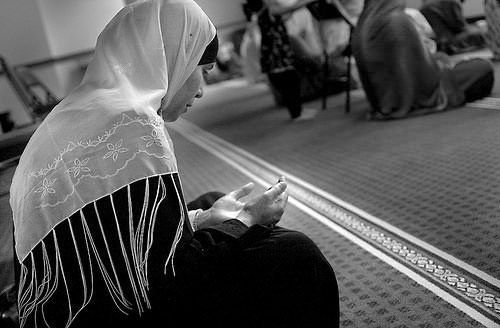 Allah is the maker, molder, and owner of our hearts. Often, sadness is a state we fall into, and we allow ourselves to remain there, sinking deeper until it seems impossible to climb out. We bury and wallow in our sadness. Our bodies then follow suit, lethargically, and getting out of the hole is much harder once we dig into it.
If we remain sure in our faith, the rocky moments in life won’t shake us. You won’t suddenly stop praying. You won’t stop reaching for your Qur’an. You’ll only keep going, keep asking, and keep hoping for an eternal akhira, over a life filled with issues. This happens with a strong heart, and a strong heart is a gift from Allah, if only you ask for it consistently.
So when the bad days happen, and when you can’t seem to get a break, and each test keeps coming: you just tell yourself, this is the life of this world; what would it be, if not filled with hardship? Jannah is coming ~ a better and everlasting life is coming.
Conclusion
Once we get into the habit of daily adkhar, it becomes so natural that even on rushed days, or relaxing days, we feel incomplete without them. We do not need the daily affirmations of the new wave of pseudo science. We already have these du’as in our sunnah, taught by the Messenger ﷺ, and directly given from Allah. Your Creator knows you best, and knows exactly what you need.
Related:
Keep supporting MuslimMatters for the sake of Allah
Alhamdulillah, we're at over 850 supporters. Help us get to 900 supporters this month. All it takes is a small gift from a reader like you to keep us going, for just $2 / month.
The Prophet (SAW) has taught us the best of deeds are those that done consistently, even if they are small. Click here to support MuslimMatters with a monthly donation of $2 per month. Set it and collect blessings from Allah (swt) for the khayr you're supporting without thinking about it.


School Counseling Grounded In The Qur’an And Sunnah: A Framework Of 10 Prophetic Traits

A Case For Critical Reading As Muslims: Reading ‘The Power of Your Subconscious Mind’ Through An Islamic Lens

Far Away [Part 31] – Following Your Lead

When A Place Teaches You What Softness Is Not

[Podcast] Wait, Muslims Have Been Here HOW Long?! | Hassam Munir

When The Shaykh Never Spoke – Deepfakes, Synthetic Scholars, And The Coming Crisis Of Religious Trust

The Stirring Of A Muslim Population In Japan: The Story Of Yusuke Fujitani

Is It Ever Too Early To Prepare For Ramadan? Reflections On Rifq, Forgiveness, And Healing The Heart

CAGE, Muslim Leadership, And Imran Khan: The Silence Test

Maryam: The Story Of The Muslim ‘Virgin’ Mary

The Best Actions for Eid al-Adha [Imam Dawud Walid]

Coming Full Circle: Who Are You Now? | Night 30 with the Qur’an

Running Away From Who We Are | Night 29 with the Qur’an

Building From the Ground Up: Week 4 Recap | Night 28 with the Qur’an

The Muslim You Are Becoming | Night 27 with the Qur’an
MuslimMatters NewsLetter in Your Inbox

Sign up below to get started
-

 #Life3 weeks ago
When The Shaykh Never Spoke – Deepfakes, Synthetic Scholars, And The Coming Crisis Of Religious Trust
-
#Life1 month ago
[Podcast] 50k Mahr, Hiding Money, & Who Pays for the Wedding? | AML Finance
-
#Current Affairs1 month ago
Long War Without End: A Quarter-Century Since The War On Terror
-
#Culture4 weeks ago
The Stirring Of A Muslim Population In Japan: The Story Of Yusuke Fujitani






Amer Rizvi
August 1, 2026 at 11:16 PM
This article really resonated with me!
جزاكم الله خيرا 🤲🏼
To really find joy through daily adhkār, I believe you have to invest wholeheartedly in learning classical Arabic.
For me, it meant resigning from my job and making my home in Damascus. My friends advised me to stay and learn Arabic in a university in Virginia 🥱
My parents, however, told me traveling to Syria was a great idea. Of course, I’m going to prefer their advice ❤️
Remember, you’ll never get to watch a heated debate between a Super Salafi and a Super Sufi in a Western college with everyone egging the debaters on with screams of “Jerry, Jerry…!” 🤣
And you’ll never get to watch a wrestling match between a Dagestani and an American brother in your Western dorm.
And, of course, you’ll never get to go through the entire al-Ājurrūmiyyah text, all in Arabic. I’ll never forget the matan:
الكلامُ هو لفظٌ مركبٌ مفيدٌ بالوضع
I am working on cycling through all the duʿās I have memorized during the sujūds of my Salahs, ان شاء الله. They actually help me ask for what’s important!
I also prefer to recite all my duʿās in Arabic using the same duas Prophet Muhammad صلى الله عليه و سلم taught us.
I find his صلى الله عليه و سلم duʿās perfect for addressing my every situation. I also find the Arabic words he صلى الله عليه و سلم used so much richer in meaning than their translations. These Arabic words open up my imagination.
For example, the Arabic word هوى is often translated as “desire” in English. That is so lame!
It doesn’t capture the feeling of a powerful pull, something that draws you in.
In Arabic, هاوية gives the image of a deep pit, a place of falling. So you have to be careful in life because it is so difficult to resist that pull.
Hawā also brings to mind a strong wind. I imagine myself on a sailboat with the sails open and the hawā pushing my boat forward. I have to set the sails just right so I can travel at a safe speed and not have the boat sink.
Funny the windy meaning makes me think of how our state Hawaii got its name 😎
It also makes me think of dopamine, which is produced by the brain. Dopamine was called the “Molecule of More,” that feeling of always seeking the next reward, like the pull of a slot machine waiting for the three fruits to line up. So you have to be careful once dopamine is released because you don’t want to get trapped in its circuit.
This rich Arabic meaning makes so much more sense when Allah says:
“Have you seen the one who has taken his hawā as his god?”
Here is a beautiful duʿā I use with the word هوى:
اللهم اجعل هواي طابعًا لما جاء به محمد صلى الله عليه وسلم
O Allah, make my hawa conform to what Muhammad صلى الله عليه وسلم brought.
Dopamine is not good or evil. You just need to make sure you are not hijacked by its circuit, and this dua helps with that.
I just don’t feel as imaginative and spiritually connected when I make duʿā in the two languages I am a native speaker of, English and Urdu.
And, of course, I love making these Arabic duʿās because they were taught by my own beloved forefather, Prophet Muhammad صلى الله عليه وسلم who taught us to say:
اللهم صلى على محمد و علي أزواجه وذريته كما صليت على ال إبراهيم انك حميد مجيد
Oh Allah, praise Muhammad, his wives and his descendants as you praised the family of Ibrahim. Indeed, only you are Ever-praise worthy and Ever- majestic.
(Authenticated by Shaykh Al-Albani, May Allah have mercy
on him).
What an honor! May Allah help me live up to it!
❤️❤️❤️اللهم صلى و سلم على حبيبي محمد
Adheen Ali
August 26, 2026 at 7:30 AM
This is a beautiful reminder that happiness in Islam is deeply connected to contentment, trust in Allah, and staying consistent with daily Adhkar. The point about making these Duas part of everyday routines is especially practical it makes remembrance feel natural rather than something we only turn to during difficult times.