
#Culture
The Muslim Soldier From Ellis Boulevard Who Never Came Home
Remembering a Muslim American soldier from Cedar Rapids, Iowa who fought Nazi Germany in World War II and never came home.

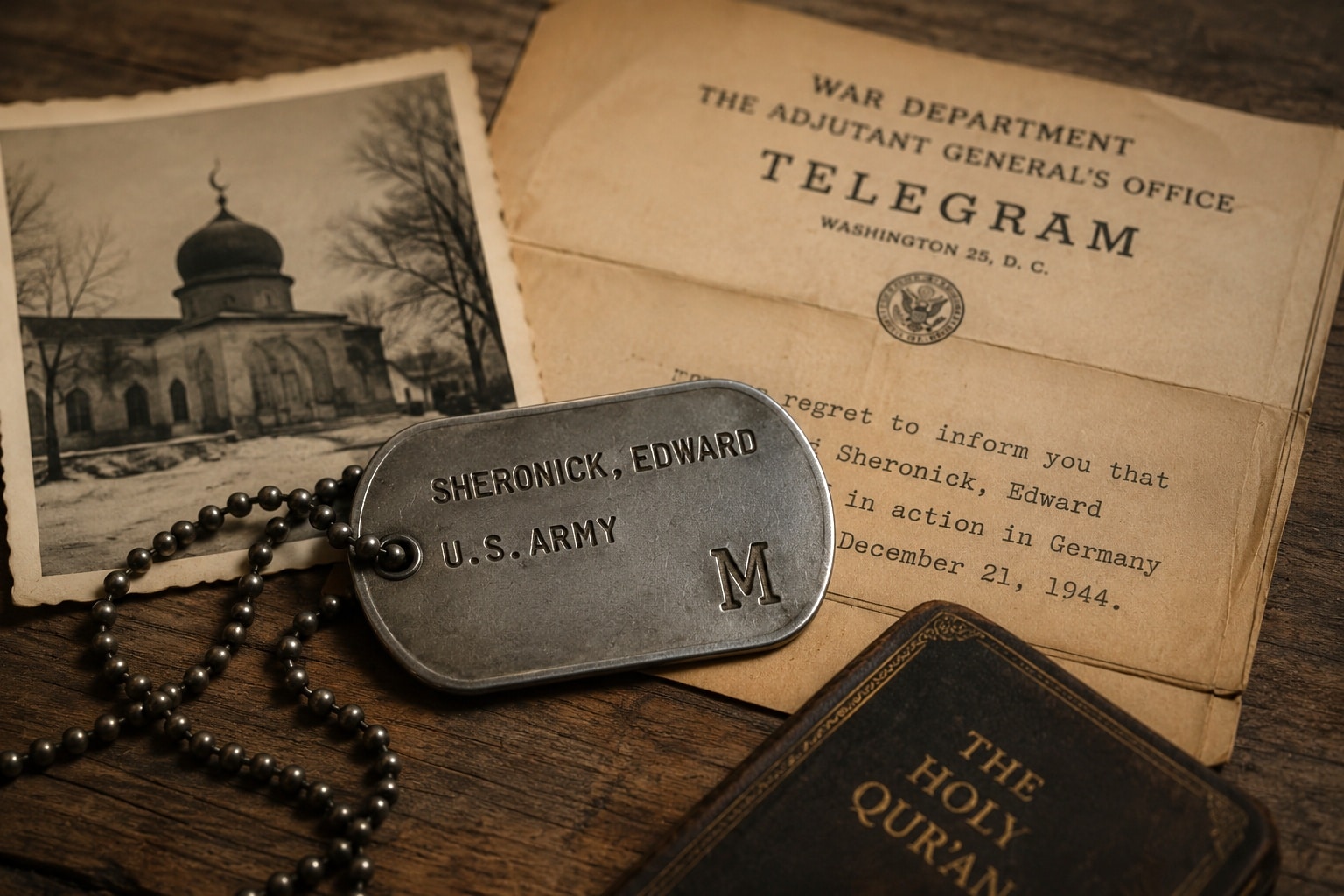
Remembering a Muslim American soldier who fought Nazi Germany in World War II and never came home.
An “M” for Muslim
At most army induction stations during World War II, soldiers could choose one of three religious identifications for their dog tags: Catholic, Protestant, or Jew. For Muslims entering military service, there was often no place for their faith at all.
One member of the small Muslim community in Cedar Rapids, Iowa, Hassein Sheronick, reportedly spent half a day persuading army officials to stamp a single letter on his identification tag: “M” for Muslim. Another veteran from the same congregation, Abdullah Igram, never succeeded. Years later, the *Des Moines Register* quoted him recalling what he told an officer who denied the request that: “in fighting for democracy it would seem a soldier should have the right to die identified with his own faith.”
Keep supporting MuslimMatters for the sake of Allah
Alhamdulillah, we're at over 850 supporters. Help us get to 900 supporters this month. All it takes is a small gift from a reader like you to keep us going, for just $2 / month.
The Prophet (SAW) has taught us the best of deeds are those that done consistently, even if they are small. Click here to support MuslimMatters with a monthly donation of $2 per month. Set it and collect blessings from Allah (swt) for the khayr you're supporting without thinking about it.
The men making those arguments were part of a small but well-established Muslim community in Cedar Rapids whose members often operated neighborhood grocery stores across the city. In 1950, the *Des Moines Register* described how the community gathered every Friday for prayer in what it called a “small building.” The mosque, founded by immigrants and their families, still stands today.
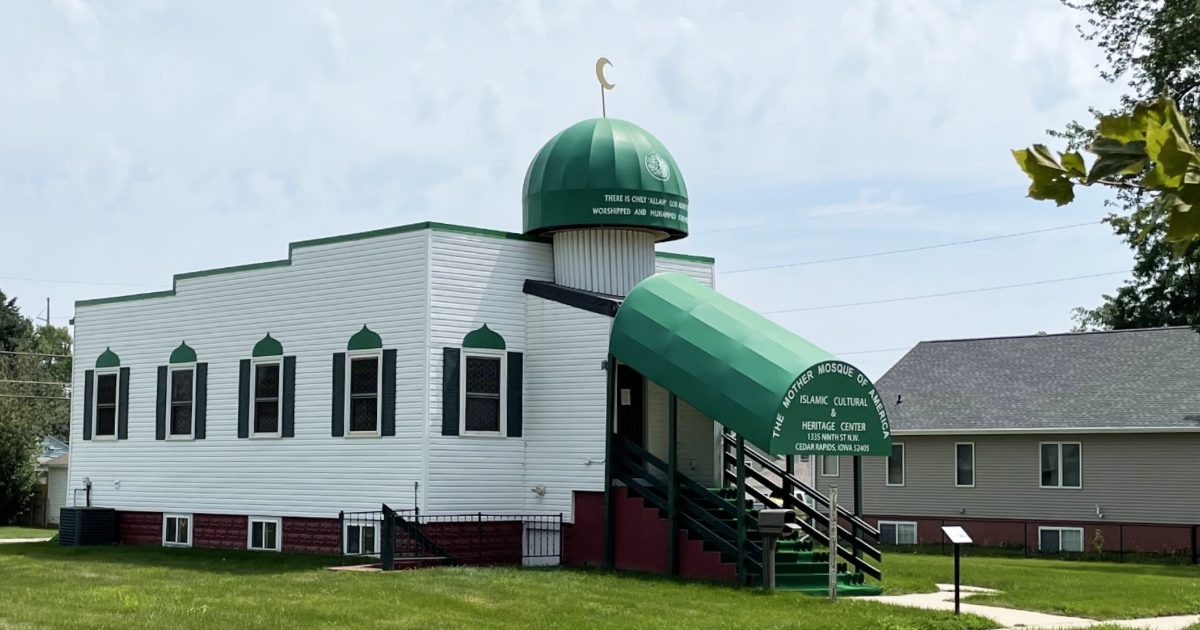
Mother Mosque of America, in Cedar Rapids, Iowa. The first purpose-built masjid in America.
Among those worshippers was Sgt. Edward Sheronick.
Edward Sheronick’s father, Sam Sheronick, immigrated from Joub Jannine, Lebanon, and came to the United States in 1907. While it is not known exactly when he moved to Cedar Rapids, the family is remembered as among the first Muslim families to live in the city, and they were certainly established by 1930. Sam and his wife Sada Sheronick lived at 325 E Avenue NW.
Their son Edward Sheronick was born in Fayette, Iowa, on July 23, 1917, and grew up in Cedar Rapids as part of that Muslim community. Like many members of the congregation, the family was involved in the grocery business. Edward worked at Sheronick and Sons grocery on Ellis Boulevard, a neighborhood store that served local residents in the years before the Second World War.
The surviving newspaper records preserve only fragments of his life, but they offer glimpses of an ordinary young man building a future for himself in Iowa. In August 1938, local papers reported that Edward had received a Class C beer permit connected to the family grocery business. At some point he met a woman named Mary, and the two married. One imagines that, like countless young couples of the era, they expected a long life together: children, grandchildren, years spent in the same community where both families were already rooted.
History intervened.
Edward enlisted in Cedar Rapids in July 1941, months before the attack on Pearl Harbor brought the United States formally into the war. He trained at Fort Eustis, Virginia, where he rose through the ranks. In May 1942, the *Cedar Rapids Gazette* reported that he had been promoted from technical corporal to technical sergeant. The paper noted that word of the promotion had been received by his parents back home in Cedar Rapids.
In the summer of 1944, Edward was sent overseas to Europe.
The Telegram from Germany
A few months later, in December 1944, a telegram arrived at 803 Ellis Boulevard NW. Mary Sheronick was informed by the War Department that her husband, Technician Fourth Grade Edward Sheronick, had been reported missing in action in Germany since Nov. 16.
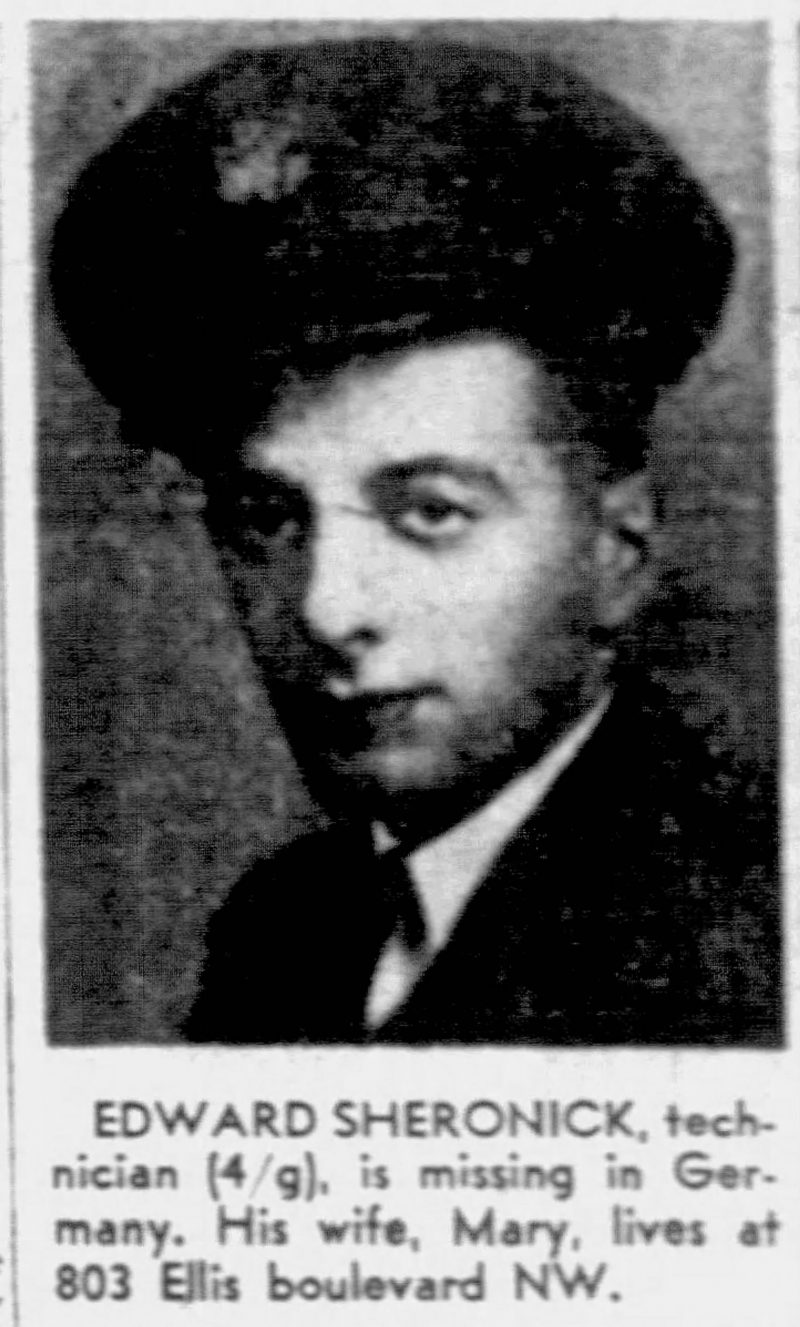
Across the United States, thousands of families received similar telegrams during the war years. Many names faded from public memory as decades passed. Edward Sheronick’s story survives today only in scattered newspaper reports, military notices, and the memories preserved by his community.
Eventually the truth became known. Edward Sheronick had been killed in Germany during the brutal fighting surrounding the Battle of the Bulge. He never returned home to Cedar Rapids.
Nearly five years later, in May 1949, his body was returned from Europe alongside the remains of 104 other Iowans killed during the war.
Funeral services for Technician Fourth Grade Edward Sheronick were held at the “Moslem temple” in Cedar Rapids. The service was conducted by Imam Hussein Karoub of Detroit, and burial followed at Cedar Memorial Cemetery.
His obituary listed the organizations to which he belonged: the Veterans of Foreign Wars, the Moslem temple, and the Rose of Fraternity lodge. It named the surviving members of his family. But like most wartime obituaries, it left many things unsaid. We do not know what Edward hoped to do after the war. We do not know what dreams he shared with Mary, or what his family endured during the years between the missing-in-action telegram and the return of his body.
Still, enough remains to remember him.
The surviving records show a Muslim family running a grocery store in Cedar Rapids before World War II. They show a local Muslim congregation sending 18 young men into military service during the war years. They show Muslim soldiers insisting that their faith be recognized even on their identification tags. And they show a funeral held in an Iowa mosque for a man killed fighting Nazi Germany.
On Memorial Day, we remember Edward Sheronick, a Muslim American from Cedar Rapids who prayed in Iowa, served overseas, fought Nazi Germany, and never came home. His story reminds us that Muslims have long been part of the American story, including its sacrifices in war.
Related:
When Azara Long Found Islam In A San Francisco Linen Shop : A Story From America’s Muslim History
Keep supporting MuslimMatters for the sake of Allah
Alhamdulillah, we're at over 850 supporters. Help us get to 900 supporters this month. All it takes is a small gift from a reader like you to keep us going, for just $2 / month.
The Prophet (SAW) has taught us the best of deeds are those that done consistently, even if they are small. Click here to support MuslimMatters with a monthly donation of $2 per month. Set it and collect blessings from Allah (swt) for the khayr you're supporting without thinking about it.




Long War without End: A Quarter-Century since the War on Terror

[Podcast] 50k Mahr, Hiding Money, & Who Pays for the Wedding? | AML Finance

What The Makkah Agreement Is Missing

Far Away [Part 26] – Shaytan Is A Liar

From a Syrian Prison to the UN: The Case of Bilal Abdul Kareem
Far Away [Part 26] – Shaytan Is A Liar
Far Away [Part 25] – To Save A Prince
Far Away [Part 24] – The Whipping

When The Bed Walked Away [Part 2] – Primordial Muck
When The Bed Walked Away [Part 1]

The Best Actions for Eid al-Adha [Imam Dawud Walid]

Coming Full Circle: Who Are You Now? | Night 30 with the Qur’an

Running Away From Who We Are | Night 29 with the Qur’an

Building From the Ground Up: Week 4 Recap | Night 28 with the Qur’an


