#Life
When Tawakkul Isn’t Enough: Why Financial Silence Hurts Marriages
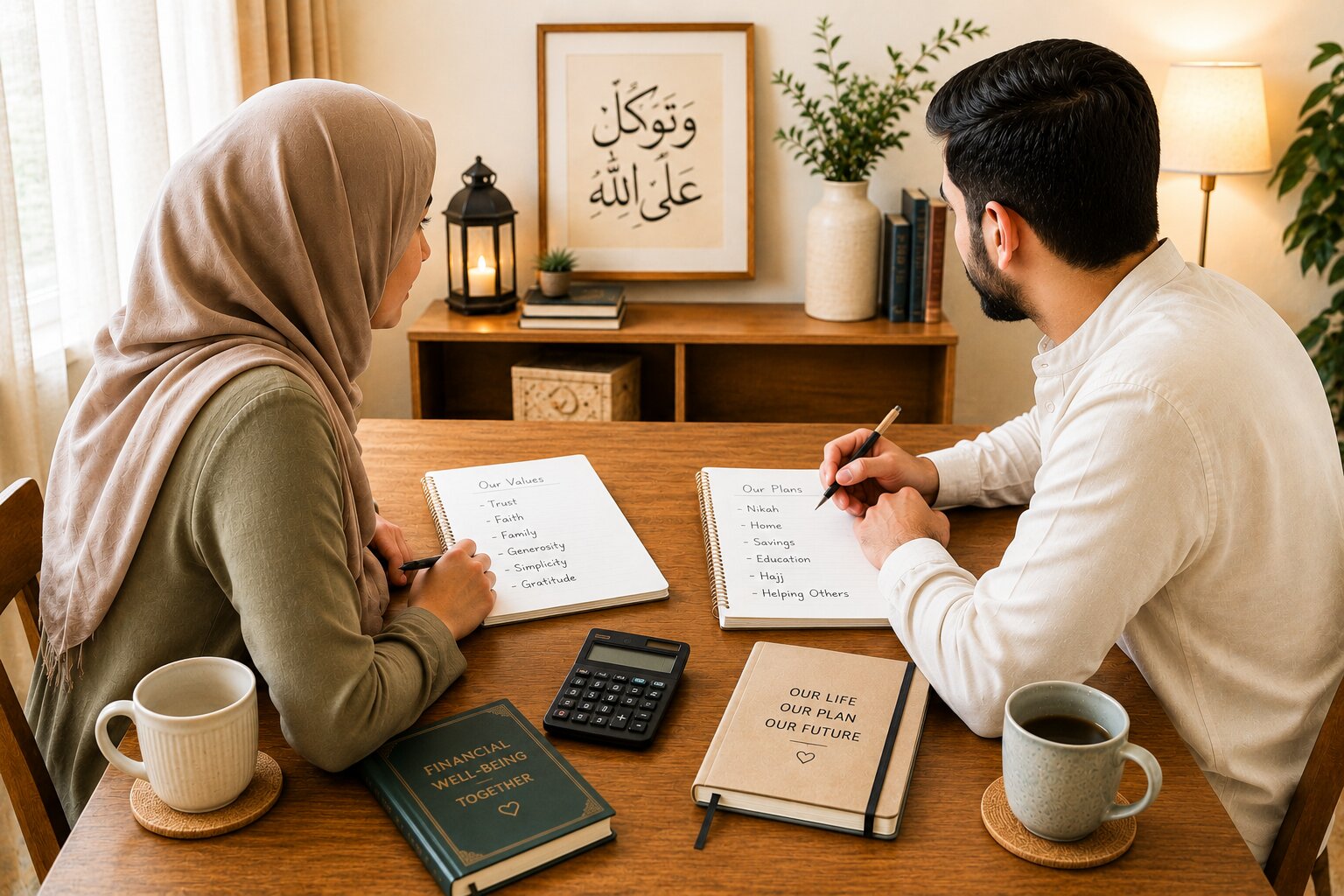
Strong marriages are built on more than tawakkul – they’re built on honest conversations about money.

Strong marriages are built on more than tawakkul – they’re built on honest conversations about money.
When Expectations Collide
Khadija, a 26 year old woman living in New York, has been searching for a marriage partner for a few years now and finally met someone she thought could marry. Her courtship with Khalid went really well for a month. She adored the fact that he was quite an ambitious man focused on serving the community with most of his free time.
Her own work as a teacher was a modest one, but she lived with her father so her own expenses were almost nothing, affording her a comfortable lifestyle. As they got closer to the marriage date, both of them began to realise that there were major differences in the way they were approaching life itself when they began to discuss the wedding ceremony.
Keep supporting MuslimMatters for the sake of Allah
Alhamdulillah, we're at over 850 supporters. Help us get to 900 supporters this month. All it takes is a small gift from a reader like you to keep us going, for just $2 / month.
The Prophet (SAW) has taught us the best of deeds are those that done consistently, even if they are small. Click here to support MuslimMatters with a monthly donation of $2 per month. Set it and collect blessings from Allah (swt) for the khayr you're supporting without thinking about it.
She wanted to have the Nikah at the mosque, with a grand reception in a rented garden afterward.
He, on the other hand, wanted something more modest, with a reception at his house with a total of 45 guests, as he preferred to spend the money on a down payment for a new house, which was not something he had consulted her about.
Neither person was acting in bad faith. The relationship ended because they had never taken the time to understand each other’s expectations. The disagreements were short but impactful and the two of them decided sorrowfully to end the courtship and what could potentially have been a wonderful marriage for the two of them.
The above is one among the many different stories that make up the Muslim marriage crisis that is swiftly proliferating the Ummah (especially in the West). Many Muslim leaders, counselors, and researchers have expressed concern that divorce has become increasingly common among American Muslims (although comprehensive national data remain limited).
The reasons for this are many and cannot be limited to one issue alone. But what we do know is that money is among the biggest factors that lead to relationship/courtship breakdown.
Financial Incompatibilities and the Marriage Crisis
 While statistics on this issue are difficult to come by, estimates suggest that financial problems contribute to roughly 20–40% of divorces in the United States, making money one of the leading sources of marital conflict. Estimates for the UK hover around the 30% mark.
To be clear, this is not due to the main earner of the house earning insufficiently (though that certainly contributes). Rather, it stems from a lack of communication around money in a relationship context that many of us are guilty of doing.
This is both an individual and a societal issue that we face. Many Muslim-majority cultures (South Asian, Arab etc.) are not fully comfortable with speaking about money (barring certain exceptions). This leads to people often avoiding this conversation (consciously or not) within their own marital contexts too. The justification at times that is given (especially by the God-conscious) is that marriage comes with its own Rizq and that we should have tawakkul regarding money matters.
However, while Tawakkul is an important attitude to have, it is not enough if it’s not supplemented by other steps. Tawakkul in Islam has never meant abandoning planning or difficult conversations. The Prophet ﷺ tied trust in Allah to taking the appropriate steps toward success. And no, this does not mean just working harder/smarter (which is also important).
Communicating Expectations
The most significant issue here is communication between the spouses. Aspiring couples should discuss finances at various stages of their courtship. They should begin with broader discussions about principles and values. As they move toward marriage, they should discuss their specific circumstances, expectations, and plans for the nikah and their first year together. Even after marriage, they should continue reviewing their financial situation and expectations regularly.
The details of this are something we discuss in a pre-Nikah guide that we at AML Finance developed.
These discussions are paramount to setting up a healthy marriage because of a key principle that many of us are often not taught: strong and collaborative marriages are built to last when couples can have hard conversations with each other.
Let’s say that again: marriages become strong when couples are not afraid to have honest and frank conversations about difficult subjects.
Struggling With Guilt and Shame
Conversations about money often trigger and bring out emotions such as guilt, shame and fear. Men especially struggle with not feeling adequate and having it all together (due to our expected role as providers) and are often coasting through marriages with their wives not understanding the financial health of their household.
 The illusion of comfort and safety only breaks when circumstances change (sudden financial expenses like a new car, medical expenses etc.). This inevitably brings about much negativity and causes the couple to fight and lose trust in the other.
Our own parents are not always able to teach us how to have these conversations. Many of our parents entered marriage under very different economic and social circumstances. As a result, they may not have had to navigate some of the financial realities younger Muslim couples face today.
Issues like the rise of women working, higher levels of integration among younger generations in the West, a cost of living crisis and smaller families, among many others, are new and not something they know how to deal with easily, despite these having an impact on our financial stories.
Our Work and Introducing the Series
At AML Finance, we help people understand their financial backgrounds and navigate financial conversations during the courtship period. Through workshops and training—primarily in the UK—we work with couples from a variety of backgrounds. While our focus is on serving the Muslim community, we believe these principles can benefit families more broadly.
This article is the first in a series exploring the intersection of money and marriage. Future articles will address topics such as personal financial stories, the expectations men and women bring into marriage, modern realities like dual-income households and government-registered versus nikah marriages, and the often-overlooked issue of financial abuse.
Our hope is to encourage healthier conversations around money, helping couples protect their marriages from the whispers of Shaytaan and build stronger relationships rooted in trust, communication, and mutual understanding.
Related:
Meaningful Money: How Financial Literacy Amplifies Your Giving
Keep supporting MuslimMatters for the sake of Allah
Alhamdulillah, we're at over 850 supporters. Help us get to 900 supporters this month. All it takes is a small gift from a reader like you to keep us going, for just $2 / month.
The Prophet (SAW) has taught us the best of deeds are those that done consistently, even if they are small. Click here to support MuslimMatters with a monthly donation of $2 per month. Set it and collect blessings from Allah (swt) for the khayr you're supporting without thinking about it.


[Film Review] Your Mother, Your Mother, Your Mother: A Complex Story Of Faith And Fatherhood

Far Away [Part 32] – Meilin’s Tale

[Podcast] A Light of Her Own: Muslim Womanhood, Seasons of Life, & Female Scholarship

School Counseling Grounded In The Qur’an And Sunnah: A Framework Of 10 Prophetic Traits

A Case For Critical Reading As Muslims: Reading ‘The Power of Your Subconscious Mind’ Through An Islamic Lens

When The Shaykh Never Spoke – Deepfakes, Synthetic Scholars, And The Coming Crisis Of Religious Trust

CAGE, Muslim Leadership, And Imran Khan: The Silence Test

Is It Ever Too Early To Prepare For Ramadan? Reflections On Rifq, Forgiveness, And Healing The Heart
Far Away [Part 32] – Meilin’s Tale

Maryam: The Story Of The Muslim ‘Virgin’ Mary

The Best Actions for Eid al-Adha [Imam Dawud Walid]

Coming Full Circle: Who Are You Now? | Night 30 with the Qur’an

Running Away From Who We Are | Night 29 with the Qur’an

Building From the Ground Up: Week 4 Recap | Night 28 with the Qur’an

The Muslim You Are Becoming | Night 27 with the Qur’an
-

 #Life3 weeks ago
When The Shaykh Never Spoke – Deepfakes, Synthetic Scholars, And The Coming Crisis Of Religious Trust
-
#Culture1 month ago
The Stirring Of A Muslim Population In Japan: The Story Of Yusuke Fujitani
-
#Culture1 month ago
[Podcast] Faith, Motherhood, and the Call to Gaza | Dr. Samaiya Mushtaq
-
#Current Affairs4 weeks ago
CAGE, Muslim Leadership, And Imran Khan: The Silence Test