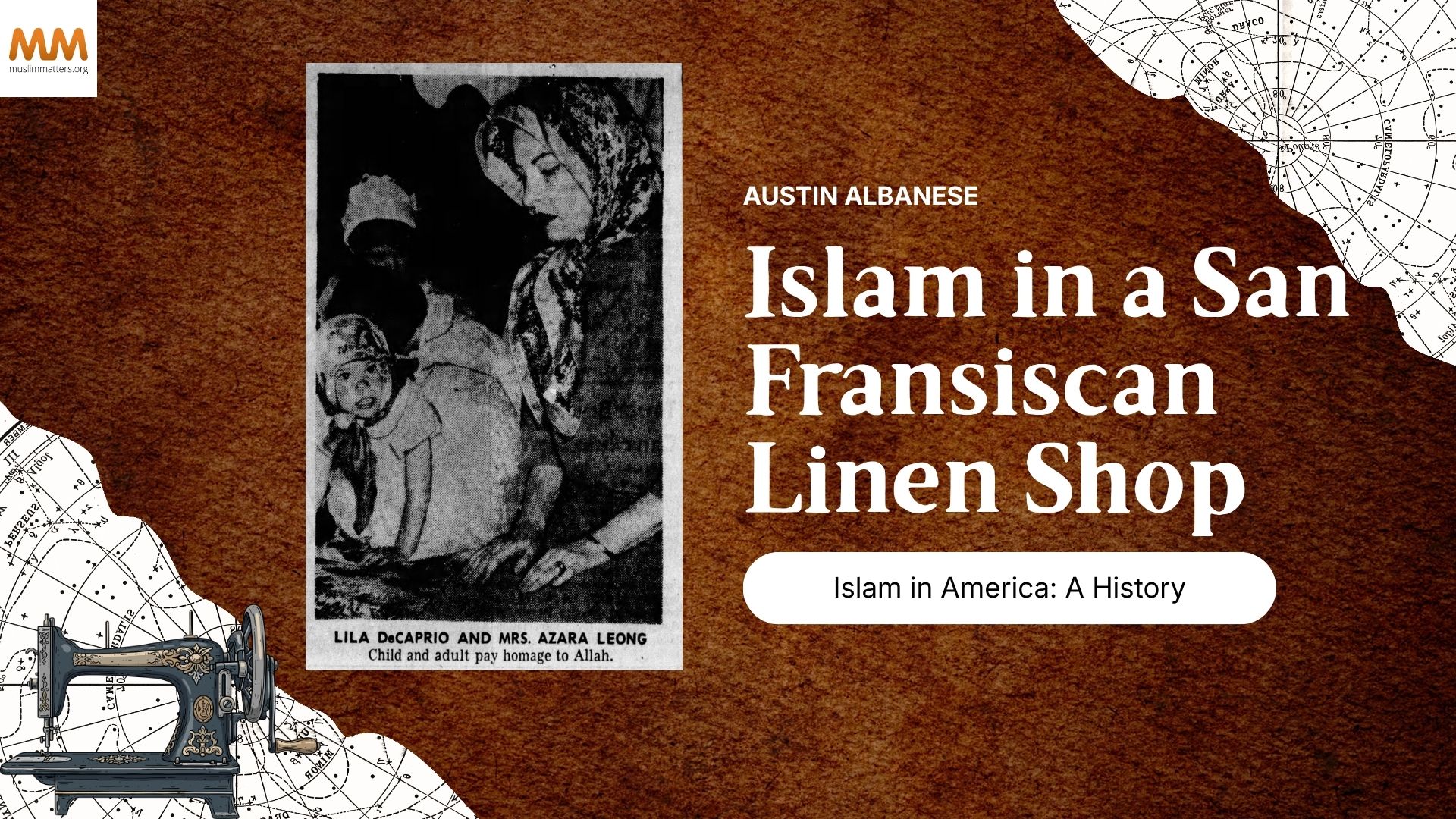
As a child, Azara Long often visited a linen shop on Sutter and Powell in San Francisco run by a Lebanese couple. Years later, she told a local newspaper that it was there, in that shop, that her path toward Islam began. “I got very interested in their religion,” she recalled. “It was in their shop that I actually became a Moslem.” Some religious lives begin through repeated human contact, where curiosity is given room to grow.
Long’s story appeared in the San Francisco News in 1958, at a moment when Muslim life in Northern California was still small enough to be overlooked and yet already rooted enough to sustain institutions, ritual life, and families. Her father had come from Yugoslavia, her mother from Italy. At 15, she said, she declared in the presence of Muslims that she had decided to become one. The paper described her as one of the first native San Franciscans to do so. Whether or not that claim can now be verified in full, the article had noticed something real: Islam was not only arriving through immigrants, but also drawing in Americans born around it.
The same newspaper account preserves a different scene. Bay Area Muslims had gathered to mark the feast associated with the pilgrimage to Mecca. The men prayed in the front room, facing the Kaaba. Behind them, about 50 women knelt on the wooden floor, their heads covered. Among them was Long, praying in what the paper called a “becoming blue sack dress” with a silk scarf tied under her chin. Nearby was a small American-born girl, Lila DeCaprio, watching the women closely and beginning to imitate them.
Keep supporting MuslimMatters for the sake of Allah
Alhamdulillah, we're at over 850 supporters. Help us get to 900 supporters this month. All it takes is a small gift from a reader like you to keep us going, for just $2 / month.
The Prophet (SAW) has taught us the best of deeds are those that done consistently, even if they are small.
Click here to support MuslimMatters with a monthly donation of $2 per month. Set it and collect blessings from Allah (swt) for the khayr you're supporting without thinking about it.
It is a striking image: Long, a convert who had first encountered Islam through the witness of others, now praying beside a child growing up within Muslim life in America. Lila’s father, Dr. Joseph DeCaprio, had converted to Islam six years before in Japan and married Lila’s mother, Menira, a native of Siberia. When the imam gave the sign, Long touched the floor with her head and recited with the others, “There is but one God and Mohammed is his prophet.” Little Lila then followed her example, saying the few Arabic words she knew: Bismillah ir-Rahman ir-Rahim, in the name of God, most gracious, most merciful. In that room in San Francisco, Islam was not only being embraced. It was being handed on.
What survives of early American Muslim history is often fragmentary: a newspaper feature here, a photograph there, a few quoted lines that carry more than the reporter may have realized. But sometimes a fragment is enough to reveal an entire moral world. In Azara Long’s case, the world that emerges is one of immigrant hospitality, serious conversion, women at prayer, children learning by imitation, and an Islamic Center in San Francisco already anchoring a community.
Long herself understood Islam as more than a private conviction. In 1959, the San Francisco News reported that she had for some time dreamed of going to the Middle East, living for a while in an all-Muslim community, and sending her two teenage children to an Islamic school for a year or so. Soon, the paper said, that dream would come true. She was preparing to leave for New York, board an Egyptian liner, and spend time in Cairo. The article quoted the president of the Islamic Center of San Francisco, Mohamedali Mirdad, announcing her departure with a striking phrase: “San Francisco’s loss is Cairo’s gain.”
That line is memorable not only for its warmth but for what it reveals. This was a community with enough coherence to feel the temporary loss of one of its own. Long was not described as a passing curiosity. She was a charter member of the Islamic Center and had served as its secretary for 2 years. The girl who had first encountered Islam in a Lebanese-owned linen shop at 15 had grown into a woman helping build Muslim institutional life in California. Her story belonged not only to conversion, but to commitment.
The same article placed her beside Mirdad, whose own life opened another window into this early Muslim world. Whereas Long was presented as one of the first native San Franciscans to become Muslim, Mirdad was described as one of the few Muslims born in Mecca during the annual Hajj pilgrimage. He had spent years in San Francisco conducting an import-export business while dreaming of seeing family again in Egypt, Saudi Arabia, and India. Even in the compressed language of a newspaper feature, one can glimpse the range of this community: a San Francisco-born convert of Yugoslav and Italian parentage, a child raised in Muslim practice in California, a physician who had embraced Islam when he married in Japan, and an immigrant leader whose life linked the Bay Area to Mecca, Cairo, and the wider Indian Ocean world.
The beginnings of this story are ordinary. Long did not describe herself as having been won over by spectacle or by some public campaign. She became interested in Islam because, as a child, she spent time in the shop of a Lebanese couple and came to know something of their religion there. That detail matters.
These fragments from San Francisco suggest a quieter truth: sometimes Islam is encountered through steadiness, familiarity, and the kind of character that makes a young person want to ask deeper questions.
There is something especially moving in the way the two surviving articles place Long in relation to others. In one, she is a convert remembering where her journey began. In the other, she is a woman at prayer beside little Lila, modeling a gesture of devotion that the child then imitates. The papers do not tell us everything that followed. They do not tell us whether Long remained abroad for as long as she hoped, or what became of her later life. But they preserve enough to show a chain of transmission: hospitality received, faith embraced, community served, example given.
To remember stories like this is not only to correct the historical record. It is also to recover something about how Muslim life in America has often grown: not always through grand institutions or dramatic public attention, but through storefronts, friendships, family prayer, women teaching by example, and communities patient enough to welcome those who were still learning. In Azara Long’s story, the path into Islam begins with curiosity, deepens into conviction, and matures into service.
Azara Long’s life reaches us only in fragments. Even so, those fragments are enough. They let us see an early Muslim San Francisco in miniature: immigrant and native-born, local and transnational, devout and ordinary. They show Islam not as interruption, but as presence.
And they remind us that long before many Americans thought to ask whether Islam belonged here, Muslims were already here — praying, teaching, welcoming, and helping others imagine a life within the faith.
Related:
– A Convert’s Story
– Podcast: How NOT to Talk to New Muslims | Shaykh Abdullah Oduro