
#Current Affairs
Muslims and the F-Word: Feminism, Dhulm, and Jahiliyyah

Introduction
“Why are Muslim women becoming feminists?” is the (not so) new “why are Muslim youth becoming radicalized?” sentiment… not amongst non-Muslims fearing the paths of angry young Muslims questioning Western socio-political hegemony, but amongst Muslims who are convinced that Muslim women are plunging our community into destruction by questioning the norms of our cultures and even of our faith. What does it really mean for Muslims to buy into the framework of feminism?
In order to answer the question of why Muslim women have been turning to feminism, we must be willing to have a long and very uncomfortable set of conversations among ourselves. There is no single or simple answer, there is a great deal of community accountability and reckoning required, and there is no neat, tidy way to solve the myriad of problems that we will see evinced throughout this discussion. If anyone truly cares about the wellbeing of Muslim women – and Muslim men, for that matter – we must be willing to overcome the set of (faulty) defenses that we have constructed against all perceived attacks on our community, which has a tendency of conflating the Deen itself with the practices of the people, even when the latter is in wild contradiction of the former.
However, it’s not just about why Muslim women are turning to feminism. Many will ask why such a question is relevant in the first place. Why does it matter that Muslim women are ascribing themselves to feminism? After all, isn’t Islam a feminist religion? Doesn’t Islam uphold women’s rights? Why wouldn’t Muslim women be focused on women’s rights?
Keep supporting MuslimMatters for the sake of Allah
Alhamdulillah, we're at over 850 supporters. Help us get to 900 supporters this month. All it takes is a small gift from a reader like you to keep us going, for just $2 / month.
The Prophet (SAW) has taught us the best of deeds are those that done consistently, even if they are small. Click here to support MuslimMatters with a monthly donation of $2 per month. Set it and collect blessings from Allah (swt) for the khayr you're supporting without thinking about it.
These complex questions, and equally complex answers, will be discussed in this paper, but be warned: this is not some pithy piece that will “put feminists in their place” or “smash the patriarchy once and for all.” This is more than just your average Muslim refutation piece. This series is meant to be a glimpse into our history, our ongoing realities, and painful truths that we must finally face before we can seek effective solutions and implement solutions that will mitigate the damage inflicted on our Ummah for centuries.
The (Still) Salafi (Formerly) Feminist Tells All
Who am I to speak on this topic at all to begin with? Once upon a time, I was known as The Salafi Feminist, a (rhetorically) fire-breathing menace on the Internet. What many don’t know is that I didn’t start off that way – the Salafi Feminist emerged as a consequence of a very real, very painful journey. My fury came from a place of experiencing dhulm not in isolation, but as part of a societal framework framed as “Islamic” beliefs and expectations. Nor was I alone. When I shared my experiences, droves of women from around the world shared similar stories, and often even much worse. What we all shared in common was that those whom we trusted, those held up as leaders, those who claimed to represent the Islamic ideal, all failed us… and often outright refused to acknowledge what we had endured.
My journey began when I was first reeling from the immense personal distress of being in a toxic marriage characterized as “Islamic,” and then confronted by a communal refusal amongst Muslims to even acknowledge all the ways that our faith is weaponized against women. The more I tried to point to the Deen as a solution to the very real problems that we have as a community, the more Muslims were hostile to even recognizing those problems, and resorted to labelling me (and other Muslim women trying to do the same) as “feminists.”
Ironically, this pushed me directly towards engaging with feminist discourse, which was problematic in many ways. In hindsight, there were many perspectives and ideas that I shared that I now regret; indeed, I apologize for any misguidance that may have occurred as a result. Despite having some familiarity with the Islamic sciences, I was not well grounded enough to be able to identify some of feminist philosophy’s fundamental flaws and the ways it would impact my way of thinking. Often without realizing it, I found myself absorbing ideas that were not in keeping with our faith; even as I was cognizant of certain fundamental principles of Islam, I found myself subconsciously absorbing attitudes and perspectives that did not align with those principles. It has taken years of personal error, spiritual growth, and increased learning to step away from the vortex and understand more deeply how wrong things can go when one is attached to the wrong framework.
My experience as a conservative Muslim woman who gravitated toward feminism in response to oppression in the name of “traditional Islam” has reinforced the urgent need for the Ummah to seriously engage with the recurring harms Muslim women identify in our thought and practice. Had Muslim leadership and communities meaningfully addressed the dhulm perpetuated in our spaces, many women (including myself) would never have been spurred towards other methods of dealing with our community’s problems.
After years of reflection, research, lived experience, and spiritual growth, I am more convinced than ever that the ultimate solutions to the Ummah’s internal and external struggles—personal and spiritual alike—lie within Islam itself. External ideologies can never offer the holistic answers we require. However, I also believe – just as emphatically – that unless the Ummah engages Muslim women’s concerns with seriousness, nuance, and accountability for our collective failures, we will continue to see Muslim women turning to the philosophies of feminism in search of justice and dignity. My work as a believing woman pursuing justice and dismantling the many layers of poison in our Ummah has only just begun. My rage has certainly not subsided; it has only been refined.
What Is Feminism?
There is no single definition of feminism. And there’s the rub – to engage with the discussion of feminism in the first place, one must be willing to acknowledge and engage with the messiness of it all. You cannot simply claim that something is “feminism,” come up with a clever comeback, and then declare victory over “feminism.” Whether in academia, social media, or the real world, there are multiple “feminisms” that are being discussed, developed, and deconstructed. There are the many waves of Western feminism; Black feminism; POC feminism; “womanism”1 Alice Walker, “In Search of Our Mothers’ Gardens: Womanist Prose” (1983), Christian and Jewish feminism; socialist/ Marxist feminism; “Muslim feminism” (which itself has multiple layers to it) and even “Islamist feminism (or womanism)” (Badran, 2009, pg. 242-245; Hidayatullah, 2014, pg 37-45).
Dictionaries will give you varying definitions (“the belief that women should be allowed the same rights, power, and opportunities as men and be treated in the same way” from the Cambridge Dictionary; “belief in and advocacy of the political, economic, and social equality of the sexes” from Merriam-Webster – emphasis mine). Loosely and colloquially, many understand feminism as believing in the complete equality of men and women and seeking to replicate that equality at all levels of life and society. Even this is not entirely accurate, as many fiercely discuss and debate the importance of differentiating between “total equality” vs “equity.”
With all this in mind, references to “feminism” in this paper will refer to secular value based movements, not just any conversations around women’s rights. Where relevant, I will specify between different types of feminist movements.
It is important to note that secular feminism has its own unique history in the West, rooted in centuries of ingrained Church-perpetuated beliefs around the inherent inferiority of women, from blaming Eve for Adam’s fall from heaven to witch-hunts and more. I will not fall into the trite habit of boasting about how Islam gave women rights 1400+ years before women in the West received the right to vote. While it is an accurate statement, it does not reflect the realities of Muslim women’s experiences in Muslim societies throughout those 1400+ years. Others have elaborated on the rights Islam gave women elsewhere, and in more scholarly detail I ever could. Our concern, however, is with modern realities, not long-ago eras of Islam’s greatest ideals realized and then lost.
The label of “feminism” has a fraught history in non-Western countries, specifically the Muslim world, where it was used as a tool of colonization even as the suffrage movement was being clamped down in Western countries (Ahmed, 1992, pg. 152-153). Whether under Lord Cromer in Egypt in the late 1880s, or the French in Algeria in the same time period (Rahnama, 2023, pg. 120-153), ‘feminism’ was little more than an imperial tool weaponized for colonial purposes against Muslim populations. Nor was this a historic phenomenon; feminism continues to be used to justify violent Western imperialism against Muslim lands (Ezaydi, 2026, pg 173-197), from the original “War on Terror” invasions of Afghanistan and Iraq to the ongoing genocide in Palestine and, currently, the destruction of Iran.
However, this is not to dismiss any and all efforts in the name of women’s rights as a solely colonial enterprise. Even as the West introduced the very category of women’s rights to political and social discourse, there were those who objected to colonization while recognizing that women were, indeed, experiencing significant oppression in our own societies (Mubarak, 2022, pg. 57-61). Women’s rights movements in Muslim countries, often referred to as “feminism,” had their own unique discussions, priorities, and activisms that did not always equate to Western secular feminist agendas (Badran, 2009, pg 1-6; Badran, 1995, pg 223-250). At times, women’s rights movements started in the same place before diverging, as with the formidable Islamist revival figure, Zaynab al-Ghazali, who split from Huda Sha’rawi’s feminist group in 1936 (Badran, 2009, pg. 24-27). Many Islamic activists, including Zaynab al-Ghazali, sought to reject both colonization and the oppression of women, all under an Islamic framework.
Unfortunately, many of us – especially in the West – are disconnected from our Islamic heritage, both ancient and contemporary. In women like Zaynab al-Ghazali and Shaykha Dr. Heba Raouf Ezzat we have examples of how to address the complex issues of anti-Islamic agendas alongside engaging in serious critique of unIslamic attitudes and practices found in Muslim societies (McLarney, 2015, pg. 219-253). Yet – for whatever reasons – their works have neither been widely translated nor made part of the dominant discourse, whether academic or Islamic. Indeed, it is deeply concerning that many who spend hundreds of thousands of hours pontificating on the topic of Islam and women in lectures, webinars, and courses somehow omit their work entirely. As a result, Muslims in the West today conflate any kind of “women’s rights” discussions with feminism even when it is not grounded in secular discourse. Traditionally trained, orthodox shaykhaat (female Islamic scholars) are constantly accused of feminism when they advocate for women’s Shari’ah rights or challenge unIslamic attitudes and behaviours towards women that is claimed to be “Islamic”; even male scholars who advocate for women are accused of being corrupted by feminism, called “white knights,” and attacked for challenging the status quo.
We must be intelligent enough to recognize that, given our geopolitical, social, and linguistic contexts, it is impossible for us to avoid engaging with certain discourses or using certain types of terminology (e.g. patriarchy; misogyny; androcentrism) when we discuss gendered matters. These words are a part of the English language, with clear definitions, even if colloquial usage influences the emotional impact of these words; just as we use terms like “racism,” “ethnocentrism,” and more when we discuss racism as a general concept as well as within Muslim communities. To claim that these words have no basis in our Islamic tradition is to render us mute on more than race and gender issues; it is an idiotic claim that would invalidate half our Islamic intellectual tradition, which contended with far more serious issues of philosophy and creed. Unless we all revert to speaking the fus’ha Arabic of the Messenger’s era and refuse to acknowledge our existence in the modern timeline, we must get over these emotional arguments and deal with the realities we live in – including speaking English and living in Western contexts.
However, this does not mean that we should not develop our own frameworks and vocabularies – we absolutely should, and at least some figures dedicated to meaningful work in the field have undertaken these efforts (McLarney, 2015). This also does not mean that we should not be extremely cautious in terms of the language we used, being aware of the way in which certain terminology is weaponized, and the foundational assumptions underlying that language. Engaging in these discussions to begin with must come with careful analyses of the terminology used, the philosophies behind them, and our theological positionality as Muslims who must contend with these epistemologies. As Talal Asad (2018) notes, the language of secularism (and thus, feminism) is not neutral; it is embedded in power, history, and practice. We cannot be blind to this reality and the ways in which it impacts us at every level.
Colloquial use of terminology that originated in academia usually moves beyond their dictionary definitions and becomes heavily laden with cultural meanings that remove nuance, conflate cause-and-effect, and adopt problematic assumptions that are not properly interrogated. We see much of this especially in online discourse, which takes phrases such as “toxic masculinity” (originally meant to critique some societal beliefs around how men are perceived as masculine) and turns them into caricature accusations against all traits associated with men. This must be kept in mind when having conversations around Islam and feminism, as it is necessary for us to consider the contexts in which we are speaking, and to whom; the average online Muslim won’t be able to parse the difference between academic verbiage and casual usage when the words used are the same. The way one person uses the word “patriarchy” as a neutral descriptor vs another who uses it as a sweeping condemnation make a massive difference in how thoughts and ideas are communicated and internalized. Preachers, activists, academics, and influencers spend far too much time talking past each other than engaging with other meaningfully precisely because of this mismatch of understanding and usage of vocabulary.
We must also be intelligent enough to distinguish between those actively calling to the secular values and definitions of feminism, those who just want to improve women’s rights but only know how to do so using popular feminist vocabulary, and those who are actively engaged with Islamic tradition to uphold Islamic values around women’s rights. If we are not willing to do this much, then we prove ourselves to be insincere in dealing with the very serious issues that plague our Ummah today.
As we proceed, we must keep the following in mind: when injustice becomes a norm, resistance is inevitable. In a Western context, this means that feminism itself was inevitable, as a response to the oppression that besieged women at every level. From being viewed as property to finally being able to own property, from the right to access equal education to protections against discrimination, and more, one must acknowledge that the suffragist movement in Western countries resulted in real, tangible, positive results that benefit women – Muslim as well as non-Muslim – today. How far feminism has gone beyond resisting oppression and pursuing justice to go to another extreme is something else to be considered.
In Muslim contexts, we must realize that engaging with the lived realities and the discourse of feminism, shared via media and technology, was and is also inevitable. What is not inevitable is a future wherein all Muslims seeking solutions to gendered injustice turn to secular feminism – but only if we as a community are committed to putting in the work to oppose this injustice from within our own traditions.
What’s So Bad About Feminism?
This is the part where many people expect either long, convoluted discussions about Marxist and neoliberal constructions of societal hierarchy and power structures… or reductive memes about “feminists are happy to make coffee for their bosses but not their husbands!” I am here to do neither.
So what is so bad about feminism? Put simply: it is a framework that does not begin with the belief in a Creator who is the All-Knowing, the All-Wise, the Most Just Lawmaker. Feminism in its many mutations, and especially its most widespread and contemporary iterations, is mired in a worldview devoid of knowledge and belief in Allah and His Guidance. Discussions around morality and sexuality, gender and hierarchy, are permuted through a lens structured solely upon human-made ideas of good and evil. Feminism, along with every other philosophy that exists, is the result of humans trying to make meaning of the world without a foundation of Divine Guidance. It is especially important to note that in the Western context, secularism (and thus feminism) is inextricably tied to the history and consequences of the Enlightenment – a movement emerging from volatile Christian violence and that eventually resulted in cutting off the concept of “God” from public life, and consequently from private morality. Thus, a deliberate choice has been made to eradicate the role of God from the most fundamental aspects of human life, with unsurprising ramifications.
It is not surprising that so many women who have experienced or witnessed injustice and oppression at the hands of men think that men are inherently the problem, or that any social structure wherein men have authority is inherently harmful to women. After all, this is what their experience has taught them. From a secular perspective, religion has only ever been weaponized against women, to women’s profound detriment. Male-led societies have rarely resulted in the uplifting of women, but in their suppression and humiliation. This is the soil from which emerges a feminist hermeneutics of suspicion: a perspective that is predicated upon the assumption that all or most religious and cultural structures are created by and for male interests.2This concept will be further examined in part 2 of this series, specifically in the context of feminist academic works in relation to Islamic scholarship. One could argue that for those without Islam, this is a logical conclusion to come to. For those without Islam, there is no God who determines good and evil or promises judgment; no Divinely ordained set of ethics by which to live, to judge, to hold oneself or others accountable; no spiritual framework which women can turn to with confidence that their very existence is respected, honoured, and valued. In a secular worldview, there is no faith in a Hereafter wherein justice will be meted out. Justice itself is a concept entirely at the whims of the dominant powers that be, malleable and ever-changing with the latest political, social, or intellectual trend.
Islam, however, gives us a different foundation upon which to build our faith and our worldview. As Muslims, we believe completely in the Qur’an as the first source of Divine Guidance and Legislation; we believe in the role of the Sunnah as the second primary source of spiritual direction and practical rulings. We also have an understanding of the rich, varied corpus of traditional Islamic scholarship – a tradition that doesn’t exist as a fossilized entity to be followed blindly, but which continues to develop to this day. We also have a healthy recognition that our scholarship is not infallible; at the same time, through our Islamic tradition, we understand that rulings and structures have deeper meaning and wisdom. Legal authority or hierarchy does not automatically equate ontological superiority. Every question that is associated with feminism, from questioning female worth to discussions around sexual behaviour, from gender roles to finances, is ultimately answered within the framework of believing that Allah revealed a Divine structure for us to exist within. Most comfortingly, we understand as believers that where justice is not implemented in this world, it most certainly will be upheld in the Hereafter by the Most Just, on the Day when none can escape His Justice.
In summary, we must always remember that no matter the philosophy or ideology in question, anything that is not firmly grounded upon the Qur’an and Sunnah – and most importantly, upon taqwa of Allah – is not something that we can rely upon. While there may be some kernels of truth to be found, or some elements of accuracy in their ideas, they will always be fundamentally flawed. It is through Islam alone that one will ever find a truly comprehensive concept of justice.
The Trauma to Feminism Pipeline
It is a caricature that Muslim feminists are spoiled young women studying liberal arts at a liberal university on their fathers’ dime. To start with this assumption is already a sign of refusing to engage with the reality of Muslim women’s experiences. We have no statistics from within the Muslim community to tell us exactly how many Muslim women began identifying as feminist after going to university. It is also true that there are many women who have not experienced trauma who identify with the term ‘feminist,’ for various reasons. We do have considerable anecdotal evidence from Islamic scholars (both male and female) deeply engaged in grassroots da’wah work, who testify to the trend of Muslim women ascribing to the term “feminist” after enduring or witnessing significant traumatic experiences.
These traumas are very real: witnessing or experiencing abuse at the hands of men evoking their status as qawwamoon; forced marriages; FGM3Female genital mutilation: the removal of some or any part of the vulva, especially the clitoris, as practiced in various regions of the world being touted as a part of Islam4This is a very different discussion from female circumcision, around which there are many contentious discussions in our Islamic legal tradition. ; being raised with the beliefs that women are inherently inferior to men in Islam5https://tafsir.app/ibn-uthaymeen/33/35 6https://www.islamweb.net/en/fatwa/381173/equality-between-men-and-women, that women do not enter Jannah except through the permission of a man, that Allah hates women, that women’s education is haraam7https://wifaq.org.za/?p=19287, and so on8https://fataawa.co.za/talks-by-yasmin-mogahed/. Fataawah, Islamic books, and masjid lectures abound labeling women as weak, emotional, incapable of rational thought or action, and constructing ideas of “wifely obedience” that go beyond the pale and into the realm of accepting abuse silently. When these are touted as the Islamic stance on women’s existence, how are Muslim women supposed to think well of Allah?
It is also common to find that people have ingrained assumptions about Islamic values and rulings based on faulty premises; for example, that hijab was mandated by men to control female sexuality, rather than that hijab is a command from Allah that is part of a larger vision of sexual ethics for all believers. Other ideas, such as teaching that women’s sole purpose in life is to become wives and mothers, do little to bring Muslim women closer to Islam.
Many girls grow up with a warped understanding of Islam itself, often because of their parents’ and communities’ lack of tarbiya. There is almost always a gross ignorance of Islam, Islamic values, ethics, frameworks, and rulings. The conflation of culture (whether South Asian, Arab, or otherwise) with Islam has been a massive source of confusion, pain, and injustice for Muslim women around the world. These traumas become a motivating force to push Muslim women away from Islam.
It is only understandable that girls and women who are not raised to believe in their inherent worth as believers in the sight of Allah, who are excluded from worshipping Allah in His Houses, whose understanding of their existence revolves around sentiments of disgust and anger, will inevitably question these premises. It also understandable that, when penalized for asking questions in the first place (as happens to many women who sincerely go to scholars with their questions), these women will seek answers from outside of our tradition in an attempt to reconcile their fitri understanding that the Most Just Creator could never condone such vile injustices.
Indeed, an oft-ignored element of the phenomenon of Muslim women identifying with the label of feminism is that the Muslim community as a whole has demonstrated a consistent refusal to meaningfully deal with these issues from the ground up, on a regular basis. Many Muslim women who ask questions or challenge our community’s status quo are immediately vilified as “feminists” trying to undermine Islam even when they explicitly say they’re not feminists and don’t identify with feminism (a common challenge faced even by traditionally trained women Islamic scholars!). When faced with such antagonism from other Muslims, many of these women actively choose to identify as feminists, since their attempts to engage from within using a solely Islamic-based terminology yielded no change or benefit. Using the language of feminism gives them the opportunity to tap into wider discussions, address certain phenomena with more specific vocabulary, and utilize existing research and social work that has been done regarding women’s issues.
If Muslims are sincere about addressing the problems of feminism within our community, then it must happen proactively, not reactively. That is to say, it is not effective or meaningful to spend thousands of hours debating “feminism as deviance”; what will prevent a mass exodus of Muslim women from looking outwards for solutions will be to aggressively deal with our community’s problems from a firmly grounded perspective in the Qur’an and Sunnah. AlHamdulillah, we are beginning to see this work being done in various capacities, but the reality is that much more work is needed in this regard – especially in light of the red pill ideology permeating many spaces and doubling down on justifying the harms done to Muslim women in the name of Islam.
There is a stark necessity to acknowledging that feminism isn’t the biggest, baddest thing to happen to the Ummah: wholesale dhulm (oppression) is. When we treat the lives of women as less than an immediate priority, when we repeatedly turn a blind eye to abusers while enjoining the abused to be patient (or to take responsibility for their own abuse!), when we demonstrate husn adh-dhann for “scholars” who commit abhorrent crimes while demonizing the victims, when we defend vile celebrity rapists who briefly use the cover of Islam while attacking believing women and calling them hypocrites and apostates – we demonstrate that we do not care about the spiritual or physical wellbeing of Muslim women. In all these cases, it isn’t feminism pulling women away from Islam… it is Muslims who are doing so.
Victims of Modernity
That’s not to say that every Muslim woman who finds herself turning towards feminism is a victim of abuse or gross cultural practices. Sometimes she’s a victim of modernity – no different from the many Muslim men wandering about who are also suffering from this affliction (though their diseases remain either undetected or simply considered not as serious).9Common practices include abandoning salah, consuming porn, engaging in zina, normalizing riba, outright apostacy, and more. However, these issues are rarely brought up with the same intensity and repetition brought to discussions about Muslim women.
Man or woman, the quality of the average Western Muslim’s Islamic upbringing leaves much to be desired. When we already contend with statistics that show that only about 42% of American Muslims even pray five times a day, can we really have high hopes that the majority of young Muslims are being raised with a robust, holistic knowledge of Islam itself? How many Muslims, male or female, have been taught to understand Islam as a systematic, structured way of life? How many young Muslims have even a rudimentary awareness of the development of the Islamic sciences, let alone how rulings around hijab or other gendered matters came to be? To expect that Muslim women should somehow know the finer details of these scholarly discussions while their male counterparts do not, and to accuse such women of disrespecting our tradition when they simply do not know, is a double standard that only does our Ummah damage to uphold.
Coupled with the lack of thorough Islamic upbringing is the absorption of modern secular liberal values, whether through the education system, entertainment and media, or simply the society that Western Muslims are raised in. This, too, is part of a larger, overarching concern that exceeds the scope of this paper, yet is required to be considered more deeply: should Muslims really be content with settling in nonMuslim lands and raising our children in cultural and intellectual environments that we are not preparing them to contend with appropriately? Muslim parents bear a great burden around the tarbiya that they provide – or do not provide – to their children, and this has endless repercussions on the state of the Muslim Ummah at large.
A common issue specifically around discussions of feminism and Islam is the projecting of modern secular liberal values upon Islam itself, with little to no understanding that secular values – feminist or otherwise – are built upon a socio-theological and historical context that is utterly different from Islam and devoid of the presence of Allah. There is rarely an awareness of how feminism was used as a colonial tool to dismantle Muslim societies as part of the effort to portray the West as inherently superior and rational, while Islam was belittled as being a backwards, oppressive faith.
Statements like “Islam is a feminist religion!” and “Prophet Muhammad was the first feminist!”10 Interestingly, the first documented use of this phrase came from a Muslim man in Algeria, Cherif bin Larbi Cadi, who sought to rebut colonial attacks on Islam (Rahnama, 2023, pg. 89). are predicated upon understandings of “justice,” “freedom,” and rights discourse that are distinctly divergent from the understandings of those same words within the Islamic spiritual-legal tradition. Questions of authority, marriage, sexual consent, abortion, and all the other trigger topics are then picked apart and understood through an intellectual paradigm that is utterly discordant with an Islamic worldview.
Perhaps most insidiously, this absorption of Western frameworks results in a type of internalized Islamophobia. There is a reduction of Islam to a private spirituality and of “Muslim-ness” as a cultural identity, rather than a holistic, publicly lived worldview and lifestyle that includes the public, the private, the domestic, the political, the social, the cultural, the ritual, and more. A sense of Western exceptionalism arises, one in which there is an assumption of Western secular values as a universal truth and superior moral system over Islamic truth, despite the constant state of flux of Western secular values.11Consider topics like the age of consent and the concept of consent; what was “decent” two or three decades ago compared to what is acceptable now; ideas around gender roles, family structure, and more. See here and here.
In these circles, it is not uncommon to find an Othering of religious Muslims as backwards and misogynist; sometimes the racism comes out blatantly by using terms such as “Taliban” or “Wahhabi” as slurs against Muslims seen as too conservative. The concept of Islam as the ultimate, timeless Truth revealed by the All-Knowing and Most Just Lawmaker is replaced by the blind, implicit belief that contemporary Western mores are the sole arbiter of what is right, what is moral, and what is just. From here on out, it is all too easy to slip from into perennialism, and from there into atheism itself.
Not the Intersectionality We’re Looking For
A consequence of being steeped in secular liberal discourse is that from well-meaning discussions around human rights and oppression, a sharp left turn is taken into the weeds of social justice warrior12Not to be confused with the term ‘social justice’ itself, a term which was used long before the current iteration of online discourse, as can be seen in Syed Qutb’s work “Social Justice in Islam” (1953). rhetoric. While it is understandable that Muslims seek allyship amongst others who will support our rights (especially in the age of ongoing illegal detainments, Zionist targeting, and endlessly increasing Islamophobia from the right wing and centrist left alike), we have sadly taken to unsavory bedfellows.
Moving beyond understanding the concept of intersectionality as it applies to certain valid spheres,13I.e. Allying with various groups for political causes that do not fundamentally compromise our theology or moral values there is an embrace of intersectionality with all elements – most notably the LGBTQ movement and its push to not just normalize homosexuality, but to celebrate it. The intersectionality of LGBTQ issues with wider rights discourse meant that Muslims looking for support for our civil rights were compromised by the expectation to change our own moral stances. It wasn’t enough for us to simply acknowledge that yes, LGBTQ people are entitled to the same legal rights and protections that everyone is supposed to have in a secular society. We were expected to move into the realm of explicit support for their causes, too; that our morality was now to mirror their ideas of morality (or lack thereof). To defy this was to be labeled bigoted, hateful, and essentially confirming racist stereotypes of Muslims as backwards, savage, and a threat to enlightened Western civilization.
As a community, we witnessed the snowball effect of this intersectionality. A blurring of sensibilities and the desensitization of our Islamic moral beliefs around sexuality have led to egregious public displays of utterly unacceptable nonsense. The examples are endless: from Ilhan Omar, a hijabi woman, dancing at Pride Marches to claims that “Islam has always had a place for homosexuality and gender fluidity!”; Scott Kugle’s laughable attempt at re-interpreting the Qur’an to allow for homosexuality; organizations like HEART aggressively attacking Muslims who uphold the Islamic prohibitions against homosexuality; blaming the political right for traditional Islamic stances against a range of issues from abortion to homosexuality, and more. At a theological level, the complicating of and rejection of “patriarchal heteronormativity” has resulted in explicit blasphemy: Rashida Tlaib publicly declaring that “my Allah is a She,” echoing the likes of Amina Wadud and others (who clearly missed the memo about Allah’s chosen way to reference Himself in the Qur’an14And, of course, keeping mind that Allah is neither male nor female, and thus the discussion need not be taken any further than that! ). Ominously, the LGBTQ cause has been weaponized by Western development and humanitarian aid organizations as an imperialist tool against Muslims.
The Qur’an and Sunnah are rendered sacrifices on the altar of intersectionality. An Islamic worldview is perceived as not just moot, but shameful. Contemporary ethics are projected onto Islam; Islam no longer defines the foundation of morality, but is expected to meet the standards of Western society on any given day, regardless of how quickly the wind blows in another direction. For those of us who still believe deeply in social justice work (as we should, in keeping with Islamic ethos), it is imperative that we do this work while firmly grounded in Islamic principles. Imam Dawud Walid’s book, “Towards Sacred Activism,” provides a solid foundation of how to navigate social justice activism without falling into the precarious pitfalls of inadvertently supporting belief systems that profoundly contradict the very foundations of our faith.
Social Media Muslim Girl Bosses, Dawah Bros, and Monetizing Ragebait
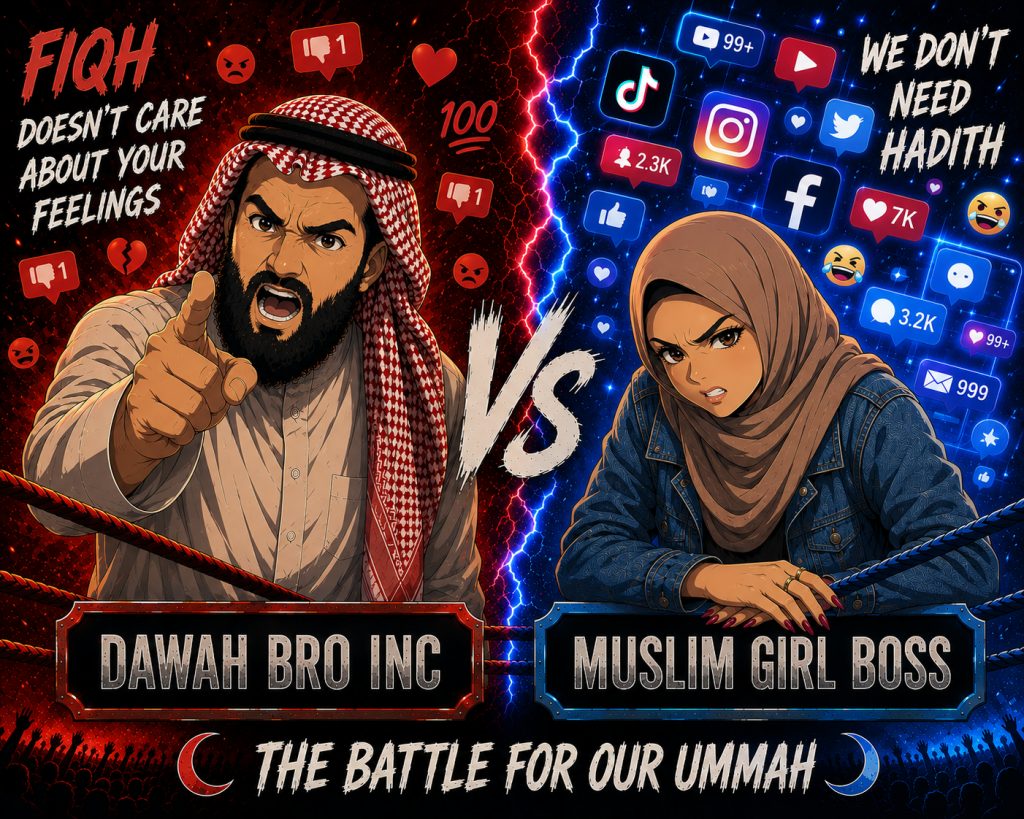
There is another place where we see the frameworks and language of feminism used to create a Frankenstein’s monster of discourse around Islam and women’s rights: the Internet. Social media, particularly on platforms such as YouTube, Instagram, and TikTok, have become a breeding ground for anyone and everyone to grab a mic and start pontificating on what they think Islam says about Islam, women, and every other topic under the sun. While Dawah Bro Inc. is perhaps most easily identified as an ugly subculture of the Muslamic Internet, they are just one side of the toxic social media coin. The other side of the coin is what can perhaps be labeled as Muslim Girl Boss ™: flooding social media feeds with sound bytes claiming that “Islam says wives don’t have to do anything!” or “Khadijah (ra) was a CEO!” or “talking about hijab is spiritual blackmail!” or “hadith are a flawed, man-made construct of the patriarchy!”
This particular genre of social media influencers consists of individuals who have no traditional background in Islamic studies, yet feel confident enough with their secular educational backgrounds to speak on Islamic matters. This is particularly dangerous, as secular educational training – even in “Islamic studies” – is a wildly different worldview than that of genuine Islamic knowledge. Even those who claim to reference fiqh tend to have little or no understanding of usool al-fiqh, the differences between madhaahib and their internal structures, and the greater holistic legal and ethical considerations of the Shari’ah.
The result is that – whether Ted Talk or podcast, YouTube short or viral TikTok video – the sweeping claims being made are both wildly incorrect and cringe-inducing. Unfortunately, they also snag hundreds of thousands, if not millions, of views; generate endless comments; are stitched by other content creators; and contribute to a Frankenfiqh discourse in Muslim online spaces that has no concern for the depth and nuance of true Islamic scholarship. Not coincidentally, these takes also reflect a very particular set of worldviews: one based on secularism, individualism, capitalism, and pop feminism.
Just as Dawah Bro Inc. thrives on creating toxic perspectives around gender roles and relationships, where women are caricatured as greedy, vindictive, and deceitful towards innocent men, Muslim Girl Boss ™ creates its own warped reality. Women who do not share aspirations of shattering corporate glass ceilings are demeaned as brainwashed baby breeders; relationships built on mutual reciprocity, albeit presenting in “traditional” ways such as husbands as breadwinners and wives attending to the domestic sphere, are recreated as inherently dangerous to women.
The weaponization of pop-therapy vernacular (not to be confused with valid therapeutic interventions!) is used to convince women that normal marital miscommunications and disagreements are equivalent to abuse. Emotional validation is given priority over all else, including personal accountability. Fiqh of marriage is dismissed wholesale as misogyny from classical scholars, to be rejected in favour of contemporary secular relationship norms (despite the erratic and fickle nature of the latter). Rather than fostering healthy discussions around gender roles and interactions in society, those immersed in pop-feminist spaces create an environment of suspicion and hostility towards those perceived as supporting a patriarchal structure within the Muslim community.
Even the use of terminology such as “patriarchy” and “misogyny” is devoid of nuance, often swapped interchangeably for one another without pausing to consider the implications. More dangerously, those who have some passing familiarity with Islamic vocabulary wield technical Islamic jargon in a manner that strips the phrases of their legal context, leaving viewers with wildly incorrect conclusions that are attributed to the Shari’ah. Many Muslim women walk away from this content feeling as though they cannot trust traditional Islamic scholarship, while also feeling justified in believing that Islam does, in fact, conform to modern 21st century Western ideals. Endless videos fill the algorithm with warnings that Islamic scholarship is a behemoth of misogyny to be rejected, that Islam itself is little different from Christianity or Judaism, that the structures of the Islamic sciences are a house of cards to be swept away.
These social media personalities do a lot more than just undermine the role of traditional Islamic scholarship; they also construct a culture of pseudo-intellectualism (characterized, ironically, by significant ignorance) and heightened antagonism between Muslim men and women. Rather than shedding light on Islamic law’s nuanced approach to all matters – including gender roles, responsibilities, and rights – they flatten the discourse into one of patriarchy vs feminism, of male oppression vs female victimhood. In their professed quest to enlighten the public about all things Islam and women, they muddy the waters of intellectual integrity, nuanced knowledge, and Ummatic allyship in the cause of justice for men and women alike.
These online dumpster fires don’t just stay online – they leak into the real world, causing young Muslim men to gravitate towards false machismo under the guise of Islamic masculinity and quoting Andrew Tate, while Muslim women grasp for responses to this poison. Unfortunately, many of those responses contain just as much poison, especially the increasingly common rejection of ahadith as a source of Islamic authority, based on accusations of misogyny and corruption. This rejection of hadith and the Sunnah, under the guise of women’s empowerment, signals something extremely dangerous: a rejection of Islam as a holistic faith, one which was sent to us by an All-Wise, All-Knowing Creator, and an attitude where personal discomfort or lack of understanding of Islamic texts is elevated over the concept of sami’na wa ata’naa (we hear and we obey).
Rather than seeking to explore deeper scholarly explanations of contentiously-viewed ahadith, rather than seeking female scholarship to provide insight and empathy while upholding the Islamic tradition, it has become a common response to claim that one’s own intellect (or five-minute Google/ ChatGPT search) is superior enough to trump a spiritual and scholarly tradition that spans over 1400 years. This reaction doesn’t actually help Muslim women overcome oppression in our communities or even reconcile personal spiritual challenges – all it does is create a doorway that leads to rejecting the fundamental premise of our faith, which is complete and utter belief in Allah’s Perfect Guidance and Justice.
In turn, rather than championing the cause of Muslim women, we end up with endless social media back-and-forths accusing influencers of apostasy (egged on by those same influencers). The Ummah’s real issues are drowned out in favour of jobless behaviour, attention-seeking, narcissism, and making money off the short-sightedness and emotional reactions of thousands of online followers whose every like, comment, and reaction video makes money for those whose last thought is their own spiritual wellbeing (let alone that of their audiences). Thanks to an algorithm which actively elevates conflict and antagonism, Muslim men and women have been manipulated into (or actively played a part in manipulating others to) view each other with suspicion even as they try to get married (to one another!), struggle to find alignment in religious values (despite sharing the same deen), and clash even in masjid spaces as polarizing views are weaponized on the minbar and divide the community15for example, by welcoming spiritual abusers back into positions of authority. There is little sense of believing men and believing women as allies of one another, seeking Allah’s Pleasure and to establish justice in the Ummah and around the world.
The phenomenon of these influencers reflects two very dangerous patterns of behaviour: the first is the sheer arrogance of speaking on matters of Islam without actual Islamic knowledge gained from traditional study; and the second is a culture of presumption that anyone can speak on religious matters, regardless of their training (or lack thereof). Bluntly speaking, this is a type of spiritual disease; one which comes with widespread, dangerous social consequences alongside the negative impact on their own spiritual states. By putting themselves in the position of speaking on such matters as Islamic law and ethics, these influencers are presenting themselves as experts – rather than directing their audiences towards those who truly are qualified to do so, including numerous female scholars with genuine traditional training and qualifications in the Islamic sciences.
It is imperative that as a collective, Muslims who have genuine concerns around women’s rights and issues concerning women do not turn to social media shills as figures of authority or influence. We must not enable their ignorance and their hubris; we must not mistake their grifts for grassroots work; we must not reward their attention seeking with our hits, views, and stitches. Instead, we must reorient ourselves to the actual methodology of seeking knowledge. Pursuing real-work change must take place from within our own tradition, not from a shaky framework cobbled together from colonialism, secularism, capitalism, individualism, feminism, and the millions of others -isms bogging down our intellectual processes and fogging our cultural filters.
From the Streets to the Ivory Towers
Most Muslims are “average” Muslims, and you don’t have to be a university graduate to be impacted by the factors that we discussed in the previous sections. Lack of Islamic knowledge, absorbing ideas around Western secular superiority, and being chronically online are all issues to be found amongst the everyday Muslim. Feminism is just one growth of the ugly morass that is the Western sociopolitical hegemony that has, alas, infected the entire world.
But for those who have gone past social media soundbytes and found themselves immersed in deeper explorations of feminism and Islam, what needs to be known about that beast colloquially known as Muslim feminism? How have the discussions in the ivory towers of academia trickled their way onto our streets, and how are Muslim women impacted when we pick up books penned addressing the topic of Islam and women? While there are endless articles, webinars, and YouTube lectures pontificating on feminism and its impacts on Muslims, there is very little actual understanding in the Muslim community of what and how feminism in a Muslim context emerged, developed, and continues to influence others – and what isn’t feminism no matter how much one tries to make it so.
As someone who used the label of ‘feminist’ for many years, I am the first to note that most people embroiling themselves in these discussions don’t know what they’re talking about. The vast majority of people who use the term feminist have not studied feminism, are not even aware of its long (often sordid) history, or the confusion of thought trends ascribed to feminism, and even more rarely have read works by Muslim feminist authors. Over the years, however, I have taken the time to actually read works by notable Muslim feminist academics and developed a much deeper understanding of the fundamental theological flaws behind “Muslim feminism.” It is only by engaging with these works, rather than relying on flimsy stereotypes, caricatures, and outdated ideas of what “feminist” discourse entails, that we can most effectively address the very real, very dangerous beliefs undergirding the entire structure.
Many women find themselves picking up copies of Amina Wadud or Fatima Mernissi’s books at some point or another – sometimes as required readings in a university religions class, and sometimes out of desperation, in search for anything to more seriously address their questions around Islam and women (especially if they were already berated by imams for daring to ask those questions in the first place!). Unfortunately, this reading is usually done without a solid understanding of aqeedah, tafseer, the development of fiqh, or Islamic scholarship in general. Without a grounding in the Islamic sciences, such readers are left unable to identify just how deeply problematic, and wildly incorrect, these authors’ foundational premises and ultimate conclusions are.
The next part of this article will examine the ideological structures underpinning the field of Muslim feminism in academia, key figures and their contributions to the field, and the necessity of effective responses to these ideas.
References
Ahmed, L. (1992). Women and gender in Islam. Yale University Press.
Asad, T. (2003). Formations of the Secular: Christianity, Islam, Modernity. Stanford University Press.
Asad, T. (2018). Secular Translations: Nation-state, Modern Self, and Calculative Reason. Columbia University Press.
Badran, M. (1995). Feminists, Islam, and Nation: Gender and the Making of Modern Egypt. Princeton University Press.
Badran, M. (2009). Feminism in Islam: Secular and Religious Convergences. Oneworld Publications.
Ezaydi, S. (2026). The Othered Woman: How White Feminism Harms Muslim Women. Pluto Press.
Hidayatullah, A. A. (2014). Feminist Edges of the Qur’an. Oxford University Press.
McLarney, E. A. (2015). Soft Force: Women in Egypt’s Islamic Awakening. Princeton University Press.
Mubarak, H. (2022). Rebellious Wives, Neglectful Husbands: Controversies in Modern Qur’anic Commentaries. Oxford University Press.
Rahnama, S. (2025). The Future Is Feminist: Women and Social Change in Interwar Algeria. Cornell University Press.
Related:
Keep supporting MuslimMatters for the sake of Allah
Alhamdulillah, we're at over 850 supporters. Help us get to 900 supporters this month. All it takes is a small gift from a reader like you to keep us going, for just $2 / month.
The Prophet (SAW) has taught us the best of deeds are those that done consistently, even if they are small. Click here to support MuslimMatters with a monthly donation of $2 per month. Set it and collect blessings from Allah (swt) for the khayr you're supporting without thinking about it.




School Counseling Grounded In The Qur’an And Sunnah: A Framework Of 10 Prophetic Traits

A Case For Critical Reading As Muslims: Reading ‘The Power of Your Subconscious Mind’ Through An Islamic Lens

Far Away [Part 31] – Following Your Lead

When A Place Teaches You What Softness Is Not

[Podcast] Wait, Muslims Have Been Here HOW Long?! | Hassam Munir

When The Shaykh Never Spoke – Deepfakes, Synthetic Scholars, And The Coming Crisis Of Religious Trust

The Stirring Of A Muslim Population In Japan: The Story Of Yusuke Fujitani

Is It Ever Too Early To Prepare For Ramadan? Reflections On Rifq, Forgiveness, And Healing The Heart

CAGE, Muslim Leadership, And Imran Khan: The Silence Test

Maryam: The Story Of The Muslim ‘Virgin’ Mary

The Best Actions for Eid al-Adha [Imam Dawud Walid]

Coming Full Circle: Who Are You Now? | Night 30 with the Qur’an

Running Away From Who We Are | Night 29 with the Qur’an

Building From the Ground Up: Week 4 Recap | Night 28 with the Qur’an

The Muslim You Are Becoming | Night 27 with the Qur’an
-

 #Life3 weeks ago
When The Shaykh Never Spoke – Deepfakes, Synthetic Scholars, And The Coming Crisis Of Religious Trust
-
#Life1 month ago
[Podcast] 50k Mahr, Hiding Money, & Who Pays for the Wedding? | AML Finance
-
#Current Affairs1 month ago
Long War Without End: A Quarter-Century Since The War On Terror
-
#Culture4 weeks ago
The Stirring Of A Muslim Population In Japan: The Story Of Yusuke Fujitani




Kirin Nabi
August 5, 2026 at 2:02 PM
Why the AI graphic? so disappointing
Wael Abdelgawad
August 5, 2026 at 2:31 PM
Why is it disappointing? It’s a pretty good graphic. MM publishes almost every day and doesn’t have funds to commission or purchase original artwork or photography for every post. How about commenting on the article itself?
Fel
August 6, 2026 at 7:12 PM
I think the Muslim ummah has already shown us it doesn’t care about eradication of injustice so why appeal to them? I will continue to call myself a Muslim feminist and I don’t have to explain myself to people who at their very best shake their heads at their abuser friends and at the worst cover up and make excuses for the abusers around them. Also I expect and I hope that you talk about the concept of Qawammah because this is what has caused so many problems for a lot of people (in the sense that it’s misunderstood).
Musafir
August 8, 2026 at 2:30 AM
I’m looking forward to the next article. As a believing Muslim woman I have absolute faith in the Justice and Mercy of Allah towards all believers, but it would be helpful to be able to think about the status of women in Islam in a rational, systematic manner. It is unfortunate that our practice of Islam is muddied by culture.
What would terminology would you use instead of feminism? I feel disparaging the term minimises the extent/ severity of oppression of women and the importance of an ideology that does champion women’s rights, whatever that branch of feminism believes in.
Alhamdulillah, happy Allah brought me to this article. It just so happens I’ve just started reading Amina Wadud’s book. Will proceed with caution, as I will with this article. Recommendations on sound female Muslim feminist academics would be much appreciated.
Amer Rizvi
August 8, 2026 at 6:04 PM
Why might some American Muslim women become feminists?
My take:
Muslim females in American Islamic communities learn from a very early age that because they are females, they cannot enjoy the same privileges as males.
I can tell you this from my own experience as a middle school teacher in an Islamic school in Virginia where I once taught English.
Every day, I used to take my 5th graders outside to play during their last free period. The boys would immediately run to the area in front of the school to play soccer with other middle school boys.
The girls, on the other hand, did not want to play soccer with the boys. Also they wore abayas and long skirts which would make it difficult for them. So they would just go out and play around in small groups in different parts of the school.
I had to find something that would engage the girls. So, the next day, I brought some cricket equipment to school: cricket bats, wickets and some tennis balls. 🏏
It was a hit with the girls! And it wasn’t just the girls with South Asian backgrounds who enjoyed it; girls with Arab backgrounds loved it too, which made me so happy. With a little coaching, they got the hang of cricket: smacking that tennis ball and running between the wickets. 😃
I used to be the wicketkeeper, so I fetched the ball that went behind me, and I had the school security guard, who was stationed at the school perimeter, fetch the ball if it was ever hit out there.
I also purchased some colored floor chalk and drew a hopscotch in front of the school and taught them how to play it. And the girls drew maybe the longest hopscotch ever drawn!
I also got a long skip rope and showed them how to play Double Dutch. But my favorite was “helicopter” with the skip rope, except I got so dizzy spinning it! And they kept asking for more! 😂
I also got loads of other outdoor games like frisbees, hula hoops and catching games that the girls would like. I kept them in the trunk of my car.
The girls were laughing, giggling and running around in the front of the school. 😃
The principal, however, who was a female Muslim, seemed bothered. She told me I would need to do all my activities behind the school in a small enclosed, caged area. She told me that the security guard had an issue because of the after-school traffic at the front of the school.
But when I myself asked the security guard if there was an issue, she informed me there was no problem with the girls playing in the front.
But why should the girls have to go to the caged area in the back of the school? Why couldn’t they just play in the front? There was really no issue.
I began to wonder whether this was really about security or whether it was also about the school’s image, especially the girls playing in front of parents who would be coming to pick up their children.
I was only a teacher at this school for a few months before I was suddenly told that my three-month trial period would not be extended and to leave the school immediately!
Once, I drove by the school to wave “hi” to the kids at the same time they always came out to play.
As I did, my heart sank. I saw the school go back to the same old system: boys in the front of the school playing soccer, and the girls in the caged area in the back, with a small group of them walking in the front.
And since I left, I bet the girls have now moved to sit in a corner of the classroom!
If Muslim girls grow up seeing boys given freedoms and opportunities that they are denied simply because they are girls, is it really surprising when they eventually question that treatment?
Perhaps experiences like these are one of the reasons some Muslim women become feminists.
والله اعلم
Umm Ismaeel
August 9, 2026 at 6:01 PM
There is a lot of resentment in the muslim community against the ‘feminists’ from the men and there seems to be no opening to any discussion about the subject of oppression of women in the community. Men do not want their wives to complain also to protect their reputation which makes it extremely difficult to discuss any problem except if she is divorced.
The most disturbing problem for me is the question of divorce by Khul when the woman is asked to forget about all her rights and give back the Mahr even if she has been married for 20 years and have 5 kids. It looks like she never earns this Mahr… It was supposed to be a gift. In this case it’s a very poisoned gift if she received a lot. Should she keeps it in the bank account all her life just in case? Many times, the husband push her to ask for the Khul for this very reason.
Also, the huge problem of men who don’t want to give the Talaq, and the Imams who do not want it either, except after sometimes years of painful discussion back and forth to know who was to blame, the men or the women, and after the man refused many times to pronounce the Talaq. It’s so easy for a man to divorce his wife, he only has to say a sentence, but for her, it’s years of painful discussions and begging and everything about her life is exposed and discussed.
It’s a nice article, but it is not talking about any specific problem. It would be good to have a review of all the problems that the women faces in the community and to try to find a solution in the Fiqh and in the organization of the community.
Sara
August 30, 2026 at 11:55 AM
I think you should be honest that you are actually an Islamic modernist even outside the context of women’s rights – you believe in returning to the original texts for reinterpretation rather than following the many old existing madhhab opinions. This isn’t a problem except you shouldn’t deny that many things you consider “unIslamic” in Muslim majority societies in fact used to be widespread madhab-held opinions and had to be socially reformed when people’s worldviews changed, and this includes issues to do with women. I understand what you mean by the issues of engagement with “a non Islamic ideology without God at the center”, but historical custom, logic traditions, and social understandings of science have always shaped how Islam is interpreted. There is no “sharia” without SOME interpretation through “outside ideologies” or otherwise you would simply bow to those old very violent beliefs about women yourself as “our tradition straight from God.”
I point this out because you are not actually engaging with the history of how women’s rights and reform have come about in the place of your own background – South Asia – because that would involve admitting that “Islamists and shaykhs” have been “theologically correct but socially harmful” while a Muslim woman who didn’t have the “perfect” theology but loved Islam and Muslim women comes under suspicion and needs to have her ideas thrown out wholesale. You ignore the activism of many Muslim women because they do not slap “Islamic” in front of all their social reforms, just the same as someone calling for primary education in a Muslim country does not brand themselves “an Islamic education reformer”. For those interested in this issue I would recommend reading Rafia Zakaria.
Sara
August 30, 2026 at 11:57 AM
The Rafia Zakaria article I mentioned:
https://dissentmagazine.org/article/pakistani-conundrum-public-private-and-female/