
#Islam
If The Four Great Imams Sat At The Same Table Today
An exploration of how the great Imams modeled humility, unity, and disagreement – offering timeless guidance for today’s Muslim community.

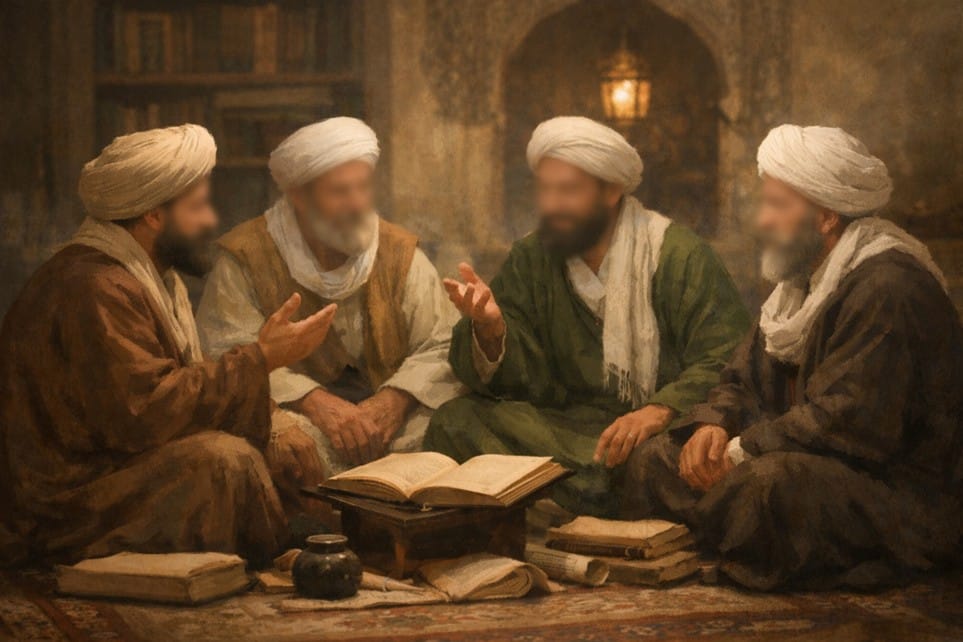
How the Four Great Imams Might Model Unity, Humility, and Principled Disagreement Today
“And hold firmly to the rope of Allah all together and do not become divided.” Qur’an 3:103
Introduction
The Muslim community has never been entirely free of disagreement, nor should disagreement itself be treated as a sign of failure. Difference in interpretation, legal reasoning, and scholarly judgment has long existed within the Islamic tradition. At its best, that diversity reflected the richness of a civilization rooted in revelation, disciplined by scholarship, and guided by a sincere search for truth. Yet in our own time, disagreement often feels less like a mercy and more like a fracture. What was once carried with adab is now too often expressed through suspicion, polemics, and the urge to delegitimize those who differ.
In such a climate, it is worth pausing to imagine a different model. What if the four great Imams of Sunni jurisprudence, Abu Hanifah, Malik ibn Anas, Muhammad ibn Idris al-Shafi‘i, and Ahmad ibn Hanbal, were seated together at the same table today? What would their conversation reveal about knowledge, humility, disagreement, and responsibility in a divided age? More importantly, what might their example teach a community that is struggling not simply with difference, but with the loss of the ethical discipline required to navigate it?
Keep supporting MuslimMatters for the sake of Allah
Alhamdulillah, we're at over 850 supporters. Help us get to 900 supporters this month. All it takes is a small gift from a reader like you to keep us going, for just $2 / month.
The Prophet (SAW) has taught us the best of deeds are those that done consistently, even if they are small. Click here to support MuslimMatters with a monthly donation of $2 per month. Set it and collect blessings from Allah (swt) for the khayr you're supporting without thinking about it.
To imagine such a gathering is not to romanticize the past or pretend that these towering scholars agreed on every matter. They did not. Their differences were real, substantive, and at times significant. Yet those differences unfolded within a shared moral and intellectual universe, one anchored in reverence for the Qur’an, fidelity to the Sunnah of the Prophet Muhammad ﷺ, and deep awareness of the responsibility of speaking about the religion of Allah. They disagreed without abandoning humility, and they defended principle without surrendering respect. Their legacy reminds us that the true measure of scholarship is not only what one knows, but how one carries that knowledge before Allah and before others.
A Gathering Rooted in Humility
 The first quality that would likely become evident in such a gathering is humility. Each of these scholars understood the weight of speaking about the religion of Allah, and none of them claimed absolute infallibility. Abu Hanifah held his conclusions with seriousness, yet without arrogance, recognizing that legal reasoning is an effort to approach the truth, not to possess it completely.
Imam Malik famously taught that every statement may be accepted or rejected except that of the Messenger of Allah ﷺ. Imam al-Shafi‘i revised a number of his own legal views during his lifetime, demonstrating that intellectual maturity includes the willingness to refine one’s understanding. Ahmad ibn Hanbal preserved and transmitted narrations even when they challenged his own inclinations, placing fidelity to the Sunnah above personal preference.
If these four Imams were gathered today, their humility would shape the tone of the room from the beginning. The purpose would not be to defeat one another, nor to defend positions for the sake of pride, but to strive collectively toward what is most faithful to revelation and most beneficial for the Ummah. Their example reminds us that sincere scholarship requires openness to correction and fear of Allah in every word that is spoken.
Anchored in the Teachings of the Prophet ﷺ
Despite their methodological differences, the four Imams shared an unshakable foundation. Their scholarship was rooted in the Qur’an and the Sunnah of the Prophet Muhammad ﷺ. These were not merely sources among others. They were the compass that guided every discussion, every disagreement, and every legal conclusion.
Abu Hanifah, often associated with the use of reasoning and analogy, never placed personal opinion above authentic Prophetic guidance. He understood reason as a tool to apply revelation faithfully, especially when new situations required careful judgment. Imam Malik built much of his legal method upon the inherited practice of the people of Madinah, believing that the living tradition of the city of the Prophet ﷺ preserved the Sunnah in action. His work Al-Muwatta became one of the earliest systematic efforts to gather hadith and legal rulings rooted in the Prophetic tradition.
Imam al-Shafi‘i clarified the authority of the Sunnah within Islamic law and established a structured methodology that balanced the Qur’an, the Sunnah, consensus, and analogy. Ahmad ibn Hanbal devoted his life to preserving the words and actions of the Prophet ﷺ, compiling vast collections of hadith and refusing to compromise the authority of revelation even under political pressure. Though their methods differed, their devotion to the guidance of the Prophet ﷺ united them more strongly than any disagreement could divide them.
Listening Before Speaking
A defining feature of classical Islamic scholarship was the discipline of listening. These scholars were not formed in isolation. They studied with one another, learned through chains of transmission, and inherited traditions of respectful engagement. Imam al-Shafi‘i studied with Imam Malik. Ahmad ibn Hanbal studied with Imam al-Shafi‘i. Their relationships were built upon learning, not rivalry.
If they were seated together today, they would begin not with accusation, but with careful listening. Abu Hanifah might explain the role of analogy in addressing new circumstances. Imam Malik might emphasize the importance of preserving the living tradition of the community. Imam al-Shafi‘i would clarify the principles that govern sound legal reasoning. Ahmad ibn Hanbal would insist that speculation must remain anchored to authentic narrations. Each would listen before speaking, knowing that justice in scholarship requires understanding before judgment.
Advising with Wisdom and Respect
Their disagreements would be real, but they would not be stripped of adab. Islamic intellectual history shows that strong debate can exist alongside deep respect. The Imams differed on many issues, yet they spoke of one another with honor. Advice would be given with sincerity, not hostility. Correction would be offered as a means of preserving the truth, not defeating an opponent. In an age when disagreement is often driven by ego, their example teaches that sincere counsel can itself be an act of mercy.
Scholarship Lived Through Moral Courage
 These Imams were not only scholars of law. They were people of moral courage. Abu Hanifah refused positions offered by rulers when he feared that authority might compromise justice. Imam Malik endured punishment for speaking truthfully. Ahmad ibn Hanbal remained steadfast under pressure rather than surrender what he believed to be the truth. Their lives remind us that scholarship carries responsibility, and that knowledge without integrity becomes a source of harm.
If they were to address the Muslim community today, their guidance would likely extend beyond individual legal questions. They would call for scholars to work together across schools of thought. They would encourage consultation and disciplined dialogue. They would remind students that disagreement has always existed within the tradition, but that it must be carried with humility and restraint. They would emphasize that the health of the Ummah depends not only on correct rulings, but on correct character.
Civil Debate as an Act of Worship
For the four Imams, debate was never entertainment or a contest for dominance. It was part of fulfilling the trust of knowledge before Allah. Disagreement was approached with seriousness, patience, and awareness that every word spoken about religion carries accountability. When governed by sincerity and taqwa, disagreement could become a source of mercy. When governed by pride, it became a source of division.
A Model for Today’s Muslim Community
The real lesson of imagining this gathering is not to ask what rulings the Imams would give today, but to ask how they would conduct themselves. They would listen deeply. They would advise sincerely. They would disagree honestly. They would preserve conviction without arrogance. They would hold firmly to the truth while maintaining respect for those who sought it sincerely.
The schools of law they established were never meant to divide the Ummah into factions. They provided structured ways for Muslims across different lands and generations to live according to the guidance of the Qur’an and the Sunnah. Their diversity was not a weakness of the tradition, but a sign of its depth and flexibility.
Conclusion
If the four great Imams were sitting together today, they would remind us that the real crisis is not that Muslims disagree. The real crisis is that we have forgotten how to disagree. We have mistaken loudness for strength, suspicion for piety, and factional loyalty for faithfulness to the truth.
Their legacy teaches that unity does not require uniformity. It requires humility, discipline, and fear of Allah. It requires scholars who speak with integrity and communities that value adab as much as argument. The future strength of the Ummah will not come from winning debates, but from producing people of character, scholars of sincerity, and communities that hold firmly to the rope of Allah without allowing difference to break their bonds.
In an age of division, the example of Abu Hanifah, Malik, al-Shafi‘i, and Ahmad ibn Hanbal calls us back to a more excellent path, one in which knowledge is joined to humility, conviction is joined to mercy, and disagreement is carried with dignity before Allah.
Related:
The Rise of the Scholarly Gig Economy and Fall of Community Development
Keep supporting MuslimMatters for the sake of Allah
Alhamdulillah, we're at over 850 supporters. Help us get to 900 supporters this month. All it takes is a small gift from a reader like you to keep us going, for just $2 / month.
The Prophet (SAW) has taught us the best of deeds are those that done consistently, even if they are small. Click here to support MuslimMatters with a monthly donation of $2 per month. Set it and collect blessings from Allah (swt) for the khayr you're supporting without thinking about it.



[Podcast] Wait, Muslims Have Been Here HOW Long?! | Hassam Munir

Far Away [Part 30] – The Rock Splitter And The Parthian Shot

Maryam: The Story Of The Muslim ‘Virgin’ Mary

Is It Ever Too Early To Prepare For Ramadan? Reflections On Rifq, Forgiveness, And Healing The Heart

Lessons From The Battle Of Badr: A Personal Transformation Perspective

Long War Without End: A Quarter-Century Since The War On Terror

[Podcast] Faith, Motherhood, and the Call to Gaza | Dr. Samaiya Mushtaq

When The Shaykh Never Spoke – Deepfakes, Synthetic Scholars, And The Coming Crisis Of Religious Trust

The Stirring Of A Muslim Population In Japan: The Story Of Yusuke Fujitani

CAGE, Muslim Leadership, And Imran Khan: The Silence Test

The Best Actions for Eid al-Adha [Imam Dawud Walid]

Coming Full Circle: Who Are You Now? | Night 30 with the Qur’an

Running Away From Who We Are | Night 29 with the Qur’an

Building From the Ground Up: Week 4 Recap | Night 28 with the Qur’an

The Muslim You Are Becoming | Night 27 with the Qur’an
-

 #Culture1 month ago
Far Away [Part 26] – Shaytan Is A Liar
-
#Culture1 month ago
Far Away [Part 25] – To Save A Prince
-
#Current Affairs1 month ago
From a Syrian Prison to the UN: The Case of Bilal Abdul Kareem
-
#Life1 month ago
[Podcast] 50k Mahr, Hiding Money, & Who Pays for the Wedding? | AML Finance





Amer Rizvi
April 21, 2026 at 8:06 AM
I was inspired by this article’s reflection on how the great Imams would interact with one another and guide the Ummah today…
Imam Shafi‘i, “Thank you for inviting me to the ADAMS Center here in Virginia. I do like it.
But I only have a few minutes. Imam Abu Hanifa, Imam Malik, and Imam Ahmad ibn Hanbal are waiting outside in the time machine, and I need to return very soon…”
A musalli smiles, “It’s our honor, Imam.”
“Good. Then listen carefully. I only have time for a few points.
First, why does the mu’adhin keep moving his head right and left? We used to do that so the sound would carry in the marketplaces of Baghdad, on both sides. But I see something right in front of his face.”
“The mic,” someone says.
“Yes, the mic! So why move your head? It is unnecessary and looks silly.”
The musalli nods. “I know, Imam. We haven’t caught up to the 21st century yet. But we’re trying.”
“Second, why give a Middle Eastern-style adhan here in the West?”
“But we use the maqām system,” someone replies.
“Please listen. You are living in the West in 2026. What kind of musical scale is popular here?”
“I guess… not maqām-based.”
“Exactly. Much of what is popular here is based on a five-note scale. Even recitations like Shaykh Noreen, may Allah have mercy on him, are based on that simpler and popular scale, very pleasing to the ear.
“Third: after the imam gives salām, why does he start talking immediately?”
“But the talks are beneficial for us ,” someone says.
“Listen carefully. The Messenger of Allah, May Allah have mercy on him, taught us that after the salām is a time for quiet, personal dhikr, du‘ā’, and reciting Ayat al-Kursi. This is private time between the servant and his Lord. No one should take away that great reward.”
The room falls silent.
“And another point, many of you are Shāfiʿīs, correct?”
“Yes, Imam.”
“Then why make qunūt in Fajr every single day?”
“But you taught us that.”
He sighs.
“That was my ijtihād, my interpretation. But the Messenger of Allah, may Allah have mercy on him, did not do it all the time. He did it in times of need. Do not confuse my opinion with his consistent practice.”
The musalli nods, now more reflective.
He turns to leave, then pauses with a slight smile.
“And one last thing…why are you dressed like me?”
“But this is Islamic dress, and you are wearing it too.”
“Please, you are living in America in 2026. If I had time to shop, I would change these myself. Please learn the difference between culture and what is religious.”
He steps away.
“My time is up. I must return now. I love you all for the sake of Allah.”
“We love you too, Imam,” they reply.
السلام عليكم و رحمة الله و بركاته
And just like that, Imam al-Shafi‘i walks out, leaving behind a question that lingers:
Are we truly following the Sunnah, or simply repeating habits?
Carr
April 29, 2026 at 1:19 AM
Assalamu alaykum. The premise is interesting to me, because several of the 4 imams met each other in the first place, and their chains of transmission overlap. e.g. https://www.muwatta.com/meeting-of-imam-malik-imam-abu-hanifa/
Imam Abu Hanifa (rahimahu Allah) met imam Malik (rahimahu Allah).
Imam Shafii (rahimahu Allah) was a student of imam Malik (rahimahu Allah) and he also met imam Ahmad ibn Hanbal (rahimahu Allah).
So they kind of did “sit together” already… And here we are, the present day. Not to mention their students’ interactions…