#Islam
Not Everyone Goes To Hajj…But Everyone Is Called: Gaza, Gratitude, And Dhul Hijjah

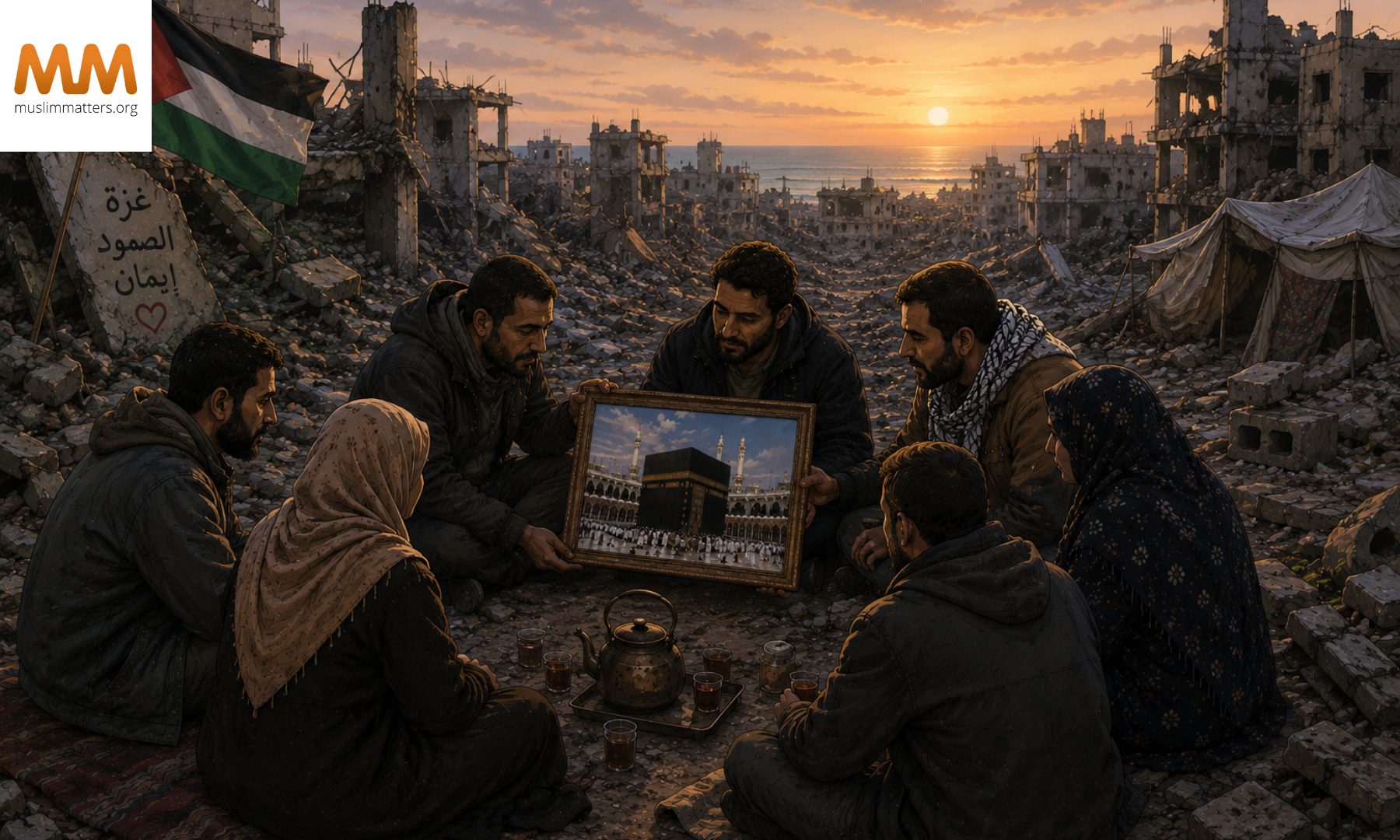
Not all of us will stand on the plains of Arafah this year. Not all of us will circle the Kaabah or feel the weight of “Labbayk Allahumma Labbayk” rise from our chests into the sky. Some of us will be in our homes, in unfamiliar cities, in places that don’t feel sacred at all. And yet, somehow, these days of Dhul Hijjah still reach us.
Dhul Hijjah has felt different for my family and me since everything we went through. There was a time when the word sacrifice felt distant to me: a story we told our children before Eid, a lesson wrapped in history about Prophet Ibrahim, his obedience, his trust. We understood it. But we hadn’t lived it. Not in the way that changes you.
After living through the Gaza war, the meaning of words shifts. Sacrifice is no longer something symbolic. It is no longer a concept you reflect on from a safe distance. It becomes something you recognize in the quiet details of life—what was lost, what was taken, what had to be rebuilt from nothing.
We have seen what it means for homes to fall, for entire lives to unravel in moments. We have seen people lose parts of themselves and still hold onto Alhamdulillah. We have said goodbye to people we never imagined we would lose. And even now, after time has passed and we have moved forward, those moments do not really leave you. They settle somewhere deep, reshaping the way you see everything.
Keep supporting MuslimMatters for the sake of Allah
Alhamdulillah, we're at over 850 supporters. Help us get to 900 supporters this month. All it takes is a small gift from a reader like you to keep us going, for just $2 / month.
The Prophet (SAW) has taught us the best of deeds are those that done consistently, even if they are small. Click here to support MuslimMatters with a monthly donation of $2 per month. Set it and collect blessings from Allah (swt) for the khayr you're supporting without thinking about it.
Sometimes Allah  does not ask you to sacrifice one thing. Sometimes, He allows you to experience what it means to lose much more—and to still remain.
I remember sitting with my children—my daughters, 16 and 14, trying in their own way to make sense of things beyond their years, and my 8-year-old son, still holding onto a kind of softness that asks questions without hesitation. We were not speaking about Eid that day. We were speaking about loss.
“What does Allah want from us?” one of them asked.
It was not a theoretical question. It was not something you answer with memorized words. And I found myself pausing, not because I did not believe—but because some questions deserve to be held before they are answered.
Because when you have lived through something that changes you, you do not rush to simple explanations.
And yet, Dhul Hijjah still came. As it always does. Quietly. Gently. As if to remind us:
“Allah does not burden a soul beyond that it can bear.”
[Surah Al-Baqarah, 2:286]
What you have lost is seen.
What you have endured is known.
And what you are still carrying…matters.
We found ourselves returning to the story of Ibrahim  , but this time it did not feel like a distant story. It felt close. Personal. Real.
It was no longer just about a father who was asked to sacrifice his son. It was about trust when nothing makes sense. About surrender when your heart is heavy. About saying yes to Allah —not because it is easy, but because you believe there is meaning beyond what you can see.
“And when they had both submitted and he laid him down upon his forehead…”
[Surah As-Saffat, 37:103]
My son once asked me, “Did Ibrahim feel scared?”
And the answer came more honestly than before: yes. Of course he did.
Because faith is not the absence of fear.
It is choosing Allah even when fear exists.
This Eid, when we speak about Udhiyah, I no longer think about the act alone. I think about what has already been given—the comfort that once existed, the sense of safety that felt permanent, the life that was carefully built and then quietly taken apart.
And I remember Allah’s Words:
“Their meat will not reach Allah, nor will their blood, but what reaches Him is piety from you.”
[Surah Al-Hajj, 22:37]
It brings a different kind of understanding; that what matters is not the outward form of sacrifice, but the state of the heart within it.
Not everyone will go to Hajj. But everyone is called to something.
To patience:
“Indeed, Allah is with the patient.”
[Surah Al-Baqarah, 2:153]
To trust.
To letting go of what we thought we needed.
To holding onto Allah when everything else feels uncertain.
The Prophet ﷺ said: “How amazing is the affair of the believer. Verily, all of his affairs are good for him…” [Muslim]
There was a time when this hadith felt comforting. Now, it feels grounding.
Because understanding it is different when you have lived through both ease and hardship and found that Allah was present in both. Not always through immediate relief, but through the strength to keep going, the people He placed in our path, the prayers that carried us, and the quiet mercy that appeared in moments we least expected it.
There were moments when my children asked me, “Is Allah still with us?” or “Why is this happening to us?” And each time, I would tell them that yes, Allah is always with us — in moments of ease and in moments of hardship. We may not always understand the wisdom behind what we go through, but we trust that Allah sees us, carries us through it, and teaches our hearts through these experiences in ways we may only understand later.
I realized then that faith is not only taught during times of comfort and stability. Sometimes it is taught in the way we hold onto one another during uncertainty, in the way we continue praying through fear, and also in the way we keep returning to Allah even when life feels unbearably heavy.
Our home is not perfect. There are still moments where memories return quietly. There are still traces of what was lived, even as life moves forward in a new place, a new routine, a new beginning.
But there is also something else now.
A kind of steadiness.
A kind of faith that is no longer theoretical.
My daughters do not just hear about sabr—they have experienced it.
My son does not just say Alhamdulillah—he is learning what it means.
And I no longer see Dhul Hijjah as just ten blessed days. I see it as a continuation—a reminder that what we go through is not separate from our faith, but part of how it is shaped.
Because maybe Hajj was never only about a place.
Maybe it was always about the heart.
About reaching a point where you can say:
Ya Allah… I may not understand everything. But I trust You.
The Prophet ﷺ said:
“There are no days in which righteous deeds are more beloved to Allah than these ten days.” [Bukhari]
And perhaps the greatest of those deeds are not always visible.
Perhaps they are found in quiet endurance.
In rebuilding….In continuing.
In holding onto faith, even after everything.
And maybe… just maybe…this, too, is a form of answering the call.
Related:
– When Allah Chooses Something: The Blessings Of Dhul Hijjah
– The Bigger Picture: Understanding Loss, Sacrifice, and Purpose in Dhul Hijjah
Keep supporting MuslimMatters for the sake of Allah
Alhamdulillah, we're at over 850 supporters. Help us get to 900 supporters this month. All it takes is a small gift from a reader like you to keep us going, for just $2 / month.
The Prophet (SAW) has taught us the best of deeds are those that done consistently, even if they are small. Click here to support MuslimMatters with a monthly donation of $2 per month. Set it and collect blessings from Allah (swt) for the khayr you're supporting without thinking about it.



[Podcast] Wait, Muslims Have Been Here HOW Long?! | Hassam Munir

Far Away [Part 30] – The Rock Splitter And The Parthian Shot

Maryam: The Story Of The Muslim ‘Virgin’ Mary

Is It Ever Too Early To Prepare For Ramadan? Reflections On Rifq, Forgiveness, And Healing The Heart

Lessons From The Battle Of Badr: A Personal Transformation Perspective

Long War Without End: A Quarter-Century Since The War On Terror

[Podcast] Faith, Motherhood, and the Call to Gaza | Dr. Samaiya Mushtaq

When The Shaykh Never Spoke – Deepfakes, Synthetic Scholars, And The Coming Crisis Of Religious Trust

The Stirring Of A Muslim Population In Japan: The Story Of Yusuke Fujitani

CAGE, Muslim Leadership, And Imran Khan: The Silence Test

The Best Actions for Eid al-Adha [Imam Dawud Walid]

Coming Full Circle: Who Are You Now? | Night 30 with the Qur’an

Running Away From Who We Are | Night 29 with the Qur’an

Building From the Ground Up: Week 4 Recap | Night 28 with the Qur’an

The Muslim You Are Becoming | Night 27 with the Qur’an
MuslimMatters NewsLetter in Your Inbox

Sign up below to get started
-

 #Culture1 month ago
Far Away [Part 26] – Shaytan Is A Liar
-
#Culture1 month ago
Far Away [Part 25] – To Save A Prince
-
#Current Affairs1 month ago
From a Syrian Prison to the UN: The Case of Bilal Abdul Kareem
-
#Life1 month ago
[Podcast] 50k Mahr, Hiding Money, & Who Pays for the Wedding? | AML Finance