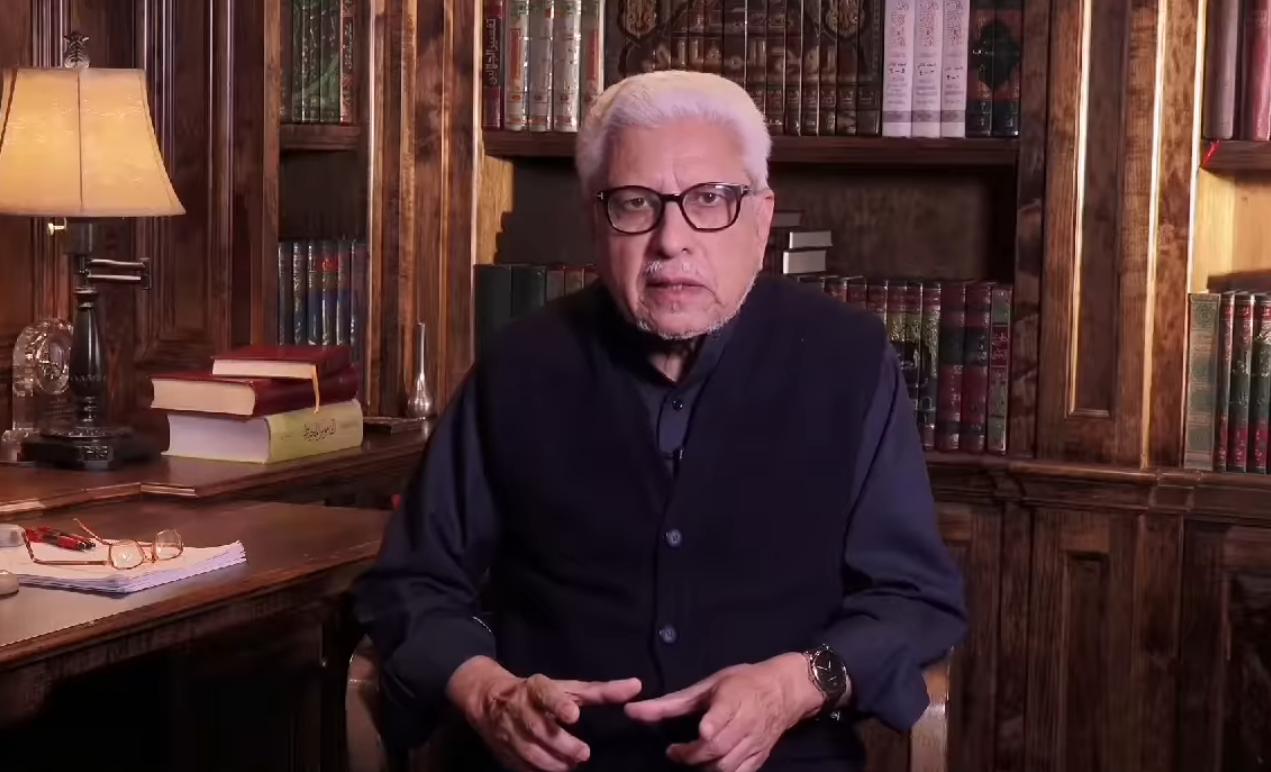
There is a certain kind of “moderate” Muslim scholar whom empire adores: calm in tone, allergic to resistance, fluent in scripture, and permanently available to explain to the oppressed why their rebellion is impractical, premature, emotional, immoral, or insufficiently spreadsheeted. Javed Ahmad Ghamidi has spent the post-9/11 era perfecting this role. He is not merely a theologian of moderation. He is the theologian of managed defeat.
His recent conversation with Shehzad Ghias was useful, though not in the way his admirers imagined. It did not reveal Ghamidi as a subtle political thinker. It revealed the limits of a mind that mistakes abstraction for depth, defeatism for realism, and imperial common sense for divine law. The interview was less political analysis than metaphysical HR training for colonized Muslims: accept the hierarchy, avoid disruption, rebuild quietly, and please do not inconvenience the powerful.
Ghamidi repeatedly invokes “the laws of the world,” as though geopolitics were governed by the moral equivalent of gravity rather than by sanctions, coups, occupations, assassinations, military bases, puppet monarchies, and the American rules-based order — that elegant phrase meaning: rules for you, exemptions for us. His abstraction is not innocent. It performs a function. By dissolving empire into “worldly laws,” it removes perpetrators from the scene. There is no Washington, no Tel Aviv, no Riyadh, no Rawalpindi; only “reality,” descending upon Muslims like bad weather.
Keep supporting MuslimMatters for the sake of Allah
Alhamdulillah, we're at over 850 supporters. Help us get to 900 supporters this month. All it takes is a small gift from a reader like you to keep us going, for just $2 / month.
The Prophet (SAW) has taught us the best of deeds are those that done consistently, even if they are small.
Click here to support MuslimMatters with a monthly donation of $2 per month. Set it and collect blessings from Allah (swt) for the khayr you're supporting without thinking about it.
This is why his politics so often arrive pre-defanged. He speaks endlessly of consequences when Muslims resist, but rarely with the same urgency about the consequences of occupation, siege, colonial plunder, or state terror. The oppressed are advised to calculate carefully. The oppressor is treated as a geological fact. Israel bombs, America sanctions, generals disappear civilians, monarchs fund devastation — and Ghamidi clears his throat to ask whether the victims have properly assessed the balance of forces.
This is not realism. It is selective realism. A realism that becomes exquisitely rigorous only when the weak contemplate resistance, and strangely poetic when the powerful commit crimes.
His treatment of Iran is especially revealing. To say that Iran “accepted Israel” before the revolution and therefore had no conflict worth mentioning is to confuse the tranquillity of a client regime with peace. The Shah’s Iran was not a neutral paradise rudely interrupted by religious zealots. It was a Western-backed police state, sustained through repression at home and alignment with imperial power abroad. Its “stability” was the stability of a boot pressed firmly on the neck of society. Apparently, if the boot is polished in Washington, some people mistake it for civilization.
Ghamidi’s framework cannot process anti-colonial agency because it has no serious place for colonialism. Muslims, we are told, declined because they failed in knowledge and collective morality. Convenient. Colonial violence becomes background noise. Coups become footnotes. Sanctions become weather. Occupation becomes context. The Global South’s long encounter with European and American savagery disappears into a sermon about civilizational failure. One half-expects the next lecture to explain that Algeria’s colonized masses should have improved their study habits.
His claim that Muslims made no meaningful contribution to knowledge in five centuries is not analysis; it is civilizational self-flagellation dressed as sobriety. It is the sort of sweeping claim that sounds profound only until one remembers that entire peoples cannot be reduced to empire charts and Nobel-counting anxieties. Muslim societies have produced scientists, poets, jurists, engineers, philosophers, revolutionaries, artists, and intellectuals under conditions ranging from colonial devastation to authoritarian suffocation. But Ghamidi’s point is not historical accuracy. It is disciplinary pedagogy: Muslims must first be humiliated before they can be pacified.
This is the deeper pattern. Ghamidi’s political theology consistently turns moral attention away from structures of domination and toward the supposed recklessness of those who resist them. Palestine is not first a story of settler colonialism, ethnic cleansing, siege, and apartheid; it becomes a case study in poor strategic planning. Kashmir is not first about occupation and militarized humiliation; it becomes another lesson in imprudence. Iran is not first a target of decades of pressure, encirclement, sabotage, and demonization; it becomes a cautionary tale about revolutionary excess.
How tidy. How civilized. How useful.
The most revealing feature of this worldview is its coldness. It has the temperature of a policy memo. One may disagree with resistance movements, criticize their methods, question their judgment, or even condemn particular actions. But to speak of Gaza, Lebanon, Iran, Kashmir, or Afghanistan with the emotional range of a risk consultant is morally obscene. Babies are buried under rubble, families are erased, prisoners are tortured, societies are starved — and the “moderate” scholar arrives to remind everyone that capacity matters.
Capacity does matter. Strategy matters. Consequences matter. Only fools deny this. But strategy without solidarity is not wisdom; it is cowardice with footnotes. Prudence that never confronts power becomes collaboration by temperament. And a theology that instructs the oppressed to survive indefinitely while never developing a serious doctrine of resistance is not prophetic restraint. It is spiritualized submission.
This is why Ghamidi’s post-9/11 career matters. He emerged as the ideal Muslim reformer for an age of imperial war: urbane, textual, anti-militant, reassuring to liberal elites, and always ready to distinguish good Muslims from dangerous ones. Under Musharraf’s “enlightened moderation,” this posture helped provide theological furniture for a state aligned with America’s war on terror. Today, in a Pakistan suffocating under military authoritarianism, the same logic mutates easily into suspicion toward mass dissent, especially when dissent threatens the uniformed guardians of national captivity.
The journey is not accidental. The “moderate Muslim” demanded by empire was never merely someone who rejected extremism. He was someone who would define extremism so broadly that resistance itself became suspect. Someone who would police Muslim anger more energetically than imperial violence. Someone who would turn “khawarij” into a portable category useful against whoever disturbed the approved order.
Ghamidi’s admirers will insist this is unfair. He is consistent, they will say. Indeed, he is. That is precisely the problem. His consistency lies in his refusal to center the mustad‘afeen — the oppressed of the earth — as the starting point of political theology. He begins instead from order, stability, capacity, and consequence. These are not trivial concerns. But when they become supreme, justice is demoted to an aspiration for better times. The oppressed are told to wait until they are strong enough to deserve liberation.
History, inconveniently, was not made by people who waited for perfect conditions. Anti-colonial struggle has always involved risk, miscalculation, sacrifice, tragedy, and impossible choices. It has also involved imagination — the very thing absent from Ghamidi’s politics. His world is governed by fixed hierarchies masquerading as divine method. The powerful act. The weak endure. The scholar explains.
And yet the world is changing. Empire is not omnipotent. Zionism is not invincible. Muslim rulers are not identical with Muslim peoples. The Global South is not a classroom of defeated children awaiting instruction from cautious clerics. It is a historical force, wounded but not extinguished, betrayed but not silent.
Ghamidi’s tragedy is not that he counsels prudence. Prudence is necessary. His tragedy is that his prudence has curdled into political quietism, and his quietism into a theology of obedience. He has mistaken the command to avoid suicide for a command to avoid confrontation. He has confused moral seriousness with strategic paralysis. He has turned moderation into a velvet leash.
In the end, the question is not whether Muslims should be reckless. They should not. The question is whether Muslim political thought must be reduced to advising the oppressed to behave better under domination. Ghamidi’s answer, beneath all the elegance, appears to be yes.
Empire could not have asked for a better sermon.
[Disclaimer: this article reflects the views of the author, and not necessarily those of MuslimMatters; a non-profit organization that welcomes editorials with diverse political perspectives.]
Related:
– Op-Ed: From Pakistan To Gaza – Why Senator Mushtaq Ahmad Khan Terrifies Power And Zionism
– Op-Ed: Bitterness Prolonged – A Short History Of The Somaliland Dispute







 #Culture1 month ago



masood m
May 4, 2026 at 11:26 AM
very true analysis
masood m
May 4, 2026 at 11:30 AM
per chance i have known about his agenda from the years 1990s. have seen himbeing projected as someone very “knowledgeable” about religion. a planted guy to attract the young who do not know anything about relegion.
sir you have done great by exposing him in the best of the ways.
Abdullah Ahsan
May 4, 2026 at 1:56 PM
This is a very disappointing position on the part of Javed Ghamdi. I didn’t expect this from him