As the caravan moves toward Mashhad, Darius trains the new recruits, faces a challenge from Cotan, receives an unexpected promotion, and learns the story of Meilin’s past.
As the caravan moves toward Mashhad, Darius trains the new recruits, faces a challenge from Cotan, receives an unexpected promotion, and learns the story of Meilin’s past.
Keep supporting MuslimMatters for the sake of Allah
Alhamdulillah, we're at over 850 supporters. Help us get to 900 supporters this month. All it takes is a small gift from a reader like you to keep us going, for just $2 / month.
After the misery of the river path, the main road felt like a gift. It was still a dirt road, and there were stretches where stones rattled our teeth. But it was broad and flat, and busy with travelers, sheep and goats, and occasional strings of camels. Most days we covered a good distance, and when a wagon broke down it was a routine problem and a quick fix.
The land around us was dry and open, with tawny grass and low scrub stretching toward bare brown hills. Every so often we passed a village surrounded by sudden patches of green fields and irrigated orchards. We settled into a rhythm. Rise before dawn for Fajr, eat, pack, move. Stop for prayer, water the animals, eat again, move. Make camp, post watches, sleep, and begin again.
As I rode, I sometimes recited the Quran to myself. Maybe I chanted one of Memdooh’s poems. Occasionally, when the landscape was wide open, I allowed myself to read the Rumi book as I rode. Other times I let my eyes wander. I had always loved animals, and enjoyed watching the ever-present hawks and eagles overhead, the curious foxes or desert dogs, and the myriad birds that covered the cultivated fields.
Once I saw a leopard perched in a tree far away, lying on a wide branch with its tail hanging down. It was a thrill. No doubt if Longwei had seen it, it would become a tale of a personal battle to the death against the beast.
Yawm Al-Ahad was my teaching day, so once a week after Maghreb I taught the recruits empty-handed fighting. There were six of them: Ardeshir from Darbi Malik, Khizr the Handsome, the two Kurdish mercenaries Shireen and Cotan, Nasra the small hijabi, and Rostam, who was so ordinary and unassuming that I always forgot he existed until I saw his face again.
Cotan sometimes gave me a hard time as a student. Not that he argued, but he tended to discount my instruction. I’d demonstrate a technique, and no matter how many times I corrected him he insisted on doing it his way. I didn’t debate. I was a child in his eyes, and no argument would change that.
Yawm Al-Ithnayn I trained archery with Kuangren. He kept a target of stuffed straw in his wagon, and we’d set it up and practice for a few hours. He taught me not to squeeze the bow in a death grip; to draw the string to precisely the same anchor point every time; to use my back, not my arm; and to hold my structure even after the shot. Still, I wasn’t yet at the point where my bow was more than a beautiful ornament.
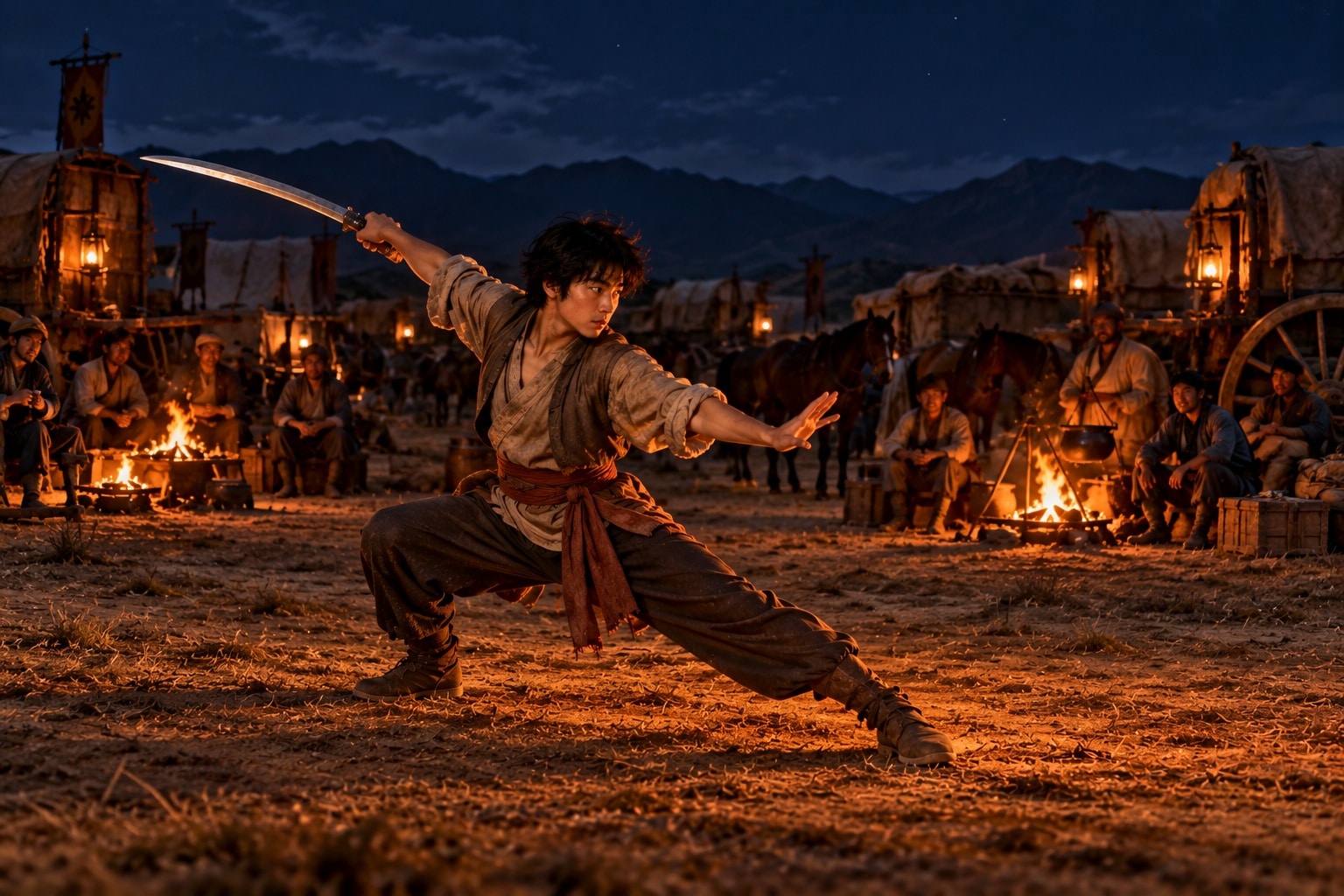
Three nights a week I practiced martial arts on my own. It felt wonderful to get back to it. I began with the Five Animals forms, followed by improvised shadow fighting. My worries about the past and the future vanished. With no opponent to worry about, I leaped, rolled, spun, and dropped to the ground and swept imaginary feet.
Often a small crowd gathered. Some people watched me for a few nights, then found other things to do. Others came occasionally. I had the feeling that “let’s watch Darius,” was one among many evening entertainments available. I could imagine guards saying, “What do you want to do tonight? Play cards? Listen to Memdooh’s poetry? Watch Darius?” The faces merged into spots of orange and red, illuminated by the campfires. They sat, some munching on the remainder of the dried fish and pistachios, others commenting to each other.
I didn’t care. For me there was only the movement. After empty hands, I moved on to the live blade. In my hands the dao flashed like a glint of light. There was a move I’d seen the Persian soldiers practicing: a downward slash that flipped into an upward slash, followed by a sideways whipping motion of the blade. I stole it, as I did with anything that looked effective to me.
Taking Shape
On the nights when I sat alone reading, Ardeshir sometimes came to join me. I would read aloud to him in Mandarin, and he’d listen quietly, understanding perhaps a fraction of it.
The boy was filling out. He’d been desperately thin when I first met him, but his body was taking shape. His face had lost the gaunt expression and hollowness around the eyes. I had the feeling that Ardeshir looked upon me as an older brother, even though we were the same age. He’d spent his life trapped in a miserable existence in Darbi Malik, and one day I’d come along on a horse and whisked him away into a life of adventure and plentiful food. But I didn’t know what to do with his need. I barely understood my own needs. How could I be responsible for his?
I thought about the people of Darbi Malik, half starved. What were their lives like now? Would the invasion even matter to someone whose entire existence was based on finding enough rice to survive the day? Thinking about this, I cast a prayer to Allah to help those people and provide for them.
One night, as I was reading to Ardeshir, Weili appeared and sat with us. She listened to my reading for a while, then broke into tears and left. I sighed and put the book away. Ardeshir leaned forward and patted the back of my hand.
We passed villages and small towns, sometimes stopping to trade. Our merchants sold tiny amounts of the goods they’d purchased in Herat, but mostly they bought whatever they thought would bring a profit farther east. After seeing them climb trees for pistachios, I knew they would leave no stone unturned in their pursuit of profits.
We usually sent two people with an empty wagon into the villages to buy food. Sometimes Ahmed and Bao were sent, sometimes Ahmed and Chen, but most often Longwei and someone else. A lot of languages were spoken in this region. A particular village might speak Persian, Turkmen, Pashto, or Kurdish. No one else had Longwei’s facility with languages.
Once I was sent in with Longwei. We had a wagon and a team of four mules, and a purse full of coins from the Five Star treasury. Longwei bargained with local merchants while I kept watch. He found for us some of the best local produce and meat, and it seemed to me that he secured good prices. There was a lot of money still left in the purse when we returned.
Later, Karim pulled me aside. “What was your impression of Longwei today?” he asked.
I gave a slight shrug. “He did well. I was impressed.”
Karim nodded. “Good to hear.”
Welcoming the Newcomers
As for communication, Karim had decided that all six of our new Persian guards would begin learning Chinese immediately. Hakim Yusuf took charge of that task. He started with the words they needed to do their jobs: horse, wagon, stop, go, left, right, danger, sword, Captain, guard.
One night I saw the recruits all sitting together, away from the other guards. They’d made a fire, and were talking quietly and munching on crab-apples and what was left of the pistachios. I remembered my own first weeks with Five Star, being an outsider, knowing no one. I decided to sit with them and try to get to know them.
I found Chen with Meilin. She was teaching him to do a backflip – it still astounded me that she could do such things – and he was picking it up quickly.
I took Chen with me as a translator, and went to join the newcomers.
“We do sit?” I asked in broken Persian.
Khizr gestured toward an empty space. I sat beside Ardeshir, with Nasra on my other side. She was the smallest of the recruits, with a round face and a dark hijab wrapped closely around her head. In the evaluations we had almost eliminated her. Her archery was poor and her swordsmanship was decent but not stellar. Then she showed us what she could do with a knife. In her hand the knife darted faster than we could follow. Ahmed argued that anyone who could handle a knife like that could transfer those skills to the sword.
Even as I watched, she was expertly coring and slicing an apple with a short dagger. When she was done she rolled the knife around the back of her hand, caught it with her pinky and ring finger, and slid it into the sheath.
Cool. I wanted to learn that.
Chen squeezed himself in between Cotan and Shireen, earning a dark glance from Cotan. The man was very protective of his sister, clearly.
Khizr tossed me an apple. Looking at him, with his lean frame, dark eyes, white teeth and shoulder-length hair, I knew objectively that he was good looking, though it meant nothing to me. Clearly it meant something to the women, though, as they smiled or giggled at everything he said.
Shireen said something I didn’t understand, and Chen translated: “Caravan work is a lot harder than being a mercenary. Mercenaries kill and get killed. You guards work like mules.”
I laughed. “No all times. But yes, caravan life hard.”
The guards laughed, and Shireen, mimicking my toddler-level Persian, said, “Hard life no problem.” She pointed around the circle. “We all hard life.”
In her case, I was sure it was true. She was a stunningly beautiful woman, but there was a hardness to her and her brother that was not compatible with comfortable living. As for her beauty, its very extremity kept me from feeling nervous. She was so far out of my league that there was nothing to be shy about. I might as well feel shy talking to a falcon or a tiger.
“We happy you here,” I added. “You all welcome.”
The Fight
“How long have you been a caravan guard?” Cotan asked.
I didn’t understand every word, but enough. “One year.”
He said something else that I didn’t understand. Seeing my blank expression, he held up his fingers and counted, then pointed to me and made a questioning gesture.
“Oh.” I nodded. “I do sixteen. Soon seventeen.”
The recruits looked surprised. Cotan laughed and shook his head, and said something I didn’t catch at all. I looked questioningly at Chen.
“He says you’re a baby. You even have short hair like a kid. Why are you teaching them fighting? He should be teaching you. But it’s okay. Make sure you stay out of his way and everything will be fine.”
The friendly smile faded from my face. “He said that?”
Looking around, I saw everyone’s eyes upon me. Khizr the Handsome was smiling faintly, while Shireen gave me a look of pity, as if her brother had just stolen my sesame sweet.
“Tell him,” I told Chen, “that if we need someone to split stones I know who to call. But on the battlefield I would kick his chunky ass to India and back.” This was a stupid thing to say and I knew it. But I had my pride. I had never in my life let anyone push me around, and I wasn’t going to start now. More importantly, I was his senior. If he did not respect me, he would not follow my commands, and that could cost lives.
Cotan’s face turned the color of fresh salmon. He stood, removed his sword and dagger and threw them down, then took off his boots. Stepping onto a flat patch of grass outside the circle, he beckoned to me, and put up his fists.
I shrugged, then stood and removed my weapons and boots. I found myself already falling into River Flow.
“Darius,” Chen said, and the words seemed to come from far away.
I turned to him.
“Don’t hurt him.”
I nodded slowly, then stepped to face Cotan.
Cotan gave me a cold grin. “Fight in air,” he said in broken Persian – maybe to mock me, or maybe so I’d understand – “not like fight real man.”
He meant my nightly practice sessions. But I was in River Flow, and the words meant nothing. As soon as I raised my hands, the big man charged and threw a straight punch at my face. He was fast, I had to give him that. When I’d fought the huge Persian guard, I’d held back, wanting to learn the rules of the contest. I did not make that mistake again. I parried the punch, and with the other hand punched Cotan hard in the liver, sinking my weight into it. He grunted and took a step back, then pivoted toward me, swinging the other hand in a wide hook. I blocked it, then delivered four rapid strikes to his nose, jaw, solar plexus and groin – a series my father had called Wing Feathers. As he staggered backward, I followed, cocked my arm, and delivered a thunderous knife-hand strike to the side of his neck.
Cotan collapsed. He was not unconscious, however. He tried to rise immediately, but his legs were rubber and he fell face first into the grass. He tried again, and fell sideways.
“Tree Viper Strikes,” I said. That was my father’s name for the strike to the neck. The fight had lasted perhaps five seconds.
Khizr came forward with a cup of water, presumably for Cotan to drink. I took it out of his hand and threw the water in Cotan’s face.
“Darius!” Chen protested. “Why did you do that?”
“Medical reasons,” I said. Though it was really just because I felt like it. My father had done it to me many times.
I stepped away and recovered my belongings. Shireen was on her feet, her jaw tight. She didn’t reach for her bow this time, though. The others were staring at me in amazement. I saw then that a dozen guards had gathered around to watch. Behind them, like a shadow, stood Captain Karim. My face flushed with embarrassment as I approached him.
“Captain,” I stammered. “You see, he said, well -”
He held up a hand. “The fight was necessary,” he said softly. “But the water wasn’t. Don’t do either of those things again.”
I Could Teach You
One evening after Maghreb, Weili approached me as I sat alone on a towel, making use of the last of the light to read a few Rumi poems.
“What’s that you have beside you?” she asked shyly.
She meant my new bow. It was never far from my hands. Of course she would be interested. Wordlessly, I handed it to her. She slipped the bow out of its case. The fading evening light glinted off its dark hardwood and bone surface.
Weili gasped. “Darius! This is so beautiful.” She stroked the bow’s curves, then, swallowing hard, handed it back to me. “I could… I could start teaching you again.”
I looked down at the damp grass. “I was going to ask Kuangren.”
“Oh!” Her tone was offhandedly light. “Of course. He’s great. What about that book? What’s that?”
I didn’t know what to do. I wasn’t interested in resuming our friendship. But it wasn’t in my nature to be cruel. I looked up at her and was about to hand her the book when her expression went flat.
“Never mind.” She shook her head quickly. “I don’t know why I’m doing this to myself. I’m not going to bother you anymore.” I looked at my book, and pretended not to hear the fading sound of Weili’s footsteps.
Wheels on the Same Wagon
The six Persian recruits improved rapidly in Chinese under Hakim Yusuf’s language instruction.
Shireen and her brother Cotan were fascinating. They had the same green eyes, the same strong features, the same thick brown hair, and even some of the same expressions. Cotan was larger and more heavily built, of course, but sometimes when one of them turned toward me suddenly, I saw the other in the face. They worked together just as closely. Watching them handle horses was like watching two wheels on the same wagon.
After a while, though, I began seeing Shireen with Chen more often.
At first I thought nothing of it. Chen was friendly with everyone. But soon the two of them were riding together whenever they had the opportunity. Chen of course already spoke Persian, and Shireen’s Chinese was improving rapidly. Once I saw him pointing at various parts of his horse and teaching her the names in Chinese, then laughing as she got the intonations all wrong.
Then one morning I saw a dark bruise along Shireen’s cheekbone. Her lower lip was cut as well.
“What happened?” I asked.
Chen’s jaw was tight. “She says her foot caught in the stirrup as she dismounted, and she fell.” There was a tension in the words that I did not understand, but I rode on, thinking, “Yup. I’ve done that.” A few moments later, something occurred to me.A few moments later, something occurred to me. Shireen was the best horseman I had ever seen. I remembered her astounding demonstration during the evaluations. That woman had fallen off her horse?
Khizr the Handsome was another story. Women noticed him everywhere we went. I even caught Meilin looking at him once.
Longwei noticed it too. “Really?” he growled.
Meilin looked at him innocently. “What? I check out all the new guards. I like to know who I’m traveling with.”
Longwei muttered under his breath and rode away.
Imagining the Future
On the journey west, every week had seemed to carry us into some exciting new world. Now we were heading east, going home, and time seemed to slow. At night, while standing watch beneath the stars, I imagined our return to Starling, where Five Star was headquartered. I imagined the admiring looks of the populace as we passed by, followed by celebrations, praise from the Five Star leadership, and bonuses. I imagined Shah Suliman’s approval and Karim’s respect.
I remembered the tiny apartment I’d rented when Five Star first hired me. I had paid eighteen months’ rent in advance. The apartment was still there, waiting, no doubt with everything inside it covered in dust, but still mine.
I remembered a safflower farm populated by people who cared about me… But thinking of that made me sad, and my mind shied away from it.
What future did I really want? A whole life based on guarding caravans, like Karim or Longwei? It was certainly adventurous. And what was the alternative? Working for Five Star in some other capacity? I had not forgotten Karim’s admission that I might not be safe with Five Star, nor the attempted assassination of Farhad, which he had implied may have been commissioned by his own relatives.
Thinking of all this, I realized how alone I was in the world. It was not a good feeling.
For now, I had my work, and I had my beautiful fool, Belly. Most importantly, I had my devotion to Allah, who was above us all, and who saw and heard all that passed, and did not fail to notice even the footfall of a mule. That was enough.
The traffic on the road thickened. Villages appeared more frequently, and cultivated fields lined the road. Then one morning, after nearly three weeks on the road, a city appeared ahead. We had reached Mashhad.
Mashhad
Even from a distance we could see the great golden dome that marked Mashhad’s shrine of Imam Reza. Pilgrims traveled the road in both directions, some alone, others in groups. We did not enter the city. Five Star caravans rarely entered cities, with Herat being a notable exception. Karim directed the wagons to a suitable place some distance from the walls, where we made camp. Then he selected a handful of guards to accompany several of the merchants into the city.
Their instructions were simple: buy supplies, learn what they could about the roads ahead, and come back before dark.
They returned with flour, rice, vegetables, fodder and other provisions. I sighed, missing the rich and delicious fish I’d enjoyed for a while.
They also returned with bad news. This entire region of Khorasan was unsettled. Armies were moving through the countryside, roads that were safe one week were dangerous the next, and no one seemed certain whose authority would exist a month from now.
Karim listened to all of it, then announced, “We leave after Fajr.”
That was the end of our visit to Mashhad.
No Time Like the Present
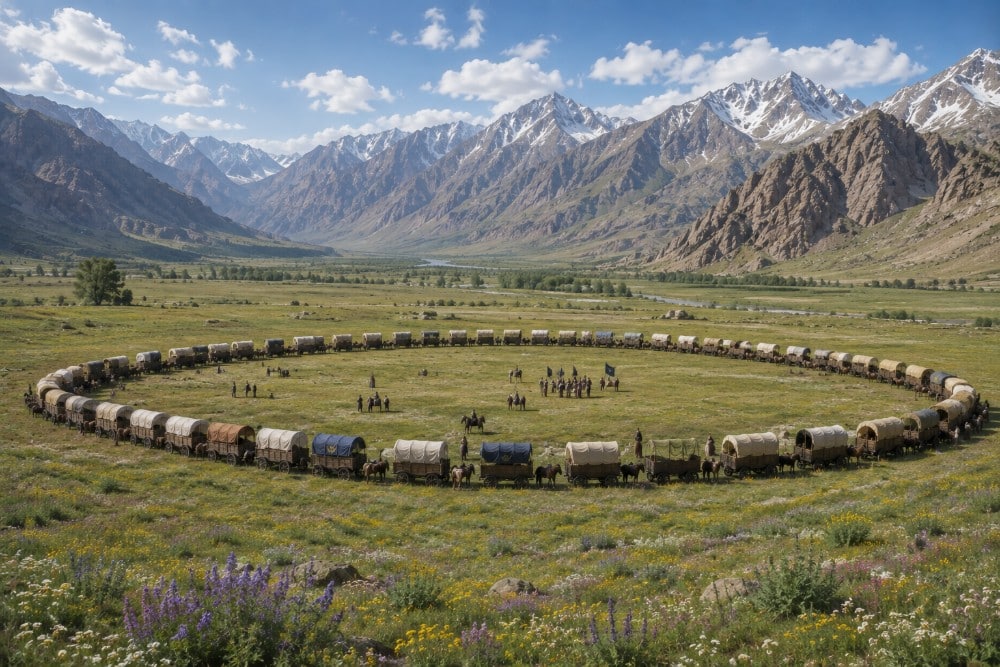
We were on the road before sunrise had fully broken across the land. The golden dome disappeared behind us. After Maghreb, we stopped to make camp in a largely deserted valley with a small creek that ran down the middle. Once the animals had been watered and the evening meal was cooking, Karim called the guards together.
“Form up!”
We assembled into standing ranks. As a Veteran Guard, I stood in the front row. I wondered what was wrong now. More bad news from Herat? Another theft?
“I’ve been meaning to do this since we left Herat,” Karim said. “But there never seemed to be a good time.” He performed a few wrist stretches on himself as he studied us. This was something I had seen him do before, and which I recognized as sword training exercises to build wrist strength. I wondered if he even knew he was doing it.
He went on: “The proper functioning of this caravan requires a clear hierarchy of authority. We have lost good men on this journey. Corporal Jian, Allah have mercy on him, was killed in Afghanistan. May Allah accept his sacrifice and grant him a good station in Jannah.”
“Ameen,” several voices murmured.
“And Corporal Hu remained behind in Herat.”
There were blank looks.
Karim sighed. “The Ghost.”
“Ohhh,” we murmured, nodding our heads.
“Furthermore,” Karim continued, “I’ve decided that I need a right-hand man. Someone who can help me with the most pressing tasks, carry my authority when I’m occupied elsewhere, and coordinate the corporals when necessary.”
He turned toward Bao. “Corporal Bao. Step forward.”
Bao did.
“From this day forward, you are Staff Sergeant Bao.”
The Beating Heart
For perhaps the first time since I had known him, Bao appeared genuinely surprised. Then he bowed from the waist. “Thank you, Captain.”
The men applauded and called congratulations. Karim allowed it for a few moments before raising his hand. “Corporal Hakim Yusuf,” Karim called.
Many of the men looked around, as obviously confused as I had been. “He’s not here,” someone said. “I’ll get him,” someone volunteered and ran off.
A few moments later Yusuf came striding up quickly, medical bag in hand. “Is someone hurt?”
“No. Step forward.” Karim took Yusuf’s free hand, and I was surprised at the tenderness of the gesture.
“This man,” Karim said, “is the beating heart and living conscience of this caravan. Many of us owe him our lives. He is skilled, wise and uncompromising. Corporal Yusuf, you are hereby promoted to Sergeant. One rank below Staff Sergeant Bao.”
Karim looked out at the men. “Make no mistake. This rank is not honorary. If Bao and I are killed, Sergeant Yusuf is in charge.”
The assembly was quiet. There was no applause like there had been for Bao. It seemed the men were unsure how to respond.
“This means a lot to me, Captain,” Yusuf said. “Ultimately, however, a man or woman’s greatest power is power over the self. And our greatest hope is in Allah the Most High.” With that, Yusuf touched his head and his heart, and departed.
Who?
Karim smiled. “As I said. The living conscience. Now. We require two new corporals.”
My attention sharpened. I had a strong feeling that Ahmed would be one, and I hoped that Longwei would be the other. He’d been overlooked in the last promotions, and later had spewed forth his bitter tirade in which, among other things, he called me a puppy with sharp teeth. Not that I objected to that characterization. I had seen some very fierce young farm dogs. But anyway, if not Longwei, then it should be Meilin. Or maybe even Kuangren, who had performed admirably during the raid, and who – since his marriage – had become one of the gentlest and most decent men in our company.
“Veteran Guard Ahmed.” Ahmed stepped forward, and I found myself grinning. I knew it! MashaAllah. There could not have been a better choice.
“You are a natural leader, our Imam, a skilled linguist, and a good fighter. Your character test for the recruits was a stroke of genius. This was an easy decision. You are promoted to Corporal.”
I applauded wildly, and others joined in. Ahmed smiled broadly and touched his head then his heart. He too had picked up that gesture in Persia.
Karim called another name. “Veteran Guard Lee Darius.”
I looked around, confused. Who?
Shah pushed me from behind and I stumbled forward to the sound of laughter.
“Lee Darius,” Karim said. “Do your legs work? Step up.”
I walked forward, not understanding what was happening.
“You possess abilities beyond your age. You are a highly skilled fighter. More importantly, at moments of danger and stress, rather than panicking, you take command. You already wear a corporal’s horn around your neck. Might as well make it official. You are promoted to Corporal.”
I stared. “Me?”
Karim’s mouth twitched. “I could give it to Belly if you’d prefer.”
“Well, I mean, Belly certainly is -”
“Stand up straight!” Karim snapped, “and accept your promotion.”
I straightened. “Yes, Captain. Thank you.”
“Don’t make me regret it, and don’t pee in strange places.”
The other guards broke into loud laughter as I returned to my spot, red-faced.
Karim announced the remaining promotions, filling the gaps that death, injury and circumstance had opened during our journey. Shah was promoted to Veteran Guard. Memdooh was promoted to Senior Guard, as were Chen and Weili. Her promotion surprised me but made me happy.
“Veteran Guard Longwei,” Karim said, and I saw Longwei stand up straight, his gaze intense. “Due to your extensive knowledge and assistance with local languages and populaces, you are awarded a special citation for service, and a bonus.”
People applauded, but when I looked at Longwei, his face looked set in stone, and his mouth was a flat line. He’d expected more than this.
When the captain was finished, he looked over the entire company. “One more thing. Every guard will receive a bonus for the successful completion of our trading mission in Persia.”
That brought a cheer.
“All of you celebrate tonight. You’ve earned it.” His expression changed. “Unfortunately, life rarely offers moments of either pure joy or pure sadness. Life is a cloud on a sunny day, or a ray of light on a gloomy one. I have sad news.”
The men quieted.
“The intelligence we acquired in Mashhad included news of Herat. The city has fallen to the invaders. The citadel was breached.”
My hand went instinctively to the ring beneath my tunic. “What about Farhad?” I asked.
Karim looked at me. “No one knows. Some say Prince Farhad was beheaded. Others say he escaped before the citadel fell. Until we hear something reliable, these are all just stories. Nor do we know anything of Corporal Hu.”
Seeing the confused looks, he snapped, “The Ghost!”
“Ohhhh,” we said.
Nobody spoke. Karim allowed the silence to remain for a few moments, then said, “Dismissed.”
I looked around, and my eyes found Longwei’s. I held his gaze, not with challenge but with compassion, until he looked away.
Love From a Distance
Some distance north of Mashhad we stopped at a village to rest and to buy supplies. Locals gathered around the caravan, as they always did, and I couldn’t help noticing a group of young women standing at a distance, all watching Khizr brush his horse. One whispered something, and they giggled.
A respectable, middle-aged merchant approached Khizr and spoke to him earnestly. As he did so, Khizr looked increasingly uncomfortable.
I sidled up next to Chen. “What’s going on?”
Chen grinned. “The merchant wants Khizr to marry his daughter.”
“Just like that? What did Khizr say?”
“He says thanks but he has his hands full.”
We moved on.
After the promotions, Longwei became distant. He performed his duties, but there were fewer campfire tall tales. He and Meilin were not as close as before, though I noticed that his eyes often lingered on her. The way he watched her reminded me of the way I used to watch Weili after she took up with Arslan. Except in this case Meilin had not left Longwei. He was the one who was keeping himself away. It was strange. I didn’t think I would ever understand love.
Mashhad was now far behind us. We traveled northeast through dry plains and rolling brown hills, sometimes going an entire day without seeing any but our own faces. We crossed into the country of the Turkmen, where the settlements grew farther apart and great herds grazed on the open steppe. Eventually we passed by Merv, an ancient city surrounded by irrigated fields and gardens in the otherwise dry land. We stopped long enough to trade and resupply, and moved on.
Speaking of love, just past Merv the thing with Khizr happened again. This time it was an elderly farmer, and the daughter he was trying to marry off was at least thirty years old, though honestly quite beautiful. Khizr, looking exasperated, shook his head. A rapid conversation ensued.
“Now what?” I asked Ahmed.
“He’s pleading with Khizr to marry her. He says she is a hard worker, an excellent cook, can ride a horse and manage a plow.”
When Khizr turned the villager down, the man pointed at me.
“What?” I asked. “What is he saying?”
Ahmed was trying not to laugh. “He says how about you marry her instead?”
Now everyone was laughing.
“Tell him I’m sixteen!”
Karim strode up. “Khizr!”
Khizr looked up. “Captain?”
“What are you doing?”
“Nothing.”
“Don’t give me that. I went through this with Kuangren all the way across Central Asia. I am not doing it again.”
Kuangren, sitting on a log nearby and eating roasted chickpeas with his wife, looked offended. “Why am I involved in this?”
Karim remained focused on Khizr. “Stop flirting with the local women.”
Khizr raised both palms helplessly. “I didn’t do anything. I’m just me. Women throw themselves at me. My uncle used to say that I was cursed by a jinn. Besides, I have two wives back home.”
Kuangren looked up at this. “Two? Really? What’s that like?”
“Shut up, my love,” Gulnur said.
“Yes, dear.”
Meilin’s Tale
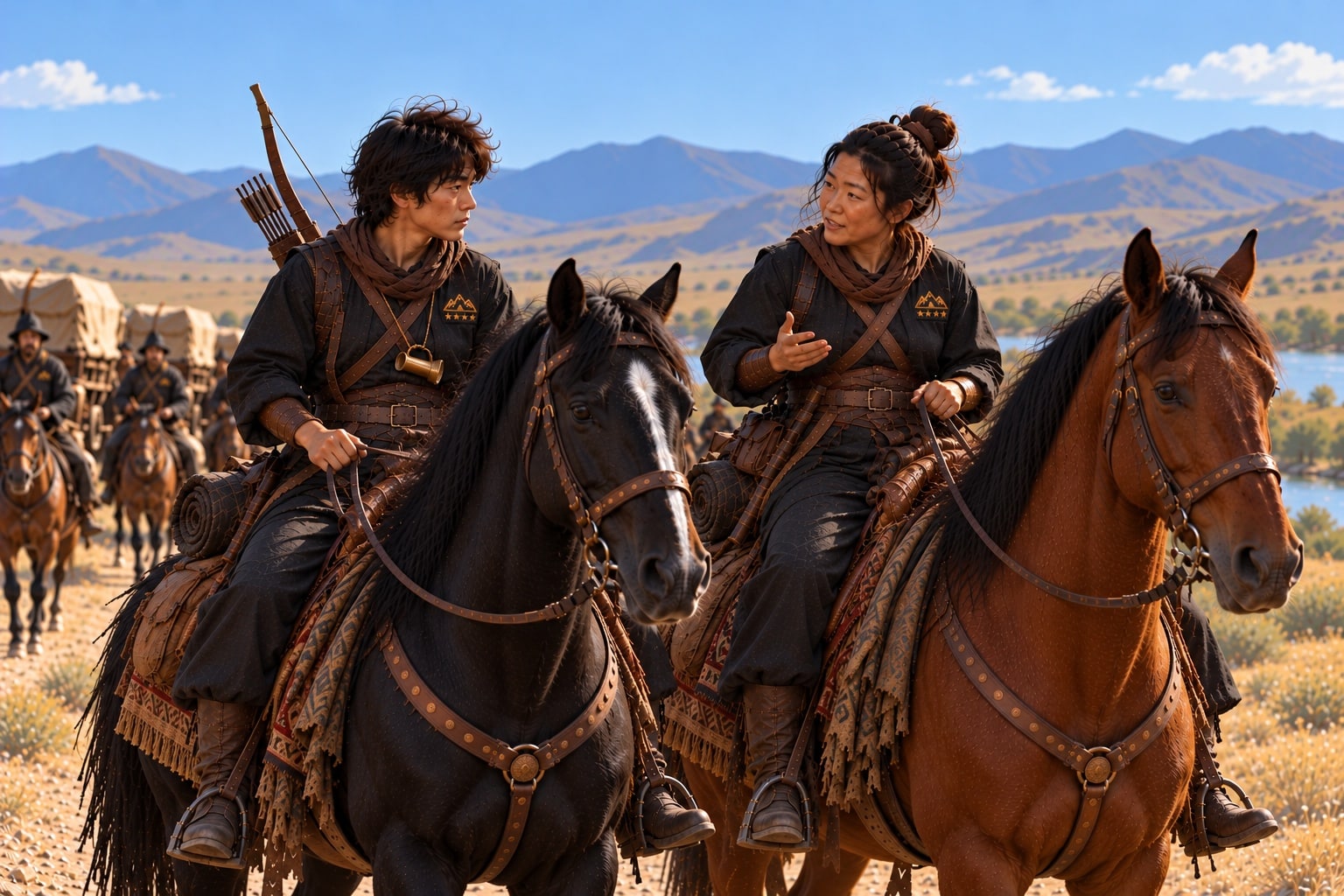
Later, on the road, Meilin rode up beside me. “You shouldn’t be surprised,” she said. “You wear a corporal’s horn. Plus, you’ve really filled out lately. You’re taller, and your shoulders are wider. You look older than your age.”
I frowned. “No, I’m the same.”
“Haven’t you had to adjust your uniform twice?”
“That’s just because…”
“Because what?”
“Because mind your business. What about you, anyway? When are you going to marry Longwei?”
“Longwei?” She raised her eyebrows. “Whatever gave you that idea?”
“He’s crazy about you. He watches you all the time.”
Meilin frowned. “Does he? I mean, Longwei is sweet. I enjoy his company. But no. He’s twice my age. He’s like an uncle. Anyway I’m done with all that.”
“With what?”
“Marriage. I’ve been through that. I was married before you were born.”
That stopped me. “I don’t see how that’s possible.”
Riding alongside each other, she looked at me sideways. “I don’t want everyone knowing this.”
I nodded earnestly. “Of course.”
“My parents gave me away to an opera company when I was small. I grew up performing. Acrobatics, tumbling, theater style wushu, singing, acting. When I was eleven years old the elderly man who owned the troupe married me. I wasn’t asked, it was simply done.”
“Oh my goodness!” I stared at Meilin in shock. “That must have been horrible.”
“It was difficult, yes. But that’s the reality sometimes for girls. And he treated me well enough. But when I reached seventeen years old, and had not given him a child, he concluded I was barren. He divorced me and kicked me out of the troupe.”
She went on to tell me how she’d had to fight for survival on the streets of Deep Harbor. Her performance fighting skills became real self-defense skills. She got a job as a cook at a cheap noodle shop, until one day she applied for a job as a guard with a small caravan company, not Five Star, and was accepted. By the time she tried out for Five Star she was already an experienced guard.
“So that’s why you fight like that,” I commented.
“Like what?”
“Like you’re performing for an audience.”
She gave me an offended look. “I fight beautifully.”
“Yes, you do.”
We rode quietly for a moment. Then Meilin said, “That Khizr, on the other hand. He could make me reconsider the whole marriage thing.”
I stared at her. “Really? You don’t even know him.”
She laughed. “I’m joking. You heard what he said. He has two wives back home.” She considered this for a moment. “But he is nice to look at. Those bright eyes, white teeth, perfect skin, and those hands with the perfectly shaped fingers and – “
“Ugh! Stop! No more!” I urged Belly forward, leaving Meilin and her laughter behind.
* * *
Come back next week for Part 33 – The Dzungurs
Reader comments and constructive criticism are important to me, so please comment!
See the Story Index for Wael Abdelgawad’s other stories on this website.
Wael Abdelgawad’s novels – including Pieces of a Dream, The Repeaters and Zaid Karim Private Investigator – are available in ebook and print form on his author page at Amazon.com.
Keep supporting MuslimMatters for the sake of Allah
Alhamdulillah, we're at over 850 supporters. Help us get to 900 supporters this month. All it takes is a small gift from a reader like you to keep us going, for just $2 / month.
Wael Abdelgawad's novels can be purchased at his author page at Amazon.com:
Wael is an Egyptian-American living in California. He is the founder of several Islamic websites, including, Zawaj.com, IslamicAnswers.com and IslamicSunrays.com. He teaches martial arts, and loves Islamic books, science fiction, and ice cream. Learn more about him at WaelAbdelgawad.com.
For a guide to all of Wael's online stories in chronological order, check out this handy Story Index.








 #Life3 weeks ago