#Culture
Far Away [Part 30] – The Rock Splitter And The Parthian Shot
Darius helps select new guards for the Five Star caravan, and a fun trip to the suq comes to a sudden, chaotic end.

Darius helps select new guards for the Five Star caravan, and a fun trip to the suq comes to a sudden, chaotic end.
Read Part 1 | Part 2 | Part 3 | Part 4 | Part 5 | Part 6 | Part 7 | Part 8 | Part 9 | Part 10 | Part 11 | Part 12 | Part 13 | Part 14 | Part 15 | Part 16 | Part 17 | Part 18 | Part 19 | Part 20 | Part 21 | Part 22 | Part 23 | Part 24 | Part 25 | Part 26 | Part 27 | Part 28 | Part 29
* * *
A Slap To The Mouth
Keep supporting MuslimMatters for the sake of Allah
Alhamdulillah, we're at over 850 supporters. Help us get to 900 supporters this month. All it takes is a small gift from a reader like you to keep us going, for just $2 / month.
The Prophet (SAW) has taught us the best of deeds are those that done consistently, even if they are small. Click here to support MuslimMatters with a monthly donation of $2 per month. Set it and collect blessings from Allah (swt) for the khayr you're supporting without thinking about it.
My own evaluations presented a problem. I had learned a few Persian words since entering the Guarded Domains, enough to say things like stop, again, come, go, left and right. And from watching the soldiers drilling, I learned the numbers one through ten. But it was not enough to teach martial arts. Most of the time I demonstrated what I wanted, positioned people with my hands, or simply performed a movement and motioned for them to copy it.
At first I tested basic movement, balance, striking and grappling. I paired the candidates against one another, then worked with each of them myself. I wasn’t interested only in what they knew, but what they could learn.
Ardeshir’s turn interested me most, because I felt personally responsible for him. He had almost no technique, but he watched me with fierce concentration. Once, I swept his foot and dropped him hard. The next time I tried the same sweep, he moved his foot before I could take it. I nodded, pleased, and made a notation.
One thick-chested man was paired with Shireen for a grappling contest. No strikes allowed. He was far stronger than her, but she caught him with a clever trip and put him on his back. A few candidates laughed. The man sprang up, his face darkening. I motioned for them to continue. He charged, and she threw him again.
He came up furious and punched her in the mouth. A major violation of the rules. I flushed with anger. I could not stand seeing a man bully a woman.
In a rapid motion, Shireen hefted her bow and pulled an arrow from the quiver, but I beat her to the punch as I darted forward, seized the man by the hair, swept his leg, and dropped him onto his back. Then I slapped his mouth.
I stood back. Apparently not having learned his lesson, the brute rose and charged me. I sidestepped and tripped him, sending him sprawling face first onto the tiles. Roaring with anger, the man rose and drew his sword.
I hadn’t expected that. But I drew my dao.
Ahmed came striding forward and shouted a command. He spoke rapidly to the man in Persian, gestured to all the Five Star guards on the compound, and pointed at the gate. The man spat, sheathed his sword and strode away.
Ahmed rounded on me. “SubhanAllah, are you out of your mind? You’re supposed to test these people, not challenge them to duels to the death. Get a hold of yourself or I’ll report you to the captain.”
I wanted to protest, but he was right. I gave a quick, resentful nod, and went on with the evaluations.
By midday my voice had become hoarse from shouting commands, my tunic was soaked through, and I was beginning to understand why Captain Karim always sounded irritated.
Bao’s station was brutal. One of the younger candidates reached his limit. His legs had been trembling for several minutes, but he refused to stop. Finally he dropped to his knees, covered his face with both hands and began to weep. Bao crouched beside him and spoke quietly. After a while the young man wiped his face, drank some water, got back up and continued the drill. Later, when I asked Bao if he had eliminated him, the corporal looked surprised.
“Why?”
“He broke down.”
“Everyone breaks down sometimes. He got back up, that’s what matters.”
True enough, but I knew the youth would eventually be eliminated. He might be a sweet young man, but this was a hard line of work, and there was no place for crying at moments of crisis. Later, yes. Once the fire was out you could find yourself a quiet spot and pray, dance, cry, recite poetry, or simply sleep. But not when it was still burning.
The Rock Splitter and the Parthian Shot
Kuangren’s archery tests began with stationary targets, but soon he increased the distance and added complications. Candidates shot from one knee, while running, and eventually from horseback. The Kurdish woman, Shireen, was very good. As I watched, she did something I had never seen before. She mounted a horse, rode away from the target rather than toward it, then – controlling the horse only with her knees – twisted one hundred eighty degrees from the waist and fired, hitting the target. The spectators broke into applause.
“Have you ever seen that before?” I asked Ahmed.
“In illustrations. It’s called the Parthian Shot. It was invented here in Persia long ago.”
Meilin’s sword test also drew spectators. She had the candidates demonstrate cuts, thrusts, defenses and footwork with wooden swords before pairing them against one another. Eventually each had to face her. She pressured them, but gently. One man swaggered into his turn smiling, no doubt wondering what this chubby Chinese woman could possibly do to him.
He wasn’t smiling afterward.
As for Shireen’s brother Cotan, he grew frustrated in his sword duels. He kept overshooting, and telegraphing his movements. When he was done, he must have seen something in Meilin’s face, and realized she was going to cut him from the list.
He threw down the wooden sword, approached Meilin and drew his own live sword. It was single-edged and curved, with the blade becoming broader and more heavily weighted toward the tip. It looked more like a bludgeon than a sword.
Alarmed, I started forward. But Cotan turned his sword around and presented it to Meilin, who took it. Cotan spoke rapidly in Persian.
“He says,” Ahmed translated, “that your wooden swords are like miswak sticks. This is a real sword.”
Meilin hefted it. “This is too heavy for hand-to-hand combat.”
Cotan said something, took his sword back, and walked toward the horses.
Ahmed grinned. “He says to get a head-sized stone from the garden, and when he comes charging, throw it at him.”
My mouth fell open. “Is he crazy or what?”
Memdooh ran to the garden and returned breathing hard, with a large stone in his skinny arms. “Take it,” he said to Bao.
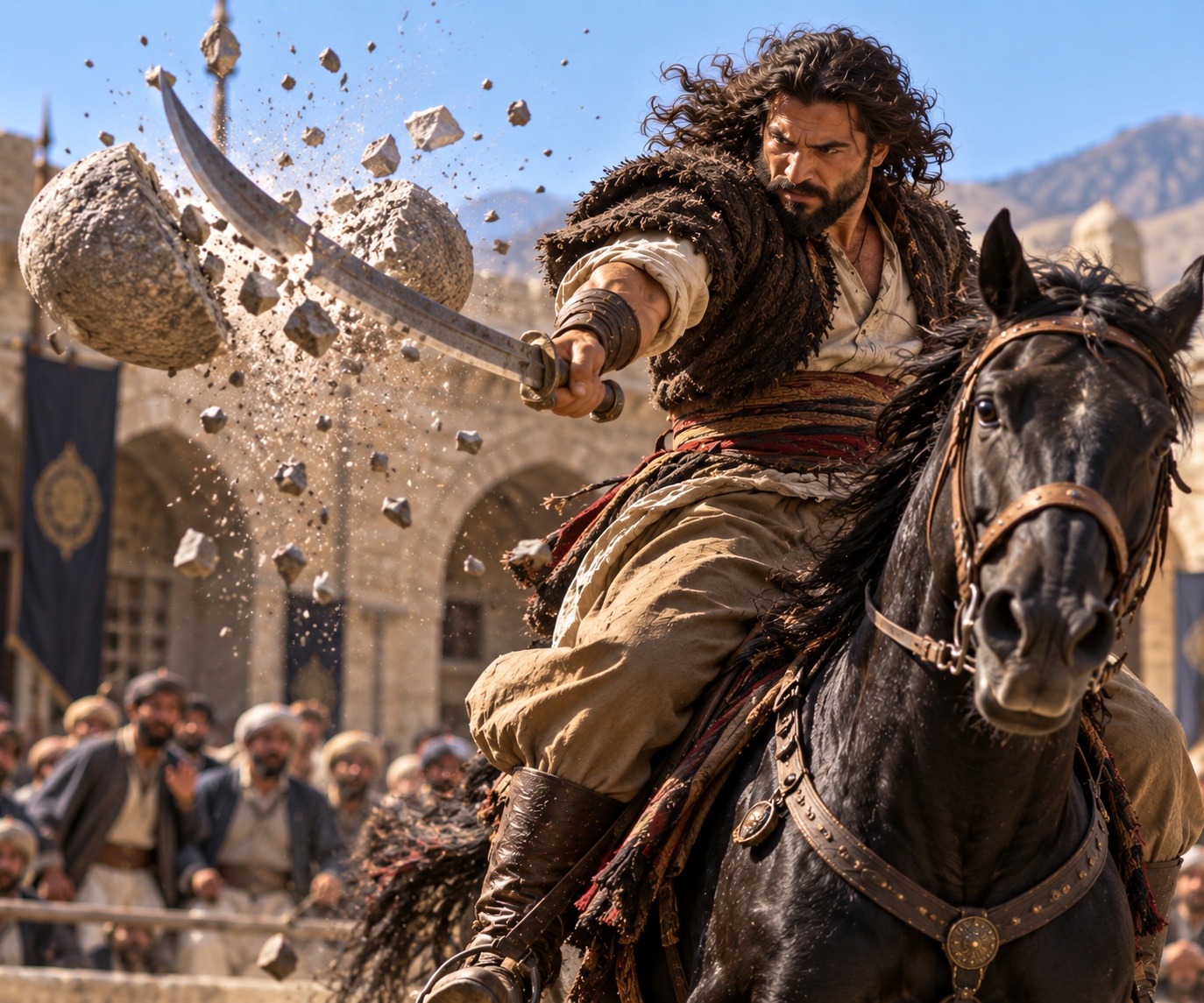
Cotan mounted a large black charger, rode to the opposite end of the courtyard, then kicked the horse and came speeding toward us, that monster of a sword in one hand. “Throw!” he shouted.
Bao heaved the heavy stone at Cotan’s head. I covered my eyes with one hand and peeked through my fingers, afraid I was about to see this guy get his face smashed. Instead Cotan screamed what sounded like, “Khween oo mee-rin!” and swung the sword with all his might. The edge of the blade met the stone, and with a loud ringing sound, the stone split in two, the half-pieces flying in different directions.
Again the crowd broke into applause.
As for Ahmed’s character evaluations, he appeared to be doing nothing. Every time I looked over, he was sitting in the shade talking to someone. I eventually discovered that the conversations were part of the test. He gave each candidate money and sent them to buy the same inexpensive item from a Five Star merchant, who deliberately returned too much change. Two candidates kept the extra money, and Ahmed crossed them off his list.
Second, he arranged for a laborer to struggle past carrying an overloaded crate and watched to see who volunteered to help.
Third, he invited candidates to criticize one another. Some refused to judge people they didn’t know. Others eagerly explained why their competitors should be rejected.
The adhaan for Dhuhr gave everyone a reprieve. We prayed, then ate beneath the awnings while heat shimmered over the courtyard stones. I downed half a bucket of water. Across from me, Ardeshir ate like a starving wolf, though apparently Chen’s lesson had taken hold because he kept everything on his plate and out of his pockets.
Three Things Cannot Hide
By late afternoon it was over. The candidates were dismissed, and the five of us gathered with our notes. The arguments began. Kuangren wanted a skilled archer whom Ahmed felt had a poor attitude. I argued for Ardeshir. Bao pointed out that he had almost no training.
“He grew up in District Nine,” I replied. “Who was going to teach him? He needs a chance.”
Ahmed looked up. “I want him.”
Bao turned toward him. “Why?”
“The boy aced the character tests. He doesn’t complain. He returned the extra money immediately, and when the laborer needed help, Ardeshir was the first to rush forward. He’s a decent human being, and that’s not something you can teach.”
The others nodded, convinced.
“What about the Kurdish brother and sister?” Kuangren asked. “The woman made the Parthian shot. And the brother sliced a rock like it was a hunk of cheese.”
I laughed at that, picturing Cotan charging around, slicing giant balls of cheese with his sword.
“The woman -” Bao checked his notes – “Shireen – has insufficient endurance.”
“She drew an arrow on that man,” I said. “She was going to kill him.”
“We don’t know that,” Meilin pointed out. “It might only have been to protect herself. Anyway, you drew your sword as well, Darius.”
“Only after he did!”
“Ahmed,” Kuangren said. “What did you say to the man to make him leave?”
Ahmed focused on me. “I told him Darius would kill him.”
“Still not the same,” I mumbled. I looked across the courtyard at Shireen. She was talking to her brother as if nothing unusual had happened. My gut told me she would have killed the man and thought as little of it as if she had stepped on a snail. The inconvenience of getting snail guts on her shoe. Nothing more.
“Let’s talk about her brother,” Bao said. “Cotan.”
“What was that,” I asked, “that he shouted when he hit the rock?”
Ahmed tilted his head. “I asked. It’s Kurdish. It means blood and death.”
“Oh.” I raised my eyebrows. “Do we want these maniacs riding with us?”
Ahmed grinned. “It would be interesting at least.”
Bao raised a finger. “The Buddha said, ‘Three things cannot hide for long: the moon, the sun and the truth.’”
We all looked at each other, then at Bao, but he offered nothing further.
“I guess that’s a yes,” Kuangren said.
Cut Another Five
Eventually we had ten candidates, including Ardeshir Parvizi. We found Captain Karim inspecting the loading of a wagon and handed him the list. He read every name, then handed it back.
“Eliminate five more.”
For a moment none of us spoke.
“Captain,” Bao protested, “these are the ten we selected.”
“They’re all competent,” Kuangren added.
Karim’s expression didn’t change. “I don’t want competent. I want the best of the best.”
“Isn’t that a high standard for new recruits?” Meilin complained.
“Ask yourself,” Karim replied, “who you want standing beside you the next time men come out of the mountains trying to kill you.”
We went back to the list and argued. Finally I said, “Let me do another test.”
We called the candidates back. One refused to do any more tests, and was eliminated. That left nine.
I divided them into two groups, one with four people, and the other with five. Then I had Ahmed explain the rules. The two teams would fight until I told them to stop. No strikes to the head, but anything else was allowed. If a team won, all its members won.
“It’s not fair,” one young man complained. “My team has only four, and one is a woman.”
I looked at my fellow evaluators and said in Chinese, “Eliminate him.”
“Do not look for a sanctuary,” Bao said, “in anyone except yourself.”
“Meaning what?” Ahmed asked.
“Meaning, I agree. A guard must be willing to fight even when outnumbered.”
Meilin shook her head slowly. “I don’t think that’s what that means.”
Bao gave an annoyed cluck of his tongue. “Who made you the Buddha’s interpreter?”
Ahmed informed the man he was eliminated, then turned to the other candidates. “If you are only willing to participate in fair fights, then being a caravan guard is not for you.”
One Year’s Wages
I gave a command and the melee began. One candidate immediately charged the nearest opponent as if he was in a personal duel, ignoring his teammates. I made a note to eliminate him.
Shireen positioned herself beside a weaker teammate and moved with him, forcing anyone who attacked one of them to deal with both. Very nicely done. There was another woman, as well. A small, wiry hijabi. I kept a close eye on her, concerned she might be a liability. But she moved quickly, fluidly, her feet agile, her hands flying from one strike to another without pause. I was impressed.
One candidate – a very handsome thirtyish man named Khizr, with bright black eyes and a perfectly trimmed black beard – had an opponent in front of him when he noticed Shireen about to be struck from behind. He could have protected himself. Instead he stepped across, shoved her out of the way and took a hard blow across his own shoulder. He winced, nearly went down, then recovered and kept fighting.
I looked at my fellow testers. They had seen it too.
We cut another because he hung back, letting his teammates bear the brunt of the fighting. Out of the remaining seven, we could not agree on a single one to cut.
We returned to Captain Karim, who was brushing his own horse. Bao handed him the list. “Sir, these six are all honest, fierce and reliable. To cut any of them would be unjust.”
Karim glanced at the list, then handed it back. “Good. Get them outfitted.”
When I told Ardeshir that he had made it through, he insisted on speaking to Captain Karim.
“My first month’s wages must go to my family,” the boy told the captain. “They will starve without my daily wages.”
“No.”
The boy blinked. “No?”
“It’s a long way from here to China. And you may ride other routes for a while after that.” Karim regarded him steadily. “I’ll give your family your first year’s wages in advance.”
The boy swallowed hard, then gave a salute using the wrong hand. Within ten minutes, Karim had tasked two guards to accompany the boy back to Darbi Malik to deliver the money. I felt emotional as I watched them ride out of the gate, with Ardeshir on the back behind a guard. A family that had been hungry all their lives might eat well tonight. I remembered when my father came back from prison a changed man, and we planted peanuts, and when the crop came in we went to a restaurant for the first time in my life. I ate foods I had never tasted before, and filled my stomach. That had been a good day. Was my father truly dead now? I hoped so, because the alternatives were worse.
“Oh Allah,” I said softly. “Have mercy on my father.”
The Talking Dog
The next morning I decided to go into the city for supplies. We’d be leaving soon, and there were things I needed for the road: tooth powder, soap, writing paper, lamp oil and other odds and ends. I found Chen sitting with Ardeshir near one of the wagons. “I’m going to the suq. You guys want to come?”
Chen translated. Ardeshir answered quickly. “He says he has no money for such things.”
I took a silver coin from my purse and flipped it to him. Ardeshir caught it, stared at it, then immediately tried to give it back.
“It’s a loan,” I said before he could argue. “Pay me back when you get paid. You need a traveling pack, boots, underwear, a knife, a comb, miswaks and whatever else you’ve been living without.” Chen translated. Ardeshir looked down at the coin, then at me. “Loan,” I repeated. Finally he closed his hand around it.
We checked in with Captain Karim before we left. He pulled me aside and said, “Get a bow.”
I blinked. “Huh?”
“Five Star guards must become proficient with empty hands, sword and bow. You have two out of three. Once we’re back on the road I expect you to resume training with Weili -”
“Captain!”
He dismissed this with a flick of his fingers. “Whoever then. Kuangren, Memdooh. Point is, you need a bow. I can issue you one and deduct the price from your wages, but if you want one of a size, strength and balance that you like, then go buy it now.”
I nodded. He was quite right. I had seen for myself the damage a good archer could do at range, and I knew it was a major gap in my ability.
The three of us entered the city. It turned out that Chen was nothing like the quiet little man I had imagined from seeing him around the caravan. He was short, somewhere in his late twenties, and apparently incapable of walking very far without talking. He told stories, made jokes, imitated people we passed, and occasionally performed a few little dance steps for no reason I could determine.
“Did you hear about the talking dog?” he asked me.
“No.”
“His owner was selling him cheap. Another man heard about this and couldn’t believe it, so he went to see for himself. He found the dog lying in the courtyard in front of the owner’s house. He said, ‘Are you the talking dog?’”
Chen changed his voice. “‘Yes, that’s me.’”
“The man said, ‘But this is incredible. How can you talk?’ The dog said, ‘Allah gave me this gift. It’s beyond understanding. When the Persian shah found out about me, he sent me to Istanbul to spy on the Ottoman sultan. After that I traveled to Russia and brought back vital information about the Russian tsar. I was involved in all the great events of our time. Now I’m retired, and I spend my days enjoying the sunshine and an occasional lamb chop.’”
Ardeshir, not understanding any of this, watched with a quizzical smile on his face.
“So the man says, ‘I’m going to buy you!’ He knocks on the door and the owner answers. The man says, ‘Why are you selling this amazing dog?’”
“The owner grimaces. ‘Because he’s a liar! He never did any of those things!’”
I gave a soft laugh. “Did you make that up?”
“It’s an old Chinese joke. I adapted it.”
“Tell it to the kid.”
“He’s no more a kid than you are.” Chen told the joke in Persian, and Ardeshir laughed so hard he literally fell over. It was like he’d never heard a joke before in his life. Maybe he hadn’t.
Pleased with himself, Chen performed a quick triumphant shuffle in the street.
The Suq
I had intended to buy only what I needed. But at one stall I found a small painted wooden horse. I picked it up, turned it over in my hand, and asked the price. The merchant gave the price, and I was about to pay it when Ardeshir stayed my hand. He and the merchant began arguing so rapidly that I couldn’t follow a word. Suddenly Ardeshir grabbed my arm and dragged me away.
“Where are we going?” I asked.
“I dunno,” Chen replied.
The merchant called after us. Ardeshir stopped, turned and answered, then shook his head and continued walking. The merchant shouted again.
In the end we returned to the stall and paid forty percent of what the merchant had originally asked.
“Wow,” I commented. “The kid is my secret weapon.”
At another stall I bought a pair of women’s embroidered slippers. Chen looked at them.
“Who are you getting these things for?” he asked. “Weili?”
I snorted. “Your jokes are good but your information is out of date. I don’t know who they’re for. I’ll decide later.”
Chen said something to Ardeshir, and the boy laughed. I ignored them.
Everywhere we went, I asked about a shop called East West Books. Eventually we found it. I asked the proprietor, a short man who seemed elderly yet had a face as unlined as a mango skin, if he had a book called One Thousand and One Nights.
He clucked his tongue, and Chen translated his response for me: “I just sold my only copy to a woman in a uniform like yours.”
The shopkeeper rooted around in stacks of books piled on tables and on the ground, brought out a small leather-bound book, and handed it to me with a triumphant grin. Like Weili’s book, this one was titled in Mandarin: “Poems of Jalal Ad-Din Muhammad Rumi.”
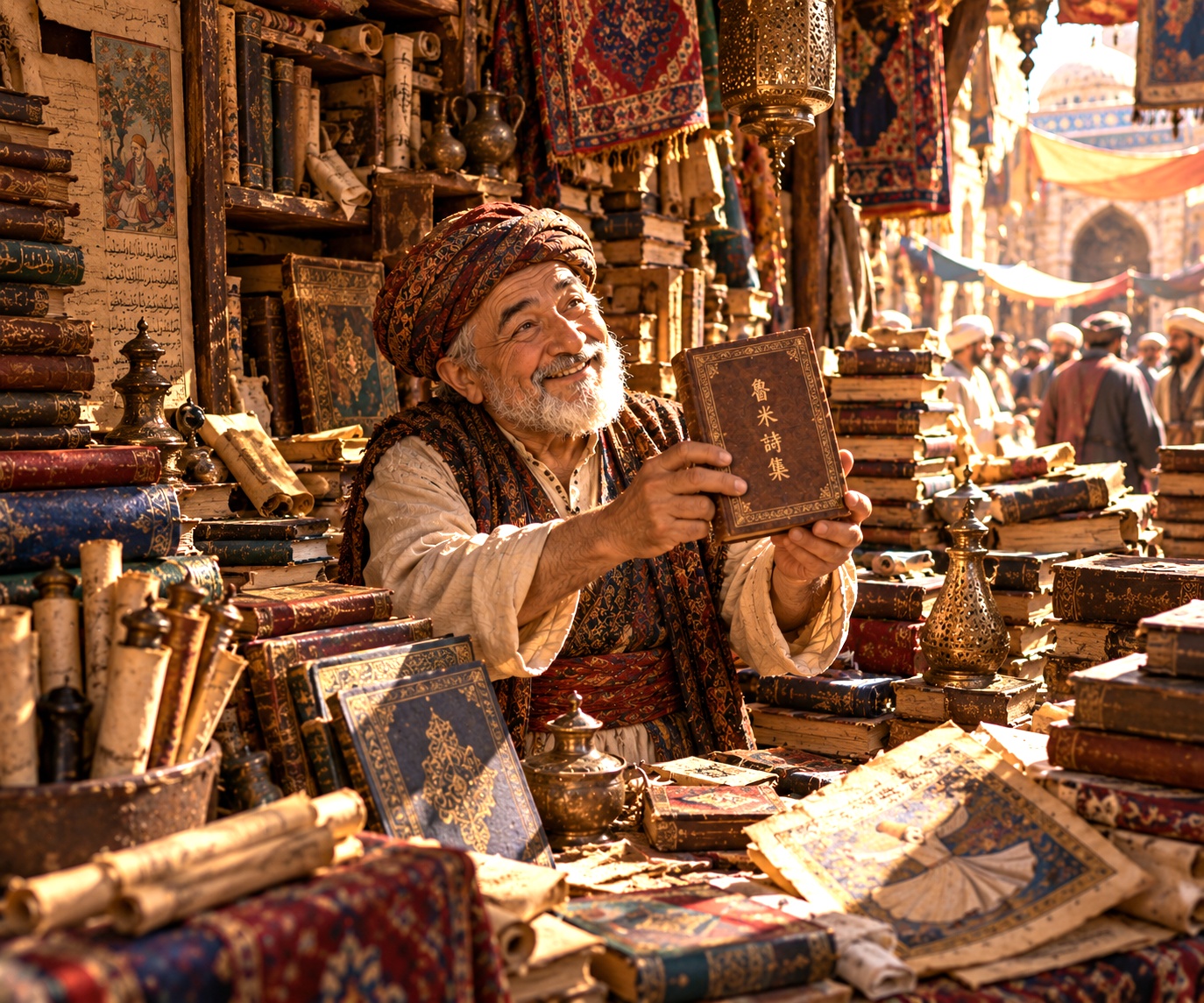
I opened a page randomly and began to read:
Where will you find one more liberal than Allah?
He buys the worthless rubbish which is your wealth,
He pays you the Light that illuminates your heart.
He accepts these frozen and lifeless bodies of yours,
And gives you a Kingdom beyond what you dream of,
He takes a few drops of your tears,
And gives you the Divine Fount sweeter than sugar.
The poem went on, as beautiful as an autumn sunset. I had never read anything like it. The bookseller gazed at me knowingly, a smile on his face. “This book is very rare,” he said. “And not cheap.”
I paid his price without negotiation.
As for Ardeshir, he didn’t seem to know what to buy, so we helped him select all the needed guard supplies. He refused anything that seemed unnecessary and guarded the money I’d given him as if he expected everyone around him to try to steal it.
Works of Art
The bowyer’s shop was identified by a painted bow hanging above the door and several bundles of arrows standing outside. Chen and Ardeshir followed me in. The shop was narrow and smelled strongly of leather, glue and wood. Bows hung from pegs along both walls, some plain and workmanlike, others lacquered and painted, with grips wrapped in fine leather. Some were like works of art. I’d had no idea that bows could look like that.
The proprietor was a stout man in a green turban, with a beard like a raspberry bush. I told him I needed a bow suitable for a caravan guard, including use from horseback. He asked me several questions about my experience, which was embarrassing, since I had very little.
The man raised an eyebrow, probably wondering if this youth in a guard’s uniform was a kid playing dress-up.
“Strong?” he asked.
“Yes.” That, at least, I could answer with confidence.
He took down a bow and handed it to me. It was compact, beautifully curved, with a dark horn belly and a leather-wrapped grip. I drew it, and found the pull light.
“Too easy,” I said. After trying several other bows – with the bowyer’s patience visibly waning – I pointed to one on the wall. It was dark and heavy, with polished horn tips and red leather around the grip. It was magnificent.
The shopkeeper shook his head. “Expensive.” He said something else, then made a shooing motion with his hand.
Chen laughed. “He says you’re wasting his time, and why don’t you go buy a toy? Should I tell him you already bought a little toy horse?”
I pursed my lips in anger. “Ask him how much.”
They conversed, and Ardeshir made a terse comment.
“The shopkeeper says one gold ashrafi. Ardeshir says that’s way too much, you could buy a house in Darbi Malik for that.”
“Let me hold it.” With an annoyed exhalation, the bowyer handed me the bow. The weapon was solid yet graceful. Thin lines of red and gold paint danced along the limbs. I imagined that this was what it was like to hold a woman in one’s arms. I pulled the string: difficult, not intolerably so. I would grow into it.
I removed four coins from my purse and set them on the counter. “Two silver abbasis, and two more for the case, quiver and two dozen arrows.” It was the most money I’d ever paid for anything in my life, yet was less than half what the man had asked for. I imagined I was driving a hard bargain.
A slight smile played over the shopkeeper’s lips as he pocketed the coins, and I knew I had overpaid. Well. It was what it was. The bowyer placed the bow in its case and handed it to me, and I slung it proudly over my shoulder. I wasn’t a bowman yet. But I’d bought this beautiful thing out of my own wages, earned with months of labor, hard travel, sweat and blood. It felt good.
Chen was grinning at me.
“What?”
“Nothing.”
An instant later, massive drums began to beat, and all smiles vanished.
Chen and I exchanged confused glances, but Ardeshir looked like a deer that has scented a lion. Around us, conversations stopped. Merchants looked toward the citadel. A man who had been arranging fruit at his stall straightened and stared toward the city walls.
The drums sounded again, and merchants began stowing their wares quickly, packing up. Shoppers hurried away.
“What’s going on?” I asked.
Ardeshir said something, and Chen translated. “Alarms. Invasion. The city is under attack.”
Live With Your Choice
The drums continued as we hustled back at a fast jog. Two men collided in their haste, both falling to the ground. Somewhere a woman shouted for a child. A donkey stood abandoned in the middle of the street, braying indignantly. While my companions watched impatiently, I stopped to comfort the donkey. I stroked his face, and gave him one of a handful of small pink apples I’d purchased in the suq. Then I whispered in his ear, “Go home,” and gave him a shove. He went trotting off. I hoped he knew his way.
From a distance, we heard four short blasts of a horn.
“That’s Captain Karim’s horn!” Chen exclaimed.
I nodded. “Double time.”
We began to run. Ardeshir led the way, darting through alleys and side streets, with Chen and me following close behind. Twice we found streets clogged with people and had to turn back. By the time we reached the broad avenue leading to the citadel, people were running in every direction.
Uniformed Persian soldiers had taken up positions outside the citadel. They were armed to the teeth, and their postures were tense. Archers stood atop the walls, and men with spears controlled the entrance while others dragged heavy wooden barriers into place.
One soldier blocked us as we approached, but one of the soldiers I’d watched training in the courtyard stepped forward and gave a command, and we were admitted. Apparently breaking their instructor’s nose had made me memorable.
Inside, the Five Star compound was like a beehive that had been struck by a stick. Five Star merchants, breathing hard, hurriedly carried boxes and bundles from tables and awnings and shoved them into wagons. Guards helped them load while teamsters harnessed horses and mules.
The Persian merchants, I noticed, were gone. To my surprise, five beautiful new wagons stood among our own, already marked with the Five Star logo.
I spotted Meilin. “What’s going on?”
“We’re going on a rabbit hunt.”
My mouth fell open. “Really?”
“No, dummy! We’re moving out! Get to your station.”
“Now?” But she was already moving on.
I spotted Captain Karim near the front of the caravan, shouting orders. I pushed through the confusion.
“Captain! What’s happening?”
“It seems an Afghan army is approaching from the north.”
“A whole army? How many men?”
“I don’t know.”
I stared at him. “Then why are we leaving? We should stay and fight. Farhad helped us. We can’t abandon him.”
“It’s not a question of abandoning anyone. Farhad has his own army. My responsibility is the caravan.”
“But we are skilled fighters. Captain, please! He gave me his ring.”
Karim’s face hardened. “If you wanted to protect the prince at all costs, you should have accepted his offer to join his personal guard. You chose the caravan. Live with your choice.”
That stung, and I winced. But he was right. I had made my choice.
Karim pointed across the compound. “Round up the new recruits and bring them to me quickly. All six. I need to talk to them.”
Rolling South
Within a few minutes I had all six standing before Karim, including Ardeshir. Karim addressed them in Persian. At first the recruits merely listened, but then Shireen stepped forward. She said something to Karim and gestured toward the walls.
“What is it?” I asked.
“Never mind. See to your own duties.” His tone brooked no discussion.
Belly was restless. The drums, shouting and movement had put him on edge. I gave him an apple, then saddled him as he chewed. I moved as quickly as I could, speaking softly while my hands worked. “Take it easy. We’re going, that’s all. Apparently we’re running away. Yeah, I think it’s weird too.”
My possessions were mostly packed already, as I was not messy, and tended not to leave my things lying about. All I had to do was add my new book, the little wooden horse and the embroidered slippers to my travel pack. I checked for the prince’s ring beneath my tunic, and felt the reassuring weight against my chest.
The first wagons were moving into position. I found Ardeshir standing beside a horse with an expression of profound distrust.
“You don’t know how to ride, do you?”
He stared at me.
I pointed to him, then the horse, and imitated a man riding. Ardeshir shook his head.
I poked my head into the medical wagon. Hakim Yusuf was packing his medicines and supplies into cushioned crates.
“Hakim, as-salamu alaykum. How are you?”
He sighed. “Wa alaykum as-salam. Please do not tell me you opened your wounds again. I think I might lose my mind if that’s the case.”
“No sir. But can the new kid ride with you? He doesn’t know how to ride a mount.”
He made a “come along” gesture.
I communicated to Ardeshir that he should ride in the medical wagon. Frustration was obvious on his face, but to his credit, he did not argue.
The great citadel gates opened.
Karim rode to the head of the column and blew three short blasts on the horn. Shireen rode beside him. Teamsters snapped reins. Harnesses tightened. Wheels groaned. One wagon rolled forward, then another, then another, until the entire caravan – now fifty-three wagons strong – undulated forward like an enormous serpent.
I rode beside the medical wagon as we passed out of the citadel’s gates. The caravan turned south, and the gates swung shut behind us. To my bafflement, I saw Ahmed and Weili break away from the column and ride north, toward the source of the tumult.
“What are you doing?” I shouted, but my voice was lost in the hubbub.
I looked back at the citadel. Atop the walls, archers with longbows had taken position. There would be no farewell between me and Farhad.
The Five Star caravan rolled south.
* * *
Come back next week for Part 31 – Following Your Lead
Reader comments and constructive criticism are important to me, so please comment!
See the Story Index for Wael Abdelgawad’s other stories on this website.

Wael Abdelgawad’s novels – including Pieces of a Dream, The Repeaters and Zaid Karim Private Investigator – are available in ebook and print form on his author page at Amazon.com.
Related:
Keep supporting MuslimMatters for the sake of Allah
Alhamdulillah, we're at over 850 supporters. Help us get to 900 supporters this month. All it takes is a small gift from a reader like you to keep us going, for just $2 / month.
The Prophet (SAW) has taught us the best of deeds are those that done consistently, even if they are small. Click here to support MuslimMatters with a monthly donation of $2 per month. Set it and collect blessings from Allah (swt) for the khayr you're supporting without thinking about it.





Far Away [Part 30] – The Rock Splitter And The Parthian Shot

Maryam: The Story Of The Muslim ‘Virgin’ Mary

Is It Ever Too Early To Prepare For Ramadan? Reflections On Rifq, Forgiveness, And Healing The Heart

Lessons From The Battle Of Badr: A Personal Transformation Perspective

Taliban Tale: How Afghan Militants Survived Campaigns In 2006-2016
Far Away [Part 26] – Shaytan Is A Liar

[Podcast] 50k Mahr, Hiding Money, & Who Pays for the Wedding? | AML Finance

Long War Without End: A Quarter-Century Since The War On Terror

[Podcast] Faith, Motherhood, and the Call to Gaza | Dr. Samaiya Mushtaq

What The Makkah Agreement Is Missing

The Best Actions for Eid al-Adha [Imam Dawud Walid]

Coming Full Circle: Who Are You Now? | Night 30 with the Qur’an

Running Away From Who We Are | Night 29 with the Qur’an

Building From the Ground Up: Week 4 Recap | Night 28 with the Qur’an

The Muslim You Are Becoming | Night 27 with the Qur’an
MuslimMatters NewsLetter in Your Inbox

Sign up below to get started