#Islam
Maryam: The Story Of The Muslim ‘Virgin’ Mary


The deserts were deserted but for traveling on foot or by animals. From city to city were scattered thorny bushes, hot sand, and a lonely well – much like our 21st-century pit stop exits for rest, gas, and lavatory business.
In the city of Nasira, from the lineage of Dawud  and Sulaiman , came a man named Imran and his wife, Hannah. Hannah begged Allah
  for a child and swore that if Allah gives her a child, she will dedicate this child’s life to the worship of Allah and place her child in Bayt-ul-Maqdis (Masjid ul-Aqsa), free of all worldly duties.
Indeed, Allah gave in her womb a soul that revered Allah .
Keep supporting MuslimMatters for the sake of Allah
Alhamdulillah, we're at over 850 supporters. Help us get to 900 supporters this month. All it takes is a small gift from a reader like you to keep us going, for just $2 / month.
The Prophet (SAW) has taught us the best of deeds are those that done consistently, even if they are small. Click here to support MuslimMatters with a monthly donation of $2 per month. Set it and collect blessings from Allah (swt) for the khayr you're supporting without thinking about it.
“[Mention O’ Muhammad] when the wife of ‘Imran said, “My Lord, indeed I have pledged to You what is in my womb, consecrated [for Your service], so accept this from me. Indeed, You are the Hearing, the Knowing.”
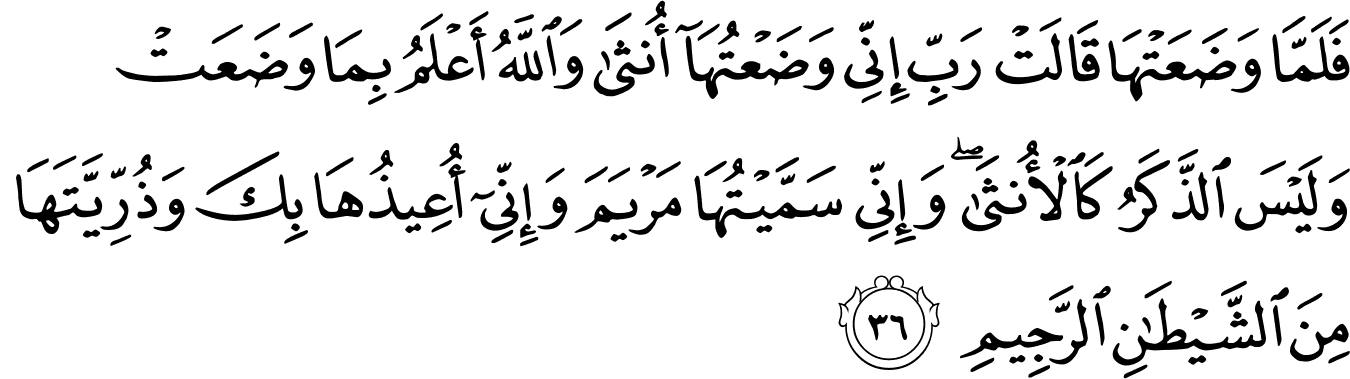
“But when she delivered her, she said, “My Lord, I have delivered a female.” And Allah was most knowing of what she delivered, “And the male is not like the female. And I have named her Maryam, and I seek refuge for her in You and [for] her descendants from Satan, the expelled.” [Surah ‘Ali-Imran; 3:35-36]
Hannah was expecting a son, but nonetheless, she devoted Maryam to the path of Allah . Allah uses this opportunity to clarify in the Quran that Allah already knew Maryam was in the womb, and Allah differentiates between the male and female. But in these verses, Allah does not tell us why or how they are different, just that they are. But this difference does not mean only males can be devoted to Allah . Hannah and Imran understood this. They knew it would be different to put a girl inside a place of worship for her whole life, but they had already made the intention to do it, out of their deep gratitude to Allah for giving her a child. Hannah took an oath, and she moved forward.
She tells the people of Bayt-ul-Maqdis of her oath, and many people want to take care of Maryam , particularly Maryam’s uncle, Zakariyya . In accordance with the customs of fairness, the people drew lots, and Allah ordained that Zakariyya raise her. Answering Hannah’s dua’, Allah made an avenue for Maryam to be clothed by the walls of Bayt-ul-Maqdis and also learn directly from a Prophet.
Maryam had her own quarters in Bayt-ul-Maqdis. This was not the ‘sisters’ side’ of the masjids we see, the ones hard to reach after a dark alley, on stained carpets soaked in three layers of dust under dim, flickering light. Maryam had her bed, her books, her own space to study religious texts and remember Allah . 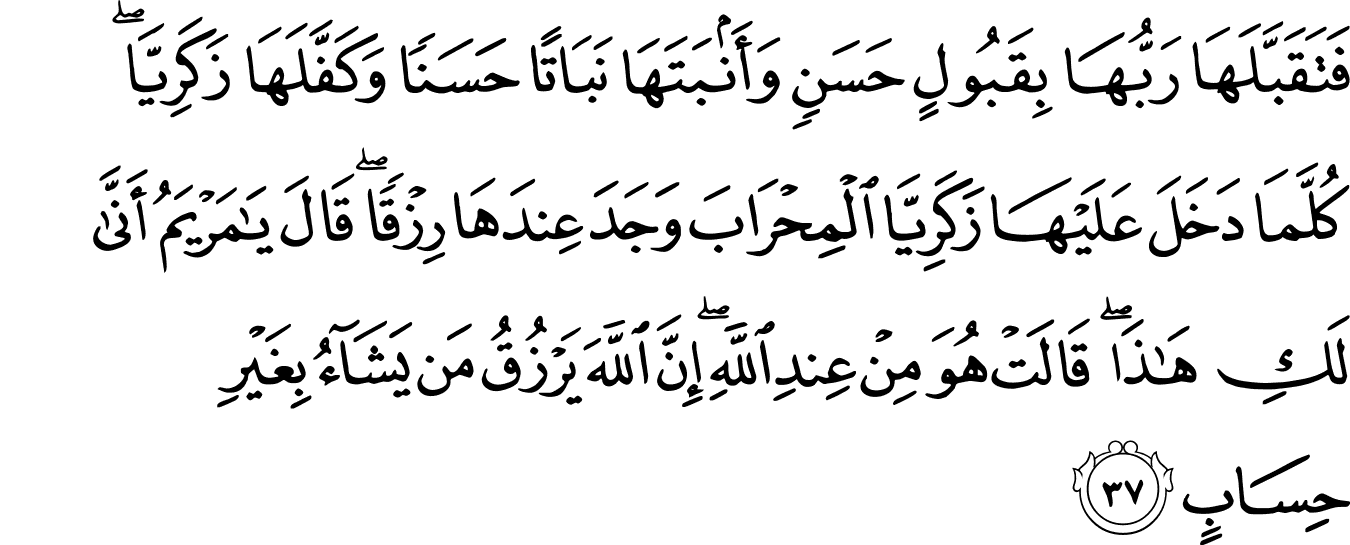
“So her Lord accepted her with good acceptance and caused her to grow in a good manner and put her in the care of Zakariyya.” [Surah ‘Ali-Imran, 3:37]
Allah uses the word: nabatan, to mean rearing, but the word also denotes the meaning of vegetation, or planting. Allah took care of her as He does plants. The farmers plow, the farmers monitor, but it is Allah who commands, Allah who sends rain, and Allah who facilitates growth. Zakariyya took due care of her, as the love of an uncle to his niece extends the environment of love and the echoing sounds of worship.
Every time Zakariyya entered upon her in the prayer chamber, he found with her provision. He said, “O Mary, from where is this [coming] to you?” She said, “It is from Allah. Indeed, Allah provides for whom He wills without account.” [Qur’an, 3:37]
He would walk in with food to give her, and find the corner of her room: fruits out of season. We witness Maryam teach Prophet Zakariyya what full trust in Allah means. It means rizq will come from Allah , from places that seem impossible.
ة
You want something. Allah knows that you want something. So badly that your heart feels like it is aching. As if you can feel cracks in the once-strong organ pumping inside your chest, made of muscle when you were in the womb. When you place your head in sujood asking for this something, you press your forehead as if it could go deeper into your prayer mat, and tears fall, sometimes softly on the mat, sometimes sliding down your warm cheek instead, the way the tea from the pot doesn’t always fall in the direction it should.
This something may be the person you feel you love, or it may be graduate school, or for the health of a loved one, or a career, or the chance to be beautiful.
You raise your hands to the owner of the Kingdom, and He will not return it empty. Allah
gives without account, and He has; just look around you. Pause the tears for a second to recognize that the ability to cry is itself a blessing, the ability to pray is itself a blessing, the knowledge of recognizing Allah, al-Malik, is itself a blessing, and all that you possess is itself a blessing. Repeat to yourself, as you gaze across all the things you possess of the dunya, and the intellect inside your brain that is intangible, allowing you to read this and internalize it, in this very second, without assistance from anyone else.

If you count the bounties of Allah, you cannot count them all. Surely, Allah is Most-Forgiving, Very-Merciful. [Surah An-Nahl; 16:18]
Overwhelm yourself first by the fact that you cannot count the rizq Allah has already given you, and then continue to beg. Allah gives without due measure. Maybe Allah doesn’t give you exactly what you want, but He will provide. Allah is shy to return your hands empty.
You are asking the Owner, when half the world is in darkness, disobeying Allah , denying the existence of Allah .
ة
Maryam’s words vibrate in the chest of Zakariyya , an old man with a barren wife, and he is quick to respond to the spark in his heart:
At that, Zakariyya called upon his Lord, saying, “My Lord, grant me from Yourself a good offspring. Indeed, You are the Hearer of supplication.” [Surah ‘Ali-Imran, 3:38]
Allah responds to the du’a by immediately putting a soul inside the womb of Zakariyya’s wife, Aisha. Remember that it was Maryam who gave the Prophet Zakariyya this reminder: to ask Allah , and Allah gives without measure; even in impossibility, there is possibility. That even in old age and a barren uterus, Allah can decide to create Yahya. Maryam catalyzed this action of Zakariyya , and in turn, for centuries, we enjoy this dua: the du’a for offspring.
As a worshipper housed in Bayt-ul-Maqdis, Maryam is not bound and enclosed in the walls. She leaves the masjid every now and then with full freedom to go out into the open air and see the sky and feel the ground beneath her. We should remember to do this: leave the walls of our concrete homes, offices, buildings, and masjids. Feel true nature by staring at the etchings of bark on the trees and the color Allah painted them, by observing the blueness of the water and the skies and asking ourselves if we could describe blue had Allah not given us sight.
In the open air, she sets up a tent; a veil of sorts to protect her from the wind and screen herself from the people traveling in the land, entering Bayt ul Maqdis.
A beautiful man approaches.
“She placed a screen (to screen herself) from them; then We sent her our angel, and he appeared before her as a man in all respects” [Surah Maryam, 19:17]
She is a free woman. She is not married to anyone. She can do as she pleases. But she chose to bind herself to the laws of Allah .
So when an extremely handsome man walks in her direction, she says: 
“Indeed, I seek refuge in the Most Merciful from you, [so leave me], if you should be fearing of Allah .” [Surah Maryam, 19:18]
She reminds the man of his responsibility to fear the wrath of Allah if he is to harm her.
She reminds the man to be righteous, with taqwa, taqiyyan.
ة
This is what holding onto ourselves means. It means telling the man to fear Allah . It means holding ourselves to that standard, that this is my space, and I do not welcome those unwelcome into my space.
Some of us are pining after a man, begging him to talk to his parents, to convince his parents, to talk to our parents, to somehow make this relationship halal. Or just waiting for the man we have given so much of our time and heart to, to decide to be with us.
To the men, we tell them: Love is not an answer. Love is nothing without action. It is a mere fantasy. Love does not answer to Allah about our sins.
We will quiver on our knees in front of Allah as He shows us our sin after sin, and we will not have the audacity to say, “it was love,” when it was wrong. Love is not always pure; love is not always right. And the one we love may not be as righteous as we have imagined them to be.
It is a ploy of Shaytaan to show righteousness as praying, reciting Quran, and dhikr. Righteousness is not merely in actions of worship but in the encompassing of worship: the actual fear of Allah , the ability to recognize sin and stay away. A righteous man does not touch what he has no right touching. A righteous man does not cause sin upon the woman he loves. A righteous man opens the doors of halal or stays at the door of Allah , awaiting qadr.
True love is wanting only the best for someone. And sins are not the best for someone.
True love is wanting their slate clean in front of Allah , not being the one who puts the stains on the slate.
ة
So the beautiful man reveals that he is actually Angel Jibraeel. 
“And (remember) when the angels said: “O Maryam (Mary)! Verily, Allah has chosen you, purified you (from polytheism and disbelief), and chosen you above the women of the ‘Alamin (mankind and jinn) (of her lifetime).” [Surah ‘Ali-Imran, 3:42]
Before continuing, we can wonder why Allah sends this angel in the form of a man. It can be to test Maryam and her righteousness, and subsequently to teach us how to behave.
Jibrael says:
“I am only the messenger of your Lord to give you [news of] a pure boy.”
She said,
“How can I have a boy while no man has touched me and I have not been unchaste?” [Surah Maryam, 19:21]
She questions. As an intelligent, rational, and honorable woman, she questions the logic of her bearing a child. Allah does not erase this from the Quran. Allah keeps the words, exactly as they are, to prove in an ayah her chastity, and to prove to us that we can question. We can be both a worshipper and still seek the answers.
He said, “Thus [it will be]; your Lord says, ‘It is easy for Me, and We will make him a sign to the people and a mercy from Us. And it is a matter [already] decreed.'” [Surah Maryam, 19: 21]
But when Allah decrees a matter, we stop questioning. We move forward. We pick up after heartbreak; we pick up after a rejection from an institute, and we move forward. We don’t keep wondering, but how, and but why? Because the simple answer is: Maryam, you were chosen. And us too – we were chosen for the hardship we are submerged in because Allah knows that you, and only you, are capable of seeing it through.
And Allah says, “It is easy for Me” to bend the laws of logic. It is easy for Allah to create from nothing. It is easy for Allah to make the hearts of the people around us bend towards us, our colleagues, our in-laws, our spouse, and our parents. It is easy for Allah to change the course of our academic or career path even when it feels impossible. It is easy for Allah to change our situation. There is no power of might other than Allah . 
“So she conceived him, and she withdrew with him to a remote place.” [Surah Maryam, 19;22]
Remote place is a motif we find repetitive in the Seerah and the Quran. To be alone is to be with Allah . We should ask ourselves how often we choose to be alone, not with a screen, but with Allah .
And the pains of childbirth drove her to the trunk of a palm tree. She said, “Oh, I wish I had died before this and was in oblivion, forgotten.” [Surah Maryam, 19:23]
A sign, again, that in moments of agony, she was as human as the rest of us. An image of grabbing the palm tree with contractions inside. For those of us who have not given birth, we have no idea what that pain is. For those of us who have, we can never truly explain it. The physical pain, the fact that she is doing this alone, and the thoughts of what the people would be saying later, combined into this one emotion.
“Do not grieve; your Lord has provided beneath you a stream And shake toward you the trunk of the palm tree; it will drop upon you ripe, fresh dates.” [Surah Maryam, 19:25]
Allah consoles her. Allah distracts her. Allah reminds her. So when we sob in the middle of our room, drowning in our despairs, we should stop and look around. At the gifts Allah has given us, the privileges, the honor, the safety, the shelter, the food. Imagine Allah’s Angels are there with you. Surrounding you and making du’a for you because you are a worshipper of Allah . The words of the Quran seem to denote that the stream wasn’t there before. That Allah made it like a canal, just for her comfort. To give her running water, a stream to drink from, and food as sustenance.
Allah tells her to shake the tree, because one does still work hard for their sustenance. Just as Allah expects from us our efforts in attaining our degrees, our careers, and our homemaking. Allah knows that shaking a sturdy palm tree may not pour down dates. One cannot actually shake a palm tree. But this movement would ease her pregnancy. Whether she understood it at the time or not, she listened and obeyed. 
“So eat and drink and be content. And if you see from among humanity anyone, say, ‘Indeed, I have vowed to the Most Merciful abstention, so I will not speak today to [any] man.'” [Surah Maryam, 19:26]
During this era, silence was seen as a spiritual act, a form of worship to be silent from dawn to dusk. Islam later takes away such a form of worship, but the essence of it remains in the stories of seclusion. Of traveling up the mountain and contemplating Allah’s Creation. Or the late-night tahajjud, a different seclusion.
She doesn’t ask Allah questions at this point. She doesn’t say, “How can I be silent when the townspeople will accuse me? Don’t I have to explain myself?” She understands that this is a commandment, even if it doesn’t make sense.
She doesn’t know that Isa will speak in the cradle, and she doesn’t know what the future holds. She cannot escape the community she is from. So she holds her words and obeys her Lord. She trusts that the Almighty thrust upon her this destiny: to be the only woman to bear a child without being intimate. She trusts that the impossible was put on her for a reason and Allah will make a way. A part of her knew that the people would not all be convinced. But her trust in Allah was greater.
So in times when we are tested with things we do not understand, and society says about us that which is not true, remember our mother Maryam

“Then she brought him to her people, carrying him. They said, “O Mary, you have certainly done a thing unprecedented.
O sister of Aaron, your father was not a man of evil, nor was your mother unchaste.
So she pointed to him. They said, “How can we speak to one who is in the cradle a child?” [Surah Maryam, 19:27-29]
She faced her reality. It is time we face ours.
There is more to Maryam’s story than this. We forget that she raised a son alone. A village helped, just as the families and communities help single mothers of today. But she did bear him alone, suckled him, taught him to walk, and held him through the hard moments. She raised a Prophet of Allah , and bore all of the accusations and whispers, even after her son healed the leper. She did not marry. She relied on Allah through and through. She passed away a virgin, forever chaste.
There are women and men on this earth who read the entire Quran over and over, within a week, a month, and in particular, Ramadan. We can imagine that the surah named after her is indeed being recited every day, somewhere, by someone on this globe. Maryam’s story left for generations to read and reflect and name daughters after. So for all the women who don’t feel loved, remember that Maryam did not have a husband to love her. She had Allah , and it is true.
The Prophet (ﷺ) said, “When Allah loves a slave, He calls out to Jibril and says: ‘I love so-and-so; so love him’. Then Jibril loves him. After that, he (Jibril) announces to the inhabitants of the heavens that Allah loves so- and-so; so love him; and the inhabitants of the heavens (the angels) also love him and then make people on earth love him”. [Bukhari and Muslim]
Indeed, the people on earth love Maryam . The believers who read Surah Maryam, who reflect on her story, and also the people of the book who revere her, albeit in polytheistic ways, love Mary. The people of the book, with their statues and distorted images, still pray three times a day this: “Hail Mary, Full of Grace, the Lord is with thee. Blessed art thou among women, and blessed is the fruit of thy womb, Jesus.”
Related:
– Taking Lessons from The Strength of Maryam, Mother of Jesus
Keep supporting MuslimMatters for the sake of Allah
Alhamdulillah, we're at over 850 supporters. Help us get to 900 supporters this month. All it takes is a small gift from a reader like you to keep us going, for just $2 / month.
The Prophet (SAW) has taught us the best of deeds are those that done consistently, even if they are small. Click here to support MuslimMatters with a monthly donation of $2 per month. Set it and collect blessings from Allah (swt) for the khayr you're supporting without thinking about it.


Maryam: The Story Of The Muslim ‘Virgin’ Mary

Is It Ever Too Early To Prepare For Ramadan? Reflections On Rifq, Forgiveness, And Healing The Heart

Lessons From The Battle Of Badr: A Personal Transformation Perspective

Taliban Tale: How Afghan Militants Survived Campaigns In 2006-2016

[Podcast] Yes, She’s Funny In This | Huda Fahmy

Far Away [Part 26] – Shaytan Is A Liar

From a Syrian Prison to the UN: The Case of Bilal Abdul Kareem

[Podcast] 50k Mahr, Hiding Money, & Who Pays for the Wedding? | AML Finance

Long War Without End: A Quarter-Century Since The War On Terror

[Podcast] Faith, Motherhood, and the Call to Gaza | Dr. Samaiya Mushtaq

The Best Actions for Eid al-Adha [Imam Dawud Walid]

Coming Full Circle: Who Are You Now? | Night 30 with the Qur’an

Running Away From Who We Are | Night 29 with the Qur’an

Building From the Ground Up: Week 4 Recap | Night 28 with the Qur’an

The Muslim You Are Becoming | Night 27 with the Qur’an
MuslimMatters NewsLetter in Your Inbox

Sign up below to get started