
Quran and Sunnah
The Greatest Bounty: Islam From Surah Fatir

By Mukhtar Ba
“The intent of the below piece is to convey a reminder to all of our Muslim brethren, regarding the bounty of Islam that Allāh  has blessed us with, through His limitless kindness. It is a known fact that as Muslims, our level of practice is at different levels, and sometimes may vary within the same individual at different stages of life. Nevertheless, no matter how little or how great our practice is, it is important for all of us to realize deep in our hearts that we are all recipients of the greatest bounty that Allāh can choose to grant His creation. Those of us who are weak in our practice should realize that their weak practice does not take them out of the ranks of the chosen slaves of Allāh among his numerous creation; and those of us who are blessed with a steadfast practice, should strive to develop the consciousness that it is the mere mercy of Allāh upon them, and not the result of their efforts. Last but not least, as Muslims we are all called to interact with each other and with non-Muslims; being aware of how great this bounty of Islam is, will allow us to develop a humble attitude in dealing with everyone and to look at everyone with eyes of care and concern, concern for their betterment…”
Keep supporting MuslimMatters for the sake of Allah
Alhamdulillah, we're at over 850 supporters. Help us get to 900 supporters this month. All it takes is a small gift from a reader like you to keep us going, for just $2 / month.
The Prophet (SAW) has taught us the best of deeds are those that done consistently, even if they are small. Click here to support MuslimMatters with a monthly donation of $2 per month. Set it and collect blessings from Allah (swt) for the khayr you're supporting without thinking about it.
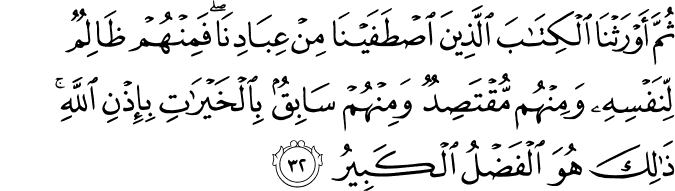
“Then We gave the Book as an inheritance to those whom We chose from among Our servants; among them is the one who wrongs himself, and among them is also the one who takes a middle course, and of them is the one who is foremost in virtuous deeds by Allāh’s permission; this is the great excellence.” Fāṭir: 32
Allāh says: “Then We gave the Book” meaning, We revealed the Qurʾān to you  , and we decided that it would be inherited by those after you.
“to those whom We chose from among Our servants”: They are the Ummah of Muḥammad , comprised of the Ṣaḥābah, the Tābiʿīn, the generation after the Tābiʿīn and those after them until the day of judgment. Allāh has chosen this Ummah over all nations, and has made them a nation treading on the middle course, so they may stand as witnesses among mankind. Allāh has also made them special by linking them to the most honored of His prophets, Muḥammad .
Ibn ʿaṭiyya explains: what is meant by the Book here are the meanings of the Qurʾān, its commands and its elements of creed [ʿaqāid]. It is as though Allāh has given the Ummah of Muḥammad the Qurʾān, and this Qurʾān is the gist of the meanings of the books revealed prior to it. It is as though Allāh has passed on to the Ummah of Muḥammad the Book that was present in the previous nations.
He then ranked this nation (the followers of Muḥammad ), and says:
“among them is the one who wrongs himself,” by coming short in their practice upon the Qurʾān, as the Qurʾān is the accepted reference for the commands of Allāh .
“and among them is also the one who takes a middle course”: that is the one whose actions are a mixture of virtuous deeds and of sins.
“and of them is the one who is foremost in virtuous deeds”: this is the one who combines his knowledge with practice; and advises or guides others towards following the same path.
This classification is most concordant with the aḥadīth narrated along the same lines.
For instance, it has been narrated about ʿUmar Ibn Al Khaṭṭāb  that he once said on the minbar (pulpit), after reading this verse Rasūlullāh said, “our foremost ones have gone ahead, our middle coursed ones are saved, and our wrongful ones are forgiven”[1].
It has also been narrated through Abū Dardā, that Rasūlullāh said, “The foremost one will enter Paradise without going through any reckoning, the middle coursed one will go through an easy reckoning and then enter Paradise, and the wrongful one will be held, until he thinks he is doomed…and at that point, he will be overtaken by the mercy of Allāh and will enter Paradise”[2].
ʿAbdullāh b. ʿAbbās explained: the foremost is the sincere [mukhliṣ]; the middle coursed one is the one who does actions with show [riyā’]; and the wrongful one is the one who is ungrateful towards the bounties of Allāh (by engaging in wrongful actions), without however denying those bounties.
Ar Rabīʿ Ibn-Anas explained: the wrongful one is the one guilty of major sins, the middle coursed one is the one guilty of minor sins, and the foremost one is the one who avoids both major and minor sins.
Al-Ḥasan al-Baṣri explained: the wrongful one is the one whose ill-deeds have overtaken his good deeds, the foremost one is the one whose good-deeds have overtaken his ill-deeds, and the middle-coursed one is the one whose good-deeds and ill-deeds are equivalent.
Abu Yūsuf [the companion of Imām Abu Ḥanīfa] was asked about this verse and he explained: all three categories mentioned are believers. The disbelievers are described after this verse in verse 36:

“As for those who disbelieve, will be the fire of Jahannam…” Fāṭir: 36
As far as the 3 categories cited before, they all are among those whom Allāh has selected/chosen among His servants, because Allāh has said “among them….among them…among them…” and “them” refers to the statement “الَّذِينَ اصْطَفَيْنَا مِنْ عِبَادِنَ”…”Those whom We have selected among Our servants”; they are the people of Īmān, the believers, and this is the position of the majority of the ʿulemā’.
The ones who wronged themselves were mentioned first in the verse to indicate that they are in large numbers. The middle-coursed ones are little in comparison to them and the foremost are less than the middle-coursed.
Ibn ʿAṭā explains: Allāh Taʿālā has mentioned the wrongful ones in first position, so they do not despair from His favour. It is also explained that He has mentioned them first so they may know that their sins do not distance them from their Lord. It is also explained that this order was set because in general, one’s initial spiritual state is that of disobedience, followed by a state of repentance [tawbah], and then followed by a state of steadfastness [istiqāma].
Sahl explains: the foremost is the scholar, the middle-coursed one is the student, and the wrongful one is the ignorant one. He also said: the foremost one is the one who busies himself with his hereafter, the middle-coursed one is the one who busies himself with his livelihood and his hereafter, and the wrongful one is the one whose involvement in his livelihood has taken him away from involvement in his hereafter.
It is also said that the wrongful one is the one who worships Allāh with neglectfulness and through attachment to cultural norms [ʿāda]. The middle-coursed one worships Him through hope and fear. The foremost one worships Him through awe and with a consciousness that He is inherently fully entitled to be worshipped.
It is also said that the wrongful one is the one who acquires worldly wealth through lawful as well as unlawful means. The middle-coursed ones strive to acquire wealth only through lawful means. The foremost one completely turns away from it.
The statement “by Allāh’s permission” means through His order/command, or through His tawfīq[3] and guidance. “This” meaning the inheritance of the Book and the selection, or it may relate to being among the foremost. “Is the great excellence” above which there is no greater excellence.
[1] Narrated by Suyūṭī in Durr Al Manthūr
[2] Narrated in Musnad Aḥmad and Al Ḥākim in the Mustadrak
[3] The word tawfīq denotes the divinely granted permission to perform good actions
Keep supporting MuslimMatters for the sake of Allah
Alhamdulillah, we're at over 850 supporters. Help us get to 900 supporters this month. All it takes is a small gift from a reader like you to keep us going, for just $2 / month.
The Prophet (SAW) has taught us the best of deeds are those that done consistently, even if they are small. Click here to support MuslimMatters with a monthly donation of $2 per month. Set it and collect blessings from Allah (swt) for the khayr you're supporting without thinking about it.


Far Away, Book 2: [Part2] – The Domain of the Dzungars

[Film Review] Your Mother, Your Mother, Your Mother: A Complex Story Of Faith And Fatherhood
Far Away, Book 2: [Part 1] – Meilin’s Tale

[Podcast] A Light of Her Own: Muslim Womanhood, Seasons of Life, & Female Scholarship

School Counseling Grounded In The Qur’an And Sunnah: A Framework Of 10 Prophetic Traits
Far Away, Book 2: [Part 1] – Meilin’s Tale
Far Away, Book 2: [Part2] – The Domain of the Dzungars
[Podcast] A Light of Her Own: Muslim Womanhood, Seasons of Life, & Female Scholarship
[Film Review] Your Mother, Your Mother, Your Mother: A Complex Story Of Faith And Fatherhood

The Best Actions for Eid al-Adha [Imam Dawud Walid]

Coming Full Circle: Who Are You Now? | Night 30 with the Qur’an

Running Away From Who We Are | Night 29 with the Qur’an

Building From the Ground Up: Week 4 Recap | Night 28 with the Qur’an

The Muslim You Are Becoming | Night 27 with the Qur’an
MuslimMatters NewsLetter in Your Inbox

Sign up below to get started
-

 #Culture4 weeks ago
Far Away, Book 2: [Part 1] – Meilin’s Tale
-
#Culture1 day ago
Far Away, Book 2: [Part2] – The Domain of the Dzungars
-
#Culture1 month ago
Far Away [Part 31] – Following Your Lead
-
#Culture1 month ago
A Case For Critical Reading As Muslims: Reading ‘The Power of Your Subconscious Mind’ Through An Islamic Lens




Aziza
April 2, 2012 at 11:23 AM
This definitely gives me some hope Alhamdullilah. JazakAllah Khair for posting this beautiful reminder.
Hasnat
April 4, 2012 at 2:40 AM
Dear Can you give the online link where to get the book of tafsir
abu Rumay-s.a.
April 6, 2012 at 12:11 AM
jazakAllah for the uplifting article… i did not see any reference to Ibn ajiba’s tafsfir (may Allah have mercy on him)?
did ibn Ajiba ascribe to wahdatul wujood as there are two treaties that have been translated from his work?
who is ibn Ata, are you referring to Ibn Attallah?