
World
Uyghur Muslims – Turmoil in China

*One very important note before continuing, the Chinese government has apparently restricted internet access, so the most readily available information is from mainstream media outlets. This post is simply meant to provide a recap of the situation as it is being reported. [See also, Chinese media coverage of the incident]
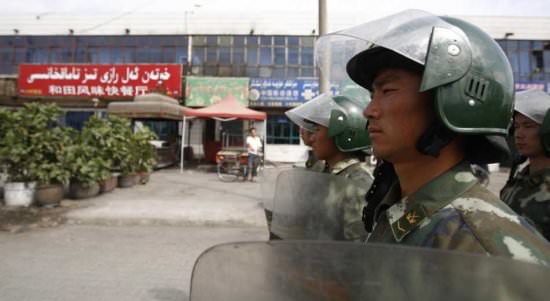
The situation in China finally hit the CNN frontpage briefly before getting drowned out by a story about Michael Jackson’s skin color, a ‘sexting’ teen, cops buying a doughnut shop, and Obama girls causing a fashion stir.
Keep supporting MuslimMatters for the sake of Allah
Alhamdulillah, we're at over 850 supporters. Help us get to 900 supporters this month. All it takes is a small gift from a reader like you to keep us going, for just $2 / month.
The Prophet (SAW) has taught us the best of deeds are those that done consistently, even if they are small. Click here to support MuslimMatters with a monthly donation of $2 per month. Set it and collect blessings from Allah (swt) for the khayr you're supporting without thinking about it.
Thankfully, the beacon of balance and fairness in America – Fox News – had a small line about, “China Vows Executions for Rioters Behind Killings” (not much information there), buried underneath a story letting us know that it has not yet been clarified whether Michael Jackson will get a butter statue memorial or not (see “Jacko Butter Debate Churns“).
To find out what is going on requires some digging, and we hope to bring a recap to the events unfurling in China, and specifically how the Uyghur Muslim population there is affected.
Before continuing on to the present protests and incidents, it is important to quickly look at some of the history of the Uyghurs in China.
The Washington Post has put together a brief primer on the conflicts between China’s various ethnic groups here. The BBC also gives a historical breakdown of the events starting from around the 1940’s. One of the primary causes for conflict is the restrictions the Chinese government have placed on the ability of Uyghur Muslims to practice their religion. All religions are subject to state control by the government, but Islam seems to have received the harshest regulations. This is partially motivated by politics as well,
This severity is a result of the association between Muslim groups and the independence movement in Xinjiang, a movement that is absolute anathema to Beijing.
BBC also notes that the policies implemented have seemed to incite an excess amount of tension that the government seems unwilling to take responsibility for,
Severe repression since the launch of a “Strike Hard” campaign in 1996 has included harsher controls on religious activity, restrictions on movement, the denial of passports and the detention of individuals suspected of support for separatists and members of their families.
This has created a climate of fear and a great deal of resentment towards the authorities and the Han Chinese. ….
In the past, Beijing has also blamed an Eastern Turkestan Islamic Movement for causing unrest, although there is no evidence that this ever existed in Xinjiang.
The authorities in Beijing are unable to accept that their own policies in Xinjiang might be the cause of the conflict, and seek to blame outsiders for inciting the violence – as they do in the case of the Dalai Lama and Tibet.
Not surprisingly, the Chinese government has also tried to label the Uyghurs as terrorists, despite a lack of evidence for the assertion (from BBC),
Beijing says Uighur militants have been waging a violent campaign for an independent state by plotting bombings, sabotage and civic unrest.
Since the 9/11 attacks in the US, China has increasingly portrayed its Uighur separatists as auxiliaries of al-Qaeda.
It has accused them of receiving training and indoctrination from Islamist militants in neighbouring Afghanistan, although little public evidence has been produced in support of these claims.
More than 20 Uighurs were captured by the US military after its invasion of Afghanistan. Although they were imprisoned at Guantanamo Bay for six years, they were not charged with any offence and many have now been accepted for resettlement elsewhere.
MuslimMatters also touched upon some of the crackdowns last year, noting restrictions placed upon the Muslims in Ramadan. And while the situation is affecting the predominantly Muslim minority there, there is a group of Christian Uyghurs that are also affected.
The violence occurring now is a fallout from protests that took place in response to clashes there. According to the BBC,
The Uighurs in Urumqi were reportedly angry over an ethnic clash last month in the city of Shaoguan in southern Guangdong province.
A man there was said to have posted a message on a local website claiming six boys from Xinjiang had “raped two innocent girls”.
Police said the false claim sparked a vicious brawl between Han and Uighur ethnic groups at a factory. Two Uighurs were killed and 118 people were injured.
A Korean paper also fills in a few holes,
Demonstrations that took place two days ago in Urumqi, the capital of the Xinjiang Uyghur Autonomous Region, led to major clashes that killed over 150 and wounded an estimated 800. The situation on the ground remains serious, with demonstrators regathering despite tight guard by military and police. … Most of the victims of the bloodshed were innocent victims.
Uyghur separatists who are pursuing sedition by stroking ethnic nationalism share in the blame for the recurring bloodshed in the region, but the Chinese authorities, who blame the separatists for the government’s severe crackdown, are also at fault. It is being reported that this incident started with a fight between Han Chinese and Uyghur workers at a toy factory in Guangdong province last month. Xinhua reported that two Uyghur workers were killed and about 60 injured when Han Chinese workers were provoked by rumors that a Uyghur worker had raped a Han woman. Photos of the scene, with people standing next to the bodies, circulated on the Internet, flaming anger from the Uyghur community. Uyghurs are saying the government lowballed the casualty figure and demanded it reveal the truth. These actions provided the backdrop for the latest bloodshed.
It is being said that Uyghurs are rioting due to strong feelings of being victimized by discrimination. The Turkic and Muslim Uyghurs have a different ethnicity, culture and language from the Han Chinese. ….
Ultimately, the Uyghur incident originates with China’s policies towards ethnic minorities. Without active efforts to respect the ethnic identity of minorities and reduce economic discrimination, the unrest in Xinjiang and Tibet cannot help but repeat itself. China must now re-examine its ethnic minority policies at its source.
Radio Free Europe adds that this is only the tip of the iceberg,
The fierceness of the rioting, in which by official count more than 150 people died, points to deeper wellsprings of discontent.
“Why they are so upset at the situation is because, every day, the government brings in hundreds, thousands, of [Han] Chinese into our motherland, East Turkestan — the Xinjiang autonomous region — but at the same time our people are sitting without jobs, suffering,” says Nizam Sametov of the Uyghur U.K. Association in London.
Sametov asserts that Chinese policy is to offer jobs to Uyghurs elsewhere in China, outside the Xinjiang region, thus reducing the concentration of this ethnic group. On the other hand, in the last five decades, there has been heavy Han immigration, so that today, Uyghurs barely outnumber the immigrants. … “Because our land is very rich in minerals, oil, gas, they just keep coming, every day bringing people from inside China to our own land. They hope soon that we will be a small minority, but we won’t,” Sametov says. “It is our own land.”
How the violence started is heavily disputed. The Uyghurs claim that the police started firing upon them, and the Chinese authorities say that the Uyghurs started the violence. The Chinese government’s control of the media has not helped produce the truth in this matter either.
A witness in the Xinjiang city of Kashgar told AP there was a protest there on Monday of about 300 people but there were no clashes with police. It is still unclear who died in Urumqi and why so many were killed.The Xinjiang government blamed separatist Uighurs based abroad for orchestrating attacks on ethnic Han Chinese. But Uighur groups insisted their protest was peaceful and had fallen victim to state violence, with police firing indiscriminately on protesters in Urumqi.Dolkun Isa, a spokesman for the World Uyghur Congress (WUC) in Munich, disputed the official figures, saying the protest was 10,000 strong and that 600 people were killed. He rejected reports on Xinhua that it had instigated the protests. (BBC)
The Xinjiang government said that WUC leader Rebiya Kadeer was behind it, but she has denied such accusations, comparing them to the accusations that the Dalai Lama was behind Tibetan violence.
In reaction, many of the Han Chinese took to the streets as well.
There were reports of Han mobs assaulting Muslim Uighurs throughout the city, even as helicopters hovered overhead.
Ethnic Han Chinese residents armed with makeshift weapons and vowing revenge on Uighurs were seen roaming the streets for a second day. (VOA)
AP recaps the violence,
Thousands of Chinese troops flooded into this city Wednesday to separate feuding ethnic groups after three days of communal violence left 156 people dead, and a senior Communist Party official vowed to execute those guilty of murder in the rioting in western China. Long convoys of armored cars and green troop trucks with riot police rumbled through Urumqi … Other security forces carrying automatic rifles with bayonets formed cordons to defend Muslim neighborhoods from marauding groups of vigilantes with sticks. ….
Officials have said 156 people were killed as the Turkic-speaking Uighurs ran amok in the city, beating and stabbing the Han Chinese. The Uighurs allege that trigger-happy security forces gunned down many of the protesters, and officials have yet to give an ethnic breakdown of those killed. ….
“When the Uighurs heard the people were fired upon, parents all came out looking for their sons and daughters,” he said, adding that security forces started to “disperse them by force, then started to beat them, tear gas them and shoot them.” [This] account could not be independently confirmed.More than 1,100 people were wounded in the violence. Dr. Yuan Hong of Urumqi People’s Hospital said most of the people treated at his facility were clubbed, while others had been cut by knives.Ahmet was quick to rattle off a long list of grievances commonly mentioned by Uighurs. He accused the Han Chinese of discrimination and alleged that government policies were forcing them to abandon their culture, language and Islamic faith. … His neighborhood in southern Urumqi was targeted by mobs of Han Chinese who roamed the capital Tuesday seeking revenge. Ahmet’s friends had video shot by mobile phones and cameras that showed the stick-wielding Han men beating Uighurs. He pointed to blood stains on a white concrete apartment wall, where he said a Uighur was severely stabbed.
A Uighur college student who called herself Parizat added, “The men were carrying a Chinese flag. I never thought something like this would happen. We’re all Chinese citizens.”
The Uighurs accused paramilitary police of allowing the Han Chinese to attack their neighbors. But in the video, the troops appeared to be trying to block or restrain the mobs.
On Wednesday, the government warned residents against carrying weapons on the street, and most people generally complied. But there were groups of Han Chinese who tried to find soft spots in police cordons and rush into Uighur neighborhoods. ….
The ethnic hatred in Xinjiang appears to run so deep that many Uighurs won’t express sorrow for the Han Chinese who were attacked Sunday.One of them was Dong Yuanyuan, 24, a newlywed who said she was on a bus with her husband getting ready to leave on their honeymoon. She said Uighur attackers dragged them off the bus and beat them until they were unconscious. Her husband was still missing, said the woman, who had abrasions on her face, arms and knees.“My aunts have been going to all the hospitals to search for him. He must still be unconscious,” she told reporters who joined a government tour at the People’s Hospital.
Abdul Rehim, a Uighur with his left arm in a sling, said he was walking with his brother when a group of Han Chinese “just came out and did this to me.”
Another victim was Ma Weihong, who said she was walking home from a park with her 10-year-old son when the riot started. The boy suffered minor injuries, but the mother had a broken arm and wrist, missing teeth and head wounds.
Amidst the religious, political, and ethnic factors at play, unfortunately, it is the innocent civilians who become the victims.
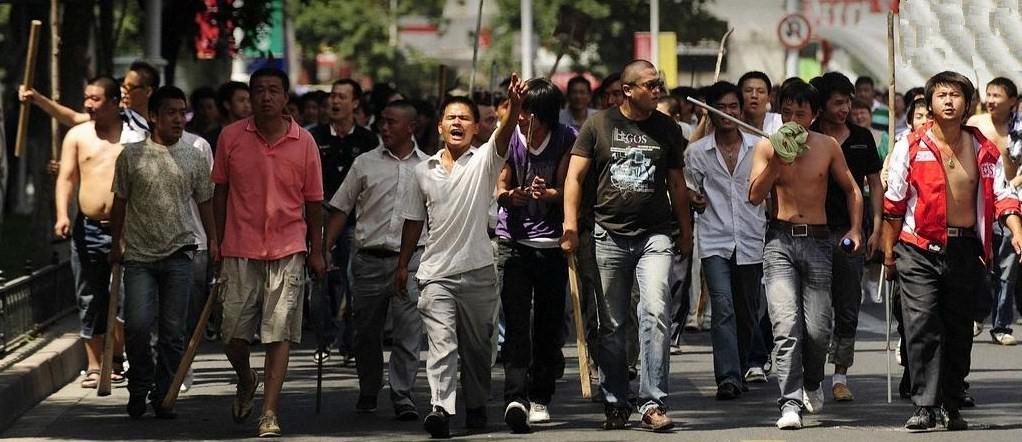
Retaliation by the Han
The Huffington Post has a nice article which touches on some of the ramifications and expected outcomes of this incident,
For a few reasons, the Communist Party’s response is likely to be harsher, and even more sustained, than last year’s response to the Tibetan uprising. ….
Second, the outside world’s familiarity with Xinjiang and Uighur plight is low. The region has never been romanticized in film and literature and only a few foreigners have visited. There are no transcendent architectural wonders a la Tibet’s Potala Palace that capture Western imagination. There is no roving ambassador, no Dalai Lama, to elicit sympathy for compromised values. Therefore, the global community’s response will be muted, led by diplomats and human rights groups, rather than CNN, bloggers and an indignant mass of activists. The issue will, sadly, fade quickly from the world’s moral radar screen. The Party will have significant room to maneuver.Third, the American “war on terrorism” – replete with kangaroo military courts and torture-extracted confessions – will make it more difficult for the West defend the interests of Uighur demonstrators, whom the Party has branded “terrorists.” Yes, there are a few separatists amongst the agitators, some of whom advocate violence as a means of advancing independence. The majority, however, want equal opportunity and protection under the law, and nothing more. But American Geneva Convention violations will lead to relatively sotte voce diplomatic condemnation.Finally, and most critically, Chinese people “fear” Uighurs more than Tibetans. The former is unfamiliar, an “alien nation.” The latter, on the other hand, is a hot tourist destination. (Tibetans practice Buddhism and their appearance is not starkly different from the Han.) The people expect their government, first and foremost, to protect the country from danger. Most mainlanders view the unknown as a threat to stability and unity, a sacred national imperative. If the Party is seen as “soft” in dealing with the uprising, it will lose credibility — even legitimacy — in the eyes of many citizens, including new generation types, perhaps the most nationalist group of all. Despite a universal belief that the “autonomous region” is an inalienable part of China, denizens of Xinjiang are regarded as outsiders. Their religion, Islam, is “foreign,” associated with violence. (Only the Hui, an assimilated and geographically scattered Muslim minority, have been accepted as “real” Chinese.) Ethnically, the Uighur do not resemble Han. Their eyes are rounder and lighter. Their skin is olive, not “yellow.” In smaller towns, the Uighur, a Turkic people, do not speak fluent Mandarin due to a culturally tone deaf, memorization-driven education system.
What’s Next?
So what will happen? The rebellion will be contained and Uighurs will continue to seethe.
To avoid adding fuel to the fire, the government will avoid extremely harsh measures – e.g., open gunfire — and keep the death count to a minimum. But make no mistake. Any fear of international opprobrium will not dampen the government’s determination to smother dissent. Under the guise of safeguarding stability, it will use coercive means to stanch future uprisings – e.g., torture, a continued tightening of digital communication that lasts for months, travel bans for Uighurs and journalists that extend into 2011, continued demolition of traditional neighborhoods and Draconian bans on community/religious congregation. The Communist Party believes “to scare the chicken, you must kill a monkey.” So it will hold high-profile show trials, covered only in Chinese publications. Some verdicts will carry the death penalty. Leaders will refuse to “negotiate” with Uighur leaders. Tension with minority populations will increase, reinforced by continued hiring discrimination and old-style, propaganda. (Today’s China Daily headline: “Locals hope for normal life after riot.”) I wish I could say the government will adopt a conciliatory approach and acknowledge the legitimacy of some grievances but primal dread of “looking weak,” exacerbated by a disinterested West, will cause tension to mount.
Mona Eltahawy also touches on a few similar points in an article as well.
See also: Slideshow of the Unrest
In the past, Beijing has also blamed an Eastern Turkestan Islamic Movement for causing unrest, although there is no evidence that this ever existed in Xinjiang.The authorities in Beijing are unable to accept that their own policies in Xinjiang might be the cause of the conflict, and seek to blame outsiders for inciting the violence – as they do in the case of the Dalai Lama and Tibet.
Keep supporting MuslimMatters for the sake of Allah
Alhamdulillah, we're at over 850 supporters. Help us get to 900 supporters this month. All it takes is a small gift from a reader like you to keep us going, for just $2 / month.
The Prophet (SAW) has taught us the best of deeds are those that done consistently, even if they are small. Click here to support MuslimMatters with a monthly donation of $2 per month. Set it and collect blessings from Allah (swt) for the khayr you're supporting without thinking about it.





Ashura: A Stick in the Oppressor’s Wheel

[Podcast] Shifa Saltagi Safadi and the Formula for Writing Muslamic Books

Slam Dunk on the Mogadishu Court: The Islamic Courts Union of Somalia

Far Away [Part 18] – The Flower Blooms, And The Flower Dies

So You Want To Become A Lawyer? [Part II] – How To Ready Yourself For A Career In Law

On Infertility And Not Having A Child: A Letter To Couples Going Through The Silent Struggle

How To Build A (Muslamic) Library
Far Away [Part 17] – The Caravan

The Woman Who Corrected Umar: Mahr, Tafseer, and Advocacy
Far Away [Part 15] – Caravan Guard

The Best Actions for Eid al-Adha [Imam Dawud Walid]

Coming Full Circle: Who Are You Now? | Night 30 with the Qur’an

Running Away From Who We Are | Night 29 with the Qur’an

Building From the Ground Up: Week 4 Recap | Night 28 with the Qur’an

The Muslim You Are Becoming | Night 27 with the Qur’an
MuslimMatters NewsLetter in Your Inbox

Sign up below to get started
-

 #Current Affairs1 month ago
The APA Gave Him A Human Rights Award. Then They Cut His Microphone For Talking About Gaza.
-
#Culture1 month ago
The Muslim Soldier From Ellis Boulevard Who Never Came Home
-
#Life7 days ago
On Infertility And Not Having A Child: A Letter To Couples Going Through The Silent Struggle
-
#Islam1 month ago
Arafah: The Door That Opens Once a Year



The Muslim Idealist
July 9, 2009 at 12:59 AM
Asalaam Aleikum Warahmatullah Wabarakatu,
I am glad the spotlight is finally being put on the Uighers; they have been suffering for a really long time in conditions we really couldn’t imagine (much like the religious crackdown on Muslims in Mecca at the time of the Prophet, peace be upon him).
What is actually much worse and is coming into light now with these riots is the attempt at watering-down Uighur culture and majority status through incentives aimed at immigration of Han Chinese to the region (much like the settlement movement in the Occupied Territories of Palestine).
I just wrote up an article on the issue and how SubhanAllah some aspects of Chinese culture were actually preserved by the Uighars after the Chinese government tried to rid them from their culture during the Boxer and Cultural revolution of the early 1900’s. Specifically, most people don’t know that Uighars actually have the most authentic Kung fu (Gung Fu) in the world.
See: Muslim Uighar Gung Fu, the Most Authentic in the World
SubhanAllah, it’s also great to see Uighars during Hajj. They are all very old grey-bearded people, as the government won;t allow them to make hajj until they are very old. It’s even more amazing to see them pick up an arabic mushaf and start reading Qu’ran with ease — makes you emotional.
Pingback: Muslim Uighar Gung Fu — The Most Authentic in the World | Muslim Idealist
Yus from the Nati
July 9, 2009 at 1:14 AM
May Allah make it easy for all the Muslims in the struggle.
Amatullah
July 9, 2009 at 1:36 AM
inna lillahi wa inna ilayhi raji’oon. Allahumma a’izzal islaama wal muslimeen.
I remember a few years ago shaykh Waleed told us to look beyond what is apparent when a calamity strikes. He mentioned the tsunami and how hundreds of Muslims, by the permission of Allah, received the honorable status of a shaheed because they drowned yet many people questioned “why” Allah would decree a disaster like that – audhubillah. We ask Allah to grant us the patience and wisdom to see the benefits in His Decree.
wa makaroo wa makr Allah wal Allahu khayr al Maakireen – they plotted and Allah planned, and Allah is the Best of Planners.
sister
July 12, 2009 at 8:38 AM
wa tarjoona minAllahi ma la yarjoon…
Sadaf
July 9, 2009 at 2:25 AM
Bismillah
These are among the trials and tribulations (fitan and al-harj: killing) that the Prophet [صلى الله عليه و سلم] warned us about. No doubt we are closer to the Hour than we have prepared ourselves for. May Allah make it easy for all our brethren to practise Islam where ever they are on earth. May He make it easy for them to bear these trials with patience and hope. And may He admit the martyrs to Paradise. Ameen.
Lnahrawi
July 9, 2009 at 3:12 AM
SubahanAllah, may Allah protect them. Ameen.
I was talking to a colleague from China and apparently he’s clueless, or rather not informed. Astargfirllah.
Pingback: Uyghur Muslims – Turmoil in China | MuslimMatters.org « euraktiva
zacharia
July 9, 2009 at 7:06 AM
check out this solid article on salon.com:
http://www.salon.com/opinion/greenwald/2009/07/06/uighurs/index.html
“What if the uighurs were christian and not muslim?”
ilmQuest
July 9, 2009 at 10:28 AM
inna lillahi wa inna ilayhi raji’oon
I pray to Allah(swt) to protect our Muslim brothers and sisters in China and give them sabr and make it easy for them to practice their Deen. I pray to Allah (swt) to accept those who died as shaheed.
Also, this again shows why we need to bring back Islamic authority right now.
sister
July 12, 2009 at 9:04 AM
Assalamualykum wa rahmatullhi wa barakatu. I apologize for the lengthy response I was just reading Sheikh Zorbozo’s book on the Purification of the Soul so I thought I’d share what I learned.
The Prophet (s) said: “The Nations shall soon summon one another to attack you as people when eating invite others to share their dish.” Someone asked, “Will that be because we will be small in numbers at that time?” He (the Messenger of Allah (peace and blessingsof Allah be upon him) replied, “No, you will be numerous but you will be liek the froth on the sea. Allah will remove fear of you from the hearts of our enemies and Allah will cast wahn into your hearts.” A person asked, “What is wahn?” He replied, “Love of the world and hatred of death.” -recorded by Abu Dawood, according to Al Albaani, it is sahih. See Muhammad Naasir al-Deen al -Albani, Saheeh sunan Abi Dawood)
May Allah give us all the taufique to purify our souls to attain closeness to Him. Sometimes we mistaken things like having an Islamic authority to be the solution to the plight of the Muslim Ummah, but in reality, this is an issue of the purification of the soul, as Allah does not change the state of a nation until we change what is within ourselves. I feel like is the result of our deeds and the condition of our imaan today. How the Muslim Ummah is striving to imitate the West, the love of dunya, and our sins as a whole.
Sheikh Zorbozo explains that the help of Allah, the kind of help the sahabas were given in the Battle of Badr is achieved through the process of purifying the souls (“Purification of the soul implies a complete reformation of the person, his conception of life, his goals, his aspirations, his deeds, and so forth.)
Umar (r) said that “Verily Allah helps the Muslims due to the sins of their enemies; if it were not for that we would not be able to overcome them for our numbers are not liek theirs and our power is not like theirs.”
“The problems faced by the Muslims are the result of the actions that they themselves are performing. Every believer must realize and believe with certainty that victory and support only come from Allah..Muslims will only be living in a situation where the Miuslims and Islam are dominant and where the blood and honor of a Muslim is respected when Allah blesses them with such a situation….Allah does not give victory to the Muslims simply because they carry the name ‘Musim” or “Islam”. And if Allah does not give the Muslims victory, then no one else will ever be able to bring victory to the Muslims…The key to attaining Allahs’ favor and grace in this life and in the Hereafter is in the purification of the soul…The change is such that the entire being and persona changes. The changes are such that it leads to Allah blessing hte Nation with victory and support.”
-Purification of the soul By Sheikh Jamaal al-Din M. Zarabozo
Umme Ammaarah
July 13, 2009 at 9:34 AM
JazakAllahu khairan sister for sharing that with us. Sadly, a lot of times we forget, and veer off the straight path, and freely blame others for our plight without looking into ourselves, for indeed Allah Ta’Ala will not change our state, until we change what is in ourselves. May Allah Arhamur-Raahimeen, Al-Lateef, have mercy on us all, though truly we are not deserving of it.
Yesterday I saw this bumper sticker on the car in front of mine – ” If your bible is falling apart, chances are that your life is staying together”, and suddenly I felt so queasy that i hadn’t seen a Qur’an that way anywhere, and mine certainly is nowhere close to it, though InshaAllah there must be some of you out there who possess such Qur’ans.
ibnabeeomar
July 9, 2009 at 10:44 AM
new feature on MM – click the pictures ;)
ilmQuest
July 9, 2009 at 10:47 AM
Now that’s cool.
Amad
July 9, 2009 at 10:49 AM
very nice!
MR
July 9, 2009 at 11:45 AM
When will mainstream media pick this up!
Amatullah
July 9, 2009 at 12:43 PM
When they’re done talking about MJ and Steve McNair…Maybe then they’ll put in a minute or two for this. SubhanAllah.
Umm Maryam
July 9, 2009 at 3:40 PM
Yah Allah, put not on us a burden greater than we have strength to bear. Help the oppressed Muslims all around the world.
http://www.newsweek.com/id/205830
Assalamualykum.
Uncle Tom
July 9, 2009 at 8:54 PM
To the author:
Before criticizing CNN and Fox News, maybe you should look at MM, where muslims matters. The conflict started on July 5, but since obviously you guys were so busy trying to find out about michael jackson’s funeral, you only got to this article on July 9.
amazing how there are < 20 responses on forgotten Muslims…
but over 200 comments discussing michael jackson's Islam
Congratulations brothers and sisters !
Habeeb
July 10, 2009 at 3:37 PM
I think the 200 comments on the Michael Jackson article were mostly complaints about having the article itself, rather than discussing.
Anyway this post has only been on for a day, and the number of people who read these posts is probably more accurate than the number of responses left, allahualim.
Habeeb
Xeno
July 10, 2009 at 5:50 AM
So true. Just like the Western politicians ignored the atrocities the Russians committed against the Chechens, they’ll ignore these Uighurs.
What’s worse is that most Muslims worldover probably don’t even know that Uighurs exist.
Would people be willing to boycott China to make a stand for their brothers and sisters in their western region?
Would say, the Arab world be willing to halt oiltrade with China until they stop discriminating the Uighurs?
Don’t think so…what’s the point of the Organisation of the Islamic conference again???
Amber
July 10, 2009 at 8:59 PM
Did you see this!
http://news.yahoo.com/s/ap/20090710/ap_on_re_as/as_china_protest
abu hamza
July 11, 2009 at 9:21 AM
There is a very detailed history of the uprising against the ching in xingiang to form the islamic sultanate.
the city of urumqi was one of the cities that rose up
more details here
http://muslimwiki.com/mw/index.php/Urumqi
http://muslimwiki.com/mw/index.php/Xinjiang_Sultanate
Pingback: What if the Uighurs were Christian Rather than Muslim? « Words of love.. words for love…
ibn bukhari
July 13, 2009 at 8:33 PM
assalamualuykum,
I have spoke with sh. yasir qadhi about this a few times in our classes. I am from uzbekistan ( hence the user name). The people in xinjiang ( East turkestan), are muslims, of turkic origin, basically the same ancestory as uzbeks, kazakz, turks, etc. They had thier own country in 1933, and again in 1944 for a few years. Then, they were invaded by the communist chinese. Before that era, they were under the general rule of the ottoman empire. Today, the chinese are literally slaughtering uygurs (uy-ghur) by the chinese communist. They dont let young ones attend the masjid, they dont allow them to grow beards, they FORCE them to eat during ramadan, they randomly arrest and murder thousands.
Many turkish, uzbek and similair muslims are trying to get the word out, but it seems as if the muslims either dont know whats happening, due to chinese propoganda, or they dnot care too much. Anyway, this post was just to inform people as breifly as I could, that these people are sunni muslims who are trying to hold on to the deen as much as they can and being killed for it. Yes, they have thier own nationaists who are fighting for a ”nationalistic” 9 ( i.e haraam) homeland, but most are trying thier best to hold on to what remains of the deen, Which is hard when scholars are killed, young ones cannot travel overseas, etc etc.
May allah guide all the muslims, help the uygurs in turkistan and everywhere and destroy the enemies of islam and enemies of allah, wherever they may be. AMEEN
vladimir
July 16, 2009 at 4:09 PM
Just in case anybody wanted a car bumper sticker on Uyghur or any other language please visit:
http://LandsAndPeople.com/en/uyghurs
Please write the administrator there if you wanted to add any other language and/or content custom stickers.
lMirza
August 26, 2009 at 12:47 PM
I just hope Al Quaeda and Taliban do not creep there. Let Chinese solve whatever be the problem. It is high time to explore our puropse and loyalties. I for one, will care for Uihger suffering, a s a human issue and not as any other thing.
Hamza
August 29, 2009 at 4:19 PM
Is there anyway to help the Muslims in China financially?
If we want to have a fundraiser, what should the aim be in order to help them?
JazakomAllahu khayran
xiaobao
April 28, 2010 at 7:00 AM
Look at all the crying muslims here
Xinjiang has been, is, and always will be a PART OF CHINA. Uighurs need to accept their fate as one of China’s minority or face the consequences. Han immigration into Xinjiang only benefits them, we bring wealth and education, and they have more civil liberties than the Han majority. Therefore, ungrateful citizens who riot and kill other ethnic groups deserve nothing less than strict punishment at the hands of the people and military.
another white brother
April 28, 2010 at 10:07 AM
Since when has East Turkestan always been a part of China? When it was the Uyghur Khanate? Or the Chagtai Khanate? The Karakhoja? The Kara-Khanid?
You bring them civil liberties huh? How about the forced closing of masaajid? Suppression of basic Islamic rights such as fasting and Friday prayers? Forced deportation of Uyghur sisters to Eastern China?
May these citizens gain strength from their “ungratefulness” and may Allah punish you all
-Edited. Chill on the language a bit pls.
Mirza
September 14, 2010 at 1:34 PM
The Western Muslim Magazine wrote about this issue years ago in a comprehensive article that highlighted the roots of the conflict. Unfortunately, the Muslim world is always more concentrated on the Middle East and tends to ignore the plight of so many other Muslims around the world. Another population to that needs to have light shed on it’s plight are the Muslims along the Myanmar/Bangladesh border, who the UN has declared to be facing more oppression than the Palestinians. Thousands of South Asian Muslims are currently being enslaved in the UAE; one of the worst cases of mass slavery since the abolition of slavery being conducted by Muslims themselves.
Musa
June 13, 2011 at 5:12 AM
I agree. We protest so much about Palestine, yet its like another Palestine is taking placie in Xinjiang and we are not even much aware of it.