
Education
To Blair or Not to Blair, That is The Question (Tony Blair, Yasir Qadhi & a Classroom in Yale)

DIGG | REDDIT
Early in 2008, Yale University announced that the former Prime Minister of the UK, Tony Blair, had just been hired to teach an exclusive, multi-disciplinary course for its students in the Fall of 2008. The course was called ‘Faith and Globalization’ and would, as its title suggests, discuss the role of religion in the modern, globalized world. Mr. Blair, being a former prime minister of one of the most powerful countries on Earth, and also a self-professed ‘man of faith’ (he had recently publicly converted to Catholicism after leaving office), was viewed as the ideal person to lead this seminar.
When I read the news, the only thought that crossed my mind was the added security that I might have to face on campus, which might hinder my own frequent wanderings between the library and my department. I didn’t really think of taking the course, primarily because I was highly skeptical of being accepted, and at that stage didn’t think the course was of much benefit to me.
Keep supporting MuslimMatters for the sake of Allah
Alhamdulillah, we're at over 850 supporters. Help us get to 900 supporters this month. All it takes is a small gift from a reader like you to keep us going, for just $2 / month.
The Prophet (SAW) has taught us the best of deeds are those that done consistently, even if they are small. Click here to support MuslimMatters with a monthly donation of $2 per month. Set it and collect blessings from Allah (swt) for the khayr you're supporting without thinking about it.
Later in the semester, the graduate students received an e-mail from the Dean advising them how to apply, and stating that there would be a rigorous application process to sift through qualified students. Intrigued, I clicked on the link within the e-mail, to be transported to a secure portal that required a few pages of information, essays, and other credentials. I logged off immediately – I didn’t feel that I had the time or even enthusiasm to fill out pages of information to try to get into Mr. Blair’s class. But over the course of the next two months, and as more and more details regarding the course emerged, the thought kept coming back to me, over and over again. Why not apply? What do I have to lose? The course was getting more and more interesting. And perhaps there was a Divine Wisdom in my being present at Yale at a time when the former Prime Minister of the UK was hired to teach here?
Thus began a series of conversations with a few people whom I look to for advice, and many hours of personal introspection. ‘What if I don’t get accepted,’ I thought to myself. ‘What’s the point of spending a few hours trying to apply finally to get rejected (most likely on ‘security risks’ for being a bearded, Orthodox Muslim!)’ But I kept flirting with the idea, and thought of the pros and cons of applying.
The cons were all petty, except for one. The petty cons were: do I really have time to take such a multi-disciplinary course (spanning the fields of business, ethics, law, religion, and international relations?) Do I want to waste time applying only to get rejected? Would taking this class, which would meet three times a week (two discussions and one lecture), affect my AlMaghrib classes or otherwise restrict my frequent travels? But of course all of these other issues could be worked around. There really was only one major factor, and it was this factor that led to my conversations with my peers and elders and my own hours of contemplation.
The main factor, of course, was the fact that Tony Blair was one of the most vocal international figures who called for the war in Iraq – a war that had cost hundreds of thousands of innocent lives, a war that had allowed Western companies direct and unfettered access to the natural resources of the region, a war that had spiraled out of control and was the direct and immediate cause of the climate of instability and fear, not to mention the Sunni-Shiite civil war. While our former vice-president, Dick Cheney, was of course the primary brain that hatched this nefarious scheme, the world at large did not think much of the intelligence of our former president, Bush, through whose mouth the VP and his neo-con cabal would speak. But the world’s public did have great respect for Tony Blair, whom they viewed as being an effective politician – one who had finally brokered a successful Northern Ireland peace process, after what appeared to be decades of hopeless negotiations. And while Blair cannot take full responsibility for the war (the lion’s share does fall on Cheney, Rumsfeld and the other students of Leo Strauss, the father and mentor of American neo-con thought), there is no doubt that he shares a good portion of blame. In particular, it was the obstinate persistence of Blair, despite the overwhelming show of opposition of the British public, that caused Britain to militarily enter this conflict. Never before in the history of Western democracies have so many millions of people taken to the streets, protesting a possible course of action by their own governments, all to fall on deaf ears and blind eyes (so much for democracy!)
So, the question that kept me awake at night was quite simple: was it morally and ethically allowed for me to take a class with someone whom many were actually viewing as a potential war criminal? What would my justification be? Obviously if I took the class, I would interact with Blair directly many times, yet due to the classroom environment it would be counterproductive to express my thoughts with the same force and vigor that I am able to now, outside the classroom. There would have to be some modicum of protocol, and dissent would have to be expressed within the appropriate and expected norms of academic standards.
While this was the major con, there were plenty of pros. First and foremost, the class itself. Contrary to my initial hastily arrived at verdict, the subject of the class was extremely relevant to someone in my position – I am intimately involved with both the forces of globalization and religion, albeit in very different ways than Blair was. The course had a very intriguing syllabus and curriculum, and would be taught by other professors as well (in fact, Blair would only come for about half of the lectures, the other half being taught by Miroslav Volf, a leading Christian theologian at the Divinity School, with plenty of guest lecturers: famous academics, politicians, and businessmen). Another reason that would justify my presence in class would be to interact with what would no doubt be a very elite group of people. Yale itself is elite enough (how many of America’s future leaders, judges, businessmen and other people of authority graduate from this Ivy Tower!), but this class would be composed of the crème de la crème – a group of students pooled from hundred of applicants. Surely this relationship would be beneficial for me in the future, and hopefully my presence would be beneficial to my fellow classmates as well. Lastly, I felt the main reason that I needed to apply was simply to have my voice and perspective heard. Even if I couldn’t change what happened, even if my solitary voice of dissent would be glossed over by other voices, at least my voice would be heard at a place where such voices are rarely heard. If accepted, I felt sure that I would have the opportunity to speak about matters, and bring perspectives, that would at least expose others to a worldview shared by billions, but typically absent at such gatherings. Even if I couldn’t change the past, I wanted to bring to the academic table opinions and facts that might possibly shape the future.
Weighing out the pros and cons (or, to be more precise, the one con) in those two months, in actuality the con was winning over. I simply did not feel comfortable being in such close proximity with Blair for such an extended period of time. I also realized that many Muslims would never see any justification for taking a class with him, and that this would (further) tarnish my image amongst some categories of Muslims. But I’ve never really acted purely based on what other people will say about me. It is not a sign of true faith to make one’s reputation one’s primary concern, and hence if a course of action is believed to be beneficial and valid, it should be undertaken regardless of what others might think. So that was never really a major concern.
Faced with such confusion, I did what every Muslim should do. After speaking with all those whom I respected, I prayed istikhara. Sincerely. And I prayed to Allah, within that istikhara, that if this course of action were indeed beneficial to me and the Ummah in the long run, then cause me to get accepted to this class with ease, otherwise turn this class away from me. Thus it was, on the very last day that the application was due, after battling with my conscience for two months, just a few hours before the deadline of midnight on a Friday in June, I sat down with determination, logged on, and filled out the entire form. Never before have I had to apply so rigorously in order to get accepted to a class. Resumes, experiences, life-vision, relevancy to the class, people who could be contacted for references, personal questions that required short essays as response, and more. They really wanted to know who I was. So I told them, honestly, completely and truthfully, and did not hold anything back. Let them hear it like it is.
I later found out that around two hundred fifty students (all Yalies) had applied; there was a quota system where a specific number had been assigned to each school. Six students were to be accepted from the Law School, six from Divinity, six from the School of Management, five undergraduates, and two graduates.
And so it came to pass that I received an e-mail in the last week of August, stating that I had been accepted to Tony Blair’s ‘Faith and Globalization’ seminar. I was one of the two graduates accepted (and, in terms of academic qualifications, the most senior, as this is the fourth year of my PhD).
The class itself was definitely the most unique I’ve ever taken in my life (and during the course of the last 17 years of University-level education, I can sadly claim that I have taken many, many, many classes…). We had a special introductory session, where we were told of the extra security measures that would be in place (bomb-detection dogs around the class, ID check-in to get inside, metal detectors, etc.), media issues (how to handle press interviews that would inevitably come our way), and even dress-code (‘not too casual’). Mr. Blair himself didn’t appear the first day of class, but welcomed us via video. And my classmates were all bright and intelligent visionaries – I could sense as we went over our introductions that each and every one of these people was a potential mover and shaker (and quite a few already were!).
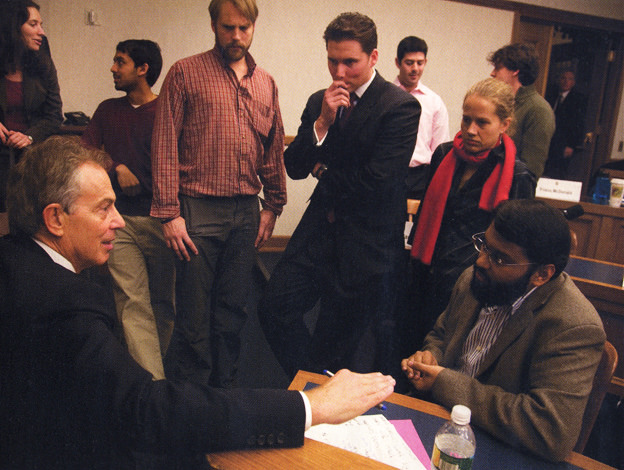
Mr. Blair came for our third session. He went around the entire class and shook our hands, one by one, asking our names. As is to be expected, he was his charming self and quickly managed to ingratiate himself amongst the crowd. (As a side point, one of the greatest lessons I learnt from the class was the art of public speaking, for there is no denying that Blair is one of the most eloquent politicians and speakers of our time).
There is much that can be written about that class (and perhaps that might form the subject of another post). But suffice to state that I felt my presence in that class was fully justified. Right after his very first lecture, when Blair asked, ‘Any questions?’ my hand was the first to shoot up, and I was called on to ask. One aspect of the lecture had been about the importance of respecting all citizens of any one country equally, and that it was potentially dangerous to try to differentiate between citizens for any reason whatsoever. My question sought to work out a realistic balance between loyalty to one’s faith and loyalty to one’s country. I felt that Blair had tried to paint too rosy of a picture of any nation-state, and when such ideals are utopic and proposed as ‘standard’, those who fall short of them will then be viewed as potentially betraying the cause of the country. So I asked him how he wished to reconcile dogmatic religious beliefs with dogmatic views of an ideal citizen, “…how can you expect a Christian to treat someone who views the very idea that he cherishes so much (viz., that Jesus Christ is the Son of God who died for man’s sins) as being blasphemous? How can you expect a Christian or Muslim or any religious person who believes in the exclusivity of his faith not to take that belief into account when dealing with others, even if they be members of his own nation?” (As a disclaimer, I am not positing that the two are mutually exclusive, for they are not; rather, what I am stating, and have written about elsewhere, is that the country must have realistic expectations of its citizens and understand its own function and role in order to foster greater loyalty amongst its people – a country cannot take the place, role or function of a religion).
Blair gave me one of his infamous quizzical looks and said ‘That’s a really good question, and I’m afraid I don’t have an answer to it, but if I think of one, I’ll get back to you on it.’ The class burst out laughing (and throughout the course of the semester, my question was referred to at least half a dozen times, by Blair and Volf). And so it began. Every time Blair came, my hand would inevitably shoot up, and I would make it a point to ask a very direct and usually uncomfortable question. In one session, after he mentioned the issue of freedom and how religions must understand that they cannot restrict the freedoms of others, I challenged him on the fact that this was a two-way street. Secular democracies could also not curtail religious freedom where they disagreed with it. When he suggested that they do not do that, I called him out on his stance on Hizb ul-Tahreer, an organization that I have no sympathy for theologically, and disagree with completely ideologically. I reminded him that he himself was trying to ban Hizb ul-Tahreer even though it was agreed that they never promoted terrorism. His response was that while it was true that they did not engage in terrorism, they were active in promoting hate speech, which could potentially lead to terrorism. To which I retorted that based on this principle, he should also ban the BNP and other racist groups that wish to spread hatred of Asians and Muslims. He didn’t really have a retort to that one.
And so it went on. I was always polite, never argumentative. I felt like Katy Couric with Sarah Palin – intrusive enough to expose the holes without being rude. At one point in the semester, as soon as he walked into class, he looked around, his gaze finally stopping on me. He winked and said with a smirk, ‘So, Yas-eer, have you got your question up your sleeve already?’ To which I retorted, ‘Not yet, but by the time you finish your lecture I will!’
For thirteen weeks, we discussed a whole array of topics, and I was introduced to fascinating authors and modern thinkers that I had never heard of. I greatly benefited from the scope and diversity of the issues that we talked about, from Nestle’s business ethics to religious conflict in Sri Lanka, from the details of working out peace in Northern Ireland to seeing the effects of globalization on coco plantations Africa. One of the highlights for me was to get to meet and interact with the two primary architects of the Northern Ireland peace process, the Catholic Fr. Alec Reid and the Protestant Minister Harold Good. Both were in their late seventies, and it was simply humbling to hear their experiences during the last thirty years and the roles that they played in bringing peace to their country.
For my final class project, I chose to discuss the veil-controversy that had occurred in 2006 in the UK. A teacher had been expelled for wearing the niqab, and less than 48 hours later, Blair himself had commented on it, before the case went to court, claiming that he supported the decision of the school to suspend the teacher. I showed the effects of such inflammatory language, and stated that politicians, especially the Prime Minister himself, did his country a disservice when he took sides with a majority against an already isolated and embittered minority. Rather than seeking to alienate, I said, it is the role of politicians to mediate. (As a side point, I could not help but notice the irony of the situation – who would have guessed that I could criticize the current PM for this issue in 2006 as I addressed the GPU, and would then get the opportunity to critique his actions in class at Yale in 2008?).
Throughout the semester, though, there was one major elephant in the room that no one dared to bring it. That elephant, of course, was the war in Iraq. We had not discussed this topic since, rather unbelievably, the Iraq war was not a part of our syllabus (perhaps on purpose?) Since the issue never came up, none of the students felt it appropriate to bring up.
On the other hand, I felt it my moral obligation that I not leave this class and end this semester without bringing up the past. While I realized that it would not change anything that had happened, I wanted to have a clear conscience and be able to speak my mind on this issue. But I also wanted to see:
1) if Blair had any regrets regarding his decision,
2) if he realized that his actions seemed to demonstrate to many people the hypocrisy of democracy when a majority of his own people opposed the war, yet he so stubbornly brought his country into this conflict against the will of his people,
3) and, lastly, if he understood that his perception in the Middle East, and in fact in many parts of the world, as a man of war, actually made it impossible for him to be an ‘Envoy of Peace’ in the Middle East.
With regards to the last point, I was trying to get the point across that his new-found role as ‘Special Envoy of the Quartet’ to try to solve the Palestinian crisis was viewed as a big practical joke by pretty much all players in the region.
Although it was extremely uncomfortable to get to this topic, alhamdulillah in the very last class (with the help of certain classmates whom I had prompted) I did manage to raise all of these issues and more with him. I tried my best to be firm and keep my cool, but despite all my attempts, my bluntness did fluster him considerably (as even my friends attested to). To summarize the entire ten minute back-and-forth, as is to be expected, Blair does not regret his decision at all (‘In the end of the day we got rid of an evil dictator’). He felt that his decision was in fact democracy in action, for if the people disagreed they could vote him out (which they eventually did). And he did not believe that his perception in the Middle East was that bad (no comment), for wherever he went he was thanked by the people of Iraq (to which I replied he should meet people on the street rather than hand-picked spokespersons). He firmly believed that he was a perfect person to be EU’s special envoy to the Middle East.
Conclusion
While my presence did not solve anything that had happened in the past, I feel that my input was greatly appreciated and valued by others. In fact, I was told the same by the professor, teaching fellows and many other students, who all said that my presence added a very unique perspective and had caused them to think about certain matters differently. Taking the class was a difficult decision for me, but I feel content in the outcome of the istikhara and hope that some possible good in the future results from it.
Living as we do in these lands, I feel very strongly that it is productive and necessary to engage directly with people from all walks of life, including politicians whom we might very strongly disagree with. We’re not going to gain much by sticking our heads in the sand, or by doing nothing except expressing our wrath and invoking curses on others. By dialoguing and communicating the way we feel and why we feel it, a lot of potential good can be realized.
It appears to me that many Muslims are extreme in their attitude towards engagement with ‘the other’. As with all extremism, two sides exist. Some feel that being involved in politics and engaging with the media is the primary way forward – that by getting involved in all walks of life, this will be our main source of revival and bring out peace in and for the Ummah. Such Muslims appear to rely on material means almost to the exclusion of spiritual ones.
On the other side of the spectrum, other Muslims are too isolationist and view any who wish to get involved with politics or the media as ‘sell-outs’. Hence, such Muslims exude nothing but contempt for those whom they view as having an inferiority complex.
As is typical, the middle path is usually best. While engagement is not the only way forward (personal spirituality and character development is far more important), it is a necessary and important step in order to make our lives better in this world, and yes, even the next. Only be engaging will we get our point across, and only by getting involved with the proper spirituality will the material side of things be effective.
The Prophet salla Allahu alayhi wa sallam commanded us to tie our camels, all the while putting our trust in Allah. I feel that engaging with such people is part of tying the camel, but let us never lose track of trusting in Allah.
Keep supporting MuslimMatters for the sake of Allah
Alhamdulillah, we're at over 850 supporters. Help us get to 900 supporters this month. All it takes is a small gift from a reader like you to keep us going, for just $2 / month.
The Prophet (SAW) has taught us the best of deeds are those that done consistently, even if they are small. Click here to support MuslimMatters with a monthly donation of $2 per month. Set it and collect blessings from Allah (swt) for the khayr you're supporting without thinking about it.







From a Syrian Prison to the UN: The Case of Bilal Abdul Kareem

The Muslim Book Awards 2026

Far Away [Part 25] – To Save A Prince

Putting Lipstick on the RSS Pig

[Podcast] Muslim Money Matters: Do You Know How to Halal Hustle? | Adam Taufique

Muslims and the F-Word: Feminism, Dhulm, and Jahiliyyah
Far Away [Part 25] – To Save A Prince
Far Away [Part 24] – The Whipping

When The Bed Walked Away [Part 2] – Primordial Muck
When The Bed Walked Away [Part 1]

The Best Actions for Eid al-Adha [Imam Dawud Walid]

Coming Full Circle: Who Are You Now? | Night 30 with the Qur’an

Running Away From Who We Are | Night 29 with the Qur’an

Building From the Ground Up: Week 4 Recap | Night 28 with the Qur’an





ibnabeeomar
February 4, 2009 at 2:04 AM
it still amazes me that people actually think like this. i really dont know what to say other than alhamdulillah for islam (seriously)
MM Associates
February 4, 2009 at 2:24 AM
Amazing article. Jazaakum Allahu khayran.
Shirien Elamawy
February 4, 2009 at 2:30 AM
I have to admit, that was one of the best reads. Barak Allahu feek Sheikh, I’m sure this one will go down in history, inshaAllah.
mofw
February 4, 2009 at 3:16 AM
I saw the picture and was shocked for a moment. Then I fought the urge to skip the article and shoot down to the comments section for a rant.
After reading the article, which I’ll say was VERY interesting, it is apparent that not taking the class would have not yielded any advantage while taking it and at least being a thorn in that smug, hypocritical terrorist’s side could be said to have been something of a victory.
I can imagine that without your determination and background the attendees could have been a pack of fawning sheep to Blair. Elite higher education seems to breed the most perniciously brain washed gangs.
That being said, I still have my reservations, I’ll keep them to myself though. Perhaps next we meet I will have them versified.
MyWadud
February 4, 2009 at 3:32 AM
I think this is the very role of the Muslim, I wish more knowledgeable, capable, respectable Muslims set out to meet, converse, explain, represent the perfectly balanced and straight view point of Islam to all that oppose and convince their hearts and minds with the help of Allah from their hardened negativity, blindness and deafness to the path of love. They may know and cover the truth, but if we don’t try to do our part of showing it with knowledge and kindness, or in seeing it and constantly bettering ourselves, we take part in the guilt.
Assalaamu ‘alaykum.
mofw
February 4, 2009 at 3:39 AM
LOL, check out the first trackback to this article. The wolves smell blood.
mofw
February 4, 2009 at 3:43 AM
hey, the pic they are using is linked to muslimmatters … if the admins want to mess with them they can change the pic on that url so they get a funny/embarrassing pic posted on their site.
Ameera
February 4, 2009 at 4:12 AM
This was so interesting that I read it all the way through. We Muslims need to learn the lesson of moderation in engaging with people. Unfortunately, a general view among the educated Muslim masses in much of the subcontinent tends to be very divisive, shunning neutral, much less friendly, interaction with Non Muslims. While they have their valid reasons such as war crimes, economic and foreign policies, the tend towards building barriers is not entirely justified.
I used to be among those who sought pleasure and satisfaction, even expecting Allah’s rewards, in a blanket hatred for the West. It was due to a vaccum of guidance as well as giving into the popular belief held in the post-Colonial era countries that the West could be nothing but evil and harm for us. Alhamdolillah, articles like these have blunted those earlier beliefs and while we shouldn’t be off our guard or blindly accept anything that comes our way, there is actually benefit for us in engaging positively with Non Muslims.
It would be a matter of heated debate whether talking to war criminals and the like can be good for us in any way but as Sheikh Yasir’s experience shows, there may yet be a positive side to everything and it’s the ultimate benefit that you derive for the Muslim Ummah that should be the tipping point.
(I’m also glad that no matter the result, Tony Blair got to interact with a Muslim student over a long period and somewhere, somehow, I believe some biased ideas and pre-conceived notions of Muslims in his mind may have weakened.)
Akhi
February 4, 2009 at 4:59 AM
I’m all for dialogue with non Muslims in terms of dawah and showing them the correct understanding of Islam but to sit in a study circle of a ruler who killed Muslims and was blatant about trying to stop Muslims from establishing a state for themselves? It’s like a Muslim in the time of Musa going to sit with the Pharoah and listen to what he has to teach.
mohammed
February 4, 2009 at 5:07 AM
our hero…good justification…if this message is not deleted then i would like to say that i smell ….nifaq
Pingback: Shaykh Yasir Qadhi - To Blair or Not to Blair, That is The Question :SeekersDigest
Abdullah Hasan
February 4, 2009 at 5:36 AM
Assalamu Alaikum,
عرفت الشر لا للشر ولكن لتوقيه ومن لا يعرف الخير من الشر يقع فيه
In order for one to begin remedying the vices found in the society, one has to understand and comprehend the nature of thought in that society. Muslims [Scholars] in the past engaged and debated with malevolent individuals like Mr Bliar. And as you correctly pointed out, your participation as a religious academic was beneficial, and even if your arguments did not get through to Mr Bliar, at least your presence was beneficial for your fellow colleagues, Insha’Allah.
Wassalam
abu abdAllah, the Houstonian
February 4, 2009 at 6:15 AM
bismillah. wait!!
He stressed what!?!?! did the words get cut off? :) i want to know!!!
i love you yasir for the sake of Allah. your istikhara is the key to my good feeling about your decision, and really the one lesson that any naysayer must contemplate in your article.
i have found that after istikhara even if in hindsight my choice was not the “best” possible decision, it always turns out that Allah guided me to the “right” decision for me at the time. another way to put it: given my own limits as a person and as a Muslim at the time of the decision, the choice Allah guided me to after istikhara was right for me, then. whereas later, after Allah permitted me to grow as a person and (more so in the past few years) as a Muslim, hindsight might let me realize that the other choice was “better,” but one i could not have followed through on, or would have executed in a way that would have reduced its merit.
none of that may make much sense, but the best example i have is the istikhara i made before visiting Al Quds — going was “right” for me at the time, before i had ever heard the story of Owais al Qarni, before i had ever heard Shaykh Waleed’s lecture about parents, and thus had my heart softened to accept the proper degree of deference to my parents wishes. if at the time of decision i had made the “best” choice — not going out of deference to my parents’ fears for my safety (completely unfounded fears, even in hindsight) — i would never have let my parents forget the “sacrifice” i was making, and thus would not have garnered any of the benefits of that choice. wAllaho’Alim — and really, trusting that only Allah Knows, i make istikhara regularly (as do most Muslims who comprehend the Mercy of Allah in that prayer).
wAllaho’Alim whether you may feel the same way later as you do now about the decision to take this course, but i have no doubt Allah guided you to the best decision you could have made at the time.
that said — you do shake hands with some pretty strange folk, lol. Manji, Blair, i shudder to think who’s next! :D
Pingback: News Round-up: 4th February, 2009 « Tony Blair
Umer Suleman
February 4, 2009 at 8:10 AM
Asalam alaykum,
Obviously a very difficult decision to make and may Allah reward you for it Yasir. I found the article thoroughly enjoyable to read and reminds us of the need to be firm but balanced in our approach.
May Allah continue to make you a source of knowledge for us,and guide us in our affairs.
ws
ibneshaheen
February 4, 2009 at 8:39 AM
Assalamualaikum WaRahmatullahi Wa Barakatuh Shaykh Yasir,
That was innovative and brave. May Allah make it easy for you in future.
Barakallahu Feekum. Alhamdulillah. I am impressed and feel very very encouraged by this academic engagement.
PS Hope to see GWB teaching somewhere something. But where and what actually he would teach and BTW how? :D
Siraaj Muhammad
February 4, 2009 at 9:38 AM
Salaam alaykum Shaykh Yasir,
Very well done. I believe your approach to this issue is one all Muslims should look to – in difficult issues, not everything is black and white. There are some that would have simply run away due to the cons, some who would have jumped in to take the class and would have thereafter been fawning after Blair and writing all the nice things they could about him for the sake of “engagement”.
Alhamdulillaah, you wrestled with your conscience, and then turned to Allah asking Him for what would be most pleasing to Him, which is something many overlook on both sides of the discussion, rather than automatically assuming you knew the answer. That you did not simply take a decision without that shura is a great lesson all of us need to learn.
I was also glad to read you respectfully, intelligently, yet aggressively went after his hypocrisies and inconsistencies and put in front of him on a regular basis, giving him an unfiltered, Main Street Muslim perspective. We often read stories of simple soldiers and great scholars confronting rulers in the past and putting their tyranny in front of them, and while we recount these stories in our Seerah and History classes, those occurrences are rare and appreciated.
Jazakallaah khayran for what you’ve done and for the example you’ve set.
Siraaj
Abu Eesa
February 4, 2009 at 9:39 AM
Assalamu ‘alaykum
You kept that one quiet Yasir! ;-)
There are some interesting points in your piece – I can pretty much relate to much of what you’ve agonised over with respect to the manner that such individuals like Blair should be engaged. No doubt Akhuna Shaykh Hamza did the same recently despite the mix-up with Saleema and her organisational work with Malaria No More (or whatever it was called).
If you had asked me about this class a few years ago being taken by Tony Blair, I would have said don’t bother as I don’t think he brings any real knowledge to the table. He certainly isn’t in the same stratosphere as Professor Miroslav who I have had the pleasure of taking two seminars with and found most enlightening.
A few years later and having been involved in a few meetings with the TB Faith Foundation led by the man himself, and I’ll tell you exactly the same. He doesn’t bring any knowledge to the table. His oration is not in doubt but his substance very much is and I’m afraid to say that I was not impressed in the slightest. Clearly though to take the class so to sit with Professor Miroslav and the other politicians and civic leaders that you’d get exposure to was the correct and a most beneficial decision so well done for that.
One anecdote that I’ll share with you: you made me smile when you asked him your first question which he didn’t know the answer to. It was that exact question that TB put to a gathering I was in a little while back looking for an answer; amongst us was also Jonathan Sacks and Mustafa Ceric and we all gave our take on it and at the end, someone asked TB his own opinion, and he still didn’t have an answer!!
:-)
AE
PS: I’m liking the site by the way MA!
Yasir Qadhi
February 4, 2009 at 9:45 AM
Subhan Allah, I’m amazed! Still searching for an answer…
I agree with your points (of course!). BTW you need to write a more detailed article regarding your experiences at Davos. I’m sure you have a lot more anecdotes up your sleeve!
Ibn Masood
February 4, 2009 at 10:36 AM
Sheikh Yasir, you’re the heeeeero, gonna take Tony Blair down to Zeeeeeeeero (can anyone guess where that’s from?).
Sorry… it couldn’t be helped.
Ozair
February 4, 2009 at 10:45 AM
Sheikh Yasir,
JazakAllah Khair for the article. I had heard about the class in early September and the thought of you attending never crossed my mind. However, I was glad that you were one of the individuals selected.
I wonder if you raised the argument that there is more chaos and civil unrest now in Iraq than during the Saddam rule. I’d be interested in hearing his response to that and his view regarding the civilian casualities in Iraq.
Moreover, I wish you had the opportunity to indulge him regarding the non-existent role that he played (and continues to play) in the recent Israel-Gaza conflict, as the envoy to the Middle East.
As-Salamu Aly-Kum.
MR
February 4, 2009 at 11:41 AM
Excellent post!
Mezba
February 4, 2009 at 12:09 PM
You had an amazing opportunity and it looks like it was a great course. Interacting with Blair was a bonus!
UmmeAmmaarah
February 4, 2009 at 12:18 PM
“Captain Planet, you’re a hero………….. ”
MashaAllah Sheikh, May we and our kids all rub shoulders (in segregated groups ;) ) with the eliterati, and rub off Islam on them, or rather, may we and our kids BE the eliterati, and save the planet ;) Aameen
Ayesha Fatima
February 4, 2009 at 12:21 PM
Jazakumallahu khairaa for sharing this with us.I am amazed at the amount of sabr you had!! Mashaallah.
salaam.
bintwadee3
February 4, 2009 at 12:41 PM
Jazaak Allaahu Khayran Shaykh Yasir. Like mofw, I too internally flipped out when I saw that photo. But masha’Allaah that article was amazing. My eyes welled up with tears of triumph. ALLAAHU AKBAR!
Muslims 3658 + 1
Kuffaar 4521215645425412
May Allaah grant you tremendously for your endeavor and bring only good. Allaahu A3lam, TB might come to his senses, repent and convert. May Allaah guide him to Islaam. Ameen.
P.S. Why isn’t it letting me Digg it?
Atif
February 4, 2009 at 12:50 PM
MashaAllah, excellent article.
As we know in Arabic Grammar, the wazn of “fa’eel” conveys more intensity than the wazn of “faa’il”.
So you can tell that Blair was fond of Sh. Yasir, as he called him Yaseer, instead of Yasir. I see this as a form of praise. :)
mnk
February 4, 2009 at 1:08 PM
MashaaAllah.
Shaykh Yasir, my only reservation is seeing you sans shalwar kamiz!
wasalaam
Algebra
February 4, 2009 at 1:37 PM
Aslamu-alaikum:
Sheikh Yasir
I liked your comments concerning your experience in the class.
I concur with SIRAJ’s viewpoints on this topic.
salam
ar.m
February 4, 2009 at 2:06 PM
steel toe caps?
Mustafa
February 4, 2009 at 2:26 PM
Shaikh Yasir,
My Allah reward you handsomely for your efforts. An opportunity that almost just slipped away and as soon as you overcame your inner doubts, Allah showed you some signs of acceptance inshaaAllah.
One thing I’m curious about is what goes through one’s mind when a man like Blair comes and offers a handshake? Does he shake hands to preserve the academic environment or does he say “I’m sorry, I don’t shake hands with war criminals?” What a predicament. Does shaking that hand prove wala to the taghoot? Or is it excused because of what the student was intending to accomplish throughout the course? These are just questions I don’t have answers for.
Mustafa
Annonymous
February 4, 2009 at 2:42 PM
asalaamu alaykum
JazkaAllah khyr for sharing this, sh. Yasir. Alhamdulilah Allah guided you to take this course. I think you brought up very valid points in your discussion with Mr. Blair, it would’ve been much more beneficial if you expanded on those points in your article so that we may gain a greater understanding of them thus facilitating our own conversations when such issues come up with others. None the less, very good read mashaAllah.
Farhan
February 4, 2009 at 2:59 PM
Salam,
Great article! Wonder who the other desi guy is in the pic?
Amad
February 4, 2009 at 3:17 PM
Digg and reddit links have been added at the top of the post. If anyone can stumble this, pls do so, and add a comment here.
AnonyMouse
February 4, 2009 at 3:23 PM
This article definitely caught my eye… and has certainly given me a lot of food for thought. It brings up quite a few questions and ethical dilemmas.
The biggest issue in my mind right now is with regards to the role of du’aat and shuyookh meeting with those who can be categorized as being amonst the tyrannical leaders in a manner that attempts to balance between strongly confronting and objecting to evil, and keeping in mind the details and context of the particular situation.
I’ll be chewing on this for a while :)
Abu Abdullah
February 4, 2009 at 3:41 PM
Assalam alaikum ya Shaikhu (br. Yasir Qadhi),
I am at work, but could not stop myself from reading despite the fact I have an urgent ask to finish…Barakallahu feekum…I felt like I did take the course….
If I were in the class, may be I would throw a shoe!
talib
February 4, 2009 at 3:51 PM
Subhan allah a whole semester with blair…i think ya sheikh this is was an opportunity for you to establish the huja on this person. this shaytan is directly responsible for killing thousands in iraq and spreading fitna in the muslim world. Obviously he had no answer to your questions because the hypocritical stance of the west towards muslims is as clear as the sun in its meridian brightness.
im just wondering who are these powers that control the issues a prime minister addresses, such as the niqabi teacher in the UK, and does the PM use his own judgment in addressing such issues or do others think for him and hes used as a marketing figure who eloquently passes on evil policies.
AbuZakariyya
February 4, 2009 at 4:02 PM
Salamualaykum Yasir Bhai
how come you’re not wearing your designer Kurta Shalwa? :P
very nice stuff though mashaAllah
wassalam
Ibnkhalil
February 4, 2009 at 4:10 PM
Assalam o alaykum, Bismillah………for the past few days I was wondering if one of the shuyookh were given an opportunity (somehow) to meet a tyrannical leader (e.g. Mr Bush Jr.), how would they go about it? The thought kept bugging me until I called my self to come to terms with the fact that it is not possible for an Orthodox Muslim to meet the pinnacle of Western power. Why? Because they are deemed just to dangerous by intelligence authorities and plus they will not give them the respect they desire.
When I saw the picture, even though I was tired and wanted to go to sleep, I had to read the article all the way through.
MashAllah Sh Yasir, a bold new step. I am glad to know you brought things to his attention that otherwise he would not have heard.
I liked the point that we cannot isolate ourselves yet we cannot also join them. The best way is to get our point across with good manners. BarakAllah u feek Sh Yasir! Truly an eye opener!
ibnabeeomar
February 4, 2009 at 4:32 PM
Sh Yasir, I would have also thrown my shoe at Tony Blair — but ONLY because it is a sign of disrespect in the Arab culture.
also, i know i am nitpicking here in regards to the comment above by br. talib, but i feel it’s an important issue of the mentality we find prevalent amongst ourselves –
I agree with the sentiments about Blair being, well, a flat out evil person. However, we should not let this cloud our judgment in acting with justice. The goal of dawah is not to “establish the hujjah” on someone and walk off. i remember sh. waleed basyouni giving an example of some ulemma debating, and one said, “alhamdulillah I have proven you are a kaafir.”
is this really our objective in dealing with people?
the sunnah does not show us any examples of the Prophet(s) trying to ‘establish hujjah’ on people – but rather we find that he fervently wished for people to become Muslim to save themselves, and this is why Allah(swt) even says he would have killed himself out of grief. we even find him praying that one of the 2 biggest enemies of islam at the time (abu jahl and umar) become Muslim.
We need not lose sight of the fact that our duty is to convey the message in the best manner possible, and not to just prove that they are condemned and evil.
I am glad that Sh. Yasir took advantage of the opportunity and at least raised the issue. It’s easy for us to sit here and say things like we would spit on him instead of shaking his hand, but we don’t really know how we would act in that situation. Islam teaches us to guide to Islam and debate with people in the best manner, and inshallah i hope Allah(swt) rewards sh. yasir for doing his best in that position to perform this duty. we’ve only heard snippets of an entire semester of class, and id like to hear more :)
midatlantic
February 4, 2009 at 4:32 PM
Thank you for sharing. I’m not sure where I stand…I am glad you were there and got to speak. But there is this unsettling aspect to it too. A discussion on Musa’s encounter with Firawn and how it relates to terms of engagement with today tyrants would be very interesting.
Mezba
February 4, 2009 at 4:45 PM
I am actually surprised by all the people who want to throw their shoe at Blair when he has come to engage and teach them. Says something about our community when we want to resort to violence that will solve nothing while accusing others of the same.
ibnabeeomar
February 4, 2009 at 4:47 PM
mezba – i know you’re not comparing a symbolic shoe to tanks and missiles that actually killed people … right?
Abu Bakr
February 4, 2009 at 4:47 PM
Assalamu alaykum
A very interesting read, jazakallahu khayran for sharing.
Abu Bakr
February 4, 2009 at 4:53 PM
As Sh. Yasir said, it didn’t change anything…but put in his shoes, I would have taken the class as well. If for no other reason, to know how the khabith thinks.
Abu Abdullah
February 4, 2009 at 6:38 PM
Assalam alaikum,
I did not literally mean that I would throw at him my shoe! Out of etiquette, I would have done exactly what Sh. Yasir did, corner him with questions to expose their hypocricy and bakruptcy of the their so called “highly cherished democratic idea(l)s” that applies to pale looking brits and their allies except muslims!!!
mohammed
February 4, 2009 at 6:38 PM
To brother Yasir,
I still dont understand why the brothers are so excited and happy that Mr. Yasir took this class. May Allah forgive me for having some discomfort against this Bro Yasir. It just does not feel right to see a brother who is active in the community to be a student of the killer of thousands of innocent muslims. I did not find anything special about this article. Please dont just jump to attack me for having a different opinion. I also dont understant why brother Yasir studying Islamic theology in a non muslim university. If it was science or technology, sure but why Islamic theology?
Gibran
October 2, 2012 at 1:54 AM
Wa alaykumusalam wa rahmatullahi wa barakatuh
Yeah I’ve wondered that. I wish I could ask Yasir that myself.
Khalil Ahmed
February 4, 2009 at 6:49 PM
“He felt that his decision was in fact democracy in action, for if the people disagreed they could vote him out (which they eventually did)”
A FACTUAL correction. Tony Blair was never “voted out” but resigned and was replaced by Gordon Brown.
Abu Abdurrahman
February 4, 2009 at 8:15 PM
True, brother Khalil – but as you’d undoubtedly be aware that almost everyone agreed that were he to continue office till the end of 3rd term he would have faced a vote of confidence by his own party members, as had almost happened on a few occasssions. He did not leave out his love for Mr Brown to be leader of the UK.
Wassalamu alaykum
AsimG
February 4, 2009 at 8:25 PM
Asalaamu Alaykum,
A fun and informative read alhamdillah.
I was expecting TB to give you an extensive defensive on supporting Iraq based on new points that have not permeated around the media. Alas, he is following the #1 rule of politics:
Have simple and easy to understand talking points.
Never move away from them.
Continually repeat them over and over until people realize you will not give them anything else (and also make yourself truly believe in them).
I want to hear more about this class though. What discussions were had in regards to Palestine and other oppressed Muslim areas?
Did TB ever back down on a point?
Who were some of the other professors?
This article has really made me want to specialize in contemporary “Islamist” movements.
Nuruddeen Lewis
February 4, 2009 at 9:48 PM
Alhamdulillah, I really enjoyed this article. On another note, I’m not sure what throwing a shoe at someone would accomplish; seems to do more harm than good.
Bint AbdelHamid
February 4, 2009 at 9:57 PM
Jazakum Allahu khayran. As many others said, one of the most interesting and insightful posts on the site. The writing and narrative were simply transporting.
Sharif
February 4, 2009 at 11:12 PM
Salam Alaikum,
I would just like to point out something, and I hope that my comment will bring benefit, inshallah. Did not Musa himself (alayhisalam) in fact go directly to Fir’awn and attend his presence, in order to challenge him on his evil views and actions? In order to educate him and try to lay the truth in front of him? Was this not the exact course of action of all the Prophets who were opposed by powerful and influential tyrants and advocates of falsehood? This is exactly what Shaykh Yasir Qadhi did, and I for one am glad that he did it, and believe that this was the appropriate move, and a precedent which wise, intelligent, and knowledgeable Muslims should follow.
Ibn Abu Aisha
February 4, 2009 at 11:32 PM
Assalamu Alaikum Ya Shaykhana,
Barak Allahu Feekum, I’ve been waiting for this article since the time you mentioned that you would write about your experience. I am curious about the authors and modern thinkers that were invited to the class – are there any books by them that we could benefit from? I would love to read them.
May Allah shower His infinite Mercy on you and your family. Ameen.
Muslimah
February 4, 2009 at 11:38 PM
This line definitely gave me a tickle inside, but more importantly painted a crisp and vivid mental picture!
An enjoyable and hard to put down read, would love to see a Part 2…
ASC
February 5, 2009 at 1:55 AM
JAK for sharing Shaykh. Interesting Read
HS
February 5, 2009 at 2:01 AM
Sh. Yasir, are there any books/readings from the class you would recommend?
osman
February 5, 2009 at 2:22 AM
assalamu alaykum,
I am so impressed by Sheikh Yasir Qadhi, he is really showing other muslims the way forward. To engage with top leaders and not become overly emotional (something that unfortunately is too typical of muslims) shows a lot of character.
I hope more muslims follow this lead.
sis
February 5, 2009 at 3:10 AM
AsSalaamu alaikum!
MashaAllah, an excellent read! Probably one of the BEST pieces on MuslimMatters!
Shaykh Yasir, I really admire the patience and persistence with which you stood up for the truth in your discussions, may Allah reward you.
I hope you will keep in touch with Mr. Blair and perhaps he will ask you for advice on how to deal with the Palestine issue he plans to be an envoy for.. :) You never know right?
Akhi
February 5, 2009 at 4:03 AM
Wa’alaykum Asallam Wa Rahmatullah,
Surely you are not comparing what Br Yasir has done to Prophet Musa. It would have been more appropriate to set up a debate with Blair and call him to Tawheed as Musa done with Firawn.
We didn’t see Musa go and sit in a study circle of the Firawn where the Firawn preached his message and Musa sat down, took notes and every now and then questioned Firawns tyranny did we?
Is this the way of the Prophets? Most defitnetly not!
To read more about Prophet Musa’s debate with the Firawn please read the article on the following link insha’Allah:
http://www.islambasics.com/view.php?bkID=85&chapter=16
abu Rumay-s.a.
February 5, 2009 at 5:15 AM
Very interesting article indeed. Some thoughts that came to mind when reading are as follows;
1. The believer’s earnest struggle and effort in decision making to please Allah, seeking His guidance, pondering over matters deeply, and seeking consultation (in such a case I believe as the prophet (saws) said, a person will be granted 2 rewards if he was correct and 1 reward if he errerd).
2. The importance of engaging in “intellectual” dialogue to present the true Muslim perspective (middle course – Allah accept it from us) in institutions of higher education and other similar forums. It is a given that your presence was not so much so directly going to affect the instructor but atleast provoking the thoughts of the other students who as you said may become tomorrow’s “movers and shakers.
3. The importance of producing individuals who are well rounded in both religious and secular discourses to be able to “acutely” represent the Muslim voice and therefore bring about meaningful results. It is quite amazing that with the large population of American Muslims, we only have a handful of Yasir Qadhis or Altaf Hussains or Dalia Mogaheds…..
4. The believers hearts reflects their brethren’s hearts, so we say Jazak Allahu khairun for voicing our thoughts, beliefs, and concerns to those leaders and engaging them as you have astutely done…
5. SubhanAllah, the believer can take wisdom and benefit in all matters and even though we all respectfully disagree with the erroneous political polemics and their contradictory arguments regarding some issues which are rather easily refuted by facts and logic, but the way of of presenting such facts is an art that has to be mastered as even Musa (as) prayed to Allah to help in that.
So thanks again and we encourage you to continue your sincere efforts, May Allah give you tawfiq and baraka and increase you and other Muslims in all goodness…ameen.
btw, TB was grilled on the issue of Gaza by one of the British news anchors on Al Jazeera at the World economic forum ..if someone can find the whole interview, please share it, I only came across a clip of it here:
http://english.aljazeera.net/news/europe/2009/01/2009130171015641793.html
Fatima Barkatulla
February 5, 2009 at 6:12 AM
Assalamu Alaikum Sheikh Yasir.
Ma Sha Allah, May Allah reward you….I have no doubt that Allah chose you to do this! And it is imperative that Iraq, continues to haunt Tony Blair, and that he is reminded about it again and again! And how right you are that he can never really be taken seriously as a peace envoy…talk about adding insult to injury!
By the way, Blair was not voted out of his premiership, he was pressured out but he stood down of his own accord. Actually he was re-elected after the Iraq war! It is to do with apathy more than support for him though and because there was no one better at the time in the minds of UK voters.
May Allah continue to make you an ambassador for our deen and allow you to speak the truth unwaveringly and keep you always firmly grounded upon the siraat ul-Mustaqeem. Aameen.
Fatima Barkatulla
London
Abu Bakr
February 5, 2009 at 7:02 AM
May I ask, what exactly did you mean when you said you completely disagree with them ideologically?
mohammed
February 5, 2009 at 11:49 AM
Brother Yassir’s followers will praise him regardless of what he does.
There is something called difference of opinion. If you disagree with Brother Yassir, all his followers will go as far as possible to label you extremist etc etc
“one of the best pieces” WHAT? May Allah give us wisdom to differentiate between “best pieces” and “something fishy”
Abdul Rahman
February 5, 2009 at 12:39 PM
Brother Yasir,
So far the best article I have read in MM. I have something to learn from each and every paragraph in this article.
Jazakhallahu Khairan.
Pingback: Will Sh. Yasir Qadhi be treated with the same contempt? « VERBALIZATIONS
Tawfique Chowdhury
February 5, 2009 at 1:15 PM
Akhi Yasir,
Thank you for sharing that with us. When you had last told me when we were at the GPU London Gala dinner, about your experience with Tony – I didn’t think it would be this engaging. I feel that if anything, you atleast got to engage in a critical analysis of Tony’s thoughts in modern western imperialism and how it aims to control religion.
Hmm, you are now going to make me apply to an Ivy league university! See you soon in America if I get accepted inshaAllah.
Tawfique
Amad
February 5, 2009 at 2:33 PM
Shaykh Tawfique, we will be honored to have you in America… that will be quite awesome.
AsimG
February 5, 2009 at 1:20 PM
Brother Mohamed,
Just because you feel uncomfortable with this article does not mean the rest of who enjoyed it are praising Shaykh Yasir for the sake of praising him no matter what.
Many of the people who commented above would criticize Shaykh Yasir when called for, regardless of his popularity.
R
February 5, 2009 at 2:08 PM
These are my questions upon reading this –
1. Is it acceptable to shake the hand of one of the biggest war criminals of this era?
2. Is it appropriate to sit at his feet as a student of his?
3. Will the martyrs from Iraq remain silent on the day of judgement at the silence left until the last lesson????
What gets me most is the issue of “if i didn’t go there would have been no benefit” kind of approach
Look – Allah knows everything you do and don’t do.
He knows that you purposely decided to not go (if you made such a decision) to sit at the feet of one of the worlds criminals as a student because of your izza and pride in Islam, and hatred for what that person has done.
Allah knows. That is enough.
Now – instead – we have another message.
Polite, cordial interaction, avoiding the key issues, with a major enemy of Allah and His Deen and the Umma is fine, as long as its at Yale and you get to ask a few “uncomfortable questions”. This impression in itself is not a good thing or a good example to set.
Don’t get me wrong I’m all for interaction.
But not this kind.
The accounting of the rulers by the scholars of the past is nothing like this at all, and their example is one of izza, steadfastness and bluntness in front of the enemies of Allah.
May Allah forgive us all.
AsimG
February 5, 2009 at 2:32 PM
So it is better to be online and make blunt posts on blogs rather than engaging with the enemy in an avenue that is given, which has the possibility of benefit?
The understanding of academia is lacking in your post. As if Shaykh Yasir was “sitting at his feet” in some masjid.
Abu Hizkeel
May 2, 2010 at 9:06 AM
Salamualaikum wr wb:
Just because something has the possibility of benefit doesn’t mean that it’s the right course to take. To think only in terms of benefit, taking interest on a loan has tremendous benefit for you. Some may argue that pornography has great benefits. Material (or otherwise intangible) benefit is not always the key. I think the brother was trying to point out that we have to look back to the Prophet’s SAWS example and see what the ruling is for us, in our day and age, in this particular circumstance.
May Allah forgive all of us,
Abu Hizkeel
Ameera
February 5, 2009 at 2:35 PM
Tony Blair’s sitting in his room, thinking about the past few months. He recalls a Muslim student in his class at Yale and wonders to himself if he’d ever discover the answer to that “question”. A few days later, he comes across a copy of the Quran (which some Muslim, possibly you and I, sent him) and thinking of his engaging Muslim student, flips it open. He skims through, reads a bit and puts it off for later… but really, it’s intriguing… so he picks it up again a few days later untill, one day he understands and accepts its Message…
I know it sounds way off and of course, this cannot possibly be the only argument in favor of interacting with a war criminal, but give it a serious thought. Hasn’t the interaction made Mr Blair understand Muslims better, even if it be in the slightest way? Isn’t it possible (and we must pray for his hidayah) that this might be something that led him to study Islam, even perhaps become a Muslim? Before you slam my theory, remember that many reverts bring forth similar stories of how positive interactions with Muslims changed their perception of Islam. Also, if one becomes Muslim, all his previous sins are written off. That’s why what Sh. Yasir did, I felt, was one form of Da’wah… Da’wah comes in all sorts of forms, not just by announcing in an open court, “I believe in One Allah and this is what I invite you to”.
darthvaider
February 5, 2009 at 2:58 PM
jazak Allah khayr shaykh yasir for this interesting read (I’m sure the class must have been an amazing experience).
gess
February 5, 2009 at 3:17 PM
As’salamu Aleikum all,
Well. I do not know anything about Yasir Qadhi, but if I had to give an advice. I rather liked the way Aref Ali Nayed gained the respect of the Catholic Church and the Pope himself after his infamous speech in Regensburg. The way Brother Aref Ali Nayed gained the respect was to refute the Pope’s speech in a way the Church could not be silence about. It was a perfect example of “pen is mightier than the sword”, and I can’t say the same way in this article by Yasir Qadhi, and on the contrary, when I read this article I got the impression that TB was *having fun*. If I must be honest to myself, very often Yasir Qadhi appear one who is eager to be intellectual and inclusive, like most South Asian stutents I met. Sometimes, the best lesson is to slow down for a while.
Wa’aleikum salaa,
Mezba
February 5, 2009 at 3:29 PM
If the companions of the Prophet had no trouble learning from prisoners of war from the battle of Badr (and they were intent on killing the Prophet and wiping out the Muslims), then how can anyone have problem with Mr Yasir learning from Mr Blair?
I find some of the comments here berating the author for attending Mr Blair’s class bizarre to say the least, and somewhat disturbing.
mujaheed
March 31, 2014 at 5:19 AM
When Tony bliar becomes a prison of war , captured by the mujaheeden and under their mercy , then Anybody can go and benefit from him on how to make a nuclear bomb or some other knowledge , no problem ! Tony phiraun is not a prisoner of war , so that analogy doesnt apply to him
Dawud Israel
February 5, 2009 at 4:07 PM
Question 1: Well this was interesting to read, I can’t help but wondering… “so what?”
Like what did you gain out of this and more importantly, what did it CHANGE? Did you get his phone number and via him did you gain influence among the British community at large?
Question 2: Can you tell us MORE jokes about this entire experience!?!? I can imagine there would have been many! :D
The tone of this article was more like, “we were just chilling out man” so I think the attacks people are making are displaced, we have a very relaxed attitude here in the West, even when it comes to deal with war criminals. And this article is making me wonder if we need to change that.
Jazaka Allahu khayran for this article.
Salam aleikum
Ruksana
February 5, 2009 at 4:10 PM
mashallah, very well written. i really liked your ending advise “let us never lose track of trusting in Allah.”
May Allah swt keep us under His shade!
Abdullah _UK
February 5, 2009 at 5:45 PM
Salam Shaykh,
I just wanted to say JazakAllah Khayr for doing this great service. I’ve not had a chance to read the comments above as they are too many and some of them are …shall we say, too negative.
I’m not sure whether the point I am about to make has been made, but here goes insha’Allah…..
As you rightly said, there were the “creme de la creme” of american society, and some will eventually go on to achieve great things in their lives, one or two may even end up being President. As you say, your presence got some of them thinking in ways that they normally would not have thought. I personally think Shaykh, through your Istikhara maybe Allah (swt) who is The Best of Planners has perhaps used you as a catalyst for good things to come via those present in the lectures, in the future insha’Allah!
Who would have thought at the time of Genghis Khan when muslims were being slaughtered in the east, that the Mongols in future generations would adopt Islam as their religion? We may not see the fruits of what Shaykh Yasir may have achieved now, but I sincerely believe that in future generations those lectures will play a profound role in the lives of some of those that were present.
May Allah bless you and preserve you. Ameen!
Wassalaam
Algebra
February 5, 2009 at 6:43 PM
Aslamu-alaikum:
To some of the negative commentators above. I really don’t understand what SHEIKH YASIR did wrong by attending the class.
IT IRRITATES ME THAT SOME OF YOU THINK THAT IT WAS WRONG OR UNISLAMIC OR NIFAQ.
Seriously, get over it and learn something. GET OUT OF YOUR COMFORT ZONES. AS LONG AS IT ISN’T AGAINST ISLAM TAKE A CLASS IN LEARNING FROM OTHERS AND TEACHING IN RETURN.
SALAM
ibnAbbas
February 5, 2009 at 7:12 PM
this was really an interesting read. I know there must have been loads of controversial moments in the room. shaykh Yasir, tell us more stories please. how many times did you corner him? :P
Al-Madrasi
February 5, 2009 at 10:36 PM
Firstly, Jazakallah khair Sh. Yasir, May Allah reward you immensely for your sincere actions.
To Sh. Yasir: It would be beneficial to us, if you can write a post about some of the questions that you have asked him along with his answers (and responses).
—-
On the other hand, I do not understand the rhetoric of some of us that Sh. Yasir committed crime or treason against muslims by attending a course ( naudhubillah, as if Sh. Yasir endorsed him unconditionally).
I just wanna ask them:
In what way him attending this course harmed muslims?…
Isn’t it wise to understand their perception and notion of islam and know them better so that one can ‘really talk to them’ (and reach them) in a language and notion that they understand us?… [Didn’t Zaid RA learned Hebrew during Prophet SA (and from whom)?…]
Are we not watching his interviews and read news that quotes him often?…
Amad
February 5, 2009 at 11:02 PM
I am just happy that Shaykh sahib decided to write. May Allah make this a precedent :)
Abd- Allah
February 6, 2009 at 12:28 AM
I wouldn’t say this is something good, nor is it something bad, it is just neutral as far as I can see it, but only Allah knows if this interaction between the two was good or bad, and what direct or indirect results might it cause in the future.
I don’t know much about Blair nor about sheikh Qadhi, and I don’t know the context of the above picture, but to give sheikh Qadhi a peice of advice since addeenu annaseeha, I would say have more confidence next time IF you ever are interacting with someone like Blair, because from the picture I see Blair as confident and dominating over everyone else around him, and the people around him look submissive to an extent. Of course this is natural for a person like him who has leadership experience, but I still think that a sheikh with Islamic knowledge such as you can use that knowledge which he knows from the Quran and Sunnah to his advantage and benefit, and to be able to dominate and control such situations. Remember that you, sheikh Qadhi, have Allah on your side since you are a muslim, but Blair has no one on his side.
47:11 That is because Allah is the Protector of those who believe, but those who reject Allah have no protector.
I would also like to give MM some advice about the google ads that come up randomly with the posts. Sometimes and depending on the topic of the post, some of the ads that came up were not very halal, and although you are not placing those bad ads yourselves and that we would hope that most of the muslims that visit MM fear Allah enough not to click on these haram ads, but shaytan is always active doing his work. So, I would suggest that MM filters the ads that are placed under their posts, so that you don’t end up aiding people and directing them to the haram, as I am sure this is not the intention of any of the people at MM.
I don’t know much about technology, but I found this post about how to filter ads, maybe it can be of some help:
http://www.themuslimblogger.com/2008/09/how-to-keep-your-adsense-ads-halal/
Allah knows best.
Omar
February 6, 2009 at 2:39 AM
Very Interesting article. Sheikh Yasir, I have tremendous respect for you, and I am indebted to you for much you have taught me, both directly and indirectly, and I ask Allah to give ‘Izza to the Umma through you.
However, I must admit, I have great reservations about this whole ordeal, A unique experience, and unparalleled exposure no doubt, but at the end of the day it is a man responsible for destruction of a Muslim Land, throwing it into civil war and complete disarray, a man with the blood of hundreds of thousands of Muslims on his hands. Would we tell the Iraqi orphans and widows we met with your invader to learn from his experience?
Would it have been correct to learn from the Crusader Richard the Lion Heart after his retirement? the Mongol Hulagu? from Abu Jahl? Stripping away his eloquence, his grandeur, his prestige in the sight of men, Blair will go down in history as one of the foremost ravagers of Iraq.
I understand this was not an easy decision to make, and there was much good out of it as well, but sometimes I wonder if we take this whole “we live in the western lands and must be practical” thing too far. This was not an average westerner with whom we have no qualm, but one of the heads of the neocon warmachine, essentially modern crusaders.
I wonder if we could stand before the Sahaba, before the Prophet Salla Allahu ‘alayhi wasallam and say “We sat in his gathering, and treated him as teacher, the disbeliever responsible for the slaughter of innumerable people of your Umma”
What makes this bearable, is that you confronted him on pertinent issues, and you gained from him what I hope inshAAllah will help you in the da’wah. But still, great doubts linger in my mind. I can twist it left and right and rationalize the decision, but when it comes down to it, Blair unapologetically has the blood of our brothers and sisters on his hands.
If you were right, may Allah give you two rewards, and if you were not, may He give you one inshaAllah,
Incidentally, how did you end up doing academically in that course?
JazakaAllahu Khayr
Abdul Rahman
February 6, 2009 at 2:41 AM
I haven’t read all the comments, so I don’t know if someone has already addressed this view..
Its not just Mr. Blair and the Shaykh, we have to remember that class was filled with other would be “movers and shakers” and they all are listening to their interactions. Even if the worst happened and Mr. Blair was just having “Fun” with the Shyakh, I hope that rest of the class wouldn’t have enjoyed it the same way as Mr. Blair. The opinion of those students are very important than what Mr. Blair thinks.
And apart from that the concern of whether we can study with a “War Criminal” – Sorry, I have enough knowledge in that area to comment about it.
Pingback: YQ & Tony Blair, one time only. « The Straight Path-لصِّرَاطَ المُستَقِيمَ
Sadaf Farooqi
February 6, 2009 at 3:35 AM
Bismillah
“Go, both of you, to Fir’aun (Pharaoh), verily, he has transgressed (all bounds in disbelief and disobedience and behaved as an arrogant tyrant). And speak to him mildly, perhaps he may accept admonition or fear Allah.” [Surah Tuaahaa: 43, 44]
What Sheikh Yasir did was similar to what was done by all the Messengers of Allah when they were in a position in which the followers of their monotheistic religion were being oppressed and killed by tyrannical rulers — they approached these tyrants with polite speech and an initiative of dialogue/negotiation/reconciliation.
Those who are “smelling something fishy” or “sensing nifaq” in what the Sheikh did, should fear Allah and pray for the guidance of us all. Look at the Sheikh’s intention behind taking the class, at his sincere istikharah when he felt inner turmoil between his rational thinking and his moral conscience. Anyone – be they average Muslims who do not have much knowledge, or notable scholars and da’ee’s – will be judged by Allah, based on what they intended when they performed an action. Just the fact that he deliberated for so long out of fear of Allah, consulted scholars, and finally, sincerely did istikharah, is enough to establish the sincerity of his heart.
The rest of us should fear Allah and refrain from judging the Sheikhs and duaat of our Ummah.
Selected Pearls
February 6, 2009 at 5:03 AM
Dear Sadaf
With all due respect I think it is somewhat of an incorrect analogy to compare what Musa (as) did in that he went to Fir’awn with what Br. Yasir did. There is a major difference between going to a tyrant in order to teach him and call him to the worship of Allah and going to a tyrant in order to learn from him and ask a few questions about the rights and wrongs of his invasions.
Having said this, it does not mean that I consider what Br. Yasir did right or wrong, but I do believe such analogies are not only misplaced but a complete exaggeration.
On a side note, whether I agree or not with Br. Yasir taking such a class, since he was there perhaps it would have been better to focus his da’wah efforts with the central call of the Prophets?!
Yasir Qadhi
February 6, 2009 at 10:27 AM
Salam Alaikum
I appreciate the point of view of those who would not have done what I did in this situation – I do not believe they are ‘wrong’ and therefore I will not ‘defend’ my position, just like I cannot claim that I was totally ‘right’. Its a very murky area.
I believe that was the whole point of the article – it’s a difficult decision and there are plenty of pros and cons both ways.
As for my own conscience, as I wrote above, alhamdulillah it is clear. I did what I could, and I fully realize that many will view what I did as being too little. As I already wrote in the article itself, my philosophy is: ”What else can we do? Of what value is it NOT to engage? Why should we not make Blair at least feel uncomfortable, and be a positive influence on others who might not see the world the way we see it?”
And I also wish to point out that it wasn’t just to ‘confront’ Blair that I took the class. It was also to interact with a very talented group of students, and I have no doubt that it is very very possible that more than one of these people will be in positions of influence later on in their lives. I know the input that I gave was unique (who else would verbalize my point of view?!) and I’m confident that my presence left a very personal effect on the course and on my fellow students. Lastly, the course itself was beneficial to me personally; Blair did not ‘teach’ me any academic material that I did not know before, but we read dozens of authors and thousands of pages, I interacted with many other teachers and visiting lecturers, and I was enriched because of it.
Perhaps others would have done things differently. So be it – some diversity is good for the Ummah. I can assure you, though, that had I not been in that room for the duration of the semester, many issues would not have been challenged the way that they were, and there would have been no one would have told Blair, to his face, in public, in front of the cameras, that his decision made him a potential war criminal, and that regardless of what others thought of the war, in the end he would have to stand before God and God would judge him for his decision.
And in the end, Allah knows best, and He will judge all of us, including Blair.
Yasir
Hahn
February 6, 2009 at 11:37 AM
Salam,
“There is much that can be written about that class (and perhaps that might form the subject of another post”
I would like to hold you to this, as the opportunity you had could not be afforded to all. It would be an educational journey for the rest of us, to learn from your experiences. It may also help to broaden our own minds.
Please do it whilst your mind is still fresh..:-)
Manas Shaikh
February 6, 2009 at 12:17 PM
This was illuminating. JAK.
BP
February 6, 2009 at 12:40 PM
Salaams,
The sheikh sought the help of Allah swt by praying istikharah and then made his decision, so do not criticise him!
May good come out of this- Ameen.
aamer khan
February 6, 2009 at 1:10 PM
if shaikh Yasir was correct, then he gets two rewards, and if he was incorrect, he at least gets one.
and Allah knows best.
Abu Fellah
February 6, 2009 at 4:57 PM
I find it ridiculous that people are criticizing Sh. Yasir for speaking the truth to Blair and helping other people in the class understand the Muslim perspective.
Can someone suggest an alternative that is actually feasible, rather than just thumping their chests and screaming for izzah? How would anyone have benefited if Sh. Yasir did NOT take the class? What he did was not any sign of weakness or humiliation.
Once again, we see the ‘internet jihadists’ with their quick criticism but no feasible alternative. As they’ve been told before, they need to rejoin the real world rather than living in the history books of the past. Its nice to read how the Ummah ‘was’, but merely by reading about it and pretending things are still the same, we won’t get there.
ALGEBRA
February 6, 2009 at 6:00 PM
Aslamu-alaikum:
Would anyone give me a DALEEL as to why was it wrong for Sheikh YASIR to join the class.
DALEEL PLEASE>
I am still not getting why some people are objecting?????
maybe i am clueless or something but i am just not getting it.
salam
James
February 6, 2009 at 8:50 PM
Sheik Yasir, thank you. You gave up your valueable time for the Ummah, so that we could be represented in that room.
Faiez
February 6, 2009 at 9:38 PM
Cameras? this was a recorded class? will this be airing in some pbs documentary?
Mohamed
February 6, 2009 at 10:31 PM
Asslaamau Allykum Wa Rahamat Allah Wa Baraktahu,
JazakaAllahu Khair sheikh, I think it is very important what you did and a step foward for this ummah.
I
abu abdAllah, the Houstonian
February 6, 2009 at 10:49 PM
bismillah. as salamu alaykum. first a point of clarification — i am not related to the abdullahs and abu abdullah’s on this or any other thread — my posts add the Houstonian (because it sounds better than the Houstoni) or you may see me post as “abu abdAllah (MM Associate)” with (Author) next to it — that would be me, too. inshaAllah, MM is working on permitting the association of gravatars with names. that should reduce, inshaAllah, the confusion that some may have now.
second, i guess the sentence i highlighted before was just a typo, because the fragment’s been removed. :) i really was curious what Blair might have stressed just then.
third, i think most of the criticisms leveled at shaykh Yasir are self-indulgent. even if their authors were right in their advice, there would not be much to characterize the statements as naseeha. the first criteria of naseeha is not being right — it’s being sincere. and sincerity is not measured by earnestness, wAllaho’Alim, so much as by adab/akhlaque.
alhamdolillah, in all the years i have known Yasir, i honestly think i have always loved his akhlaque. :) may Allah preserve his good character.
Dawud Israel
February 6, 2009 at 11:44 PM
Ma sha Allah, this was very well said. THIS is why your a shaykh…and we are not!
Manas Shaikh
February 7, 2009 at 12:23 AM
I am sorry to see the lack of “tehzeeb” (manners) in which the Shaykh is being criticized (not all, no). Even if his decision was wrong, people- please understand, it is his intention that his action shall be judged. And we are to assume the best intention on the part of our brother/sister.
To the Shaykh, I am proud that you were bold enough to go in there and engage. Alhamdulillah.
Sharif
February 7, 2009 at 1:04 AM
Here is a video of Tony Blair after his first class at Yale. About 45 seconds through, he says (referring to his class), rather unenthiusiastically, “They were a little smart actually.” I think we all know whom he was thinking of in particular ;).
Abu Muslim
February 7, 2009 at 1:07 AM
After Yasir Qadhi revealed what he was doing at Yale University, there has been a lot of comments and criticism about his actions. Some did their best to justify what was in his heart – as if that’s something up to us – to improve Yasir’s image as a pioneer in communicating with the heads of the dragon. At the same time, there were those who remained unyielding in their response as they only saw Yasir as a sell-out; this happens to be my opinion. This action of Yasir’s needs explaining so that one can understand why I have taken such a harsh approach towards him. Some have reminded me to consider his words to Tony Blair in the classroom setting, and I haven’t forgotten them. However, there is an entire context to why we look at him in a certain light. This is what I wish to shed here.
It all started with the arrest of Shaykh ‘Ali at-Tamimi, may Allah free him. Before his arrest, the pure Da’wah in America was strong and Yasir Qadhi was a unique asset for the Talib al-’Ilm. Yasir Qadhi was a specialist in ‘Aqeedah, and so the concepts and pillars of Tawheed were catching on to many Muslims. However, after the arrest of our beloved Shaykh, the worldview of Yasir started to shape in the wrong direction. Shaykh Tamimi’s arrest was looked at as “something we need to avoid.” In other words, if we continue with that Da’wah, we’ll end up like him. So a nascent Islamic leader that many of us had hopes in were demolished by the fears of this man; thankfully, our beloved Shaykh, Imam Anwar al-’Awlaki took this position unintentionally when his famous lectures on Jihad (Story of Ibn al-Akwa series & Constants on the Path of Jihad series) were made public.
We started to see strange opinions – justifying weakness – coming from Yasir’s lectures. For example, we saw him justify that weakness in, “The Treaty of Hudaybiyyah and Its Relevance to Our Time,” we saw him spurting out strange opinions such as his Gaza article, and we saw him allowing Muslims to turn in fellow Muslims to the authorities on suspicion of ‘terrorism’.
However, with the majority of his works within the past two years, there aren’t that many things one can point out as wrong according to the Kitab and Sunnah. Rather, what is seen as wrong is how he uses weakness to justify further weakness. For example, in his lecture “Muslims in the West: Where are we Going?“, besides some minor issues, most of it was correct. But look at the situation. Is he talking to a group of youth who are excited about making Hijrah for the sake of Jihad, or youth who are interested in making Hijrah for the sake of Hijrah, or youth who don’t really care about Hijrah except that they want some knowledge? We ask that because the calls of Hijrah today from our Scholars is a Hijrah for the sake of Jihad due to the fact that it’s fard ‘ayn from East to West; otherwise, Hijrah for the sake of Hijrah is only good if you can find an exceptional place to live in where you can worship Allah better without any worries.
Another problem of his downplaying of Hijrah is that instead of regarding the rulers in the Muslim lands as Tawaagheet that need to be removed – and this is a task for us youth – he completely ignores this momentous task, making it appear to this creative generation of Muslims that we have nothing to do with the return of Islam overseas. The times we live in where the Ummah is finally waking up and establishing Shari’ah through Jihad, he makes it appear that we actually don’t live in such times, and in some cases, he makes it look like its a problem or hindrance rather than a solution.
Instead of reminding the youth of their weakness in the face of a Crusader onslaught, he should be strengthening our youth by reminding them of the likes of Khalid ibn al-Waleed, Salah ad-Deen, Al-Qa’qaa, Khattab, and so on. When you remind youth of weakness in a time of war, by telling them that they are in the Makkan Phase and they should bow their heads to the tyrants that are technologically superior, do you think the victory of Islam will appear? Or is that love for Islam’s victory even a part of his agenda? Sometimes, we even question that due to his revisionist views.
The Muslim’s humiliation is called peace,
And the Arabs are heedless and asleep.
Naturally, even if he changes for the good and starts focusing on the pure Da’wah, he himself isn’t going to change the world. The point is however, to do whatever is in one’s means to bring it back up. A building is not established without the appropriate material. Similarly, an Islamic State will not come except with incitement, support, blood and stacks of skulls. There are Mujahideen out there who are rushing to this goal and have shown us its fruits with the establishment of Shari’ah in many parts of the world, defying the West and the Tyrants. Yasir, due to his influence, needs to either engage with these people (or their supporters or Scholars) or make it clear what his stance is on this global effort to bring back Islam without submitting to Western influence in terminology (such as Islamophobia, Terrorism, Islamists etc.). What Yasir does, simply put, is pretend that there is no need to address these vital issues because it might land him in jail or he might get visits from the authorities. Instead of following the blessed path of Imam Ahmad ibn Hanbal, we see him following the path of those who frown upon hardships in life and avoid all tests.
When we look at Yasir sitting with Tony Blair, we are once again reminded of this weakness that he justifies. After reading his article, one would get a sense of that awful smell that one usually smells after hearing from a brother that would attend an anti-war protest saying, “We achieved something great!” When in reality, it was a complete waste of time, in most cases.
Some of Yasir’s fan would use the argument of Musa, ‘alayhi as-salaam, saying that Yasir going to Blair is like Musa going to Fir’awn. This is like insulting a Nabi of Allah. Musa, ‘alayhi as-salaam, did not go to learn how Fir’awn used his magic nor how he had spread his influence. Rather, he went to him to warn him, expose him, and make demands of him. After that, he stopped going to him, unlike Yasir who continued to sit in his class and ask questions that were empty of the Da’wah to Tawheed and Bara’ of Shirk.
Musa entered Fir’awn with ‘Izzah and Yasir entered Blair with humiliation.
Musa left a tyrant with victory and Yasir left a tyrant with admiration.
When you connect all of Yasir’s recent past-doings and his obsession over ‘American Islam’ and the issue of voting for Obama, the picture becomes clear: he is just another one for the show. With every step he takes, he is closer to the camps of Kufr – camps that are full of the Tawaagheet, boot-licking Muslims, Kuffaar, Disbelieving Governments, Fuqaha’ al-Marines, Defenders of the Oppressors – and further from the camps of Imaan – camps that are full of Muslims that love other Muslims more than al-Ka’ba, Uncompromising ‘Ulema that follow that the footsteps of the Salaf as-Saalih, and Mujahideen who establish the Shari’ah and defy the greatest superpower to date.
An advice to Yasir’s students and fans: Yasir Qadhi may have studied at Madinah University for 10 years and is one of the few Scholars that are attending an Ivy League Institution, but a brother with sincere intention who lies on the wet cold ground, upon the snowing mountains, peeking through his scope amongst the fog, waiting patiently to ambush the enemy, has been raised to a much higher status by Allah, Al-Jabbaar. Undoubtedly, this is the status that Yasir frowns upon due to its inherent hardships. Shaykh Abu Anas al-Shami رحيمه الله took this path; a Shaykh who happened to be studying at Madinah University at the same time Yasir was studying. One went to meet Allah and the other went to meet a Taaghoot.
لاَّ يَسْتَوِي الْقَاعِدُونَ مِنَ الْمُؤْمِنِينَ غَيْرُ أُوْلِي الضَّرَرِ وَالْمُجَاهِدُونَ فِي سَبِيلِ اللّهِ بِأَمْوَالِهِمْ وَأَنفُسِهِمْ فَضَّلَ اللّهُ الْمُجَاهِدِينَ بِأَمْوَالِهِمْ وَأَنفُسِهِمْ عَلَى الْقَاعِدِينَ دَرَجَةً وَكُـلاًّ وَعَدَ اللّهُ الْحُسْنَى وَفَضَّلَ اللّهُ الْمُجَاهِدِينَ عَلَى الْقَاعِدِينَ أَجْراً عَظِيماً – دَرَجَاتٍ مِّنْهُ وَمَغْفِرَةً وَرَحْمَةً وَكَانَ اللّهُ غَفُوراً رَّحِيماً
[4:95-96]
Abd- Allah
February 7, 2009 at 2:43 AM
Brother Sharif, providing us with a warning along with that video that it contains some haram content (like a woman who is not properly covered) would have been appreciated. Providing that disclaimer or warning when you provide a link to a video or something is for your own benefit and no one else’s, because if a person goes to that video without knowing what it contains and based on the trust that he has for his muslim brother which provided that link, and when that person sees the haram in the video, then the person who provided the link to that video automatically gets sins for providing this link or access to that video. Providing a warning message with the link or video when you post it frees you (or atleast you would hope) from the sin associated from directing other people to the haram, because if you provided a warning or disclaimer about the content of the video, and someone still went and clicked on it and saw that haram, then they would be held accountable for that sin because they knew that this video contained haram content but still went to it, but if you didn’t provide a warning along with the video, then they might click to see the video without knowing that it has haram content and then once they see the haram then you get the sin as well because you played a part in directing them towards that haram.
I just wanted to make this point clear to EVERYONE, that if you provide an external link which might contain some questionable material that could be found offensive or disturbing to some muslims even if they are not disturbing to you, please have the courtesy to provide a short message along with the link to warn other people that it has content that is considered haram or disturbing to some muslims.
Alhamdulillah, this video had minor problems compared to the other videos and links that some people post sometimes which have much worse things in them like music and women who are much more uncovered, and to some of us, while we might be used to this stuff around us and in our society, but for others who are very practicing (may Allah make us from them, ameen) and who lower their gaze and guard themselves properly, then things like this, even a glance at sight that we consider “nothing major” could have a big effect on them and could be disturbing to them.
So just as a piece of advice, brother Sharif and EVERYONE else (and I say this because I care for my fellow muslims), next time please provide a short warning along with the video to let others know if the video or link contains something haram.
JazakumAllah khayr, and Allah knows best.
Siraaj Muhammad
February 7, 2009 at 3:44 AM
YQ Questions Blair:
http://www.youtube.com/watch?v=qtVTcvIyWdA&feature=PlayList&p=003CE0429CAE4E19&index=23
http://www.youtube.com/watch?v=ROUigKcEUV0&feature=PlayList&p=003CE0429CAE4E19&index=42
Siraaj
VM
February 7, 2009 at 4:32 AM
Assalam Alaykum,
A very enjoyable read. JazakAllah khair. I’m glad this was an oppurtunity for people to learn the perspective of the ‘other’ side directly.
Dawud Israel
February 7, 2009 at 12:19 PM
You guys need to really relax.
You could justify both meeting Blair or not meeting him, the deen can justify for either, because in the history of our ummah- this has always been the case. Do not, for one minute, dismiss a scholar because you don’t agree with his opinions. The only person who can disagree with a scholar is another scholar, and that too, they do with courtesy. You either love all the scholars, the way of the Muslim, or you hate all of them. If you are going to pick and choose, it’s not very different from picking and choosing from amongst the Prophets, or the Sahabas. What gives you that right?
It doesn’t matter what interpretation a scholar follows, you respect it. Khalaas. Give the scholars your respect. Don’t go to the extremes of either worshiping them, or rejecting them and wanting to kill them.
If you do NOT respect it, then why would you sow the seeds of discord?
I say this because just a little while ago, Umar Lee was hating on Hamza Yusuf, not one shred of evidence or argument except that he hated everything about Sh. Hamza. This attitude is troubling because Sh. Hamza has had a death threat on his life before. We don’t wanna see that happen to ANY of our teachers, regardless of their interpretation of Islam.
Dawud Israel
February 7, 2009 at 12:29 PM
HOOOOOOLY SHNIKEYS !!
Algebra
February 7, 2009 at 12:40 PM
Aslamu-alailkum:
i thought i would put up a link that shows the other side. Just humorous tone to all of this thrashing back and forth :)
http://www.youtube.com/watch?v=grLmZGlzBW8&NR=1
salam
intellect1429
February 7, 2009 at 2:07 PM
For those who are slandering against Shaykh Yasir, I just want to say that you think you know a little something about the deen, but instead of hate-mongering on Muslim blogs, why don’t you confront the Shaykh himself in private? (such was the way of our Beloved Prophet – peace and blessing of Allah be upon Him) if you really claim to be following “salafi” Islam.
Sometimes I even think (and I’m not much of a Jewish/non-muslim conspiracy theorists) that these haters are not really Muslim, but non-Muslims who are attempting to create Fitnah among the Muslims by posing as Muslims. Only Allah knows. Stop the online jihad.
I didn’t even want to comment on these individuals, but its my two cents.
Qas
February 7, 2009 at 3:15 PM
I usually stop reading when the comment reads like “transliterated” English.
AsimG
February 7, 2009 at 3:20 PM
Am I the only one that thought Abu Muslim’s response was interesting?
I don’t agree with it, but it’s something I’ve been wondering about. So many are calling for jihad, but how do we know when the call is right, real and universal?
UmmNour
February 7, 2009 at 3:46 PM
Brother Yasir qadhi is the hero of our time? Has he been whipped, lashed, imprisoned, lost his wealth, his family for this deen? People who are calling him a hero really need to go back into our dictionary and find out what a hero really is. The Shaykh just asked the tyrant of our time some ‘tough questions’ that any disbelieving activist would’ve asked! I mean maybe that’s all right but please dont belittle the real heroes of our time by calling a shaykh a hero for simply asking tough questions
Our ulama of the past, did not only question the tyrants, they spoke the haq and did not fear being imprisoned, or fear being labeled a title or fear even death. They didn’t play the ‘safe’ ground. I’m not saying that had I been in the shaykh’s position, I would have done any different. But thats the thing, the level of ulama’ is right the Prophet and Shuhadaa, why? Because they are not like us. They are ones who carry the torch of knowledge and bring Islam victory, not through their politically correct speeches, but by speaking the Haqq and encouraging the muslimeen to sacrifice..
If our shaykh can’t do that, they should remove the title of scholar of this deen from themselves. Call themselves just knowledgable brothers, imaams of a community… and leave the title of a scholar who is willing to die for his knowledge.
MuslimahCA
February 7, 2009 at 3:56 PM
Take It easy UmmNour!
JazakhAllahu Kheir Sh. Yasir
This was an amazing article and like Br. Dawud said previously, you are a Shaykh and we are not! We have VERY limited knowledge and may Allah preserve your ilm and help us attain some of it by being in your circles of knowledge!
As a ex poli sci major, this is all incredible fascinating to me, if i was given this opportunity I might have just took it and made sure my point of view was heard. I am kind of in a that situation with an atheist ex Muslim Irani lady who has to critize all religion and comes to me with random questions about Islam and most certainly I reply back to her with the knowledge I know! Its difficult being a student here in the west but this is test and we have to let our prescense be known. We cant be silent and invisble forever, we are Muslims!
See you in April Shaykh, may Allah bring you to us safe and sound and with lots of stories about this experience!
BarakhAllahu Feekhum
Abd- Allah
February 7, 2009 at 5:47 PM
Sister UmmNour, from what I know about sheikh Qadhi, and with all due respect, I wouldn’t say he is a “scholar”. He is just a sheikh who has some knowledge in the deen, but I would not say he has acheived the title of a “scholar” yet. One thing is that here in the west, and due to the lack of big scholars, the term “scholar” is used loosely and is inter-changeable with sheikh, imam, da’e….
From what I have seen, I do think that many people have gone to extremes regarding sheikh Qadhi, so while some harshly criticize him and attack him for minor things, others idolize and glorify him more than he deserves.
Allah knows best.
Abd- Allah
February 7, 2009 at 6:30 PM
I would like to ask sheikh Qadhi the same question he asked Blair, whether one can be fully committed to one’s faith and still be a fully committed, engaged and responsible politician? Do you think that a person can excel in both his religion and politics at the same time, or does excelling in one has to come at the expense of the other?
Algebra
February 7, 2009 at 6:53 PM
Aslamu-alaikum
I thought Umar bin Abdul Aziz was both a politician and a scholar.
Also in Pakistan one of the presidents from a couple of years ago was a politician and a learned Islamic person’
Actually in ISLAM it would be more feasible than in any other religion.
there is no separation of STATE and RELIGION in ISLAM whereas, in other religions there is a separation of state and religion.
that is the BEAUTY of ISLAM
maybe Shaykh Yasir should have brought that to the attention of BLAIR
salam
Algebra
February 7, 2009 at 7:00 PM
Aslamu-alaikum:
To be HONEST, i don’t Idolize and glorify any shaykh in America. I have seen many scholars in Pakistan and have been around many well learned scholars in Pakistan and other countries. I agree with you in that respect Abd Allah. However, i don’t think anything is wrong in taking that class with Blair. I really don’t think that it was against Islam or anything. Many SCHOLARS in history, especially Pako- Hind Scholars used to get many MA.S in Biology, Geography, Medicine, Literature, Languages(persian, ENGLISH, arabic) and also study RELIGION.
So there isn’t anything wrong with broadening our KNOWLEDGE BASE.
that is what we are saying when we say there isn’t anything wrong with taking that class.
I don’t know shaykh Yasir to know if he is watering down the religion or copping out so to speak so he may not be put in jail.
salam
Intelect1430
February 7, 2009 at 7:19 PM
-Edited. Off the topic completely. Pls use Sunday thread for other issues. jazakallahkhair.
intellect1429
February 7, 2009 at 8:11 PM
@MuslimahCA
I can second that. Exactly, we can’t be silent and sit on the sidelines while our religion gets bashed in the classrooms. What was the first ayah revealed by Allah: “Iqra”, so our deen is based on education – not just learning but also learning to refute biases against this spectacular Deen. I’m a psychology major, but I’ve taken poli sci courses and know what it feels like to have smeers of your religion painted in the classrooms – and you’re right, sometimes you feel like the instructor is directing it specifically at you. People really need to study the elements of jihad in our religion (myself included), and to know that jihad is not just physical fighting, but a daily “struggle”. The way I look at at, what Shakyh Yasir did was an act of jihad (“struggle”) and I commend him for representing our faith in that classroom. I’m appauled by some “muslims” bashing on him.
talib
February 7, 2009 at 9:34 PM
the doha debates, class with blair…i think sh yasir has political aspiration…which we are in dire need of…seekers of knowledge who are also engaged in political affairs and this is not new…since our ulemaa bin baz, al-albany rahimuhum allah were well aware of political issues and were constantly engaged in the political issues of muslims around the world.
im wondering were brother Abd- Allah gets the idea that islam and politics dont intersect…well they do and its called siyasah shari3iya and its the only way forward to create a leadership for our countries. leaders who are knowledgeable deeply in islamic sciences and in modern politics.
Rasheed Moore
February 7, 2009 at 10:10 PM
Salaam,
It’s been a while, I’m glad to see you are still doing big things.
Bit Tawfeeq
Rasheed
Hamdi
February 7, 2009 at 10:33 PM
talib – Did shaykh Yasir participate in one of the Doha debates; am I missing something?
Amad
February 7, 2009 at 11:31 PM
Yes, Sh. Yasir went to the Doha MLT discussions. I am not sure those the same as the “Doha debates”… seems like a lot of debating goes on in Doha!
Ameera
February 7, 2009 at 11:59 PM
I saw Sh Yasir on BBC, participating in the Doha Debates as a member of the audience. :)
Intelect1430
February 8, 2009 at 1:15 AM
OK on the topic now, boy that was brutal, no one cares these days.
I heard former President Bush will be taking political lecture in Yale soon, would this be a sell out as well?
I wonder what he might chose as a topic? Iraq, economy, winning wars, oil or WMD…….. may be how to retire from White House rich and comfortably.
Back in old days, sorry, GOOD old days, I did not see so much takfeer among people of knowledge compared to today. So, how come one expects the common Muslims to unite when Allah (T) has taken away the “true Ilm” by taking away the “understanding of Ilm” from so many scholars these day, no pun or offense to scholars intended, sincerely . I am too afraid to go to jail or be questioned by authorities for my comments as I write ;)
fozia
February 8, 2009 at 3:19 AM
ur article was amazing Jazakhullah !!
may allah swt reward u !
Tony Blair is a person that is not a true leader he is a follower of other wrong doers.
A person with intelligence stands out from the crowd and sticks up for what is right and wrong.
U were def that brave person so stick up for what is right and wrong and speak what was on your mind.!!
Mashallah!
Abu Abdur-Rahman
February 8, 2009 at 7:50 AM
jazak Allah khairun Abu Muslim i came on here to post your words but alhamdulilah they are already here. I dont expect Yasir Qadhi or his supporters to provide a concise response but it may be that Allah guides some away from the defeatist actions that are far from the status of a hero. The ummah has not been preserved by students of knowledge going to leaders of taghout and asking polite questions that are softer than that of average non muslim anti war protestor, rather the likes of Ahmad Ibn Hanbal, Ibn Taymyiah sacrificed with their blood and manifested their tawheed by action. Today there are still a few from the people of knowledge who are doing the same like Sh Abu Anas As-Shami (rAllah) but i guess those who chose the luxury life will realise the extreme regret on yaumal qiyamah when others are recieving a far higher grade from Allah swt.
Abu Abdurrahman
February 8, 2009 at 8:32 AM
42.” Go, you and your brother, with My signs, and be not faint in My Rememberanc
43. Go, both of you, unto Pharaoh. Nay! he has transgressed all bounds.
44. And speak unto him a gentle word, that perhaps he may heed or fear!”
Besides Yasir was in a class- environment, as is obvious and he even did point it out, and the effect of establishing the truth in such a manner (calmly with composure) is far more effective in an audience in the West – as opposed to huffing and puffing and making no other effect.
To not point out that Blair left with furyher humiliation and the Proof of Allah further established upon him – is a miscarriage of justice in your ‘analysis’ of Yasir’s situation.
Wa billahit tawfeeq.
Wassalamu alaykum wa rahmatullah
talib
February 8, 2009 at 2:37 PM
Yea the sh participated in the debate whether “political Islam is a threat to the West ”
http://www.thedohadebates.com/debates/past.asp
and i think he should have participated in that debate..since 3 of the 4 debaters had no sense of what basic islam is…and were rambling opinions in islam that had no sense.
Abd- Allah
February 8, 2009 at 3:01 PM
“im wondering were brother Abd- Allah gets the idea that islam and politics dont intersect”
brother talib, of course islam includes politics, but it includes islamic politics, which is very different from western politics. To say that both types of politics are the same is not accurate. That is why I don’t think islam intersects with western politics. Lets face it, no government in the world today runs according to islamic politics, not even the muslim countries.
Hannah
February 8, 2009 at 4:11 PM
your mind is very important for the future of our Ummah. May Allah protect you from harm. Ameen. To your family, may Allah protect them and reward all of them for their patience and efforts in taking good care of you. very good read. impressed as always, interesting, full of activity.
talib
February 8, 2009 at 4:35 PM
akhi abd allah…studying secular/western politics is also important…how do you defeat a concept if you do not understand what it contains. and akhi many countries have islamic sharia and politics combined in their system. such as saudia and all gulf states, malaysia etc
dont be pessimistic akhi…the muslims are gaining grounds in the political atmosphere and insha allah we will see a khilafa system with our own eyes just as we witnessed a black man running the states.
MuslimahCA
February 8, 2009 at 4:45 PM
Asalamu Alaykum
I just have to say the mods here have an amazing talent of speed deletion, these rude people who seem to have no other goal in life but to insult their own brothers and sisters in Islam need to Fear Allah! This is not how to make your point across in general as someone else mentioned, please just make it a point to go to Sh. Yasir’s classes or lecutures or even his khutbahs and personally and KINDLY address your issues. This is not even the manner the Prophet Sallahu Alayhi Wassalam dealt with the Quraish, Christians or Jews, why do you insist on bashing Muslims?
Other then that! Sorry mods if this is needs to be deleted :)
Faraz Omar
February 8, 2009 at 5:11 PM
Excellent stuff!! Masha Allah. Baarak Allahu feek.
That’s well said brother Yasir Qadhi.
I think engaging is a strong form of Da’wah Insha Allah. That’s how you let your opinion being heard and accepted. One of the biggest problems we have is a lack of Muslim intellectuals, who are well-versed in the Deen, its usool, and Aqeedah, in these intellectual groups and discussions. Even if there was ONE proper Muslim among such elite, like how Yasir Qadhi could say it there, the opinion would be respected, and the enemies would fear transgressing against us Insha Allah.
A lot of us, who are Alhamdulillaah on the path of the Qur’an and Sunnah and methodology of Salaf-us-Saalih, knowledgeable, and Insha Allah practicing to some ability, are so much in isolation that we are totally unaware of how the world functions, the strategies, and the ideological warfare.
Its only when we get out of our comfort zones and our circles, and meet others we face the full onslaught of foreign opinions and their reservations and their (wrong) views of what is correct and what isn’t. And only if we are grounded well in the Usool, can we face it and bring up a strong argument in support of our Islamic principles, using their own ‘words of reason.’ If a Muslim isn’t grounded well in Islamic principles, then he may well fall for some of their (wrong) ideologies, and consider it to be correct.
So one always has to be in constant touch with Ulema and seek their advice, because it really helps and clarifies. They may not be knowing the political situation, but the usool and knowledge of the deen and insha Allah their worship and practice upon that knowledge brings Allah’s help that they are able to answer and clarify to u. So their opinions really matter a lot.
Of course I do not say that everyone will be capable of handling it, but there must be a group of such Muslims. I can’t remember who, either it was Shaykh Muqbil or Muhsin Al-Abbad or some senior scholar who said that ideological war is the greatest of all or something similar
Faraz Omar
February 8, 2009 at 5:31 PM
and also to some of the criticism… isn’t that like acting a scholar ourselves in giving a ‘fatwa’ if its right to do or not?
I don’t know its Shari’ rulings, and I would suggest to ask some MAshaayakh if one wants to know.
I wonder if it can be linked to how Muslims in the past would stand up to tyrant rulers… because Muslims do not have a ruler, and especially in America which is not even a Muslim land! And the goal of meeting him was to speak up to the oppressor. And yes learning some of the strengths and tools to use against them?
I don’t know… I’m just wondering and thinking aloud… and it would be great if someone actually spoke to some of the real scholars in the Middle East and give us their view.
Are we going to leave the field of calling up scholars just because some misuse it?
Abd- Allah
February 8, 2009 at 5:36 PM
“I can’t remember who, either it was Shaykh Muqbil or Muhsin Al-Abbad or some senior scholar who said that ideological war is the greatest of all or something similar”
Brother Faraz Omar, I don’t think that what these shuyukh said about ideological war, I don’t think that this is what they meant. I’m not sure if this meeting between the sheikh and blair counts as “ideological war” according to these senior shuyukh. But I do agree that we don’t know if this is something good or bad, and we should ask the scholars about it.
Qas
February 8, 2009 at 6:29 PM
Shiekh Yasir does say in his artilcle “Thus began a series of conversations with a few people whom I look to for advice”. I am pretty sure it would include reputable scholars he has access to.
Abd- Allah
February 8, 2009 at 6:37 PM
Brother talib, studying secular/western politics is one thing, and practicing it or taking part in it is something else. I have no problem with us studying it and learning more about it. As for taking part in it or practicing it ourselves, then I think this is a matter that should be referred to our senior scholars for a ruling on it.
As for the muslim countries, none of them fully applies the laws of Allah, not even Saudi Arabia, even if they are better than other countries that aren’t applying any of the laws of Allah.
I am not pessimistic that we are gaining grounds in the political atmosphere, but if it is going to come at the cost of sacrificing our deen, and that is what happens most of the times when muslims try to get involved in secular politics, because the keyword is secular, and islam is a way of life that encompasses everything including politics. This is something we all have seen happen. Just take for example a muslim congressman will always have to put his duty for his country before his duty for his deen, because that is what secular politics entail.
The khilafa is going to be established again in the future. When? Only Allah knows when. But I highly doubt that the way to establish a khilafa is by muslims getting involved in secular politics.
Allah knows best.
Syed
February 8, 2009 at 7:02 PM
In this kind of graduate courses as you learn from the teacher the teacher learns from you. If you believe that Tony Blair is a sincere person and was just misguided then such interaction would help him to do good. OTOH, if he did what he did on purpose then teaching him will just help him in dealing with us in a ‘better’ way next time. But, one has to assume that at least some of the participants must be sincere individuals, so on the whole I do not think that this was an exercise in futility. May Allah reward the shykh for his good intentions.
Enosh
February 8, 2009 at 8:03 PM
Assalamu’alaikum,
It is great that you addressed our Muslim viewpoints to the former PM Blair! MashAllah and thanks, and keep it up!, with your recognition try talking to some of our Muslim Congressmen in the US !!
I notice that a main theme in the article was about the Iraq war, so I got a question: is it good that Sadaam is out of power in Iraq? He was a bad leader in my opinion. He slaughtered hundreds of thousands of Kurds in the north in an open act of genocide. These people where Muslims(from what I know). How bout starting a war against Iran just years after the “Islamic Revolution” (note use of quotations) overthrow of the Shah, in this war he took aid from the US to kill other Muslims (as far as I know) in Iran. Sadaam threatened to go to war with Saudi Arabia, did overtake Kuwait, killed many Shi’a in Iraq, and was a part of the secular ‘Ba’ath’ party. Granted the man was good in some areas, bringing education up in Iraq, but still a terrible ruler who had innocent blood on his hands.
The way in which the US and GB went to war in Iraq was a war crime in the massive killing of civilians, ruining infrastructure, etc. And the flaming of Shia-Sunni tensions and innocent people being killed on both sides is the fault of those Iraqis suicide bombing, kidnapping, and killing each other that continues to this day and making Iraq an unsafe place. Today Iraqis pose a bigger threat to themselves than do the US army, with “Shias” being slaughtered by “Sunnis” and then the retaliation with the killing of more innocent Iraqis by Iraqis. The disunity amongst Muslims is disheartening and the abandonment of basic Islamic principles(brotherhood, unity, 8:46) have made this ummah militarilly weak and self-destructive, and not the actions of the ‘West’.
salam.
Suhaib Webb
February 9, 2009 at 5:56 PM
Asalamu alaykum,
Sheikhana:
This was an amazing piece mashallah! I enjoyed reading your misgivings because I’m sure they were the same as many of us. You walked us through your thought process and truly inspired us to engage instead of sitting back and puffing.
May Allah reward you sheikh
Your student
Suhaib
Yasir Qadhi
February 9, 2009 at 7:57 PM
Shaykhana,
Jazak Allah for your comments.
Keep up the good work. We’re eagerly waiting for you back in the States; when you come back we expect, with Allah’s help, that you will bring much good for the Ummah!
Your student, who always is dwarfed by your towering presence, haqiqatan wa majazan,
Yasir
QasYM
February 9, 2009 at 11:11 PM
Shaykh Yasir, that application process for TB’s class sounded pretty similar to what the Ilm Summit-ers were saying for their application process. LOL
May Allah (swt) preserve you, and protect you, and allow us to benefit from you for a very long time.
Dawud Israel
February 10, 2009 at 12:47 AM
Just thought it would be an interesting to see how Imam Zaid and Shaykh Hamza were treated by Tony Blair and how that contrasts sharply with Sh. YQ’s experience : http://www.hahmed.com/blog/2008/10/03/imam-zaid-shakir-misunderstanding-not-treachery/
ABCDEFG
February 10, 2009 at 7:21 PM
Salaam wawrwb
Many people died in iraq in afghanistan in palistine an many other muslim countries and indeed tony blair is not to blame for all this but as u say its the american goverment or bush or who ever makes the final disessions who are out 21 centrey fir’own and thoese who agree or even copy there actions are fir’owns them selfs . Didnt tony blair send almost 3000+ troops to iraq killin 655,000 more then half a million MUSLIMS and as we no the blood of a muslim is more sacred then the kabah and the blood of the muslims who blood was split can fill a oceace and subhanallah we see a ustad that we hold dear to our hearts sit in a room with 1 of these fir’own subhanallah the moment he agreed to this invasion on iraq his blood became hallal and its is hard for 1 to be in a the same country as him let alone the same school let alone being as student to this fir’own may we all takiallah
jzk ustad :D
Ayesha
February 11, 2009 at 3:37 AM
Assalamu Alaikum,
This was an amazing article.
MM needs more like this.
WS
Mohamed
February 12, 2009 at 12:12 AM
SubhanAllah……that’s baller.
ComplexitySimplified
February 13, 2009 at 11:23 PM
As Salaamu Alaikum,
I trust Br. Yasir Qadi will not now be infusing and diluting his Islamic lessons at al-Maghrib and other places with what he has learned about the values of liberal democracy from evil Tony. I trust Br. Yasir Qadi will take extra care to ensure his own views, beliefs and values have in no way shape or form have now been moderated by what you he has learned from sitting with evil Tony over the many weeks…
I’m sure by choosing to not to bring up Iraq and Afghanistan until the last lesson Br. Yasir showed himself to be a moderate Muslim to the Yale Ivy leaguers and not least Tony.
May Allah protect us from the dawah of those that call to liberal ‘democracy’ and its false values – and protect us from falling in its trap of watering down Islam to appease their hatred of it.
Was salaam
ComplexitySimplified
February 13, 2009 at 11:41 PM
Following up my earlier comment
Whilst Br. Yasir did not make this decision lightly – it took two months of agonising and consultations and istikhara – it would be good to hear from Br. Yasir, an evalutaion of the course – what were the pros and cons in his partaking of it? And how does he intend to use this newly aquired knowledge. Also it would be good to know whether Br. Yasir consulted any of the senior scholars about his decision to partake or does he hold the view they don’t know enough about America and Tony Blair to be able to provide balanced advise.
was salaam
Qas
February 14, 2009 at 1:36 AM
Complexitysimplified…I have a question for you. Do the great Scholars of the East “know enough about America and Tony Blair to be able to provide balanced advise” or do you think there is a chance they might have different opinions sensitive to the proposal they are approached with? In other words, do these scholars know the gayb and can ALWAYS make the right judgment, or can there recommendation change by how one approaches them?
ComplexitySimplified
February 14, 2009 at 9:47 PM
Qas:
You ask a number of questions (of course i’m not a scholar of the East, nor one of the west for that matter! so I don’t presume to answer on their behalf – nothelessless I offer you my personal views and Allahu Alam)
1) Do the great Scholars of the East “know enough about America and Tony Blair to be able to provide balanced advise”?
On this issue, I’m sure learned scholars of the east, the west, north and south all have sufficient knowledge of Mr. Tony Blair SPECIFICALLY and America GENERALLY to be able to give sound advice and guidance on whether it is right or wrong or appropriate or inappropriate for a Talib to sit and take knowledge from Mr. Tony Blair over a 13 week period. Of course this is generalisation. Nonethess I believe Br. Yasir knows learned and respected scholars from the east fromwhom he can get the balanced advice from should he choose to approach them and use them for such issues.
2) do you think there is a chance they might have different opinions sensitive to the proposal they are approached with?
Absolutely – that is exactly what is to be expected. A learned and just scholar will advise based on the proposal and information provided to them as well as their wider knowledge and broader experience. So absolutely if you ask different questions and provide different information it is natural to get different answers ‘sensitive to the proposal’.
3). In other words, do these scholars know the gayb..?
No – only Allah knows the gayb (I’m sure you know that already?)
4). ..can ALWAYS make the right judgment..?
No – only Allah can ALWAYS make the right judgement (I’m sure you know that already?)
5) or can there recommendation change by how one approaches them?
I believe this question is similar to question 2 and has a similar answer. Like many things and for the sake of simplicity – let me illustrate:
Recommendations are based on: A1: Input of information + A2 question and A3 ‘how one approaches’ if you like >>>>> This is then processed with B) KNOWLEDGE & C) EXPERIENCE of the scholars & A1+A2+A3 and any other inputs >>>>>> this should resut in C) Recommendations/advice/rulings from the scholars
So naturally if any of the inputs (A) differ and or the quality of processes factors (B) differ the answer you get in C will change.
I’m sure Br. Yasir being aware of the context has suffient level of A’s and knows scholars with suffinet level of Bs to be able to get a really sound C!… and Allahu Alam
Did that answer your question or were you attempting to make a point? (if so, I didn’t get it)
Was Salaam
Yasmine Gharib
February 21, 2009 at 2:44 AM
WOW!
MashaAllah Shaykh!
Thanks for sharing….
Very aspiring and history making experience
by the by, was i the only one after reading this thought of how the class would be if Sheikh Yasir Qadhi AND George Galloway attended?!
the idea just popped in my mind while i was reading…..although i know its crazy and as impossible as impossible could get….but…
“….You may say Im a dreamer, But im not the only one” -George Galloway
IbnAbbas
February 21, 2009 at 11:22 AM
George would have ripped him apart. I guess If Mr Tony was paid the most highest salary ever to attend a class with him, he would NEVER do. The man was so scared of Georgy!
Abd-Allah
February 23, 2009 at 11:52 PM
Brother Yasir, Sheikh Yasir, I think you thought this through and you did istikhaara and then you gave your viewpoint. I dont think it was an issue of learning so much anything from him. But this class gave you an opportunity to meet businessmen, thinkers, etc, future leaders perchance one day you will be an even bigger future leader(in shaa Allaah) and Allaah might be preparing you for that.
I think it will be not be easy to sift through muslims comments. There are muslims who are uneducated and backward and will percieve your action as being such and such and your comments as such and such.
Yet I feel education is definitely the key for any muslim. And Although I do not agree with many of your viewpoints on some to alot of the matters dealing with “stuff” shall I say but I have the sense to take the truth wherever it comes from and to have respectful differences for even the sahaabah did so, but I am happy you are attending an Ivy league university to gain knowledge. I am happy for you because it is a privlidge to do so.I had applied for medical school at Yale and Harvard and was rejected sad to say but if I had gotten an opportunity to go there I would have, simply like you mentioned future leaders graduate from there. And that school is seen as not for the bourgoise (I dont know the correct spelling) but for priviledge people taht will make future decisions on the lives of many people “sad to say.”
Confronting the fir’oun is something that can be done on many levels and certainly you did and only someone in your position could be qualified to do it not someone like us(definitely not an undergraduate student for sure).
If you do not mind, i would like to email you to ask you how can I get into Yale, thanks
wasalaam
Abd- Allah
February 24, 2009 at 12:02 AM
Just to clarify things, I am NOT the “Abd-Allah” that posted the above comment.
Abd-Allah
February 25, 2009 at 5:09 PM
who cares?
obviously the site administrators and Sheikh Yasir Qadhi know we are two different people, our emails are different, I didnt even notice someone spelled Abd-Allah exactly the way I did. otherwise I would have chosen a different nickname and there is nothing wrong with what I wrote anyway although it might differ from your viewpoint.
Algebra
February 25, 2009 at 8:58 PM
Aslamu-alaikum:
I think one of you should change the name. It is misleading.
salam
The Original Abd- Allah
February 25, 2009 at 9:01 PM
Brother, I DO care, and there are more people than the site administrators who read these articles, and in my opinion, I do not agree with what you wrote, so this is why I clarified things. Well now that you know that this is my name, how about changing yours..
Amad
February 25, 2009 at 9:04 PM
One way to overcome the Abdallah mix-ups :) is to perhaps give the initial of your last name or add any initial. One name handles may have trouble being original.
And it does matter to people actually, because if you intend to use your nick for a long time, then you are building a reputation of sort, and that can carry baggage (good or bad) for the future.
Algebra
February 25, 2009 at 11:46 PM
Aslamu-alaikum:
Hey my name has its perks and its original.
I am known very well on these blogs. :)
salam
Algebra
February 25, 2009 at 11:47 PM
Aslamu-alaikum:
I have already established a reputation and what can i say.
salam
abu abdAllah Tariq Ahmed
February 25, 2009 at 11:56 PM
lol with Amad @ the dueling abdAllah’s. one reason, but not the only one, that led me first to add “the Houstonian,” and now to use “abu abdAllah Tariq Ahmed.” though when/if you guys start copying that, i may have to bring out the whole moniker: “abu abdAllah Tariq Ahmed, the Houstonian.”
which is why i hope, inshaAllah, that the site will soon fully support “gravatars” — those may even keep all the plain old abd-Allah’s happy and distinct.
The Original Abd- Allah
February 26, 2009 at 12:17 AM
I think color coding the comments would be a cool idea. Each time a new comment is posted from the same email, it gets the same color as the previous comments from that author, so each person would get all his/her comments in one, unique color that is different than everyone else’s color. One catch though is that eventually you run out of colors, but I wonder how Gmail deals with that issue…
Abd- Allah Thaani
February 26, 2009 at 10:31 AM
okay how is Abdullah Thaani or Abd-Allah the second ?
Abd- Allah
February 26, 2009 at 11:11 PM
sounds great, now I can go back to being plain old Abd- Allah.
Mona Zaman
February 28, 2009 at 4:42 PM
If I was in your shoes…I would never have hesitated to take that class. What an interesting and awesome chance to furthur your thinking. Thanks for sharing your experience in the class. Very cool article!! You inspire me.
J
February 28, 2009 at 7:07 PM
You know, I really wonder what the extremists–who criticize YQ for this–would have done in said situation. Maybe gone and thrown their shoes at Blair and cursed him out. How jaahil they truly are. They don’t realize that we live in the modern world where you must act academic. When two academics meet, they talk courteously to each other, even when the meaning of what they are saying is completely cutting through the beliefs of the other.
YQ had to stay civil and academic, and had he not done that, then the image of Islam would have been tarnished even more. I think most of these extremists have no experience with academia and civilized discourse, let alone at a place like Yale. Jahil bandars. We need to stop caring what they think altogether.
J
February 28, 2009 at 7:18 PM
Someone asked what to do if someone like Tony Blair extends his hand for a handshake, what should the believer do? Should he spit on it, slap it away, leave him hanging, etc? I really wonder how the extremists would act in this situation. The answer is:
Al-Bukhåri• cites in al-Adab al-Mufrad, with a sound chain from Ibn ‘Abbås; who remarked: “If Pharaoh had said to me, ‘May Allah bless you’, I would have said, ‘And you too’.” (source)
As Shaykh Salman al-Oudah added to the above: “For the ethics of Islam teach us to reply to a greeting with its like.”
Sister
March 2, 2009 at 9:39 PM
Be it Bush, Tasleema Nasrin, or Blair…they all deserve one thing–> http://www.youtube.com/watch?v=zTDM-si7RFM
Nice Beatings!
Though, I don’t know if it is Islamically right to beat up Islam/Muslim haters when they are visiting your city or country (despite them deserving it) it is very inspiring to watch the emotions that are provoked among NON-WESTERN Muslims upon seeing such criminals. I believe such emotions are suppressed in Western Muslims under the name of academic tolerance, practicality, ..etc. Some of us can tolerate to sit, smile and ‘discuss’ issues with such people…
In any case, I eagerly await such a video about Blair so I can add it to the Humor section of my youtube channel. It’s hard to find good humor these days…
Sister
March 2, 2009 at 10:06 PM
n’…Br. Yasir Qadhi…the hero of our time? Sis Umm Nour…thx for the reality check!
One sure shot way to destroy your fellow Muslim is to excessively praise him on his face! If y’all love YQ…hold your tongues, or should I say hold those typing fingers and learn to analyze things objectively. That is better for you and better for him!
J
March 2, 2009 at 11:12 PM
Educated and civilized people generally react in sophisticated ways, as opposed to the jahil awwam. Generally, foaming at the mouth, throwing temper tantrums, and chanting slogans is considered uncouth.
Muslimah
March 3, 2009 at 12:34 AM
I completely do not agree with this decesion. period. How can you learn from an enemy? How can you humble yourself in front of a person who openly hates muslims?
Sister
March 3, 2009 at 12:57 AM
Oh I forgot to add that valid emotions are also suppressed in the name of..’education, civilized demeanor and (the lousiest of them all) ‘sophistication’. I must also acknowledge that aside from randomly whooping criminals up, these emotions can be channeled to other actions (like setting up an Islamic govt. and doing it in a more organized fashion).
So is sitting down with an open enemy/murderer of Muslims, humbling yourself before him, and ‘learning’ from him.
Let me make clear that I am not a big fan of engaging in uselessly “sophisticated” back n forth argumentation. Just like everyone else I was merely expressing my thoughts.
Wallahu Alim!
Abd- Allah
March 3, 2009 at 1:13 AM
I think it would have made a big difference if Sh Qadhi had invited Blair to Islam by the end of the class, for if he had offered him islam (which is the sunnah of the prophet peace be upon him) then that would have made his decision undisputable since he would have took that class to give Blair dawah and invite him to islam, as you never know, maybe Blair was never invited to islam and all he needs is someone to explain to him what islam is and he might accept it right away. So my question to Sh Qadhi is: Did you invite Blair to islam at any point during this class? I mean a direct invitation like “say La Ilaha illa Allah” or atleast ask him “do you want to become muslim?”. Did you Sh Qadhi directly invite Blair to islam at any point during your encounter with him?
Now before someone jumps and says ” they way we act is dawah”, yes I agree, the way we act is dawah, BUT the sunnah of our prophet peace be upon him was to never leave it just at that, nor would he limit his dawah to the way he used to act and behave, but he used to always invite people and ask them to become muslim.
And also if anyone is thinking “hey he is a criminal and has killed many innocent muslims, why should we even want to invite him to islam and why would we want him to become muslim after he was responsible for killing so many innocent muslims”, and the answer to that is in the prophet’s seerah, when some companions after fighting the muslims and killing so many of them, they finally accepted islam and became muslims, so we should never stop giving people dawah and we should always invite people to islam, even if they have killed innocent muslims in the past.
J
March 3, 2009 at 2:20 AM
Does anybody here actually think that Ustadh Yasir Qadhi went to learn anything? Let’s be serious here. Tony Blair has no qualifications. Ustadh Yasir only went in order to interact with him, and speak a gentle word, as Prophet Moosa [as] was commanded to do with Pharaoh.
Ustadh Yasir did not at all humble himself before Tony Blair. If so, please tell us how. As for “learning” from him, see what I said above.
On the one hand, you say you are not interested in back and forth argumentation, yet I ask: why did you bother to come here and publicly insult Yasir Qadhi?
In any case, the bottom line is this: Ustadh Yasir did ijtihad. If he erred, then he still gets one reward. You should simply have said: “I respect Yasir Qadhi; I would’ve differently and I disagree with Ustadh Yasir’s decision, but insha-Allah he will get one reward for it…and neither does his error negate all the good he has done for dawah in America.”
Sister
March 3, 2009 at 2:44 AM
Publicly Insult? Please get your terminology right. As far as I know, accusing a commentator of something he/she has not done is a breach of ‘civilized demeanor’ and ‘sophistication’. It is far from the way of ‘educated’ people.
Khayr, I was only here to drop in my 2 cents. I’ve run out of change now…
Nothing personal brother, just take it easy! We all just need to get our basics right.
Abd- Allah
March 3, 2009 at 2:51 AM
Brother J, I agree with “Sister”. No where did she “insult” Sh Qadhi, so you shouldn’t accuse her of that.
Qas
March 3, 2009 at 3:36 AM
All I know is that most of us won’t do much for the Ummah except for spending the occasional 2 cents to show how someone who tries something is doing it wrong. May Allah have mercy on me.
J
March 3, 2009 at 11:51 AM
Brother Abd-Allah, the way she gave her input was snide, and insulting–if not an insult. Khair, perhaps I expect better of people!
“Nothing personal brother, just take it easy! We all just need to get our basics right.”
All I am saying is that you could have given your input in a better way. Please look up the proper way to give feedback to the people of knowledge.
Fi Aman Allah
Sister
March 3, 2009 at 2:41 PM
Cirtiquing someone’s (self-acknowledged) murky actions is indeed doing something, even if done occasionally. Let’s not waste time frowning on people who are spend their cents. Spending cents might lead to spending dollars…or even pounds…who knows. Look on the positive side.
Yeah…me too!!!
J…I’ll say it again don’t take it personally…Just Chill-Ax!
The content of the majority of the my comments was general in nature and those parts that can be considered very ‘personal’ were directed at Blair. I am not in the least bit embarrassed about what I’ve said. As a matter of fact, if it weren’t considered spamming and if I had the time I would be happy to fill the comments section up with such comments.
What I said about sitting down and ‘learning’ from (second-degree) murderers or in other words criminals was in part an extraction of what YQ himself acknowledged in his article.
When ‘murky’ matters, which potentially are mistakes, are reported publicly, they are open to criticism. If we don’t know the difference between and an insult and a criticism, then maybe we need to learn how to classify.
My comments were not snide and so I’ll warn you again about your inaccurate usage of your snide vocabulary.
Faraz Omar
March 3, 2009 at 3:00 PM
Wow! Masha Allah u all write so well. Why don’t you use that skill and time to write something good, inviting people to Islam, penning down some nice reflections? I work for an English daily in Saudi Arabia that has a readership of tens of thousands of people, and it has Islam page twice every week.
Interested? Great opportunity of Da’wah Insha Allah. Mail me farazomar (at) gmail (dot) com
Sister
March 3, 2009 at 3:15 PM
Nifty marketing…I must say!
Salma
March 3, 2009 at 8:15 PM
Assalamu Alaikum Brother,
I want to ask you about something you said in the end of your “Stories from the Seerah” series regarding the difference between a Rasul and a Nabi. I believe you said something to the effect that a Rasul is someone whose nation does not believe in him and a Nabi is someone whose nation does believe in him. I apologize if I’m misquoting you. Wouldn’t that be opinion be in contradiction with the Qur’an? In verse 19:51 and 19:54 Allah refers to Musa and Isma’il (Alayhis Salaam) as both Rasul and Nabi and in 33:40 Muhammad (Sal Allahu Alaihi Wa Sallam) is acknowledged to be a Rasul and the Seal of the Anbiya. The following link gives a different opinion regarding this issue: http://www.renaissance.com.pk/marq995.html . Do you think that this opinion could be more correct?
Jazak Allah Khair
ComplexitySimplified
March 3, 2009 at 9:58 PM
Would it be too simplistic to try to answer the connondrum of To Blair or Not To Blair, by asking the following questions?
How would Jews treat Hitler (or for that matter any holocaust deniers)? [Hitler = Mass Killer of Jews in the name of Arian Supremacy]
How should Muslims treat Blair (or for that matter any war criminal, mass murderer)? [Blair = Mass Killer of Muslims in the name Democracy]
Would Jews attend classes in Yale led by Hitler?
Should Muslims attend classes in Yale led by Blair?
Would Jews engage with Hitler academically and maintain academic decorum and wait 13 weeks before raising the issue about the matter of killing over 6 million of their brethrens in Germany, Poland? Would a Jew be satisfied by making Hitler fluster over a few questions over a ten minute period?
Should Muslims engage with Blair academically and maintain academic decorum and wait 13 weeks before raising the isse about the matter of killing over a million of our brethrens in Iraq and Afghanistan? Should a Muslim be satisfied by making Blair fluster over a few questions over a ten minute period?
How would Jewish University students respond if they knew their University was hosting Hitler / Mass Jew Killer for a semester?
How should Muslim University students respond if they knew their University was hosting Blair / Mass Muslim Killer for a semester?
Or perhaps the above questions are not really applicable – after all we are talking about more than 6 million Jewish blood and only over 1 Muslim blood. Hitler killed in the name of Arian Supremacy. Blair killed in the name of Democracy.Hitler speaks German and Blair speaks eloquent Oxbridge English.
So the question to our Muslim Shaykhs and Learned Islamic Scholars in the west – how should we treat and engage the likes of Blair? Should we treat him as Jews would treat Hilter or should we treat Blair as Shaykh Yasir Qadhi treated Blair?
Or should we be satisfied by Mr. Blair’s standard response which would be – you can only say all the above because you enjoy the fruits of democracy – and therefore accept these of the millions of deaths of our Muslim brothers and sisters as the price they need to pay to enjoy the same fruits of democracy as we do?
Or are there other options which Islam sanctions, recognising we have no Islamic state and we live in the West?
I’m sure Shaykh Yasir Qadhi is wiser and brighter, after the event, from your class with Blair on “Faith & Globalisation” and hope you can insha’Allah try to answer some of the above questions to act as a guide and toolkit for how Muslims in the West should cope with these contradictions between our Deen and Democracy.
Siraaj Muhammad
March 4, 2009 at 12:24 AM
Sister
March 4, 2009 at 2:01 PM
Istikhara is a form of dua. Unless Allah tells us, there is no way of saying whether the Istikhara was answered. As we know, Allah doesn’t accept all supplications/duas in exactly the way we ask them. Ofcourse, when you pray istikhara and pursue a course of action, you won’t have any sin recorded if you were wrong. But performing a certain action after praying istikhra doesn’t make the action right and acceptable for all Muslims!
Sister
March 4, 2009 at 4:48 PM
In general, I think it is relatively easy to judge between right and wrong by looking solely at the action precluding the person who performed it. We are not dealing with a Prophet here to uncritically accept everything that was done.
Unless there is solid proof from the Quran and the Sunnah to justify the action, there is no need to silence gut instincts by offering it ‘interesting’ , ‘rational’ or ‘logical’ explanations. Logic is a means to understanding religion, not the end!
Simple things should not be complexified. Complexity should be simplified (yeah…I got that from someone’s sn).
Siraaj Muhammad
March 5, 2009 at 3:08 AM
No one said this made it acceptable for all Muslims – I’m simply re-quoting what was written, that being that he prayed, applied to get into a difficult program, and was accepted, though he could have more easily been rejected and the case would end there. It amazes me that people criticize someone who clearly weighed the pros and cons (and feared the cons), and then turned to Allah for guidance.
So on the one hand, you are correct, if the wrong choice was made, no sin was recorded – on the other hand, if he made the right choice, you cannot disprove that either, and it is therefore wiser to keep quiet and focus on asking for your own guidance from Allah rather than going on and on and on and…
…on. What you think, and what is in your gut is not necessarily the Qur’aan and Sunnah either. I respect what Shaykh Yasir did because he followed the prescription of the Sunnah, which is to take advice from those whose knowledge he trusts on an unclear situation, and then ask Allah for guidance, leaving the rest to Him to facilitate the correct path.
May Allah give Muslims who don’t want to argue back and forth better things to do with their time.
Siraaj
Sister
March 5, 2009 at 11:51 AM
I never said I can. And I never ‘argued’ about it!
Thanks for the reminder. Keeping quiet and asking for my own guidance is something that I do regularly. However, sometimes I feel it is necessary to talk. So I’m here.
On the other hand, the same piece of ‘advice’ applies to you. Nobody specifically asked you for your input. I wonder why you gave it.? I can say with certainty that I engage in a lot fewer online discussions, than you. One’s gotta practice what one preaches, else the effect of one’s “advice” is lost.
Though I never went on and on and on…on, I don’t mind doing so in the future if I feel that’s what I need to do in order to satisfy my genuine concerns/curiosities.
I never said it was…and I don’t feel bound to change it unless there is some textual evidence, keeping in mind the hadith about consulting the ‘heart’. And no I’m not arguing about it, just stating it.
Thanks but no thanks for your accusatory “dua” for the productive usage of my time. It seems to me that you are a very judgemental person (the kind that I feel obligated to avoid).
May Allah give “advice” giving Muslim the taufeeq to be accurate in their speech and prevent them from falsely accusing others. May Allah also prevent them from reading their bias/emotions/anger in other people’s comments.
PS: If I have anything more to say or ask about the article, I will certainly do it. Please don’t try to get my attention by making false accusations against me.
Siraaj Muhammad
March 5, 2009 at 12:45 PM
She keeps going and….
and going and going…
and going and…
and going and going and going and…
and going and…
Nothing outlasts a person who argues so much, they even argue that they’re not arguing – they keep going and going and…
Wouldn’t think of it! Carry on, I’m off to build a house in Jannah, insha’Allah.
Siraaj
anonymous
March 5, 2009 at 2:53 PM
haha…this has become a joke..
why cant the mm mods close the commenting on this article? it’s not doing anyone any good.
Sister
March 5, 2009 at 2:55 PM
Wow siraaj, its amazing how you’ve “proved” yourself! Who was talking to you in the first place? Learn some humility…don’t accuse others in order to cover your own shortcomings. Learn the definition of arguing…it might come in handy in your future futile online expeditions. And don’t expect others to be the same as you.
Siraaj Muhammad
March 5, 2009 at 3:27 PM
My thoughts exactly.
Siraaj
Sister
March 5, 2009 at 4:32 PM
Too bad your “house in jannah” collapsed! tsk tsk…
I’ll start renovating mine.
-Unargumentative Sister
Qas
March 5, 2009 at 4:53 PM
I have the last comment. I WIN!!!!
Siraaj Muhammad
March 5, 2009 at 5:33 PM
How so?
Siraaj
Sister
March 5, 2009 at 6:53 PM
I thought you were “off to build a house in jannah” … but apparently you came back to establish your virtual “victory” at the expense of the ‘heavenly’ one!
Sadly, none of them exist.
——————————————-
Now, no more irrelevant discussions! Back to topic!
J
March 5, 2009 at 10:36 PM
Is it not hilarious how argumentative the unargumentative sister is?
Oh yes, and calling MM “Murky Matters” is not insulting, right? Oh no, not at all! I guess our sister should add ‘disingenuous’ to her self-proclaimed epithet of “unargumentative (disingenuous) sister.”
Muslimah
March 5, 2009 at 11:21 PM
I don’t understand why everyone is picking on “Sister.” Just like everyone else she was giving her input.
Anyway, it would be best if everyone can stick to the topic!!!
anonymous
March 5, 2009 at 11:29 PM
she was not just giving her input she was shoving it in all our faces..and then denying the fact that she was arguing..
“sisters” like her give us normal muslimahs a bad name…and then people like her wonder why they’re not married…
Siraaj Muhammad
March 5, 2009 at 11:32 PM
Don’t you know the hadeeth of the Prophet which states that the one who gives up argumentation, even when they are right, will have a home in jannah constructed for them? That’s what I was referring to – which is why I even agreed with your statement (about me being right, of course), and have not been arguing any points against you since then =)
Siraaj
Sister
March 5, 2009 at 11:35 PM
I never called Muslim Matters ‘Murky matters’ I used the term murky because YQ used it in one of his replies. Go back and read if you missed it!!! The alliteration in one of my previous replies was coincidental.
It seems like some disingenuous people are turning this serious topic into a joke! Some people seriously need to check their intentions before making comments!
Screw ur hollow accusations! I don’t want to talk to you.
Salaam Alaykum
Sister
March 5, 2009 at 11:36 PM
LIars like you give sisters like me a bad name!
anonymous
March 5, 2009 at 11:38 PM
i rest my case..
Sister
March 5, 2009 at 11:52 PM
I think 5/6 of the time I was arguing about the accusations that were made against me, NOT about the article.
I realize that this post is now attracting wobbly and immature commentators. Not someone I want to interact with…screw them!
Siraaj Muhammad
March 6, 2009 at 12:11 AM
I agree, you have been arguing quite a bit (apparently 5/6ths of the time). Maybe you need a break from the internet, it might be therapeutic.
Siraaj
I.H
March 6, 2009 at 12:20 AM
Directed to Brother Yasir Qadhi,
A few questions, not related to this topic, have confused me and bothered me for a long time. Insha-Allah, i’m seeking your guidance to stay on the straight path, may Allah help us in this world to prepare ourselves for the hereafter.
1) In Sahih Al-Bukhari volume #2, book #22, ‘Actions while praying’. I do not understand what Kuraib Maula Ibn Abbas meant when he narrates; “Allah’s Apostle then put his right hand over my head and caught my right ear and twisted it.” Please clarify this.
2) Also in Sahih Al-Bukhari, forgive my memory, but i think one of the Prophets wives (peace be upon them both) said that the Prophet (PBUH) used to push her feet when ever he performed sijdah and when he got back up, she stretched her legs out again. What is the purpose of narrating that?
3) Which Seerah of the Prophet (PBUH) do you recommend to help increase my knowledge and iman? I have little knowledge of Islam, the only knowledge I have is from some of you lectures i have downloaded onto my mp3.
4) How should i go about trying to stop my friends from drinking and doing drugs? BTW They are muslim and I believe that they can be helped but i just don’t know how to.
5) How long did it take you to become an Alim? At what age did you start? What struggles did you face, if any, when you were working your way towards your goal?
6) At first i thought my goal in life was to make my mother happy by becoming a doctor. But i realized that my sincere desire is to become an Alim and teach other young muslims about islam like you do. Do you have any advice for me on when to start and what to do?
7) Does being a “Syed” or “Syeda” have anything to do with the prophets lineage? I heard those who are syed and syeda cannot receive charity of any kind, please clarify.
I think those are all the questions I had, or those can be the only ones i remember right now, but i really need answers. So please, insha-Allah answer my questions and help me understand Islam a bit better. Please, if you can, email me. If not, i’ll be checking to see if you commented. Thank you.
Qas
March 6, 2009 at 1:12 AM
Dear Brother LH,
Please use the form on “http://muslimmatters.org/contact-us/” to contact Sh. Yasir. I think it’s the best way to get in contact with him.
Abd- Allah
March 6, 2009 at 1:52 AM
The prophet Muhammad peace be upon him said whoever believes in Allah and in the last day, then let him say good or be quiet.
Please brothers and sisters, especially those who are going into pointless arguments, lets apply the above hadeeth. No more pointless arguments, please.
Radhwan
March 22, 2009 at 5:40 PM
Asalamolaikum,
How a muslim can you boast about taking a course by blair is beyond me…
Walaikamsalaam
Siraaj
March 23, 2009 at 7:45 PM
Yeah, me neither. Let me know when you find a muslim
about taking a course with blair so that we can advise him together.
Siraaj
J
March 23, 2009 at 10:20 PM
Radhwan– Yasir Qadhi never boasted about it, so keep your sanctimonious response to yourself….
-Edited. Pls tone down language.
Sister: No non-sense, Please!
March 23, 2009 at 10:38 PM
Hey Muslimmatters admin,
Are people allowed to express their views on this blog without being annoyed, harassed and bullied? There sure are nicer ways of disagreeing (regardless of the disagreement being legit).
In addition to gender interaction guidelines, it would be very ‘safe’ if this place had some guidelines for general ettiquettes.
Oh…btw…thanks for deleting what I asked you to delete. Though, I must say that I never asked my dua to be deleted. So here it is again…
Jazakallah khair Br. Abd-Allah for the hadith. May Allah reward you and make you a role model for others (especially men) of the Muslim Ummah. Ameen.
PS: Don’t respond if you are not one of the admin-I probably wouldn’t even want to talk to you.
Amad
March 23, 2009 at 10:44 PM
Any house rules can be found on modus operandi on the left. Beyond that, we expect the readers to police themselves… we are all adults and most of us are Muslims, so we do what we can to try to maintain a certain level of netiquettes, but we are not on 24/7 so we can only do so much. Furthermore, what one may find offensive may be perfectly fine for many others. You can actually learn quite a bit about interactions when you jump into blogging and comments.
Sister: No non-sense, Please!
March 23, 2009 at 10:53 PM
Thanks!
True, I guess we will have to personally chastise the rude ones.
Some comments are outright boorish. 100% wrong by unanimous consesus. It’s not hard to pass a judgment on them.
Through my observations and experiences, I’ve learned quite a bit on how to sense non-sense! I’m not a newbie.
Amad
March 23, 2009 at 10:54 PM
I wasn’t referring you specifically. It was a general comment.
Sister: No non-sense, Please!
March 27, 2009 at 9:28 PM
I meant legit/illegit. What a fatal error!
zaytoon
March 31, 2009 at 1:07 AM
“I called him out on his stance on Hizb ul-Tahreer, an organization that I have no sympathy for theologically, and disagree with completely ideologically.”
Why do you disagree with HT , Sheikh? From my limited and humble perspective, they seem to be the only group with the ideas necessary to revitalize the Ummah and save it from the clutches of secular liberalism and Western neocolonialism. I would appreciate any input that you may give us in light of your busy schedule.
Wassalam
Abd- Allah
March 31, 2009 at 1:29 AM
Brother zaytoon,
any “Hizb” is not good, because forming ahzab is not part of islam and not from the sunnah. All this does is break the muslims up because each hizb is calling for their own beliefs, which are not islamic, or else it wouldn’t be a hizb. No hizb will be able to revitalize the Ummah. The only way to revitalize the Ummah is by practicing and understanding islam the way the prophet salalahu alyhi wasalam and his companions did.
Yasir Hilal
April 1, 2009 at 9:45 AM
SubhanaAllah..
This is amongst the very few articles that I have ever read in completion. Wallahi, I thank Allah that we still have ISLAMIC intellects amongst us. I think this is an amazing opportunity that Sheikh Yasir Qadhi had that can have an everlasting impact on muslims and non-muslims, equally. I beleive this experience demands a book that will have its effect on all faiths and politics. I strongly urge you Sheikh to take upon this endeavor and wallahi I am at Allah’s service if there is anything this poor servant of Allah can do to make it a possibility. May Allah protect me, you and the entire muslim Ummah.
Wasalaam
Yasir Hilal
Mehrunnisa
April 11, 2009 at 2:48 PM
Asalamu-alaikum Warahmatullahi Wabarakatuh Shaykh Yasir!
Excellent article mashaAllah!
May Allah(swt) reward you immensely! Especially for your sabr mashaAllah! :)
BTW…did he come up with an answer to that question then?!
Neen
November 18, 2009 at 2:07 PM
Asalamu Alaikum wa rahmatullahi wa bara katuhu,
Excellent post ya Shaikh. and I’m proud to call you a Shaikh!
We need more Muslim individuals such as yourself who possess your knowledge and speaking skills.
I’m completely gobsmacked at the level of disrespect some individuals have shown here towards the Shaikh. I urge them to do something better with their time and make a difference in their communities instead of blurting out non-sensical, ignorant and hateful comments against a fellow muslim.
May Allah swt reward you ya Shaikh for all that you and your family are doing for the Ummah. Ameen.
Laila
September 30, 2012 at 8:44 PM
Few “scholars” ever bother to read the views of Nabhani, the founder of HT hence the absurdity of some comments about his ideology and theology.
His works span the social sciences and the Islamic sciences, lifting the most strongest and persuasive positions. His notion of what went wrong in Muslim history, the need for ridding Muslim lands of foreign hegemony, restoring the Islamic ruling system of the Caliphate (discussed by the classical scholars not in their books of fiqh but books of theology!) so Muslims can practice Islam beyond the personal realm, is so stunningly obvious and correct, I have yet to see any serious critique or refutation done over the last half century…
Yasir Qadhi / Abu Eesa you are welcome to put forward your critique which I would be happy to consider.
Abu Fatimah
February 9, 2014 at 8:04 PM
You don’t even need to justify yourself to us ya shaikh, it was obviously the right choice and beneficial to attend the class. If Shaikh Yasir Qadhi is one of the leaders of the ummah, then of course having this sort of inside information and knowledge is going to be useful in helping the shaikh determine what is more beneficial in terms of direction for the ummah
Aisha
October 28, 2017 at 12:45 AM
Reading this enlightening article in 2017! Alhamdulillah in this day and age we Muslims have Dr Shaykh Yasir Qadhi…cant believe the negative comments…who else can claim to have confronted with those or similar questions in the face of Blair???? No one!!!
May Allah reward you Shaykh with the best ameen.