
#Islam
Stoning The Jamarat: Naming The True Enemy

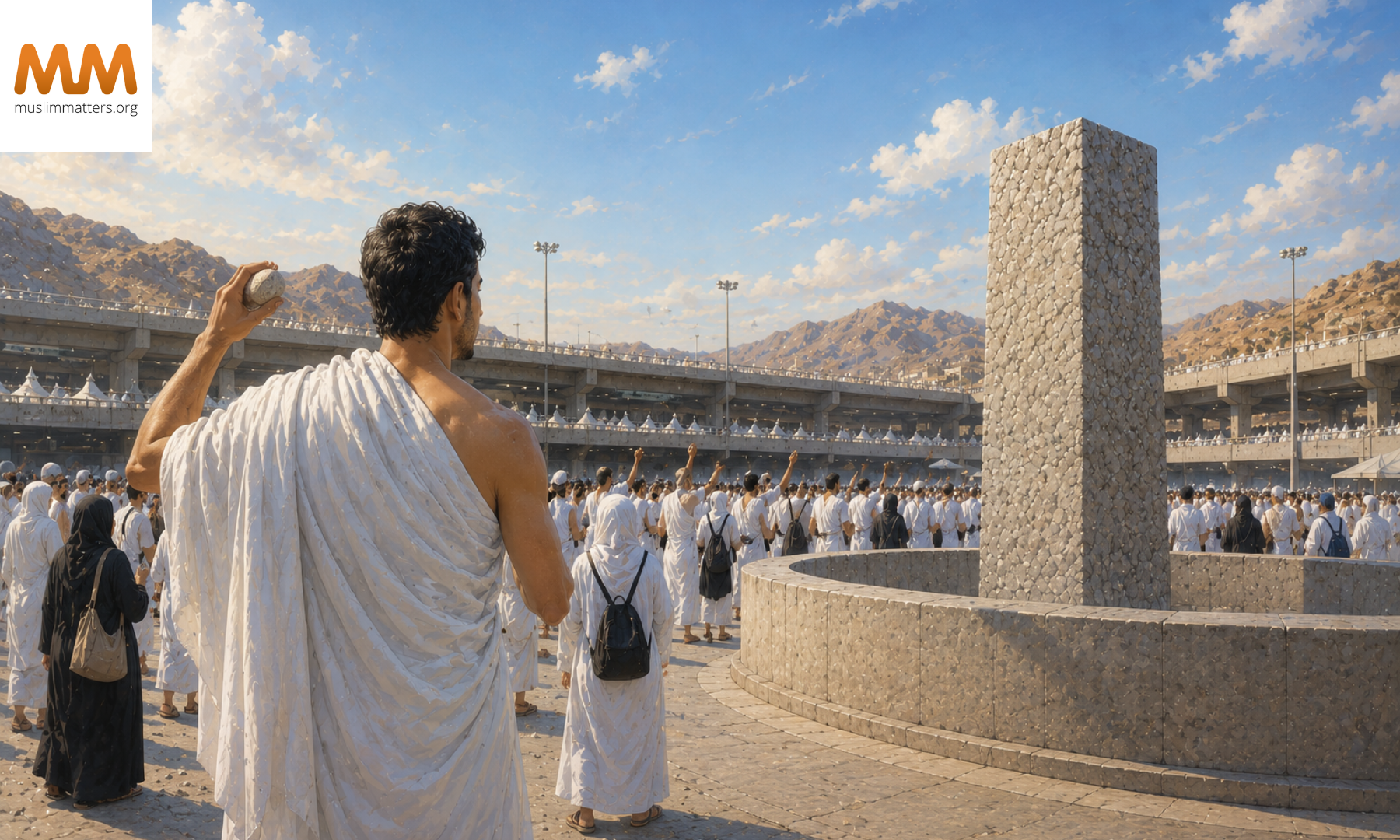
I attended Ḥajj at the end of 2006, just four months after embracing Islam. I was still in college with no real financial means, yet I was blessed with a once-in-a-lifetime opportunity to join an American delegation. During that journey, I met the King, the Grand Mufti Shaykh ‘Abdul ‘Azīz ibn ‘Abdillāh, and several other notable figures—though as a new Muslim, I only vaguely grasped their significance. People advised me to ask the King for something, suggesting he might be generous, perhaps even offer a scholarship to the Islamic University of Madinah. But when I stepped forward to shake his hand, nothing came to mind except a single thought, “I hope you and I will make it to Paradise.”
The full meaning of that experience only unfolded over time, as I grew in knowledge and matured into adulthood. Yet one of its most intense moments came near the end of the journey, during the stoning of the Jamarāt. These are pillars representing Satan, at which pilgrims cast pebbles in remembrance of Ibrahim’s ﷺ triumph over the devil.
As a zealous new Muslim, I was determined to follow the Sunnah as closely as possible. The majority of scholars hold that the optimal time for the stoning is after zawāl, when the sun begins its descent just past noon. My Shaykh had advised me to delay it due to the crowds—a responsible concession, grounded in well-known legal opinions. But a group of us, stubborn in our youth, went ahead anyway, carried by a sense of invincibility. I did not even know that a stampede had occurred the previous year at that exact time, killing nearly 400 pilgrims.
Keep supporting MuslimMatters for the sake of Allah
Alhamdulillah, we're at over 850 supporters. Help us get to 900 supporters this month. All it takes is a small gift from a reader like you to keep us going, for just $2 / month.
The Prophet (SAW) has taught us the best of deeds are those that done consistently, even if they are small. Click here to support MuslimMatters with a monthly donation of $2 per month. Set it and collect blessings from Allah (swt) for the khayr you're supporting without thinking about it.
The scene was chaotic—far more dangerous than we had anticipated. Masses surged forward as people hurled large rocks and even their shoes at the pillars. We became trapped in a sea of bodies, jostled as if tossed by ocean waves. At one point, a caravan from one of the countries forced its way into the crowd with reckless abandon, showing little regard for the safety of others. I nearly fell and would have been trampled had I not seized the shoulders of an unknown brother—himself from an unknown land—who steadied me. I cast my pebbles (not rocks) at the pillars and fled through a sudden opening, as if Allah  had parted the sea just long enough for my escape.
On the other side, I found myself alone. I had lost my shoes and my favorite hat, and I had lost sight of the friends who had been with me. I walked back to our tent by myself. My Shaykh was relieved to see me, but one of our companions was still missing. We remained on edge for hours until we finally found him in another tent. A group of French Muslims had taken him in and fed him lunch—truly among the kindest people I have ever met.
This was not how it was meant to be. One of the Companions, Qudamah ibn ‘Abdillah, said, “I saw the Prophet ﷺ stoning the Jamarāt at Ḥajj while he was on his camel. There was no hitting, nor crowding, nor anyone shouting for people to move.”1 al-Tirmidhī, Sunan al-Tirmidhī (Dār al-Ġarb al-Islāmī, 1998), 2:237 #903; the narration is authentic (ṣaḥīḥ) according to al-Tirmidhī in his comments. The stoning itself is a deliberate act of moderation and restraint, with small pebbles, not rocks, shoes, or anything else. Ibn ‘Abbas had picked up seven pebbles, small like those used for flicking. The Prophet ﷺ took them, saying, “Like these, so throw them,” then he announced, “O people, beware of excessiveness in religion, for those who came before you were only destroyed by excessiveness in religion.”2 Ibn Mājah, Sunan Ibn Mājah (Dār al-Risālah al-ʿĀlamiyyah, 2009), 4:228 #3209; the narration is authentic (ṣaḥīḥ) according to Shaykh Shuʻayb al-Arna’ūṭ in his comments. The Prophet ﷺ had explicitly cautioned against the very excess I witnessed centuries later, in that same place—as if he knew it would come to pass.
We lamented the experience as we struggled to make sense of what had happened. Was it ignorance, misplaced zeal, or perhaps selfishness? We could not fully understand what we had witnessed, but something the Shaykh said stayed with us: “Hajj is a barometer of the state of the Ummah. The problems you see here are the problems you will find everywhere.”
Submission in Stoning
More than two decades later, I have had the opportunity to reflect more deeply on the meaning of the stoning of the Jamarāt. What does this ritual signify? What are we meant to learn from it? Is it merely symbolic, or are we, in some sense, literally stoning Satan? Can it be understood rationally, or does it ultimately belong to the realm of divine mystery?
Imām al-Ghazālī, one of the greatest minds produced by the Ummah, explains the inner meanings (asrār) of stoning the Jamarāt:
“As for stoning the pillars, intend by it submission to the command of Allah
—manifesting servitude and slavery—and rising to pure compliance, without any share for the intellect or the ego in it.
Then intend by it to imitate Ibrahim, peace be upon him, when Iblis—may Allah
If it occurs to you, ‘Satan appeared to him, and he saw him, so he stoned him—but as for me, Satan does not appear to me,’ then know that this very thought is from Satan. It is he who casts it into your heart to weaken your resolve in the stoning, and to make you imagine that it is an act without benefit, resembling mere play, so that you neglect it. So repel him from yourself with seriousness and resolve in the stoning, in spite of Satan.
And know that outwardly you are throwing pebbles at the pillar, but in reality, you are striking the face of Satan and breaking his back. For nothing humiliates him except your compliance with the command of Allah
Stoning the pillars is an act of submission to the command of Allah , in opposition to lower desires and whims—even when its wisdom resists purely rational explanation. Satan is the committed enemy of all people, as Allah said,
“Tell My servants to say only what is best. Satan certainly seeks to sow discord among them. Satan is indeed a sworn enemy to humankind.” [Surah Al-‘Isra’; 17:53]
Identifying Our Unyielding Enemy
Yet unlike external enemies, Satan’s battlefield lies within the hearts and minds of people, manifesting as evil thoughts and the impulse to act upon them.
As we stone the pillars, we acknowledge the presence of this cosmic evil and name the enemy for what he truly is. The Prophet ﷺ said, “Verily, Satan flows through the human being like the flowing of blood.”4Muslim ibn al-Ḥajjāj al-Qushayrī, Ṣaḥīḥ Muslim (Dār Iḥyāʼ al-Kutub al-ʻArabīyah, 1955), 4:1712 #2174. The devil operates within us, exploiting our ignorance and furnishing excuses for our worst inclinations. The Prophet ﷺ warned us about catastrophic consequences, “Verily, Satan has given up that those who pray will ever worship him, so rather he incites discord between them.”5al-Tirmidhī, Sunan al-Tirmidhī, 3:492 #1937; the narration is good (ḥasan) according to al-Tirmidhī in his comments. Imam al-Nawawi commented, “Rather, Satan strives to incite discord between them with conflicts, hostility, wars, tribulations, and so on.”6Yaḥyá ibn Sharaf al- Nawawī, Sharḥ al-Nawawī ‘alá Ṣaḥīḥ Muslim (Dār Iḥyā’ al-Turāth al-’Arabī, 1972), 17:156. And so it has come to pass—across time and space, again and again, to this very day.
The righteous predecessors had a clear understanding of the true enemy: it was not the unbelievers, the idolaters, or the heretics. They did not fear advancing armies as much as they feared an evil reckoning with Allah , brought about by their own sins, orchestrated by malevolence from the Unseen realm. The righteous Caliph, ‘Umar ibn ‘Abdul ‘Azīz, would take pledges from his military leaders, saying:
“There is nothing of the hostility of your enemies that deserves more caution than your own selves and those with you who are sinfully disobedient to Allah. For I fear the sins of our people more than the plots of their enemies. Verily, we were only transgressed by our enemy and given divine support over them due to their sinful disobedience. Were it not for that, we would have no power over them.”7Abū Nuʻaym, Ḥilyat al-Awliyā’ wa Ṭabaqāt al-Aṣfiyā’ (Maṭba’at al-Sa’ādah, 1974), 5:303.
Satan is the only enduring enemy whose hostility toward humanity never ceases. People, nations, and states, by contrast, can change, reconcile, or even embrace Islam. Some of the Prophet’s ﷺ fiercest enemies later became among his most devoted Companions, or at the very least ended their violent opposition to him. The true conflict, then, is waged within the realm of human hearts and thoughts, only spilling into the physical world at certain times.
Ḥātim al-Aṣamm, one of the great sages of the Ummah, teaches us to identify our true enemy:
“I saw that everyone has an enemy, so I said I would find out who mine is. As for one who backbites me, he is not my enemy, nor one who takes something from me; he is not my enemy. Rather, my enemy is one who commands me to disobey Allah
Thus, the enemy is named—his war against us declared before we were even born, his intransigence everlasting until the Day of Judgment. Our weapons are not swords, bullets, or bombs, which mean nothing to him; rather, they are among his favored instruments. No, our weapons more closely resemble shields than spears. The Messenger of Allah ﷺ said, “Take up your shields.” They said, “O Messenger of Allah, is the enemy present?” The Prophet ﷺ said, “No, rather your shields from the Hellfire are to declare the glory of Allah, the praise of Allah, there is no God but Allah, and Allah is the greatest. Verily, they will come on the Day of Resurrection as saviors and guardian angels, and they are ‘righteous deeds everlasting.’”9 al-Nasā’ī, al-Sunan al-Kubrá lil-Nasā’ī (Mu’assasat al-Risālah, 2001), 9:313 #10617; the narration is authentic (ṣaḥīḥ) according to Shaykh al-Albānī in Ṣaḥīḥ al-Jāmi’ al-Ṣaghīr wa Ziyādatihi (al-Maktab al-Islāmī, 1969), 1:612 #3214; note that this authentic narration is found in Imam al-Nasā’ī’s larger collection entitled al-Sunan al-Kubrá and not the smaller, more well-known collection entitled Sunan al-Nasā’ī.
The Shield of Rememberance
Satan’s arrows are the evil thoughts and base impulses he provokes, leading people into disobedience to their Creator. Greed, envy, malice, lust, vanity, arrogance, pride, and rage are among his machinations. Allah has named him “the lurking whisperer” in the final chapter of the Qur’an—repelled by hearts that turn to Him in remembrance.10Sūrat al-Nās 114:4-6. A man came to the Prophet ﷺ saying, “O Messenger of Allah, one of us has thoughts within himself, suggesting something that would make him love to be reduced to charcoal rather than to speak of it.” The Prophet ﷺ said, “Allah is the greatest! Allah is the greatest! Allah is the greatest! All praise is due to Allah, who has turned back the plot of the whisperer.”11Abū Dāwūd, Sunan Abī Dāwūd (Dār al-Risālah al-ʻĀlamīyah, 2009), 7:435 #5112; the narration is authentic (ṣaḥīḥ) according to Shaykh Shuʻayb al-Arna’ūṭ in his comments. Mujahid explained, “The lurking whisperer is Satan over the heart of a human. When one remembers Allah, he withdraws.”12Abū Ja’far al-Ṭabarī, Jāmiʻ al-Bayān ‘an Ta’wīl al-Qur’ān (Mu’assasat al-Risālah, 2000), 24:710.
The remembrance of Allah in the heart pushes back Satan, not merely the uttered words. Allah said,
“Indeed, when Satan whispers to those mindful of Allah, they remember their Lord, then they start to see clearly.” [Surah Al-‘Araf: 7;201]
“But the devils persistently plunge their associates deeper into wickedness, sparing no effort.” [Surah Al-‘Araf: 7;202]
Prayers, supplications, and acts of remembrance redirect our attention to Allah , rather than to Satan’s insinuations; the key to overcoming him, then, is to disengage from his whispering. Shaykh al-Islam Ibn Taymīyah writes, “If the shepherd’s dog troubles you, do not busy yourself warring and defending against it. You must appeal to the shepherd, who will direct the dog away from you and suffice you.”13 Ibn Qayyim al-Jawzīyah, Asrār al-Ṣalāh wal-Farq wal-Muwāzanah Bayna Dhawq al-Ṣalāh wal-Samā’ (Dār Ibn Ḥazm, 2003), 1:76. When the mind turns to Allah and away from an evil thought, the satanic whisper dissolves into nothingness.
The Companions were equipped with knowledge of Allah’s Names and Attributes, His commands, and the moral compass of His Messenger ﷺ, prioritizing these above all else before any external strategy of warfare was devised. The Prophet ﷺ told them, “Shall I not tell you of the best of your deeds, which is the purest to your King, which raises you among your ranks, which is better for you than spending gold and money in charity, and which is better for you than meeting your enemy and striking the necks of each other?” They said, “Of course!” The Prophet ﷺ said, “It is the remembrance of Allah Almighty.”14al-Tirmidhī, Sunan al-Tirmidhī, 5:389 #3377; the narration is authentic (ṣaḥīḥ) according to Shaykh al-Albānī in Ṣaḥīḥ al-Jāmi’, 1:513 #2629.
Know, then, that stoning the Jamarāt is your recognition of the true enemy, one who flows within you, waiting patiently for any opportunity to lead you astray. The pebbles you cast at the pillars do not harm him; rather, every declaration of Allah’s Greatness—Allāhu Akbar—strikes him with frustration and defeat. When you internalize this reality upon completing the ritual and your Ḥajj as a whole, you have come to understand the nature of evil and the means to overcome it. Victory begins with saving yourself from the devil’s plots, then teaching the path of purification to those around you—one heart at a time.
Success comes from Allah , and Allah knows best.
Related:
– Experiences, Lessons, And Reality Checks From Hajj 2024
– [Podcast] Dropping the Spiritual Baggage: Overcoming Malice Before Ramadan | Ustadh Justin Parrott
Keep supporting MuslimMatters for the sake of Allah
Alhamdulillah, we're at over 850 supporters. Help us get to 900 supporters this month. All it takes is a small gift from a reader like you to keep us going, for just $2 / month.
The Prophet (SAW) has taught us the best of deeds are those that done consistently, even if they are small. Click here to support MuslimMatters with a monthly donation of $2 per month. Set it and collect blessings from Allah (swt) for the khayr you're supporting without thinking about it.



[Podcast] Wait, Muslims Have Been Here HOW Long?! | Hassam Munir

Far Away [Part 30] – The Rock Splitter And The Parthian Shot

Maryam: The Story Of The Muslim ‘Virgin’ Mary

Is It Ever Too Early To Prepare For Ramadan? Reflections On Rifq, Forgiveness, And Healing The Heart

Lessons From The Battle Of Badr: A Personal Transformation Perspective

Long War Without End: A Quarter-Century Since The War On Terror

[Podcast] Faith, Motherhood, and the Call to Gaza | Dr. Samaiya Mushtaq

When The Shaykh Never Spoke – Deepfakes, Synthetic Scholars, And The Coming Crisis Of Religious Trust

The Stirring Of A Muslim Population In Japan: The Story Of Yusuke Fujitani

CAGE, Muslim Leadership, And Imran Khan: The Silence Test

The Best Actions for Eid al-Adha [Imam Dawud Walid]

Coming Full Circle: Who Are You Now? | Night 30 with the Qur’an

Running Away From Who We Are | Night 29 with the Qur’an

Building From the Ground Up: Week 4 Recap | Night 28 with the Qur’an

The Muslim You Are Becoming | Night 27 with the Qur’an
-

 #Culture1 month ago
Far Away [Part 26] – Shaytan Is A Liar
-
#Culture1 month ago
Far Away [Part 25] – To Save A Prince
-
#Current Affairs1 month ago
From a Syrian Prison to the UN: The Case of Bilal Abdul Kareem
-
#Life1 month ago
[Podcast] 50k Mahr, Hiding Money, & Who Pays for the Wedding? | AML Finance




Amer Rizvi
May 21, 2026 at 2:35 PM
For me, I was certain that terrifying scene could not be from my religion. I knew my beloved Prophet Muhammad (صلى الله عليه و سلم) would never ask me to be in a situation that involves such a dangerous ritual. My parents would also have never chosen a religion for me that would require someone to be put at risk of being crushed. My knees were literally shaking. I was so scared 😢
I followed the fatwa of Shaikh Yusuf Al-Qaradawi, may Allah reward him, and refused to enter that crowd. I threw the pebbles quietly at night. And while I was at that scene, I made sure a Saudi security guard standing there knew how I felt about the safety situation.
الحمد لله على نعمة الإسلم