#Islam
Lessons from the Battle of Badr: A Personal Transformation Perspective

Human beings are constantly engaged in internal battles. According to Robert Greene in his book The 33 Strategies of War, humans have a continuous battle within themselves, reflecting a deeper psychological truth about personal transformation: growth doesn’t happen in the comfort zone but rather by confronting fears, managing uncertainties, and having eternal faith. Islam, being a complete code of life, authenticates this reality. According to Maulana Wahiduddin Khan, Islam is a religion of common sense harmonizing with human nature. Hence, the Quran serves as a blueprint guide for all times and ages, containing profound and greatest lessons.
One of the greatest lessons for personal transformation can be derived from the Battle of Badr, providing insights into human psychology, unwavering faith, and resilience. While the Battle of Badr is predominantly seen as a blueprint for strategizing warfare according to Islamic strategic thought, it also provides important lessons on personal growth. The blog explores the Battle of Badr through this lens and presents six major lessons derived from the Battle.
Faith in Difficult Moments
Sustaining faith in difficult moments is the first major lesson. During the Battle, Muslims, as compared to non beleivers were very few in number: 313 muslims against 1,000 non-believers, as reported by Abdul-Malik ibn Hisham in Sirat Rasulullah  . This big gap instills fear and disparity into the heart and mind of any normal human being. In such a situation, hopelessness overpowers the human mind. But it is faith that serves as a powerful tool to blow away the clouds of hopelessness. Allah SWT acknowledges this psychological reality, stating (Quran, 8:9): “Remember when you sought help from your Lord, and He answered you: ‘I will reinforce you with a thousand angels, following one another.’”
Keep supporting MuslimMatters for the sake of Allah
Alhamdulillah, we're at over 850 supporters. Help us get to 900 supporters this month. All it takes is a small gift from a reader like you to keep us going, for just $2 / month.
The Prophet (SAW) has taught us the best of deeds are those that done consistently, even if they are small. Click here to support MuslimMatters with a monthly donation of $2 per month. Set it and collect blessings from Allah (swt) for the khayr you're supporting without thinking about it.
While fear is a natural human emotion, letting fear overpower or dominate the mind leads to paralysed actions. The fact that Muslims, despite being fewer in number, attained victory reflects this very reality: despite fear, they remained unconvicted in their faith and demonstrated the contemporary psychological underpinnings that success is on the other side of fear. Hence, the greatest lesson here is to remain steadfast amidst uncertainty, and eventually Divine Mercy emerges as a beacon of light in the forest of darkness.
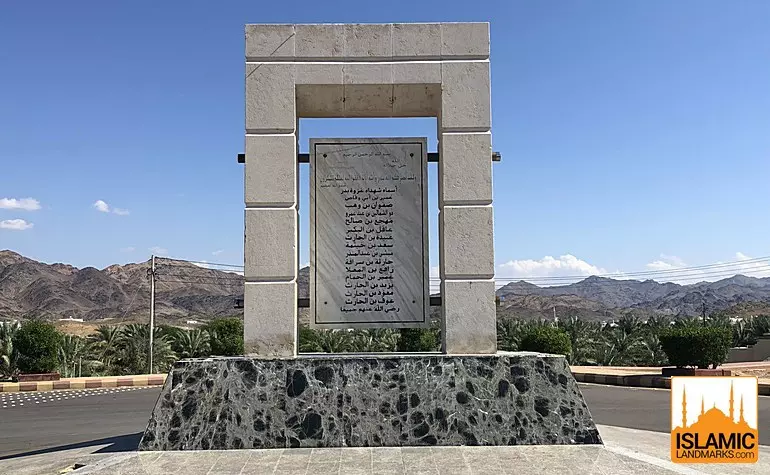
The battlefield of Badr outside Medinah. Photo: IslamicLandmarks.com
Managing Uncertainty
Along with maintaining faith amidst crisis, the Battle of Badr teaches us another profound lesson, i.e., managing uncertainty. The fact that the Muslims were few in number, uncertainty would have been natural. A lot of what-ifs go through the mind in such similar situations: what if I fail, what if I couldn’t do that. These are constant thoughts that come to one’s mind when any of us are pursuing a path of our purpose. But success and personal growth occur then by managing uncertainties through Prayer, Tawakul, Shura, Self-reassurance, and Spiritual reflection. Then to reassure yourself: to have what we call in Urdu khudmukhtari (self-assurance): that is the cheat code to manage uncertainty. And lastly, to constantly reflect on yourself through spiritual grounding.
In this backdrop, Allah reassured the muslims by stating (Quran, 8:11), “He made drowsiness overcome you as a security from Him.” The verse highlights the psychological underpinnings of faith being an anchor during uncertainties that helps in managing uncertainties. This crisis management and managing uncertainty made Muslims under the command of the Holy Prophet victorious over non-believers.
Therefore, the Battle reflects a deeper truth: that life is uncertain, and there’s nothing guaranteed. But having faith as an anchor keeps us grounded and focused on purpose. While there’s a lot of noise; there’s a lot of degeneracy going on in the world; there’s a lot of fear; there’s a lot of post-truth politics going on, where identifying what truth is is always uncertain and confusion is always there; perplexity is always there. But keeping your faith as your anchor is what helps you to manage your uncertainty. And once this uncertainty is managed, Success is achieved.
Courage Despite Fear
Along with uncertainty management, it is pertinent to remain courageous despite fear, serving as the third greatest lesson from the Battle of Badr. Fear is a natural emotion. It occurs because we all are humans. But growth seldom happens if you remain stagnant and stay in the shackles of fear; growth never happens, and success never comes. Success comes only when you confront your fears by having faith in God, preparing in advance, and pushing yourself to do 1% better every day. Because fear comes from waswasas from Shaytan. In this backdrop, Allah warns believers of this reality, stating (Quran, 3:175): “It is none but Satan who frightens (you) of his friends. So, do not fear them; but fear Me, if you are believers.” Hence, it is faith that helps you manage your fears, because the only entity to fear is All-Powerful Allah. And the fact that prophets were always fearing Allah and not letting the waswasas of Shaytan entertain them; the management of fear amidst the crisis led to this victory.
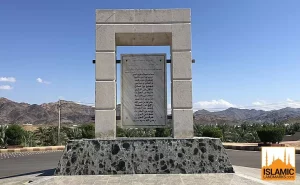
A plaque commemorating the martyrs of Badr. Photo: IslamicLandmarks.com
Growth Through Hardship
Next to sustaining courage is growing and evolving through hardship. This serves as a fourth lesson. Growth doesn’t happen in isolation. It happens while going through difficulties. Because that’s what Allah says (Quran, 94:6): “Indeed, with hardship comes ease.” The wording of Allah here is significant and full of His Divine Wisdom. He explicitly says with hardship, not after hardship, in this verse, reflecting a deeper truth of human psychology. You go through hardship, you build endurance, you build strength, and that’s how hardships are turned into ease. And that’s how growth happens. You become strong, you become vigilant, you become aware, you become agile and flexible. Hence, growth happens not in isolation, not by birth, and not through some unicorn luck, but by enduring hardships, by going through difficult times. The Muslims of the Battle of Badr exemplified how growth happens through enduring hardship. It was in scorching heat; it was in the desert, and that too in the month of Ramadan, when abstinence from food is maintained. And in all these crises, in all these difficulties, growth only occurred because endurance was maintained. And the most important lesson was that success doesn’t come by putting your hand over it.
Effort Alongside Faith
The fifth lesson drawn from the account of the Battle of Badr teaches that faith alone is not enough; rather, it requires effort and discipline alongside. To be victorious, it is pertinent to be prepared alongside faith; sole reliance on a divine miracle is not enough. One has to put in all the work and effort. The fact that Muslims were preparing beforehand for the battle through going through intense training and military exercises, while having complete tawakkul on Allah, is how the victory was ensured.
But when we expect success to come through a miracle while putting hand over hand and not doing anything, success does not come. As Allah stated (Quran, 13:11), “Indeed, Allah will not change the condition of a people until they change what is in themselves.” Because in this aspect, divine faith is not enough; divine help comes when you are the one putting in effort. As Allah says in the Quran, Allah does not help those who don’t help themselves. Divine help, the help of Allah, comes when you are putting in the effort.
The same truth is reflected in prophetic tradition reported in Jami al-Tirmidhi: “Tie your camel, and trust in Allah.” Meaning that you put in your efforts, do your homework, and rely on divine help. From contemporary psychology, when you focus on input and leave output to God, that is how victory comes. If your entire focus is on, may I get this, may I get that, and you’re putting no effort to attain what is your purpose, it is a waste of human intellect. It is the waste of the honor of being the vicegerent of God that Allah gave you as His crown of creation.
When you put effort into input, for example, if we have an exam, we want to ace that exam; we want to get a good grade, but if we just keep visualizing, “I will be the top, the top student, I will be in the Dean’s list, I will ace the most competitive exams,” without putting in any effort, then we will be disappointed, there will be no success. In retrospect, if we are focused on input by studying daily, by taking notes, by doing fast studies, by attending lectures, and so forth, then the victory comes despite our anxiety about the outcome.
Transforming the Fear of Failure
Lastly, the Battle of Badr teaches us to utilize fear positively as a catalyst for transformation. Fear as an emotion holds intense power that we humans, being the crown of creation, are duty-bound to redirect either towards evolving or declining. This is because the fear of failure is not a discouragement; rather, it is a motivation. If you fear failure, it is up to a human to use the emotion of fear for progression or for progression, evolution, or devolution. Using fear as a motivation tool such that for instance, if I fear that I will fail the exam, that will motivate me to study even harder. That is how personal transformation occurs. The fact that Muslims were fearful because non-Muslims were more numerous; hence, the fear was natural. But if they feared and let their fear define their path in a way that they gave up and stayed behind, that would have led them towards deviation from the path, from the purpose of Islam. And the result would be failure and loss of attainment of God’s mercy and the paradise he promised.
Related:
Fourteen Centuries since Badr: Recalling Islam’s First Decisive Battlefield
Victory or Martyrdom: Strange are the Ways of a Believer
Grit and Resilience: The Self-Help versus Islamic Perspective
Keep supporting MuslimMatters for the sake of Allah
Alhamdulillah, we're at over 850 supporters. Help us get to 900 supporters this month. All it takes is a small gift from a reader like you to keep us going, for just $2 / month.
The Prophet (SAW) has taught us the best of deeds are those that done consistently, even if they are small. Click here to support MuslimMatters with a monthly donation of $2 per month. Set it and collect blessings from Allah (swt) for the khayr you're supporting without thinking about it.






Lessons from the Battle of Badr: A Personal Transformation Perspective

Taliban Tale: How Afghan Militants Survived Campaigns in 2006-16

Is It Ever Too Early to Prepare for Ramadan? Reflections on Rifq, Forgiveness, and Healing the Heart

[Podcast] Yes, She’s Funny In This | Huda Fahmy

Far Away [Part 29] – Kurdish Killers and Stolen Gold
Far Away [Part 26] – Shaytan Is A Liar
Far Away [Part 25] – To Save A Prince

From a Syrian Prison to the UN: The Case of Bilal Abdul Kareem

[Podcast] 50k Mahr, Hiding Money, & Who Pays for the Wedding? | AML Finance

Long War Without End: A Quarter-Century Since The War On Terror

The Best Actions for Eid al-Adha [Imam Dawud Walid]

Coming Full Circle: Who Are You Now? | Night 30 with the Qur’an

Running Away From Who We Are | Night 29 with the Qur’an

Building From the Ground Up: Week 4 Recap | Night 28 with the Qur’an

The Muslim You Are Becoming | Night 27 with the Qur’an
MuslimMatters NewsLetter in Your Inbox

Sign up below to get started