
featured
Is It Ever Too Early To Prepare For Ramadan? Reflections On Rifq, Forgiveness, And Healing The Heart


As I write this, Ramadan is still about six months away. Some may wonder why we should speak about Ramadan now. Yet, over the years, I have noticed a distinct pattern: many of the wounds we hope to heal in Shaaban were not actually created in Shaaban. They are heavy burdens we have carried for years. By the time we begin preparing for Ramadan, we discover that deep resentment, broken relationships, and hardness of heart cannot simply be repaired in a few short weeks.
Every year, as Shaaban arrives, we dutifully begin our preparations. We increase our Qur’an recitation, attend the mosque more regularly, fast voluntarily, plan our charity, and look for ways to improve ourselves before the blessed month begins. Yet, amid all this outward preparation, one particular teaching causes a unique discomfort.
The Prophet ﷺ informed us that Allah  looks upon His Creation on the night of the middle of Shaaban and forgives His Servants, except for two: the one who associates partners with Him, and the one who harbors enmity and rancor (mushahin) toward his brother. [Sunan Ibn Majah 1390]
Keep supporting MuslimMatters for the sake of Allah
Alhamdulillah, we're at over 850 supporters. Help us get to 900 supporters this month. All it takes is a small gift from a reader like you to keep us going, for just $2 / month.
The Prophet (SAW) has taught us the best of deeds are those that done consistently, even if they are small. Click here to support MuslimMatters with a monthly donation of $2 per month. Set it and collect blessings from Allah (swt) for the khayr you're supporting without thinking about it.
Suddenly, the path to forgiveness is no longer just about the rituals of prayer, fasting, or charity. It requires something far more intimate: healing the heart.
Many of us sincerely want Allah’s Forgiveness. We are willing to spend long hours standing in worship, wake up before dawn in Tahajjud, donate generously, and serve the community. Yet, making that one difficult phone call, reconciling with an estranged family member, or letting go of an old grudge often feels impossibly harder. Why is standing in prayer for hours sometimes easier than forgiving a parent? Why does charity feel easier than letting go of years of resentment? Year after year, many of us enter Ramadan carrying the exact same wounds, even though we know the steep price of holding onto them.
The more I reflect on this, the more I see why Islam places such a tremendous, uncompromising emphasis on gentleness, kindness, and softness of heart. For a striving believer, the ultimate dream is to attain Allah’s Pleasure, enter Jannah, and be saved from the Hellfire. What strikes me is how beautifully the Prophet ﷺ promised exactly that, simply through the character trait of gentleness.
The Prophet ﷺ said:
“Allah is Gentle (Rafīq) and loves gentleness. He gives through gentleness what He does not give through harshness, and what He does not give through anything else.” [Ibn Majah 3688]
He ﷺ also said:
“Whoever is deprived of gentleness is deprived of all good.” [Sahih Muslim 2592]
And in another profound reminder, he ﷺ asked:
“Shall I not inform you of those for whom the Fire is forbidden? Every person who is near to people, gentle, easy-going, and approachable.” [Jami al-Tirmidhi, 2488]
The Prophet ﷺ is not merely recommending gentleness as a minor character trait; he is connecting it directly to one of Allah’s own attributes and linking it to salvation itself.
Why does gentleness receive such an elevated status? Perhaps it is because gentleness has a unique power to heal. A single gentle word or a softened gesture can be the very balm that removes a spiritual blocker for a believer who has been trying to draw closer to Allah , but has been unable to shed a deep-seated ill feeling for years. Gentleness heals the heart that is quietly suffering from carrying a heavy bag of grudges.
Harshness operates in the exact opposite way. Material deprivation creates a temporary need, but harshness creates a lasting wound. Needs can eventually be met, but emotional wounds linger for years, quietly spreading from one relationship to the next. A harsh word from a parent can remain embedded in a child’s heart for decades. A cruel comment from a spouse can echo long after the conversation ends. A humiliating remark from a friend can shape how a person views themselves for a lifetime. Unlike physical deprivation, wounds of the heart often reproduce themselves.
Modern psychology offers a fascinating perspective that echoes this profound Islamic reality. For decades, developmental psychologists like John Bowlby, Mary Ainsworth1Secure Attachment Theory (John Bowlby & Mary Ainsworth): Established via foundational texts like Ainsworth’s Patterns of Attachment (1978), demonstrating that a child’s confidence in parental responsiveness forms the baseline blueprint (internal working model) for how they safely approach and show compassion to the rest of the world., Nancy Eisenberg2The longitudinal relations among dimensions of parenting styles, sympathy, prosocial moral reasoning, and prosocial behaviors (Pioneered by Dr. Nancy Eisenberg et al., published in Child Development). Link: ResearchGate., and Martin Hoffman3Empathy and Moral Development (Martin L. Hoffman): Fully detailed in his seminal work, Empathy and Moral Development: Implications for Caring and Justice (Cambridge University Press). He theorized how operational parental warmth and “inductive discipline” (explaining how actions affect others rather than using raw harshness) allow children to internalize empathy as a core identity trait rather than a temporary chore. have studied how secure attachment and parental warmth contribute to compassion and concern for others. Their research consistently shows that children who experience warmth, affection, and respectful treatment are far more likely to develop empathy, trust, and emotional regulation as adults. Longitudinal studies have found that parental warmth directly predicts higher levels of sympathy and helping behavior as children mature. Kindness, quite literally, reproduces kindness—a phenomenon researchers call the “contagion of kindness.”
Conversely, a large meta-analysis4How Childhood Maltreatment Predicts Prosocial Behaviors: A Systematic Review and Meta-Analysis (Published in the Journal of Youth and Adolescence). Link: PubMed. involving more than 58,000 participants concluded that childhood maltreatment and harshness are heavily associated with lower levels of prosocial behavior later in life. While many exceptional individuals beautifully overcome painful pasts to become deeply compassionate adults, the overall trend is clear: harsh treatment leaves deep scars that fundamentally affect how people relate to others.
Both kindness and harshness tend to reproduce themselves. A child treated harshly at home may grow into an adult who unknowingly acts harshly with a spouse. That spouse, feeling the weight of that pain, may become less patient with the children. Those children then carry those emotional wounds into their own future families. One unhealed wound multiplies into many.
But the opposite is equally true. One intentional act of gentleness can ripple outward in ways that are impossible to measure. A teacher encourages a struggling student; that student gains confidence and later becomes a compassionate mentor. A parent speaks softly and kindly to their children; those children grow up secure, becoming kind spouses and loving parents. A believer chooses forgiveness instead of retaliation; one act of mercy becomes a legacy of mercy.
Perhaps this is why Allah loves gentleness so much. Gentleness does not merely improve a single, passing interaction; it fundamentally changes the environment in which future relationships grow. It creates the fertile soil in which mercy can flourish.
When Allah described the Prophet ﷺ, He beautifully noted: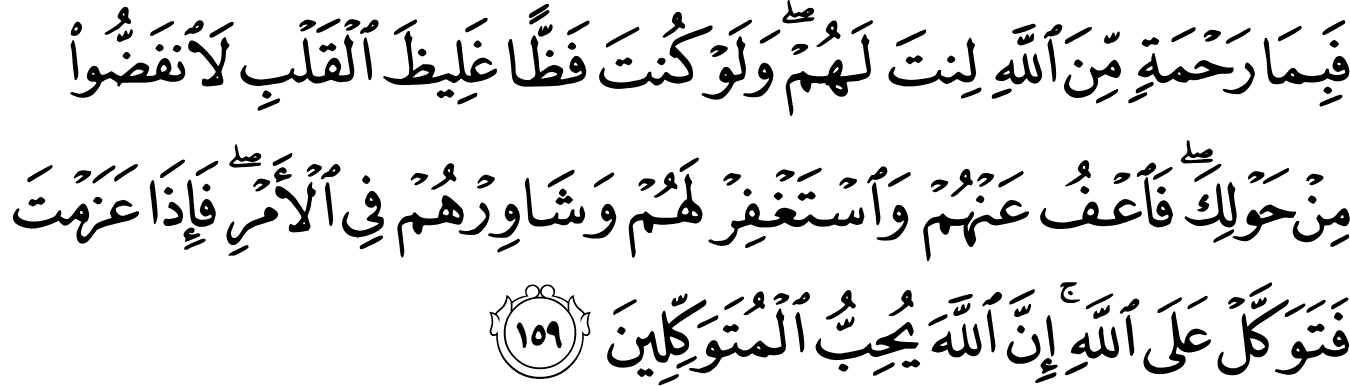
“So by mercy from Allah, [O Muhammad], you were lenient with them. And if you had been rude [in speech] and harsh in heart, they would have disbanded from about you. So pardon them and ask forgiveness for them and consult them in the matter. And when you have decided, then rely upon Allah. Indeed, Allah loves those who rely [upon Him].” [Surah Ali-Imran, 3:159]
This is a profound lesson. Allah reminds even His final Messenger ﷺ that sustained harshness would have driven people away from him. If even the Sahabah—the greatest generation to ever walk the earth—could not have thrived in an environment of harshness, how can we expect our families, our children, our communities, and our masajid to do so?
Is this not enough to make us reflect? We often look around and wonder: why are families fragmented? Why are communities divided? Why do people quietly walk away from Islamic centers, organizations, and lifelong friendships? People can easily overlook mistakes, human weaknesses, and structural imperfections. What they cannot endure is sustained harshness. Gentleness gathers the very hearts that harshness would have scattered.
The Quran repeatedly directs us to break these cycles of hostility rather than perpetuate them:
“Repel evil with that which is better, and then the one between whom and you was enmity will become as though he were a devoted friend.” [Surah Fussilat, 41:34]
This verse reads almost like a divine strategy for interrupting emotional contagion. Instead of passing our pain forward, we are taught to absorb it, transform it through faith, and return something better. This explains why unresolved resentment is treated with such gravity in our deen. A heart carrying a grudge continues to spread pain long after the original incident has passed. These unhealed wounds quietly shape the atmosphere of our homes and friendships.
Crucially, this gentleness must also apply inwardly. Those who are incredibly harsh toward others are often deeply harsh toward themselves, unable to forgive their own shortcomings, entering Ramadan burdened by heavy self-condemnation rather than hopeful anticipation. True reconciliation is difficult, but that is precisely why the reward of kindness and gentleness is so intimately tied to Allah’s ultimate Pleasure.
It takes immense strength to let go of long-standing grudges. Is it difficult? Yes, absolutely. But that is precisely why Allah Most High promises profound forgiveness to a heart that purges itself of animosity. Looking at it from another angle, for someone bearing deep emotional pain, a single kind word, warm smile, or gentle gesture can be the catalyst that frees them from an old, toxic grievance. Experiencing genuine kindness softens the hard heart. Perhaps this explains why the Almighty promised to grant through gentleness what He will never bestow through anything else. What remains perplexing is that while the rewards are so vast and the risks of doing the opposite are so dangerous, we rarely emphasize this on a communal level. It often feels as though our communities prefer to leave this vital issue on the back burner. It is time to shift our focus. If we strive collectively starting today, we can help one another reach Ramadan with genuinely sound hearts. What a beautiful triumph it would be to enter the blessed month already forgiven.

Let me conclude with a profound act of kindness that has remained with me for more than twenty-five years.
Allah blessed me with the opportunity to perform Hajj. During the days of Tashreeq, I suffered an asthma attack. After completing Tawaf, while trying to return to Mina, I became completely lost and could not find my tent. I was struggling to breathe, utterly exhausted, and barely able to take another step.
Suddenly, out of nowhere, I felt a gentle hand on my shoulder. An elderly man looked at me and asked in English, “Are you lost?”
I could only nod. Without saying much else, he took my hand and safely guided me through the massive crowds. A short while later, my tent finally came into view.
Before leaving, he turned to me, smiled, and asked, “My son, what is the reward for Hajj?”
I replied, “Jannah.”
He then looked at me and said words I have never forgotten: “Jannah is not cheap. It is worth whatever it takes.”
I never saw him again. But his gentleness has stayed with me ever since. Whenever life becomes difficult, whenever I feel the weight of the world is too much to bear, I remember his voice: “Jannah is worth it, my son.”
Perhaps that is the lasting, geometric power of gentleness. A single act of kindness, lasting only a few brief minutes, can continue to steer a person’s heart for decades. If a chance encounter with a stranger can leave such a permanent mark, imagine what our daily words and actions can do for the people who live with us, work with us, worship beside us, and love us.
Allah loves gentleness because it heals the very wounds that harshness creates. As Ramadan draws nearer, perhaps the greatest preparation we can make is not just increasing our voluntary prayers, fasting, and recitation, but allowing those old, heavy wounds to finally heal. Let us seek reconciliation where we can, lower our wings, and become a source of gentleness, kindness, and safety for everyone around us.
Alhamdulillah.
Related:
– [Podcast] Dropping the Spiritual Baggage: Overcoming Malice Before Ramadan | Ustadh Justin Parrott
– Prepare Your Heart for Ramadan | Yasmin Mogahed
Keep supporting MuslimMatters for the sake of Allah
Alhamdulillah, we're at over 850 supporters. Help us get to 900 supporters this month. All it takes is a small gift from a reader like you to keep us going, for just $2 / month.
The Prophet (SAW) has taught us the best of deeds are those that done consistently, even if they are small. Click here to support MuslimMatters with a monthly donation of $2 per month. Set it and collect blessings from Allah (swt) for the khayr you're supporting without thinking about it.





[Film Review] Your Mother, Your Mother, Your Mother: A Complex Story Of Faith And Fatherhood

Far Away [Part 32] – Meilin’s Tale

[Podcast] A Light of Her Own: Muslim Womanhood, Seasons of Life, & Female Scholarship

School Counseling Grounded In The Qur’an And Sunnah: A Framework Of 10 Prophetic Traits

A Case For Critical Reading As Muslims: Reading ‘The Power of Your Subconscious Mind’ Through An Islamic Lens

When The Shaykh Never Spoke – Deepfakes, Synthetic Scholars, And The Coming Crisis Of Religious Trust

CAGE, Muslim Leadership, And Imran Khan: The Silence Test

Is It Ever Too Early To Prepare For Ramadan? Reflections On Rifq, Forgiveness, And Healing The Heart
Far Away [Part 32] – Meilin’s Tale

Maryam: The Story Of The Muslim ‘Virgin’ Mary

The Best Actions for Eid al-Adha [Imam Dawud Walid]

Coming Full Circle: Who Are You Now? | Night 30 with the Qur’an

Running Away From Who We Are | Night 29 with the Qur’an

Building From the Ground Up: Week 4 Recap | Night 28 with the Qur’an

The Muslim You Are Becoming | Night 27 with the Qur’an
MuslimMatters NewsLetter in Your Inbox

Sign up below to get started
-

 #Life3 weeks ago
When The Shaykh Never Spoke – Deepfakes, Synthetic Scholars, And The Coming Crisis Of Religious Trust
-
#Culture1 month ago
The Stirring Of A Muslim Population In Japan: The Story Of Yusuke Fujitani
-
#Culture1 month ago
[Podcast] Faith, Motherhood, and the Call to Gaza | Dr. Samaiya Mushtaq
-
#Current Affairs4 weeks ago
CAGE, Muslim Leadership, And Imran Khan: The Silence Test




Amer Rizvi
October 2, 2026 at 10:36 AM
Thank you for the article. Showing gentleness in Ramadan is, of course, very important.
But let’s not forget the principle that, in Islam, when justice and gentleness clash, justice takes priority. In fact, showing kindness to an oppressor can itself become an act of oppression.
Let us remember that Ramadan had just come in when our Prophet (صلى الله عليه وسلم) chose to raid the loaded Quraysh caravan returning to Mecca from Syria, and some of his relatives were in that caravan.
Our Prophet (صلى الله عليه وسلم) knew that, in some circumstances, the rights of the community could take precedence over the interests of the individual.
When I was in the process of suing our school district, it was Ramadan. I asked the imam of our masjid that it took me a very long time to write my briefs, motions, and replies against the defendants.
I had to fight my case pro se against a rich and powerful county, and I was very busy during the day. The imam told me that the nights I spent writing would be rewarded, insha Allah.
So, let us also not forget about justice in Ramadan.
😃🕌جمعة مبارك