#Islam
Good Speech and Sacred Trust: Lessons from Sultan Mehmed II and Shaykh Abu’l-Wafa
A reflection on spiritual counsel, political authority, the ethics of justice, and the sacred trust of leadership in the Islamic tradition.

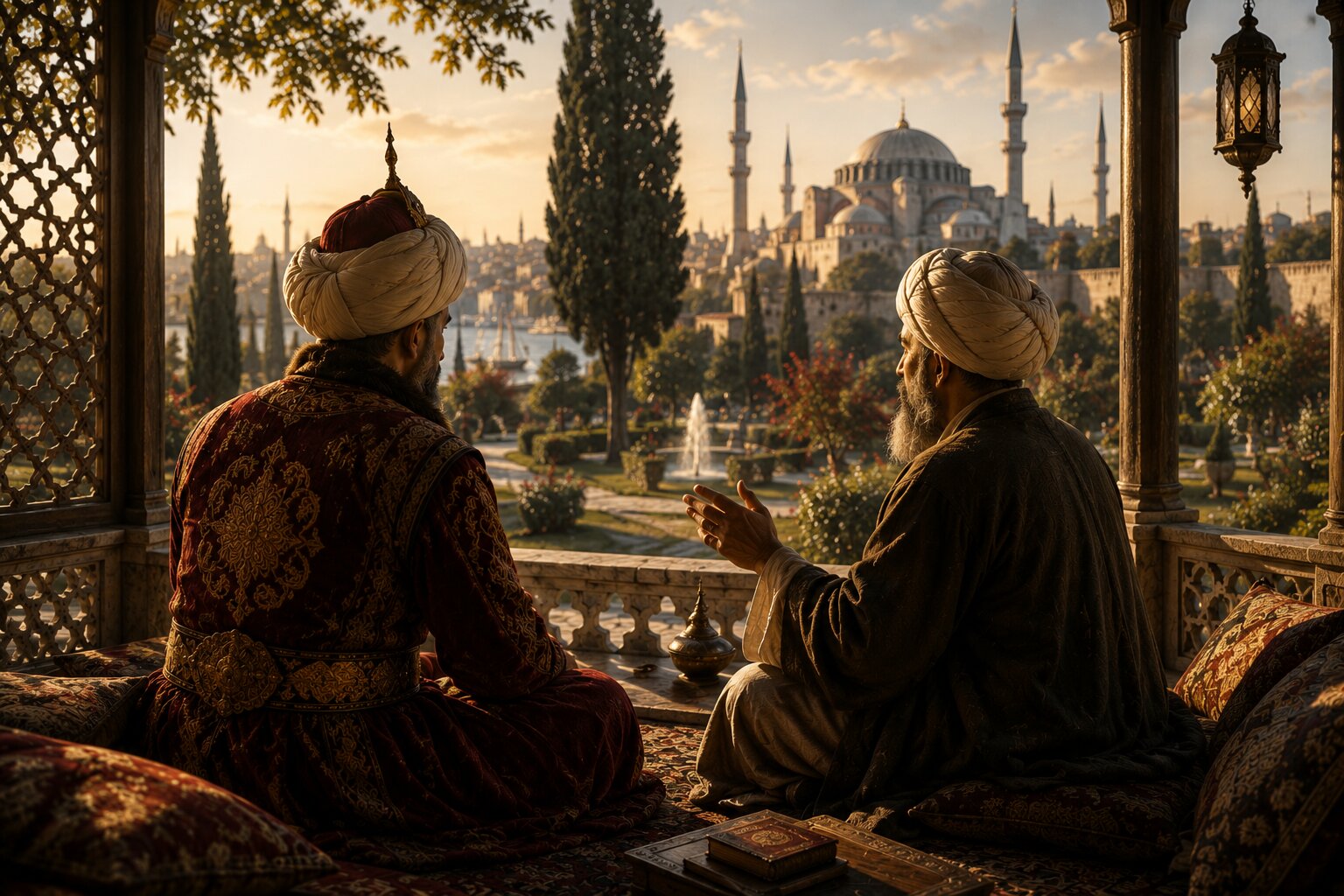
A reflection on spiritual counsel, political authority, and the ethics of justice.
By Dr. Bekim Belica
With love.
The Key That Opens Hearts
Keep supporting MuslimMatters for the sake of Allah
Alhamdulillah, we're at over 850 supporters. Help us get to 900 supporters this month. All it takes is a small gift from a reader like you to keep us going, for just $2 / month.
The Prophet (SAW) has taught us the best of deeds are those that done consistently, even if they are small. Click here to support MuslimMatters with a monthly donation of $2 per month. Set it and collect blessings from Allah (swt) for the khayr you're supporting without thinking about it.
There is a quiet wisdom in the belief that good speech opens what force cannot. A heart rarely yields to command, pressure, or display. It opens when language carries sincerity, restraint, and mercy. In this sense, speech is not merely a tool of communication. It is an ethical act. It can protect dignity, guide conscience, and awaken responsibility.
The tradition of spiritual counsel has long understood this. A word spoken with humility can correct without humiliating. A word spoken with love can reveal a truth that power might otherwise resist. The human heart has its own lock, and good speech, when rooted in sincerity, becomes one of its keys. Praise be to Allah; the hearts of people are not opened by harshness alone, but often through the gentleness of a word placed at the right moment.
A Sultan Seeks Spiritual Counsel
A story is told of Sultan Mehmed II who approached Shaykh Abu’l-Wafa after learning that many seekers had been welcomed into the lodge, while he himself had not been accepted among them. The question could have been asked with royal authority, but he asked it with humility.
“Honored Friend of Allah, you accepted everyone at your door. Why did you not accept us? Did we make a mistake? Did we do something wrong? Did we neglect something?”
Shaykh Abu’l-Wafa did not answer as one trying to flatter a ruler. Nor did he answer as one trying to distance himself from worldly power in order to appear pure. His response carried a more difficult wisdom. He recognized that the palace and the lodge were not identical spaces, and that each carried its own form of accountability.
“My Sultan,” Shaykh Abu’l-Wafa replied, “you are entrusted with justice, leadership, and the protection of the people, while we are entrusted with supplication. Each of us must remain in our appointed place.”
The answer did not diminish Sultan Mehmed II’s spiritual capacity. Rather, it placed his political responsibility within a moral and sacred frame. To govern justly was not presented as a lesser path, nor as a distraction from devotion. It was a form of service with consequences that extended beyond the ruler’s private soul.
Justice as an Act of Worship
Shaykh Abu’l-Wafa then said something that unsettled any simple hierarchy between the spiritual life and public duty.
“My Sultan, one day that you spend ruling with justice is better than a thousand days that we spend in remembrance of Allah.”
Such a statement is not a dismissal of remembrance. It is a reminder that worship cannot be reduced to the visible gestures of devotion. A person entrusted with authority serves Allah not only by withdrawing into prayer, but by preventing oppression, protecting the vulnerable, and judging without favoritism. Justice, when sincerely upheld, becomes a form of remembrance enacted in the world.
Sultan Mehmed II, hearing this, wondered aloud whether he was being judged unfit for the path of supplication. Shaykh Abu’l-Wafa answered with tenderness.
“No, my Sultan. Your heart is softer than ours.”
The response is striking because it reverses expectation. Shaykh Abu’l-Wafa does not accuse the ruler of hardness. He does not suggest that political life has made him spiritually incapable. Instead, he identifies softness as both a gift and a danger. A heart deeply moved by divine love may long to leave behind the weight of office. Yet not every longing, even when noble, should be followed without discernment.
The Weight of Leadership
Shaykh Abu’l-Wafa explained that if Sultan Mehmed II entered the lodge and tasted the sweetness of spiritual absorption, he might not return to the duties of governance. The concern was not that the sultan would become worse, but that he might become absent from a responsibility only he could fulfill. Love, when it is not disciplined by duty, can become a form of escape. The path to Allah does not always lead a person away from the world. Sometimes it sends him back into it, carrying a heavier awareness of what has been entrusted to him.
“The ruler of the empire and the nation of Muhammad is a trust placed in your hands, my Sultan,” Shaykh Abu’l-Wafa said. “If you neglect your responsibility, harm will come to the people. The consequences of that neglect will weigh heavily upon both you and us.”

Here Shaykh Abu’l-Wafa offers a political theology of responsibility. Leadership is not treated as privilege. It is treated as amanah, a trust. The ruler does not possess the people. He is answerable for them. His authority is morally legitimate only insofar as it serves justice. If he abandons that trust, the damage is not private. It enters homes, courts, markets, families, and the vulnerable places where ordinary people experience the decisions of those above them.
Guarding Hearts from Dependence
Sultan Mehmed II understood, yet another question remained in his heart.
“I wish you had at least come with your disciples, the seekers who gather in your lodge,” he said. “Why did you deprive us of your kind words?”
Shaykh Abu’l-Wafa’s answer again revealed the subtlety of spiritual leadership.
“I feared that the disciples might see your generosity and begin to rely upon your kindness rather than Allah’s kindness.”
This was not ingratitude toward Sultan Mehmed II. It was a protection of the seekers. Shaykh Abu’l-Wafa knew that spiritual communities can be tested not only by hardship, but also by patronage. Generosity from the powerful can relieve material need, but it can also shift the inward gaze from the Provider to the benefactor. The danger is not wealth itself, but attachment. A heart may claim to trust Allah while quietly becoming dependent on the favor of people.
Shaykh Abu’l-Wafa was therefore guarding both sides. He was protecting Sultan Mehmed II from abandoning governance in the name of spiritual longing, and he was protecting the disciples from confusing royal generosity with divine provision. His restraint was not coldness. It was love governed by insight.
Then he said to Sultan Mehmed II:
“We are always here for you, my Sultan. Your heart beats within our hearts.”
This sentence carries the emotional center of the story. Distance did not mean rejection. The closed door was not a denial of love. It was an act of care shaped by knowledge of station, capacity, and consequence. Shaykh Abu’l-Wafa did not need Sultan Mehmed II to become a disciple in order to honor him. He needed him to become more fully accountable as a ruler.
The Foundation of Just Rule
Sultan Mehmed II, moved by this exchange, asked whether there was anything Shaykh Abu’l-Wafa desired from him. Shaykh Abu’l-Wafa’s request was simple, but it held the whole meaning of the conversation.
“Judge fairly, my Sultan. Judge justly, so that we may remain loyal to this blessed city of Constantinople, a city opened to receive the glad tidings of our Noble Messenger.”
Shaykh Abu’l-Wafa asked for no wealth, no title, no estate, and no personal advantage. His concern was justice. This is important because justice is the public face of mercy. Without it, devotion becomes sentimental and authority becomes dangerous. A society may admire piety, celebrate heritage, and speak beautifully of sacred ideals, but if judgment is corrupted, the moral order begins to fracture.
The request also reveals that love for a city is not sustained by nostalgia alone. Constantinople, in this telling, is not merely a place of conquest or memory. It is a trust that must be honored through fairness. A city opened with sacred hope must not be governed through negligence, arrogance, or favoritism. Its spiritual meaning must be renewed through the conduct of those who rule and those who pray.
Good Speech and Sacred Responsibility
The story should not be read as a rejection of public life in favor of private devotion, nor as a romantic elevation of power. Its deeper teaching is that each station has its own adab, its own discipline. Shaykh Abu’l-Wafa serves through counsel, prayer, restraint, and purification of intention. Sultan Mehmed II serves through justice, protection, judgment, and responsibility. Neither station is complete without humility, and neither is safe without accountability.
Good speech is the thread that holds the encounter together. Sultan Mehmed II asks without pride. Shaykh Abu’l-Wafa answers without fear. Correction is given without insult. Authority listens without defensiveness. Spiritual insight does not humiliate political responsibility, and political authority does not demand spiritual submission. Their exchange becomes possible because both men speak from recognition rather than ego.
This is why the opening claim matters. The secret of creation is good speech, not because words alone build worlds, but because speech reveals the condition of the heart from which action proceeds. A just command can protect a people. A merciful correction can redirect a life. A sincere word can prevent a ruler from mistaking escape for holiness, and can prevent a seeker from mistaking patronage for reliance upon Allah.
Shaykh Abu’l-Wafa’s wisdom lies in knowing that love is not always expressed by bringing someone closer. At times, love returns a person to the place where his duty awaits him. It says: your longing is real, but so is your trust. Your heart may wish for retreat, but your people need justice. Your tears may belong to the lodge, but your accountability belongs to the court, the city, and the lives affected by your rule.
A Timeless Lesson
In an age that often separates spirituality from governance, and private feeling from public responsibility, this story offers a more demanding vision. It asks whether devotion can shape power without being consumed by it. It asks whether rulers can receive counsel without resentment. It asks whether spiritual people can speak to authority without seeking its favor. It asks whether good speech can still open the locked doors of the heart.
The answer is not found in ornamented language alone. It is found when speech becomes truthful, measured, and merciful. It is found when justice is treated as worship. It is found when leadership is understood as trust rather than possession. It is found when the people of prayer and the people of authority recognize that both will answer to Allah for what was placed in their hands.
May Allah grant us speech that heals without flattering, corrects without wounding, and guides without pride. May He grant those in authority the courage to judge fairly, and those who counsel them the sincerity to seek nothing but truth. May He keep our hearts attached to Him alone, while making our actions a mercy for His creation.
Ameen.
Related:
Practical Spirituality Part 1: The Inaugural Address of the Prophet
Keep supporting MuslimMatters for the sake of Allah
Alhamdulillah, we're at over 850 supporters. Help us get to 900 supporters this month. All it takes is a small gift from a reader like you to keep us going, for just $2 / month.
The Prophet (SAW) has taught us the best of deeds are those that done consistently, even if they are small. Click here to support MuslimMatters with a monthly donation of $2 per month. Set it and collect blessings from Allah (swt) for the khayr you're supporting without thinking about it.





Good Speech and Sacred Trust: Lessons from Sultan Mehmed II and Shaykh Abu’l-Wafa

Undecided Nation: How A Mosque In Kamagasaki Fills Japan’s Immigration Gap – A Photo Story

Trusting Allah: Lessons from Hudaybiyyah

When Tawakkul Isn’t Enough: Why Financial Silence Hurts Marriages

From The Chaplain’s Desk – Custody Of The Eyes: Lowering The Gaze In A Hyper-Visual World

On Infertility And Not Having A Child: A Letter To Couples Going Through The Silent Struggle

The Woman Who Corrected Umar: Mahr, Tafseer, and Advocacy

So You Want To Become A Lawyer? [Part I] – On Faith, Duty, And The Legal Profession

Far Away [Part 17] – The Caravan

From The MuslimMatters Bookshelf: Your Summer 2026 TBR

The Best Actions for Eid al-Adha [Imam Dawud Walid]

Coming Full Circle: Who Are You Now? | Night 30 with the Qur’an

Running Away From Who We Are | Night 29 with the Qur’an

Building From the Ground Up: Week 4 Recap | Night 28 with the Qur’an

The Muslim You Are Becoming | Night 27 with the Qur’an
-

 #Life3 weeks ago
On Infertility And Not Having A Child: A Letter To Couples Going Through The Silent Struggle
-
#Culture1 month ago
How To Build A (Muslamic) Library
-
#Islam3 weeks ago
The Woman Who Corrected Umar: Mahr, Tafseer, and Advocacy
-
#Life3 weeks ago
So You Want To Become A Lawyer? [Part I] – On Faith, Duty, And The Legal Profession