
#Islam
The Woman Who Corrected Umar: Mahr, Tafseer, and Advocacy

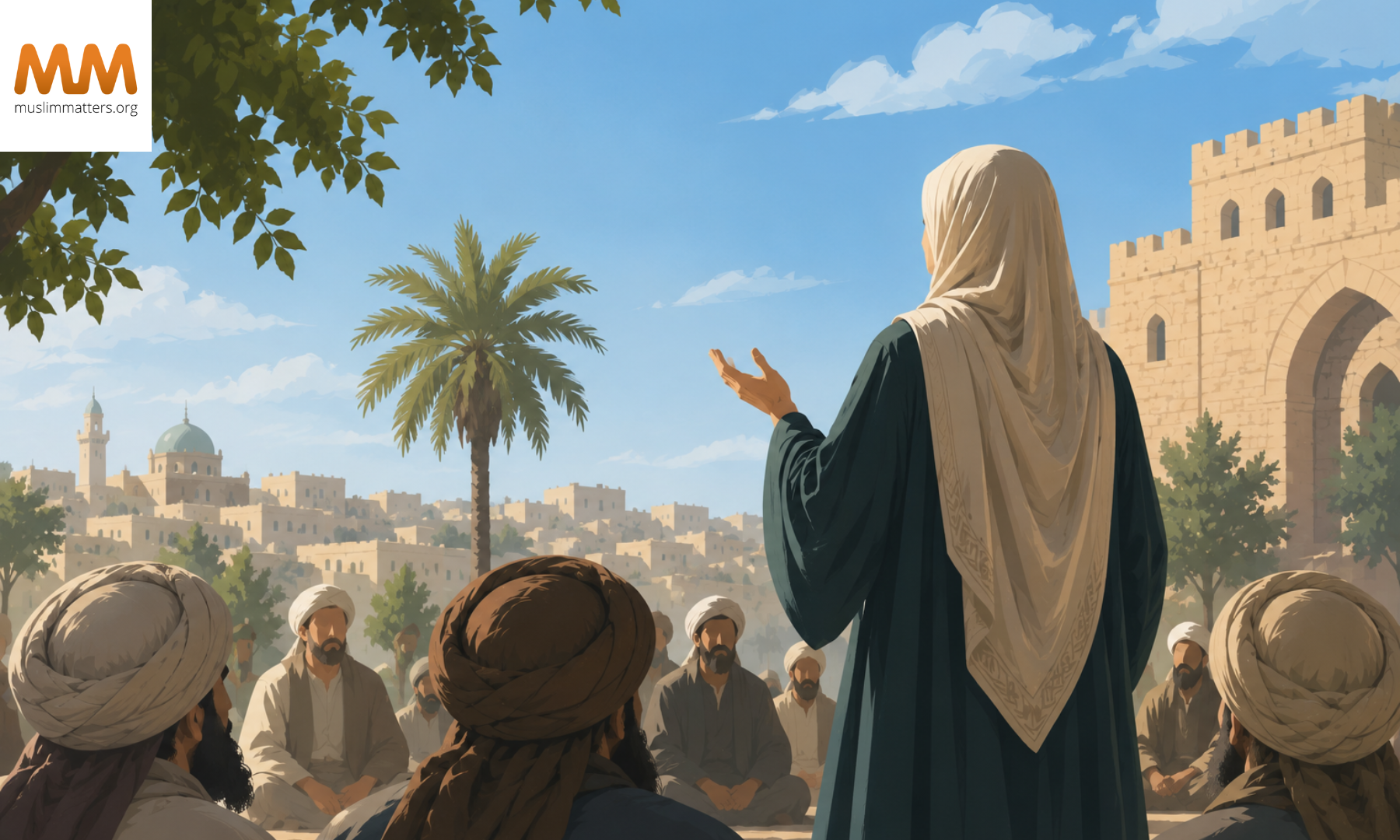
This Qurayshi woman remains anonymous, but her story features most prominently in the Qur’anic exegetical literature in connection to the 20th ayah from Surah An-Nisa1https://legacy.quran.com/4/20. Her claim to fame was an incident in which she confronted ʿUmar ibn al-Khaṭṭāb  (d. 23 AH/644 CE) for a policy he enacted while caliph that limited the amount of mahr (marital gift) a woman could request upon marriage. While the general contours of her story are well known, what is missing is a closer analysis of the transmitted historical narrations about this incident and the remarkable details they reveal about the changed cultural ethos of seventh-century Arabia regarding women. More significantly, when we use this incident as a benchmark to measure women’s access, visibility, and advocacy in North American mosques, it reveals critical gaps that need to be addressed within our Muslim communities.
Pre-modern and modern exegetical heavyweights alike often affirmingly cite this anonymous woman’s advocacy in connection to the meaning of the verse: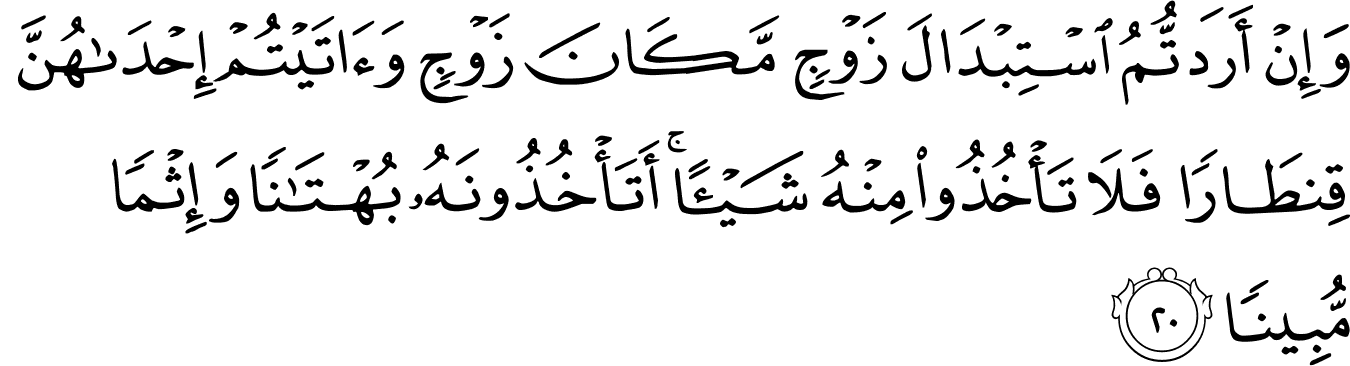
“If you desire to replace a wife with another and you have given the former a heap of gold (as a dowry), do not take any of it back. Would you take it unjustly and very sinfully?” [Surah An-Nisa, 4:20].
Keep supporting MuslimMatters for the sake of Allah
Alhamdulillah, we're at over 850 supporters. Help us get to 900 supporters this month. All it takes is a small gift from a reader like you to keep us going, for just $2 / month.
The Prophet (SAW) has taught us the best of deeds are those that done consistently, even if they are small. Click here to support MuslimMatters with a monthly donation of $2 per month. Set it and collect blessings from Allah (swt) for the khayr you're supporting without thinking about it.
Most narrations focus on her success in convincing ʿUmar ibn al-Khaṭṭāb to rescind his policy to institute a cap on the mahr based on the merit of her argument. According to one narration, ʿUmar instituted a policy that put a 400-dirham limit upon the marital gifts given to women upon marriage.2 Ibn Kathīr, Tafsīr al-Qurʾan al-ʿAẓīm, 1:580. The Qurayshī woman argues that a correct understanding of Q. 4:20 demonstrates the permissibility of women requesting a high marital dower (even heaps of gold), if they so wish.
It is interesting to note that not a single exegete (mufassir) cites this story with any sense of rebuke, chastisement, or dissent to this woman’s advocacy. From Ibn Atiyya (d. 541/1147), Fakhr al-Dīn al-Rāzī (d. 606/1209), and Muḥammad ibn Aḥmad al-Anṣārī al-Qurṭubī (d. 671/1273) to Ismāʿīl ibn ʿUmar Ibn Kathīr (d. 773/1371) and Muḥammad al-Ṭāhir ibn ʿĀshūr (d. 1973), among many others, exegetical heavyweights cite this incident affirmingly. The woman’s success in advocating her case and ʿUmar’s subsequent repeal of his policy becomes further evidence for classical exegetes that it is permissible for women to request a high or excessive marital gift. The primary piece of evidence they reference is the verse itself, since God does not use anything that violates divine law as an example.3 Ibn ʿAṭiyya, al-Muḥarrar al-Wajīz fī Tafsīr al-Kītāb al-ʿAzīz, 2:29, aal- Qurṭubī, al-Jāmiʿ li-Aḥkām al-Qurʾan, 6:163; Ibn ʿĀshūr, al-Taḥrīr wa’l-Tanwīr, 2:288. Ibn ʿĀshūr states, “This exaggerative term indicates that giving a large amount (qinṭār) is legally permissible (mubāḥ sharʿan) because God does not give as an example something that the Sharīʿa condemns, such as the forbidden” (2:288). Accordingly, the verse’s example of a man giving his bride a qinṭār (a large amount of wealth) for her marital gift means it is valid to do so.
Yet what is more important than the validity of women’s right to request as high a mahr as they choose, are the critical lessons offered by this historical incident on the ethics of dissent, a community’s inclusivity of individuals impacted by policies, women’s advocacy, and cultivating an egalitarian cultural ethos. There are many relevant lessons to glean from the historical encounter between this anonymous Qurayshī Arab woman and ʿUmar ibn al-Khaṭṭāb (God be pleased with them) during his reign as caliph of the Muslim empire between 634 to 644 CE. The woman’s ability to offer a dissenting opinion to his policy reflected a new cultural ethos that valued women’s perspectives, intelligence, knowledge, and contributions. I will provide a brief analysis of the historical narrations (riwāyāt) that have been transmitted about this woman’s advocacy and ʿUmar’s response, God be pleased with them.
In the twentieth-century commentary of Muḥammad al-Ṭāhir ibn ʿĀshūr (1879–1973), Al-Taḥrīr wa’l-Tanwīr, he narrates the following version of this historical incident:
For this reason, when ʿUmar ibn al-Khaṭṭāb
delivered a sermon in which he forbade excessive dowries, after he descended [from the minbar], a woman from Quraysh said to him, “O Commander of the Faithful, is God’s Book or your statement more worthy of being followed?” He replied, “Indeed, the Book of God. Why is that?” She replied, “You have just forbidden people from charging a high amount [al-mughālāt] in women’s dowries, although God states in His Book: even if you have given her a great amount of gold, do not take any of it back” (Qur’an 4:20).
ʿUmar
The first lesson to be gleaned from this riwāya (narration) is the nascent Muslim community’s inclusivity of women in this space where ʿUmar declared this new policy. All the historical narrations about this incident demonstrate that this woman was in the vicinity to hear ʿUmar’s ruling and publicly challenge this policy. Furthermore, the historical records underscore the woman’s accessibility to ʿUmar (God be pleased with them) such that she could respond to him when he declared this new ruling. She did not struggle to hear his policy from a remote room with a dysfunctional sound system. She did not have to walk around a building to find the men’s section. She did not have to walk down a second-floor balcony reserved for women or seek permission to speak to ʿUmar ibn al-Khaṭṭāb . She did not have to write a letter to his secretary to request a meeting with him. In only one of the exegetical reports I have come across, that of Ibn ʿAṭiyya in his commentary, al-Muḥarrar al-Wajīz fī Tafsīr al-Kītāb al-ʿAzīz, he writes that the woman approached ʿUmar from “behind the people” (min warāʾ al-nās)5Ibn ʿAṭiyya, al-Muḥarrar al-Wajīz fī Tafsīr al-Kītāb al-ʿAzīz, 2:29.. One of the narrations in Ibn Kathīr’s commentary notes that she was standing in the rows of women, which nonetheless indicates she was close enough to be heard (فقالت امرأة من صفة النساء)6Ibn Kathīr, Tafsīr al-Qurʾan al-ʿAẓīm, 1:580..
Whether the woman approached him from behind the men or not, the transmitted reports unquestionably affirm the woman’s ease of access to ʿUmar ibn al-Khaṭṭāb
These observations give rise to the following questions: How many Muslim women today would have access to a religious leader if she disagreed with a statement or policy he issued? Could this exact scenario be replicated in our own mosques today in North America? How many women would be rebuked, shunned or herded away if they wanted to be publicly heard in a mosque? Furthermore, do the structures and designs of our mosques today facilitate women’s access to the space where policies are being enacted? Or rather, do our mosques exclude women from spaces where policies are being enacted, even when those policies impact them directly?
Second, and quite significantly, the reports cited in the exegetical literature affirm that the woman’s understanding of this ayah was correct. Although we don’t know her name, we know that her skilled legal reasoning changed a policy that may have impacted women for centuries thereafter. If God states in His Holy Book that upon divorce, men cannot take back a penny of what they’ve gifted their wives in the form of mahr, even if it was a heap of gold, this indicates that women could ask for heaps of gold, which would be deemed excessive in that historical context. In al-Qurṭubī’s commentary on this verse, he notes that scholars have agreed that there is no limit to the amount a man could gift his wife as a marital gift (mahr), but they disagree on the minimum amount7al-Qurṭubī, al-Jāmiʿ li-Aḥkām al-Qurʾan, 6:166-7. . Therefore, this woman’s advocacy and ʿUmar’s subsequent repeal of his policy have shaped legal scholars’ understanding of this issue for centuries thereafter.
Third, ʿUmar’s response to this woman offers many lessons in effective leadership. First, he took the time to listen to her. Although he was a busy man and of great status, he didn’t see it “beneath him” to hear out this woman’s argument. Second, he displayed great intellectual humility by submitting that she was correct and that he made a mistake. Third, he immediately corrected his mistake, validating her judgment to subsequent scholars who analyzed this incident. He didn’t make excuses about how it would make him look or claim “it’s too late now.” He simply walked back up the minbar and rescinded his policy. According to a narration in Ibn Kathīr’s commentary on Q. 4:20, ʿUmar states, “I had forbidden you from increasing women’s marital dowers beyond 400 dirhams. However, whoever desires, let him give from his wealth whatever he likes.8Ibn Kathīr, Tafsīr al-Qurʾan al-ʿAẓīm, 1:580. He states, “إني كنت نهيتكم أن تزيدوا النساء في صداقهن على أربعمائة درهم، فمن شاء أن يعطي من ماله ما أحب.”” The narrations underscore ʿUmar’s remarkable intellectual humility, as he allegedly states, “God forgive me; everyone is of greater understanding [afqahu] than ʿUmar.” In another narration, he states, “A woman was correct, and ʿUmar was mistaken.9Ibn Kathīr, Tafsīr al-Qurʾan al-ʿAẓīm, 1:580.”
Fourth, the different transmitted narrations about this historic incident reveal the female companions’ deep level of trust in divine justice and their direct spiritual connection to God. Like the female companion whose advocacy forms the backdrop of Sūrat al-Mujādila (Khawla bint Thaʿlaba  ), this female companion demonstrates a deep spiritual connection to God and her faith in divine justice. In one of the narrations in Ibn Kathīr’s tafsīr, after ʿUmar declares, “Do not increase the dowries of women, even if she is the daughter of a nobleman,” the tall Qurayshī woman says to ʿUmar , “That is not for you [to limit] (mā dhāka laka).10Ibid.”
Her statement, “that is not for you [to limit],” reflects more than meets the eye. Like other female companions during the prophetic period, this seventh-century Qurayshī woman felt a deep, personal connection to God and recognized Muslim women’s rights as divinely ordained. She and other female companions, based on other historical reports, did not view the male companions as the arbiters of their faith or deliverer of their rights. They understood that their rights came directly from God.
The woman’s statement, “That is not for you [to limit]” reflects a recognition that the marital dower (ṣadāq) is ultimately a legal right that God Himself bestows upon women. The bride has full autonomy to determine what her ṣadāq should be, and the woman is the sole recipient of this gift. This anonymous Qurayshī woman’s ability to recognize God as the ultimate arbiter of women’s rights reflects her deep intellectual insight. Centuries later, legal-minded scholars arrived at a similar conclusion. For example, in his commentary on Q. 4:4, al-Qurṭubī notes writes, “Al-Ṣadāq [marital gift] is a gift from God to women.11Al-Qurṭubī, Al-Jāmiʿ, 6:44.” Similarly, the thirteenth-century exegete al-Rāzī, a logician and philosopher known for his philological tafsīr, deduces a similar understanding as the Qurayshī woman – that God is the one who has gifted women the ṣadāq. In his commentary on Q. 4:4, al-Rāzī asks, “From whom is the mahr a gift [ʿaṭiya]?” He notes that there are two possibilities. It is either a gift from the husband or a gift from God. In support of the second possibility, he writes, “Others have stated that God gave both men and women the shared benefits of marriage, such as sexual enjoyment and procreation, yet God ordained this gift from the husband to the wife, so it is a gift from God [to women] from the outset.12Al-Rāzī, Mafātīḥ al-Ghayb, 5:148.”
This seventh-century Muslim woman’s response to ʿUmar , “that is not for you [to limit],” would come across to many Muslims today as offensive or insulting. Can we imagine, for a moment, a woman telling a religious leader in our Muslim community today that a specific matter was beyond his authority to determine? Instead of viewing this statement as insulting or offensive, we should view it as an affirmation of this woman’s tawḥīd, her belief in one God with whom there are no other sovereigns. This is perhaps the most important quality that we need to revive in our own communities today. The recognition that our loyalty belongs to God first and foremost, and that human beings can never stand as intermediaries in our relationship with God. Accordingly, when humans fail to deliver justice, whether they are religious leaders or not, this should not shake our faith but invigorate our search and advocacy for divine justice.
Related:
[Podcast] Guardians of the Tradition: Muslim Women & Islamic Education | Anse Tamara Gray
The Light of Female Islamic Scholarship: Da’wah, Difficulty, And Determination
Keep supporting MuslimMatters for the sake of Allah
Alhamdulillah, we're at over 850 supporters. Help us get to 900 supporters this month. All it takes is a small gift from a reader like you to keep us going, for just $2 / month.
The Prophet (SAW) has taught us the best of deeds are those that done consistently, even if they are small. Click here to support MuslimMatters with a monthly donation of $2 per month. Set it and collect blessings from Allah (swt) for the khayr you're supporting without thinking about it.





Maryam: The Story Of The Muslim ‘Virgin’ Mary

Is It Ever Too Early To Prepare For Ramadan? Reflections On Rifq, Forgiveness, And Healing The Heart

Lessons From The Battle Of Badr: A Personal Transformation Perspective

Taliban Tale: How Afghan Militants Survived Campaigns In 2006-2016

[Podcast] Yes, She’s Funny In This | Huda Fahmy

Far Away [Part 26] – Shaytan Is A Liar

From a Syrian Prison to the UN: The Case of Bilal Abdul Kareem

[Podcast] 50k Mahr, Hiding Money, & Who Pays for the Wedding? | AML Finance

Long War Without End: A Quarter-Century Since The War On Terror

[Podcast] Faith, Motherhood, and the Call to Gaza | Dr. Samaiya Mushtaq

The Best Actions for Eid al-Adha [Imam Dawud Walid]

Coming Full Circle: Who Are You Now? | Night 30 with the Qur’an

Running Away From Who We Are | Night 29 with the Qur’an

Building From the Ground Up: Week 4 Recap | Night 28 with the Qur’an

The Muslim You Are Becoming | Night 27 with the Qur’an
MuslimMatters NewsLetter in Your Inbox

Sign up below to get started




seeker
June 23, 2026 at 2:00 PM
One could argue that the article reads a seventh-century incident through a twenty-first-century lens. Classical scholars preserved the story because it demonstrated the authority of the Qur’an, the humility of ʿUmar (RA), and the legal principle that there is no upper limit on mahr—not because they intended to formulate a theory of gender advocacy or challenge hierarchical structures. The woman appealed to revelation, not to personal autonomy or a rejection of patriarchal authority. The lesson is not that authority should be viewed with inherent suspicion, but that all human authority remains subordinate to revelation and open to sincere correction with knowledge and adab.
The article then moves from a woman correcting a public policy in the time of ʿUmar to a broader critique of contemporary mosque leadership. While the historical incident demonstrates the importance of accessibility and accountability, it does not necessarily follow that contemporary Islamic institutions generally fail in this regard. In many communities today, scholars are accessible through office hours, appointment systems, email, phone calls, WhatsApp, and online platforms—means of communication unavailable in earlier centuries. Women’s classes, counseling services, female teachers, and other avenues for engagement are common in many Islamic centers.
Furthermore, access does not require identical physical arrangements. Access and influence are not synonymous with occupying the same physical space, and distinctions in modes of interaction do not necessarily imply exclusion. The principle established by the incident is access to knowledge, justice, and the ability to offer sincere correction—not necessarily identical forms of participation. Thus, while the story highlights humility and accountability in leadership, it does not by itself establish the broader claims about gender advocacy and institutional exclusion that the article seeks to derive from it.