#Islam
Tahajjud: A Call to All Pajama Heroes
Discover the beauty and power of tahajjud. Learn its rewards, and practical steps to make this intimate act of worship part of your life.


Discover the beauty and power of tahajjud, the voluntary night prayer. Learn its virtues, rewards, and practical steps to make this intimate act of worship part of your life.
A Special Invitation
What if I were to tell you that there is a special invitation that comes to you every night? It peaks around the corner after twilight, and drops into your lap before the morning sun beams’ brilliance appears. When all others are asleep, it almost unnoticeably slips into the pockets of your soul. As the distractions of the day let you be with the nocturnal darkness, it invites you to find yourself in uninterrupted seclusion with the Highest of High. It welcomes your heart to enjoy a private conversation with your Creator. It is tahajjud, and it tells you to come, come, be with your Lord.
Note: The night is considered the time in between isha and fajr prayer. Qiyam al-layl, “standing at night,” is often used to define the voluntary night prayers offered before sleeping, and tahajjud, “giving up sleep,” are usually the supererogatory nightly prayers prayed before fajr after having slept. For the sake of ease, this article does so too. Both terms, however, are generally applied interchangeably.
Among the Righteous
Keep supporting MuslimMatters for the sake of Allah
Alhamdulillah, we're at over 850 supporters. Help us get to 900 supporters this month. All it takes is a small gift from a reader like you to keep us going, for just $2 / month.
The Prophet (SAW) has taught us the best of deeds are those that done consistently, even if they are small. Click here to support MuslimMatters with a monthly donation of $2 per month. Set it and collect blessings from Allah (swt) for the khayr you're supporting without thinking about it.
Tamim al-Dari was one of the sahaba who was well-known for his wholehearted dedication to the night prayer. He would be the first to light up the glimmering oil lamps at the masjid. Our beloved Messenger, may Allah send peace and blessings upon him, would stand in nightly devotion for hours and hours, so much so his feet would swell (Sahih al-Bukhari 4836). Sayyida Zainab once tied a rope hanging in between two pillars in the masjid so she could hold onto it when she got exhausted from standing in prayer at night, though the Prophet, may Allah send peace and blessings on him, advised not to go to such lengths. (Sahih al-Bukhari 1150). Commitment to voluntary prayers in the nighttime was truly a given in the early Muslim community. These moonlit hours were created for both sleep and worship.
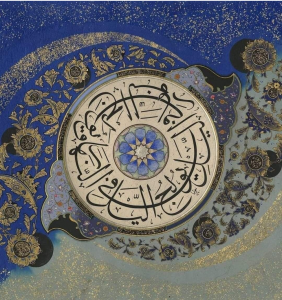
“Allah makes the night into the day and the day into the night. Allah hears and sees all things.” (Surat al-Hadid 6; illumination by Nilgün Gedik)
The Prophet said so himself, may Allah send peace and blessings upon him: The best prayer after the obligatory prayer is prayer at night (Sunan an-Nasai 1614). It is the habit of the righteous who came before us. It brings us closer to our Creator, expiates our evil deeds, and prevents us from sinning (Sunan al-Tirmidhi 3549). Night vigil is an opportunity to be elevated in rank, as we know that Allah can raise us to a station of praise when we commit to it (Surat al-Isra, 79).
Through what is referred to as the Hadith of the Heavenly Dispute, we learn that our beloved Prophet, may Allah send peace and blessings upon him, once asked Allah in a dream what the highest angels dispute about. Alongside providing food and speaking gently, praying at night was one of the most virtuous deeds the angels argued about when discussing the expiation of sins (Mishkat al-Masabih 748).
Surat al-Furqan reminds us that the true servants of the Most Compassionate are those who walk on the earth humbly, and when the foolish address them improperly, they only respond with peace. They are those who spend a good portion of the night prostrating themselves and standing before their Lord (63-64). The upright? They are those who sleep only little at night and pray for forgiveness before dawn (Surat al-Dhariyat 17-18).
The knights of the night are among the real muminin. Surat al-Sajdah tells us so. “The only true believers in Our revelation are those who, when it is recited to them, fall into prostration and glorify the praises of their Lord and are not too proud. They abandon their beds, invoking their Lord with hope and fear, and donate from what We have provided for them. No soul can imagine what delights are kept in store for them as a reward for what they used to do” (15-17).
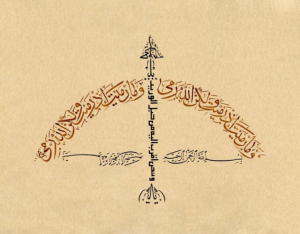
Calligraphy by Emre Sessiz of two Quranic verses: “And you did not throw when you threw but Allah did throw” (8:17), and “And We are closer to him than the jugular vein” (50:16)
What Happens at Night?
It is said that Imam Muhammad ibn Idris al-Shafii compared the dua made at the time of tahajjud to an arrow that does not miss its mark. In the last third of the night, Allah comes down to the lowest heaven, asking “Is there anyone to invoke Me, so that I may respond to invocation? Is there anyone to ask Me, so that I may grant him his request? Is there anyone seeking My forgiveness, so that I may forgive him?” (Sahih al-Bukhari 1145).
This means that in this last part of the night, your Creator comes and seeks you out. As the night prayer tends to be more concealed, some argue that it is closer in sincerity. It is kept between the worshipper and Allah, a little secret between you and Him in the stillness of the night. In those moments before you stand to pray at daybreak, you can get as close to Him as you can in this dunya. You are invited to pour your heart out, beg for forgiveness, and ask for anything you so desperately yearn for.
Night prayer brings comfort to the soul. It is a soothing balm of sakina that we need to make it through the day. Men of knowledge such as Muhammad ibn Muhammad al-Ghazali and Jamaluddin Abdul-Rahman Ibn al-Jawzi have dedicated endless writings to qiyam al-layl, the latter considering the night prayer as the ultimate spiritual weapon of the believer. Leaving sleep is a disciplining trial that is hard on the lower self. The battle with the bed is when tahajjud does its deepest work, even before the prayer begins. Do we want to snooze and snore, or does our heart long for closeness to Allah and choose it over rest and comfort? In addition, recitation in night prayer offers an opportunity to profound contemplation as our daily distractions are put to sleep.
Fireflies in Dark Times
Praying at night was one of the first sunan established. The Prophet, may Allah send peace and blessings upon him, stressed its importance in his first sermon in Madina (Sunan Ibn Majah 3251). Given its context, we can read the practices mentioned in this sermon as key elements to build a close-knit community: spreading peace to promote unity and social cohesion, offering food to those in need, and praying at night. It is a way to strengthen our spiritual wellbeing and resilience, a tool to purify our heart and make our willpower steadfast and our body more powerful. These are key elements to build a foundation on. Imagine the effect we can have on the Ummah, the relief we can bring. Imagine how it can allow us to excel in doing good and bringing our best self to the table.
When our Prophet was distressed in Makkah, Allah addressed him through Surat al-Muzzammil, may Allah send peace and blessings upon him. The Surah’s first verses (1-8) read, “O you wrapped in your clothes! Stand all night in prayer except a little, pray half the night, or a little less, or a little more, and recite the Qur’an properly in a measured way. For We will soon send upon you a weighty revelation. Indeed, worship in the night is more impactful and suitable for recitation. For during the day you are over-occupied with worldly duties. Always remember the Name of your Lord, and devote yourself to Him wholeheartedly.” For our beloved Messenger, may Allah send peace and blessings upon him, to be able to handle this weighty revelation, this heavy task that was looming, he had to prepare himself spiritually. For us to be able to carry our own role in this dunya gracefully, we need to do the same. Tahajjud can help us with that.

A lantern-lit room at night, by Franscisco Fronseca
Rise at Night and Rise in Rank
The broken-hearted, the sinners, the great, those who have tried and those who try, the virtuous, the ones that are lost and those who do well. Tahajjud is a call to us all. Even if you have not been able to fully commit to the five daily prayers consistently, you can try to pray a little at night. Perhaps it will offer you the strength you lack to fulfill the obligatory during the day. A waterfall of other good habits might sprout from it.
The struggle starts the day before. Fill your daylight hours with good deeds, avoid sins to avoid a heavy heart, steer clear of man-sized meals before you go to sleep, recite your evening adhkar, and sleep early with the intention of waking up for tahajjud. Make notes during the day on what to make dua for and turn your place of prayer in a serenely attractive spot. If you are a woman and you would like a circle of support, you can join Rabata’s Tahajjud Threads on WhatsApp. If you need a sturdy wake-up call, you can try the most irritating Fajr alarm ever developed. Remember, when you wake up your spouse and resort to sprinkling water in their face to do so, Allah shows mercy for this most romantic act (Riyad al-Salihin 1183).
Start with a pure intention. As tahajjud is voluntary, there is no fixed set of rakʿat required. It is prayed in sets of two and recommended to start with two short rakʿat (Riyad al-Salihin 1179). The Prophet, may Allah send peace and blessings upon, would pray eight rakʿat in total, four times two. Yet for you to build this habit, begin lightly. You can start by waking up 15 minutes before fajr and sticking to two rakʿat. Depending on the scholarly opinion you follow, you can conclude with the odd witr prayer.
Once you have been able to establish a recurring routine, you can wake up earlier and add more rakʿat. Remember that the actions that Allah loves most are the most constant, even if little (Sahih al-Bukhari 6464). Give yourself time to get used to it and do not despair. Our soul is changed by what we return to. Only steadily our bond of love with the Divine becomes rooted.
You can turn to longer ayat or shorter ones. In your dhikr and dua, focus on forgiveness. Recite out loud and let the meanings of the words seep into your heart. Did you know that the angels come down to listen to your recitation (Sahih Ibn Hibban 779)? If you follow the Shafii madhab, you can read from a mushaf in your sunna prayers and gradually complete a khatma in your night prayers this way.
Allah is calling you. You can be one of those pajama heroes whose limbs drag themselves out of their beds and who illuminate their homes like Tamim al-Dari did. Turn your house into a lighthouse for our people. You do not even have to adorn yourself with your best attire for this extraordinary encounter. Have a look, dig deep into the pockets of your soul. Are you answering the invitation?
Related Posts:
A Tahajjud Journey To Inspire Your Own : A Ramadan Goal That’s Not As Hard As It Seems
Keep supporting MuslimMatters for the sake of Allah
Alhamdulillah, we're at over 850 supporters. Help us get to 900 supporters this month. All it takes is a small gift from a reader like you to keep us going, for just $2 / month.
The Prophet (SAW) has taught us the best of deeds are those that done consistently, even if they are small. Click here to support MuslimMatters with a monthly donation of $2 per month. Set it and collect blessings from Allah (swt) for the khayr you're supporting without thinking about it.





From a Syrian Prison to the UN: The Case of Bilal Abdul Kareem

The Muslim Book Awards 2026

Far Away [Part 25] – To Save A Prince

Putting Lipstick on the RSS Pig

[Podcast] Muslim Money Matters: Do You Know How to Halal Hustle? | Adam Taufique
Far Away [Part 25] – To Save A Prince
Far Away [Part 24] – The Whipping

When The Bed Walked Away [Part 2] – Primordial Muck
When The Bed Walked Away [Part 1]
Far Away [Part 23] – Delirium

The Best Actions for Eid al-Adha [Imam Dawud Walid]

Coming Full Circle: Who Are You Now? | Night 30 with the Qur’an

Running Away From Who We Are | Night 29 with the Qur’an

Building From the Ground Up: Week 4 Recap | Night 28 with the Qur’an

The Muslim You Are Becoming | Night 27 with the Qur’an
MuslimMatters NewsLetter in Your Inbox

Sign up below to get started