#Islam
Know Where Your Charity Goes: A Guidebook by Tauqir Sharif for Muslim Givers this Dhul Hijjah

Published
Preface
The first time I held a dying child in my arms, something in me changed forever.
She was a little girl in Syria. The same age as my own daughter.
A barrel bomb had fallen on her home. When she was brought into the hospital, there was nothing left to do. The damage was too severe. She died shortly after.
Keep supporting MuslimMatters for the sake of Allah
Alhamdulillah, we're at over 850 supporters. Help us get to 900 supporters this month. All it takes is a small gift from a reader like you to keep us going, for just $2 / month.
The Prophet (SAW) has taught us the best of deeds are those that done consistently, even if they are small. Click here to support MuslimMatters with a monthly donation of $2 per month. Set it and collect blessings from Allah (swt) for the khayr you're supporting without thinking about it.
When her family came to collect her body, we carried her back to the very same house that had just been destroyed. There was nowhere else to take her. The walls were shattered. The roof was gone. Dust still hung in the air. That was her final journey.
I remember standing there with a feeling I struggle to describe—a deep, suffocating powerlessness. A feeling that came with the knowledge that someone sitting far away, pressing a button, could erase a child’s life in seconds. A child who laughed, played, and was loved. A child no different than my own.
War strips away illusion. It shows you how power really works.
And after over fifteen years in the charity sector, working in Palestine, standing in Gaza, and operating in Syria during the war, I began to see another layer of power. Not bombs. Not weapons. But money. Narratives. Aid.
Charity is not neutral. It shapes outcomes. It can create dependency or build independence. It empowers communities or it locks them into cycles. It can restore dignity or quietly undermine it.
I have seen extraordinary generosity from our Ummah. I have seen donors give their last pounds in the hope of relieving suffering. But I have also seen how parts of the system operate behind the scenes. How priorities shift. How branding overtakes strategy. How short-term relief becomes a permanent model.
And it hurt, because I knew we could do better.
I am not writing this book to destroy Muslim charities. Muslims are among the most generous people on Earth. Our culture of sadaqah and zakat is one of our greatest strengths. But strength without structure can be exploited. Systems without accountability drift. And when they drift, the consequences are not theoretical, they are measured in real lives.
We cannot continue giving the same way, without scrutiny, strategy, or demanding transparency.
This piece is not for executives or corporate boards. It is for the donor, for the fundraiser who carries the weight of an amanah, for the believer who gives sincerely and assumes that trust will be honoured.
Sadaqah and zakat are sacred trusts before Allah. They are not marketing tools. They are not revenue streams. They are instruments of justice.
I know this piece will make some uncomfortable. It may create enemies for me within the sector. But my loyalty is not to institutions.It is to the Ummah.
After holding that child, after standing in rubble, after watching aid shape futures, silence would feel like betrayal.
If this information unsettles you, sit with that feeling. How we give determines more than we realise.
Tauqir Tox Sharif
Introduction
My name is Tauqir Sharif, though most people in the charity world know me as Tox. I was born and raised in London. In my second year of university, where I expected a conventional career path, an opportunity arose to travel to Gaza. I took it, and I never returned to complete my degree. That decision changed the course of my life.
At the time, the UK Muslim charity landscape was dominated largely by two major organisations: Islamic Relief Worldwide and Muslim Aid. Most donations flowed through them, and entering the sector formally required credentials, networks, and a polished CV. I had none of that. I simply wanted to help.
In 2009, I travelled to Gaza on the Viva Palestina convoy. What I saw there reshaped me in ways I could never have imagined.
I witnessed two things that remain with me to this day. First, the resilience of a people in the most suffocating circumstances: families rebuilding beside rubble, children smiling under blockade, optimism in a place the world had written off. Second, their iman. They had so little materially, yet their faith was immeasurable. We in the West had comfort, consumerism, and resources, and still we were restless inside. They had almost nothing and yet they were anchored by faith.
On that convoy, I met Kieran Turner, the mission lead, who became a mentor. He taught me how to navigate borders, prepare cargo manifests, and move aid strategically rather than emotionally. I absorbed everything I could. Over time, I began leading convoys myself, slowly building a reputation, not within the formal charity structures, but on the ground.
In 2010, I joined the Gaza Freedom Flotilla aboard the Mavi Marmara. Nine of my comrades were killed during the raid. We were arrested and imprisoned before being released after international attention. That experience taught me a crucial truth: aid is never neutral. It exists within power, politics, and consequence.
After returning home, I balanced work between my family business and travelling to disaster zones such as Pakistan floods, earthquake regions, and more. Then in April 2012, a group of us organised and delivered one of the first aid convoys into Syria. No Muslim charities were willing to help. They were too scared. They told us what we were doing was crazy, that we should wait until the British government issued clear guidelines, or until it became safe to intervene.
We couldn’t wait. Blood was already spilling. People were suffering. Every moment counted.
At first, we went as nothing more than a community group, because no one else was stepping forward. Despite countless difficulties, we successfully delivered our first convoy: twelve ambulances, loaded with aid, into Northern Syria.
But what I saw there changed everything.
How could I leave Syria while families were still fleeing toward the borders, escaping the tyranny of Bashar Assad’s crackdown?
From inside Syria, I began calling back to the UK, arranging the next wave of ambulances. When they were finally ready, I returned home, but only for three days. This time, I brought my wife Racquell with me.
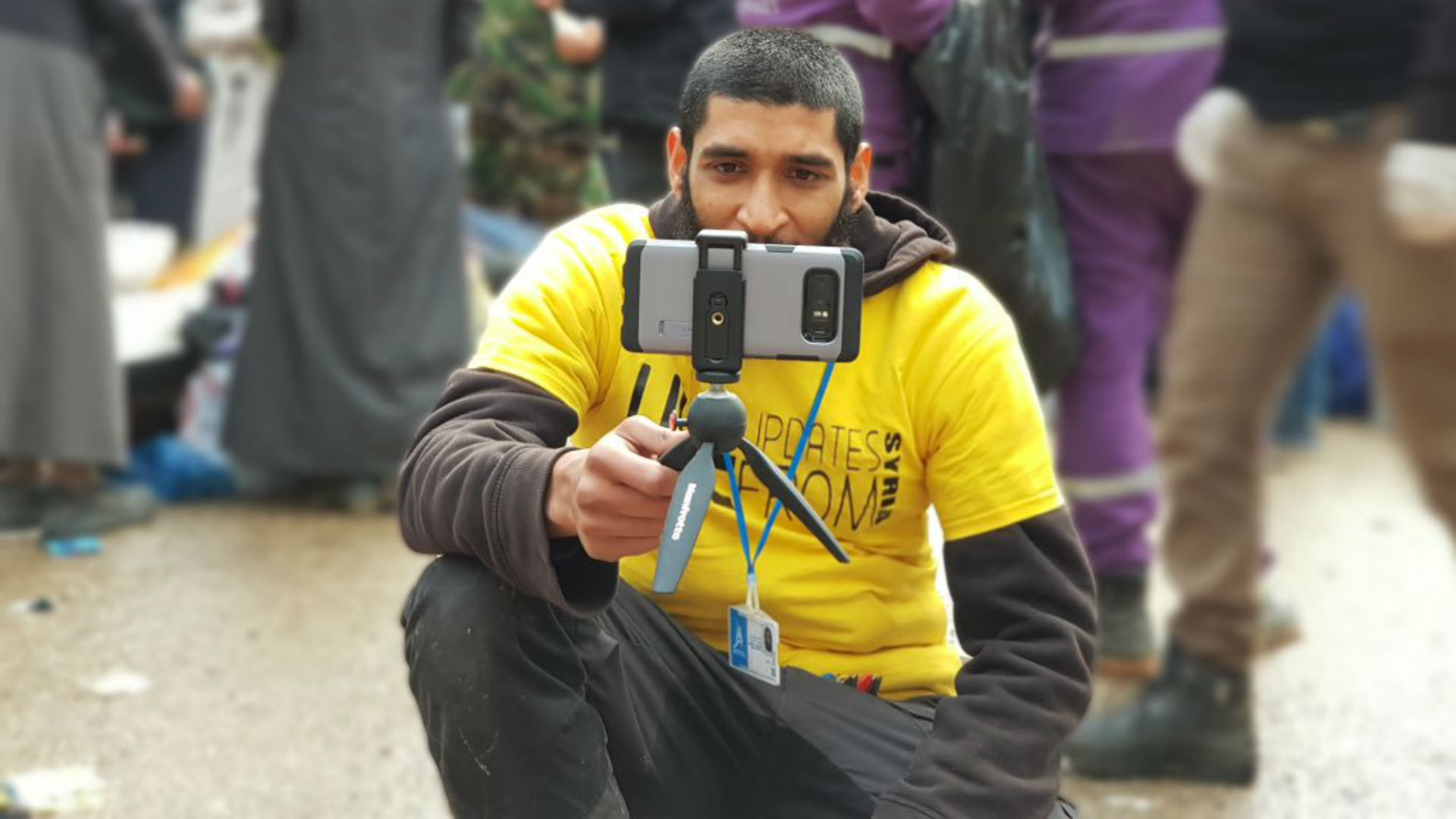
We had been married just ten months, and together we launched Live Updates from Syria —reporting from the ground, raising support, and witnessing refugee camps emerge along the border in real time.
For the first time, people could see a Muslim couple speaking directly from a war zone in English, supporting Muslims with aid. This marked a shift in the Muslim charity sector. Soon, charities from around the world contacted us, asking us to implement their projects.
Motivated purely fi sabilillah, we accepted, wearing everyone’s logos on our shirts. We didn’t care about branding; we only cared that aid reached the people who needed it most.
But reality struck hard. Many charities abandoned us when challenges arose: political shifts, changing priorities, or simply because Syria was no longer “popular.” Not only did they leave us alone, but they profited from the attention we had garnered. They used the data we were creating online—fundraising pages, social media followers, and donors—to continue fundraising themselves. At the time, we weren’t thinking about marketing strategies or donor cultivation; our focus was on implementation. That lesson was bitter, but it taught me how the sector really operates.
For over fifteen years, I have operated in conflict zones and fragile regions. I have implemented projects for charities from the UK, the United States, Malaysia, Indonesia, South Africa, and beyond. I have overseen emergency relief, infrastructure builds, education
initiatives, and long-term development projects.
I have seen sincerity. I have seen strategy. I have seen dysfunction. And I have seen how narratives are shaped to unlock donations.
I understand how funds are raised. I understand how they are allocated. I understand the pressures charities face. And I understand the discrepancy between what donors believe and what sometimes happens. project sites. After fifteen years inside this world, I believe it is time to speak openly.
Aid Is a Weapon of War
Aid can save lives but it can also be weaponised to control populations, weaken independent governance, and create dependency. Understanding this is critical for anyone giving sadaqah or zakat.
Syria: The Atma Camp Incident
In northern Syria, near the Turkish border, hundreds of thousands of families were living in tents after fleeing bombardment. Water, something most of us take for granted, became the centre of a calculated power struggle.
At the time, the area around Atma was under the control of a local Islamic group, striving to maintain order and support the refugee population. Their governance represented independent authority, based on Islamic principles, in a chaotic war zone.
The International Rescue Committee (IRC) had created a system where trucks delivered water daily to tanks outside the refugee tents. On paper, it looked like humanitarian logistics. In practice, it was insidious. The system made tens of thousands of people entirely dependent on external control. If deliveries stopped, for any reason, families went without water.
In 2013, there was an incident at Sarmada where the same Islamic group accused IRC staff of spying for foreign governments. They raided its and detained members of its team. What they did not realise, however, was that IRC held a powerful pressure point over the refugee camps. Almost immediately, the water supply system was shut down. The trucks stopped coming, and the camps in Atma were left without access to the most basic necessity of life: water.
Day One: Families rationed water they had stored, unsure if help would come.
Day Two: Thousands gathered to demand water, protests spreading through the camp.
Day Three: Desperation escalated, roads were blocked, vehicles burned, and tension boiled over.
Day Four: Only after immense pressure did water flow resume.
It became clear: water had been weaponised to punish communities under independentIslamic-led governance. This was deliberate. The
truck-based system gave external actors leverage and created dependency.
Curious to understand the organisation behind this, I investigated the IRC. Its leadershipincluded Madeleine Albright, Colin Powell, and David Miliband—high-profile political actors who embody Western strategic interests – creating the conditions for war globally while presenting dependency on western aid as a panacea to the problems.
From that moment, I knew that if we were to operate ethically in Syria, we could not rely on temporary aid models that gave outsiders such leverage.
In response, very early in the revolution, we launched our Solar Power Water Well initiative.
As a small organisation, we were remarkably successful. Our systems, powered by solar panels and independent pumps, allowed refugee camps to operate fully autonomously, free from reliance on external water deliveries.
The impact was immediate. Many organisations from outside Syria contacted us, asking to implement these systems for their projects. This initiative not only saved lives but also helped establish numerous refugee camps that remained fully independent, proving that sustainable, community-empowering solutions were possible even in the most challenging circumstances.
Somalia: The Wheat Crisis and the ICU
A similar pattern emerged in Somalia. In the early 2000s, the Islamic Courts Union (ICU) rose to power, bringing stable governance to southern Somalia after years of warlord rule. Their model was independent, popular, and based on Islamic principles, which made them a target for external actors.
The United States viewed the ICU as a political challenge. Military intervention by Ethiopia and U.S. forcibly ousted the ICU from power. But aid also played a strategic role. Western organisations supplied massive quantities of wheat into refugee camps, ostensibly to relieve hunger.
On the surface, it looked like humanitarian relief. In practice, it destroyed local markets.
Somali farmers could no longer sell their crops, and communities became dependent on externally supplied food. When aid flows shifted or stopped, populations revolted against the ruling powers, destabilising governance and consolidating control in favor of external interests.
Food became a weapon. What appeared as aid was deliberately used to weaken independent Islamic governance and create dependency.
Lessons for Donors
These two incidents — Atma in Syria and the wheat crisis in Somalia, reveal a clear pattern:
1. Aid can empower, but it can also control and destabilise.
2. Systems that focus only on primary relief (food, water, temporary aid) without infrastructure or sustainability create dependency.
3. External actors, often with political agendas, can leverage aid to punish, manipulate, or weaken independent governance, particularly Islamic authorities.
Many Muslim charities today unwittingly fall into the same trap. They focus on primary relief without investing in long-term solutions or empowering communities.
Aid can save lives. But without understanding the dynamics behind it, aid can also be a weapon. The above experiences are warning for us to give strategically, ethically, and effectively.
The Five Types of Charity
When Racquell and I first arrived in Syria, we started with something simple: we wanted to give live updates from the ground and help people directly. That was it.
The project began organically. We would meet families who had lost everything, film and put their stories online, and witness people respond immediately. Instant feedback. Instant support. Private relief work in its purest form. We would raise funds, deliver aid, and donors could see the impact with their own eyes.
At the time, it felt like charity was simple.
But very quickly, we realised that private relief was not enough.
We were witnessing the birth of an entire generation inside refugee camps. In the early days, we were part of building some of the first camps in the Atma region on the Turkish border. And what we saw there deeply disturbed us. Men were martyred fighting against the oppression of Assad, sacrificing everything for freedom and dignity, and yet their children were growing up in tents with no education, no future, and in many cases still being taught the Assad regime’s curriculum.
What was the point of fighting to remove oppression, only to lose the next generation at the same time?
That is when we decided to build Iqra Charity, named after the first word revealed in the Qur’an: “Read.” We realised that education was not secondary. It was survival. If we didn’t build schools, develop teachers and hope, an entire generation would be lost. This was the moment we began transitioning away from pure primary relief and started thinking about mid-term and long-term transformation.
But while learning how to build projects, we were also learning something far darker.
We soon discovered the world of third-party fundraising charities.
At the beginning, I had no clue there were different types of charities. I assumed a charity raised money and delivered aid. Simple.
But I learned the truth the hard way.
We were exploited. These charities built their brands off our backs.
In the early years of the war, we agreed anytime any organisation contacted us and asked us to wear their vest, put their logo on our boxes, or distribute aid under their name. Fi sabilillah.
Our thought process was simple: the aid must reach the people. The logo didn’t matter.
What we didn’t realise was that for them, the logo mattered more than the people.
The arrangement was always the same. They would give us fundraising links. We would raise the money through our supporters. They would pass us what we raised, but they would keep the Gift Aid. At the time, we thought that was a fair deal. We were naive. We didn’t understand what was really happening.
Because these charities weren’t just receiving Gift Aid. They were receiving something far more valuable: access.
Over the years, we built a core of hundreds of fundraisers who annually raised around 15,000 to 18,000 donations for Syria. We thought
those donors were part of our mission. But these charities saw them as a database.
While we were focused on implementation, they were building marketing teams, email campaigns, data strategies, and donor pipelines. And slowly, they began targeting our supporters directly.
They didn’t have to take any risks, operate inside Syria, or build infrastructure. They simply collected donations, attached themselves to our work, and benefited from the credibility we generated on the ground.
And then when things got difficult, when Syria became politically messy, when fear spread, they dumped us and moved on.
Over the years we wore the branding of many charities. Not because we were loyal to logos, but because we were trying to keep aid flowing. But many of those charities later went on to falsely claim they were “working in Syria,” when in reality they had retreated to the neighbouring countries Turkey, Jordan, and Lebanon.
They were running safer operations, safer deployments, and safer fundraising campaigns, while Syria itself was abandoned.
I finally understood that third-party fundraising charities are brokers.
They subcontract your amanah.
They are middlemen who thrive on primary relief because it is fast, marketable, and endless.
The Three Countries of Charity
To understand the charity world properly, you need to think in terms of three different countries.
1. Donor country: Where donations are raised.
2. Transit country: A neighbouring country where many charities operate safely. In Syria’s case, this would be Turkey, Jordan, or Lebanon.
3. Crisis beneficiary country: Where suffering is actually taking place, such as Syria itself.
Your donation can pass through one country…or through all three. Every extra layer means more middlemen, more cost, and more dilution of accountability.
The Five Types of Charity
Within these three spaces, five different types of charities exist. Most donors only ever see the first, fourth, and fifth. The others are usually hidden behind layers.
1. Third-Party Fundraising Charities
Let me get straight to the point. Third-party fundraising charities are brokers: the middleman. They take your donation in the donor country, then look for someone else to deliver it on the ground. This means your money passes through multiple layers before it reaches beneficiaries, increasing inefficiency and diluting accountability.
These charities never implement aid themselves. Their strength is fundraising, branding, and mobilisation, not delivery.
Key Features
Third-party fundraising charities operate as subcontractors. They raise funds, run campaigns, and then pass the money to partners in transit countries or crisis countries. They focus heavily on social media, influencers, marketing, and emergency appeals. Most staff and infrastructure are based in affluent donor countries, not in the crisis zones. They are almost always focused on primary relief because it is fast, repeatable, and easy to market.
A major red flag is when these charities offer constant deployments in bordering countries rather than the crisis country itself. In Syria’s case, many organisations spent years operating only in Jordan, Lebanon, or Turkey while claiming Syria work.
Strengths
These charities can raise large sums quickly. They have strong media teams and know how to mobilise donors during emergencies. They generate awareness and can bring attention to crises that might otherwise be ignored.
Weaknesses
The weaknesses are structural. As middlemen they create extra layers, extra cost, and reduced transparency. Accountability is diluted because the charity is not physically delivering anything themselves.
They also trap the Ummah in primary relief cycles. They distribute what is easy, not what is transformative. And because they lack a deep presence in crisis countries, their auditing systems are often weak and reliant on partner reporting.
Questions to Ask
The first question for a charity is always:
- Who is your implementation partner, and which country are they based in?If they are candid enough to tell you, then ask:
1b. What made you choose this partner, and what due diligence did you perform?
- Only if they claim they implement directly should you move on:
- How long have you been working directly inside Syria?
- Who is your charity’s lead or manager inside the crisis country?
- Can you show me your organisational structure on the ground?
- Can you provide photos of your offices, warehouses, or personnel?
- What is your flagship project?
- What mid-term and long-term projects do you offer?
- Can you show success stories from your work over the last ten years?
These questions expose whether you are dealing with a broker or a builder.
2. Transit Charities
Transit charities operate in neighbouring refugee countries. They often exist as an additional middle layer between fundraising and implementation. Transit charities can sometimes be necessary, but they also introduce political risk.
Key Features
They operate in safer bordering countries and often handle logistics, permissions, and cross-border transfers. They may subcontract again to implementing charities inside the crisis country.
Weaknesses
Transit charities are sometimes influenced by state agendas. A donor must understand that neighbouring governments often have interests in where aid flows.
Questions to Ask
As a donor, you will rarely have access to a transit charity directly. But if your charity tells you who their transit partner is, ask:
- What due diligence did you perform before partnering with them?
- Can you provide evidence of projects your partner has completed successfully?
- Are they implementing themselves, or subcontracting again inside Syria?
- Do you know they are not being funded in part or fully by the government that hosts them?
3. Implementing Charities
Implementing charities are the real first responders. They are based inside the crisis country, working directly with beneficiaries. They run the warehouses, employ staff, manage distributions, build projects, and take the risks that brokers never take.
Strengths
They understand the ground reality better than anyone. They know the needs, the communities, and the local dynamics. They are the ones doing the work.
Weaknesses
Their weakness is funding. Most do not have independent donor bases, so they become reliant on third-party fundraising charities. This often means they are told what projects to do, even when those projects are not what the community truly needs.
4. Sovereign Charities
Sovereign charities are more developed organisations. They operate across all three countries: donor, transit, and crisis. They raise funds, manage logistics, and implement directly, reducing dependency on middlemen.
Strengths
They have full control, stronger accountability, and the ability to plan long-term projects strategically. They are not forced into primary relief cycles.
Weaknesses
They are complex and costly to run. Their overheads can be higher, so donors must still demand transparency and scholarly oversight.
5. Reform (Islah) Charities
Reform charities are rare. They do not just deliver aid, they challenge the system itself. They embed deeply in crisis communities, build new models, focus on long-term independence, and often engage in activism and public truth-telling.
Strengths
They provide thought leadership, courage, and strategic vision. They build institutions, not handouts. These charities are risking their lives and sacrificing comfort to work directly with the people who need aid most. They deliver real impact, challenge systemic problems, and drive meaningful change. Supporting them maximises safety, accountability, and transformative impact.
Weaknesses
Because they operate on front lines, they face political risk, censorship, and danger. They are often misunderstood or attacked because reform threatens the status quo.
A Donor Principle
In my opinion, the weakest and most damaging model for the Ummah is the third-party fundraising broker structure. It is a business model built around subcontracting sacred trust.
Your goal as a donor should be to support sovereign charities or reform charities wherever possible.
The Ummah does not need more middlemen; it needs builders.
The Four Types of Charity Work
Years in the field and in a war zone taught me lessons that no textbook ever could. In the beginning, most of the work we were doing was driven by emotion and necessity. But over time, something began to trouble me. I started to realise that survival alone is not victory. And if charity remains stuck in emergency mode forever, it does not liberate people, it traps them.
The Atma incident was one of the first moments that opened my eyes. Western NGOs were operating in the camps, but almost all of their work was focused purely on primary relief. They were not building infrastructure. They were not investing in independence. They were delivering aid in a way that created dependency. And when the system was disrupted, half a million people were left without water overnight.
It made me ask a terrifying question: what kind of society are we building if people cannot survive without the daily truck?
And then I realised something even harder. We had fallen into the same loop.
The majority of the work we were doing, despite sincerity, was also creating dependency. Refugee camps were being built where an entire generation of children grew up believing that life meant waiting. Waiting for the food box. Waiting for the distribution. Waiting for the next handout.
Many families would receive a parcel once a month, sell half of it, survive on the rest, and repeat the cycle. Children were not going to school. Men could not find work. Dignity was eroding quietly. And a new dangerous culture was forming, not because the people were lazy, but because the system around them was training them into dependency.
That was the moment our thinking had to change.
It was no longer enough to ask, “Did we feed people this month?”
We had to ask, “What future are we building?”
Through this painful realisation I began to understand the different types of charity work.
1. Primary Relief Work (The Focus of Third-Party Fundraising Charities)
Primary relief is the first response to disaster. It is what keeps people alive in the early days of war and displacement. Food, water, tents, blankets, emergency cash, all necessary in the beginning.
But primary relief is also the weakest form of charity work when it becomes permanent. It is easy to repeat, easy to market, and easy to distribute endlessly without ever changing anything.
If a charity remains trapped in primary relief, then the Ummah will remain trapped in survival mode forever. This is why third-party fundraising charities love it: it produces quick feedback, strong emotions, and endless fundraising cycles.
Primary relief is necessary, but it is not a strategy.
2. Transitional Work
As the emergency stabilises, the next stage is transitional work. This is the bridge between survival and rebuilding. It is what happens when people are no longer dying tomorrow, but they are still not stable. This includes temporary schools, mobile clinics, refugee camp upgrades, semi-permanent housing, and livelihood support.
Transitional work is more strategic than relief, because it asks: how do we stop the bleeding?
How do we prevent collapse?
But it is still not enough on its own. It prevents disaster, but it does not build independence.
3. Development Work
Development work is where real change begins, where charity stops thinking like an emergency distributor and starts thinking like a nation builder.
This is when you build solar-powered water wells instead of water trucks. Permanent schools instead of temporary tents. Hospitals instead of mobile visits.
Development work is harder. It requires expertise, planning, long-term presence, and courage. But it does something relief never can: It creates independence. It gives dignity. It breaks dependency.
This is what we are lacking today. The Ummah is stuck donating in emergency mode, while our enemies plan in generations.
i. This Is for the Thinkers
Sadly, most Muslims have been conditioned into shallow charity thinking: Donate quickly. Feel good. Move on.
This section is for the thinkers, those of you who dream of liberating Al Aqsa, freeing Palestine, and restoring dignity to the Muslim lands. Those who understand that the Ummah will not rise through parcels alone.
The Qur’an uses the word Islah, not simply to fix something broken, but to restore what is right, to revive what has been lost, and to rebuild society upon truth, justice, and the pleasure of Allah.
Islah is not charity marketing. It is Ummah renewal.
ii. Long-Term Solutions
Reform work asks the deepest questions: why are Muslims always in need? Who benefits from permanent dependency? How do we build institutions, not handouts? How do we stop aid being weaponised?
This is where waqf becomes central.
A waqf is a uniquely Islamic model of long-term giving. Instead of donating something that is consumed once, you build or invest in something that continues to generate benefit for years, even generations.
Rather than endless food parcels, a waqf could be farmland, an orchard, a school, a water well, or a business whose profits support orphans, widows, students, and the poor year after year.
Waqf is charity that does not just relieve suffering temporarily, it creates permanent systems of independence. This is how Muslims historically built civilisation.
This is Islah.
iii. Tarbiyah (Building the Correct Mindset)
Reform charities also have something that most organisations completely ignore: tarbiyah.
They understand that liberation does not come from food parcels. Liberation comes from raising people who are educated, resilient, morally grounded, and capable of rebuilding their lands.
Tarbiyah is about cultivating a generation willing to sacrifice for the sake of Allah. A generation that does not live for comfort, salaries, and careers, but lives for duty, sincerity, and service of the religion.
Reform charities are trying to revive the spirit of fisabilillah, men and women who give, build, teach, and struggle, not because it is profitable, but because it is worship.
iv. Uncomfortable for the Enemies of Islam
Reform work is uncomfortable for the enemies of Islam, because it threatens the status quo. It does not just feed the poor, it challenges the machinery that keeps Muslims poor.
Oppression does not survive only through bombs and armies. It survives through dependency, through broken institutions. It survives when an Ummah is kept permanently weak, reactive, and uneducated.
A hungry man can be controlled. A refugee population that relies on monthly parcels can be managed.
But a generation that is educated, dignified, skilled, and grounded in Islam becomes impossible to dominate.
That is why reform work goes beyond food boxes. It builds schools instead of tents. It builds curricula instead of handouts. It builds minds instead of dependency.
The enemies of Islam do not fear charity that keeps Muslims alive. They fear charity that makes Muslims strong.
That is why it is rare.
And that is why it matters most.
The 100% Donation Policy vs the Admin Fees Trap
After working in Syria for several years and building up a reputation on the ground, charities from all over the world began contacting us. Many wanted us to implement projects for them inside the crisis, and one phrase kept appearing again and again:
“100% Donation Policy.”
At first, it sounded pure, Islamic. It sounded like the safest option for donors who wanted their money to reach the poor. Only once we began implementing projects did I realise something wasn’t right.
When funds would arrive, we would explain something simple: delivering aid has costs.
Warehouses, vehicles, staff salaries, security, auditing, logistics, none of this is optional, it is a necessity. Aid does not magically arrive at a refugee camp. It takes infrastructure.
Often the response was blunt: “Take it from the donations.”
We would reply, “But you claim 100% donation policy. How can costs come from donations if donors are told every penny reaches the poor?”
And that is when the truth became clear. They would say: “Yes, we are giving 100%… to you.”
In that moment, I realised the 100% donation policy was a fallacy. These broker charities were not donating directly to beneficiaries. They were donating to implementing charities like us, and the real costs of delivery were simply hidden downstream.
That is the first truth: admin costs are real and necessary. A serious charity must have systems, auditing, trained staff, logistics, and accountability. These costs are not corruption, but part of protecting the amanah.
But then comes the second danger: if costs exist, what stops a charity from taking too much? This is where ethics and scholarly oversight become essential. We realised early on that scholars must guide and regulate how amanah is administered. Unfortunately, many charities do not operate with this balance.
This brings us to the second truth: 100% donation policies are often a play on words. They may sound pure, but they often reflect third-party fundraising models that remain stuck in primary relief and avoid long-term strategic change.
And then comes the third truth: the most dangerous charities are the ones with unlimited admin and no transparency. These are organisations where overhead becomes indulgence, where salaries and influencer budgets are hidden, and where donors are discouraged from asking questions.
So where should Muslims be? Islam is balanced. We reject both extremes: the illusion of “zero cost charity” and the corruption of extravagant profiteering. The Ummah deserves charities that are professional, transparent, scholar-guided, and strategically focused on real impact.
If a charity claims 100%, ask them: do you implement directly or through partners? If directly, how do you fund auditing, offices, warehouses, and staff?
If a charity does not claim 100%, ask: what are your admin fees, who regulates them, and where is your scholarly oversight?
A Simple Reality Check
One of the easiest questions you can ask any charity is:
How many staff do you have in the donor country…and how many in the beneficiary country?
This single question exposes everything. If a charity has forty staff in London, and two in Syria, then their story does not make sense. Aid is not delivered by Instagram, but by people on the ground.
Charity Sector Prostitution
I chose this title because what I am about to describe is not a small issue of inefficiency or admin costs. It is something far deeper: the selling of what was meant to be sacred. It is the monetisation of suffering. It is the loss of sincerity. It is what happens when charity becomes an industry.
When something sacred becomes a commodity, it loses its soul. That is what I mean when I say: Charity Sector Prostitution.
When we first started out, things were different. We were not part of the established charity circuit, or backed by major organisations.
We were simply a Muslim couple, reporting directly from the ground, and asking the Ummah to help.
This was the early days. Social media was just beginning to shape the way people engaged with crises. Quickly we began to amass followers from all over the world. In those early years, something beautiful existed: people supported us fee sabeelillah. Muslims were being bombed, displaced, and slaughtered, and the Ummah responded with sincerity. Many people gave without expecting anything in return. That was real charity, with barakah.
But Syria became complicated. The conflict dragged on, and the rise of Daesh changed everything. Fear entered the Muslim community. People started to distance themselves. Charities became cautious. Support became conditional. Self- preservation became the priority. We learned something painful: many people will stand with you only when it is safe, only when it is popular, and only when it benefits them.
As the years passed, the cycles continued. When we became popular again, people returned. When attention rose, support rose. And we began to notice something darker. Whenever we gained momentum, certain influencers and public Islamic figures would want to be involved, but not always for the sake of Allah.
Two motivations became clear. The first was clout. The second was safety. For some imams, supporting a cause was no longer about truth, but about whether it was politically convenient, whether it was safe for their position, and whether it would cost them.
For influencers, something even worse began to emerge. At first it was a minority, but then statements abounded like, “Speak to my manager,” or “He can tell you the prices.” Prices. For what? For reminding the Ummah? For standing with the oppressed? For fundraising for dying children?
It was shocking. Over time, what was once rare became normal. The suffering of the Ummah became a commodity. Charity became an economy. And people began to sell themselves. That is why I use the word prostitution, because what else do you call it when sacred work is sold for a fee?
Fast forward to today, and this sickness has spread openly. It is no longer hidden or rare. It has become mainstream. It has been widely reported that Human Appeal paid Khabib Nurmagomedov £729,000 for a fundraising tour in the UK, and that Khaled Beydoun was paid over $2 million from Gaza fundraising.
Let that sink in. Khaled Beydoun raised around $7 million and took over $2 million for himself. How someone who calls himself an advocate for Palestine and can take that amount of money intended for Gaza and sleep at night is beyond beggars belief. That money was meant for widows, for children, for people under rubble.
This is what charity prostitution does. It sets a precedent in our community that nothing is done purely for Allah anymore. Everything has a price. Everything has a percentage. Everything has a personal benefit attached. And once that becomes normal, barakah disappears. Victory disappears. The Ummah remains dependent.
Perhaps the saddest part is that some of the worst offenders are veiled in Islam. They give reminders, speak about the akhirah, quote Qur’an, and appear sincere, but behind the scenes they are making large sums of money from charity campaigns. This is spiritual hypocrisy, and it is catastrophic for the Ummah.
What example is this setting for young Muslims? That the more followers you have, the more you can earn from the suffering of others. That charity is a career ladder. That serving the Ummah comes with perks, contracts, fame, and money. This is not the tradition of the Sahaba. This is not sacrifice. This is not fi sabeelillah.
Most people should understand that if you enter the charity path sincerely, your wealth may reduce, but the barakah in your life will increase. That requires tawakkul. That requires iman. Charity was never meant to be a business model.
The orphan is not content. Gaza is not a brand. Syria is not a marketing campaign. Sadaqah is sacred, and the Ummah is not a customer base.
Charity is not supposed to be an industry. The oppressed are not supposed to be commodities.
Muslims of influence are not supposed to sell themselves for a lowly price. If charity becomes prostitution, then we should not be surprised when it produces no liberation, because Allah does not place barakah in corruption.
Questions Every Donor Should Ask About Influencers and Marketing.
If the Muslim charity sector has become addicted to influencers, branding, and celebrity fundraising, then donors must begin asking the most uncomfortable but necessary questions. Because if a charity cannot survive without paying personalities to promote it, then you need to ask what is really being sold.
Here are some of the most important questions you can ask any charity today:
- How much do you pay your influencers? Be direct. This is donor money. You have a right to know.
- Do you have an official influencer payment policy? Is there a written framework, or is it done privately and informally behind closed doors?
- Do you have any influencers who work with you completely for free? Are there people who genuinely believe in the cause without needing payment?
- Who supports your projects for free, without any financial incentive? This is one of the most revealing questions. It shows whether a charity has real sincerity, or whether everything is transactional.
- Why are you not declaring how much you are paying your influencers? If this is ethical, whyis it hidden?
- Can you declare the salaries of your senior staff and executives? Donors deserve transparency, especially when millions are being raised in the name of the poor.
- Can you declare the costs of your marketing teams and fundraising departments? How much of the budget is going toward delivery… and how much toward promotion?
- Where do these marketing budgets come from? Are they taken directly from donations? Are they coming from separate funds? Are donors being clearly informed?
The Sacred Trust — Scholarly Oversight
One founding principle of Iqra was a balance between Islamic excellence and professionalism. We did not want charity work to become merely logistics and delivery. We wanted it to remain what it truly is: a spiritual amanah.
To do that, we realised very early that we needed more than good intentions. We needed knowledge. We needed fiqh. We needed to understand the sacred laws of zakat and sadaqah, because these are not simply donations, they are obligations, trusts, and rights that belong to Allah and to the poor.
And in order to learn that, we had to find scholars.
Syria was historically a hub of Islamic knowledge. Students from across the Muslim world would travel to Damascus and Aleppo to study the religion. When the revolution began, many major scholars either sided with the regime or sadly fled the country. But Syria remained a melting pot of knowledge, and among the ranks of the revolutionaries were students and scholars who had joined the struggle.
It was from amongst these people that we found a trusted group who became the scholarly board of Iqra. They taught us the fiqh of zakat and sadaqah, guided us in administering the amanah properly, and helped us establish Islamic policies that would protect both the organisation and the vulnerable people we served.
Their role was not simply to issue a fatwa and disappear. They were involved in building systems. They helped us understand how zakat should be distributed, what categories it belongs to, and how to ensure that the poor and needy were truly receiving their rights. But their influence went beyond finance.
As the organisation grew, we faced many sensitive realities on the ground. We had lone sisters whose husbands had been martyred. We had vulnerable widows. We had orphans. We had female prisoners. We had families living without protection. We needed Islamic regulation and guidance on how men and women should interact within the organisation, how safeguarding should be structured, and how dignity should be preserved in the delivery of aid.
This is where the scholars had a massive impact. They shaped not only what we delivered, but how we delivered it. They ensured that charity remained spiritual service, not simply humanitarian work.
Sadly, this is not the case for most charities today, especially third-party fundraising charities. What you will often see is that these charities have celebrity scholars who attend dinners, appear at events, and make emotional fundraising appeals. But the reality is that many of these figures have no role in auditing, governance, zakat distribution, or implementation oversight. They are not part of monitoring teams. They are not shaping policy. They are simply endorsements.
When scholarly oversight becomes branding rather than governance, the charity becomes a business, not a sacred trust. This is where corruption spreads, accountability disappears, and the amanah of the Ummah is placed in danger.
That is why scholarly oversight is not optional. It is central. Zakat is worship. Sadaqah is worship. And worship must be protected.
So what should donors ask?
You must begin asking charities serious questions, not marketing questions.
Ask them: What are your zakat and sadaqah distribution policies? What is your policy for amilin alayha — those who are paid from zakat funds? Who are your scholars? Who is your board of scholars that gives approval to your charity?
More importantly, ask: Are these scholars involved in monitoring and development, or are they simply names on a poster? What Islamic training are you giving your staff in the donor country?
What Islamic training are you giving your staff in the crisis country?
These are not small questions. These are red lines.
If a charity cannot answer them clearly, then that is a major red flag. Because without real scholarly oversight, charity drifts away from amanah and becomes an industry.
And the Ummah cannot afford that.
Ten Questions to Ask Any Charity Before You Donate
- Do you implement projects yourself, or are you working through an implementation partner? If so, who is that partner and which country are they based in?
- What due diligence did you perform before choosing that partner? Can you provide evidence of their past work?
- How long have you been working directly inside the crisis country (not just in bordering refugee countries)?
- Who is your lead or manager on the ground in the crisis country?
- Can you show photos or evidence of your offices, warehouses, staff, or operational presence inside the crisis country?
- What is your flagship project that goes beyond food parcels and short-term distributions?
- What mid-term and long-term projects do you offer to reduce dependency and build independence?
- What are your admin fees, and who regulates or oversees how much is taken from donations?
- Who are your scholars or scholarly board, and what role do they actually play in zakat policy, governance, and monitoring (not just fundraising events)?
- How much do you pay influencers or public figures, and why are these payments not transparently declared to donors?
A Final Amanah
If you take one thing from this guidebook, let it be this: the Ummah is in the state of decadence that we are in because something in the way we operate as an Ummah is wrong. The brokenness of the charity sector is simply proof of that.
The charity sector today is fractured and in desperate need of reform. This guide was not written to destroy it, because Muslims are among the most giving people on the planet. Our hearts are generous, and our willingness to sacrifice is real. But sincerity without strategy is not enough.
The goal of this book is for us to become smarter, more strategic, and more aware of where our amanah is going. Our enemies they are far more calculated in their giving than we are. They build institutions, they plan for generations, and that is why you see them overcoming us in so many arenas.
But here is the truth that every donor must realise:
Charities exist because you give. Their budgets, their influence, their platforms, their entire machinery survives because of the donor. And yet the donor has been trained to feel small, emotional, and passive — duped by slogans, celebrity endorsements, and powerful marketing tools. That must end.
The Ummah cannot afford to donate blindly anymore. We must do our homework. We must ask the hard questions. We must support builders, not brokers. We must stop being manipulated by branding and start being guided by truth, transparency, and long-term vision.
This is how reform begins.
We as Muslims must take our asbab. We must rebuild correctly, and deliver our zakat and sadaqah with excellence and foresight. And when we do so, Allah subhanahu wa ta’ala will grant victory.
Keep us in your du’as. I hope there is benefit in this work. Anything good in this guidebook is only from the blessings of Allah subhanahu wa ta’ala, and anything wrong is from myself.
In the coming period, I will be releasing my own charity scoring and breakdown of the major Muslim charities in Syria over the last fourteen years. I will be telling you clearly what type of charity each one is, whether they are third-party fundraising brokers, transit charities, sovereign charities, implementing organisations, or true reform charities, and I will be giving them a score out of 100. So stay tuned.
Your brother in Islam,
Tauqir “Tox” Sharif
If you found this beneficial, please consider donating. Your support enables us to continue this work.
Related:
Keep supporting MuslimMatters for the sake of Allah
Alhamdulillah, we're at over 850 supporters. Help us get to 900 supporters this month. All it takes is a small gift from a reader like you to keep us going, for just $2 / month.
The Prophet (SAW) has taught us the best of deeds are those that done consistently, even if they are small. Click here to support MuslimMatters with a monthly donation of $2 per month. Set it and collect blessings from Allah (swt) for the khayr you're supporting without thinking about it.





From a Syrian Prison to the UN: The Case of Bilal Abdul Kareem

The Muslim Book Awards 2026

Far Away [Part 25] – To Save A Prince

Putting Lipstick on the RSS Pig

[Podcast] Muslim Money Matters: Do You Know How to Halal Hustle? | Adam Taufique

Muslims and the F-Word: Feminism, Dhulm, and Jahiliyyah
Far Away [Part 25] – To Save A Prince
Far Away [Part 24] – The Whipping

When The Bed Walked Away [Part 2] – Primordial Muck
When The Bed Walked Away [Part 1]

The Best Actions for Eid al-Adha [Imam Dawud Walid]

Coming Full Circle: Who Are You Now? | Night 30 with the Qur’an

Running Away From Who We Are | Night 29 with the Qur’an

Building From the Ground Up: Week 4 Recap | Night 28 with the Qur’an