
#Islam
Zakah: More Than The 2.5% – Where Wealth Meets Worship

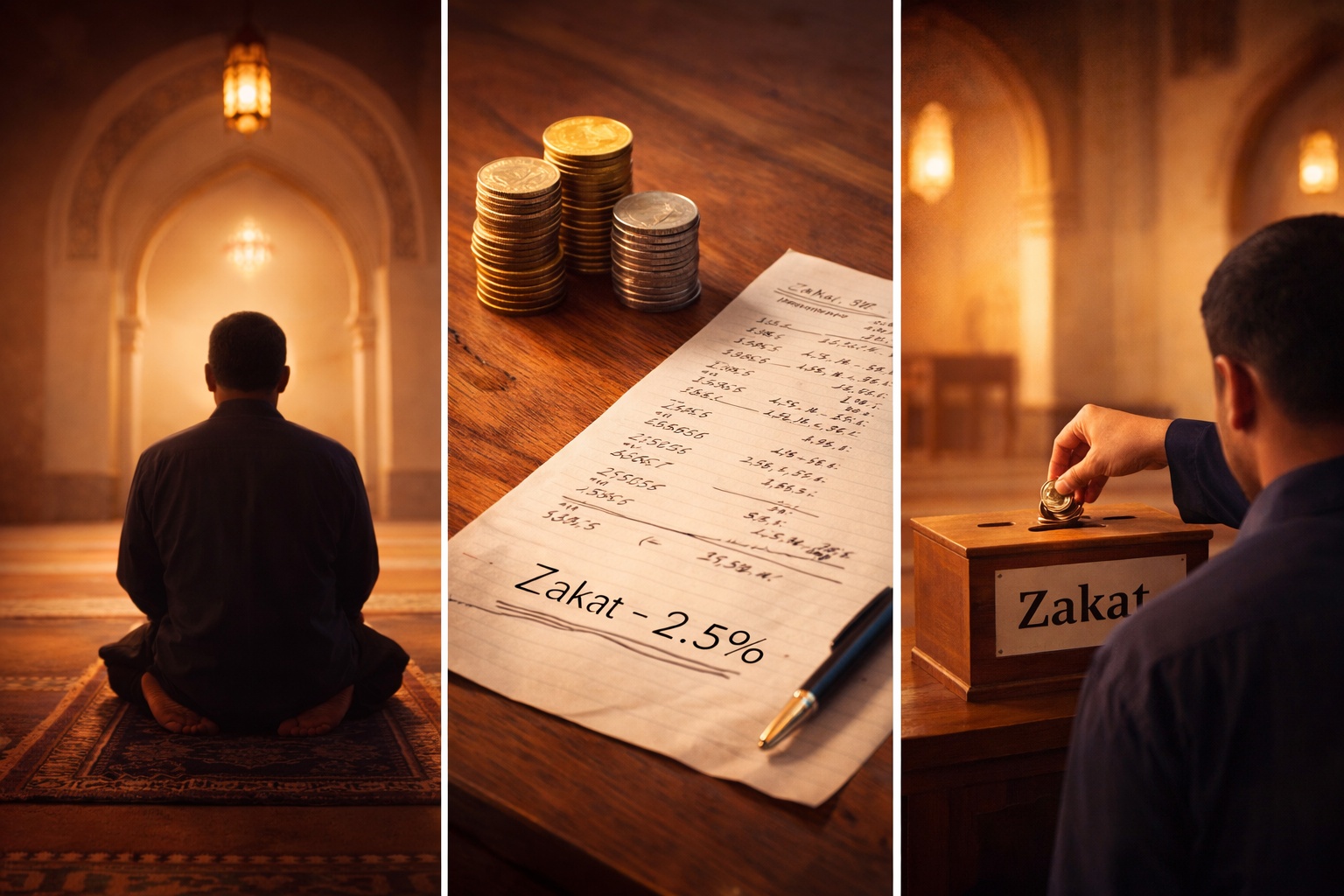
Zakah is often described as a financial obligation. Yet in reality, it is one of Islam’s most profound acts of spiritual discipline, shaping how believers understand wealth, responsibility, and trust in Allah  .
.
Allah says in the Qur’an:
“Take, [O, Muhammad], from their wealth a charity by which you purify them and cause them increase, and invoke [ Allah’s blessings] upon them. Indeed, your invocations are reassurance for them. And Allah is Hearing and Knowing.” [Surah At-Tawbah 9:103]
Keep supporting MuslimMatters for the sake of Allah
Alhamdulillah, we're at over 850 supporters. Help us get to 900 supporters this month. All it takes is a small gift from a reader like you to keep us going, for just $2 / month.
The Prophet (SAW) has taught us the best of deeds are those that done consistently, even if they are small. Click here to support MuslimMatters with a monthly donation of $2 per month. Set it and collect blessings from Allah (swt) for the khayr you're supporting without thinking about it.
The Prophet ﷺ also reminded us:
“Charity does not decrease wealth.”[Sahīh Muslim]
Zakah is often reduced to a number.
2.5%.
A calculation entered into a spreadsheet.
A reminder set in a calendar.
A transfer made before a deadline.
For many of us, this is where our relationship with zakah begins, and sometimes where it quietly ends. We fulfil it because it is the third of the five pillars of Islam, and because we do not wish to fall short. And while obedience is never small in the sight of Allah , zakah was never meant to be confined to arithmetic alone.
Zakah purifies wealth, but more importantly, it purifies the heart that holds it.
This is why the Qur’an speaks of zakah not merely as charity, but as purification.
In the Qur’an, Allah repeatedly pairs prayer with zakah, reminding us that worship is not confined to private devotion. How we handle our wealth reflects our imaan. What we release for the sake of Allah says as much about us as what we guard.
Understanding Nisab and Calculating Zakah
Zakah becomes legally obligatory when a Muslim’s wealth reaches the nisab – the minimum threshold, and a full lunar year passes while it remains above that amount. At that point, 2.5% of qualifying savings and assets become due.1Zakat calculator | Islamic Relief UK 2How to calculate the Zakat – IslamQA
Classical jurists derived the nisab from Prophetic guidance that fixed the threshold at twenty dinars of gold or two hundred dirhams of silver. In contemporary terms, scholars approximate this as about3Zakat Nisab – IslamQA :
- 87.48 grams of gold
- 612.36 grams of silver
In the Hanafī madhhab, the value of silver is typically used to determine the nisab threshold and eligibility for zakah. The other schools of law generally calculate the nisab based on the value of gold.

Because the value of these metals fluctuates, the monetary value of the nisab changes throughout the year.4Nisab Value – What is Nisab? – Zakat and Nisab | Islamic Relief UK When a person’s qualifying wealth reaches this threshold and remains above it for a lunar year, zakah becomes obligatory.
This ruling applies equally to men and women. Islam recognises each legally responsible Muslim as financially accountable before Allah . In the Hanafi school, zakah is obligatory upon a Muslim who is legally responsible (sane and mature) and possesses wealth above the nisab. In some other schools of law, zakah may also be due on the wealth of minors if it reaches the nisab, with a guardian responsible for paying it on their behalf. This diversity of interpretation reflects the careful legal reasoning developed by scholars across the Islamic tradition. Zakah, therefore, is tied not to gender or status but to ownership and responsibility.
Wealth may be visible or quiet: savings accumulated over time, gold received as gifts, inheritance, investments, business income. Yet Islam counts what we own, not how publicly we hold it.
Zakah generally applies to liquid wealth: savings, cash, investments, business assets, and, according to many scholars, gold and silver. Everyday essentials such as clothing, furniture, mobile phones, electronic devices or the home one lives in are not subject to zakah. If one’s wealth does not reach the nisab, zakah is not due. The law of Allah is not burdensome; it is measured, precise, and merciful.
There are also scholarly differences, particularly regarding jewellery. In the Hanafi school, gold and silver jewellery, even when worn, are considered zakatable if they reach the nisab5How does a Wife Who Has No Source of Income Pay Zakat on Her Jewellery?. Other schools generally regard personal jewellery intended for regular use as exempt.6 Zakat on jewellery | Islamic Relief UK Does One pay Zakat on Gold Jewelry? – IslamQA
What matters most, is following sound and reliable knowledge with consistency rather than anxiety.
The Inner Meaning of Zakah
Beyond the rulings lies something deeper.
Zakah is not generosity; it is a right of those whom Allah names in the Qur’an: the poor, the indebted, the vulnerable, those striving in His cause.7Qur’an 9:60 (Sūrat al-Tawbah). It is not about rescuing others; it is about restoring balance. It acknowledges that wealth circulates by Allah’s Decree and that some of what we hold belongs, by right, to others.
Allah says:
“And in their wealth there is a known right,
for the one who asks and the one deprived.” [Surah Al-Ma’arij 70:24–25)
Letting go of 2.5% can still feel difficult. In a world that teaches us to prepare for every uncertainty, releasing wealth requires trust. Zakah gently disrupts the illusion of control. It reminds us that security does not lie in accumulation, but in reliance upon the Provider.
Even its structure contains mercy. If wealth drops below the nisab during the year, the zakah year resets. If it remains above the threshold, zakah is due only on what one owns at the end of the lunar year. Precision replaces panic.
It is also important to distinguish between zakah and sadaqah. Zakah is fixed, obligatory, and rights-based. Sadaqah is voluntary and expansive.8Difference between Zakat and Sadaqah | Islamic Relief UK One cannot replace the other. Together, they cultivate a heart that gives with discipline and compassion.
From Calculation to Consciousness
There is barakah in intentionality.
Zakah given mechanically fulfils a duty. Zakah given consciously softens the heart. Before transferring the amount, pause. Name it for what it is: worship. Gratitude. A recognition that what you hold is a trust from Allah
.
Ultimately, zakah is an invitation – an invitation to align faith with finances and devotion with justice. It teaches that spirituality is not abstract. It lives in quiet calculations made for the sake of Allah .
Perhaps this is the deeper secret of zakah: it loosens the heart before it lightens the account. It teaches us to release without fear and to trust the One who promises that nothing given in His cause is ever lost.
When a believer gives zakah with awareness, they affirm that provision comes from Allah , that dignity belongs to every member of the ummah, and that nothing given sincerely for His sake is ever lost.
As the Qur’an reminds us:
“Say, “Indeed, my Lord extends provision for whom He wills of His servants and restricts [it] for him. But whatever thing you spend [in His cause] – He will compensate it; and He is the best of providers.“ [Surah Saba 34:39]
Related:
– Keep Zakat Sacred: A Right Of The Poor, Not A Political Tool
Keep supporting MuslimMatters for the sake of Allah
Alhamdulillah, we're at over 850 supporters. Help us get to 900 supporters this month. All it takes is a small gift from a reader like you to keep us going, for just $2 / month.
The Prophet (SAW) has taught us the best of deeds are those that done consistently, even if they are small. Click here to support MuslimMatters with a monthly donation of $2 per month. Set it and collect blessings from Allah (swt) for the khayr you're supporting without thinking about it.




[Podcast] 50k Mahr, Hiding Money, & Who Pays for the Wedding? | AML Finance

What the Makkah Agreement is Missing

Far Away [Part 26] – Shaytan Is A Liar

From a Syrian Prison to the UN: The Case of Bilal Abdul Kareem

The Muslim Book Awards 2026
Far Away [Part 26] – Shaytan Is A Liar
Far Away [Part 25] – To Save A Prince
Far Away [Part 24] – The Whipping

When The Bed Walked Away [Part 2] – Primordial Muck
When The Bed Walked Away [Part 1]

The Best Actions for Eid al-Adha [Imam Dawud Walid]

Coming Full Circle: Who Are You Now? | Night 30 with the Qur’an

Running Away From Who We Are | Night 29 with the Qur’an

Building From the Ground Up: Week 4 Recap | Night 28 with the Qur’an


