
#Culture
Far Away [Part 13] – Brotherhood Under A Bridge
Alone in Deep Harbor, Darius struggles to survive, finding brotherhood beneath a bridge and fearsome purpose in the sword on his back.

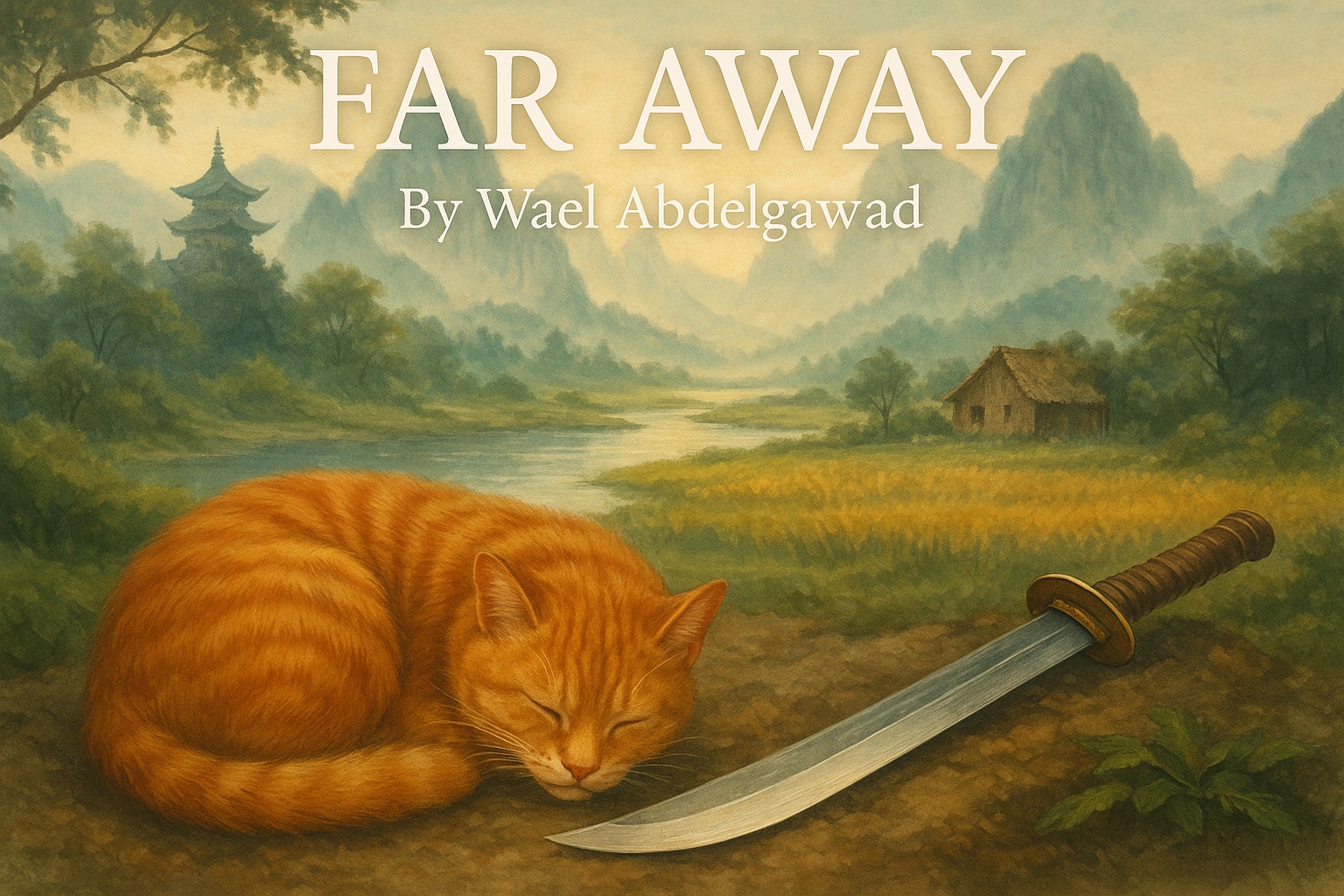
Alone in Deep Harbor, Darius struggles to survive, finding brotherhood beneath a bridge and fearsome purpose in the sword on his back.
Read Part 1 | Part 2 | Part 3 | Part 4 | Part 5 | Part 6 | Part 7 | Part 8 | Part 9 | Part 10 | Part 11 | Part 12
* * *
Many Kinds of Scams
Keep supporting MuslimMatters for the sake of Allah
Alhamdulillah, we're at over 850 supporters. Help us get to 900 supporters this month. All it takes is a small gift from a reader like you to keep us going, for just $2 / month.
The Prophet (SAW) has taught us the best of deeds are those that done consistently, even if they are small. Click here to support MuslimMatters with a monthly donation of $2 per month. Set it and collect blessings from Allah (swt) for the khayr you're supporting without thinking about it.
I stood staring at the two gold bracelets in my hand. Improbably, and even to my own surprise, a smile broke out on my face, and I laughed out loud. In retrospect, it was the worst thing I could have done.
“You find this funny?” my uncle demanded.
I turned to Zihan Ma, whose face was red with anger. “No, subhanAllah. It’s just ridiculous. I’ve never seen these before in my life. Someone put them in my pack.”
“Who would have done that?” Master Chen sneered. “You are the only thief here.” He turned to my aunt Jade. “This is your fault, for bringing this delinquent into your home, and then into mine. If anything else turns up missing, I hold you responsible.”
My eyes flicked from one person to another. Lee Ayi had gone pale. Haaris was frowning. The elderly servant stood behind his master, back erect, stock still. But Nai Nai’s eyes were on her husband, and there was a troubled, questioning look in her eyes.
I put it all together in an instant. My father was indeed a thief, and as I mentioned he had taught me the intricacies of many kinds of scams.
Lee Ayi was stammering an apology to her father-in-law. I stood up straight and interrupted. Inclining my head to the elderly servant, I said, “He did it.”
The servant did not respond, but his body stiffened. Master Chen’s chest puffed up and his eyes narrowed. “Just like a gutter rat,” he said, “To blame a poor, elderly servant who cannot defend himself.”
“Darius, be quiet!” Zihan Ma snapped.
“I will not be quiet. I recognize a scam when I see one. The elderly gentleman placed the bracelets in my bag when they were in his care, most likely at Master Chen’s command. Then, when we were about to leave, the gentleman whispered in Master Chen’s ear, remember? That was to tell him that the deed was done.”
Chen’s chest puffed up as his eyes narrowed. “How dare you,” he snarled. “You piece of street trash. I should have you arrested and flogged.” He turned to Zihan Ma. “You should probably unwrap those other items. Most likely he stole those as well.”
“What do you say to that?” Zihan Ma asked me.
The absurdity of this situation was no longer funny. My face and hands felt heavy, and my heart felt too large and filled with a reservoir of sadness.
“They are gifts,” I sighed. “For you, Lee Ayi and Haaris. I bought them in the marketplace.”
“A street rat buying gifts,” Chen sneered.
“I used the gold coins from my father’s enlistment and salary. I swear it in the name of Allah, and He is my witness.” I put the gold bracelets on a small table. “Whoever is telling the truth, may Allah support him and give him strength. And whoever is lying, may Allah expose him.” I put my belongings and the gifts back in my pack, and slipped the strap over my shoulders. As I did so, Zihan Ma bowed deeply to Master Chen, apologizing, and thanking him for not calling the constables.
Take Care of Far Away
I walked out. Outside the villa, in the street, I waited for my so-called family. I might have walked away, except that my dao was in the wagon, and I did not know the way back to the stable yard.
Walking back to the wagon, no one spoke. I felt as cold and rough inside as the great river that coursed uncaring through this city. Zihan Ma, the man I had almost come to think of as a second father – the man who was my rescuer and teacher – thought I was a lying thief. Or if he did not think so, he had doubts. I was fairly sure that Haaris believed me, and I had no idea what Lee Ayi thought. What a fool to think that a ruffian like myself could be accepted by respectable people. What had Chen called me? A street rat? Maybe that was what I was, and maybe that was what I should be.
When we reached the wagon, I was deeply relieved to find my dao where I had left it, wrapped and hidden beneath a blanket. I strapped it to my back. As the others mounted the wagon, I opened my pack and took the gifts out. Still wrapped, I handed Haaris his gift. “So you don’t have to whistle through leaves anymore,” I said.
As Zihan Ma took his wrapped gift, I said, “A fine needle for a fine healer.”
I handed Lee Ayi the beautiful little comb. “For your lovely hair, Auntie. Also, Lee Ayi, I have a request. Please take care of Far Away. Don’t let him wander off. Be kind to him. Promise me.”
She frowned. “What are you talking about? I always take good care of him. Who do you think feeds him when you are out in the fields?”
I nodded. “Yes, you’re right. It’s just… I couldn’t bear it if anything happened to him.”
“Darius,” Zihan Ma said testily. “Don’t be dramatic. Get in the wagon so we can get home before midnight.”
I drew a shaky breath and shrugged. “I’m not coming. I will say goodbye now. I thank you all for everything you did for me. Allah give you barakah.” I turned and walked away.
I heard footsteps behind me and turned to see all three of them hurrying after me.
Haaris grabbed my sleeve. “Stop! What are you doing?” He began to cry. “You can’t leave, you’re my brother. Who will play games with me?”
His tears scalded my heart, making me feel deeply guilty; but my own hurt and anger were greater. “I can’t stay,” I explained. “Your father thinks I am a liar and a thief. How can I live in a house where people think of me that way?”
“No, he doesn’t!” Haaris protested. “Tell him, Baba.”
Everyone turned to Zihan Ma. “I don’t know what to think,” he said. “The situation is confusing.”
I took Lee Ayi’s hand and kissed it. “Remember your promise. Take care of Far Away.” Once again I turned and strode quickly away, and this time no one followed me. Haaris sobbed, and Lee Ayi called my name, but I did not stop, and soon I was gone, lost in the chaos, noise and crowds of late afternoon in Deep Harbor.
The Meaning of Brotherhood
The time passed in a blur.
I survived because Deep Harbor was a city that consumed labor endlessly. Barges arrived day and night carrying grain, timber, iron, salt fish and refugees. Crates had to be unloaded. Wagons had to be pushed through muddy streets. Messages had to be carried from warehouse to warehouse.
No one cared who I was as long as I worked hard and did not complain.
At dawn I joined laborers at the docks, standing among wiry old men, refugees and orphan boys waiting to be chosen for work. Some days I hauled crates from barges until my shoulders burned and my palms bled. Other days I carried sacks of rice through the market district or delivered bundles of cloth and letters for merchants.
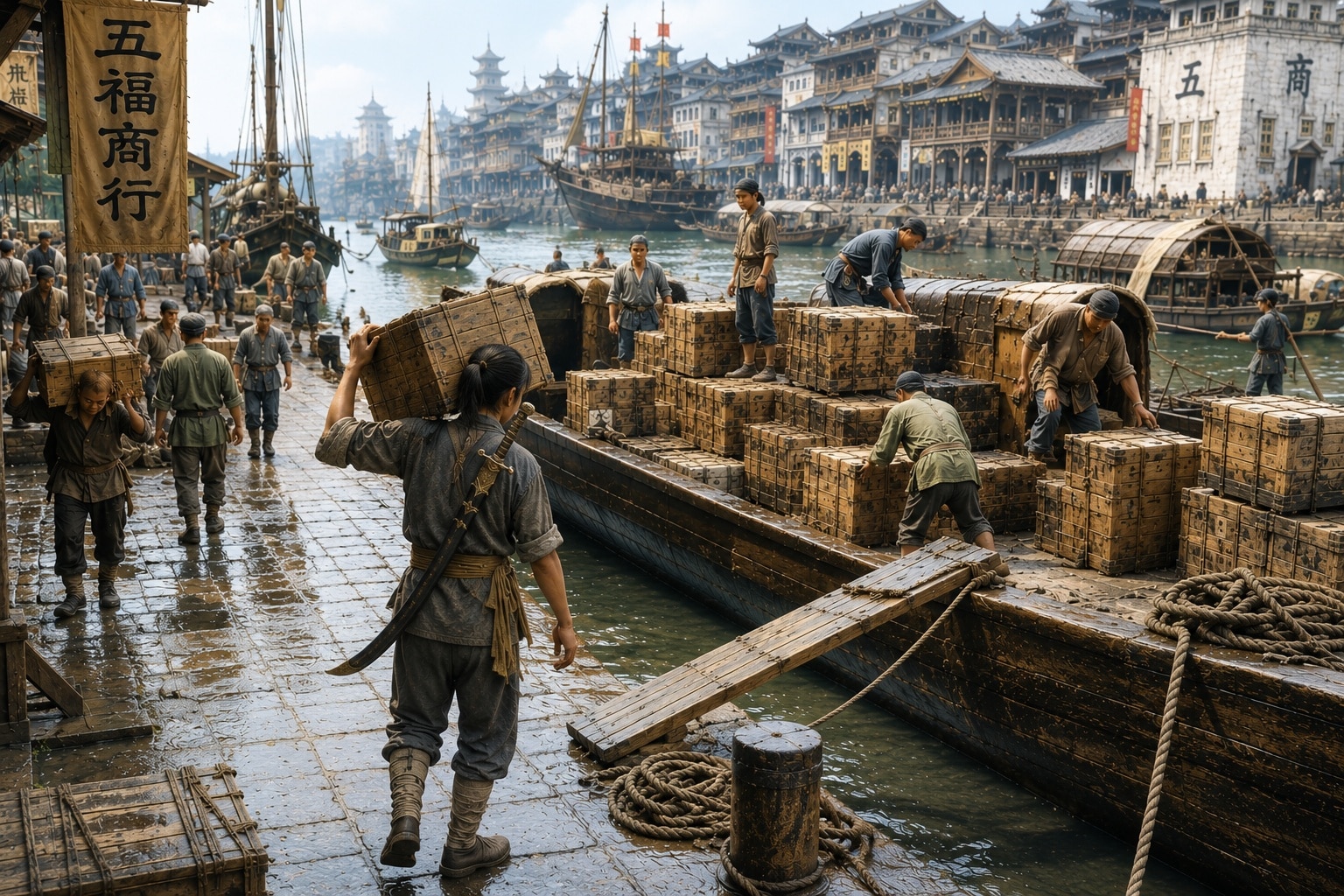
The riverfront never slept.
Even late at night lanterns swung above the water as men shouted from boats and ropes creaked against wooden posts. The smell of Deep Harbor became familiar to me: mud, fish, smoke, wet wood, sewage and spices.
I still had four gold coins remaining from my father’s wages, but I kept them well hidden, always on my person, and did not spend them. With my earnings I bought a thick wool coat from a secondhand stall near the docks. It smelled faintly of mildew and another man’s sweat, but it was warm. I also bought a blanket stuffed with cheap cotton batting. During storms I rented a narrow room at the cheapest inn I could find, sleeping on a straw mat while drunk sailors argued downstairs, but most nights I stayed beneath one of the stone bridges spanning the river channels.
There were dozens of people living there already. Old beggars. Crippled veterans. Widows with children. Men who drank themselves insensible every evening. Some ignored me entirely. Others watched me with the cautious curiosity reserved for newcomers. Still others called the adhaan, formed ranks and prayed there beneath the bridges. When I saw that, I joined them, and for a few moments were not a ragtag group of discards and laborers, but a unified brotherhood, standing together under the most impoverished of circumstances. If a man needed a coat, a Muslim brother would give it. If a woman was hungry, another would share. I learned much about the meaning of brotherhood and sisterhood on those streets and beneath that bridge. It was not a concept. It was a reality that saved lives and warmed the heart on freezing nights.
Trouble
There were also those who wanted to exploit, hurt and steal.
The first trouble came only three nights after I began sleeping beneath the bridge. I was returning from the masjid after the evening halaqah when two older boys stepped out from behind a stack of wooden pallets near the river stairs. One was broad shouldered and missing several teeth. The other carried a brass pipe like a club.
“That’s a fine sword,” the taller one said, nodding toward the dao on my back. “Too fine for a little country boy.”
“It was my father’s,” I replied. “Leave it alone.”
The shorter boy smirked. “Maybe we’ll hold onto it for you.”
He reached for the hilt.
I caught his wrist and twisted sharply. He yelped and bent forward, and I struck the elbow hard with my forearm, shattering it. The boy screamed. Before the other boy could swing the pipe I kicked his knee sideways and drove my elbow into his jaw. He stumbled backward into the pallets, cursing.
The first boy was down and not getting up, but the second one untangled himself from the pallets and rushed me wildly. I sidestepped, seized the back of his coat and hurled him face first into the stone stairs.
As they rolled on the ground in pain, I walked away. I genuinely hoped they would be able to get medical care, the first one in particular, or he would lose that arm. But they would have to find someone else to help them.
The second attack was worse. One night three full-grown men cornered me in an alley beside the fish market. They smelled of wine and river mud. One grabbed my coat sleeve while another demanded my money.
I warned them once, but they only laughed.
The first man lunged for my pack. I drew my dao and cut him across the face so quickly that for a moment he did not understand he had been wounded. The second man came at me with a knife. I stepped aside and chopped downward instinctively.
His arm fell into the mud beside him.
The screaming that followed drew people from nearby alleys and doorways. By the time constables arrived the attackers had dragged the wounded man away themselves.
After that the stories spread, and people began giving me space in the streets. I heard whispers sometimes as I passed:
“The boy with the sword.”
“The farm boy.”
“The one who cut a man’s arm off.”
“The bridge boy.”
“The bridge killer.”
I hated hearing it. Yet at the same time another part of me felt grim satisfaction. Let them fear me. Fear kept people alive.
Figs and Halaqas
Every evening, no matter how tired I was, I went to the great masjid for Maghreb prayer. The warmth there steadied me.
Sometimes I helped sweep the floors afterward or carried water buckets for the old caretaker. Sometimes he gave me figs. After prayer I remained sitting among the worshippers for the Quran taleems and Islamic halaqahs. Scholars, merchants and travelers gathered in circles beneath the lantern light while teachers spoke of fiqh, hadith, tafsir and purification of the heart.
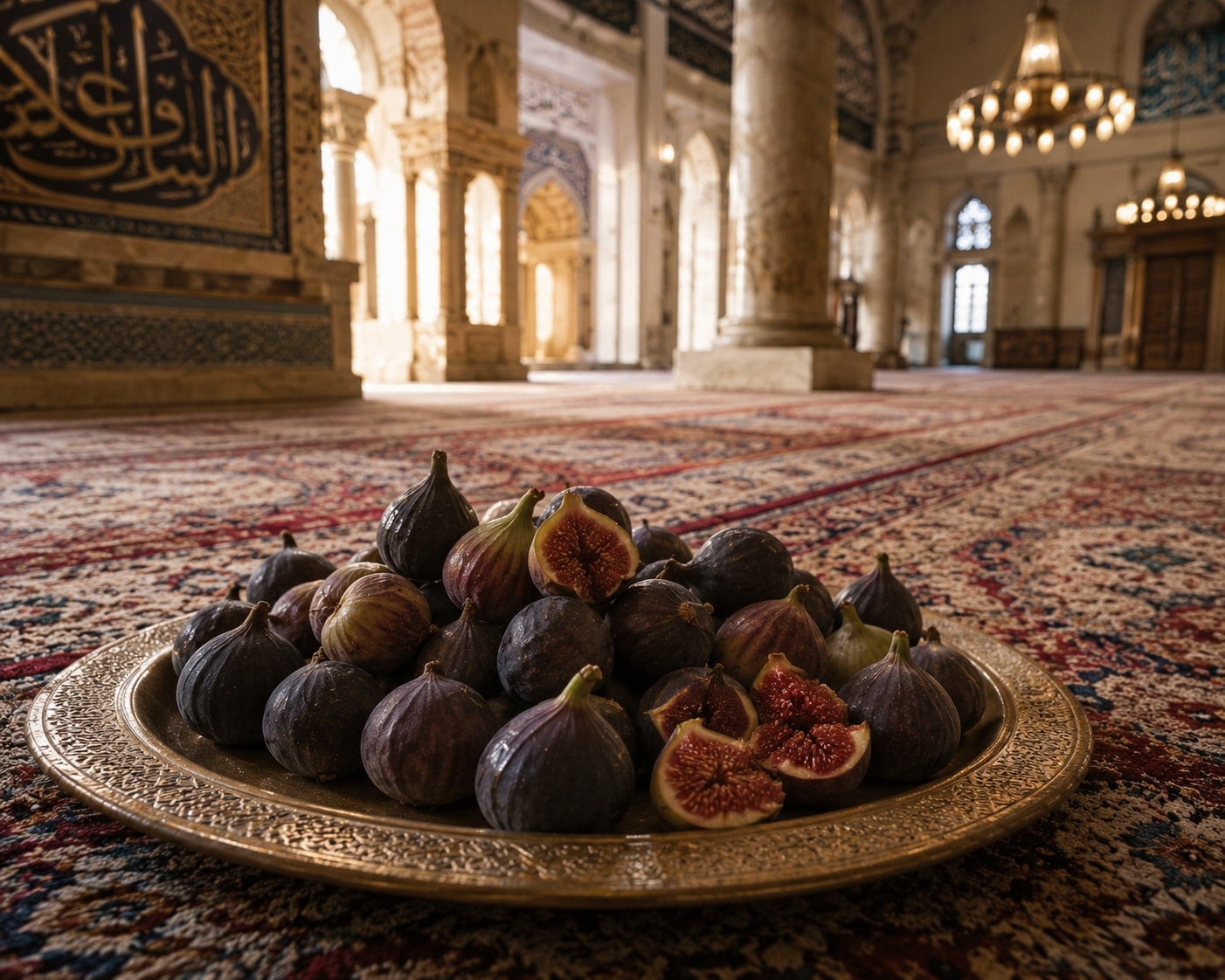
Often I did not fully understand what was being discussed, but I clung to it anyway. I no longer knew who I was supposed to become. Was I a healer? A fighter? A thief’s son? A farm apprentice? A wandering street worker and fighter? A refugee? I did not know. But I knew I was Muslim. No one could take that from me. When I bowed beside the other worshippers, shoulder to shoulder, rich and poor alike, I felt human again.
At night I lay wrapped in my blanket beneath the bridge listening to the river move through the darkness. Ships passed sometimes, their lanterns glowing faintly through the mist while water slapped softly against their hulls.
Those were the hardest hours, for that was when I thought of home. Not my father’s ruined farm. The other home.
I thought of Haaris laughing as we worked in the fields. Lee Ayi humming while she cooked. Zihan Ma bent over a patient with calm concentration. Bao Bao sprawled arrogantly in the sunlight. Far Away sleeping against my side.
More than once I rose before dawn with the idea of walking south to the farm. I imagined hiding in the darkness outside the house just to glimpse the warm lantern light through the shutters. Perhaps I would see Haaris reading. Or Lee Ayi preparing breakfast. Or Far Away sitting in the window. I wanted it so badly that my chest hurt.
But I never went. I knew what would happen if I did. Either they would welcome me back, and I would spend the rest of my life wondering whether Zihan Ma still doubted me, or worse, they would not welcome me at all.
A Familiar Face
Once, a few months since my parting from my family – for I still thought of the that way, I couldn’t help it – I was on my way to the grand masjid for Jum’ah prayer, and as I approached I saw Zihan Ma standing near the entrance to the masjid, watching as the people entered. I pulled back, and watched from behind a parked wagon. What was he doing here? A business trip maybe, selling safflowers? Buying goods for the farm? A visit to Nai Nai? Was he alone?
Tears came to my eyes and I wiped them away angrily. Stupid, Darius! I was not a little child who needed his daddy. Nor was he my father. I didn’t want to see him. There was nothing to say. He thought I was a thief; let him think as he pleased. I walked away and attended Jum’ah at one of the smaller masjids.
The months passed, and Deep Harbor slowly ceased to feel temporary.
The city did not soften, but I learned its rhythms. I learned which dock foremen cheated laborers and which paid honestly. I learned where to buy hot buns cheaply before dawn, and which alleys to avoid after dark. The tides of the river and the moods of the waterfront became familiar to me. Refugees continued to pour into the city. Soldiers marched through the streets regularly. Sometimes funeral processions passed with no mourners except exhausted wives and silent children.
I survived. Aside from my dao, I now also carried a dagger on my left hip, and in my pocket I kept a small cylinder of brass that I could use to strike someone in the face if I just wanted to hurt them without wounding them. I wore sturdy boots, and tied my long hair back – I had not cut it in ages – in a ponytail. Everyone on the street knew me, and no one bothered me.
The Tournament Notice
One afternoon, while delivering a crate of dried tea bricks to a warehouse near the eastern market, I noticed a crowd gathered around a large wooden platform draped in red banners. Musicians played flutes and drums while young men demonstrated spear forms and wrestling techniques before cheering spectators.
A notice hung beside the stage announcing a martial tournament to be held three days later.
Open sparring!
Archery!
Weapons demonstrations!
The competition was sponsored by the Five Stars Trading Company. The winners, the notice said, would be given prize money, and the opportunity to interview for jobs as caravan guards.
Five Stars Trading Company belonged to the Shah family. My mother’s family. I stood reading the notice for a long time. Finally I approached a man sitting at a table with a registry book. He was thin, and wore a shirt with a high white collar, and round spectacles with bamboo frames. His thin gray mustache looked painted on.
“I want to sign up,” I said. “Weapons demonstration.”
Without looking up, he said, “School and sifu?”
“What do you mean?”
Now he gave me an annoyed look. “What martial arts school do you attend? Who is your sifu?”
“I don’t attend any school. I work at the docks and other places.”
The man tut-tutted. “Get lost. This is a competition for real wushu artists, not ruffians.”
My shoulders stiffened. “Do you have a supervisor here?”
The man glared at me incredulously. His moustache somehow curled upward, looking like an odd smile, and this made me want to laugh.
“Boss!” the clerk called out.
A tall man in an expensive suit broke away from watching the demonstrations, and came to the table. He was in his late twenties perhaps, pampered and soft looking, but with a hardness to his eyes that reminded me of the thousand year old stones from which the bridges were made. Those bridges had survived war, famine and revolution.
“This dock worker punk,” the clerk said, “doesn’t have a school or sifu.”
“Hello,” the man said. “My name is Shah Suliman. I am sorry, but we have rules.”
I knew this man. Lee Ayi had told me about my relatives on my mother’s side. My uncle – my mother’s older brother – was Shah Amir. This man was his son. He was my cousin.
The thought of lying never entered my mind. Wasn’t that what Master Chen had accused me of? Wasn’t I a Muslim now? Whatever else I was, I must hold fast to that.
“I am Darius Lee,” I said firmly. “Son of Yong Lee and Shah Nur, daughter of Shah Zheng. I have no school, but I am trained in martial arts. My sifu was my father. Register my name, please. Either open sparring, weapons, or both.”
Shah Suliman’s face went white. He rocked back as if buffeted by an invisible wind. He swallowed, and his face registered shock, then wonder, then calculation.
“What do you want?” he said at last.
“I told you. To participate in the tournament.”
“That’s all?”
“Well, yeah. I mean, if I win, I want one of those caravan jobs.”
Suliman snorted. He looked me up and down, taking in my dao and dagger. Understanding dawned on his face. “Are you the one they call the bridge killer? The one who chopped off a man’s arm?”
“Yes. But I haven’t killed anyone. People exaggerate.”
“The Yong family had their own martial arts style. What is it?”
“Five Animals.”
He nodded slowly. “Sign him up.” Then he gave me a withering look. “Not that I believe a word you say. I’m giving you an opportunity to embarrass yourself.” With that, he turned his back and went back to watching the performers.
* * *
Come back next week for Part 13 – Five Star
Reader comments and constructive criticism are important to me, so please comment!
See the Story Index for Wael Abdelgawad’s other stories on this website.

Wael Abdelgawad’s novels – including Pieces of a Dream, The Repeaters and Zaid Karim Private Investigator – are available in ebook and print form on his author page at Amazon.com.
Related:
Keep supporting MuslimMatters for the sake of Allah
Alhamdulillah, we're at over 850 supporters. Help us get to 900 supporters this month. All it takes is a small gift from a reader like you to keep us going, for just $2 / month.
The Prophet (SAW) has taught us the best of deeds are those that done consistently, even if they are small. Click here to support MuslimMatters with a monthly donation of $2 per month. Set it and collect blessings from Allah (swt) for the khayr you're supporting without thinking about it.




Far Away [Part 13] – Brotherhood Under A Bridge

Not Everyone Goes To Hajj…But Everyone Is Called: Gaza, Gratitude, And Dhul Hijjah
Far Away [Part 12] – Accused

From The MuslimMatters Bookshelf: Puberty Books For Girls

From The Chaplain’s Desk: From Madinah To Our Campuses, Reviving A Quran-Centered Culture

Op-Ed: Javed Ghamidi And The Theology Of Managed Defeat

Why Liberation Is Sexual(ized) – The Forces Driving The Unquenchable Thirst To Emancipate Muslim Women

[Podcast] Can the Golden Age of Islam Save Us? | Sh Abdullah Mullanee

Daughter Of Which Nation? The Persecution Of Asiya Andrabi And India’s Crackdown On Muslims

Beyond Representation: Reclaiming Spiritual Storytelling For Muslim Children

Coming Full Circle: Who Are You Now? | Night 30 with the Qur’an

Running Away From Who We Are | Night 29 with the Qur’an

Building From the Ground Up: Week 4 Recap | Night 28 with the Qur’an

The Muslim You Are Becoming | Night 27 with the Qur’an

What Will You Leave Behind? Legacy in Islam | Night 25 with the Qur’an
-

 #Current Affairs2 weeks ago
Op-Ed: Javed Ghamidi And The Theology Of Managed Defeat
-
#Culture1 month ago
The Boycott: A Simulation Of The Valley Of Shib Abi Talib
-
#Current Affairs3 weeks ago
Why Liberation Is Sexual(ized) – The Forces Driving The Unquenchable Thirst To Emancipate Muslim Women
-
#Culture1 month ago
Muslim Capitalism And The Rise of Tech And VC Culture: Are We Going Down The Technological Lizard Hole?


