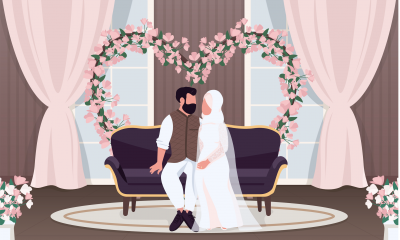
After over 18 months of being married by nikaḥ kitÄba, today marks the day my wife and I will be having our “ruksathi” wedding party after which will begin to live our lives together forever, inshaAllah. After a wonderful year and a half of a beautiful relationship Allah blessed us with, we came up with what we feel is an essential survival guide for couples undergoing the same journey we just completed. If you are married by nikÄḥ kitÄba or will be in the future, then this list is for you.
I don’t necessarily agree with the idea that there are too few good Muslim men; at least in relation to the numbers of good Muslim women. In this case, “good” refers to those who have an appreciation of the deen, but also know how to function in dunya, without resorting to the haram. Most of the guys I have met through the rishta scene (i.e., those I was introduced to via my parents) have been decent chaps, masha’Allah. I have very few (if any) horror stories to share, alhamdulillah. However, I do agree with the idea that for some reason, educated Muslim women are finding it hard to find a suitable match.
The Toronto Star has had a flurry of articles recently regarding polygamy in the Muslim community. The environment that we live in is one that is marred by misrepresentation of Muslims, especially in national media. While many hope that we will have more Muslims involved in fields such as journalism to help combat this, it does not help when Muslims write about Muslim issues that can be construed to contributing to the problem instead of the solution.
Many practicing Muslims on the verge of having a wedding party find themselves struggling with how to set up the big day. They don’t want it fully mixed between genders, but should the party be fully be separated with a partition? Or is just segregated the seating on different sides okay?
The following article, from www.themuslimhousewife.com, touches on this issue with a very eye opening personal story (and a cameo by Shaykh Yasir Qadhi!).
In my career as an instructor of “Fiqh of Love” and “Love Notes” with AlMaghrib Institute, the activity and survey sessions conducted in the class environment included many personal questions submitted by students (both men and women), regarding marriage and marital life. Through this, and the overwhelming marriage counseling sessions and advices given in the course of the past four to five years, I was able to collect enough data and statistics to open a window on the status of social life in the Muslim community in America and provide an insight into the crisis of marriage we face here. The findings com from multiple locations all around the country including places such as Houston, New Jersey, New York, Chicago, The Bay Area and elsewhere – and the results were startling. The marriage crisis is a big crisis indeed, and while many of our respected older generation are unaware of it, or at least act like that, the youth were left helpless and sometimes hopeless.
*Please note that the opinions expressed in this post, like all op-ed pieces on MM, represent the viewpoint of the author, and are not necessarily endorsed by all MM writers*
Here’s a brief summary of a few of Sunday’s TDC talks, from our “reporter in the field”, Ahmad Al Farsi– Sex Ed., Domestic Harmony and Meet the Shayookh (Sh. Yasir
Yasir Qadhi added his bit: I’m writing from the convention center… I’m attending all of the lectures by our dear Shaykh Salah al-Sawi. He is giving an intensive series on
Bountiful, B.C.: The first thing that comes to mind is a recollection of the media frenzy surrounding the ultra-fundamentalist Mormon community, which under their so-called “prophet” Warren Jeffs practices an
AlMaghrib Radio on Demand is back. Thursday, August 30, 2007 7:00pm – 10:00pm (EST) This time with one of AlMaghrib’s newest instructors – Shaykh Riad Ouarzazi (you can see his