
Family and Community
The Penalty Box: Muslim Women’s Prayer Spaces

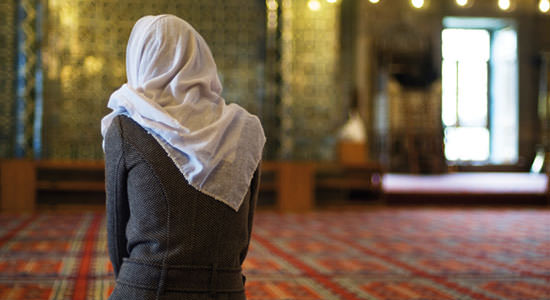
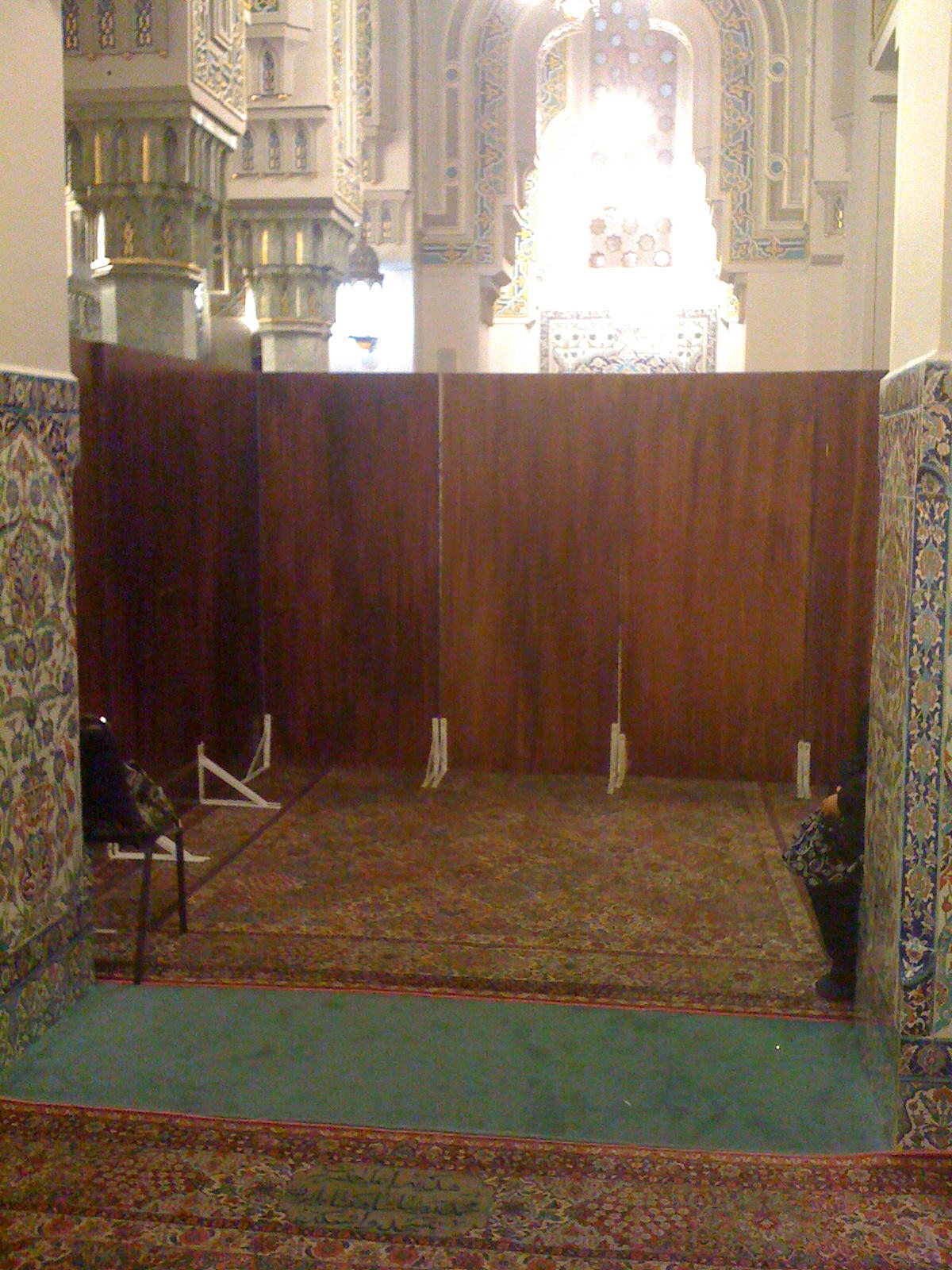 One bitterly cold and windy weekend here in Washington DC, a friend and I decided to visit the U.S. Botanic Garden, which is located indoors. We left the garden shortly before the time for maghrib and decided to head over to a local restaurant to get a bite to eat. On our way, we could tell from the sky that the time for maghrib was near. As I began to wonder where we would pray, I happened to see the iconic minaret of the Islamic Center of Washington, DC just down the road. Alhamdulillah, I thought, we can stop and pray there. In warmer weather I do not mind finding a spot to pray outside, but as this day was particularly cold, I was grateful for the opportunity to pray in a warm masjid.
We parked on the road and as we prepared to walk inside, an older brother of uncle-age turned to eyeball us on his way into the masjid. I reminded him to lower his gaze, and he hurried into the masjid. Despite the cold weather, we walked around the building looking for a separate women’s entrance but could not locate one. Surprised, we entered through the same doorway used by the brothers and up the same narrow shared staircase to the shared shoe racks to the shared entrance to the upper level main prayer room. All this equality and equal access was quite remarkable and rather baffling, particularly 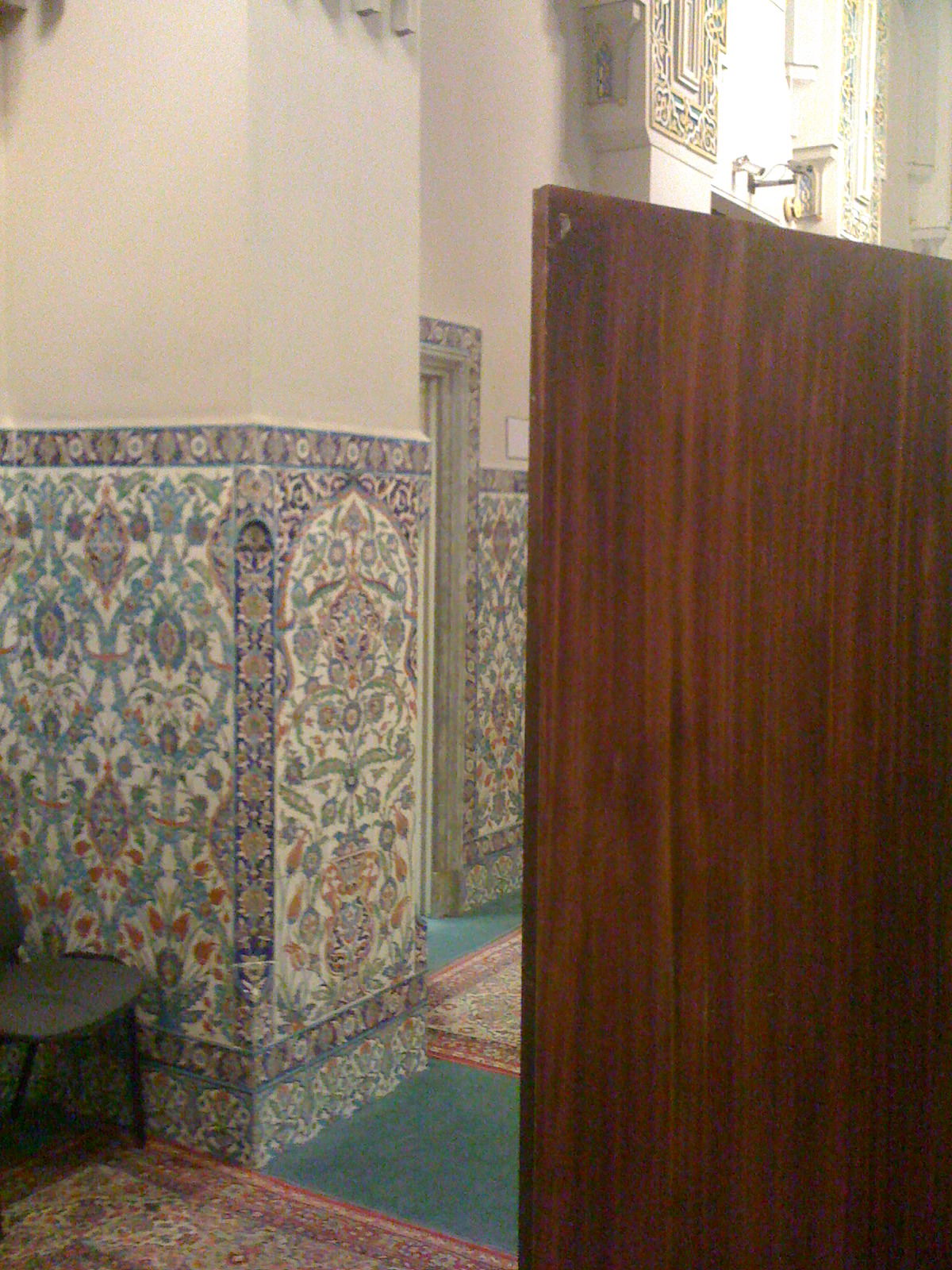 because for Friday prayers, the cramped women’s prayer area is little more than a glorified basement broom closet. In the years since becoming Muslim, I’ve come to expect separate and unequal, if not downright shoddy and dangerous accommodations for sisters in most masajid. My friend asked me where the sisters pray and I told her there is some space blocked off for us in the main hall. She went in to find it but I held back, timid and shy, feeling a nervousness that has developed from my experiences of being a woman that desires to pray in the masjid. She motioned me inside, and we walked over to the area reserved for sisters. We listened to the adhan, and as my friend had never before visited the Islamic Center, she took in the sights of ornately decorated walls and ceilings. We prayed our sunnah and waited for the prayer to begin.
My friend asked me about the right of women to see the imam, a topic we had learned about in the AlMaghrib Divine Link: Fiqh of Salah seminar. She tried rather unsuccessfully to peek through the narrow cracks in the large wooden dividers to gauge whether she would be able to see the imam. I then suggested that we pray in the main section, in the back, behind the men. Not really much cause for fitna as there were barely two rows of men and ample prayer space. She agreed. I must say, I felt somewhat nervous while waiting for the iqamah, our cue to escape from the penalty box/women’s prayer area and enter the main prayer area. I felt for a moment what Asra Nomani must have felt standing alone in her masjid in Morgantown, West Virgina (and I don’t agree with her on most matters), and also what countless women, forced into cramped, crowded, and unseemly prayer spaces in so many, far too many of our communities, feel each time they desire to worship their Lord in the masajid.
Keep supporting MuslimMatters for the sake of Allah
Alhamdulillah, we're at over 850 supporters. Help us get to 900 supporters this month. All it takes is a small gift from a reader like you to keep us going, for just $2 / month.
The Prophet (SAW) has taught us the best of deeds are those that done consistently, even if they are small. Click here to support MuslimMatters with a monthly donation of $2 per month. Set it and collect blessings from Allah (swt) for the khayr you're supporting without thinking about it.
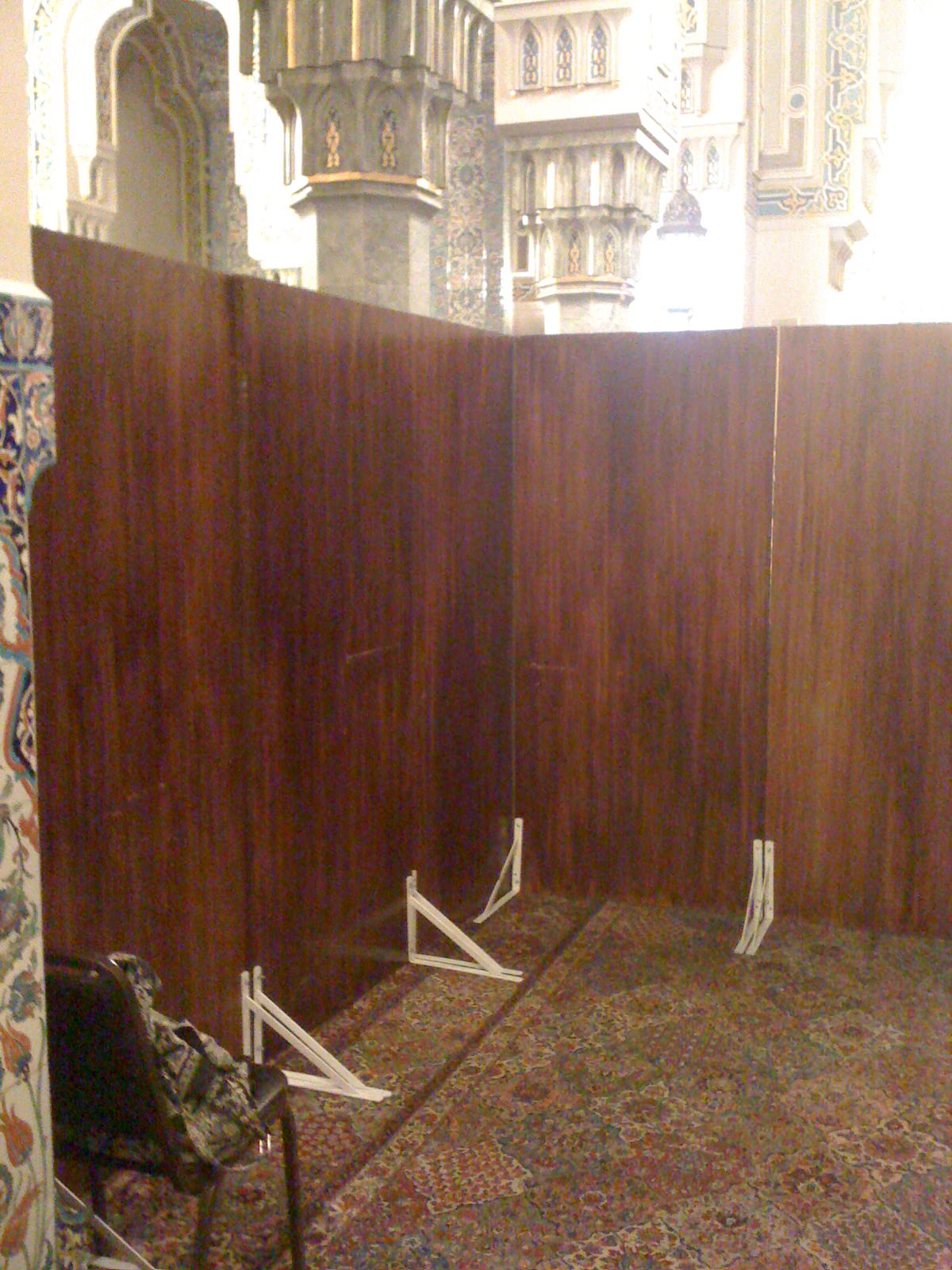 After the iqamah, the scant two rows of men lined up, and we lined up off to the left side toward the back. One easily could have placed a dozen rows of worshippers between us and the men. We did something quite revolutionary, we prayed maghrib salaah in the main room, outside of the penalty box, and then we prayed our sunnah. There were no fireworks, no angry shouts, and most of the brothers left quietly after they prayed. One lone brother just could not resist telling us that the prayer space for women was located inside the penalty box in the back right hand corner of the masjid. When we said that we preferred to pray over here to be able to see the imam, he countered by telling us that the brothers who come late like to pray in the back (as if they could not find any other space to pray in the huge masjid). Seeing that we were unimpressed and unmoved by his feeble arguments and attempts to persuade us, he also left.
My friend then humorously suggested that the area designated for the women would be more rightly utilized as a penalty box for the men who come late to the salah, as a rebuke and punishment.
I’ve been reflecting upon this experience and others, and it occurs to me that I entered into Islam believing that I had found a religion which dignified and validated my existence as a human being. I continue to believe as Jafar ibn Abi Talib said to an-Najashi, that we were a humiliated people before our Islam and within Islam we found our dignity and honor in rejecting false idols and in worshipping God alone.
I’ve spoken to many converts and the same can be said of people born into the faith: we did not leave jahiliyyah in order to be treated poorly and with injustice by our brethren in faith and to remain quiet. We 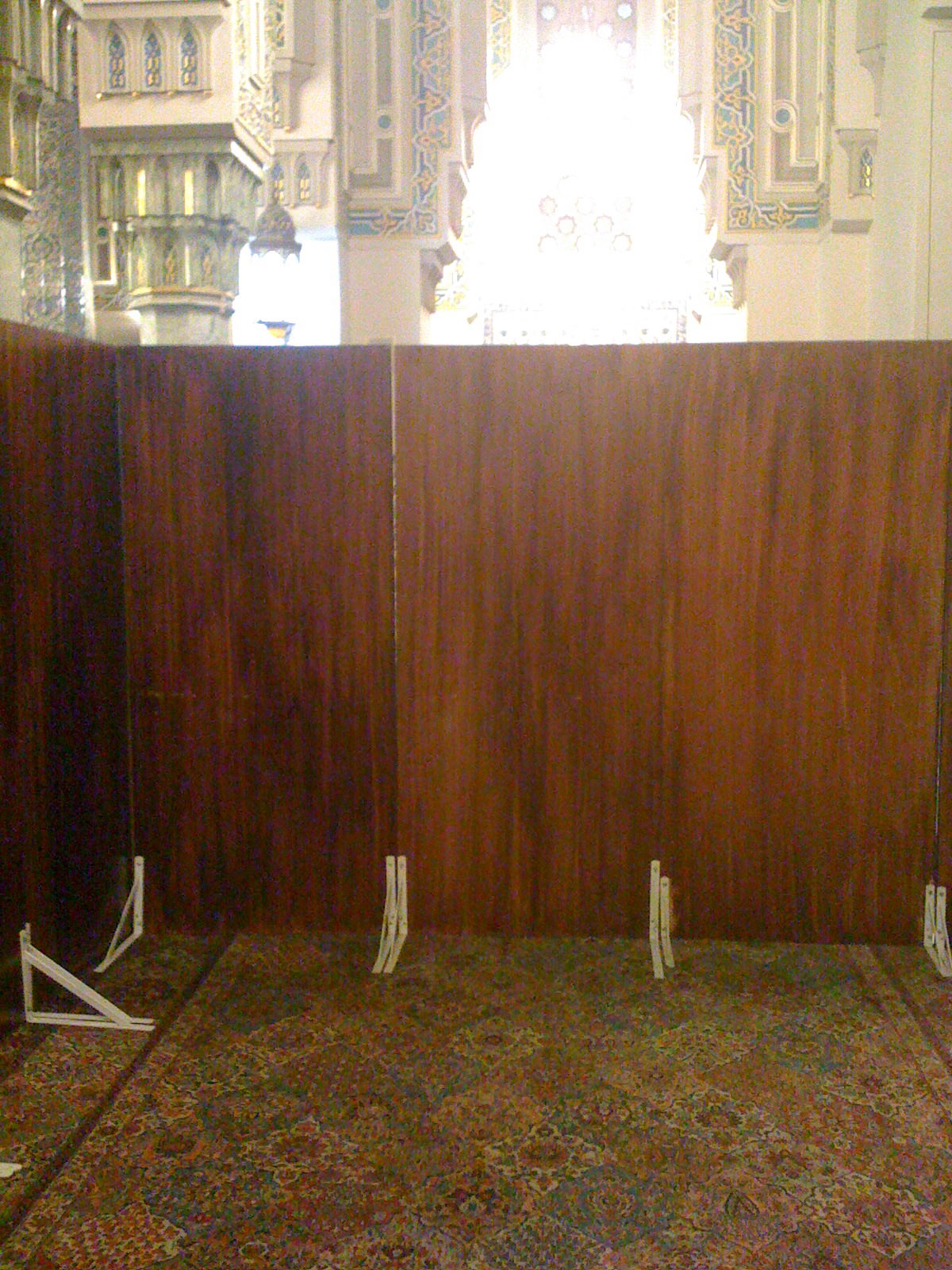 left jahiliyyah and entered into Islam with a statement on our tongues coupled with belief in our hearts and the actions of our limbs. Yet day after day, we are asked to tolerate the injustice and inequity manifested in the poor treatment of women and children in so many of our communities. If we dare to speak up and out against these shameful scenes, we are labeled as being too “Western” or “liberal” or “progressive” or as “feminists” or “sell-outs.” Since when is advocating for universal values and simple common decency “Western”?
In my own local community, I once took it upon myself to ask the shura members of a masjid not for equitable prayer space, nor to pray in the same room, nor even to be able to see the imam; I simply asked that the outside doors on the sisters’ side not be locked and chained shut from the inside, as I had learned in childhood that chains on doors are a dangerous fire hazard. The responses I received were disheartening: most seemed unaware that this serious fire code violation had been a routine practice, and one questioned the perceived “critical” tone of my email. But alhamdulillah, the chains have not been seen on the doors for some time.
 Equally disheartening are the seating arrangements at some AlMaghrib Institute seminars, where brothers are given the front rows closest to the instructor and sisters are given the back rows. Particularly in locations that have upwards of 500 students, being in the back is akin to sitting in the cheap seats atop the USTA’s Arthur Ashe stadium. The irony is that sisters are still charged the same $165 tuition fee for often inferior seat choices and options. It is true that some sisters proudly assert their right and preference to sit in the back and some brothers complain that they will be too distracted by the sight of a sister in a classroom to be able to focus on the material being taught, even though they somehow managed to focus throughout their years of secular education. Yes these may be valid concerns, but why is my right or the right of other sisters that come early to secure a seat in the front, where we feel that we can better focus, not also given the same merit? Why should a disinterested, sprawled out, reclining, and dozing-off brother be given preferential seating over a serious, awake, interested, and motivated sister?
At the most recent AlMaghrib seminar here in Maryland, brothers and sisters prayed in the same barrier-free room and everyone behaved themselves appropriately. I sometimes feel that by placing barriers we not only assume the worst but absolve people from needing to take responsibility for their own actions. How will individuals learn to act appropriately in the presence of the opposite gender outside Islamic bubble environments in the wider barrier-free world? On the last day of the most recent AlMaghrib seminar in Maryland, the instructor asked the students to move down and come closer in order to fill in the gaps in the first rows. So some sisters moved down to the left-hand side of the very first center row which had been occupied by a few brothers on the other end. There were several unoccupied chairs in between them and I hesitated whether or not I (as the ameerah) should ask the sisters to move back a row or two. I decided against it and let them remain in their chosen seats. These are mature adults, both men and women, they paid for the seminar, they desired to sit in the front row closest to the instructor, and I saw no reason to move them as they all acted in an appropriate manner.
But, it’s not compulsory for sisters to attend the masjid; it’s better for them to stay at home and learn from the men-folk when they return. However, the reality is, the men who pray in the masjid are few, and a sister who has striven to come to pray the salah at its proper time in a masjid should not simply be excluded by virtue of her gender, nor should she be forced to pray in sub-standard conditions with her children: conditions which no man with any sense of fairness, let alone a modicum of authentic gheerah, would allow for himself or his family. The reality, particularly in the West, is that the majority of students and volunteers in many Islamic environments are women. If women did not go out and actively seek knowledge, they certainly would not get it from their missing-in-action brothers, fathers, sons, and husbands (assuming their family is Muslim, which is not the case for many converts).
I’ve been contemplating a project to photograph as many women’s prayer spaces as I can in the various masajid I visit and then to publish them on a new photoblog, highlighting the good and shaming the disgraceful ones. In discussions such as these, in which emotions run high and rationale is often thrown to the wind, a picture is often worth more than a thousand words.
From the MM archives:
Ruth Nasrullah: Women and the Wall
Keep supporting MuslimMatters for the sake of Allah
Alhamdulillah, we're at over 850 supporters. Help us get to 900 supporters this month. All it takes is a small gift from a reader like you to keep us going, for just $2 / month.
The Prophet (SAW) has taught us the best of deeds are those that done consistently, even if they are small. Click here to support MuslimMatters with a monthly donation of $2 per month. Set it and collect blessings from Allah (swt) for the khayr you're supporting without thinking about it.








Israel Seeks Escalation For Latitude – The Regional “Conflict” Widens

Post-Ramadan Reflections From A Mother Of Littles

[Podcast] Palestine in Our Hearts: Eid al-Fitr 1445 AH

Foreign Affairs Official Resigns Over Gaza Genocide

A Ramadan Quran Journal: A MuslimMatters Series – [Juz 30] Solace For The Sincere And Vulnerable

IOK Ramadan: 7 Qualities of Highly Effective Believers | Keys To The Divine Compass [Ep18]
IOK Ramadan: Choose Wisely | Keys To The Divine Compass [Ep15]
IOK Ramadan: Making Time for Allāh at Night | Keys To The Divine Compass [Ep21]
IOK Ramadan: Appreciating the Prophet ﷺ | Keys To The Divine Compass [Ep22]
IOK Ramadan: They Were Not Created Without Purpose | Keys To The Divine Compass [Ep23]

IOK Ramadan: The Importance of Spiritual Purification | Keys To The Divine Compass [Ep30]
IOK Ramadan: The Power of Prayer | Keys To The Divine Compass [Ep29]
IOK Ramadan: The Weight of the Qur’an | Keys To The Divine Compass [Ep28]
IOK Ramadan: Families of Faith | Keys To The Divine Compass [Ep27]
IOK Ramadan: Humility in Front of the Messenger | Keys To The Divine Compass [Ep26]
-

 #Islam3 weeks ago
IOK Ramadan: 7 Qualities of Highly Effective Believers | Keys To The Divine Compass [Ep18]
-
#Islam3 weeks ago
IOK Ramadan: Choose Wisely | Keys To The Divine Compass [Ep15]
-
#Islam3 weeks ago
IOK Ramadan: Making Time for Allāh at Night | Keys To The Divine Compass [Ep21]
-
#Islam3 weeks ago
IOK Ramadan: They Were Not Created Without Purpose | Keys To The Divine Compass [Ep23]

Amatullah
February 8, 2010 at 12:23 AM
A sad reality indeed.
I have prayed at the Islamic Center quite a few times. If you can believe it, the penalty box is actually an upgrade from what they had a few years ago….So alhamdulillah it’s getting better. It was basically a cardboard shack that was not connected to the masjid, it was outside in some back corner.
Allahul Musta’aan.
I do prefer the back of the class though and sometimes I think it’s better that way, but that’s just my opinion. Allah knows best.
abu Rumay-s.a.
February 8, 2010 at 12:50 AM
Thanks for sharing your thoughts and I would agree that often the “barriers” between brothers and sisters are put in place without much thought whereby it places some unnecessary hardship for the sisters.
However, on the other hand, we need to have balance and respect in our rectification approach and keep our focus on the main goal of the ibadah (salah, seeking knowledge, etc.). We may ask questions like “is sitting a few rows closer to the lecturer going to increase my eeman or should I get my money’s worth and go ahead and move closer”? Ibnul Qayyim (ra) mentions such situations whereby we are tempted at times to chose something which may be permissible but at the expense of something much more rewarding…
Also, we should have more mercy and compassion towards our brothers and/or sisters who are trying to protect their eeman by “appropriate” separations. Perhaps a more thorough study and research of the historical references during the Prophet’s (saws) time would give us a much more vivid idea of the limitations which you discuss. Also, I would deem it necessary to get the opinions of our well respected shuyookh as these are matters of the religion which require deep knowledge and understanding.
In the end, I agree with your observations about limitations of space, access, safety, etc.
May Allah ta`ala bless us all with guidance, knowledge, and unity..ameen..
your brother,
abu Rumay-s.a.
Muslim Apple
February 8, 2010 at 4:28 AM
Salaams Abu Rumay-s.a.,
I appreciate your comments. In a classroom setting, whether at college, the masjid, or some other Islamic event, I prefer the front row for a number of reasons least of all because I am required to pay the same amount of money.
I can focus better on the material presented as I am not distracted by the things happening behind me like people coming in late or talking or sleeping. I have an unobstructed view of the instructor and/or powerpoint screen. Being close to the instructor allows me to also learn from the manners of the instructor. And truly, it seems to me the true methodology of any serious student that he or she would desire to sit close to the instructor. I don’t mind raising my voice but when sitting close to the instructor I don’t need to as much when asking a question and it also prevents me from talking out of turn, slouching, and making excessive noise when I am that close to the instructor.
I’ve experienced good and equitable treatment of the kind I am calling for at some masajid and Islamic events with the approval of the respected people of knowledge present so my ideas are not completely out in left field but are grounded in a respect for true Islamic traditions. I would say, some of what we see today in terms of inequitable prayer space has more to do with cultures where women are not encouraged to seek knowledge and/or pray in the masjid.
abu Rumay-s.a.
February 8, 2010 at 5:19 AM
in my view, your concerns are indeed valid and need to be addressed appropriately. Jazakie Allahu khairun and May Allah make it easy for us all..ameen
Abu Asiya
February 9, 2010 at 2:07 AM
Assalaamu alaikum
I just wanted to point out that the generalization of seating arrangements of Almaghrib Seminars is not proper. Seminars held in certain cities have Sister rows and Brother rows side by side with a walkway gap in between. E.g. Santa Clara, CA and Sacramento CA.
This allays the concern of sisters and provides equal opportunity to sit closer to the lecturer.
Abu Yunus
February 8, 2010 at 12:56 AM
Your article in indicative of how much you have been influenced by the so-called “progressive Muslims”. You are begging the question when you imply that the so-called “penalty box” as you call it is meant to be humiliating and subjugating the women. You also seem to be forget that the best of rows for women are the last ones and the worst are the first ones. Had people not know that that was the teaching of the Prophet (S), one would have called the one who spoke such a chauvinist. What happened to the bashfulness and shyness of our women?!?! Keep your paranoia to yourself – your article is baseless and without precedence.
Muslim Apple
February 8, 2010 at 4:35 AM
Abu Yunus,
I have not forgotten the hadith, which refers to the rows in prayer. In salah, I actually seek out the back row, seeking to implement that hadith and because I’ve been in tight spaces where there was not much separation and I felt uncomfortable, so much so that I left and chose to pray elsewhere. I don’t want to make ruku on the backsides of the brothers. And in this particular case, my friend and I were praying in the last ajr-filled row, alhamdulillah.
Many of the prayer spaces I have encountered are humiliatingly shabby in comparison to the prayer spaces for men. Maybe you haven’t experienced that but I would suggest you visit some women’s prayer spaces in your community so you would have some “basis” and “precedence” for your own comments.
Amad
February 8, 2010 at 5:16 AM
Please be careful with personal comments. You can disagree in a respectful and calm manner without resorting to labels.
Remember that the Ummah composes of all of us, and for every one that thinks like you, there are many more that don’t. Either we can pretend others don’t exist, or we can discuss the issues. In the end, there is always the solution of agreeing to disagree.
Amad
February 8, 2010 at 5:37 AM
By the way, I also cringed at the mention of Asra in the piece… Perhaps she could have been mentioned to show how about getting this issue resolved the WRONG way :)
Muslim Apple
February 8, 2010 at 6:02 AM
I thought people might get stuck on the Asra bit and I almost left it out but it’s true so I added the requisite disclaimer. :)
By the way, I hear Asra attended an AlMaghrib class with us in Virginia some years back.
AsimG
February 9, 2010 at 11:35 AM
I cringed as well and the disclaimer only put more questions into my head. I would have been more emphatic in my disassociation with Asra and her ‘opinions’.
I think part of Abu Yunus’ response comes from that initial disdain when one mentions certain controversial Muslim personalities.
Asra Nomani
February 25, 2010 at 8:49 AM
Dear Ify,
My warmest salam to you.
I did attend an al Maghrib class on fiqh. Amused with myself, I called it Fatwa School. It was led by Muhammad Al Shareef, who was the tour guide for my family, including my son, Shibli, who was just three months then, on the haj in the winter of 2002. His wife and he were so very kind to my family and me. I will never forget the image of his wife, in her niqab, holding Shibli and playing so lovingly with him from Mecca to Medina.
It touched my heart so deeply to see that expression of unconditional love, because I knew I had an arduous path ahead of me as a single mother. To feel support and love inside the community meant so much to me, and it was exemplified by this young couple, so different from me in ideology but connected to me by humanity.
They very much modeled for me the fact that while we may come to different ideological interpretations of faith, there is no reason that we have to be anything but kind to each other.
I thank you for the courage of your voice seeking the same inside the community.
With warmth, Asra
Ify Okoye
February 26, 2010 at 12:51 AM
Salaam alaykum Asra,
Welcome to Muslim Matters. That’s a beautiful story, thank you for sharing. Yes, I experienced some of the same warmth when I visited Ottawa for an AlMaghrib class, they both treated me kindly and made me feel welcome. I’ve always loved the hadith: Indeed, Allah is gentle and loves gentleness, and gives due to gentleness that which He does not give due to harshness.
Abu Yunus
February 8, 2010 at 2:13 PM
Rather, your opinion or my opinion is of no importance. Islam is not a religion of “his opinion” or “her opinion” – Islam is not a religion of opinions so long as there are clear texts regarding issues. Otherwise, it is “his-lam” not Islam.
Also, you tend to forget the principle of zaroorah (necessity). If an act which is “sunnah” can lead to a greater evil during particular circumstances, you leave that act.
As for the, sister’s section, I have seen them and I thus far I haven’t seen any reason for bickering.
Muslimah82
February 8, 2010 at 2:38 PM
Salaam Abu Yunus,
Where in the Sunnah or Hadith does it mention separation of the sexes i.e. women needs to be behind men the masjid with a barrier in front of them?
Abu Yunus
February 10, 2010 at 6:44 PM
I already addressed this issue of the principle of dharoorah (necessity) elswhere on this thread.
A R Abd Razak
February 9, 2010 at 10:00 PM
I think the sister is entitled to voice her opinions.
Why don’t you cop a feel of the penalty box?
Abu Yunus
February 10, 2010 at 6:57 PM
Abu Dawood (567) narrated that Ibn ‘Umar (may Allah be pleased with him) said: The Messenger of Allah (blessings and peace of Allah be upon him) said: “Do not prevent your women from going to the mosques, although their houses are better for them.†Classed as saheeh by al-Albaani in Irwa’ al-Ghaleel, 515
If prayer in the homes is better for women, why even make a big deal regarding prayer space and accomodations for the sisters. Meaning, if praying at homes is more preferable and has more rewards for women, isn’t praying at the masjid merely an exception to the norm?
In fact, many senior scholars have stated that women praying at their homes even in Makkah has greater rewards than praying in Masjid al-Haraam.
Abu Yunus
February 10, 2010 at 7:00 PM
Believe me, I have prayed in more constricted spaces like the MSA of my former college. In fact, the sisters had the larger room. There was no need for us to bicker, we just had to be grateful for even having a prayer space.
Safiyyah
February 11, 2010 at 1:47 PM
The sisters already said they were on their way somewhere and salaat time came in. It’s not like they left their houses to go to the masjid (even if they did, so what?). Should a sister miss/delay her prayer until she returns home? They never had screens in the Prophet’s (saw) time. The women prayed in the back and the men in the front – but no screens off areas to make them not part of the congregation.
Ms Rianne C. ten Veen
June 26, 2010 at 6:36 PM
Assalam aleikum Br Abu Yunus,
May this message find you in the best of health and iman.
Re: “If prayer in the homes is better for women, why even make a big deal regarding prayer space and accomodations for the sisters. Meaning, if praying at homes is more preferable and has more rewards for women, isn’t praying at the masjid merely an exception to the norm?”
It should be up to the Sister to decide (because the ‘better’ refers to compared to other demands on her time at that/ Prophet’s time); no Sister should de facto be almost forced to choose home as the option in the mosque is so bad (I don’t go to the mosque as often as I’d like to as it doesn’t really help my iman being ‘banned’ to dingy cellar or broom cupboard where you have no means to know where in the prayer the imam is should you happen to miss the very beginning). I understand women are given more leniency (especially around Jummah prayer) so as to respect women more, not as an excuse for men to decide that as Jummah is not obligatory for them, the men can thus ignore the sisters need for decent space in the mosque.
Re: “In fact, many senior scholars have stated that women praying at their homes even in Makkah has greater rewards than praying in Masjid al-Haraam.” – based on what? How could this be the same for all women around the world living in such different circumstances? And could you share a name of such senior scholar for me to research it?
To clarify, I’m sure there are many excellent examples around the world and really excited about those. Perhaps as a convert in particular it’s difficult to accept this difference in what we read about Islam, then what we all too regularly come across in practice and more so the increased challenge this poses in how to convince our non-Muslim relatives that Islam is not about oppression, but respect…
In peace, Rianne
Abusafiyah
February 17, 2010 at 4:19 AM
SubhanAllah brother
Your tone is really harsh brother. you need to relax. 1stly take a deep breath relize that maybe you knowing a few hadith on particular subject or you knowing the views of certain shuyookh does not make you some sort of authorative on a particular issue. This issue as i have learnt is one where the scholars views have varied. obviously there is a relm where opions have no basis and it goes out like way out.
There are numerous ahadith that indicate women in the presence of rasool sallalhu alaiwassallam and at times infront of other men making statements and asking questions without there being barriers. Take a simple thing like a barrier in the mosque between men and women. In the Time of the Prohet we know that it did not exist even though there was the means to create it. now i know the argument about preventing fitnah and yes this is a valid argurment however the countyer argument from the other side is that there was a sahabah that used to look under his arms in sujoood to see the women and Allah SWT mentioned this in the quran….and still this did not necessitate a curtain.. so hence fitna existed and will continue to exist…what i am just trying to point that there are various arguments (hermeneutics) and sometimes a certain way seems right and another wrong where as in other peoples minds it is acceptable. (how important it i sto have an amir) And yes at the end of the day we must refer matters back to Allah and his messenger sallahu alai wassallam. As understood by the salafus salih… but even in this methodology differences still apear.
Your tone brother is unacceptable calling the sister’s tone something similar to ‘progressive muslims’ is really harsh. Allah ualam
p.s i would’nt want my wife to sit in the same line as men even if there was a row between them..yes if there was a partition seperating them…and another option i would accept is at the back. this is my preference others may not agree and well as long as they have their proof i am cool with it
M. Hussain
February 24, 2010 at 2:16 AM
Making wild accusations against the Muslima is in bad taste and is unIslamic. Shame on you, may Allah guide you.
Muslim Brother Who like Hayaa
February 8, 2010 at 1:52 AM
Akhi Abu Yunus may Allah reward you akhi!!! Could not have said it better!
Question for Sr.Ify: I have read a few of your post and it seems you always throw the brothers under the bus and make the sister seem like the victim, why?!?!
Don’t get me worng the sisters do have it harder here in the US but still. Clam down and read up on hadith talking about how women should act. Allah Al musta’an. May Allah give our sisters the best hayaah! Ameen!
Amatullah
February 8, 2010 at 2:20 AM
you’re joking, right? The Prophet sal Allahu alayhi wa sallam said, “I declare inviolable the rights of the two weak ones: orphans and women.” There is no “seem”, it is the truth as stated by Rasul Allah.
Please do some research on how the Prophet sal Allahu alayhi wa sallam treated women before using his blessed words to demean people.
Hayaa goes both ways brother, so I advise you to have some hayaa with your words and refrain from accusations.
You can disagree with her post if you like, but do so in a manner that is befitting of a Muslim.
Muslim Apple
February 8, 2010 at 4:48 AM
Well said, Amatullah. I’m still hoping for the conclusion of the Ahadith Pertaining to Women class, it was awesome although abbreviated.
unlissted
February 8, 2010 at 5:54 PM
now bring the explanation of the hadeeth(from trustworthy scholars)….so you dont fall into self interpretation…. that goes for anyone who simply quote ayaat and ahadeeth without knowing and stating what they mean and their rulings attached to them from the scholars unless you are mujtahid!!!!!
Muslim Apple
February 8, 2010 at 4:47 AM
Muslim Brother,
I’m tend to be a bit leery of the word “always” in arguments as it is often a good indication of a weak argument or the speaker’s own bias to follow. Exactly, how many posts have you read of mine? I’ve only written three on Muslim Matters. I’m not throwing anyone “under the bus” just advocating for better accommodations at masajid and Islamic classes, in sha Allah.
Calm down? I would challenge you to spend some time in the spaces allocated for women and see how much you calmly enjoy facing locked doors, doors chained shut, inability to hear or see the imam, being cramped together with other women and children, dark rooms, disability-inaccessible facilities, having to walk to the other side of building at night, walking past smelly trash dumpsters, being forced to pray in the hallway where others walk past while our brothers, our protectors are calmly praying inside perhaps oblivious to the difficulties their sisters experience, etc.
At one local masjid, during iftar in one cold wintry Ramadan, the brothers were given space outdoors and they immediately began complaining of how unjustly they were being treated, that the facility was too dark and cold, etc. One might say they sounded like women except that the women had used those facilities or similar ones for years without complaint. And now some improvements have been made and better accommodations are had by all. I sometimes think, our brothers are simply unaware of what happens once you enter from the sisters’ side, don’t you agree?
Umm Bilqis
February 8, 2010 at 2:06 AM
Well sister you have some valid points but I agree with abu Rumay-s.a it would be more pertinent to consult shuyukh about the kind of set up that is islamically acceptable.
I hear your concerns about some of the spaces or lack thereof, however i tend to see the glass as half full and not half empty many masajids are correcting these issues and many brethren realize the necessity of having learned wives, daughters and mothers of future generations. Instead of Frivolous sisters with time wasting concerns.
On the scale of things that the ummah has to deal with this would now score maybe 1 out of 10.
Shaming your brethren is futile and will only garner hatred or ill will towards yourself especially if they don’t have the money to open the space up.I believe you catch more bees with honey or perhaps be proactive and ask the your local masjid to allow you to raise funds for this.
However, it would be even better if you helped the destitute, the sick, the war ravaged .
MM Associates
February 8, 2010 at 5:11 AM
I don’t really see what benefit can be gained by linking the issue of female prayer areas with the need for helping out the needy. How are the two even remotely related? I believe Sr. Ify has highlighted something which is highly relevant to American Muslim women who frequent the masajid. At the very least, it should be okay to *look* into the matter to see if there is room for improvement.
If we began to base our arguments on “but the more important issue is helping out the war victims!”, then that would nullify the basis for discussion on so many other matters of daily importance. It is a kind of emotional manipulation and does not do anyone good but rather, causes divisions within our ranks.
– Ameera K
Muslim Apple
February 8, 2010 at 5:52 AM
Salaams Ameera,
I agree, should have read your comment before posting my own. I’d be interested to hear your own experiences with this sort of treatment overseas. By the way, welcome to the MM team.
Ibrahim
February 8, 2010 at 8:58 PM
Please, keep your Western-infected understanding of male/female relationships to yourself. Don’t need to export it outside of the US.
-This comment was about to be deleted had it not been for the witty response by Qas. But pls consider it quite simple. If you have a comment that talks to the content of the post, pls post it. If you wish to make a personal attack on the author or any of the other commentators, then you are just wasting your energy as it will be deleted 99% of the time as per our policies. -Editor
Qas
February 8, 2010 at 9:01 PM
Lol…what a time we live in when going to the masjid becomes a “western-infected understanding”.
A R Abd Razak
February 9, 2010 at 10:07 PM
The war ravaged?
Wouldn’t that be too far fetched sister?
And western influenced understanding.
Why couldn’t we have just plain fun discussion….
And Qas…that was plain cool. LOL
M. Hussain
February 24, 2010 at 2:20 AM
I happen to be a male from Bangladesh and agree with the Muslimah. This kind of tone is highly uncalled for and disrespectful. There is no issue of western-infected but rather of reason and understanding.
Abdus Sabur
February 24, 2010 at 4:02 AM
I was watching a talk by Dr. Abdullah Quick and he mentioned that many masjids over seas (he stated specifically that he would not mention where) that many of the accommodations for sisters are shabby and sub-par. He stated that the men’s section was nicely carpeted and there were fleas hopping about in the sisters section. Quite sad :(
Umm Abdullah
April 2, 2011 at 11:33 AM
Assalamu alaykum,
Wouldn’t it be better if he did mention where? I live in Kuwait, and mosques are built with separate areas for women, but the women’s areas have the same standards (except for being smaller, which is understandable, since many more men than women pray in the masjid). In malls, the zoo, amusement parks, the Sceintific Center, etc., there are also prayer areas for women as well as men.
Alhamdulillah, finding a place where I can pray when I need to is not something I even have to think about. But it’s one more thing to deal with when I visit the U.S… (It always makes me laugh when articles about Muslims in the U.S. insist that the U.S. is the best place to practice Islam.)
Muslim Apple
February 8, 2010 at 5:50 AM
Salaams Umm Bilqis,
I have consulted with people of knowledge that I respect and they have approved the arrangements in both prayer spaces and seating arrangements at Islamic events. Many of the masajid, I’ve visited do not need any extra money to treat women equitably, they simply require enough concern to do so. It didn’t cost anything for me to pray in the back row of the masjid but it did cost something to put up those barriers you see in the pictures.
That there may be more pressing issues is a bit of a red herring, there are always other issues which can be discussed so does that mean, we should not discuss the inequitable treatment of women? Do you confine your own discussions at home or with whomever only to the suffering of people around the world? Can we not speak about our children, our loves, our joys, our happiness or sadness because there may be more desperate situations experienced by others? I don’t think so. One reason I blog is to shine a light on the things I see. And don’t assume that I am not helping those groups you mentioned. I’m sure if I blogged about it, people would still criticize and say I should have more haya and cover my good deeds.
Umm Bilqis
February 8, 2010 at 9:40 AM
Assalamu aliakum sister,
Thank you for your considerate reply.
It is a pity that some misconstrued the best part of the my post in regards to helping the poor, less fortunate brethren as emotional manipulation?
Rather it was a reminder as per the Quraan about our more important priorities and the places where we get the Most Reward.
I come from a war ravaged country and we, the sisters are trying to compete in raising funds for wells and such.
It was not a reflection on you but a general highlighting of priorities as I see them for myself.
Like I previously stated I agree with some of your points, but specifically disagree with shaming as a strategy to deal with them, this would be counter productive.
Muslim Apple
February 8, 2010 at 12:31 PM
Wa salaam alaykum wa rahmatullah,
May Allah azza wa jal restore peace, tranquility, prosperity, and safety to your country and to all war-torn countries. Ameen.
MM Associates
February 8, 2010 at 2:36 PM
I take back the “emotional manipulation” part. Jazakillah for clarifying… I’m sure, with your background, these topics would sound minor to you and of course, that’s understandable. May Allah put ease in your situation! Ameen!
– Ameera
Umm Bilqis
February 8, 2010 at 3:52 PM
Jazak’Allah for understanding my point of view. Ameen to both your duas. As to Br Amad’s request I grew up everywhere neither from east nor west as the daughter of a diplomat. Which probably means I get were most of you are coming from.
2 points of concern for me:
1) Is that we don’t turn this issue into a war between the sexes.
2) That we deal with each other with mercy and respect,( which I think is the intent and tone of the author of this article)
P.S I celebrate the fact that as sisters we can participate in dawah, defend the religion against Islamophobes and help establish this deen all in the space of the time that it takes the brothers attend the congregational prayer! ( since some of us can not attend due to family responsibilities).
All in a good day’s work :D
Umm Bilqis
February 9, 2010 at 10:24 PM
Yes Br Abd Al razzaq war ravaged and I guess you have eastern influences in your post. lol
This ummah needs to get serious, because we are in serious trouble and with all due respect to the commentator who thinks that American muslimah’s are the most oppressed I think they don’t understand the word oppression.
The women and men in kashmir, Chechnya, Af-Pak, Iraq, Palestine,Yemen, Somalia and all the war zones are oppressed.
Abu Yunus
February 8, 2010 at 3:13 PM
I agree with Umm Bilqis – We need to get our priority straight. Also, not to mention that the Islamic Center of Washington DC in GENERAL is very constricted. The masjid looks huge from the outside, but from the inside even men’s area is pretty small – that explains why the women’s area is so small. The problem is not the men’s area vs. women’s area. It is a problem of ill-designed masjid in terms of musalla.
AsimG
February 9, 2010 at 12:30 PM
In Chicago we have many masaajid that have awesome sister sections. They are either on a large balcony or they have a separate room with large flat screen televisions showing the imam.
There is one old masjid with a large desi population that has an inappropriate women’s section, but it doesn’t seem possible to have anything bigger because of space issues.
Some sisters have complained without understanding the space issues.
However, they are now building a massive addition with a nice women’s section insha’Allah.
Things are changing. Just have to approach people correctly and realize most Muslim brothers are dedicated to deen and not making sisters into second class citizens.
Concerned
February 8, 2010 at 2:22 AM
Assalam o alaykum, I hear your concerns but I don’t think taking this approach is a solution to the problem.
In an Al Maghrib class in one of the Qabeelahs, the sisters kept on pushing that there be no barrier between men and women i.e. a wall seperating the men and women because sisters felt that they could not learn from the Shaykh because of the barrier. The Imam of the masjid strongly disagreed with this. It is for our sisters own good. I would not like my sister, mother, daughter etc. to be looked by from the men. This seperation is to protect our sisters. Why is it so hard to understand?
I specifically did not like the example of Asra Nomani and how she felt. It does not matter how she felt. What matters is the maslaha. You could criticize the establishment for not doing a good job on the sister’s side of the prayer hall and not provide adequate equipment to alleviate their concerns but the article shy’s away from this and instead takes a more revolting approach.
Many sister’s do not realize the fitnah of women is very strong for men. And in order to prevent this fitnah to destroy an individual and society this segregation is necessary.
Amatullah
February 8, 2010 at 3:32 AM
wa alaykum salam wa rahmatullah
I see what you’re saying brother but you have to realize that women will always be looked at by men. May Allah reward you for your gheerah but as a niqaabi i can tell you that a sister can be covered from head to toe and men (muslim and non muslim) will still find something to look at..be it her hands or her eyes or something else.
Allah azza wa jal prescribed the hijaab for the muslimaat and if they abide by this correctly, then why should the blame go on them if men still look at them? Why should their learning experience be downgraded because some men come to classes for the wrong intention? Sisters at these classes are not throwing themselves at the brothers, they’re not singing, they’re not wearing skimpy clothing, so I do not understand how a sister who is properly covered and wants to see the teacher should be told ‘sorry sister, you’re too much of a fitnah, please sit in the back row behind the wall.’ Allah does not burden a soul more than it can bear, brothers need to realize that and check themselves first before throwing the fitnah card around.
You said it is for the sisters own good…Unfortunately, many times it is not. If this barrier issue was properly discussed and taught to sisters, then there wouldn’t be a problem. We got to university and other places that are not segregated so you cannot blame sisters when they are uncomfortable with sitting in a box behind the men without being given a proper explanation other than “they are a fitnah”. Allah subhanahu wa ta’ala has honored us with this religion, Islam has liberated women and given them their rights, but if we jump on the sisters every time they ask a question about this or want to address this problem, then we are not honoring the ‘izzah of this Deen.
The Prophet sal Allahu alayhi wa sallam said to make things easy for the people and not difficult, so how about you or the other brothers in your qabeelah discuss this next time with the sisters in an organized fashion where they can ask their questions to the Imam or teacher so they can understand this properly. Shaykh Yaser Birjas in Fiqh of Salah actually said that sisters have the right to see the Imam in prayer, and that masajid should cater to this more. Having reactions like this hinder sisters from the religion more than bringing them closer to it.
To all the brothers: If we treat sisters like they are the second class creation, then guess what, they won’t understand why it is better for them and will have more contempt for this amazing religion than love for it.
I personally have no issues with the barrier and I prefer to sit in the back of the classroom, but I do not jump on my sisters if they happen to disagree with my opinion on this matter. I feel that having men and women equally on each side of a room with a divider in between, so both can sit in the front and see the teacher without sitting next to each other or seeing eachother, is the best option. Allahu ta’ala a’lam.
Concerned
February 8, 2010 at 4:59 AM
Wasalam o alaykum wa rahmatullah i wabarakatuhu sister, I think going to an extreme in trying to protect our women from every man’s eyes is virtually impossible and is too extreme. Allah(SWT) wants ease for us not hardship. This would cause an unnecessary hardship for everyone. I am speaking in general.
Sister as I mentioned earlier the situation in universities is different from an Islamic setting. Given the fact we live in the West, isn’t it something good that we provide our womenfolk a setting away from men’s eyes (while giving them the opportunity learn which is their right no doubt)? The secularists use the argument that hijab degrades women to second class citizens because whats the use of talking to someone when you cannot see them.
I agree that this issue must be explained to the brothers and sisters but the rules and the barrier are there. The solution that you gave is the best one mashAllah and must be implemented. Unforunately, in the same Al Maghrib class this same setup was not acceptable to most sisters, as it would hinder learning from a face to face perspective because “the shaykh moves around alot and the sister’s view of the shaykh would be obstructed.”
Isn’t it possible that we have breast feeding women? For Ramadhan men and women make i3tikaf, wouldn’t that also cause a problem? What about when the Prophet(SallAllah u alayhi wasallam) said”…and the best rows of women are the back rows”? Plus sometimes sister talk to each other in the masjid and they are talking softly to each other and for the men to be in the same prayer hall could lead to problems. We are human beings. Men are more atracted to women then women are. Shaykh Jamal once remarked about segregating the wedding,” If the wedding is divided, the marriage will be united.” mashAllah to the wisdom of Shaykh Jamal. So what about the prayer?
And as far as the issue of seeing the Imam, I was not aware of this. I have not taken Divine link and I don’t know the context of this so I will not speak on this until I research it further inshAllah. In our local masjid, the establishment installed big monitors for the sisters to see the Imam and congregation. May Allah(SWT) accept from them.
In Surah Al Ahzab(33:53) Allah(SWT) teaches the believing men to becareful when speaking to the wives of the Prophet(SallAllah u alayhi wasallam). It is better to talk from behind a barrier with them. These are Sahaba and they are the wives of the Prophet(SallAllah u alayhi wasallam).They are known for their righteousness. So what about us ordinary men and women? Should we not be as cautious as this verse points to?
Again, the point I try to make is that a barrier must be put up between brothers and sisters in a social setting for the general good of the society. With that if there are issue such as if the sisters cannot see the Imam/teacher, or the voice reaches very feebly, or the women area is too small, or it is not taken care of, or it is shabby, or there is smell etc.- workarounds must be found within the confines of the barrier and brought to the attention of the masjid caretakers. Wallah u a3lam
wa jazakillah khair for making good points(mashAllah) :)
Abu Asiya
February 9, 2010 at 2:42 AM
Assalaamu alaikum
Question: The biggest weakness of men is ?
second question – are women not attracted to men ? and rest of the points fall in line
Having said that should the bio-physical attraction be the reason/no reason for the barrier, or should the reason be the precedence in Sunnah or the time of the Sahaba. I will assume that the latter will be chosen.
Now, let us analyze, simple, and logical – is there a need for a barrier in our masajids ?
1. Analyze the social and religious behavior of Men/Women/Youth/Teens in the community
2. Analyze the Attire of Men/Women/Youth/Teens in the community & finally
3. Analyze the future impact of current decisions based on social environment (political, demographic, social, PR, and most important impact on the religious identity of the community)
If the thought is deep, and the idea is to resolve a conflict of an existing or perceived in-equality, then the steps taken will be towards resolution and will not resort to a terminology of ‘penalty box’ by the sisters or resorting to Ad-hominem attacks on the author of the blog.
The solution is not a point fix of the barrier. The solution is going back to the roots of sunnah, strengthening the imaan, teaching the concept of Ihsan, and more often than not in a more altruistic way than we might be comfortable with, regardless of our personal bias or opinions.
Arif
February 8, 2010 at 10:57 AM
I fully agree with the above situation. I realize that the Masaajid have perhaps not been as forthcoming as they should have been, but we should look for a solution that still stays under the guidelines of Islam and is acceptable for the majority of Muslims. In Masjid Ar-Rahmah in Baltimore, I felt very pleased with the arrangements that they had put forth for a debate competition; it was exactly in the same way that was mentioned above, with sisters and brothers both occupying seats in the front, but with a barrier between them. The sisters debated against the brothers on the topic at hand, but there was a very minimal chance of seeing them as both groups were very well on different sides. More Masaajid are acknowledging this, and I’m seeing it at different Walimahs and lectures that I go to – reminds me a lot of TDC Alhamdulillah. Perhaps we can do the same at IlmFest and AlMaghrib seminars Insha’Allah :)
Muslim Apple
February 8, 2010 at 5:02 AM
Wa salaam alaykum Concerned,
Different cultures have different expectations. You want a physical barrier, perhaps a wall of some sort for yourself and your family members and I do not. What is the solution? I say possibly, those who want a barrier should seclude themselves outside of the classroom. In our qabeelah, we sometimes have a separate Mommy Cam room, where mothers and their children can sit with access to close-circuit video and audio of the class. Perhaps, something could be worked out for those who request barriers that way they are not impinging on the rights of other students? I’m not joking, I’m actually being quite serious.
You are requesting special accommodation, which impinges on the rights of others, while my request doesn’t or maybe that is my bias? In the solution, I proposed in the post, one side for sisters, one side for brothers, and the middle rows could have brothers in the front and sisters in the back, you have the widest array of possible seating arrangements. Would that work for you or are you set on a having a physical barrier?
I have taken the approach to talk to the people in charge at the masjid as in the case with the locked and chained shut doors on the sisters’ side. After much back-and-forth through email, the brothers in charge agreed to seriously look at the issue. I’m all for raising the issues with the people in charge but that is not always feasible and those in charge are not always open or receptive to feedback. And of course, it’s much harder to talk to them, when you can’t even see them.
Concerned
February 8, 2010 at 5:16 AM
So wait, if I want this only for my family members wouldn’t I be unjust? Wouldn’t it be like saying, I don’t care about other sisters, just my immediate female family members to seclude them and the rest can just be exposed. (by the way when I say barrier it means a barrier between the men and women, with the solution you suggested).
Special accommodation for all brothers and sisters which would inshAllah become the norm.
Wait, so the people who are incharge of the masjid are not even willing to talk to you and ask you to go behind a wall and then talk to you? Pretty strange and very extreme. :)
Ms Rianne C. ten Veen
June 26, 2010 at 6:15 PM
Assalam aleikum Br ‘Concerned’,
May this message find you in the best of health and iman.
Re “It is for our sisters own good. I would not like my sister, mother, daughter etc. to be looked by from the men. This seperation is to protect our sisters. Why is it so hard to understand?” – so you lock up your female members at home? Men and women now (and in the Prophet’s time!) go about normal business. Yes, there is temptation, but that is part of challenge of our time in this world; if there is no temptation it’s no challenge/ effort to be good.
Also, why put all the blame on the Sisters? Note the Quran FIRST says “Say to the believing men that they should lower their gaze and guard their modesty: that will make for greater purity for them: And Allah is well acquainted with all that they do.” (24:30) and then states: “And say to the believing women that they should lower their gaze and guard their modesty; that they should not display their beauty and ornaments except what (must ordinarily) appear thereof; that they should draw their veils over their bosoms and not display their beauty except to their husbands, their fathers, their husband’s fathers, their sons, their husbands’ sons, their brothers or their brothers’ sons, or their sisters’ sons, or their women, or the slaves whom their right hands possess, or male servants free of physical needs, or small children who have no sense of the shame of sex; and that they should not strike their feet in order to draw attention to their hidden ornaments. And O ye Believers! turn ye all together towards Allah, that ye may attain Bliss.” (24:31)
In peace, Rianne
AS
February 8, 2010 at 2:42 AM
Assalamu Alaykum,
First off, I am a male. In reading some of the comments that have been posted here, I’m a little disheartened. Our sisters in Islam are our equals, not an afterthought as some people may think. Why should they have to pray in cramp, damp, smelly, disgusting areas while brothers enjoy spacious, warm, comfortable areas? I guarantee you prayed outside as Sr. Amatullah mentions, you would be demanding better praying conditions as well as Sr. Ify said. I don’t think its a matter of being a “progressive”,
I think its a matter as Sr. Ify said of equal treatment. I really want you to take a step back and ask yourself if you would allow your mother to pray outside in a shack in freezing temperatures. Seriously, would you?
I was at the AlMaghrib seminar Sr. Ify mentioned in her article and there was no free mixing, no hanging out from what I could see after the end of prayer. During the first weekend, there was a small logistical issue where the entrance was near the Qiblah so we asked the brothers to wait and allow the sisters to enter first so that they wouldn’t have to pass by the brothers in order to be in the back of the room. I bet if others were in a situation like this, they may have said the sisters should just pray after the brothers or pray somewhere else. Let’s use our minds to come up simple solutions to everyday problems. What was the end result of this solution? Brothers simply put their shoes on and left first.
My one suggestion would be not to do a photoblog as you suggested at the end of your article. I think that there is a proper etiquette that should be followed in making complaints about things such as this.
Muslim Apple
February 8, 2010 at 5:09 AM
Salaams AS,
I appreciate your comments. Perhaps, I will not do a photoblog, although I really think it might add some perspective to the discussion. I would couple the photos with followup with the masjid leadership, in sha Allah. I don’t know if people can really appreciate what sisters regularly encounter if they have never seen what we see. It’s easy to get lost in the theoretical when in practice we see something very different.
I’ve brought my non-Muslim family members, my mother and my sister with me to the masjid but I am very careful, which ones I choose because I want them to be guided to Islam and not to be turned away by the poor treatment and facilities they might encounter but of course it is Allah that guides the hearts. May Allah guide them and all of us. Ameen.
MM Associates
February 8, 2010 at 5:18 AM
With all neutrality, JazakAllah for your approach. It’s not about criticism or questioning Islam at all, but about seeing how we can make things better within the limits of the Shariah.
– Ameera K
Muslim Apple
February 8, 2010 at 6:08 AM
JazÄkillÄhu khayran Ameera, you have encapsulated very succinctly exactly what I want.
Abu Muawiyah
February 8, 2010 at 3:50 AM
I agree with Sister Ify on the issue of the bad conditions of women prayer spaces and the treatment of women and children, she is correct to be angry about these issues.
However, regarding the seating of men in the front and women in the back without a barrier as in the Al-Maghrib classes then this is a sunnah practice as the prophet (peace be upon him) did so in the Masjid without a barrier.
Asra Nomani is not a role model Muslim in any manner, she should not be looked up to.
Muslim Apple
February 8, 2010 at 5:14 AM
Abu Muawiyah,
I don’t look up to Asra but I can appreciate what is like to be a woman desiring to pray in a masjid and being scolded or forced to pray in the shabby spaces reserved for women.
The people of knowledge that I respect have also validated other seating arrangements. In a lecture hall or any classroom style setup with three columns of seating, it is very easy to designate one column for sisters and one column for brothers and allow the middle column to be as you have explained, in sha Allah.
Abu Muawiyah
February 9, 2010 at 12:24 AM
If thats what you meant then I have no problem with that, in the classes I teach, some of them have the women sitting behind the men with no barrier, others have two columns side by side with a barrier. The barrier is not my idea but I live in a very conservative community in which women are not even allowed in a Masjid and have had almost no access to Islamic knowledge till now, so one step at a time.
But since you clarified it, I agree with you :)
Tikyda
February 8, 2010 at 4:20 AM
-Please add any unrelated comments to the open thread -editor
Haroon
February 8, 2010 at 4:59 AM
Asalaamualaikum
I agree that in the Masjid the women should be able to pray behind the men in a comfortable way and have seperate entrances for men and women -this is the sunnah.
However your arguments about women being able to sit in a class on the same rows with men is weak and has no foundation in the shariah. You cannot use arguments like oh it happens in University or college so it’s ok. We have to talk using rulings from our religion not what we think is ok. If you have a scholarly argument which states that men and women can sit in the same rows for a long period of time then please bring it forward but I’ll tell you now that you won’t find it.
Yes it is a problem in the Al-Maghrib and similar courses that the women are so far back they can barely see the teacher but this needs to be resolved with Islamic solutions not solutions such as I don’t think I will cause any fitnah or I’m not talking to the men so it’s ok. I’m surprised by this discussion because having segregation between men and women in an environment like a classroom has never been a point of discussion in fiqh. And Allah knows best.
Muslim Apple
February 8, 2010 at 6:15 AM
Wa salaam alaykum Haroon,
My position is not advocating for men and women to sit in the same row. My position is in a classroom setting with three column seating that the two end columns be exclusively designated for one gender and the middle column can be what people like to term sunnah-style.
MM Associates
February 8, 2010 at 5:31 AM
After reading your post and the comments so far, I see how important this issue is so Jazakillah, Sr. Ify for writing about it. I haven’t lived in America but I grew up in Saudi Arabia, then moved to Pakistan so I’ll give you an idea of what it’s like at both places.
In Saudi Arabia, most major mosques (and those are pretty well distributed) have separate prayer areas for women. From what I remember (until about four years ago), the quality of the prayer areas for both men and women were comparable. If it was a well kept mosque (good architecture, facilities, etc.), the carpeting, lighting, etc. were all exceptional. I didn’t feel uncomfortable at all. In one mosque, the women’s area was on the top floor but sort of like a loft so we could walk up to the front and see the men’s rows below. The wall was about three feet high and then there was a one-way glass barrier. It was the best arrangement I could ever think of because the first row of women could *see* the Imam too. I know there are places with not-so-good arrangements and it also depends on the budget, but we are free to take lessons from good examples wherever we can in the Ummah.
In Pakistan, most places *don’t* cater to women at all. Even in up scale areas, such as a mosque attached to a 5-star hotel, have barely discernible, temporary arrangements. A drab curtain hung over a string to separate a tiny wedge of the prayer hall from the rest of the men, was what I saw in the compound of the 5-star hotel. Not only was it dark but also dusty and hot. I was grateful I didn’t have to miss my Salah but I was also in a hurry to leave. That’s not how a mosque should be, sadly.
So now, when you talk of women’s prayer areas in American masajid, I can relate to it, to a certain extent. The idea of chains is quite shocking though. Dark and damp areas with scratchy sound systems and lighting are surely worth looking into. Like Noman Ali Khan said once, the masjid has to be an inviting place where people want to visit and learn more about their Deen, especially for the Jumah prayer. A little bit of effort would go a long way. Perhaps the brothers in the organizing committee (as well as some brothers who are raising interesting counter arguments here) could consult with their Saudi counterparts to get some advice on practical segregation Insha’Allah, that works for everyone.
– Ameera K
Muslim Apple
February 8, 2010 at 6:21 AM
Very interesting. Thank you for sharing. I’ve seen a movement now in the better-funded and intentionally built masajid towards having the women’s prayer as the second floor loft similar to what you described in Saudi, where the women in the front rows can look down over the imam and the brothers praying below. The first time, I saw this was in a local Ahmadi masjid and now a couple of other more orthodox masajid are building similar facilities.
Ruth Nasrullah
February 8, 2010 at 7:51 AM
Salaamu alaikum, Sr. Ify. I am attempting not to write in CAPS to shout my agreement with your commentary on the state of the “women’s section” (as though the main prayer area only belongs to the men) of most masajid. The sad truth is that I no longer go to the masjid in large part because I grew weary of sitting behind a barrier, albeit semi-opaque, unable to see the imam or participate in questions and answers after a lecture, etc. Women are told to sit behind these barriers or in another room, and after salah invariably the women start chatting, children start running around and screaming, and pretty soon it’s as though you’re at a social gathering rather than a masjid. And as for being able to see the imam, it’s most evident that this is a necessity when confusion reigns when the imam makes a mistake or during prayers that not everyone is familiar with, such as janazah, and the women all kind of do their own thing. What kind of worship is that?
Another unfortunate result of women being relegated to the “penalty box” – I LOVE that term! – is that the men forget that they exist. So many times men have started planning activities and forget about including women altogether. I wrote about this on MM a couple years ago in a post called “Women and the Wall.”
I suggest men spend a week in the so-called women’s section and see how it feels to attempt to worship there. The man’s experience of a masjid is entirely different from a woman’s, from the moment you pull into the parking lot and start stressing over walking in “the right door.” Thank you, sister, for this post.
Muslim Apple
February 8, 2010 at 8:31 AM
Wa salaam alaykum Ruth,
I just read your post Women and the Wall, brilliant!!! The same arguments are in the comments, two and half years later, ma sha Allah.
Every year in Ramadan, I always wish the imam would announce how he intends to pray witr in the same way he announces a rakah that will have a recitation prostration. Because invariably, the sisters are left sitting wondering if he will get up for the third rakah without sitting or end with taslim before standing for one rakah. And it’s even worse when there are tv monitors above, because invariably the sisters will be tempted to look up from their place of prostration to see what the imam intends to do. An amazingly sad way to lose the khushoo we should have in the salah.
Julie
February 8, 2010 at 11:07 AM
This article, as well as the comment by Sr. Ruth, sum up my sentiments exactly regarding the situation faced by sisters in all too many masajid and certain Islamic events. After getting fed up of sitting in the ‘penalty box’ within the Muslim community, I turned instead to volunteer work with non-Muslim organisations where I am valued as a human being rather than dismissed time and time again as a ‘fitna’. Alhamdulilah we do have a few masajid in my city that welcome sisters in the main prayer hall (where they pray in the last rows in the back), and those are some of the most vibrant and active communities due to the collaboration of both brothers and sisters regarding the affairs of the community. Providing optional segregation is one thing, but imposing barriers, etc. as a blanket requirement on everyone is something else…
Muslim Apple
February 8, 2010 at 12:35 PM
Salaams Julie,
I understand your sentiments, it just amazes me how much respect I can be and am afforded by non-Muslims in their organizations and in their houses of worship but not with my fellow Muslims.
Muslimah82
February 8, 2010 at 8:02 AM
Salaam Ify,
I do appreciate your article. I, personally, only converted back in Ramadan. But I have quickly noticed in some masjids that the prayer areas for women are not the greatest. Those pictures you posted of the prayer area you have described is horrible. Chains on the doors? Seriously? That’s pretty much breaking the law not to mention dangerous.
Areas in question in some of the masjids from brothers I know were described as “beautiful”, whereas our areas can only be described as a level below and having a nice carpet and a decent sound system and no decorations. Others I have been are very cramped that women can’t even pray in the right direction!
So, no, this is not a “progressive” movement. This is a valid issue, especially if it is going to put sisters’ health and/or physical lives in danger. Which brings me to my next point.
I have read all the comments and some I’m really disappointed with (not yours, of course, Ify :)). There are those who keep saying, ‘it’s for the sisters good’. But when faced in the situation of praying in the same conditions as women have, they cry foul. That goes with the time old say of ‘Well ain’t the pot calling the kettle black’, otherwise known as hypocrisy. And we all know what Allah (swt) and the Prophet (pbuh) thought about hypocrisy, now do we?
Everyone has mentioned that separation of the sexes are in the Hadith or Sunnah, where exactly can I find it(just for my own educational benefit)? Now I don’t mind being separated. What I do mind is we don’t have the same amount of space and/or conditions as the brothers may have.
Muslim Apple
February 8, 2010 at 8:37 AM
Wa salaam alaykum Muslimah82,
Ma sha Allah, congratulations on your conversion, it’s such a blessed time being a newbie trying to learn and soaking up this deen, enjoy it, and may Allah the Exalted facilitate ease for you in all of your affairs. Ameen.
I’m always stunned by the picture of President Bush visiting the Islamic Center after 9/11, being guided around and enjoying the ornate beauty when I contrast that to what I have experienced there as a woman. Ma sha Allah, our brothers treated Bush better than they treat us.
Muslimah82
February 8, 2010 at 9:15 AM
I, personally, have not been the Islamic Center as of yet (I live in the DC metro area), but from the pictures posted above, I’m not sure if I even want to now.
Inbetween – I love the term penalty box for it!
Balance
February 8, 2010 at 7:26 PM
I’m sure that’s not what Ify meant to convey in her article. It’s actually a beautiful mosque and I personally feel that the sisters who go there are mostly friendly and welcoming.
Ummoamla
March 3, 2010 at 5:23 PM
Asalam Alikoum
Sister Muslim Apple, Jazak Allah khier for your efforts and May ALLAH subhana wa ta’ala give you strength and direction to succeed in your mission to better the prayer areas/access to masjids for our sisters nationwide.
Allhamdullilah I am very satisfied with our prayer areas here in the DFW area. I was curious have u started your photoblog of various prayer areas for sisters nationwide? If you would like to enlist help I would be happy to take pictures of the masajids in my area over a period of a few weeks (as I attend them) and pass them on to you, let me know inshallah…I am sure there are plenty of sisters willing to help in this.
Ify Okoye
March 5, 2010 at 5:32 AM
Wa salaam alaykum Ummoamla,
Ameen.
I have started working on that photoblog, it’s in its infancy, but I’d love to have your contributions: OurSides
Blackman
February 8, 2010 at 8:34 AM
I understand the sisters points in the article. I do think what is missed is the perception of women culturally. I believe this to be more of a cultural issue than anything Islamic. The unfortunate reality is that most of the masajid run by an administration that comes from a culture where there is a misplaced understanding of the value of women you find these things, ie small prayer areas. However in most Masajid run by Westerners from birth you find a size, more often than not, that is big enough to appease the amount of sisters that show up for Jumuah.
Our greatest work is correcting misplaced “cultural Islamic” understanding.
Muslim Apple
February 8, 2010 at 12:37 PM
The question is how do we go about correcting those perceptions and some people as you can see from the comments will adamantly insist this sort of stuff is completely Islamic and they’ll point to this hadith or practice, etc.
Sister Susan
February 8, 2010 at 8:58 AM
Assalamu ‘Alaykum wa Rahmat Allaahi wa Barakaatu,
Jazaki Allaah khairan, Sister Ify, for blogging on the important issue of Sisters’ equity in the Masjid. It is a sad state of affairs that we should have such a small, dreary space in the Masjid of our nation’s capital and so many Masajid. Why are we given such a small, drab space? What does this tell visitors about Islam, which honors and elevates the status of women? Is the true Islam in all of its comprehensive manifestations being practiced in these Masajid?
Meanwhile, Alhamdulilaah, many Masajid have wonderful prayer areas for Sisters that are clean, spacious and lift one’s Emaan (like the Albanian Islamic Cultural Center in Staten Island). This is contrary to the conditions of another Masjid in Staten Island, where I prayed ‘Asr Salat in the Sisters’ area and turned around to find Brothers praying right behind me! Aoothu Bilaah! When I complained to the Imam, he bashfully explained that the Brothers section was downstairs and far from the office and Maktabah, so out of convenience the Brothers sometimes prayed in the Sisters’ section.
So, thank you for this blog, Sister, which reminds those who administer Masajid to give women their rights. We want to trust our Brothers to preserve and protect our rights. As Islam and the number of Muslimahs grows, Alhamdulilaah, we must keep in mind that the space designated for Sisters must also grow (particularly when we must actively seek knowledge and righteous companions). As reported by Al-Bukhari and narrated by Anas regarding one of the Signs of the end of days, “Women will increase in number and men will decrease in number so much so that fifty women will be looked after by one man.”
When those days come, perhaps the Brothers will end up with the smaller accommodations :-)
Muslim Apple
February 8, 2010 at 12:39 PM
Wa salaam alaykum wa rahmatullahi wa barakatuh Susan,
lol, next time, I’m in New York, I’ll have to do some masjid-hopping, in sha Allah. At two local masajid, the sisters were routinely kicked out of the masjid, in the spaces that had been designated for them to accomodate the brothers until the sisters revolted and won back the right to use their own spaces.
Nez
February 8, 2010 at 8:58 AM
Excellent article. More awareness is needed in the area of how unfairly we treat our sisters. I don’t understand how there is even any room for argument here. How can we keep on singing the mantra of ‘Islam gave women rights XYZ’ but we can’t even give them a proper place to pray? Look at the pictures of this masjid in question. You’re telling me some of funds used to adorn it couldn’t have been used to make a more inviting place for the sisters? We really need to get our priorities in order if we don’t want to turn of new converts and other interested in converting. I’ve heard stories from my mother about how women were asked to move from the area setup for them (which is actually nice in her masjid) to the basement because a bunch of men came to the Friday prayer late. She said they had tears in their eyes. Tell me where in the Sunnah it says we should do that…
Muslim Apple
February 8, 2010 at 12:41 PM
I would love to see less ornate masajid and more money spent to develop prayer space for men and women including a space for women who are not praying and on parking lots or garages because we always need more parking.
A Brother
February 8, 2010 at 9:15 AM
Jazaki’Allah Khayr
Pingback: The Penalty Box: Muslim Women’s Prayer Spaces « Muslim Apple
ummaasiyah
February 8, 2010 at 10:14 AM
Hmmmmmm…interesting article.
I used to feel this way a few years ago, particularly during my time in the Islamic Society at university as we had barriers in the prayer room, also known as the Berlin Wall (which is still standing), but in hindsight, I reckon we needed that barrier, because the prayer room was also a hangout room for a lot of brothers and sisters between lectures, and us girls could sit without our hijabs and just chill in privacy.
But a lot of masjids are not appropriately designed for sisters. The best masjid I have been to is the National Mosque of Malaysia. Not only was it beautiful, but the sisters section was a gallery-style overlooking the brothers’ section allowing the sisters full view of the imaam and the brothers, etc.
And yes, the masjids in Pakistan have little or NO sections for sisters…some places don’t even have a place to pray. It’s very sad.
As for lectures and seminars…I attended an Al Kauthar course this weekend in London (which was fantastic, btw!), which was well organised, but of course had brothers at the front and sisters at the back. I do wholly appreciate the fact that sisters should be allowed to secure a better seat at the front closer to the instructor, but to be perfectly honest, the seating plan does fulfil the Sunnah. The other seating plans suggested would also work and I have thought about them myself too, but I guess for EVERYONE to have full view of the instructor, the current one seems to work. As for the instructor not being able to hear sisters’ questions and comments…I must say that it is upto the institute to provide microphones for both brothers and sisters as neither could hear either. Alhumdulillah that facility was available this weekend, particularly for sisters.
The other issue with sisters being at the back is because it is more practical for sisters who want to practice the Sunnah of taking the back row. I know it sounds like a poor excuse, but it’s true. I find it quite comfortable, because I can slip in and out to the bathroom for wudu’ without anyone noticing :)
I don’t think you’re being ‘progressive’ or ‘Western’ at all. You’re just saying what you think.
Amatullah
February 8, 2010 at 10:20 AM
I also prefer sitting in the back, but I completely understand when sisters request to sit closer to the front. I once broke (or lost? don’t remember lol) my glasses and they wouldn’t be fixed for a whole week, so I attended a class without my glasses and sat closer to the front so I could see the board. other sisters get very distracted seeing the backs of ppl’s heads so I understand that as well.
and lol @ the berlin wall. nice name :)
Muslim Apple
February 8, 2010 at 12:43 PM
Ideally, I would like to provide as many seating options as possible and the one I have outlined a few times in the comments encompasses not only your desired seating arrangement but also mine. :)
Asiah Kelley
February 8, 2010 at 10:42 AM
Assalaamu alaikum sister Ify, Thank you for an AMAZING, AWESOME article!
I’m very sad to see some of these responses tho. :-/
My two fav bits:
-that the more we segregate ourselves, the less the pressure is on men/women to learn how to act appropriately. That is BLATANTLY obvious when men or women who are used to this segregation are forced then to act with the opposite sex, whether here in some Western setting or even upon getting married. Results are often disastrous.
-the masjid is for use by women as well, it is our right and we can go there. In the time of the Prophet saw, women would sleep and live in the masjid, in tented off rooms. However, that was not for the prayer. How many hadith do we have of women asking questions of the Prophet or of scholars? How can that be if they are in a basement, with the cleaning supplies? (a “subtle” hint as to their perceived role I suppose)
Modesty should not keep us from learning our deen, and while yes we have the internet, we should be fighting to make our masajid more like the Christian community centers we see in the West, where counseling, youth services, medical services are all available. I use the example of Christian churches because sadly, many Muslims ahve forgotten that the own Prophet’s masjid served these means as well.
It’s sad that your article is in anyway dismissed as “progressive.” It’s a knee jerk reaction by people who perhaps didn’t read past the mention of Asra Nomani. Unfortunately, as much as we may not like some of things sister Asra stands for, she is our Muslim sister, and not all of her intentions are bad. Islam doesn’t dismiss people or ideas completely. But what is true and good is always good, no matter who says it.
Lovely lovey article.
And I have often thought of doing something with sister’s spaces, but your idea of a photoblog is brilliant. I would definitely read it and iA it would have some affect of making women’s spaces better/equal/accessible to Islam.
Note: I totally support the right of any woman who likes to sit in the back, stay in sister’s rooms etc. In fact, I feel a good mosque should have room for women to pray in the back (as the Prophet showed us). And also a separate women’s room, as were also available in the Prophet’s time for women who wish to attend the mosque but can’t pray or want to pray in another are.
But since women are making up more and more of Islamic conferences, classes, MSAs, – every AlMaghrib seminar – I almost want to ask, why should we be asking for equal? If we make up 75% of the group, why are not we in the front, main room, with men in the back (not for prayer but for courses) or in a “box”
JAK Sister, for a GREAT article.
Salaams
Muslim Apple
February 8, 2010 at 12:47 PM
Wa salaam alaykum Asiah,
‘Tis true women are in the majority at many of these events, so perhaps we should be given priority seating and at the very least not sub-par accommodation. I think separate spaces that are equally comfortable for women who are not praying and perhaps also children is a much overlooked topic when discussing masjid arrangements. And like you said, our masajid in the West do function as community centers.
TheSussist
February 8, 2010 at 10:45 AM
Salaam alaykum
Sister Ify, your article drew criticism from some members merely because of it’s tone.
Merely it’s title had me in a defensive mood for some reason (Yes, I am a man). It sounds harsh and full of frustration. You sound like a very angry young Muslim woman. And very angry, fed-up muslim women who are sick of culture and want to change everything in a tick themselves become irritating and counter-productive.
I think you’d fit in very well with this lot of sisters:
http://www.youtube.com/watch?v=97LUJkOczGk
Your mentioning of the man who was looking at you who you reminded to lower his gaze, and then he hurried into the mosque I thought was totally irrelevant and unnecessary. Why tarnish the brothers’ image? Did you need us to have a negative of the brothers inside so that we’d accept your argument even more?
If you want to bring about change, there’s a way of doing it when dealing with men, and that’s not just muslim men.
Choosing to sit in the main hall out of protest and “acting hard” is not going to achieve anything. It’s only going to fuel the anti modern, anti progressive and anti feminist attitude even more. And then the good you want to achieve, will be even more difficult to do so.
I don’t doubt your intentions, I really don’t. You made some good points, it sounds like you’ve had a very tough time at the mosques you’ve been to.
But you will learn with time that alot of your energy will go wasted and the good you want to achieve for our lofty sisters around america and the globe will only come about through wise planning, actions and statements.
Wassalaam
KS
February 8, 2010 at 11:29 AM
Brother, well said, especially your pointing out of the following
“Your mentioning of the man who was looking at you who you reminded to lower his gaze, and then he hurried into the mosque I thought was totally irrelevant and unnecessary.”
Also, by mentioning that incident and feeling for Asra’s situation does not help the cause in anyway. If the author is sincere then a more balanced article was needed instead of such a confrontational one which arises emotions more than serving the purpose.
sister
February 8, 2010 at 12:12 PM
she didn’t say his name or give a description so his rep is saved thankfully you can rest without worry for that.
KS
February 8, 2010 at 12:32 PM
He said: Why tarnish the brothers’ image? AND NOT Why tarnish the brother’s image?
Muslim Apple
February 8, 2010 at 1:06 PM
Salaam alaykum TheSussist,
Any article’s tone may offend a reader, it’s within the nature of writing. As you can see from the comments there is a mix of supportive and critical comments. lol, at your other comments trying to sum up my feelings and personality from an article, clearly you don’t know me very well. I actually wrote a post some years back about that documentary, it’s on my blog if you want to check it out.
I don’t know if you’ve experienced men (or women in your case) looking you up and down like your a piece of meat that they would like to get some of but it’s not fun, it’s not pleasant, it’s not enjoyable, it’s not inviting, and doesn’t lead to warm and fuzzy feelings being generated toward that person. The brother in question was eyeballing us, and when I felt his stare I met it and gave him a look of death so to speak but he was unmoved. I then said what I said because my friend who was unaware was busy bending over reaching for something in the car and he was still eyeballing us so out of that sense of gheerah and to protect her modesty, I wanted him to alter his behavior, which he did. The relevance is the same as the relevance of mentioning that we were at the US Botanic Gardens, heading to get a bit to eat, it was maghrib time, and that the day was cold, it’s called giving some background and setting the scene. I didn’t say what country or background the brother was from, didn’t mention his name, etc. If you wish to think badly of him that’s your prerogative, and why would you think badly of him? You don’t think eyeballing unsuspecting sisters is okay?
How is praying outside the penalty box “acting hard”? I prayed an enjoyable prayer as did everyone else. My dad came to the US in 1962 and participated in the Civil Rights movement after participating in throwing the British out of Nigeria. That sort of revolutionary spirit is in my blood, I can be patient but I am not prepared to sit quietly by when I see injustice and lack of equity being acted out on a daily basis not only in this issue but in other issues as well. The chains are off the doors, by your logic, I should have patted the brothers on the back, made them some chai, sat at their feet, and politely begged for them to rectify this dangerous and illegal situation but that’s not my style. You go and beg, as for me I’ll fight for my rights to have my dignity respected, if you don’t want to give it, I’ll take it. Can’t stand the heat, get out of the kitchen.
KS
February 8, 2010 at 3:12 PM
Next Nomani in the making
Sister
April 3, 2011 at 6:20 PM
Jazak Allahu khayran sis, for shedding MUCH needed light on this situation.
Some of the responses show just how much of a gap there is in understanding between the men and women in our communities which I think stems from intellectual apathy/lethargy ..
Your pent up frustration and anger is very much legitimate and speaking out and acting upon these issues is what brings change. The sexism in the tone of some of these comments is disgusting and insulting. We have legitimate concerns and complaints that need to give rise to social equity and improvement for our communities. Stamping a label on us whenever we do voice concerns just reveals a fear of thoroughly addressing and solving these problems. These attitudes HINDER our progress. In simple terms for KS: you’re making us look stupid.
KS
February 8, 2010 at 11:14 AM
I understand the point the sister is making but she could have done it in a better way.
Asiah Kelley
February 8, 2010 at 1:20 PM
No way. The tone is often in the mind of the reader. And while I think she skirted the line, she did not approach hostility or anger.
But we SHOULD be angry! Angry that our sunnah is not preserved! Angry that in the case of certain schools of thought, the jumu’ah is invalid (if one can’t see the imam). Angry that women are cut off from learning!
THIS IS NOT ISLAM. Sister Ify’s tone is downright cordial compared to the fierceness with which we should be holding fast to the rope of Allah.
MM Associates
February 8, 2010 at 2:45 PM
I thought there was nothing in the tone that was odd, myself! I mean, I have *heard* and seen Asra Nomani and no way was Sr. Ify like that!! It’s all about how the reader perceives it and also, if they’ve read other articles by the writer. Before jumping to conclusions, always seek to check out other stuff the writer’s written.
– Ameera
Holly Garza
February 8, 2010 at 3:01 PM
“Perception is Reality” is so true! Just like some non muslims view us as extreme amongst other things we can’t change their mind, we can’t change peoples mind sadly they just will percieve their perception as reality. As it says on my my space
“I can’t really tell you who I am. All I can do is spit basic facts about what I like or do with myself and my time. After all Who we perceive ourselves to be, may be completely different than what others perceive us as. Remember “Perception is reality”. Even if someones perception is crap… it is their reality that’s why trying to end racism, sexism, bigotry, and hatred is virtually impossible.”
Muslimah82
February 8, 2010 at 3:22 PM
Salaam KS,
In what way should she have written it? The only reason why you are getting upset about it is because you know, deep down, that she speaks the truth in this matter. You just don’t want to hear it.
Anyways, she is not the next Nomani. If you read it clearly, she said that she doesn’t agree with most, if anything, that she has spoken out about.
Asra Nomani
February 24, 2010 at 2:36 PM
My warmest salam to you. Thank you for a wonderful conversation.
With warm regards, Asra
asra(a)asranomani.com
Ify Okoye
February 24, 2010 at 9:55 PM
Salaam alaykum Asra.
Asra Nomani
February 25, 2010 at 8:57 AM
Walaikum as salam!
Amad
February 25, 2010 at 3:01 AM
Waalikum assalam Asra.
Asra Nomani
February 25, 2010 at 8:58 AM
Thank you, Amad, for your kind welcome.
Amad
February 8, 2010 at 11:26 AM
General observation and question:
I wonder who among the commentators is a convert?
Secondly, who are the ones who have actually lived the situation (i.e. Muslims in the west) vs. living in the East?
My hunch is that those that answer yes and yes above are the ones most likely to favor the sentiment of this post, and vice-versa.
We perceive things differently based on our own individual experiences and upbringing. The sister who is a convert probably went to a church before where there isn’t the sort of segregation or she never experienced this sort of separation in what is supposed to be a learning setting. Moreover, she wants to experience Islam FULLY that she feels the “penalty-box” prevents :)
As for those who don’t live this reality of the Western mosques, then it is very difficult for you to understand the context of Muslim participation in the mosque. It isn’t like in the East, where mosques are just for ritualistic prayers. Mosques are centers of activity and community, and so are treated and looked at quite differently.
I would like to request commentators to mention the 2 facts about themselves (location, convert/born) in their comments… it will help the context… no requirement, just my suggestion.
P.S. I may be totally wrong in my hunch, based on my non-scientific observation of the comments here, so pls don’t take it wrongly if you didn’t like it.
Muslimah82
February 8, 2010 at 12:09 PM
Salaams Amad,
First, I am a convert (I believe you were referring to me in your post (I’m assuming)). Second, and unfortunately is an assumption I get asked a lot, but no, I was never raised in the Church.
I have been in mosques years before I converted where the men and women were separated side-by-side with a curtain inbetween. There was enough room for all on either side. Unfortunately, in a lot of cases here in the West, this is not the case. In the prayer areas I have been to, women (and myself included) would have to wait until the prayer is over before we can pray. The opposite is true for the men.
This is kind of disheartening whenever I get an arguement from a non-Muslim that believes that Islam does not represent equality between men and women.
amad
February 8, 2010 at 12:41 PM
nope, i wasn’t referring to anyone in particular…just a general observation
Muslim Rx
February 8, 2010 at 11:43 AM
Salaamu Alaykum Ify!
Well-written article, masha’Allah. I find it disheartening (yet not so surprisingly, unfortunately) to read some of the harsh responses that have been posted. But, of course everyone is entitled to their own opinion. We should always, however, express our opinions in the utmost respectful manner.
Whether you agree or disagree on the matter if a woman should pray in the masjid or not, or if you feel that if woman are allowed in a masjid, that they should be given tiny walled-up corners or dark, cold basements to pray in is your right. AND, we should put aside our feelings and opinions and look at the sunnah before making judgments or rulings. Did the masjids in the Prophet’s (salla Allahu alayhi wa salam) time have barriers, or basements? Were the women ever told NOT to pray in the masjid? Were the women told to pray in the corner?
Sh. Yaser Birjas addressed this issue in the Divine Link and expressed his own displeasure at seeing walls and barriers between the men’s and women’s section, stating that it is recommended for women to be able to see the imam. Should women be neither seen nor heard in Islam, including in masajid? Is that the message we are trying to portray? I don’t know what non-Muslims would think if they were to see this boxed up corner and then told that’s where women pray. I can only imagine it would not be positive (but then again, many don’t have positive feelings about hijab or niqab, so that’s not really a great measure).
What Sr. Ify did was neither haram nor ill-mannered. We prayed in the farthest corner of the masjid, away from the brothers. It was the brother’s choice to come have a face-to-face contact with me and tell me that we should have prayed in the sister’s corner because we were praying in the “designated late-comers” section. When we go to colleges, universities, grocery stores, malls, etc, we are mixed with the opposite gender. We talk to clerks, professors, students, etc of both genders. As Muslim women, we dress modestly (in a largely immodestly clothed society) and as Muslims are told to lower our gaze and maintain proper etiquette when dealing with the opposite gender. If we, as Muslims, can go through our secular, westernized societies and maintain our dignity and our appropriate limitations in gender interactions in every day life, why not in the masjid, where most are coming with one intention – to worship Allah? What do men do in Hajj or in the haram, where women and men are so tightly mixed that avoiding one is almost impossible?
What I have a hard time understanding is the purpose of such barriers. Are they protecting the women from the lustful gazes of men or are they protecting the men from having lustful gazes at women? If we come, appropriately dressed and pray in the farthest back we can be in the masjid, what is the issue in not being able to pray in the general musalah, and instead being given a special boxed up corner? That is something I have a real hard time understanding. If someone can explain to me how that is haram, inapprropriate or “ayb”, please, I am open to learning and understanding. Jazakum’Allah khairun!
And jazak’Allah khair Ify! :)
Muslim Apple
February 8, 2010 at 1:11 PM
Wa salaam alaykum wa rahmatullah MuslimRx,
Jazakillahu khayran. I agree with your sentiments. Ma sha Allah, you’re such a rebel :)
Muslim Rx
February 8, 2010 at 10:31 PM
Ha ha! Seems as though I am. Insha’Allah in the best way, I hope. :)
Holly Garza
February 8, 2010 at 12:33 PM
Asalaamu Alaikum waramatulahi wa barakatu very good article, it inspires thought and response; good job =)
I’ve seen all of these examples both the article authors’ and some of the commentators p.o.v.’s as well.
I’ve been to a Mosque with an upper hallway closet, I was not impressed :/ I can so totally relate and disagree strongly with that. That Is NOT Islam the Prophet Sallalahu Aleji Wa Salaam never told us to do that.
However, AlhamduliAllah 3 of the Masjid’s I am proud to attend all have good to GREAT accommodations. Depending on preference and personal opinion some are greater than others to different people.
(these are not order to preference I go to all 3 when I can)
One is Islamic Foundation in Villa Park Illinois. The upper area is a spacious balcony style open area room looking below to the speaker/sheik.or Imam and brothers. Very full of activities and Islam.
Second is Orland Park, a gorgeous place MashaAllah. Kind of the same set up and very brand new Mosque clean and comfortable. Arabic and English
Third is Bridgeview, love it. They have lectures and speeches together; women on the right men on the left, and imagine no one misbehaves or gets all bent out of shape because a woman is in the same area and same room. It can be done. If men can’t focus because a woman is with in the vicinity then someone needs to reevaluate their intentions Allahu Alim.
Now on to Al Maghrib. I volunteer for them and have been in both situations or all 3 depending on how you want to view it. I have sat “in the back” but here in Illinois the accommodations are good with good hearing and cleanliness AlhamduliAllah. There is the trying to see over head or big hijabs but oh well Allah blessed me with a small height.
I am attending a class right now in which we are split right down the middle sisters on the right, bros on the left, there is NO Fitnah. Men and women actually know how to behave and no one is creating a progressive Islam or trying to change it. Men are not creatures who can’t control their whims and we (men and women) need to stop acting as though the mere sight of a women will destroy all.
AlhamduliAllah the brothers who are seeking knowledge and the sisters who are seeking knowledge Truly have pure intentions and go only for that, I have had no problems in the 3 Masjids I mentioned or with the Al maghrib Wasat Qabelah.
Muslim Apple
February 8, 2010 at 10:46 PM
Wa alaykum salaam wa rahamtullahi wa barakatuh,
Thanks for sharing your experiences and I would love to visit those exceptional masajid and QWasat, in sha Allah. I love your comment about being responsible for our own actions and controlling our own whims.
Sadaf Farooqi
February 8, 2010 at 12:37 PM
Bismillah
Well, I live in the East. I have no idea why this post is getting so many negative comments! It is well-written and passionate, and I am sure it is putting a voice to the sentiments of thousands of our Muslim sisters (myself included). I have prayed in “prayer areas” for women that left my forehead and nose covered in dust after standing up from prostration. Masha’Allah! Subhan Allah!
If the Prophet’s [صلى الله عليه Ùˆ سلم] mosque didn’t have a barrier…….need I even say more? Follow his way, it is the best way.
Allah knows best.
Jazakillahu khairan for the post, Ify. And its good you uploaded actual photographs; they add to the authenticity of the whole argument. I think your photo blog idea is wonderful; please go ahead with it!
amad
February 8, 2010 at 12:45 PM
well, the ratio of positive to negative comments is not that unbalanced… when we can get negative comments even on our positive muslim in the west, a mother of a sick child, then this is nothing :)
Hamza21
February 9, 2010 at 8:43 PM
You are referring to me Amad.
Although, yes, my comment could be construed as negative. However, it can’t be seen as wrong nor unjustified. Your highlight of Basyouni’s wife had more to do with writing an article spotlighting a MM favorite’s wife as than with unbiased look highlighting positivity within “Western” Muslims. Which is fine but disguising it as a unbiased piece upon positivity by muslims in west. When in reality it was a piece written to lift spirits a mother with a sick child was distasteful. Especially when this article was written a few weeks after the death of Khadijah Rivera. A woman known for years of service to Muslims and non-muslims alike. Had the article been about the works of Asma Hanif (founder of Muslima Anisah) or similar person then you wouldn’t have received justified criticism.
On this article by Ify Okoye I agree with her 1000000%. Personally I don’t pray at masaajd that are unwelcoming to women. Most masaajid that are not fit for women are very unwelcoming to children in general which lead to those masaajid shutting down in near future because a lack of communal involvement.
The fact of the matter most Muslims in the West don’t go to the masjid. The way women are treated is a major reason why.
Until people who, in all honestly, come from p**s poor countries with host of social ills that are incapable of solving, are removed from leaderships positions the future for Islam in the US & Canada doesn’t look bright.
People who let fools lead them will always be lead to foolish and failure.
Asiah Kelley
February 8, 2010 at 1:23 PM
I’m also confused as to the negative comments…
“If the Prophet’s [صلى الله عليه Ùˆ سلم] mosque didn’t have a barrier…….need I even say more? Follow his way, it is the best way.”
Darn right! May Allah help us to follow in the way of the Prophet saw and follow His religion closely, ameen!
Muslim Apple
February 8, 2010 at 10:49 PM
Salaam Sadaf,
I don’t know about the photoblog, it seems like it could become a lightening rod although it’s already a bit hot here in the comments section. :)
I’d like it to be a collaborative project where sisters all over the world could upload their own pictures and stories and try to engage the leadership in our local communities.
Abd- Allah
February 8, 2010 at 1:10 PM
JazakumAllah khayr for this post and bringing up this issue.
One thing that sisters should know is that most brothers don’t even know how the sisters’ side looks like. For the two masajid in my area which I go to most of the time, I have never been to the sisters’ section and don’t even know how it looks like. I always assumed that their section is similar to the brothers’ side.
Optimally, the way to solve this issue is to have one large area which is common for both men and women with two entrances/doors though, and if sisters covered properly and brothers lowered their gaze then things would be fine.
The main reason why the men’s section is much bigger is because men have to go pray jumu’ah prayer while it is not an obligation on women. So for jumu’ah prayer, men are more entitled to the space than women, and in most cases space is limited. That is why most masajid are set up in a way I guess that gives the sisters a smaller section, because they have jumu’ah in mind, and jumu’ah is when all the brothers come to pray so they need all the space they can get, because jumu’ah is obligatory for the men. This isn’t the case with all the other prayers unfortunately, because most brothers only come for jumu’ah and not for most of the other daily prayers. This is why I think a main common hall would be best, because the space would be divided up based on who needs it more, meaning during the regular prayers sisters won’t be crammed in a small space and they can take the space they need because there aren’t a lot of brothers who need that space, and there will still be plenty of empty space between the rows of men and women. However, if this is the case then women will be asked not to come to jumu’ah because all the space in the masjid will be needed for brothers. Of course a lot of sisters like to attend jumu’ah and learn a lot, but there remains the fact that jumu’ah is not an obligation on women as it is an obligation on the men, and for jumu’ah prayer, the men’s section becomes crowded and we can use all the space that we can get. The masjid becomes so full for jumu’ah (Alhamdulillah) that some brothers have to pray outside the prayer hall.
So, the only feasible solution to this problem, keeping in mind that space is limited and buying more space is expensive (unless you have a huge prayer area which doesn’t even fill up during jumu’ah prayer), is to have one large common prayer area for both men and women, and women can have the space they need to be comfortable for the 5 daily prayers and lectures that are held throughout the week, but the only downside to this is that they will be asked to not attend the jumu’ah prayer because the brothers need all the space they can get, and in the case of jumu’ah they are entitled to the space more than the sisters because of the fact that it is an obligation on them.
As for lectures and seminars such as the AlMaghrib ones, optimally you would have separate seminars for brothers and sisters all together. That would be the best solution in terms of all aspects. The good thing about this is you can also have seminars on different topics which might only be relevant to sisters or to brothers, and so it would be possible to hold these seminars since they are separate, so you can have a qualified woman scholar who can teach this certain topic that is relevant to the sisters in the sisters only seminars. Holding separate seminars for brothers and sisters would probably be the best solution. When the women at the time of the Prophet sallalahu alyhi wasallam complained that the men are getting the most knowledge from the Prophet and the women aren’t getting enough access, the Prophet sallalahu alyhi wasallam told them to pick a time and place where he would go to them (the women) and teach them. Notice that he didn’t tell them to squeeze themselves among the men to try and get the same knowledge, but instead he told them to pick a suitable time and place for them to have a separate meeting where the Prophet would go and teach them, so this would be the best solution for seminars.
However, I do realize that this idea is far fetched considering the state that we currently are in, so the next best thing to solve this issue is to divide the hall into two sections, brothers on the right (or left) side and the sisters on the other side while having a barrier between the two sections. This way sisters who want to sit up front can do so, and at the same time nothing else is compromised. I do not think that allowing brothers and sisters to occupy the front rows together without having any barrier between them except for the few empty seats in between is a good solution. Just because this is what most of us had to go through when we got our secular education does not mean we should be fine with doing the same with our Islamic education. We have a say in our Islamic education, and the Islamic regulations and what the shari’ah has to say are respected and held in a high status, so we can abide by them for our Islamic seminars, even if we had to compromise that aspect of our deen and were forced to sit in a mixed setting in order to attend secular institutions and get an education from there, but that doesn’t make it right or acceptable to do so in all our affairs.
One thing to keep in mind is that shaytan works in small steps, and he never calls us to things that are obviously wrong for us, but instead comes with small things and leads us bit by bit in small footsteps to where we would have never thought we would go. Sure nothing happened the first time that both brothers and sisters sat in the front row at a seminar while leaving a few empty seats between them, and nothing will happen the next couple of times this happens as well. But seminar after seminar, year after year, and as a generation of students leave and more and more new students come in, with time those few empty seats in between the brothers and sisters will get filled up, because some more brothers or sisters who also want a front row seat but didn’t get one will also say “I sat next to men and women during my secular education, what is wrong with doing so here?! At least this is to learn something good and beneficial!” and so with time those seats fill up gradually, and with time, also the few empty seats between brothers might get filled up by sisters and the few empty seats between sisters might be filled up by brothers, all with the same arguments that I want a closer seat and I am entitled to a front row seat and I sit in mixed classes for my secular education, etc.. and as time goes by, brothers and sisters will start sitting next to each other and they will start mixing and socializing as if there is nothing wrong with it. Remember that even though the foot steps of shaytan are small, but as they say the journey of a thousand miles begins with a single step, and that is certainly true with the journey that shaytan is trying to take us on with him!
Asiah Kelley
February 8, 2010 at 1:28 PM
“One thing to keep in mind is that shaytan works in small steps, and he never calls us to things that are obviously wrong for us, but instead comes with small things and leads us bit by bit in small footsteps to where we would have never thought we would go.”
So true!
It usually happens that some mosques put up a small curtain, or a latticed framework, so the sister’s can still see a bit or move the curtain for pray times. An innovation, but still able to pray in the correct way.
Then the barrier becomes more permanent. A def innovation when it comes to praying and in some ways invalidating prayers. And removing women from sight, dialogue, community…
Then the women get moved, to a different floor or sometimes a different building. The imam is piped in on TV sometimes. However the reverse is not true – no tv or microphone is alotted to the sister’s section for their questions or comments or God forbid! – their criticisms.
Then people write articles about the situation and how it is not the Sunnah of our beloved Prophet, how it inhibits women from learning and growing in Islam, and how it is really against the nature of Islam itself. And ppl comment on that article, explaining why it is wrong and why barriers, and separate women’s sections are needed. however they cannot really explain why, they can only throw out names like “progressive!” and “immodest!”
And with those small steps, Shaytan’s work is done.
Oh Allah! Guide us all!
Muslim Apple
February 8, 2010 at 10:52 PM
I agree that it’s hard for some brothers to even recognize a problem exists when they have never even seen the conditions on the women’s side and women’s input is marginalized if not simply ignored in the decision-making process. I think the possible solutions are many but it’s much harder to sideline and marginalize women when there is truly equitable and not second-class accommodation available.
Abd- Allah
February 9, 2010 at 12:45 AM
True, but most brothers aren’t even involved in the decision making process. It is usually a few older uncles who run the masjid committee and make the decisions. So bringing up the issue with them would be the best way to approach this issue on a case by case basis. So any sister that is facing this issue in her community of her masjid should take it to the board of her masjid and voice her concern to them.
Shariq
February 9, 2010 at 12:23 AM
LOL! People like you still exist? I think the best solution would be: 1) move back to your own country, 2) create a salafi nation of your own. Perhaps you can name it Salafistan. 3) find your own penalty box to hide in.
I know this comment will get deleted and I’m ok with that. I just wanted to vent a little :)
Abd- Allah
February 9, 2010 at 1:05 AM
Brother Shariq, yes people like me still exist Alhamdulillah, and they will continue to exist as the words of the Prophet (peace and blessings of Allaah be upon him): “A group of my ummah will continue to prevail, following the truth. They will not be harmed by those who humiliate them until the decree of Allaah comes to pass when they are like that.†(Narrated by Muslim, 1920).
I’ll tell you one thing though, you don’t have to be jealous of the salafis because they follow the sunnah, you can follow the sunnah too.
Although you tried to insult me, I still forgive you though, because you just don’t know any better.
It was narrated that ‘Abd-Allaah ibn Mas’ood said: It is as if I can see the Prophet (peace and blessings of Allaah be upon him) telling us the story of one of the Prophets whose people beat him and made him bleed, and he was wiping the blood from his face and saying, “O Allaah, forgive my people for they do not know.â€
(Narrated by al-Bukhaari, 3290; Muslim, 1792).
{So turn away from them and say, Peace, for they shall soon come to know.} [43.89 ]
KS
February 9, 2010 at 8:59 AM
Very good brother Abd-Allah, mashaallah. May Allah bless you.
Abd- Allah
February 9, 2010 at 12:59 PM
May Allah bless you and your family akhi KS.
mama a to z
February 8, 2010 at 1:46 PM
issue of penalty box-sized spaces aside (no excuse for that), while we’re reminding about the Prophet’s masjid having no barriers, let’s remind everyone how the sahabah and sahabiyaat acted with each other. i.e. not “chatting it up”, hanging out, laughing. Oh, and let’s remember how the sahabah were, that they wouldn’t gawk at female worshippers. And while we’re at it, we can remember how the sahabiyaat used to dress (no, it didn’t include jeans and shirts) and how modest they were–to the point that they would have so much shyness of the men that they would walk with their clothes rubbing against the walls as they passed men. (not a politically correct example, but found in the history books nonetheless).
And as for the alMaghrib classes, when the men can learn to act like sahaabah and not stare at the women and try to chit-chat, then I’d be cool with having no barrier. As it is, either women behind or side-to-side with a physical barrier is much more appropriate IMO. Call me cynical, but somehow I don’t think that having the men and women sit side-by-side is going to cause the men and women to stop intermingling and start dressing and acting islamically.
(end rant) :)
Point is, the changes in our culture and practice have led to sometimes more rigorous separation and scholars have mentioned that the reason for that is barring the path to more sins being committed (since most people are already sinning by mixing, dressing, and acting inaproppriately at the masajid). It’s a fiqhi principle called sadd-udh-dharaa’i’ and this is why the actual format of the Prophet’s masjid (sallallahu alayhi wa salam) is not preserved today, and rightly so.
but partitions aside, yeah, give us some decent sized spaces and respect for goodness’ sake!
KS
February 8, 2010 at 3:07 PM
Well said, sister.
ummaasiyah
February 8, 2010 at 4:02 PM
‘ while we’re reminding about the Prophet’s masjid having no barriers, let’s remind everyone how the sahabah and sahabiyaat acted with each other. i.e. not “chatting it upâ€, hanging out, laughing’
So true! I totally agree! I think you are one of the few people commenting on here who understands why the situation today is so different to the way it was in the Prophet’s time.
In the Prophet (saw)’s time, the men and women knew how to interact APPROPRIATELY with each other. They dressed appropriately, no tight clothes, no funky hijabs, no full-on makeup and the sahaabah knew how to lower their gaze. They were always aware of all this.
Just because the Prophet’s mosque was not segregated at the time, it doesn’t mean it needs to be de-segregated now. The hayaa of the early Muslims was so great that when Imam Ahmad ibn Hanbal saw just the heel of a woman due to the wind lifting her abaya slightly, he put his face in his thobe and cried “This is a time of fitna!”
Can you believe that? Just the heel of a woman and one of the imams of the four schools felt it was a time of fitna…so who are we to start talking about bringing down barriers?
Times have changed because of the people and so further action on ensuring segregation is maintained is due to the people.
When the President of my Islamic Society told some of us sisters that people who are married should attend a face-to-face meeting with him, I was affronted and felt seriously put down for being a single sister who, apparently, could not be trusted to control herself. But a few years later, now that I am married, I do feel that there was a little wisdom, albeit insensitively given and not 100% sensible, but definitely something I can relate to now. What I am trying to say is that because times have changed and we have become desensitised to the opposite sex, we don’t realise how much of a fitna we can be to each other.
As for space and conditions of women’s section…some of them are a disgrace…I agree with that part of the article and definitely feel that that is what needs to be addressed first and foremost. Also, a point people keep making is quoting Yaser Birjas on the right of the women to see the imaam. Whilst he is correct and many scholars would agree with him, I am almost pretty confident that he and other prominent Western scholars, e.g. Yasir Qadhi, Shaykh Haytham al Haddad, etc, would find that maintaining appropriate segregation in masjids (and most other places) is far more important than women seeing the imaam due to the fitna being more rife in our time and culture than it was in the time of the sahaabah. It’s not a way to put women down and box them into their little area, but more to protect them from the gazes of men that aren’t being lowered anymore. With the advent of all sorts of technology, perhaps we should be funding and supporting our local masjids more so that sisters can participate in the talks by the imaam without their modesty being compromised.
Sadaf Farooqi
February 8, 2010 at 10:38 PM
Very interesting and valid input from you both. Jazakunn Allahu khair!
I personally think that there should be optional seperation/barriers for women at the mosque, because some women feel more comfortable in it, can breastfeed babies, restrain younger children, and take off their face-cover and abaya to pray with ease. Those who wish to be in a cut-off room or area where no one can see them and they cannot see the imam/men, should also be respected and accommodated at the mosque.
However, that said, I do not think Ify and her friend did anything wrong when they prayed in the back rows with a large gap between them and the men’s rows.
Ideally, we should strive as an ummah to emulate the Prophet’s [صلى الله عليه Ùˆ سلم] and his companions’ teachings and practice of Islam at their level; the level that made it possible for them not to deem it necessary to erect a physical barrier between the genders at his mosque.
This includes following the Islamic dress code and lowering of the gaze, as some people have mentioned in the comments.
However, there is no question that in environments of fitnah, barriers and segregation should be observed, especially in social settings.
And Allah knows best!
sis
February 12, 2010 at 12:18 AM
I read that in the Prophet sws’s time the barrier between the men and women was a curtain? However, no one here has mentioned it??
ummaasiyah
February 13, 2010 at 10:59 AM
Where did you read that?
Abdus Sabur
February 8, 2010 at 2:02 PM
Alhamdullilah for this piece because the masjid that I attend in Orono, Maine (The University of Maine) was just completed less than a month ago. What I think is unique about the logistics of the Islamic Center of Maine, Orono is that the main entrance to the building is for the sisters. I like this because it is more convenient for them and safer, in my opinion. I am more than happy to walk around to the side entrance and enter into the prayer room from the side entrance. Perhaps this could be the beginning of a new trend because if we are concerned for our sisters we should offer them the easiest, safest access to the masjid, not the other way around.
May Allah give us taufiq & taqwa, Abdus-Sabur
Asiah Kelley
February 8, 2010 at 2:14 PM
This is awesome! Does this masjid have pics up?
Very good point about safety. I attended a talk about that where the shaykh was discussing exactly that point, that the sister’s entrance makes the safe from brothers’ eyes, but not from thieves or rapists. Where’s the reason!?
Salaams
Abdus Sabur
February 9, 2010 at 6:24 AM
http://theicmo.com/ There are not too many pics but the main pic is the sisters entrance. The brothers walk around to the left and it is on the side.
Muslim Apple
February 8, 2010 at 10:31 PM
Ma sha Allah, that’s awesome and heartening to hear. If I’m ever up in Maine, I’ll do my best to go masjid-hopping over there, in sha Allah.
Abdus Sabur
February 9, 2010 at 6:28 AM
The masjids are few an far between in Maine. There are a couple in Portland (1 hour north of Boston), 1 in Lewiston (about an hour or less from Portland -northwest) and the Islamic Center of Maine, Orono which is about 3 hours north of Portland. I live way off on the east coast and have drive about 60 miles to attend salatul jumah. Alhamdulillah, this give me a lot of time for dhikr and listening to quran on my ipod :)
Uzair
February 8, 2010 at 2:05 PM
I agree with the majority of points in this article except for the complaint about sisters having to go to the back of the class while the brothers come to the front.
There are many times where logistically because of venue setup and logistics that any other configuration is impossible. In theater style classes, it is impossible many times to split the class down the center due to the the stadium style seating that is in these rooms. Many times, qabaail are left with no choice but to take venues that are of this seating arrangement and the best they can do with it is to split it with brothers in the front and sisters in the back.
I’m all for split classes down the center, but it can only be done if the venue setup and logistics allow for it. It as not as simple as it looks.
Muslim Apple
February 8, 2010 at 2:18 PM
As I am very involved in booking venues for AlMaghrib seminars, I think that’s mostly a crock used to perpetuate the status quo. Blame it on the inadequacy of facilities to excuse our own lack of action particularly when we are the ones booking those very facilities.
My experience has been that in most classroom-style setups there are more possibilities than just brothers in the front, sisters in the back. If there are rows of tables and chairs, you can usually split the room down the middle and if it’s three column seating, the two end columns are gender exclusive and the middle sunnah-style.
Uzair
February 8, 2010 at 9:32 PM
Subhanallah now that’s a very general statement. Not knowing what the situation, city, or context I am coming from you are very quick to judge me or others like me as having lack of action. I would highly advise you to practice husn ad dhan and not assume the worst of others. You simply cannot assume that your ideal seminar works in all situations based on your own experience. Every situation is different and is dealt with the naseeha from shuyookh, experienced organizers, hq and others. Don’t be so quick to judge.
z
February 8, 2010 at 10:14 PM
I remember trying to do a centre split for an almaghrib course but since the entrance to the hall was from one side only this was not possible.
Muslim Apple
February 8, 2010 at 10:29 PM
Br. Uzair, from your name I assume you might be the new Ameer of Majd in Toronto, no? I’ve been to a few classes in Majd including Ilm Week and each time I ask, I hear that same excuse, which you offered. I’m sure you guys are working hard to find venues and I have nothing but love for your volunteer crew.
At Ilm Week where there was a single main doorway, the room could have been split in half or the brothers could have had 1/4 of the room, say the left hand corner because there were so few of them in comparison to the sisters. To claim that brothers in front and sisters in back was the only possible feasible solution is a bit disingenuous. Maybe that works better in your community or is preferred but other solutions were possible.
Abdus Sabur
February 9, 2010 at 6:45 AM
After reading the posts I can’t help but wonder how much of the separation issue has to with something other than Islam? For instance perhaps so regional influences creep in. A culture other than Islam. Islam is our culture, nothing else. Alhamdulillah, I am so thankful that sisters are speaking up and demanding their rights! Islam is about equality not apartheid! Apartheid leads to alienation, subjugation, abuse, and on and on. Brothers need to check themselves and because of our weakness the sisters should not be ones that have to suffer the consequences for our actions. These issues are the very things non-muslims use as ammunition against us. Islam is for ALL time, for ALL people. Let’s stop innovation and get back on the straight path!
Yus from the Nati
February 8, 2010 at 2:31 PM
السلام عليكم
I think this piece is on point. For the people disagreeing…what exactly are you disagreeing with?
-That the prayer spaces for women are fine (in an avg. Musalla across America)?
-That the solutions provided suck?
Everybody has had different experiences, but I’ve seen/cleaned some funky women spaces. Closets, no air-flow, hot, or too cold, sometimes roaches. It’s embarrassing to bring a non-Muslim let alone your fellow Muslim to it! We supposed be humble and have hayaa, nobody is arguing that…but can’t we just be normal? These spaces are ridiculous. A perfect example is the pic. It IS a penalty box! When I went there for first couple times, I thought it was a bathroom area or something (coming in from the men’s side)…I did not even know people (women) prayed there until Ramadan. SubhanAllah.
I’d like to believe that this post is just an example of a deeper issue which is Muslim women’s views/perspectives/input are not being validated as a whole. A minority within a minority. I recently went to a masjid where they had an Imam visiting. After his lecture, he asked “Anybody have any questions….anybody on the women side…or do you do that here?” It was kind of hilarious because I was looking around and people were just looking at each other dumbfounded.
I thought the solutions given were practical and fine?
-Divider for a class? why not? where the only person who can see both sides is the teacher. (I’ve been to Muslim camps where this was implemented, and worked fine)…although when I was younger I would have question….why does HE get to see both sides and we can’t? That’s a side tangent.
-the 3 column thing as suggested by the author. why not?
I’m not understanding the opposition basically…explain please.
Muslim Apple
February 9, 2010 at 6:19 AM
Salaams Br. Yusuf,
I just rescued your comment from the automatic spam filter queue.
Yes, I agree that there are much deeper issues as you mentioned, which relate to validation and opportunity for participation (or lack thereof) of women in our community affairs.
Pingback: uberVU - social comments
Kate
February 8, 2010 at 5:07 PM
When women (and the children, because of course the kids are always with their mothers) are relegated to a penalty box, it has been mentioned that after the salah, even during the khutba, the women talk! Part of this must be because they feel completely detached from what’s going on on the other side. I can’t imagine women feeling so free to chat during jumuah, for example, if they were behind the brothers in full view of the imam. I have noticed while trying to raise my kids that the women’s side often feels more like a playground than a masjid. The kids are growing up detached from the imam, detached from the real heart of the community. It feels like that the “action” happens on the brothers’ side, and those of us behind the curtain are there just to listen in. Am I supposed to feel honored by being “allowed” to listen? Like Ify, I appreciate options. Niqaabis and nursing sisters often like a full barrier so they can relax and feed their babies. I also know that many of our communities’ problems could be dramatically improved if the sisters were actual participants rather than just silent witnesses to it all.
Brothers shouldn’t feel like this is an attack on them. Often, sisters contribute to their own sad situation. There was one jumuah where an usually large number of brothers was expected, so some sisters moved the divider over to give the brothers 2/3 of the prayer space. Masha’Allah, that was so nice to give some of our space to the brothers, right, since they are obligated to pray in the masjid! What happened though was that the brothers had plenty of empty space in the back, and the sisters and all the kids were spilling out into the hallways (to be walked over by the brothers who were trying to get into the roomy brothers’ section). If anyone thinks that putting women in a penalty box is really for our own good and for our protection, then do the job well and protect us! Spilling out into the hallway hardly protects our modesty and putting our sisters in such positions does nothing to honor them.
Muslim Apple
February 8, 2010 at 10:58 PM
Salaams Kate,
I agree particularly about just listening in to the action “over there” and I appreciate your perspective as a mother raising children in our masajid.
I was there that day when the sisters (or more precisely some sisters) were generously giving up their own space to the brothers and women and children were spilling out in the hallway to make sujud on the shoes and having anyone and everyone from brothers that came late to the hotel workers walking past them.
Cucumber
February 8, 2010 at 5:54 PM
Very well written MashaAllah. having been to the Islamic center a few times, I too was confused as to why the sisters section was completely boxed off. JazakAllah Khair for addressing it.
abuyahya
February 8, 2010 at 5:59 PM
Asalaamoalaykum
This article has prompted some interesting discussions, and I hope the comments which have been made by a few of the people here will help explain why things are done in a certain way.
I think there is an agreement here, by and large, that the space and conditions provided for women in our masaajid are inadequate. We need to sort this out. Sisters areas of the mosque should also include ‘play areas’ where they can take their children if they start becoming restless. That way, other women can concentrate on their ibaadah, and women who do have children wont be put off by going to the mosque.
What this article has highlighted, is our understanding of segregation of the sexes in Islam.
People who ask for barriers to be taken down in mosques and so forth are in essence saying that times are changing, so islam needs to change in order to to keep up…
Islam needs to change?!
Rather than us all discussing these issues and going round in circles, lets turn to Allah and His Messenger for solutions…
In Verse No. 53 of Surat al-Ahzab, Allah says (Interpretation of the meaning); “…for anything ye want, ask them from before a screen: that makes for greater purity for your hearts and for theirs…”
In explaining this Verse, Ibn Kathir (May Allaah have mercy on him) said: “Meaning, as I forbade you to enter their rooms, I forbid you to look at them at all. If one wants to take something from a woman, one should do so without looking at her. If one wants to ask a woman for something, the same has to be done from behind a screen.”
The Prophet (May peace and blessings be upon him) enforced separation of men and women even at Allaah’s most revered and preferred place, the mosque. This was accomplished via the separation of the women’s rows from the men’s; men were asked to stay in the mosque after completion of the obligatory prayer so that women will have enough time to leave the mosque; and, a special door was assigned to women.
Umm Salamah (May Allah be pleased with her) said that after Allah’s Messenger (May peace and blessings be upon him) said “as-Salamu ‘Alaykum wa Rahmatullah’ twice announcing the end of prayer, women would stand up and leave. He would stay for a while before leaving. Ibn Shihab said that he thought that the staying of the Prophet (May peace and blessings be upon him) was in order for the women to be able to leave before the men who wanted to depart.” Narrated by al-Bukhari under No. 79
My brothers and sisters in Islam, look how strict segregation was even in the mosque. Although there wasn’t a physical barrier, just look at the way in which the hadith is narrated, and be true to yourself; imagine in your mind how it would have been, how much haya there would have been, and how much respect there would have been between the genders. The women were all covered fully in accordance with the Shariah (Which in itself is a seperate discussion!) whilst the men were those who lowered the gaze ALL the time in the presence of women.
The day we as an ummah can be like that, then perhaps we too can let the barriers down. If we did let the barriers down now (as some masaajid have done), you open the doors to fitna..women and men openly chatting in the mosque, and imagine the thought of the masjid turing into a ‘flirting ground’!!
Some people site the argument that:
‘well we do not have segregation of sexes in public places, so why do some muslims set up barriers’?
In answer to that:
Abu Usayd al-Ansari narrated that he heard Allah’s Messenger (May peace and blessings be upon him) say to the women on his way out of the mosque when he saw men and women mixing together on their way home:
‘Give way (i.e., walk to the sides) as it is not appropriate for you to walk in the middle the road.’ Thereafter, women would walk so close to the wall that their dresses would get caught on it. Narrated by Abu Dawood in “Kitab al-Adab min Sunanihi, Chapter: Mashyu an-Nisa Ma’ ar-Rijal fi at-Tariq.”
So in light of this, we should try to be mindful of segregation even in public places, although setting up a physical barrier in public is impossible.
In sum, as has been mentioned by a few here, we need to look at the practices of our early generations, for they had the TRUE understanding of the sunnah.
Finally, a response from IslamQA about the need for seeing the imam:
http://www.islamqa.com/en/ref/3832/women%20mosque
Wasalaam
abu yahya.
Muslimah82
February 8, 2010 at 6:38 PM
This is not actually not about desegregating the masjids. This is about how in some masjids, there is very little, if any space for women to pray in. Or in some instances the space that they do have are in deplorable conditions.
ummaasiyah
February 9, 2010 at 5:35 AM
The point you’re making about women’s sections having awful conditions is fine…we, as women, should have better areas than men because we also have children with us too, but what abu yahya is trying to say is that the point about bringing down the barriers in other places isn’t correct, because that’s how some parts of the article came across.
I just wanted to add something else…when we go to AlMaghrib/Al Kauthar seminars, some of the sheikhs actually prefer the sisters to sit at the back because they themselves would feel uncomfortable having sisters that close to them. I know it’s a learning environment, but we don’t know how it affects their imaan or anything and if they say that they like the current setup, then we should stick with it.
Abu Rumaisa
February 12, 2010 at 3:40 PM
True, but i think the brotehr wrote abt segregation as many here were arguing for de-segregation.
HasaanKalimullah
February 8, 2010 at 6:18 PM
Why do you MuslimMatters people delete comments that are slightly different than what is posted in the article? If you won’t let us voice our opposing view to nonsense you post, then why post these nonsense and have a comment section? If you are incapable of reading and holding opposing view, do warn us that your site only accepts views that are inline with your own. Other views are squashed and crashed and deleted just like in so-called Muslim countries with perennial state of emergency.
Muslim Apple
February 8, 2010 at 11:01 PM
I have not deleted any comments from this post. I’m not a big fan of censorship unless it’s something completely obnoxiousness and offensive or off-topic. But again, blogs are personal, commenting is a privilege not a right, no one forces anyone to visit the site nor to leave comments nor are the blog owners obligated to post every single comment.
Amad
February 9, 2010 at 6:57 AM
As a staff editor, I did remove a comment which was personal and offensive in nature on Sr. Ruth’s post, if that is what was being referred to.
To say that we delete comments that are slightly different from the article is utterly and logically false, in the fact that your comment is still there, and there are tons of comments right here on this article that are quite vehement in disagreement.
Having a different opinion is completely okay. Having the right to be offensive and personal because of that is unacceptable. And Sr. Ify summarized rights vs. privileges quite well!
Zahra
February 8, 2010 at 6:30 PM
One of my favorite pieces on this topic, by a male, is Empathy Day: http://www.examiner.com/x-17122-SF-Muslim-Examiner~y2009m9d15-Empathy-Day.
It reflects on the idea of switching place with the brothers for just one day, so they can get a feel for what it’s like inside the ‘penalty box.’
Jazaks for the great piece Ify!
Abd- Allah
February 8, 2010 at 6:52 PM
Although this is slightly off topic, but many have been referring to this concept of “equality” between men and women in their comments. In Islam, men and women are not equal and they are not treated “equally”. That concept of “equality” is a foreign one that the secular societies came up with. In Islam, there is justice, and that is where everyone gets their rights. Men and women have different rights just like the rights of a little kid are different than the rights of an old man. Giving every person their rights is the concept of justice in Islam, and the concept of “equality” is faulty because to treat two things as if they are equal then they have to be the same, and men and women are not the same, each has their own needs, duties, rights, responsibilities, etc.. So to say that they are “equal” means you can put men on one side of the equation and women on the other side of the equation and put an equal sign in between, which everyone knows and admits that this isn’t true and that men and women are not the same and therefore they are not equal, but to have justice then everyone should be given their due rights. Therefore, part of justice and treating women justly is to give them their right in the masjid as far as what they deserve in terms of their own section or prayer area of the Masjid according to their needs and in order to fulfill their needs, and not to call for them to be treated “equally” with men, because even if they are given exactly the same space that the men have been given, then that might not be giving them justice and what they deserve.
Allah knows best.
Muslim Apple
February 8, 2010 at 11:02 PM
I think most people were referring to equity and fair treatment i.e. justice.
Abd- Allah
February 9, 2010 at 12:00 AM
But my point is that justice and fair treatment have nothing to do with equity. Most people were referring to “equality” by saying that treating both men and women equally is justice, where in reality justice is not to treat them equally, but to give each their rights and the treatment they deserve even if it is different or not “equal”.
Allah knows best.
Zulander
February 8, 2010 at 6:59 PM
Please correct me if I’m wrong, but wasn’t the Prophet salAllahu alayhi wasalam’s masjid open without barrier?
Zulander
February 8, 2010 at 7:15 PM
Awesome post btw… I dislike how many brothers I’ve met are just like “who cares they should pray at home anyways…”. I can understand that some sisters want the extra privacy but I’m not sure that haya should be rewarded with the living conditions of a gerbil. I would also like to add that not all masajid are like that as well.
Muslim Apple
February 8, 2010 at 11:03 PM
Indeed, I have been to some excellent ones and would like to visit some of the ones mentioned here in the comments, in sha Allah.
Asim
February 8, 2010 at 7:03 PM
Just for the record, I agree with the author and deplore some conditions I have seen for women. However, I do think it is unfair to generalize about a few masajid and Al Maghrib on a grand scale and representing all masjids/Muslim organizations.
I currently live in NJ, and the best set up I have found ANYWHERE in America is in IFS, Villa park, IL.
Muslim Apple
February 8, 2010 at 11:05 PM
I agree. I don’t think I was generalizing about masajid or AlMaghrib, as I have experienced quality and poor accommodations and I made use of the the word “some”.
AsimG
February 9, 2010 at 5:53 PM
That’s funny, some sisters don’t like the setup at IFS at all :P
Alhamdillah chicago has some really awesome masajiid and sisters sections so maybe we are a bit spoiled :P
Holly Garza
February 9, 2010 at 6:07 PM
I like it, it’s sepearte and you can either go further back or closer up towars looking over the Speaker AlhamduliAllah most of us here in Illinois are spoiled to have been blessed with a space to pray and a clean spacious one at that.
Balance
February 8, 2010 at 7:23 PM
I think the article definitely has some valid points. But at the same time we shouldn’t generalize and blow the issue out of proportion. Of all the mosques in the US, what is the percentage where this is a problem affecting the safety, dignity and spirituality of the sisters and the cohesiveness of the mosque community? I personally have been to many mosques where the prayer area for sisters is great. In some of them we can see the imam, in others we can’t (because the sisters’ area is on a different floor etc and there’s a TV screen). But I’ve also been in mosques where the sisters prayer area is cramped and neglected.
So, to address this issue, let’s first identify what the Islamic (and not cultural) guidelines on it. What do the hadiths and fatwas say? Second, let’s make sure that knowledge of those guidelines are widespread. Third, help our sisters bring this issue and its proposed solution up to the imams and mosque boards, carefully pointing out that it’s not just a gender equality issue, but even more important for the cohesiveness of the community and encouraging a sense of belonging at the mosque. Once we have that sorted out, let’s then focus on the major unadressed issue: the age gap at the mosque or the phenomenon of the disappearance of ages 25-35! I don’t know if anyone’s noticed this but in most mosques that I’ve been to you only see the older generation 50+ and the families with young children. What happens to young members of our community between finishing high-school and returning (if they ever do) to the mosque after they get married and start a family?!
Muslim Apple
February 8, 2010 at 11:09 PM
Salaams Balance,
Community cohesiveness and having a thriving community where all are welcome and actively participate is one of the most overlooked issues in this discussion. I love to pray in the masjid despite experiencing poor conditions because I derive many personal and spiritual benefits from going there. But it can be discouraging to be constantly sidelined and treated with lack of respect for my dignity as a human being and as a believer.
Jams
February 8, 2010 at 8:32 PM
As Salaam Alaikum Ify,
Excellent article! I’m definitely not surprised by the negative comments. It’s a common response when ppl feel ‘challenged. It’s ironic how some were caught up on 2 or 3 sentences, yet can’t seem to grasp the overall concept of the article. Is it easier to focus on the ‘hot button’ parts than taking a real look at the issue? Allahu ta’ala a’lam
I just wonder how many opinions would change if the brothers and sisters had to switch prayer spaces.
Muslim Apple
February 8, 2010 at 11:12 PM
Wa salaam alaykum Jams,
I dug out my car today with much help, back still hurting. I figured this would be a hot-button issue, I mean everyone has an opinion on women whether it’s their dress or their accommodations at masajid and seminars. What did MLK say, I have a dream…
Abd- Allah
February 8, 2010 at 9:29 PM
“as my friend had never before visited the Islamic Center, she took in the sights of ornately decorated walls and ceilings.”
Something that might be irrelevant to this topic (or maybe very relevant since we are talking about reforming our masajid and making them according to the sunnah), but decorating the masajid (and masaahif) in an excessive manner is not from the sunnah. The Prophet sallalahu alyhi wasallam said, “If you embellish your masajid and adorn your masaahif (Quran), then destruction will be upon you.”
Allah knows best.
Muslim Rx
February 8, 2010 at 10:30 PM
It WAS excessively decorated. Beautiful and awe-worthy, but excessive.
Muslim Apple
February 8, 2010 at 11:13 PM
I know, the money could have been better spent on increasing the prayer space for men and women and in building a parking garage.
Arif
February 8, 2010 at 11:54 PM
Dunno how many people know, but that money was not raised by fundraising. The Masjid is located on Massachusetts Avenue, host to a number of foreign embassies (including some from Muslim countries). These Muslim embassies have contributed materials from their respective countries and were then utilized by the Islamic Center. That’s why when you step into the Masjid and gaze around, you will see small bronze plaques all over the place, signifying which countries helped out with what (ex. carpets from here, marble flooring from there, etc.).
Shabana
February 8, 2010 at 10:55 PM
Excellent article, masha Allah. And I think that would be a great idea to collect pictures of sisters’ prayer areas and compare them with brothers’ prayers areas in the same masajid.
In our masjid, there isn’t a “penalty box” for the sisters. We do have a section at the back of the mens prayer hall that is open to the men for part of the first row. And recently they installed a large screen and closed circuit TV so that sisters towards the back can see the Imam/speaker. The problem is the size of the sisters’ area. When our community was building a masjid, I saw the plans and noticed how the sisters’ area was almost 1/3 the size of the brothers’ area.
Naturally, when the masjid opened, the number of people who attended skyrocketed. Once the newness wore off, less people came. However, on Fridays that happened to be vacation for kids, Taraweeh prayers, and Eid prayers, the sisters section was a nightmare. First, the sisters have most of the children. On top of that, they are managing car seats, diaper bags, and purses. There would never be any place to sit. Recently, Ramadan nights have become so crowded, that they are sending sister with children upstairs to pray in a multipurpose room. But the children are running amok and making so much noise that it’s impossible to concentrate (not to mention, I couldn’t focus because my own child was becoming victim to other children’s bullying…a few times one night, a couple of women were breaking their own prayers to rescue my 3 yr old child who was trying so hard to keep other children from hitting him or take his toy car).
When I’ve brought up space issue to my husband, he sympathizes, but says, when they are building a masjid they have to look at costs vs benefits. How many sisters come on a regular basis to prayer that would warrant an equal size prayer area? Since the masjid construction is funded solely on donations, there are very limited funds. so they increase cost for one thing, they have to cut costs elsewhere. I’ve heard the imam of the masjid address the issue of less space for the sisters saying, how often are there so many sisters that there isn’t enough room? Just one day? One day a week? one month out of the year?
but I counter those arguments with the fact that the same times that there are a lot of men at the masjid (Fridays, Ramadans, and Eid) are the same times that there are a lot of women as well.
So I dont know if it is an immigrant issue? Most of the masajid that I am aware of are built by the older immigrant generation who are from cultures where women typically don’t attend the masjid. So could it be that they are just looking at the situation from a different perspective that says that women don’t really come to the masjid as much as men so the masjid dollars don’t need to go towards building equal-size facilities?
If that is the case, then maybe we wont’ see change until the next generation begins to the take over the administrative positions of the masajid. B/c I just don’t see that change happening right now…
Umm Ibraheem
February 8, 2010 at 11:02 PM
Muslim Apple – I’m a little confused about what you keep mentioning about AlMaghrib classes. The classes in Hosna are actually set up as you’re saying – three columns, one with brothers, one with sisters, and the middle has brothers in the front and sisters in the back. Maybe the classroom set up just varies for different locations?
JazakAllah khayr for bringing this up. I’m not so sure why people are taking it so negatively…The sisters SHOULD have a good, clean, not-boxed-in area to pray. Maybe it was the tone of the article….I personally didn’t like the reference to Asra, but good article :)
Now someone should talk about how they should have women’s area in the masjid in MUSLIM countries. or at least make a place for them during EID prayers :(
Muslim Apple
February 8, 2010 at 11:17 PM
Salaams Umm Ibraheem,
Good to hear about Hosna, we also do this in Nurayn but if you travel around the AlMaghrib world you will encounter (as I have) hostility to such a setup in a number of qaba’il. Some refuse to even acknowledge it is an issue, will tell you they prefer it that way, and others blame it on the facilities. Ilm Summit 2009 had good seating arrangements once we got the long tables and chairs setup but Ilm Week London and Toronto were another story.
musa
February 8, 2010 at 11:25 PM
Assalamu alaikum
I am from asia. At normal times everyday in my asjid, women have an entire big place to pray(can accomodate about 200) and the same applies on eid.
I have been to india and nowadays masjid make a place for women for eid prayers. Also when travelling in south india, a masjid went out of their way to provide for my female members of family to pray knowing we are travellers
NahyanInc
February 8, 2010 at 11:19 PM
excellent article
Unfortunately, too true about the sister’s section in the masajid.
At my local masjid it kinda sorta doesn’t even exist :P – unless a sister manages to go through the maze of stairs and doors (plus she escapes the angry uncles’ view from the wudu-khana)
Lapop
February 8, 2010 at 11:38 PM
The point is, if so many Muslimah are complaining about sexist and cultural practices
(despite having the freedom and equality ALLAH [not a man] gave them) then the men
should listen up and try to help, not aimlessly defend themselves and use the lame
excuse of “I have raging hormones sister, please get away from me or I will not be
able to control myself.” There obviously is an injustice when many repeatedly express it.
Lapop
February 8, 2010 at 11:46 PM
Go Ify Okoye!!
Men need to hear this. The ones with the negative comments are the ones that should be listening, not defending.
May Allah make this easy for you and I hope you don’t take any ignorant rudeness personally. These men need to go back and study how the Prophet Muhammad s.a.w. truly was; a gentle, kind hearted MAN toward women.
A second class prayer section is NOT kind. And his (s.a.w.) masjid did NOT have a push-women-away barrier.
Umm Bilqis
February 9, 2010 at 12:42 AM
Well sister Ify such generalizations against men was why I wrote this:
2 points of concern for me:
1) Is that we don’t turn this issue into a war between the sexes.
2) That we deal with each other with mercy and respect,( which I think is the intent and tone of the author of this article)
Unfortunately some commentators have decided to male bash and cover their tracks by excluding the prophet of course! : ((
P.S I celebrate the fact that as sisters we can participate in dawah, defend the religion against Islamophobes and help establish this deen all in the space of the time that it takes the brothers attend the congregational prayer! ( since some of us can not attend due to family responsibilities).>>>I should have included that this is through the usage of the internet!
Abdurrahman
February 9, 2010 at 12:57 AM
This is a non-issue because women are not required to pray at masajids but have the right, we HAVE to. Why don’t us men complain about the fact that the woman halaqas at some of our masajids force the imams to take the kids downstairs to our main prayer room and where we are doing our sunnah prayers, kids are distracting us…this is b/c the sisters want their own space and don’t want to bother with (their own) kids. It’s ridiculous; I try to keep it in why can’t you do the same? i have to go to the masjid and the sisters are inconveniencing us a lot of the times because they WANT to, when they don’t have to.
UmmOmar
February 9, 2010 at 7:43 PM
Subhannah Allah, brother maybe I am misunderstanding you. You have sisters who are mothers at your masjid having a halaqah so they can learn about Islam at a time when so many are completely ignorant about Islam, and the brothers don’t want to be bothered by their own kids so their wife can learn?
You are making your sunnah prayer in YOUR “MAIN PRAYER ROOM” and you cannot perform your sunnah prayers because children are present? ALHAMDULLILLAH – Rasullullah(SAWS) was so merciful and kind that he performed some of his fard prayers with a child upon his back and shoulders. There are brothers making prayers with bombs falling around them. There are sisters in their own homes with multiple children and they are expected to make their prayers. There are brothers making prayers with the knowledge that the masjid may blow up during the sallaah. May Allah guide you to strengthen your emaan to a point where you can focus on Allah with children in the room.
You are “inconvenienced” by the fact that sisters don’t want to be bothered by children who will grow up to be……. well maybe kafirs since no one wants to be bothered by them.
Here’s a thought – try picking up a Quran and sitting them down and earning a whole lot of ajr for each letter you can teach them to recite?
sabirah
February 9, 2010 at 1:54 AM
I’m a revert muslimah. I’m just grateful that I can submit to Allah in prayer, I do not require any particular space or something at least equal to our brother’s space in the masjid.
But I do think that it’s our brother’s duty and responsibility to take the most of kuthba, tafseer etc and 1) act upon it 2) try to communicate it to others – that includes the women in their families that didn’t hear it in the best and most authentic way they can. And if they are not sure what they heard they can always get back to the imam or shaykh
Many masjids in South Africa for instance do not even allow women inside.
I used to feel offended by this masjid prayer room thing, but I’m more offended that women are often not allowed to learn how to read or write at all in some muslim countries. I keep forgetting the blessings that I already have may Allah forgive me!
I feel blessed that I can pray at all.
By the way, there are Hadiths that mention the Prophet SAW giving seperate talks and sermons to the women, so they were important to him!
Siraaj
February 9, 2010 at 2:56 AM
My personal experiences on the barrier issue:
– In some cases, the sisters have a legitimate case. In others, there’s unnecessary squawking for the sake of squawking. The issue isn’t, “Sisters are always oppressed,” or “Sisters are always asking for too much.”
– The people who run these masjids, may Allah reward them for working to put together a masjid and provide a prayer area for the community, are often unaware of varying opinions and not students of knowledge, nor do they know who you are that they should take your word as an authority. They have teachers who advocate these opinions, and they follow their teachers, and it’s legitimate for them to do so, so I personally think the barrier is fine. What I think is unacceptable is to create a shoddy and / or dangerous prayer area for sisters, regardless of the existence of a barrier.
– On AlMaghrib classes, I believe set up varies from city to city. Some cities always do side by side, some front and back, some switch depending on venue (as we do in chicago). When I was ameer, I preferred front and back seating over side by side seating, as this was the Sunnah of the Prophet in teaching men and women, and when the men became too many, the women were given their own day, not side-by-side seating (another viable solution even in that context). However, I can see the issue when one city has too many students, and due to scheduling how this isn’t really possible, so I understand the need for concessions. However, if the seating is such that sisters can hear the speaker clearly and read the slides, then I see no problem. I understand it’s nice to be able to see the instructor smile, frown, or move through other nonverbal cues, and it has it’s benefits, but it’s not necessary.
– On fitnah, I find sisters tend to have a naive view of brothers. The overwhelming majority of brothers are what they are, whether they are practicing Muslims or not. Our nafs runs high, especially if we’re unmarried, and while you think it is reasonable for brothers to be under less duress due to your cover, the reality is the difficulty is worse because you are more accessible as potential wives / significant others than the nonMuslim women, if not in reality, then at least in mind. Indeed, the advice of the Prophet comes to mind:
Abu Usayd al-Ansari narrated that he heard Allah’s Messenger (May peace and blessings be upon him) say to the women on his way out of the mosque when he saw men and women mixing together on their way home:
‘Give way (i.e., walk to the sides) as it is not appropriate for you to walk in the middle the road.’ Thereafter, women would walk so close to the wall that their dresses would get caught on it. Narrated by Abu Dawood in “Kitab al-Adab min Sunanihi, Chapter: Mashyu an-Nisa Ma’ ar-Rijal fi at-Tariq.
So when we say, we’re already intermingling and intermixing, so what’s a little more, I say, ask Barseesa.
Siraaj
Concerned
February 9, 2010 at 3:55 AM
mashAllah so aptly put! jazakAllah khair akhi! READ AGAIN!
ummaasiyah
February 9, 2010 at 7:12 AM
SubhanAllah, this article sparked off a discussion between my husband and I…and he said exactly the same thing.
I, myself, was VERY naive about guys until I got married. I have no brothers and therefore did not know how a guy’s mind works…until my husband told me…and it all makes sense. Regardless of whether brothers are practicing or not, they are affected more than we are, as sisters and unfortunately, few sisters realise how even the bat of an eyelash or the bite of their lip can actually affect men. Even I didn’t know! This is not to say that men are constantly running on testosterone, but when men have been commanded to lower their gaze, then that’s the way it should be, regardless of whether they can control themselves or not, because the smallest of things can set off thoughts further spurred on by shaytaan.
Thoughts turn into desires, desires become actions.
“So when we say, we’re already intermingling and intermixing, so what’s a little more, I say, ask Barseesa.”
100% correct!! If anyone doesn’t know the story of Barseesa…just look it up. It’s really thought-provoking how one of the most pious and strong Muslims could die in a state of shirk just because he fell prey to shaytaan’s whisperings in order to ‘help’ a sister in Islam.
ummaasiyah
February 9, 2010 at 7:17 AM
http://fastaqim.blogspot.com/2007/08/story-of-barseesa.html
Abdus Sabur
February 9, 2010 at 5:28 PM
jazakallahu khair for posting this story.
Aurora
February 9, 2010 at 9:57 AM
I follow this view point, jazakAllahu khair.
Our masjid has a huge one-sided window (so only sisters can see the men’s side), and also 2 wide screen TVs, which I believe is sufficient, and better than nothing, so alhamdulillah. Although I do wish that during guest lecturers (not during jummah), we would go downstairs in the basement where men and women are next to each other, and the barrier is in between… but they have an equal view of the shuyookh.
Personally, if there was no barrier at the masjid, I would probably stay at home simply because I would definitely not have the same khushoo to perform salah. I would always feel that some indecent men are always watching…
I don’t have problems with our Qabeelat’s sitting… I prefer the sunnah way, ONLY if its a lecture theatre where the view of the instructor is obstructed.
Abdus Sabur
February 9, 2010 at 5:31 PM
A solution for lectures even khutbah’s would be a projector. They are inexpensive these days. problem solved. Men and women could be in separate rooms.
Ayesha
February 9, 2010 at 3:44 AM
My thought after I read this post was… “SubhanAllah, how bani Adam are so keen on taking their rights!!!…”THIS is My right….I have a right to This “”…how so particular are we while taking OUR rights….but how many of us have thought “Am I giving others their right”…
Am I giving my parents their right of serving them…am I giving my siblings their rights of being a good companion to them …am I giving my children their rights of guiding them…and am I giving Allah His right of not worshipping anyone other than Him and by thanking Him for His blessings…..(wa lahul mathalul a’ala)…believe me these days most of us jus wanna take ALL of our rights!!…Allah yaeenna…
newayz I would like to advice myself first and then to the rest of the crowd…
Yes, we all do have complains…we do find flaws in many things…we are bani Adam…but before complaining, let’s weigh both, its gain and pain…
If, the gain is more…and it outweighs the pain then LEAVE complaining…believe me…the pros cover the one fault we are complaining of…..so let’s NOT complain…
And if the negative factors outweigh its benefits then LEAVE what you are doing…don’t do it…..and DON’T complain…
so either ways we’ll learn NOT to complain…..but yea of course sometimes things need to be brought to notice and the suggestion maybe genuine…in that case…yea we can always give our suggestions….but we must keep in mind that we do this not with the unnecessary crowd but to the one who is hadhir and qaadir…go ahead complain to those who have full knowledge of what problem you musbe facing, can understand what your point of view and the most important “has” the ability to make amends…
Another thing I would like to remind myself first and then the others of, is…in matters of duniya ..if we aren’t satisfied with what we have then let’s calm down, not make a big issue of it, and console ourselves by looking at those lower than us…
For instance…
We complain of the voice not being audible, of not being able to concentrate during the lecture (coz the speakers weren’t loud enough…we had to sit in the last rows)……..what about those who aren’t getting even this knowledge that we are blessed with…so say Alhamdulillah
we complain of not having enough place to pray in the masaajid…what about those in other countries, who want to do their waajibaat of praying and fasting but are compelled not to…so again Alhamdulillah
We complain of the improper arrangements made, jus to listen to a lecture…what about those who are doing memorization of the Quran …in the burning heat outside…
So whenever we feel devoid of something…let’s look at the many blessings we have and say Alhamdulillah, coz doing shukr increases the doors for more as Allah says in the Quran “wala in shakartum la azeedannakumâ€â€¦
And this is what I have to say…I know most of us here know all this but we always need to be reminded as Allah says in the Quran “wa dhakkir fa inna dhikhra tanfa’ul muumineenâ€
Umm Bilqis
February 9, 2010 at 10:37 AM
This post is highly divisive despite the fact that I give the benefit of doubt to the author.
Here is the caption at the front:
“We did not leave jahiliyyah in order to be treated poorly and with injustice by our brethren in faith and to remain quiet. We left jahiliyyah and entered into Islam with a statement on our tongues coupled with belief in our hearts and the actions of our limbs. Yet day after day, we are asked to tolerate the injustice and inequity manifested in the poor treatment of women and children in so many of our communities.”
This issue regards a local and somewhat personal issue and highlights it as an issue of justice and inequality for the majority.
Many posts have highlighted that many of the new masajid that are being built are more equitable in regards to space.
Others have highlighted that the masajid that have this problem are largely those built or payed for by the first generation “uncles” who suffer from culturally induced inequality and that this issue is not one of Islaam and islaamic culture but of some cultures within the community per se.
I believe this problem is of its own accord being addressed by many communities and that it can be dealt with locally without the shaming factor.
Now how about a more proactive method of addressing it such as fund raising with the sisters and supplying the masajid with the money to address these concerns. Lets discard the victim mentality. In this day and age the most victimized human beings on earth are Muslim men with their Human rights being deprived on an ongoing basis. They are incessantly denounced as oppressors and quite frankly I am tired of this narrative by groups that have agendas that have led to the destruction of their own families by pitting women against men.
It is lamentable that this narrative feeds the misguidance of Islamophobes that islaam is inherently oppressive and that Muslim women are oppressed.
Muslim Apple
February 9, 2010 at 11:00 AM
Salaams Umm Bilqis,
I have traveled outside of my local community and have experienced the same issues and commentators from around the world mention encountering these issues. Some masajid have good accommodation and others do not. The issue is not simply one of lack of funds, it’s about how we view and treat the members in our community. It doesn’t cost a cent for women to pray in the masjid highlighted, yet clearly people in charge felt it necessary to go to the expense of erecting large wooden slabs to create a separate and unequal women’s section.
As we can see here in the discussion, it doesn’t cost a penny more to have the seating arrangements in Islamic seminars that I mentioned but a number of people would prefer to spend money to erect barriers or simply deny women a choice other than the back rows or behind a barrrier.
I’m all for building better and more equitable prayer space but when confronted by spaces which are not, I’m not content to simply pretend like it is okay for my life and my dignity to be considered of lesser import simply because I had the blessing and good fortune to be born female.
Umm Bilqis
February 9, 2010 at 11:13 PM
As I said in the previous post:
How about a more proactive method of addressing it such as fund raising with the sisters and supplying the masajid with the money to address these concerns. Lets discard the victim mentality. In this day and age the most victimized human beings on earth are Muslim men with their Human rights being deprived on an ongoing basis. They are incessantly denounced as oppressors and quite frankly I am tired of this narrative by groups that have agendas that have led to the destruction of their own families by pitting women against men.
It is lamentable that this narrative feeds the misguidance of Islamophobes that islaam is inherently oppressive and that Muslim women are oppressed.
This point is worth reiterating.
http://www.savethemales.ca/000159.html
unlissted
February 9, 2010 at 5:34 AM
How is this any different from undercover mosques..Did you have permission from the masjid to take pictures of their masjid and then did tell them you were going to openly criticize them on the internet…..It seems we see western gutter media tricks then incorporate them in islam..how you like if someone went to your house and captured somethings that might SEEM troublesome then put it on the internet for millions of people to see in turn which could humiliate or cause fitnah..MuslimMatters now you need to go and seek the official statement of the masjid she captured pictures of…….. La hawla wala quwata illa bilaah…
Umm Ibraheem
February 9, 2010 at 12:48 PM
I agree that there was no need to expose the masjid, the essence of the article could have been conveyed without mentioning a specific masjid. Please clarify me if I am wrong.
Umm Ibraheem
AsimG
February 9, 2010 at 2:15 PM
Wow, I didn’t even think about this.
Insha’Allah the sister has already contacted the masjid and if not then maybe take the details out?
If this was a Chicago masjid that I knew of, then even I would have been embarrassed and annoyed and would wonder why no response from the masjid admin was placed in the article.
Yus from the Nati
February 9, 2010 at 2:41 PM
ما شاء الله
I didn’t even think of this. I agree.
Muslim Apple
February 20, 2010 at 11:33 PM
Unlissted:
The masjid is a public space and a tourist destination, no permission is required to photograph their public spaces nor to write about one’s own thoughts and experiences. These are the spaces the masjid has put forward for use by the public at large. Furthermore, a sister has been trying to reach the masjid administration for some time, to no avail, she’s called and left messages and even hand-delivered a letter to the imam and there has been no response. Perhaps, they’ll talk to you because they don’t seem to be talking to the sisters and of course not sure how one would approach the leadership from within the penalty box.
muslimfitforlife
February 9, 2010 at 5:58 AM
Jazak Allahu khair for posting. I know that within the African American muslim community, there is a strong resentment towards these boxes for sisters. There are some masajid that have great spaces for sisters. But most that I have seen is sub par in comparison to the facilities for brothers.
Yus from the Nati
February 9, 2010 at 2:43 PM
I’d agree. I have seen the “sunnah” implemented mostly in the masaajid of the WD persuasion. (separate entrance for women and men, still everybody in same prayer space, no barriers).
UmmOmar
February 9, 2010 at 8:13 PM
I attended a wedding at a previously known “NOI” masjid that had converted itself and it’s congregation to sunni muslim. Alhamdullillah. Noticed the same thing – no barriers at all in the musallah. Felt strange. Then I was amazed at something, after the prayer through out the lecture given. NO SISTERS STARTED TALKING. NO KIDS STARTED RUNNING AROUND. NO SISTERS STARTED BREAKING OUT THE TEA AND COOKIES AND SPILLING FOOD ON THE FLOOR. Subhannah Allah. That is when the thought occured to me – The WALL is the impetus for so many other issues in the masjid with the women. Kids run wild because……. daddy’s on the other side of that wall and cant see or hear me. Women start talking and socializing because – they aren’t in front of the imaam who would repremand them and ask them to be quiet. Out of sight. Out of mind.
A friend asked me to attend a lecture being given at a masjid, and my instincts had told me not to go because the sisters can never hear on their side anyway. But the sister kept asking and I finally gave in. I prepared myself to sit and chit chat throughout the lecture because – that’s what sisters do on their little private side of the masjid. It becomes a social gathering. But then, before the lecture started the scholar asked all the brothers to move forward. He kept asking them to get closer together. He kept urging them to sit next to each other. Then before he started he addressed all the sisters in the masjid. He asked every sister who wanted to hear the lecture to come from behind the wall and sit behind the brothers. He encouraged us until most of the sisters went to sit where many never had before. Then he began the lecture. At first we may have felt proud and satisfied to be sitting on that previliged side of the wall, but soon we realized – no talking or whispering would be tolerated. No getting up and moving around. No laying down to doze. Wasn’t so easy as we thought it would be. LOL. But still everyone of us was able to hear and understand him. He passed out paper so that sisters could ask questions without the fitnah of our voices being spoken. He answered all of our questions along with the brother’s questions.
Muslim Apple
February 9, 2010 at 8:27 PM
That’s a great story, thanks for sharing.
I remember during one Ramadan fundraiser at a local masjid, they had a powerpoint presentation and were trying to get two projectors to work but the projector on the sisters’ side wasn’t working properly. I thought we would have to sit listening to the commentary sans visuals but to my (and those of many sisters) great surprise, the imam asked the brothers to move up and he invited us over to the brothers’ side. I had been attending that masjid for years but that was my first time over there on the brothers’ side. The space was massive and someone performing itikaf even had a full-sized tent in there, ma sha Allah. But the whole thing went off without a hitch, everyone behaved appropriately, even the children were in awe. A beautiful example of community cohesiveness.
Muslim Apple
February 9, 2010 at 8:20 PM
I’ve seen good and bad from predominantly African American masajid, which may illustrate just how central the issue of culture is in this debate.
F
February 9, 2010 at 10:42 AM
Many of the issues such as women’s role in the mosque, society and other non-gender related items really come down to the diversity of opinion. Within Islamic scholarship, there is a myriad of opinions on fiqh related matters. This has been the case since the earliest times when Abu Bakr (ra) would have one opinion and Umar (ra) another. And it will not change as it was out of Allah’s wisdom that He made certain matters clear and fixed while others were left to the interpretation of qualified trustworthy scholars.
The problem becomes exaggerated in North America because people of different opinions from all over the Muslim world interact with each other. And while this is an extremely enriching experience not found in many other places, it does bring with it challenges. The primary one being, how do we satisfy the different opinions that people have based not on their whims but on sound Islamic scholarship.
The dominant action seems to be: “My opinion is the best and most sound because the scholar I follow is the most knowledgeable. Therefore, that opinion should be implemented.â€
So whoever is in power implements their favored opinion on the rest. Sometimes, this opinion is in conformity with the masjid congregation and there are no issues. But at other times, it brings about dissatisfaction within the attendees.
As long as we continue the line of thinking that only my scholar knows best, disregarding reputable and trustworthy opinions that go against ours, I don’t see a solution to this problem. We will continue to fight over most issues.
Sarah
February 25, 2010 at 12:48 AM
Brilliant explanation of a really serious problem among Muslims. Not respecting the rich diversity of Islamic opinions, especially Fiqh opinions, has resulted in many Muslims becoming close-minded, arrogant, and intellectually stagnant.
SA
February 9, 2010 at 11:22 AM
Assalamu ‘alaikum,
to the sister who wrote this – don’t be discouraged by the people who speak against
this without any base. you addressed the issue without any transgression in modesty.
i know i feel like my modesty is the first thing that is attacked when I speak out against issues similar to this.
i’m reading some of these comments with serious disappointment at how much
some of them seem to be lacking in understanding.
even if you don’t agree, at least try to understand where she’s coming from
and if you are really concerned about your state with Allah, then worry about
how you address your Muslim brothers and sisters and give her some respect.
some of the comments were just rude.
Muslim Apple
February 9, 2010 at 12:27 PM
Wa salaam alaykum wa rahmatullah SA,
Thank you for your words of support and encouragement. Truly, I don’t think I can adequately express my appreciation to you and so many others here or elsewhere that have contacted me. I know the threat of real or imagined hostility and negativity keeps many people silent. Alhamdulillah, that I was blessed to develop a bit of a thicker skin, which allows me to continue to raise important issues.
Sincerity
February 9, 2010 at 12:25 PM
Bismillah,
This topic has been in my mind ever since I started attending Halaqas. As someone who, throughout her entire secular education sat in the center of front row (ALWAYS, W/O an exception from middle school to all the way in last college class), this became a habit and my focal point. I couldn’t concentrate or absorb much info if I sat somewhere else.
Now comes the Seminars with 300+ students. If seats are arranged such that sisters are in the back, then believe I will most likely walk out of seminar without having learned anything. Mainly because thats how my mind has learned to function and secondarily, sisters talk alottttttttt and I mean ALOT. SubhanAllah, sometimes it amazing me on why would they spend so much money to attend the seminar and waste the opportunity of coming closer to Allah by not paying attention? Oh and the best part is God forbid if you tell sisrters ”shhh” or ”stop talking” as this will offend them and you will come across as snoby person who is pretending to be all that.
I personally prefer side to side with a barrier in the middle & Alhamdulillah most of our classes have been like that so no complaints.
Muslim Apple
February 9, 2010 at 8:14 PM
I understand, from a fellow front-rower. But even when I cannot sit in the front and am relegated to the back, I still come and learn whatever I can, an exercise in patience and discipline.
Yaqeen needed
February 25, 2010 at 1:38 AM
Sincerity,
I personally feel..I personally prefer…It is my habit…..All of these points out the need to ask ourselves whether we can truly sacrifice when called upon to do our personal desires, inclinations, preferences et al for that which is closer to achieving the pleasure of Allah azza wa jal. After all what really is Islaam.
Just because one has spend all his or her learning life in college bla bla bla seating in front does not mean that pattern or preference cannot be sacrificed to please Allah. And what makes you think Allah cannot guarantee you that focus you need if you sacrificed and went to the back for His sake and His sake alone. Let’s seriously think out this point brothers and sisters. The issue here is sacrificing Remember it is Allah that guarantees tawfeeq for If you go to the back for Allah’s sake, you will NEVER lose. Man taraka shay’an lillaahi awadhahullaahu khayran minhu. He who leaves something for the sake of Allah, Allah will provide for him that which is better. This is what our nabee alayhe salam taught us.
‘I couldn’t concentrate or absorb much info if I sat somewhere else’
In our heavily materialistic world, there is a tendency for us to think we get things done only .Allah is the musabbibul asbaab. He makes things to be the means for actions to occur. He who has made you understand in the front can make you understand in the back even with sisters making noise. While we often go through more often than not these points in what seems to be theoretical classes of tawheed, it is with these day to day life events and challenges we are called to practically demonstrate our beliefs in the asmaa wa sifaat (He is AlQadeer) and rububiyya we all learn and often willing to reel out. This is how we truly differentiate ourselves from the Christians. We need to read more and struggle to internalise in our activities the sincerity-infused sacrifices of the companions and the true salaf. Dear sisters, remember the true sacrifice of Suhayb ar-roomi, the hijra of Umm Habeeba ,etc . With all these- better than quoting and following people of our times- we will be energised to not only sacrifice our desires to avoid causing mixing by sitting in the back but apply this in all our daily lives. PLus more importantly we will be passing it on to our children -the future of Islam- and perhaps influencing our husbands positively too. As such we will not asking – how will Allah make me understand well if I go to the back. But if we have certainty of faith and are sincere, we do not doubt He will do it as we were taught by our nabee shareef
Moona
February 9, 2010 at 2:07 PM
Awesome article – been wanting to write about the same topic for a while. =) Overall, its high time we’ve realized the importance of women. As a nation encouraged to do everything with excellence, accommodating the female half of the nation should be no exception.
Faraz Omar
February 9, 2010 at 2:40 PM
Salaam alaikum,
I kind of disagree with your post. I’ve never been to the west, so i don’t know.
Do women’s prayer areas need to be improved? Yes. Did women pray behind in Prophet’s masjid? yes.
What I disagree with or dislike is the way it’s written. Sensational and presumptuous. It could simply be put that women’s praying halls are not of good standards and an appeal to make it better. But the manner of criticism I feel is either making it look as if it’s intentionally done by Muslims — to demean women or it disregards the sanctity of male-female interaction, the mannerism required and laws enshrined.
I don’t know how best to explain it. But this is written in typical media-propaganda style. like criticizing an existing institution to dirt (penalty box) and giving full sanctity to what we are promoting. So… in the process it loses out balance, and credibility.
just my opinion… i hope it doesn’t offend you. I’m not judging your intention at all, which by default is insha Allah good.
Abd- Allah
February 9, 2010 at 2:53 PM
Good points akhi Faraz!
Sayf
February 9, 2010 at 4:48 PM
I think i would have to agree. What’s being said makes complete sense, but the way it’s being said could be improved. When reading the paragraph with the “We did not leave jahiliyya…” I was thinking wait, what are we talking about again?
Muslim Apple
February 9, 2010 at 8:17 PM
Not offended at all and I appreciate your sentiments, which were expressed respectfully. Healthy discussion and disagreement is fine with me and I encourage more of it.
Ameera
February 10, 2010 at 1:59 AM
Br Faraz has experience with big seminars, I’m sure, through his association with such gatherings in India. These gatherings, which are addressed by a Islamic speaker or scholar, I’ve seen are usually organized with men at the front and sisters in the back or on a gallery (if it’s indoors). The women are provided with screens but they can see the speaker directly too. We’re talking about massive numbers here.
As for the tone of athe article, I’m surprised I didn’t pick up what Br Faraz has said, although I usually do. Maybe it was because I’ve read Sr Ify’s posts previously and have an idea where she’s coming from. :)
KS
February 10, 2010 at 3:52 PM
Thank you brother Faraz, this is exactly how I felt. Jazakallah.
Abu Ayesha Al Emarati
February 9, 2010 at 3:24 PM
The author of the article has highlighted a valid concern. My wives raise this issue everytime they pray in a masjid. Why are women almost an after-thought?
None of the Salafi scholars I have sat with said anything against women going to the masjid or even praying outside the ”penalty box”. At the most, Sheikh Rabi Al Madkhali said to me ”If their is a chance of fitnah, it is better to pray behind a hijab”. I asked him again, specifically if it was wrong to pray behind the men, without a curtain or partition sheilding the women. He said ”No!”.
However, looking at the comments of some of the people on here who have been hostile in their opposition to the sister author’s views, it is easy to see why for every convert/revert that enters Islam, I know one that leaves.
Just stating my observations before any of the ”pious” remind me of how sinful I am for stating my observations.
anon.
February 9, 2010 at 5:10 PM
As-salamu `alaykum,
I’ve always felt that MM was moving the wrong direction, but I never knew it would sink this low
To think that one is allowed to speak in such utter ignorance without any realization of the significance of her words is just staggering.
May Allah save us all. Ameen.
AsimG
February 9, 2010 at 5:25 PM
really uncalled for. She hasn’t said anything to warrant such a response.
Again, I think this might have to do with mentioning the name Asra Nomani
Muslimah82
February 9, 2010 at 5:47 PM
Anon,
Wow. Simply wow.
If it was because of the mention of Nomani’s name you would think she was saying “Heil Hitler“.
If it wasn’t, which brings me to my original point of what I was going to point.
I’m a recent convert and the negative comments I have been seeing with this particular article have been some of the very stereotypes of Muslim men that we, as an Islamic culture now, are trying to fight. And as a woman, this is particularly disheartening to see.
The only way to get rid of these stereotypes is to do away with what might be called “a country’s way of viewing”. Meaning, all of the really negative thinking of how Ify “was wrong with writing this article” or “as a woman she has no business writing about this”, etc. needs to stop.
This article is not a “progessive” or not a “feminist” issue. Look at what the Prophet’s (pbuh) history with women in the mosques. Some women sat in front of him and asked questions and debated with him on issues! If I’m also correct, I believe the Prophet (pbuh) wanted all Muslims to rise above the cultures that they were raised with and follow the Quran.
To those who have stated that we should leave “Western ways of men/women relationships” out of the East, this is not just something that is occurring in the US, but around the world.
Not my comment might get a few people upset, but after watching many of comments, I have to say my two cents.
Peace be upon all of you.
Muslim Apple
February 9, 2010 at 8:31 PM
Salaams Muslimah82, if you and I are in the same area, we should meet sometime. I’d love to meet you, drop me a line over at my blog if you’re interested. I spent the period before and after my conversion away from the physical Muslim community and only interacted with an online community, which had its good and its bad. Sometimes, nice to speak and interact with a real person. A lot of people talk big on the internet but in person they’re completely opposite.
Qas
February 9, 2010 at 10:27 PM
“A lot of people talk big on the internet but in person they’re completely opposite.”
That sentence should be written in gold!
Muslimah82
February 10, 2010 at 5:12 AM
Salaams Sis Ify,
I would love to do that and will have to go onto your blog. What you state as simply true. I usually try to keep my cool, but whenever I see “women should stay at home period” that always gets my goat or go off on a tangent when the very mention of a controversial figure (besides Islamic figures).
In general, I was always taught to stand up for my rights and to not take any ignorance. Since becoming a Muslim, I try to dispel the stereotypes that the world thinks of us as a whole. But when people play out those stereotypes it is very hard to convince non-Muslims to not believe in them.
Muslim Apple
February 9, 2010 at 8:29 PM
Wa salaam alaykum,
lol, so low that you could find nothing better to do than deign to grace us with your exalted anonymous presence and comments, I’m sure. :)
AsimG
February 9, 2010 at 5:57 PM
Has anyone ever visited the masaajid in China?
I read in some places the men have their own masjid and women have their own masjid and when it comes time to prayer the audio is linked from the men’s building to the women’s so they all pray together.
Qasym
February 9, 2010 at 7:10 PM
Typical Feminist Rhetoric
Has it been taken into consideration that our Masaajid (most if not all) are in a constant struggle with funds, that the fact that they even plan and construct a “Penalty Box” should be enough?
Why are our sisters trying to start a revolution against our masaajid when it is better for them to pray at home anyway? I’m not saying don’t go to the Masjid, but it IS better for you not to, so if you do find a place in the masjid for you, say Alhamdulillah…stop crying.
I wouldn’t be surprised if Asra sat down with you and helped you write this post.
anon
February 9, 2010 at 7:13 PM
Does it feel nice to attack a fellow sister with such jibes? Quite the Muslim man you are.
Muslimah82
February 9, 2010 at 9:51 PM
Qasym,
Wow. Rarely has my floor dropped to the floor. What you should do is read the above comment by Anon and read my response to his comment and think about what you just demonstrated: a typical stereotype that we as a community are fighting against and what most of the world thinks Muslim men are and how they treat Muslim women.
usman
February 9, 2010 at 7:24 PM
Salaam, can we get a scholar in here please!!
Asmaa
February 9, 2010 at 7:31 PM
Thank you for posting this. I often find myself at odds with issues like this. I hate attending masajid where I’m relegated to some dingy room downstairs where I can’t even hear the imam. It’s embarrassing, particularly because Muslims claim to treat their women with such dignity and respect. And women are such an integral part of our moral fabric – especially in this time when we see a major lack of real “men” to move our communities forward. It’s like we do all the work but we can’t be afforded a decent prayer area. SubhanAllah. To be fair, not all masajid are like this – some are very lovely with how they split their halls mashaAllah.
As for AlMaghrib, I see what you’re saying and I think that I’d be a fan of sitting in the front row, any day :) But in terms of splitting the hall half-half, I think it’s more complex than just the venue set-up. I think it depends on the city that you’re in and what the climate is in terms of religiosity, culture, age-range, etc. A split-class set-up might be fine in some cities, but might stir up unwanted reactions in other cities. I don’t think that context can be side-lined. So a wise decision would be to take into consideration a whole range of factors, and not just generalize to say one set-up would be ideal for any and all cities.
My 2 cents. Jazakillahu khairan for this piece :)
Muslim Apple
February 9, 2010 at 8:43 PM
Salaams Asmaa,
I completely agree and understand. We here in Nurayn and I suppose Hosna (if what I hear is correct) are considered “liberal” because we don’t always relegate women to the back rows in classroom setups. When I visit other communities, I immediately get a vibe and begin to feel out the community. In my experience, the AlMaghrib students in Majd and Tayybah are more “conservative” in that the front/back solution is what works best for them according to some people. I can respect that but rarely is that ever brought to the forefront of the discussion. When I ask, I often get some rather lame excuses but I can appreciate the arguments you put forth.
Qasym
February 9, 2010 at 7:45 PM
People like these don’t want to be given equal rights or “side by side” seating. They want to be in front of the men and men to be in the back. They “think” they are being mistreated so now they want revenge. And we’re the fools giving them the platform to influence the rest of our sisters.
La hawla wala quwwata illa billah
UmmOmar
February 9, 2010 at 8:31 PM
Brother, believe me, I don’t need any other sister to have any platform to influence me or my children as negatively as the mistreatment, prejudice, and injustice that has been inflicted upon us by our brothers in Islam. Revenge? Well to be honest the thought crosses my mind. I believe there is some laws within the shariah that wold allow me to demand and recieve my rights in Islam. But alas, there is no Islamic governing body to exact the payment according to Quran and Sunnah. So my hope lays in the fact that one day they will face the Most Just who will make sure I am given every single right taken by the actions of muslim brothers. Me and my children as well. Until then………well as you men are so quick to tell the beaten, abused, neglected, abandoned, wives and children – SABR, SABR, SABR.
Ibrahim
February 9, 2010 at 8:55 PM
That’s what you think. If influence wasn’t subtle there would be no need for media propaganda. This issue is not the topic rather, like yours, it’s the tone and the real message this article conveys. The Qur’an and ahadeeth are clear that women submit to men; that they’re under men’s protection. Hence, Islam is conveying how women’s thinking should be compared to men; that they must yield to men. Can you understand this mentality? But, this article teaches you the opposite under the guise of women’s rights. Of course, treatment of women and not abusing powers given to men is also essential and part of Islam.
But, the thing is women must understand their position in Islam and in the society. Today men are becoming more like women and women more like men, which is a recipe for disaster. No wonder divorce rate in the West amongst the Muslims is so high…men are meek and women trying to take charge, compete in leadership of the house and fighting for ‘equality’, a think non-existent in Islam
anon
February 9, 2010 at 9:16 PM
Speak for yourself brother because you don’t stand for the rest of us.
UmmOmar
February 9, 2010 at 9:31 PM
I hope that what you really meant to say was that women submit themselves to their lawful male relatives according to Quran and Sunnah. Because a think more than a few muslim men would have a problem with you telling their wives to submit to you and obey your every command because you are a man and they are women.
Furthermore, I hope we are not operating out of complete ignorance of the fact that there are a good deal of muslim women who are not under anyone’s protection or maintenence.
Raise your hands – all women who dont have a husband, muslim male relative, and the brothers in your community are paying all your bills and providing everything you need to survive.
Furthermore, raise your hands all muslim women whose husband is depending upon the woman’s welfare check and medicaid and section 8 housing to “provide” for them.
The truth is that alot of muslims women here in america are protecting and maintaining themselves. Alot of muslim women are raising kids from muslim men by themselves. In that “position in society” we look to those pious predecessors amongst the sahabiyaat who worked to provide for themselves, who fought in wars along side the men and defended the Prophet(AWS), who spoke out against injustice and demanded their rights according to Islam.
You say that meek men are a bad thing. Rasullullah(SAWS) was regarded by some as meek and gentle with his wives. Did he not regard them as fragile vessells and treat them with the utmost kindness and respect? Did not his wives say that he(SAWS) was always in the service of his household when needed? Did he not mend garments with his own hands?
You say that equality is a non existent thing in Islam. Nay, equality lays within Islam as it does no where else. Maybe you just forgot where to find it.
Muslim Apple
February 10, 2010 at 8:50 AM
My hand is raised. UmmOmar, I like you and appreciate your comments very much. :)
AsimG
February 9, 2010 at 10:09 PM
Akhi, you must be reading a very different article.
popover
February 9, 2010 at 8:03 PM
Please refrain from feministic comments.
Zaynab b. Mohamed
February 9, 2010 at 8:23 PM
Salaamu alaykum sr.Ify,
Just wanted to send some love your way.
Even if people disagree with you, the viciousness of some responses is seriously uncalled for. And dismissing everything you say because of a few lines is also quite immature.
It’s a problem in a lot of masajid, and ignoring the issues in our communities won’t make them go away.
May Allah ta’ala protect you, make your words beneficial, forgive you, and accept your efforts. Ameen <3
Muslim Apple
February 9, 2010 at 8:49 PM
Wa salaam alaykum,
Ameen and the same for you my dear sister in Islam. I am always reminded of the beauty, simplicity, and sincerity that first attracted me to Islam in the warmness and gentleness I experience from my Muslim brothers and sisters. It’s one of the things that kept and continues to keep me strong particularly when I think back to those early days after my conversion, my Islam was new, my knowledge next to nothing, and the hostility from my family intense but the Muslims I met, mostly online were so loving and supportive.
Reading your comment brought a huge smile to my face, it’s refreshing, just the pickup I needed to lighten my heart. May Allah azza wa jal reward you with all goodness.
Abd- Allah
February 9, 2010 at 9:19 PM
I don’t think this “discussion” is going anywhere, perhaps it would be best to close the comments because people are just repeating their claims on both extremes without any of them really showing any respect for others.
Allah knows best.
Muslim Apple
February 9, 2010 at 9:29 PM
I don’t really believe in deleting (except really offensive comments) and closing off comments. I like and don’t shy away from vigorous debate, it’s always been a hallmark of my family discussions but to each his own.
The personal attacks are what they are but don’t really hurt me and they afford me a small window in the psychology of that individual. If we can’t discuss these issues on Muslim Matters where can we discuss them? I’ve never truly witnessed a discussion in any community I’ve lived in or visited like the one we are having here.
Abd- Allah
February 9, 2010 at 9:57 PM
Sister Muslim Apple, the problem is that this isn’t even a “discussion” anymore. A discussion is where people are making valid claims supported by solid arguments that might lead to finding a practical solution to this issue, but all you find here in the comments are extreme views from both sides, and no one is actually providing arguments. I haven’t seen anyone quote what an actual scholar has to say on this issue. People just throw their own opinion without even reading what others have to say. Not to mention the lack of manners and the way that people are addressing each other. If there was any benefit coming out of this “discussion” then that would have been great, but I think the smart thing to do here is to close the comments because this really isn’t going anywhere, aside from the insults that are thrown and the extreme views that aren’t being supported by any proof. It would have been nice to hear what an actual scholar has to say on this, but I guess no one really cares to find out what is the correct Islamic view about this and people just want to “claim victory” for their own opinion. May Allah guide us all.
Muslim Apple
February 9, 2010 at 10:54 PM
I might disagree with your definition of a discussion and I know what I’m about to say might might be controversial or rub some people the wrong way, so with that disclaimer here goes:
I don’t need a fatwa or opinion of a scholar to tell me it is dangerous and illegal to chain and lock exits from the inside. I don’t need a fatwa to tell me that there is something wrong or out-of-place or that I may feel unsafe when forced to walk through a dark alley or around a building in the darkness of night. I don’t need a fatwa to tell me that I don’t feel included or valued or even able to participate effectively in discussions or questions and answer sessions that take place “somewhere over there on the brothers’ side”. I don’t need a fatwa to tell me that it is not only possible but Islamically acceptable to treat women better and afford them better accommodation. These things are common sense. In Islam, we respect the people of knowledge and defer to them to guide us and our actions as they are the inheritors of the prophets, yet Allah has also given us laypeople an intellect with the capacity for critical thinking. Are you going to tell me I need a fatwa before I ask that the exit doors on the sisters’ side not be chained and locked from the inside? Or perhaps, some sisters need to be crushed to death or die in a fire in that masjid before we speak up? Or hasn’t that already happened somewhere else?
In other issues, yes, that’s one reason I’m always traveling to seek authentic knowledge of this religion and why I’ve seen many different seating arrangements.
Abd- Allah
February 9, 2010 at 11:40 PM
However sister, you do “need a fatwa” to tell you how you solve all these problems which you mentioned. It is simple to point out the problems, but where are the solutions. Quit frankly, I haven’t seen anyone propose practical solutions to all these issues, and talk is always easier than actually fixing things.
Besides, scholars have a position of authority, in general. So if a scholar provides us with the Islamic ruling on such situations and their practical solutions, then you won’t find too many people who object. Two people might argue all day long whether dolphin meat is halal or not, but if a credible scholar whom they both trust gives them a final verdict on the issue, then neither of them would really continue to argue.
Anyhow, my point is that although you brought up all these problems, but no one has yet to suggest any practical solutions to any of them.
Allah knows best.
UmmOmar
February 9, 2010 at 11:30 PM
What do the scholars say about women praying with walls where they cannot see the imaam, jamaat, and only hear the takbir? Or about dividers in the masjid?
Question:
We have a masjid, and on the northern side of it there is some fenced land that is attached to the Masjid. We would like to designate this area for the women to offer prayers during Ramadhan. Is that permissible, knowing that they would not see the imam and they would only be following him by the microphone?
Answer:
Concerning the correctness of their prayer on the mentioned land, there is a difference of opinion among the scholars. If they do not see the imam or those who are behind him, and they only hear the Takbir (his saying Allahu Akbar’), it is safer for them not to offer the prayer on the mentioned land. Rather, they should offer prayer in their homes until they find a place in the Masjid behind those (men) who are offering prayer, or another place outside of the Masjid from which they can see the Imam or some of those (men) who are being led in the prayer.
Shaykh `Abdul-`Azeez Bin Baz
Permanent Committee of Scientific Research and Iftaa’ Saudi Arabia
Abdullah ibn Goud, Abdul Razaq Afifi, Abdullah ibn Ghedian,
Abdullah bin Baz. Fatwa #2611, 20/9/1399 H. Majalat Al-Buhuth Al-Islamiyah
“To our knowledge, there was no partition in the Prophet’s (SAAW) Masjid during the
time of the Prophet (SAAW) or during the time of the Rightly Guided Khalifas. Also
there was no partition made from fabric. The Prophet (SAAW) never ordered it nor
did any of his Rightly Guided Khalifas. This is supported by the Hadith from Sahl bin
Saad when he said, “The people used to pray while tying their (izars) around their
necks.”
Because they were very short, it was said to the women to not lift their heads until
the men were fully sitting because it was feared that the women would see the
men’s private parts. If there was a partition, this fear would not exist.
But if there was a fear of Fitnah, there would be no harm in erecting a partition
between men and women that would not prevent the women from following the
Imam in their Salaat. This would prevent corruption and enable them to perform
Salaat in the Masjid, which is allowed for them. Allah’s Grace and peace be upon our
Prophet, his family and his companions.”
Wow! Honestly, brothers are so worried about some sexual desires or deviant thoughts entering their minds that a wall needs to set up to separate them from women entering and sitting and praying behind them, when we can see clearly from this hadith that the Prophet(SAWS) did not do so even when the private parts of the men might be seen by the women praying behind them?
Maybe the question should not be simply about the accomodations of the women in the masjid, but that there are separate accomodations at all. According to several fatwas if anyone in the masjid cannot see the imaam or follow visually the prayer, the prayer is not accepted. How many of our masjids have accomodations where the women cannot see any part of the prayer?
We have reached a point in this country where we have to decide what path to take in regards to how our masjids are going to be built and operated. We have to decide wether to follow what the Jordanians do, or maybe the Pakistanis are right, or maybe the Nigerians got it right, or maybe each nattionality just needs their own masjid where they can each practice Islam the way they think it is supposed to be. That is where alot of us are right now in major metropolitan areas. Separated into little cultural groups with american reverts trying desparatly to figure out whose right or wrong and how to fit in anywhere.
In the meantime, our children are all growing up. Second, third, fourth generation american muslims. They are marrying each other. They are starting their own families. They will be building the future Islamic schools, masjids, Islamic centers, dawah programs, etc. These muslim youth are learning about Islam from public schools? TV? Video games? No, their access to Islamic knowledge is the masjid. Who takes them to the masjid? In most cases – Mommy!
We have to set a basis now. The Arabs have their way of figuring out where the woman’s place in the masjid is. The Pakistanis have their way. The Africans have their way. The Asians have their way. In their own homelands! Now we are in america. We come from many diferent places. We have to decide how to come together and build the ummah here in this country in a way that will make us strong and attract more americans to this deen.
Many americans seem to want that basis to be built upon Quran and Sunnah. Alhamdullillah! That is the only right way. So let’s set aside our diferences and try to find a way to meet the needs of the american muslim ummah in a way that follows Quran and Sunnah. Otherwise, as one american saying goes – A house divided against itself cannot stand. – Abraham Lincoln.
Muslim Apple
February 10, 2010 at 8:55 AM
‘Tis true. I think many converts would like to begin starting our own intentional communities where men and women and children are valued as it is often very difficult to work within some of our communities where no one like us has a voice in the running of the affairs.
AsimG
February 9, 2010 at 10:06 PM
But no one is really saying anything (at least not anymore).
I think most of the offensive comments are from a misread of your article so I don’t think you should take offense nor should the fans of the article degrade the critical brothers as being typical chauvinists.
Having an appropriate women’s section is very important and I don’t think anyone disagrees.
Rather it is in the manner of the disagreement and the publicity of it all. I wouldn’t be surprised if some Islamophobes jump all over this article as proof that Islam is anti-women and, as a former “feminist”, that’s a narrative I’m tired of hearing.
And with all respect, outing an Ameer and two different qabaail for a public thrashing is not something I ever want to read. There’s better places for such discussions (and I sincerely request those comments be removed)
It is a shame that the most commented articles on MM revolve around controversy (i.e. 200+ in two day).
If only we all spent as much time discussing the Surah Yusuf series. SubhanAllah, now that’d be awesome :)
Muslim Apple
February 9, 2010 at 10:24 PM
“outing” are you serious? Being an Ameer or Ameerah is a public position, we are held to a different and higher standard than others, most of us are required to use our full names on the AlMaghrib forums so that we can be known. If people want to hide when commenting they usually don’t use their own name. I did not thrash any qaba’il just pointed out perceptions, which I think anyone whose lived in or visited the communities in question would validate. Some qaba’il are viewed as more liberal or conservative than others. Do you disagree? I think you might need to step back and evaluate your own biases as we all should. There was no thrashing.
AsimG
February 9, 2010 at 10:58 PM
With all respect ukhti, this is not the Al Maghrib forum and I believe there are certain issues that shouldn’t be discussed in public.
Whether a qabeelah is “conservative” or “liberal” is not of our concern. They work for the students of their area and the choices they make are their own with, insha’Allah, the best of intentions to best accommodate their students. If one wants to criticize their decisions or claim their reasons are a bunch of crock, well I’m sure there’s a better place for such a discussion.
Again, I am in agreement with you on the subject matter of the article, so I’m not sure where my bias comes into play.
Maybe I’m being over-protective, but I think cautiousness is more important than discussion.
Muslim Apple
February 9, 2010 at 11:06 PM
AsimG:
And I most respectfully disagree.
Liyana Nahrawi
February 10, 2010 at 12:49 AM
As salaam alaikum Sister Ify,
Thank you for the article. And masha’Allah, check out the responses!
Although I do agree that the sisters musallah area should be improved, I don’t think that praying outside the “penalty box” was the wisest move either.
I have been to the Islamic Center in DC a couple of times and yes, the sisters area could’ve been better. But I think the prayer area in the masjid in general is small.
Also, I totally agree with the being labeled as too “westernized” whenever you decide to speak up and actually do something that is legit in Islam. I guess when people are so used at things being a certain way, when you decide to point out that the usual way, is not necessarily the right way, that’ll ruffle up some feathers. May Allah help us all.
Anyhow, I just wanted to share the prayer area situation for women in Singapore.
So far, masha’Allah I think that it is well equipped and fair. We usually have a floor to ourselves as most masjids are big and multiple floors.
Smaller masjids will have a partition area similar to the one like the Islamic Center in DC but one thing that is different is that these partitions are moveable and they move according to the jamaah in the masjid – like if there’s a lecture, the partition will be enlarged to accommodate the ladies that come to hear the lecture, but normal prayer times, it’ll be the usual smaller area.
Also, there’s always a visual and audio system like flat screen tvs in the sisters side if the imam cannot be seen from the prayer area. Normal prayer times, it’s not usually switched on but for taraweeh prayers, lectures and occasions, it’s switched on.
But I do have a bone to pick. Like for Friday jummuah, women don’t usually go to the masjid. I only personally know of one masjid that does cater to women for Friday prayers. The main reason is coz the masjids are packed to the brim for Friday prayers, and the men will take over the women prayer areas – they even have to pray outside if they’re late. I guess its just the culture here since Friday prayers is not a must for the ladies.
And yeah, start that photographing women prayer area project. I’d love to contribute too!
Muslim Apple
February 10, 2010 at 8:59 AM
Wa salaam alaykum wa rahmatullah Liyana,
Thanks for sharing your stories from Singapore. One day, in sha Allah, one day I hope to make my way over there so you can take me masjid-hopping. I need a good name for the photoblog.
Wisconsinite
February 10, 2010 at 1:47 AM
Assalamu ‘Alaikum,
Jazakallahu khairun sister for raising awareness on an important issue that deals with the very health and soundness of our Muslim communities. Before I mention my 2 cents below, I want to first say that I agree with the notion that shuyookh have to be consulted as to how we should go about seeing progress in our communities on this issue.
Mosques are public property – anyone can enter and leave, man or women. However, mosques are not buildings in the middle of nowhere that were created out of nothing that random people come in and out of. They are allocated to communities, certain people run them, and generally speaking, usually the same people are in and out of the mosque on a daily basis with a few exceptions here and there. These things need to be taken into consideration when consideration any desire for change to a mosque. There is no 1 standard rule as to how a mosque should be in regards to the sisters side and as many people above have alluded to – it really just depends on the community.
An established version of Islam is something fairly new to America. As we all know, Muslims came to America in the masses after 1965 when the immigration gates opened. When these gates opened, the Muslims brought with them a lot of cultural baggage as to how they wanted to establish Islam in America. In ‘most’ of our Muslim countries, for a variety of reasons, women generally did not go to the mosques. When these immigrant Muslims began building mosques in America, they made them with very little understanding as to how the future of Islam in America may be. They just wanted a place to pray! They clearly did not have in mind that at some point in the future, women would strongly desire to come to the mosque – they were not familiar with this idea at all given what they were exposed to in their home countries.
I mention this brief history because I think we need to cut our communities some slack. In order to see any change in regards to the sister’s area, we have to undo an immense amount of cultural baggage and that takes a lot of time. A lot of women, because this issue affects them directly, get very emotional about the fact that accommodations suck for them at mosques, and then ultimately conclude that they don’t want to go to the mosque anymore, and then they further conclude that they have to disconnect themselves from that Muslim community, even while they still live in the area. If we consider the history of how our masajid came to be how they are, I think it’s only fair to say that if we want change, it’s going to take a lot of time and patience
I’d like to share an example from the Muslim community in Madison, Wisconsin. The mosque was built in the 1980’s, it basically looks like a renovated house – even today. The sisters area began as a very small separated room. It was horrible: holes in the wall, moldy dry wall, water leaking from the upstairs apartments, old rough carpeting, wash room facilities were tiny and just overall disgusting, and so forth. In time, as sisters started coming more to the mosque, the administration (all men), started getting some complaints about the accommodations for women. Over a course of 10-15 years, they changed a lot of these things, piece by piece – brand new carpeting, new dry wall, new washroom facilities, couches, tables, video feed to the men’s side, better audio system, better lighting etc…
I studied at University of Wisconsin-Madison, and I remember my first year there, they were making announcements that the balcony, which is above the main prayer hall for men, is now available for sisters who wish to pray upstairs to see the Imam/khateeb. The other room behind the wall for the sisters became more for anyone who did not want to walk up the stairs (generally older women). Around the year 2000, I was told that women began participating on the mosque’s shura committee…The few years I studied there during my undergrad, some of the brothers and I would sneak in there just to check it out. We noticed that that they had like a 5 inch old TV with no color that was wired to see the main prayer hall. So my friend donated his 20 inch color TV for the sisters. That was there temporarily, because immediately after that, someone else donated a larger, flat screen TV, I think 37 inches.
All of this happened over the course of 30 years because of the efforts of certain women who were patient with their husbands and patient with the rest of the male-dominated, culturally-biased administration. They stuck with the community, they didn’t give up, they continued to participate and voice their concerns, and IN TIME they saw change alhumdulillah. I have to say that the community still has a lot of problems in regards to sisters participation and accommodation, but I can also say that things are gradually changing for the better. The reason why I mention this is because I notice that sisters get very upset and emotional at their accommodations and they give up on their local Muslim communities immediately and move to non-Muslim organizations, national organizations, or just give up on Islam all together. I have personally seen this for myself in Madison and it is really disheartening to see sisters with such amazing potential just give up or very rudely complain, or even start making their own rules in the mosque, permissible or not. If change is going to happen, it won’t happen overnight by a letter or a sister with no reputation in the community yelling at someone with reputation. Our local communities need more sisters who are on the front lines, patiently struggling to make situations better for themselves and others. It’s really the best way to avoid any fitnah. We can take a tough situation, complain a little bit and then run away….or we can take a tough situation and stick with it with the intention of seeing progress. Both may be allowed, but which one builds more character?
I mentioned in the beginning that this is an issue that depends on each mosque. The other mosque in Madison, and this is what the local sheikh told me (I don’t know the fairness of how this vote proceeded), the male-dominated administration were having a meeting about whether or not they wanted to tear down the wall/barrier that separated the men and women, and the men wanted it down, but were only concerned of the potential fitnah that may occur if a man and women are alone in the mosque together. But they decided that ultimately they’ll let the women who frequent the mosque the most decide on this issue. So they asked them 1 by 1, and a clear majority of them wanted to keep the barrier according to him. This makes sense to me since primarily older Arab and Desi women frequent this mosque. Why should their be anymore discussion on this issue for this community? Imagine a new American-Muslim sister visits this mosque, decides to go against the rules, goes to the large prayer hall, prays behind men, finishes her prayer and walks out the door. I don’t understand why that is necessary even if she has that right? She is visiting, the brothers and sisters that frequent, and run the community have already established the accommodations for sisters. Why not respect that?
I agree that women have the right to see the Imam, and I understand that in the prophet period, a barrier did not exist…but I also feel that sisters should follow the rules and regulations of the communities mosque out of respect for the building, the people funding it, the people running it, and the people who frequent the mosque the most…despite the mosque being public property. If they want to see any type of change, I feel they should get fully involved in that mosque community, build a reputation with them, voice their concerns, be patient, and pray to Allah (swt).
Salaam,
Wisconsinite
Muslim Apple
February 10, 2010 at 10:40 AM
Wa salaam alaykum Wisconsinite,
Beautiful story and experience, too good of a gem to be buried here in the rough, thank you for sharing. I appreciate your concerns and your feedback. I think a combination of approaches can work, sometimes go slow, sometimes a little public pressure, sometimes behind the scenes, sometimes separating from the community. I was involved in the community with the chained and locked exit doors on the sisters’ side for 6-7 years before I even raised my concerns with the masjid authorities through an email even though from the very beginning, I found it mind-boggling that this was a common occurrence.
UmmSqueakster
February 13, 2010 at 5:39 PM
Assalamu Alaikum fellow Wisconsinite!
I was wading through these comments, not intending to say anything, but I just wanted to convey my salaams to a fellow UW alum. Maybe we were there at the same time? I remember the take over of the balcony, and aborted attempts to pray in the back of the main hall. Ah, good times.
I’m fortunate enough now to live in the twin cities. One of the things that makes this frozen wasteland tolerable is the wide variety of masjids we have here. If you’re willing to drive, you can find a few masjids where sisters and brothers pray in the same space. And if that’s not what you want, you can always drive somewhere else and pray where people are in seperate rooms.
The Brother that went Buuurp!
February 10, 2010 at 2:03 AM
I haven’t gone through the other posts since i found some of them are out of the context, incongruent and taken way too personally.
I strongly believe that sisters have equal standing in Islam. I suggest to the brothers who disagree, disagree with the sister with the flair of a gentleman. I believe all of you have biological sisters and wouldn’t like any stranger to speak to your sisters in a harsh manner.
And when it comes to knowledge of the Deen, to my humble opinion this exercise should be done genuinely on the basis of sharing knowledge. It is futile if one starts to throw random facts regarding Hadeeth etc. that he/she might have googled from the interweb. There is no need to fuel the urge of machismo on the internet. We are in the end of the day random nameless personas on the internet.
About lecture spaces, why don’t split the hall in the middle and let the lecturers weave in and out on the stage.
Hall with screen in the middle
_______________________
X – speaker/lecturer
alternate audiences on stage
_______________________
I
I
Bros I Sis
I
This solution to my humble opinion sorts both conflicts:
1) Both brothers and sisters get equal immersion during the attainment of knowledge. Placement of the stage will also help in assisting the lecturer in reaching to the lecture group e.g. a raised platform/stage will give a clearer line of sight between audiences and the lecturer etc. Lecturers who prefer to sit can be placed in the middle of the platform where they would have proper line of sight with their audiences.
2) Resolves also the barrier issue since segregation is maintained. If a brother still finds a way to see the sisters, then he is a naughty brother that attends the event for knowledge and also for seeking future wive/s. He shall be punished by eating 20 bagels all at one seating plus laxatives for dessert to reprimand himself for such a shameful conduct :D
One thing for sure brothers and sisters, cookies are always fantastic with a glass of milk and that is exactly what i’m going to do. Allahu A’lam
Muslim Apple
February 10, 2010 at 9:05 AM
That’s a very interesting name, thanks for the support bro, and I say perhaps to your suggestion. I think one issue might be in some seminars that I’ve attended the ratio of sisters to brothers is 70/30 or higher so splitting the room down the middle wouldn’t work as sisters will require by far the majority of the available space.
The Brother
February 10, 2010 at 11:47 PM
Interestin
The Brother
February 10, 2010 at 11:52 PM
Hehehehe. 70/30 is a big difference. Brothers! We have to keep up!
-Nickname edited.
The Brother
February 11, 2010 at 12:22 AM
Seminars that are exclusive to sisters/brothers is the ideal solution. But usually seminars are governed by the availability of the lecturer and most of the time constrained budget deters multi-session seminars to be conducted.
Instead a one-off event is a more relevant approach i guess.
Then, compromise is the key.
Survey or RSVP for seminars will assist organizers in identifying the group that makes up the majority in any given seminar.
If sisters make up the majority of the audience, brothers should make way for them and vice versa. Barriers should be maintained but in this case justice is served since the space and amenities are justly dispersed and utilized.
In this scenario where a sister/brother finds his/herself blocked from the speaker due to the barrier, he/she will not have an impression that they are mistreated. Instead it will be just a matter of him/her coming late hence preventing him/her getting a sweet spot for the seminar. Get where i am coming from?
With simple space management we can avoid unnecessary conflict.
But let me stress that back where i came from (Malaysia), banana fritters goes well with vanilla ice cream.
Allahu A’lam
Abd- Allah
February 10, 2010 at 11:59 PM
Akhi (the one who burped, lol), just as a side note, saying “Alhamdulillah” after burping is not from the sunnah, and neither is saying “Audho billahi mina shaytan arajim” after yawning. Neither of these acts are from the sunnah, so it is better not to do them.
The Brother
February 11, 2010 at 12:25 AM
Jazaakallah Khair Abdullah.
The Brother
February 11, 2010 at 12:31 AM
Dear Abdullah
It was supposed to be a tongue in cheek affair :D but i recognize and thank you for reminding me.
Jazaakallah khair again bro!
-If you cannot maintain decorum, and this includes your chosen nick-name, then we can give you company in the spam folder -Amad
the sister that likes good manners
February 11, 2010 at 1:28 AM
akhee maybe better eat in moderation, could solve your burping problem…
Pingback: New PhotoBlog: Muslim Women’s Prayer Spaces « Muslim Apple
Ruth Nasrullah
February 10, 2010 at 9:19 AM
I’ve barely been able to keep up with the comments on this thread…
But I will say that I still don’t get the logic that says:
Men and women, merely by being near each other or even by being able to see each other, will be tempted to lust. This includes even Muslim men and women who are observing proper hijab and adab. The sexual tension between Muslim men and women is so strong that a physical barrier is required to keep them apart. And that’s the case even when Muslims are in a masjid or classroom intent on praying or listening to a lecture or taking a class.
Now we have those same pious Muslims in the world outside their hypersexualized Islamic centers and schools. In the greater world they are exposed to men and women in revealing clothes, titillating ads, alcohol, smoking, gambling, and inappropriate behavior between the genders. Yet they survive this environment without being driven to lustful acts.
So the logical conclusion of these two sets of facts is that the Muslim women wearing hijab and lowering their gaze are far more sexually tempting than women on the street wearing mini-skirts. *That’s* what I’ve never understood about this whole “men and women mustn’t see each other” culture.
F
February 10, 2010 at 9:55 AM
Sr. Ruth, it can be argued that what’s done in the public is out of necessity and out of our control whereas a mosque should be setup in the best way possible. This argument does have some merit.
There are valid opinions that support completely segregating men/women in all instances (unless there is an extreme need). And there are valid opinions saying that segregation is not necessary in all instances but should be done based on context.
While I may not agree with the first opinion, I respect it nonetheless.
Is it not possible to move towards a climate where we respect each other’s opinions that are sound Islamically even if they go against what we believe?
Lets put aside our egos and work towards compromise and accommodation (this is a general statement and not meant towards any specific indvidual).
Allah(swt) knows best.
Abd- Allah
February 10, 2010 at 12:33 PM
Sister Ruth, I think that practicing Muslim men who usually lower their gaze when they are in society and don’t look at other women who are not covered properly, it is harder for them to lower their gaze when it comes to Muslim women who are properly covered. I know this doesn’t make any sense, but the fact is that many brothers who are single do want to get married and are looking for a wife, and yes although most of them go to the masjid to pray or to the seminar to learn, yet the thought of finding a good Muslimah for him to take as a wife is always on his mind. I think the same goes for women too (sisters correct me if I am wrong please). But single sisters who want to get married are also looking for that practicing brother, so where it might be easy for them to lower their gaze when they see a non-muslim man at the grocery store, it isn’t as easy to lower their gaze when they see a good potential husband at the seminar, even if they went to the seminar with pure intentions of simply to learn their deen, yet the thought of marriage always creeps into the minds of single brothers and sisters. That is a simple fact, single people want to get married, so they are always on the lookout even if they are not aware of it, but it is on their mind. Refer back to what brother Siraaj had to say in his comment, it will shed some insight on why it is harder for practicing Muslim men to lower their gaze when they see a practicing Muslim sister who might be covered up (even if she is wearing niqaab) than to lower their gaze when they see a random woman at the store who is not covered properly, because they would never consider that woman as a wife, so they can simply lower their gaze. So practicing brothers don’t always look at women because of lust, but because they are trying to find a wife. Sure that doesn’t make it permissible for them to not lower their gaze, but the reality is that most practicing brothers who are single and looking for a wife would be more tempted to look at Muslim women who are covered in order to find a wife (not looking with lust or sexual desire), because after all, that is the kind of wife that he wants, so that is where he looks.
Allah knows best.
F
February 10, 2010 at 12:53 PM
On the concept of looking to find a wife, there is nothing wrong with it.
Though this shouldn’t be the reason to take down barriers at mosques/lectures but it shouldn’t also be the reason to erect one either.
UmmOmar
February 10, 2010 at 3:51 PM
Permanent Committee of Scientific Research and Iftaa’ Saudi Arabia
Abdullah ibn Goud, Abdul Razaq Afifi, Abdullah ibn Ghedian,
Abdullah bin Baz. Fatwa #2611, 20/9/1399 H. Majalat Al-Buhuth Al-Islamiyah
“To our knowledge, there was no partition in the Prophet’s (SAAW) Masjid during the
time of the Prophet (SAAW) or during the time of the Rightly Guided Khalifas. Also
there was no partition made from fabric. The Prophet (SAAW) never ordered it nor
did any of his Rightly Guided Khalifas. This is supported by the Hadith from Sahl bin
Saad when he said, “The people used to pray while tying their (izars) around their
necks.â€
Because they were very short, it was said to the women to not lift their heads until
the men were fully sitting because it was feared that the women would see the
men’s private parts. If there was a partition, this fear would not exist.
But if there was a fear of Fitnah, there would be no harm in erecting a partition
between men and women that would not prevent the women from following the
Imam in their Salaat. This would prevent corruption and enable them to perform
Salaat in the Masjid, which is allowed for them. Allah’s Grace and peace be upon our
Prophet, his family and his companions.†– end of fatwa
Wow! Honestly, brothers are so worried about some sexual desires or deviant thoughts entering their minds, but we can see clearly from this hadith that the Prophet(SAWS) did not do so even when the private parts of the men might be seen by the women praying behind them?
This ongoing story about the walls, barriers, curtains “preventing fitnah” and “protecting the men” and “hiding the woman”. None of this existed at the time of Rasullullah(SAWS).
Brother you speak about brothers looking at women in the masjid and that this might be a reason for the wall separating them. Did not the woman come to Rasullullah(SAWS) and present herself for marriage to him in front of several other men? When Rasullullah(SAWS) did not want her, didn’t one of the other men who saw her ask for her?
Subhannah Allah! We speak about this like it is something abnormal and indecent to look at a woman and be considering marriage according to Quran and Sunnah at the masjid. The mere thoughts of Islamic marriage are “dirty” or a great distraction of the brother from his salaat? Really? If anything that is a healthy normal reaction from brothers and sisters. This is how Allah created us. If a man is going to have dirty thoughts because he turned his head and saw a muslim woman in hijaab praying in the rows behind him, then surely anything else such as the pattern on the carpet or the chandelier hanging from the ceiling is going to distract him.
We have set such low standards for ourselves. We have reduced the bar. We are ecstatic if our kids finally learn Juz Ammaa. We are proud of ourselves if we can convince our teenage daughter to wear hijaab even if it’s with skin tight pants. We feel a sense of accomplishment if our sons can turn off the video game long enough to pray maghrib and isha. We feel that the only way to ensure we can halfway concentrate during prayers at the masjid is to put the women into another room. We think we have done a great thing because we showed up at the jumuah prayer before the imaam finished the khutbah. If we left work to make one night of itikhaf at the end of Ramadan, it was a great burden upon us. After the Eid prayer we cannot drive fast enough to get back to work or get our kids back in the public school. We have reduced ourselves to baby steps. How do we expect so little of ourselves as muslims? How little is the faith we have in Allah’s power to guide us and protect us from the evil of mankind and shayton? We are the ones limiting and restricting ourselves in the deen.
Abd- Allah
February 10, 2010 at 4:42 PM
Sister UmmOmar, I never said that there should be a barrier in the masjid. I’d rather things go back to the way they used to be at the time of the Prophet peace be upon him. I was only trying to explain to those sisters who didn’t understand why, as sister Ruth put it: “facts is that the Muslim women wearing hijab and lowering their gaze are far more sexually tempting than women on the street wearing mini-skirts.”
However, I do support the barrier for seminars if the sisters and brothers will be sitting side by side, and not because they might look at each other or steal glimpses of each other, but because that barrier stands for much more than just a physical barrier. In the minds of people, it says something that there should be no socializing between brothers and sisters and random chatting which isn’t important. Sure you can tell new students that come in that brothers and sisters should not be chatting or socializing and mixing together, and you can repeat it every seminar, but nothing carves it in the minds of people better than a barrier. It shows the seriousness of the matter. Brothers and sisters are less likely to start chatting if there is a barrier between them in a seminar, where as if they are sitting side by side with no barrier, then they can easily get carried away and start socializing and chatting. For the masjid the barrier isn’t needed since sisters are behind the brothers and not next to them, and so the barrier isn’t really needed in class for the seminar if the sisters are behind the brothers, and a barrier, in my opinion, is only needed when you have brothers and sisters sitting next to each other side by side.
Umm Bilqis
February 10, 2010 at 10:13 AM
Ruth Nasrullah said:
So the logical conclusion of these two sets of facts is that the Muslim women wearing hijab and lowering their gaze are far more sexually tempting than women on the street wearing mini-skirts. *That’s* what I’ve never understood about this whole “men and women mustn’t see each other†culture.
My response This is Islaamic etiquettte it came to instill a higher morality for men/women and we will adhere to this standard whether anyone likes it or not.
Muslimah82 says:
What you state as simply true. I usually try to keep my cool, but whenever I see “women should stay at home period†that always gets my goat or go off
>>> Why get offended by this?Stay in your homes and do not be like the Non Muslim of Jahiliyyah is what Allah instructs us in the Quraan!
Br AsimG Says:Rather it is in the manner of the disagreement and the publicity of it all. I wouldn’t be surprised if some Islamophobes jump all over this article as proof that Islam is anti-women and, as a former “feministâ€, that’s a narrative I’m tired of hearing.
I fully concur this is an issue with some masajid, deal with it on a case by case and at a local capacity.
We All want to be positive contributors to Islaam and can do this with determination and sabr, not by
providing a forum that can lead to a war between the sexes and much controversy.
MuslimApples says>” Yet day after day, we are asked to tolerate the injustice and inequity manifested in the poor treatment of women and children in so many of our communities.â€
My response:why make the job easy for the Islamophobes by equating this with Injustice and inequity? Can you not find a solution to this localized problem that is more proactive?
It is lamentable that this article feeds the misguidance of Islamophobes that Islaam is inherently oppressive and that Muslim women are oppressed. The fact is that this issue is being resolved by many locales in North America without shaming or photo blogs.
Always ask yourself before writing anything is this contributing to corruption in any way, am I sowing corruption on the land, is this helpful and perhaps I need to change my methods so as not to garner fitna? In the end we are all answerable to Allah for our intentions and actions and I do believe that perhaps you did not know the ramifications of this article but someone in mm probably did, sad.
This point is worth reiterating.
http://www.savethemales.ca/000159.html
Muslim Apple
February 10, 2010 at 10:34 AM
Umm Bilqis,
I haven’t seen any Islamophobes here in the comments or linking to this post, yet I have seen people I know turned away from Islam with my own eyes when they encounter the way women are treated in many of our communities. Sometimes, a little public pressure is beneficial even if it makes some uncomfortable, squirm, or cringe although my preferred method is to first work behind the scenes with the people involved.
I brought my non-Muslim sister to a salatul jumuah with me one day, what impression do you think is conveyed by some of the accommodations we see? I don’t have to say a word, talk is cheap, our actions speak much louder. So many people love to repeat how Islam elevated the status of women but to someone with a critical mind interacting with Muslims on a daily basis, one might wonder what then happened in our communities.
UmmOmar
February 10, 2010 at 3:20 PM
As Sallaamu Alaikum,
Hiding dirt under the rug so company doesn’t see it doesn’t get rid of it. It’s still there. Eventually it will find its way out. We have so many numerous news stories about muslims killing their daughters because they found out they were dating, muslim men beheading their wives, muslim men setting their wives and children on fire, etc. etc. all within america.
The muslim ummah in america also has an alarming rate of divorce and abandonment of women. Do you think that the non muslim mothers, fathers, brothers, and sisters of all these “green card” wives don’t know and have a negative stereotype of Islam because of it?
These are not localized issues, they are issues affecting the entire ummah. In reality, they are not even american issues, because as several posts have pointed out muslim american women have significantly better conditions and positions and respect within the muslim american ummah than women in other so-called “muslim” countries.
If we are so worried about the islamaphobes perceptions of us, we need to combat it openly, not throw skeletons in the closet. We need to publicly let all americans know – YES THERE ARE MUSLIMS WHO COMMIT MURDER. YES, THERE ARE MUSLIM FAMILIES SUFFERING FROM DOMESTIC ABUSE. YES, THERE ARE MUSLIM COMMUNITIES WERE THE TREATMENT AND PERCEPTION OF THE WOMAN’S STATUS IS NOT WHAT IT SHOULD BE. BUT….ISLAM IS PERFECT. MUSLIMS ARE NOT.
We cannot remain little localized communities within larger kafir communities and hope to effectively establish a strong cohesive ummah within america. We can’t be “The Houston Pakistani Islamic Center” and ignore or pretend that what happens at the “Dallas Arab Islamic Dawah Center” is unimportant. Wherever we see injustice or mistreatment or anything that oppposes Quran and Sunnah within our ummah here, we need to do what we can to try to stop that.
um
February 10, 2010 at 11:44 AM
Assalaamu alaikum,
Alhamdulillah this was a thoughtful piece rooted in the author’s experience. Well done.
I’m a sister, and have prayed in numerous masajid in the US and Canada. One that really stood out was a woman’s section that was a completely different room from the main musalla. It was connected by a speaker and no video. When the speaker didn’t work or momentarily went out, the sisters would have no idea whether the salaat had started, or what part of the salaat they were at. It was chaos. The walls had graffiti all over them, the rug was caked in grime.
Another small masjid had no room for sisters whatsever. When a couple of sisters and I stopped at the masjid en route to a class in a neighboring city, we were going to miss salaat unless we prayed there. (It was maghrib time and we did not wish to be out on the road praying). The brothers needed convincing and cajoling to allow us to pray at all in their building! They cleared out a space in the adjoining office. But alhamdulillah we were allowed to pray.
Now, this said, I’ve also experienced masajid type that allows pretty much free mixing of men and women except at the time of salaat itself. There is no men’s or women’s entrance. Sisters are putting on shoes next to brothers. When a 6 foot plus brother bends over to put on his shoes next to a shorty sister like me, it is not a pretty sight. Groups of men and women squeeze by each other in narrow halls. There was a nasheed concert in one masjid hall, it was a totally mixed audience; teens, youth, adults of both sexes in totally mixed seating, lights out, except for the lights on the band. It was wierd and uncomfortable to say the least.
Finally, something else to consider: sisters behavior in their section. It is something I’ve found irritating since coming to Islam – the brothers are all sitting quietly and perfectly still, listening to the khutba, but in the women’s section, the sisters are talking, joking, making gestures, selling stuff, moving around to sit next to their friends, etc. I’ve been to a masjid where the sisters were still cooking tea on an open flame, eating, and chatting in the masalla when the taraweeh prayers were just about to start. I’ve literally seen a sister answering her cell phone and talking for several minutes on the phone during the jumuah khutba. While some sisters are dealing with kids, in the situations I described above there were no kids in sight. And frankly, the kids are often better behaved than adult sisters.
When all this is going on, you glance over the balcony, or peep through the barrier, or look at the video screen, and the brothers are in perfect rows, eyes serenely ahead, silent, listening to the imam, or doing their dhikr, or making their sunnah prayers.
This is an issue the sisters have to reflect on and deal with on their own, regardless of other factors.
I’ve often thought there should be an ameerah, or sheikha, or equivalent, appointed by the masjid to serve as leader for the women’s side. She could be an advocate for the sorts of issues Sr. Ify raises, as well as providing kind (not the bossy, yelling, pushing style some sisters assume) management of behavior on the women’s side.
Abdullah
February 10, 2010 at 12:47 PM
Imam Suhaib’s thoughts:
“Sisters deserve a 5 star suite!”
“The prophet said, “treat women well.””
“And he (sa) said as related by Hakim, “the best of you r those best towards women, and I’m the best toward women.””
Elham
February 10, 2010 at 5:05 PM
Salamalykum,
To be frank, some sisters might like the penalty box in order to protect them from the eye-balling of men (lol,had to use that word!) ,
but some sisters might not like it because of the claustrophobic feeling it gives.
I agree with the point of the article which is to give women better prayer spaces.
Anyhow, I just wanted to say that in my university there is this room that we use on fridays (and the christians on sundays). When I first entered the ‘back door’ I was shocked with the amount of space we were given and this barrier stood there and looks a bit like the one in the picture (ours was blue)! Suubhanallah my mouth was hanging open. BUT,
I realised it was only 4 to 5 sisters who actually attend if not just me and my friend. So it made sense since mashallah the brothers would pack the place full and it IS obligatory for brothers to attend the jumuah they have NO choice.
They did try to make it more ‘nicer’ or ‘normal’ so they would always put the prayer mats on the floor for us ahead of the time for salat since some of them would be preparing for making the iqamah or the khutbah.
Nobody asked them of it, so I forgave them for the box :) Besides the worshippers are increasing these days and the place is going to be changed soon for a bigger one. (no unfortunately it aint the sisters growing)
So , I think that it depends on a lot of factors and I think the size of the masjid/masalah and the number of sisters that actually attend is a crucial one.
We can fix these issues with understanding between the brothers and sisters, Inshallah, and with husn dhann for each other. It doesnt help if we feel victimised or hurt by others, lets try to solve our problems with a positive attitude, Inshallah
waalaykum asalaam and may Allah remove all distress from your heart
and the hearts of the Muslims, everywhere,
whether in a penalty box or outside it :)
LI Layla
February 10, 2010 at 6:54 PM
I am not surprised by the heated responses in some of the posts. It is unfortunate that there still exists this knee-jerk reaction to disagree with what is obviously a reflective post about an individual’s experience. What is even more unfortunate is that there are a lot of ahadith flying around and yet one is always forgotten in debates such as these…The Prophet said, “None of you will have faith till he wishes for his (Muslim) brother what he likes for himself.” (Bukhari).
There is a lack of empathy for another Muslim who is expressing difficulty in performing a crucial act of ‘Eebaadah and I am sad to see that the only thing my Muslim brothers can do is become defensive and pontificate upon the validity of her argument, which by the way has much merit.
The fact is that sub-par praying conditions is a reality and many Muslim women cringe at the thought of going to a house of Allah while traveling because her experience may be one full of discomfort and fraught with hostility. AlhamduliLLAH, for those Muslim brothers, who recognizing the dysfunction of this cultural plague in the Muslim society, seek to purge it from their communities. But it is an uphill battle for them as they are faced with the sad fact that some brothers either do not care that their mothers, wives, sisters, and daughters are forced in cramped, uncomfortable, and often unhealthy (improper heating, shoddy construction, inadequate exits, etc.) praying conditions while they are allowed to pray in comfort and dignity or they are entirely caught up in enforcing a cultural (not Islamic but cultural mind you) paradigm so much so that they would fight the very ones who have the audacity to speak about the inadequate and unequal conditions. Not bothering to note that the Prophet (SAWS) warned men to be wary about their treatment of women. A subject so important that it was part of his khutbah on Arafat.
Muslim women only want and end to the apartheid-like segregation that humanity has fought against in the USA, South Africa, and all over the world. It is hypocritical of wave placards about injustice, human rights and inequality but encourage a ghetto-like area for an entire demographic, whose only crime is being born a certain gender. Charity begins at home and it only encourages the stereotype that Muslim men are sexist (before you fight with me about the term, make sure you look it up and look in a mirror first). It would be wonderful if more of our Muslim brothers would take the standard of “Maintainers and Protectors” and make sure that the houses of ALLAH are for all his worshipers and is equipped with suitable conditions so that they may all pray in dignity. The “Back of the Bus” mentality of some must not be allowed to set the paradigm.
May ALLAH bless you sister for your thought-provoking post. Take comfort in knowing that there are men out there who will struggle to end the second-class treatment of their Muslim women. Pray for their success-ameen.
Qasym
February 10, 2010 at 8:12 PM
The author and those who think like her ie the Progressives don’t want equality. They don’t want men and women sitting side by side in classrooms or in the same room at Masaajid. NO. They want to be in front while the men sit in the back. They want to lead the prayers while the men follow in the back. And it seems from some of the brother’s responses that they woudn’t mind.
UmmOmar it seems to me like you’ve had a bad experience with men or at least one man and you’re trying to take it out on the rest of the world. That fatwa doesn’t apply to us, because they didn’t have carpet, mics, minarets, gymnasiums, kitchens, and the list can go on and on back in the Prophet’s (saw) time. Should we abandon all that too? Wait no mics? Well how will the women hear? All the women at the time of the Prophet (saw) had their faces covered. There were strict rules in place about the women who used to attend the prayers but they never complained alhamdulillah.
I’ve been to one masjid in America where the women and men were given as much equality as you can imagine for the prayers for taraweeh. WAllahi the fitnah I witnessed after prayer was over was as bad as the “Club ISNA” seen.
My bottom line is no community wants to take that chance of having men and women in the same room because they don’t want to be responsible for what might come out of it. It has nothing to do with respect or lack thereof for the women. That’s just Asra talking to you guys a bit too much.
Allahu Alam
UmmOmar
February 13, 2010 at 3:28 PM
Qasym,
First – wallahi al adheem I had to go google to see who Asra was. I dont know about her or what was going on with her. And I am deeply offended that you feel you have a right to mock me, make fun of me, or imply that I am the follower of any such person. You need to address your sister in Islam with a little more dignity. I am a free believing woman, not some slave at your heel.
Second – Allah is the Most Just and He will deal out justice in it’s entirety upon each and every muslim man who mistreats the women, and the ones who stand by and do nothing to prevent the mistreatment of women. You don’t need to worry about me taking anything out on the world, Hasbi Allah wa Ni’mal Wakeel.
Third – Why would the fatwa not apply to “us”?
Why do the masajid have dividers now between men and women? I believe it is to keep the men from seeing the women and vica versa. Right? With the supposed notion that this is preventing the fitnah of dirty minds and sexual relations between men and women at the masjid. Right? But that becomes a problem when it invalidates the prayer of any single part of the jamaat. We are talking about the prayer. Is the valid prayer of your sister in Islam important or unimportant to you? Is it less important than your brothers? Is it more important for the men to make their prayers valid by using a means that makes the women’s prayers invalid?
“Pray as you have seen me praying”.
“Do not forbid the women from attending the prayer.”
Several have asked about fatwa and proof and reasons about the walls and barriers. Until I started looking I did not realize that alot of my prayers over the past ten years may not have even been accepted or valid. Now I find that the muslim who cannot see or follow the Imaam because of a barrier is not valid. I find that all four of the madhab agree as well that the prayer of the one who is praying behind a wall, curtain, or other barrier and is not a part of the jamaat in congretation – THEIR PRAYER IS INVALID!
Otherwise, why dont we just follow the imaam from a radio in our house? Or we can follow streaming video of taraweeh in our homes during Ramadan?
The reason I posted this fatwa and there is so much more, is that I want brothers and sisters to think about the implications of this – the prayer of the one who is in a separate room from the imaam and cannot follow the prayer visually is invalid.
I have prayed in masjids where the women were in a trailer accross the property from the men following the microphone – Surrey,BC, Canada. I have prayed in masjids where the women prayed in rooms without windows or doors and followed only by microphone – California, and Texas.
Subhannah Allah, the more I read the more I am finding. Do we think that it never occured in any previous generation that a man came into the prayer late and had to pray behind women? What about the woman to joins the same line as the men with a space between them for prayer because there is no other spot? Is the prayer of the man invalidated if he prays next to a woman? What if a man makes his nawafil prayers in the musallah in a row behind a row that a woman is praying in? Go research some of this and see what hadith, fatwa, and advise from the four imaams you can find.
I am not talking about anything but the musallah. I am not worried about the gymnasium, party hall, kitchen, Islamic school, special tea/coffee room for the men, heated water for whudhu, microphone, or any other luxuries. You can put me in the mud outside with a roof and no walls if you want. Maybe some of us need to have some mud on our foreheads to remember the actual sunnah. We are talking about the prayer.
If you are invalidating even a single pious woman’s prayer because you refused to let her attend the prayer by forcing her to pray behind a wall where she cannot see the jamaat or follow the prayer, then you need to take that seriously.
The sisters in California were praying making a line parallell to the front wall and I prayed that way with them for awhile until one day I went into the “men’s musallah” and saw that they had lines on the floor and prayed facing a diferent direction. When I asked the imaam, he said that the men had no idea that the women were praying facing the wrong way all that time. Subhannah Allah. We had to put white tape on the floor to get the women to start praying the right direction.
I have seen several whole taraweeh prayers just stop in the sisters section and everyone lost their prayer because the women didnt realize they were supposed to be in sujood and not ruku. I have come into the “women’s musallah” and the prayer has started but none of the women know which rakaat or what part of the prayer the imaam is in so they lose a whole rakaat until they figure it out.
Maybe if there was no wall to hide behind, you might find that the amount of sisters showing up in stretch pants and see through hijaabs with half a bottle of purfume on wouldn’t be so much of an issue anymore. Maybe if there was no wall to hide behind, the imaam/sheikh could actually see what the sisters were doing and ask them to leave if it was inappropriate. Did not Rasullullah(SAWS) advise those who prayed behind them to stop something that was wrong with their prayer or their whudhu? How can you advise people you cannot see or hear?
Women who want to come to the masjid for prayer need to remember that this is what they are allowed – to come for prayer. Adhaan, sunnah, takbir, tasleem, sunnah and get up and leave. That’s your prayer. If there is a lecture, halaqah, or other event, then you need to ask persmission from your mahram, if you have one. If you come for lectures, halaqahs, or other events, then you need to behave appropriatly, dress appropriatly, or be asked to leave. Contrary to what you might believe brother, there are many sisters who truly wish someone would address and correct the behaviour of the women at the masjid.
The imaams/sheikhs/whoever need to start engaging the women. Tell them when they are dressed inappropriatly. Announce that sisters showing up without hijaab will be asked to leave. Sisters showing up wearing excessive make up will be asked to leave. Sisters wearing purfume should be told flat out – your prayer will not be accepted. Tell them the truth and back it up with Quran and Sunnah. Use proper adhaab of course.
And please send a few brothers out into parking lot to round up all the teenage youth and gather them inside where they can benefit.
Ironic that it is a literal divider that is dividing the ummah in this case. Take away the divider and force the whole congregation to implement sunnah during the time they occupy the musallah at the masjid.
Or if you have put up some sort of divider, then make sure that it doesn’t invalidate the prayer of anyone there to pray or that you are in disobedience to Rasullullah(SAWS) by preventing a woman from attending the prayer.
If nothing else, please take a moment and just think about it and be honest. Why do you have a wall or a separate room for the women? What is your intention? If we look at some of the masjids it is clear that the reason and intention is to prevent the women from comming to the masjid to begin with. In some cases it is because we are all – both men and women – using the masjid as a social center. We all want our own little spaces to drink tea and eat sweets, sit and talk about wordly matters, go outside and smoke a pack of cigaretts with our brothers from our home country. It has become a place to see other muslims. But the prayer area where we worship Allah subhannah hu wa ta’ala needs to be more important, more special, more sacred, more discreet. When that takbeer is made and we are lined up to pray to Allah with the hope of attaining Jannah, we need to be united and strong like a wall. No space in the rows. No dividers between us. Everyone following the actions of the imaam, not just hoping they are going to be able to hear the takbeerat on the microphone and guess where he is in the prayer.
Abdus Sabur
February 13, 2010 at 3:38 PM
Subhanallah! Excellent and well thought out. Jazakallahu khair.
sabirah
February 11, 2010 at 12:03 AM
“Do not prevent the female slaves of Allah from coming to the mosques of Allah, but their houses are better for them.â€
I can’t see where it advises men from discouraging women to go to the masjid. It is still up to the woman to decide – not the man if she wants to go?
It clearly says “do not prevent” ..( I like that quote ‘what part of “do not” do people not understand?’)
It discourages men from preventing women to go AND on the other side from women to decide when it’s better for them to stay at home. In a perfect world, women and men would discuss that between themselves and agree both on equal terms if the woman prays at home or in the masjid.
Also, it seems paradox to me that women in most countries can go everywhere they want – shopping malls, museums, etc where they can be subject to a lot of haram stuff but they are discouraged to visit the place of worship to Allah which can only be beneficial for their spiritual development?
Ok, if the women are to stay at home to have supper ready for the men after maghrib, that could be a valid reason (supposed to be funny).
Another thing that I wonder is that I have recently read that congrational salah is invalid for people (men and women) that cannot see the imam as the imam must be visible. That would make the women’s prayer invalid if they do have to pray in a secluded space with curtain/wall?
UmmOusama
February 11, 2010 at 9:14 AM
Assalamu alaikum,
There are too many comments to read everything so I am sorry if this has been said before.
One way to change the sitting arrangement in talks is to separate the rows in the middle by some dividers or a curtain or anything else. This way, there will still be some front rows for sisters and there will be some back rows for brothers too.
If you have tables, this is very easy to do. If you have rows like in an university sitting, then put a curtain in the middle or, if you could put the curtain anywhere, in a pro-rata between the brothers and sisters.
Umm Ousama
aideh
February 11, 2010 at 5:47 PM
well said sister Ify. masha Allah I have seen and commented on this same issue among my famiy, friends, and peers. It is a darn shame and it shoud be changed. insha Allah, we can do it if we just make our voices heard (in a rationale way and of course in accordance to Islamic values) instead of just keeping quiet, ike its okay.
may Allah make you successful in your endeavors (and your blog) and if you need any contributions with those pics I would be more than glad to send you some. Alhamdulillah the local masjid that I frequent has a reallly big and beautiful space for sistesr overlooking the imaam. Allhamdulillah. may Allah help us to change our conditions~
Faraz Siddiqui
February 11, 2010 at 6:05 PM
i think the women’s praying area in the picture is too big. Perhaps a smaller one will be cozier. Of course, we want only the best for our sisters. Its for their comfort.
I think a viewing screen should be carved out, but should have a hinged cover on the brothers side. Whenever the brothers feel pious, they can close it–they can open it when they’re feeling horny.
I feel like the walls should have a design. Some masajids have done some great 3D prison bars design. There should be a verse or two from the Quran about how women should stay indoors.
Thank you for the article, kudos to the sisters who keep sane despite insults in the mosque and on this blog, and thank you to the sisters who stand up for what is right! :) ps, yes the first paragraph is sarcastic
Salina
February 12, 2010 at 12:30 AM
ThankYou! I too am a revert, and couldn’t wait to be welcomed into the ummah – what a shock I found in the masjid? I found myself wondering if these Brothers REALLY believed in answering to Allah for how they treat the women and their families… And if the women really believed they were equal in the sight of Allah, or did they never read the Quran for themselves… So, now I only visit one local school if/when I make Juma since they don’t have a barrier and have the sermons in English.
Umm Bilqis
February 12, 2010 at 12:46 AM
Subhana”Allah, sister Salina, A few questions for you to ponder!
Are all the brothers in that masjid responsible for the situation? Perhaps the vast majority are innocent of what you accuse them of!
Always be specific and fair lest you are unjust in regards to people who are innocent of any wrongdoing!
Second, You said:
And if the women really believed they were equal in the sight of Allah, or did they never read the Quran for themselves…
How does this reflect on whether the sisters believe they are equal in the sight of Allah?
Third, You said:
So, now I only visit one local school if/when I make Juma since they don’t have a barrier and have the sermons in English.
So you ran away and think the problem will fix itself how proactive of you!
Muslim Apple
February 12, 2010 at 10:11 PM
Umm Bilqis, don’t be such a bully. Salina’s a convert, why not welcome her into the religion with gentleness and kindness? I remember soon after I converted I joined a few online Islamic discussion boards, I spoke up innocently and sincerely and one sister went psycho on me, and it hurt me deeply. One, I never expected that from her, wasn’t hip to all the dynamics of discussions, and two, I was experiencing a lot of hostility from my family, the Muslims online were a bit of a refuge for me. It took me 6-7 years before I found a place of comfort in my Islam and found or regained my voice to challenge the status quo to advocate for improvement at my local masjid.
Umm Bilqis
February 12, 2010 at 10:24 PM
Muslim Apple>>>Wallahi As Allah is my Lord That statement has shocked me and I am not interested in arguing with you over its veracity. It is as unjust as your article and ultimately we will both stand before Allah for our collective statements. Please contribute to the unity of Islam sister not to disunity. I will calmly withdraw from commentary on this article and I will forgive your mistake Insha’Allah. To say more will be a disfavor to both of us.
Muslim Apple
February 12, 2010 at 10:03 PM
Salina, you’re welcome :)
Pingback: Friday Links — February 12, 2010 » Muslimah Media Watch
Shakura
February 12, 2010 at 9:31 PM
Assalamualaikum Sister,
I read and skimmed over your article a couple of times, and I’m having trouble understanding what the main point is..
I agree with the first part about women needing better places to pray in some masaajid where the woman’s area’s may be small, cramped and dirty.
In terms of AlMaghrib classes, The discussion on here makes it seem like you are struggling to see anything from the back, when infact its far from that.
I think the seating arrangement with sisters in the back and brothers in the front is fine. You still get to listen and see the speaker properly. Since there is the “70/30” divide between brothers and sisters, they don’t take up that many rows and you may even be seating as close as the 6th row. Even in classes of 500 I have not found any problems in hearing the speaker, If a sister wants to be closer to the front its not an issue.
A lot of sisters specifically prefer the farther back seats so there is always plenty of room in the front area of the sisters side.
I don’t know I just think its complaining over something that isn’t an issue, As long as the place I pray in is clean and uncramped its fine, barrier or no barrier.
I’m happy to have the opportunity to got to the masjid and pray or listen to a lecture. As long as I can hear the shaykh properly.
We shouldn’t turn this into a gender dividing issue, because Allah knows we need as much unity as we can get.
My 2 cents..
:)
Muslim Apple
February 12, 2010 at 10:25 PM
Wa salaam alaykum Shakura,
Read my first comments to Abu Rumay-s.a. to see why I prefer the first row in class. In many situations, it is quite possible to accommodate this preference and in many situations that I have been experienced firsthand, the rows in the back carry a host of issues from poor visibility to poor sound quality. Try raising your hand to ask a question from the back in one of those large lecture halls, good luck if the instructor will even see your hand. I think that’s great that some sisters want to sit in the back, more power to them, I like solutions that afford individuals the most choice possible. But when I say, I want to sit in the front the response I get is quite unlike the response we hear when a sister says she wants to sit in the back. Why is that?
Abd- Allah
February 12, 2010 at 11:27 PM
Sister Muslim Apple, here is my perspective as a brother perhaps it might be of benefit. Just like most sisters have a preference (whether their preference is to sit in the front, back, middle, etc.), most brothers have a preference too. Most brothers prefer that no sister is sitting in front of them during a seminar, and since this is simply their preference, then there is no need to even justify it, it is a preference. Now I know that the counter argument would be that this preference is impeding on other people’s rights, such as a sister’s right to sit up front. However, what if a brother says that he prefers to sit all the way in the back in the last row behind all the sisters, that is his preference and it is surely something that can be accommodated, right? But what if other sisters who prefer to sit in the back themselves are not comfortable with having brothers sit behind them? We have two conflicting preferences here, so which one do we give preference or priority to? The same thing goes for the first scenario where a sister prefers to sit in the front and a brother prefers not to have a sister sit in front of him. Two conflicting preferences, but which one gets priority?
Now the reason why you don’t have anyone complaining when a sister says she prefers to sit in the back is because the brother also prefers that she does not sit in front of him, so here the two different preferences are not conflicting and are in harmony in this instance, that is why things are peaceful and no one complains. There remains the unanswered question of which of the two conflicting preferences should be given priority, the brother’s preference of not having a sister sit in front of him in class, or the sister’s preference of wanting to sit up front? The only way to answer this is to weigh the harms and benefits of each of the two preferences on both individuals, the brother and the sister. It is crucial that we take into consideration the harms and benefits of each case on both of them together and not just the benefits or harms that a certain setting might have on only one of them, because this will be biased, and this really the cause of the entire disagreement so far on this post.
One thing remains in order to make things fair, and that is each of the brother and sister get to determine the harms and benefits of each case on them alone, and they have no say in what harms or benefits that a certain setting has on the other person. For example, the harm on a brother of having a sister sit up front might be that women are a fitna. For sisters they can never understand what that means since they are not men, just like brothers can never understand certain issues that only a sister can experience, such as giving birth to a baby. So to be fair, a sister can not discredit any claims that a brother makes about how a certain seating arrangement affects him, and a brother can not discredit any claims that a sister makes about how a certain seating arrangement affects her.
Now, if you have been following with me so far and I haven’t lost you yet (hopefully), I will list some of the harms and/or benefits that each of the two seating arrangements have on a typical brother that attends these seminars (brothers feel free to add your thoughts), but I will leave the harms and/or benefits that each of the two seating arrangements have on a typical sister blank, so that you and the rest of the sisters can fill those out.
Once we have that list of harms and benefits of each seating arrangement, we can then look to see which has more harm or benefit overall, to both the brothers and sisters combined together. Hopefully this method should help us find a solution to this issue. I will start by filling out the brothers’ part, and will leave the sisters’ section empty for the sisters to fill out.
Seating Arrangement 1: Brothers in the front, sisters in the back.
Harms that this seating arrangement has on a typical brother: None.
Benefits that this seating arrangement has on a typical brother: There is no fitna of women. Easier to concentrate in class. Class environment is not mixed.
Harms that this seating arrangement has on a typical sister: (for sisters to fill out)
Benefits that this seating arrangement has on a typical sister: (for sisters to fill out)
Seating Arrangement 2: People can sit where ever they want. So some sisters will be sitting in the back and others in the front, and some brothers will be sitting in the back and others in the front.
Harms that this seating arrangement has on a typical brother: There is the huge fitna of women ( I will not quote the hadith of the Prophet peace be upon him because I think everyone has it memorized by now). Will not be able to concentrate on the material being learned, and even if he is not looking at the sisters sitting in front of him, but he will be distracted by just thinking about it and having the thought that there are sisters sitting in front of him always on his mind. He might start going to seminars to look for a wife or check sisters out instead of going to learn. This is the same as a mixed setting, and honestly I am not comfortable with being in a mixed setting because most, if not all, senior scholars say that a mixed setting is haram, even if all Muslims there dress modestly, but a mixed setting is not permissible, and having everyone sit where ever they prefer will turn the class setting into a mixed one where there is no separation between brothers or sisters. Since I don’t like to be in mixed settings, I decide not to attend any more lectures and seminars and stay at home, because avoiding fitna gets priority over seeking knowledge according to the scholars. I can go on but I will leave the chance for other brothers to add their input.
Benefits that this seating arrangement has on a typical brother: None, other than the possibility of finding a wife.
Harms that this seating arrangement has on a typical sister: (for sisters to fill out)
Benefits that this seating arrangement has on a typical sister: (for sisters to fill out)
Now the sisters can fill out their parts, but keep in mind that they can not discredit any of the claims that any brother makes, and the same goes for the brothers. To keep everyone happy, I called them “claims“, and this is what they are, mere claims, but we still have to accept them from people without questioning the credibility of those claims, since we want others to accept our claims without questioning them or discrediting them, so please, no one try to discredit or criticize the claims of the other side.
UmmOusama
February 13, 2010 at 12:10 AM
Assalamu alaikum,
Even though I am a woman, I have enough life experience to completely understand the brother’s view.
Seating arrangement 1
Harms: too much noise. The back rows are, in any classroom, always for those who are less keen to learn. Furthermore, the back rows are usually where the entrance is so it is hard to concentrate when you see people coming and going all the time (or people arriving late. Harder to see the speaker.
Benefits: Hayaa.
Seating arrangement 2
Harms: too much fitna.
Benefits: easier to concentrate. I am not sure it is easier to be seen as the speaker will, anyway, look much more at the brothers. Easier to see the speaker (do not forgot some people are vision impaired).
Seating arrangement 3:
I’ve said that arrangement above but I’ll repeat it here:
The theatre is divided into two parts: the left one for brothers and the right one for sisters (or the opposite). There is a divider (or a curtain) in between so that brothers and sisters cannot see each other, only the speaker can see the women.
Solution for question asking:
Sisters could write their questions on a paper. Maybe even ALL brothers and sisters could write their questions on paper, then the speaker answers the questions. Questions are collected every 5 minutes or so. This also allow shy sisters to ask questions.
Abd- Allah
February 13, 2010 at 12:24 AM
Wa Alaikum Assalam Warahmatullah
Even though I prefer the first one, but I agree that seating arrangement 3 is a good compromise from everyone’s perspective, as long as the divider doesn’t disappear with time. Do any brothers or sisters object to this arrangement?
Muslim Apple
February 14, 2010 at 9:29 AM
Salaam alaykum Br Abd-Allah,
Woah, that was quite a bit to get through and I appreciate your comments, suggestions, concerns, ideas, and the general respectful tone of your comments.
I would just again re-iterate that in a solution I proposed where there is three column seating such as is commonplace in many lecture halls, those who prefer the brothers in the front/sisters in the back option would have that option. But there would also be room for other options in the side columns so that as many personal preferences as possible could be accommodated within the confines of the shariah with as little free mixing or infringement on others.
I don’t think looking for a spouse at a seminar is that problematic as long as proper adab is observed, like minds attract, if you both enjoy attending seminars you may have other things in common. I do not believe barriers are an ideal setup in the classroom or masjid as I mentioned in the post and elsewhere. It’s not good for community cohesion, even for families, invariably a brother or sister or child may have difficulty seeing or reaching their family member on the other side of the barrier. I’ve received a number of respectful requests to help a brother find his wife or his child and vice-versa. As well as absolving people from taking responsibility for their own actions, we seem to increase the sexual tension just as if I were to say don’t read the next line or don’t look at the elephant in the room. We then do not teach proper interaction between the genders, which is much needed particularly when we live in non-Muslim majority countries where we need to interact on a constant basis with people of the opposite gender. It seems to me that if a brother fears he will not be able to control himself, then he had best stay at home to protect himself.
Abd- Allah
February 14, 2010 at 11:29 PM
Wa Alaikum Assalam Warahmatullah sister Muslim Apple.
From a brother’s perspective, the three column seating would not work, because even having a sister sitting in front to the left, or in front to the right (ie diagonally in front) is still considered to be in front for a brother. This is just the way a brother would look at things, that is why I think that the two columns with a divider in between is better than the three column setup.
As for the issue of looking for a spouse at a seminar, that is not a problem, I know, but the thing is that men are naturally attracted to women and so it is very easy for a brother to get attracted to a sister, any sister, simply because he has seen her several times at different seminars and therefore he gets emotionally and psychologically attached to her and might want to propose but he doesn’t express interest or tells her because he might not be ready to get married or might not have the means to get married yet, or she might even be already married to someone else but he doesn’t know it and gets attached to that sister… The point is that interaction between brothers and sisters should be kept to a minimum if it is not necessary, and the best way to do that is by having the sisters sit behind the brothers, or by having a divider in between them if they are sitting side by side. That is why from a brother’s perspective, the three column seating would not work, unless you also have dividers between the three columns, and Allah knows best.
UmmOusama
February 12, 2010 at 11:57 PM
Assalamu alaikum,
I just realised something, sister, in your article:
If you pray at the back of the mosque and not in the penalty box as you call it, then you should have been the first one to leave. Straight after the prayer (even before doing your dhikr), you should have got up and left. You cannot claim to part of the sunnah and not do the other part yourself. This is why the best row for women is the last one as they come late and they get up first! As there was plenty time for brothers to comment and even argue with you, it means that you forgot that part of the sunnah. (the same would apply to seminars)
As for praying behind a wall, I rarely pray with the Imam anymore like that. It is too confusing, you concentrate on hearing the takbeer instead on concentrating on the prayer itself. You don’t know how many times I’ve had to change my intention to continue the prayer by myself because it was so confusing. So a BIG NOOOOOOOOOO to praying behind a microphone.
Muslim Apple
February 14, 2010 at 9:40 AM
Salaam alaykum UmmOusama,
I didn’t include all of the details in the post: Some of the brothers jumped right up after the salah to leave. I said my adkhar while my friend prayed her sunnah and she said her adkhar while I prayed my 2 rakat sunnah (to ensure no repeats of the previous eyeballing situation) because we would not make it home before the time for maghrib had expired.
My friend and I were in the left back corner of the masjid, the door being in the middle and the penalty box over the right. The brother (singular) who stopped to talk had to divert his way from the door and come over to us in order to speak even though he could have continued out the door like everyone else.
As for the wall and microphone, I understand. Sometimes, the microphone cuts out and we sisters have to change our intention from praying in congregation to praying individually. And in the witr during Ramadan, it’s always so confusing and khushu-loss inducing to not know how the imam will pray.
UmmOusama
February 18, 2010 at 1:33 AM
Assalamu alaikum,
I think you should have either gone out of the mosque straight away and pray qada sunnah when you reach home. Or you could have gone to the “penalty box” to do your dhikr and pray your sunnah.
I also think it would have been better if you were at the right back corner of the mosque, just in front of the “penalty box” instead at the opposite side. As brothers know some sisters sometimes pray there, they avoid looking at that corner and they look at the opposite side.
Abdus Sabur
February 13, 2010 at 3:01 PM
Alhamdulillah, varied comments, interesting perspectives…..much disputation with minimal problem solving. Circular arguments. Net result? Redundancy. Since we live in a technological age, as I have suggested before, purchasing or renting a projector and screen that would enable sisters and brothers to remain separate would eliminate fitnah. There is no need to be in the physical presence of the speaker at a seminar is there? If you are experiencing it real time via a projection screen one still the has the opportunity to participate in the Q&A without physically being in the room. The brothers can converse with the brothers during the breaks and the sisters with the sisters. I wonder if this could be taken into consideration as a practical solution? Truth resonates. Whether you hear and watch on an ipod or in person it is all the same….it resonates and inspires or it doesn’t.
Muslim Apple
February 14, 2010 at 10:01 AM
When you consider the expense and logistics, your idea is not the feasible. Particularly, when you have hundreds of students some of whom register on-site and the ratio of sisters to brothers may be 70/30 or higher. It is more feasible to rent a single room or lecture hall and know you maximum seating capacity and not need to duplicate all of the A/V equipment, which can also be quite expensive. Many venues require you to use their own equipment and they sometimes charge rather exorbitant prices.
Abdus Sabur
February 14, 2010 at 1:41 PM
Am I reading correctly? The ratio of sisters is 70% to brothers 30%? That is remarkable. Can you provide me with rough numbers of the average attendance of any given seminar?
In regards to venues requiring that their equipment be rented is something I did not consider.
Muslim Apple
February 16, 2010 at 10:34 AM
I don’t have exact numbers as they vary from qabeelah to qabeelah and seminar to seminar but some of the more successful qaba’il average upwards of 350 to as many as 600-800 students on special occasions. In general, at just about every seminar I’ve attended, the sisters outnumber the brothers sometimes it’s a closer distribution and sometimes heavily skewed with more than twice as many sisters.
Pingback: Outside the Box: A Beautiful Jumu’ah | MuslimMatters.org
Pingback: Moving Beyond the Penalty Box « Blog Archive « Muslim Women's Prayer Spaces
fam
February 17, 2010 at 11:55 PM
asSalaamu Alaikum,
a thought arises:
walking out of this “penalty box” and into the main prayer hall area, does it not seem to be disrespectful to the rules of the masjid? the writer in a presumptuous tone implied that the uncle (who approached reminding the sisters that the area they were praying in for the men) was some sort of antagonist. one thing is that whichever masjid, fundraising dinner, lecture, seminar, etc that i attend, i make sure to follow the rules that have been set by the organizers. going against that, and audaciously stepping out of the “penalty box”, is only a call for fitna (in the sense of breaking rules and possibly causing an uproar). it is very disrespectful and completely inappropriate.
masha’allah well-written article which brought up a good point… and this point is something which is always reiterated as it should be and alhamdulillah has been and is being dealt with with increasing positivity… and that is that the separate and partitioned area for sisters needs to be in better condition. make it more comfortable, nice carpeting, appropriate separate controls for heating/cooling (when necessary). as br. faraz omar mentioned that i dont think any masjid administration has sinister plans to make the sisters’ section as uncomfortable as possible so as to shun them away from the masjid. it is, in cases i have seen, due to lack of space, money, etc. and first priority when improving the physical layout is usually for the men’s side because, as we all would agree, men have a much more strict religious obligation to come to the masjid. women are not obligated to, but of course need to come at times for iman-boost, ilm lectures, meeting sisters of the community, etc. this is obvious (just thought to reiterate before anyone decided to jump on the issue and derail the actual point im making). and definitely, i have also seen a case in which the sisters’ section was not taken care of simply due to neglect. this is absolutely inappropriate and should be kindly brought up to the masjid administration.
but Subhanallah, it is noteworthy and quite scary to see the lack of care being put into gender separation at masjids and islamic events. this is really baffling. in the times of the Prophet (sallallahu alayhi wa sallam) and the subsequent generations so much emphasis was put on proper separation. but now, simply putting up a physical barrier to fulfill the purpose of hijab (yes, the PURPOSE of the concept of hijab) is equated to some sort of oppression, unnecessary segregation, and you name it. and astoundingly, people wish to put a religious spin on their argument to ban a physical partition. we then like to add that “regardless of hijab/niqab/separation, brothers will find a way to sneak a peak.” that is true, i agree. shaytan is cunning and we know this from countless occurrences. but this only ADDS to the reason as to why there should be a physical barrier. when bringing up accountability for actions, it makes absolutely no sense to say the means-of-blocking-the-evil (the barrier in this case) should be removed. it is embedded in fiqh and ihsan to adopt all means to block evils and attain the good in order to achieve the objective. that is why, as in this case, the objective of preventing zina is achieved by placing a ‘blockade’ well before the culmination of the act.
seeing the Imam, of course i can understand its benefits. but priority clearly is upon that which is an obligation, and heavy one as a matter of fact… making it even heavier is the environment and times of fitn we live in today.
intentions may be sincere (and sometimes not), but without seeing the reality of the point of the partition, and the spirit of the hijab (in its totality), we as muslims in america are bound to slowly but surely begin to lose such foundational points of our deen to the point of considering it foreign to islam na’udhubillah. this is exactly what is happening nationwide regarding lowering the gaze, separations, etc and gender relations in general. adding to its momentum are masjids and msa’s adopting these standards and labeling them as Islamic. may Allah ta’ala protect us.
fam
February 18, 2010 at 12:00 AM
p.s.
one thing i hate about posts/texts/emails is that the tone of the writer cannot be accurately conveyed, often leading to misunderstandings. i hope i’ve gotten the point across, insha’allah, without sounding rude or conceited. also, apologies if i have reiterated what was already said. i did not read through ALL the comments posted. jazakumullahu khair.
Muslim Apple
February 19, 2010 at 8:39 AM
Salaam fam,
No, I don’t think walking out of a penalty box is disrespectful. I thinking trying to force sisters into a penalty box in a largely empty masjid is disrespectful. The issue is always one of perspective and perhaps culture. Some will say because the brothers cannot handle themselves, sisters should be hidden behind a barrier usually in inferior accommodation, if even allowed to come to an event or the house of Allah. Why not say, those brothers should be hidden behind a barrier or should be required to stay home to save their religion, which they claim they wish to protect?
Mombeam
February 19, 2010 at 8:15 AM
I wonder if all those men who are saying that women should just shut up and pray at home are willing to accept the consequences of women and children inevitably developing lower imaan, less connection to Muslims and therefore Islamic learning and culture because it is allegedly better for them to stay and pray at home and not learn their deen or associate with other Muslims in a formal environment. As “um” mentioned the behavior of women in the masjid, I have to say that IMO, this is caused by the barrier in the first place. When people are behind a barrier in another room, listening to the khutbah over a loudspeaker, unable to see the imam or the congregation, there is a lack of seriousness about the environment. It’s like you’re not really participating because you’re not really there. You’re just a spectator. The children are not taught to regard the masjid as a place to be serious and contemplative for the same reason. Muslim men, most of whom go to work every day with women colleagues in the same room, need to grow up and and instead of throwing around strict-sounding cliches about how “women belong at home” need to understand that the building of a strong Islamic community with men, women, and children who are strong in their deen, is not going to happen by men acting like babies who can’t share their toys and women and children who stay home and don’t care about praying in the masjid or going to Islamic knowledge seminars.
Muslim Apple
February 19, 2010 at 8:41 AM
Right on Mombeam! That sound you hear is my applause :)
ummaasiyah
February 19, 2010 at 10:58 AM
Surprisingly, I agree. I do think that the whole ‘women belong at home’ argument is not well thought through by a lot of brothers. Yes, it is better for women to pray at home, but just because they’ve come to the masjid, don’t stick them into a room with poor facilities.
I reckon men should take children with them to the masjid. How about that? Maybe then their children can learn to respect the manners of entering the masjid if they attend regularly with their fathers. Any brothers who disagree with my suggestion should try it and actually realise the difficulty of being a mother when coming to the masjid and finding atrocious facilities within the sisters section.
I’m still FOR the whole segregation and physical barrier argument, but if facilities were improved for women and maybe if there was a TV screen to watch the imam when he’s giving a Jumuah khutbah, then it would be ideal, because it’s easier to focus.
Eshe
February 19, 2010 at 9:12 AM
Assalamu alaikum wrwb,
I pray you are in good health and emaan inshaAllah.
I saw your article ‘The Penelty Box’ on Muslim Matters. It was very interesting mashaAllah. I have interviewed Fatima Thompson for Examiner.com (I’m a DC Islam Examiner) and she advised me to contact you for permission to use one of your photographs of the barrier at the Islamic Center in DC.
I would very much appreciate it.
JazakAllah khair.
Eshe.
Sam
February 21, 2010 at 8:43 AM
http://blog.beliefnet.com/news/2010/02/women-protest-for-right-to-mix.php
Ruth Nasrullah
February 23, 2010 at 8:07 AM
Salaamu alaikum. Don’t know if you’re aware that Asra Nomani posted a link to this post on her Facebook page.
Ify Okoye
February 23, 2010 at 10:13 PM
Wa salaam alaykum,
I was not aware until you mentioned it.
AsimG
February 23, 2010 at 10:40 PM
Ugh… Let’s at least keep Irshad Manji out of this
AsimG
February 23, 2010 at 10:56 PM
SubhanAllah have you read the comments section on that blog linked above and all the reposts of this article and from Sister Fatima’s?
All the attacks on Islam, Muslims and the affirmation of the public notion that Islam is archaic, backwards and anti-women are being brought forward by the recent articles.
I am NOT attacking the issue, but I am categorically attacking the unnecessary publicity and I am saddened that my previously stated predictions on the consequences of such an article turned out to be true.
Again with the understanding I have major major respect for you ukhti, do you have any regrets or at least want to make some clarifications or caveats so there’s more context to what has been written for the non-Muslim audience?
I know online authors have to develop thick skin and rarely, if ever, back down from something they write, but as someone more dedicated to the deen than the online ego I’m sure insha’Allah that critical self-reflection is a possibility.
AsimG
February 23, 2010 at 11:02 PM
And also, as an Ameerah, have you spoken to any of the instructors (many of whom are also Imams) about your specific situation?
I would love to hear what Shaykh AbdulBary Yahya’s and Shaykh Yaser Birjas have to say specifically regarding this masjid.
Ify Okoye
February 24, 2010 at 12:00 AM
AsimG:
If you are interested to hear from them, ask them. You are their student as well, right? What do you think I should say for “the non-Muslim” audience? I responded to the Beliefnet article in the comments. At the Islamic Center, the barriers are up for everyone, Muslim and non-Muslim, to see and don’t try to pray outside the penalty box if you are a sister or you can expect to see a DC police officer kneeling next to you waiting to escort you out or arrest you.
You know Asim, I’ve been doing a lot of thinking and introspection lately considering the situation and what has transpired, the thoughts are still marinating in my mind, not yet fully formed nor ready for publication. You seem to have been doing quite a bit of thinking or at least posting here in the comments yourself, care to write any posts or attempt to talk to the administration at the Islamic Center on our behalf because they’re not talking to us?
Best wishes.
UmmOmar
February 24, 2010 at 3:09 PM
As Sallaamu Alaikum,
Some people do some pretty wild and crazy things in the name of Islam. Some people drive planes into the sides of buildings. But I don’t think that the USA muslims should be blamed for their actions. Some people hold children hostages at schools or blow up explosives on subways. But I don’t think that we should start asking the UK muslims to take responsibility for their actions. Even I don’t see anyone asking or passing judgement onto the countries that these people came from.
Why then would we start to blame someone who voiced their concern in a matter for the actions of some other person?
Should all the sisters start now to remain silent and accept injustice because they are scared that Asra Nomani might show up and do something at the masjid?
If we start to operate in a mode of fear of the people instead of the mode of fear of Allah, then truly we are lost. If we start to blame people for the actions of others instead of holding them accountable for their own actions, then again we have been misguided.
There is a middle path. We need to figure out what that is and not let the two other extremes guide us astray.
Uthman
February 23, 2010 at 3:50 PM
Latest news from Islamic Center in DC: Asra Nomani leads muslim women through a protest against masjid rules.
http://www.womensenews.org/story/religion/100222/protesters-break-prayer-rules-at-leading-mosque?page=0,0
I will leave why and how this happened to the imagination of the reader.
F
February 23, 2010 at 5:22 PM
I doubt the women protesting decided to do so after this article. There are only 20 of them so it shows no one really cares.
After the 5 minutes of fame, they can take the traveling circus to the next mosque.
Asra Nomani
February 25, 2010 at 8:40 AM
Dear Uthman,
My warmest salam to you. Thank you for caring about this issue.
I just want to clarify that I did not lead the protest at the Islamic Center of Washington. I supported it, as I do all efforts to return women’s rights in the mosque and the Muslim community to the respected status that the Prophet Muhammad gave women in the 7th century.
In 2003, I did lead my own protest at my mosque in Morgantown, WV. I chose to write about my experience, because, as a journalist, I knew that the best way to write about a complicated issue is to humanize it. Because so many women weren’t then ready to chronicle their own experiences in their mosques on the record, I became my own anecdote.
When I heard about the 20 FEB 2010 “Stand In” organized for the Islamic Center of Washington, I intentionally did not sign the endorsement statement because I knew, as some of this discussion illustrates, I could become a convenient distraction to avoid discussion of the substance of the issue.
To me, it’s so important to hear the pain in the hearts of so many women. It may not be all women, but if we ignore the pain that so many women–like the author of this article–feel, we will only disenfranchise more Muslims from the faith. To me, that is particularly painful when we are speaking of converts, people who made a conscious, adult choice to be Muslims.
It breaks my heart that the communities we have to offer them do not always exemplify the loving spirit of Islam that drew them to make the choice to become Muslim. I am sorry to all of you who have been disappointed.
I don’t think anyone here–no matter where they fall on the issue–wish to alienate and ostracize. The Prophet Muhammad was so kind to even his detractors.
20 FEB 2010, I was thrilled to do what I know how to do: report. I went to the protest as a journalist to write not a straight piece (since I clearly have a point of view) but a reported opinion piece. The voices seeking empowerment inside of our mosques are a truth in this world that goes well beyond me as a human being. If I disappeared tomorrow, the Fatimas and Ifys and Ruths and the MomBeams of the world would still be here.
I’m happy to play the role of Shaitan-ess and take the hits, but know that the pain and sadness some women (and men) feel in mosques has nothing to do with me. It is a truth. I apologize for the length of this post, and thank you for the opportunity to speak to you.
With warmth, Asra
Uthman
February 28, 2010 at 11:58 PM
Walaykum salam Asra, Thank you for the clarification. I don’t think the protest did much good. Infact it has shown an utter disregard for authority and the
leadership which goes against Islam. This is not the way the women in the 7th century, during the time of the Prophet(SallAllah u alayhi wasallam) behaved.
Your experiences ,though negative are not a justification for changing the rules of the religion of Allah(Subhanahu wa ta3ala) no matter how sincere the
intention. It is love to this Deen that we do not allow change on the principles. The objective is never to ostracize or alienate but to segregate the sexes
to maintain modesty in the society and its individuals which is one of the goals of Islam. It is also for the maslaha(communal good). Some communities fall short in proper implementation of these rules.
If you are I disappeared tomorrow or today, the ummah would never gather on something that is against the Shari3ah as it never has and never will inshAllah.
I dont think playing the role of Shaytan-ness is helping your cause. On the contrary, has it brought people together? Splitting an already divided ummah into more division, rebellion against the masajid religious and/or the general leadership? No doubt it is a truth that some individuals feel pain and sadness when they go to their masajid. It is a truth indeed but it is because the Sunnah has been put aside and the whims of some have taken precedence.
Perhaps you can come back to the community by embracing the fundamentals of the religion of Islam and we can work together to alleviate the situation. Join
us and don’t ostracize yourself. Work with us, (keeping the principles of Islam at bay) not against us.
With respect
Uthman
Secrecy
February 23, 2010 at 4:28 PM
Salaam ‘alaykum Ify,
Haven’t had chance to read all the comments, at all I may say!
Though I wanted to comment,
“Equally disheartening are the seating arrangements at some AlMaghrib Institute seminars, where brothers are given the front rows closest to the instructor and sisters are given the back rows.”
Now everyone finds it disheartening, I think you and others should keep in mind, this is your opinion and alhamdulillah that’s cool, though there are other sisters and brothers I may say, who hold a different opinion to yourself, which is cool as well.
We should respect that some Qabaa’il like this and it’s something that due to their upbringing and the culture in the community is acceptable for them and they prefer it, just like your thoughts are due to your experience.
I say this, knowing my local Masaajid doesn’t allow women to pray in the Masjid – which I disagree with totally and have discussed it with my father, it’s still unsolved but insha Allah it will improve, I’m hoping to make change with a male member of my family and not just myself as a women take it upon myself – My personal preference.
I just want to conclude, such thoughts cannot be taken as a general opinion for all Qabaa’il and organisations, as a leader of my own Qabeelah, I’m really happy with the seating alhamdulillah and it allows me and the sisters to chill out and feel comfortable. If I want to ask the Shaykh something, the brothers in my Qabeelah masha Allah will communicate the message and we’ll get him time, if we want a personal Q&A, we’ll ask and we’ll get it, alhamdulillah, we even at times organise the Shaykh to come to one of the brothers house and the sisters also attend and we both learn.
So, let’s judge each situation accordingly and be weary of sending a message out which can be interpreted that we should conform to a certain way, that may be an opinion.
And Allah knows Best.
Final conclusion – I pray your well and smiling Ify! :)
wassalaam,
Alima.
Ify Okoye
February 23, 2010 at 10:24 PM
Wa salaam alaykum my dearest Alima,
Smiling for sure, always good to hear from you. I think I should have emphasized and bolded the word “some” when referring to AlMaghrib seminars because that’s just what I meant, some not all. I’m not trying to force change upon anyone, I’m advocating for choice and options and real discussion of the issues. So often, this situation is not even acknowledged or simply blamed on the facilities or our brothers’ supposed inability to act mature, which I feel is more often than not a cop-out. Like I mentioned in my response to Asmaa (just search for it, if interested) I can understand and respect community dynamics at work. I mean if women aren’t even permitted to come to the masjid, that is the first step or part of the conversation before we jump to other issues. Not trying to judge others but simply to convey a perspective all too often overlooked and silenced.
Secrecy
February 24, 2010 at 6:59 AM
Not everyone*
Alhamdulillah, it’s good to hear your insight and additionally it’s nice having a personal insight into it as an AlMaghrib Ameerah. Makes you see it from a different perspective. Jazaakillahu khayrun for sharing.
I pray your aim in this is successful and not sidelined inshaAllah.
At times such a cause can be interpreted in a different way than you intended, I guess that’s why you get the comments, ah the lovely world of blogging!
Regarding women not being allowed to pray in the Masjid, I do agree personally agree that the best place for women is the home, however practically at times we are travelling so it’s convenient that Masjid’s have an area for women – Though tarweeh in the Masjid cannot be beaten!
This being said, not allowing women to pray in the Masjid has much bigger implications and this is why your cause is a great one and becomes my cause as well. Such Masjids who have no place of prayer for woman usually don’t have much going for the women, learning activities and youth activities for sisters to get closer to Allah. Hence, the sisters are going astray and we can’t come with a few simple solutions, such as opening up the masaajid to sisters as a hub for the community.
This is why I agree with your cause, and I personally think we need the brothers to champion this cause, get our fathers, brothers, husbands and the men involved to make this change, with the sisters involved. If we take it upon our self – I don’t it will be as fruitful as we hope. Keeping in mind – This is OUR cause not my cause as a women.
And Allah knows Best,
wassalaam,
Alima.
Safiyyah
February 23, 2010 at 5:13 PM
As Salaamu Alaikum:
JAK for the link Brother Uthman.
If the story weren’t so sad, I’d be laughing. The “mosque employee” called the police on a group of sisters praying in the last row?! Allah help us!
Did it go something like this?
911: “911, what’s your emergency?”
Mosque Employee: “We need assistance right now! There’s a group of women breaking the rules and distracting the men! Hurry, come quickly!”
911: “Okay. Don’t worry. We have a unit on the way.”
Mosque Employee: “Oh, THANK YOU!”
Gimme a break! Did they really have to call the police?!
As mentioned, there is no partition in the women’s area in KSA. Nor was this done in the time of the Prophet saw. Same with brothers who do not “allow” sisters in the masjid.
Talk about “breaking the rules.” What gives Muslim men a right to do this? I’ll tell you how they get away with it. Us sisters allow them to do things not from the religion of Islam, that’s how!
Same thing with Jewish women in the synagogue. I was Jewish before becoming a Muslim, Alhamdulillah. The women’s balcony of the Orthodox synagogue is also something that never originally was.
Abdus Sabur
February 24, 2010 at 3:47 AM
sister Safiyya, sounds like a scene from a bad B-movie. lol.
That sisters are demanding their rights…is very good thing, in my opinion. What it demonstrates is that muslimah’s are strong, confident women contrary to the ‘myth’ that is perpetuated by muslims and non-muslims alike.
I was once told by a brother a long time ago. “I don’t ask for my rights, I take them.”
Abd- Allah
February 24, 2010 at 12:24 AM
Sister Ify, do you have their contact info ? What is the name of the Imam there or the board director?
Abd- Allah
February 24, 2010 at 12:42 AM
Never mind. It turns out they have more serious issues than I thought. lol
Abd- Allah
February 24, 2010 at 12:41 AM
It seems like this center is messed up beyond repair and has had issues since before I was even born…
http://www.islamiccenterdc.com/whathappened.htm
Abdus Sabur
February 24, 2010 at 1:22 AM
Thank you for posting the link Abd-Allah. Sure clears up the issue for me, at least.
I was going to write a scathing rant about it but I will refrain. Knowing what I know now I wonder
why anyone is wasting one moment of their life (that they will never get back) concerned about
this issue at this particular masjid? Seriously.
AsimG
February 24, 2010 at 11:07 AM
wow…we are talking about a wall when they have bigger issues like breaking the masjid into 2, arresting the imam and complete confusion on ownership.
The board is made up of ambassadors from different countries who bring all their cultural baggage to the table and probably don’t care too much about what the non-muslim is saying.
I don’t know what to say except subhanAllah…
Ruth Nasrullah
February 26, 2010 at 9:21 AM
I’m curious why despite all the scathing comments about Asra Nomani no one has taken the opportunitty to address her personally now that she has commented here.
Ify Okoye
February 26, 2010 at 9:57 AM
Ruth, I think one reason might be that she killed them with kindness and that whatever their disagreements they cannot help but to actually agree with her sentiments expressed here. So much easier to lack sensitivity, speak harshly, and hate others when you dehumanize them. Asra’s responses here demonstrate a lot more class and better manners than many of those who opposed her did in their own statements.
A quote from Eudora Welty comes to mind: “My wish, indeed my continuing passion, would be not to point the finger in judgment but to part a curtain, that invisible shadow that falls between people; the veil of indifference to each other’s presence, each other’s wonder, each other’s human plight.â€
This is one reason I write and one reason that I continue to ask questions.
So Ruth, will we ever see you return as a writer on MM?
Amad
February 26, 2010 at 2:46 PM
Ditto to what Siraaj said.
To be honest, I find this comment, Ify, sorry to say, to be an utterly juvenile (extremely rare for you). I cannot speak for others, but what I needed to say, I already said. I am not apologizing for it neither am I backtracking on it. There is no need to rub it in. I did not insult her, I mentioned facts, and if Asra wishes to take me up on ANYTHING I said, I will be more than willing to defend my position and if I can’t, apologize.
Let me speak in general, not specific to this issue but nevertheless related, if someone is openly attacking Islam or its basic, mainstream, agreed-upon tenets (this isn’t an issue of different ideology please, it’s about a different religion pretty much), then I have no qualms and neither should any Muslim about warning others about it (at the right time and in the right place). However, if that person enters your home in peace, it is common courtesy and good manners to give the person some space and treat him/her as you would any guest. We always hope for good, and people change, and if the person distances himself/herself from the past, then we should never waste a second to take the person back in.
Finally, we should not be deceived OR impressed by a few comments by someone (again talking in generality), especially if they speak in your favor (because psychologically you are tempted to “like them” and be less than objective). Every person who is a public figure needs to be judged on the sum of their history, not on one or two events.
Ify Okoye
February 26, 2010 at 11:56 PM
Amad, I don’t what you are talking about. I didn’t have you or any specific person in mind, not trying to rub anything in, just remembering the general tone of personal attacks and negativity in the comments from the Doha debates and in other discussions. I have no idea what you may or may not have said, which was apparently (in your view) rather objectionable.
Siraaj Muhammad
February 26, 2010 at 12:07 PM
A couple of reasons come to mind:
1. The topic has run it’s course, and as comments are being added after hers, no one knows she commented.
2. An issue should not be judged by the person supporting it, the issue should be judged on its own merits. If she’s on the right side of the issue, there’s no need to argue with that.
Had she visited the Doha debates discussion when it was fresh, it would have been entirely different. Had she carried on in the tone she had during the debate, you can be sure it would have been an online bloodbath.
Siraaj
suhail
February 26, 2010 at 2:13 PM
So because people did not insult Asra it means that we agree her on everything that she perpetrates. And you are trying to cheer her up.
There is a problem with the accomodation that muslim woman gets in the mosque and it should be addressed in the correct way.
But to get a cheer leader like Asra is not a good thing as you are thinking. It will be counter productive to your cause as well as to your image as well among the muslim community at large.
She wants to change so much basics of your religion that after she is done there will be no Islam left. Also she flouts her sins all over the public forums and wants to remove parts of the Quran which in her wisdom and kindness are not civilized. Would you be happy if Abdullah Ibn Ubay Ibn Salul would come and help you with this.
Sometimes it is important to keep things in perspective. Yes it is good to promote better accomodation of Woman in the masajid but if people like Asra becomes my cheer leader i would rather pray in the cave.
Amad
February 26, 2010 at 2:52 PM
It is a rare day when I agree with Suhail (only partially) :)
But you will find in any classic negotiations literature that if you as a party would like to settle some grievances, not every partner is helpful. If your counter-party sees a partner whose record is hostile (in their eyes) in a similar event, it will actually make them even less likely to negotiate.
The rest is up to you.
Siraaj Muhammad
February 26, 2010 at 11:49 PM
@Suhail and @Amad
Guys, you’re conflating my statement with your own thoughts on Asra’s name mentioned in the article – my point is the cause is not wrong because her name is attached to it, and that there’s nothing to attack her on if she’s said something right. I hope you can appreciate the difference between what I’m saying and what you’re thinking.
Siraaj
Asra Nomani
February 26, 2010 at 2:27 PM
Dear Siraj, My warmest greetings to you. It’s an interesting point that you raise regarding tone.
The truth of the matter is that I’m the same person here as I was during the Doha Debates. I was, quite frankly, suprised that Yasir Qadhi chose not to talk about the very cordial and, I thought, friendly conversations that we had.
Sometimes I wonder if a person’s tone can ever be right when folks don’t want to hear certain ideas. I notice a similar criticism here of the tone of the article published here.
The notion of an online bloodbath is also very unfortunate, I think. Why, really, does it have to get so violent, especially to the spirit?
Thank you for your thoughts. Warmly, Asra
AsimG
February 26, 2010 at 3:34 PM
Salam Asra,
It is nice to see you commenting here and we appreciate hearing your thoughts.
But instead of just having a discussion solely based on niceties, let’s get to some substantive discussion.
You say you are a Moderate Muslim and you “use the fundamentals of Islamic thinking — the Koran, the Sunnah, or traditions and sayings of the prophet Muhammad…”
Yet at the Doha debates, did you not claim women should be allowed to marry women?
-Is this based on your “ijtihad” to allow for homosexuality?
Or that it was only “Yasir’s version” of Islam that Muslim women cannot marry non-Muslim men?
At the Doha debates you were able to use emotional pleas and red herrings to present your case, but the audience here is not as gullible nor are we ignorant (insha’Allah) of the Qur’an and sunnah.
So make your case.
Forget all the men and the “mullahs”. Islam has a long history of female scholars of the highest stature and yet I have yet to read any of them coming to the conclusions that you have. Were they just ignorant?
Are you going to claim that Aisha (ra), one of the most knowledgeable companions and the 3rd largest narrator of Hadiths, was wrong for wearing niqaab (a step further than hijaab!) or praying separate from the men?
Or was she just following culture over religion?
If there was ever a Muslimah who had the logical “right” to lead the mixed prayers it would have been Aisha (ra)
And yet she didn’t.
AsimG
February 26, 2010 at 4:24 PM
I just wanted to give a little bit of background of where I am coming from so I’m not thrown away as another woman-hating man.
My family has a long history of strong Muslim (and Indian) women.
My grandmother was at the front lines fighting for women’s rights in India going from protest to protest. She was a strong woman who even in her 70’s could crush my hand easily (from her military training) and did not take anyone’s nonsense.
But with all that, she tried her best to make sure her opinions and actions were within the confines of the Qur’an and Sunnah. Her dedication to Islam was her first cause and, with maturity and age, her only cause.
In my earlier years, I was not practicing and had more extreme feminism positions regarding Islam than you are advocating today, but I was not following the example of my grandmother.
While I was lamenting about the validity of abortions and the unfairness of polygamy, she was reading Qur’an and asking me over and over again to sit and read and to establish the prayers.
She is what I consider the true “Muslim feminist”.
There was no bending Islam to her whims or understandings. She understood this world is nothing and God and His Laws trump all.
But her type has seem to become extinct. Instead of spending precious time reading Qur’an or telling others about Islam (haha, her telling the hospital priest about Islam was sooo classic) , it now has become all about MY RIGHTS, MY WANTS, MY NEEDS.
Instead of enjoying lectures and learning from those who have dedicated their lives to religion, feminists want to be the one giving the lectures and tout their mix of basic readings of Islam with culture as the ultimate truth.
1400 years of male and female scholarship be damned because I know better!
Where is the humbleness? Where is the dedication to God?
And one cannot help but notice how the “feminists” of today try their hardest to gain national media attention to further their cause.
So instead of, I don’t know, telling people about the Oneness of God, we tell them MEN HAVE HIJACKED ISLAM! DOWN WITH THE MULLAHS!
I say, down with these new-age “Muslim feminists” who have hijacked a once noble cause and whose arrogance in religion can only be matched by extremists killing Muslims today.
Siraaj Muhammad
February 26, 2010 at 11:44 PM
Salaam alaykum sister Asra,
May Allah guide both of us to say, act, and think in the way He wishes from us. Ameen.
I agree with what you’ve said about tone. I believe it’s equally true that the one advocating a view may miss the tone in which they deliver their message, as well as the nonverbal communication cues apparent on their face and in their body language.
As for the online bloodbath comment, I’m not sure what your internet experience is like, but the position you’ve staked out in the Doha debates is out in the wild blue yonder of liberal – I’m not kumbaya enough to believe an uncensored blog discussion between yourself and others would go well.
Siraaj
suhail
February 27, 2010 at 7:09 PM
Sorry Brother Siraaj my comment was not regarding your comment. It was a reply to sister Ify comment about how people are some how afraid to confront Asra because of her kindness etc. I am not even afraid of her for any reason kindness or whatever.
She wants to change the deen of Allah and is thus an enemy to Islam. I would rather be stern with her than show kindness until she changes her stance towards the teachings of Islam.
UmmOmar
February 26, 2010 at 3:10 PM
As Sallaamu Alaikum,
I dont even think of this as an opportunity to address her. This particular discussion was about the accomodations of women at the masjid for prayer, not Asra. Should we now start another discussion about peoples positions and opinions of Asra, that leads us in a whole diferent direction?
If the author of the original article wants to start such a discussion, then perhaps another article or forum to do so is better. Otherwise the focus of this discussion is diverted to Asra, Asra, Asra, Asra.
I am sure such a polite and modest woman as Asra wouldn’t want this to turn into a discussion all about her with everyone discussing her and paying attention to her, since we all know that Asra is really concerned on keeping the focus on those she says she is working so hard to help, not herself.
Let us keep this discussion on the subject. If it has indeed run its course and there are not anymore helpful suggestions or discussions, then it is finished. In any case, let’s not take what seemed to be a focused dialogue about women’s prayer accomodations in the masjid and turn it into a discussion about Asra.
Amad
February 26, 2010 at 3:21 PM
good point.
Ruth Nasrullah
February 26, 2010 at 3:40 PM
I wasn’t expressing an opinion when I mentioned that Asra had commented here and the only people who actually addressed her directly were Amad and Ify. I just thought it was interesting.
I do find it bizarre that people continue to talk about her in the third person even after she has joined the discussion…is she such a pariah that mainstream Muslims can’t even address her? I agree with what Amad said:
However, if that person enters your home in peace, it is common courtesy and good manners to give the person some space and treat him/her as you would any guest. We always hope for good, and people change, and if the person distances himself/herself from the past, then we should never waste a second to take the person back in.
And no, Ify, I don’t see myself returning as an MM writer.
Abd- Allah
February 26, 2010 at 8:22 PM
Sister Ruth, since when do people go around addressing every single person who leaves a comment? Addressing people should be on a “need to” basis. Besides, to me, Asra is just another sister regardless of who she is, and this issue isn’t about her as sister UmmOmar mentioned, so there is no need to even talk about her.
Sister Ify, I don’t think that she “killed” anyone with her kindness. If a person treats you with respect, you treat them with respect, but that doesn’t mean that if they say something wrong that we keep quiet because they were nice and not correct them and point out the truth instead.
However, as brother Amad said, she came in peace, and so far, she hasn’t mentioned anything that needs to be addressed.
Siraaj Muhammad
February 26, 2010 at 11:54 PM
I think it would be bizarre if I was addressing her directly and spoke to her in 3rd person, but since I was responding to your question, the answer was in 3rd person, very similar to your opening statement:
You even used her full name :D
Siraaj
Pingback: Muslim Women Man-Eaters « Inner Workings of My Mind
Saifullah
March 5, 2010 at 4:30 AM
I have been to many masajid where the women simply pray in the back and the men in the front of the same prayer hall. This is not a problem for them, why is it a problem for this HUGE mosque in DC?
Northbrook Islamic Center in the northwest side of Chicago is like this, the men enter through one door positioned to the side of the prayer hall at the front and women enter at another door positioned on the same side which opens to the rear of the prayer hall.
Not a problem. if the prayer area gets too full the MEN are the ones to flow out into the overflow areas within the rest of the Mosque.
This one I visited most frequently, however there are many others across Chicago area which are arranged in the same way. No partition to separate them.
The Mosque that my parents attend in Charlotte, NC is arranged in the same fashion.
A Mosque I visited in San Jose, CA is also the same.
Insh’allah these minorities will become the majority within another generation.
Keep fighting the stupidity.
Ify Okoye
March 5, 2010 at 5:35 AM
It’s encouraging to hear of more masajid welcoming and recognizing the importance of women in providing clean, safe, and equitable prayer spaces. We’re going to keep fighting, in sha Allah.
Ify Okoye
March 9, 2010 at 11:53 AM
Salaam alaykum,
NPR’s Tell Me More program is interested in doing a segment on Muslim women’s prayer spaces. They would like the story to be balanced but are having a difficult time finding any sisters willing to express why they support the use of partitions in masajid. Any pro-partition sisters interested and willing to do a radio interview, in sha Allah. If so reply here and I’ll email you privately, in sha Allah.
sidiq
June 6, 2010 at 7:45 PM
” If women did not go out and actively seek knowledge, they certainly would not get it from their missing-in-action brothers, fathers, sons, and husbands (assuming their family is Muslim, which is not the case for many converts)”
It is not correct to make a blanket statement like this, you fell into an error by putting a label on people who you have not met . To suggest that Muslim males are not prepared to carry out what is obligatory in Islam and women are is something that is not only incorrect but a slander against Muslim males, applying it to all of them. The public condemnation of Allah’s houses is something I do not agree with, people have took a lot of trouble building masaajid so it may benefit the people, the intention is not to harm the people. May Allah increase the publicity of these masaajid through the ‘humiliating’ pictures and give extra reward to those who built them and run them.
That said, the penalty box itself looks quite appalling and something has to be done about it clearly, but the answer is clearly not trying to publically humiliate the organizers. And especially not taking pictures. Pressure can be done through other means.
Ify Okoye
June 6, 2010 at 10:28 PM
The statement was intended to convey partiality but also a generality from my own experience, many sisters I attend Islamic classes with, lament the fact that the men from their families are more interested in staying at home, watching tv or playing video games than in coming to attend sessions of ilm. And in many of these classes, the sisters far outnumber, sometimes 70/30 the brothers. Not condemning the house of Allah, simply the drifting away from the sunnah of the Prophet sal Allahu alayhi wa sallam in the example of his own masjid and community. I have a post coming up tomorrow, insha’Allah that is quite germane to the topic, feel free to contribute.
Pingback: Pray In Accordance to the Sunnah: Muslim Women Protest Against Marginalization | MuslimMatters.org
Pingback: Why ‘The Muslim Orange?’ « The Muslim Orange
Ms Rianne C. ten Veen
June 26, 2010 at 5:43 PM
Assalam aleikum (may peace be upon you) all,
May this message find you in the best of health and
Re Sr Ify: “I’ve been contemplating a project to photograph as many women’s prayer spaces as I can in the various masajid I visit and then to publish them on a new photoblog, highlighting the good and shaming the disgraceful ones.” – you should! And so as (convert, who chose beauty of Islam, not to be quashed by Muslims) sisters we can also highlight how unIslamic it is and encourage better practice.
Re Sr Amatullah: “I do prefer the back of the class though and sometimes I think it’s better that way, but that’s just my opinion.” – that’s fine, then sit in the back, but that doesn’t mean all sisters should be forced to sit in the back (like black woman who’d stood up against racism on US public transport, sitting back in the back after racist rules were lifted – it was now her choice to sit in the back!)
BTW: mainly arrived on this site when doing search on Islam & environment… glad MM is giving it some attention, an issue too often neglected in my opinion.
In peace, Rianne
Ify Okoye
June 26, 2010 at 8:39 PM
Wa salaam alaykum wa rahmatullah Ms Rianne,
May Allah reward you good for your support, I’ve been busy but insha’Allah will update that blog soon with some new pictures.
Pingback: telling women where to pray « wood turtle
Pingback: Pray In Accordance to the Sunnah: Women Protest Against Marginalization « Ify Okoye
Pingback: Between Mosque & Home: Telling Women Where To Pray | MuslimMatters.org
Pingback: Discussion of Mosques on @KatieCouric « Muslim Women's Prayer Spaces
Junaid Farooqi
March 21, 2011 at 8:36 AM
Salaam-Alaikum!!
After reading some of the comments from the brothers on here, I had to express my opinion that I agree 100% with sisters. The masajids spend so much useless money on the 100s of 1000s of dollars of chandeliers, wall decorations and amazingly lavish carpets. And then talk about this ridiculous nature of ‘zaroorah’ or necessity of having sisters boxed into a ‘penalty box’ because they are fitnah.
Stop wasteful spending and honor the sisters and either allow them equal access or build a equal access to the imam prayer area for the sisters especially with this new inventions now a days called a TELEVISION and ONE WAY GLASS WINDOW. In the time of the prophet (SAS) the women attended all 5 prayers with him without separation. If there was ever a need of necessity for the lack of money or resources, it was the time of the Prophet.
Don’t tell me it is necessary to box women into a penalty box because the masajids are spending millions of dollars on decorations that Rasool-Allah clearly prohibited but DID NOT prohibit women from the masjids.
Sister Ify Okoye, we need more muslimahs like you and Jaza-kallah-Khairan.
Ify Okoye
March 21, 2011 at 7:27 PM
Wa salaam alaykum Junaid, welcome to the discussion more than a year later! Thank you for your kind words. Not sure we need more people like me just more people unbowed by the pressures to remain silent in the face of absurd and unfair practices.
Ify Okoye
April 2, 2011 at 11:35 PM
Wa salam alaykum Umm Abdullah,
I think the U.S. has much good to offer an individual wishing to practice his or her deen, not perfect of course, but not the worst place either.
Pingback: An Open Letter to My Masjid Calling for an End to Separate Prayer Rooms | QA The World
Ibn Ayube
July 7, 2014 at 8:11 AM
Salaam,
A great compliment to this article is a documentary that was done by Sister Zarqa Nawaz which can be seen here: http://topdocumentaryfilms.com/me-mosque/
I agree with your article Sister and feel strongly that if we as brothers were ourselves provided with the accommodations that we establish for sisters, we would not accept it for ourselves. Along the same lines I also concur that it is necessary we speak up and appropriately criticize masajid which are impeding on these basic civil rights as this issue has plagued our communities for far too long and we need to work our way past it collectively.
Ultimately I feel the barriers/partition discussion varies based on the comfort level and maturity of each individual community and that being the case we should only be breaking down barriers overtime–not building them (pun intended :).
May Allah grant us tawfeeq and rectify our affairs.
Danish Riyaz
July 8, 2014 at 8:02 PM
You people should be happy that at least you have this ‘penalty box’ for women where you can at least establish your salaah, here in Indo-Pak you will hardly see any masjid having even this penalty box for the friday salaah leave aside the five times, as if its written there ‘Women and alone kids NOT allowed.’ Our women don’t know how does a masjid look like from inside and what is this thing called minbar. This Ummah has lost its masjid.
Anonymuslim
July 23, 2014 at 9:37 AM
This is one of the big issues that I find deeply concerning. Masajid are supposed to be a place of worship for all Muslims yet sadly we have decided exclusivity for men in many of them. What if you are out with your spouse and you needed to pray? What are the women supposed to do if the closest masjid is for men only (there are plenty of examples here in London!)? Surely prayer is equally obligatory on women too right? What about treating other Muslims just like you’d want to be treated yourself…maybe we missed an exception clause whilst translating that hadith? Maybe the only way we would understand this problem is if we traded places with our sisters, then maybe we would feel that there is a problem. I’d rather be in a situation worse off for myself then to see my fellow Muslim sisters getting lesser treatment.
I recall a charity event that I went to recently in Central London. The organisers had advertised it a few weeks in advance with the option to purchase VIP tickets for front row seats regardless of gender. My friend and his wife decided to purchase these VIP tickets. On the day of the event, we get to the hall to find that there is segregated seating, as you would expect of course. However the seating for women, including VIP seats, started after the last row of seats for the men! Rather than separating the seating vertically the organisers decided to do this horizontally with men at the front. And to add to this, sisters paid the extra for the VIP ticket, when in reality there was no VIP treatment for them. Disgraceful!
What happened to Muslim chivalry? It’s embarrassing. If there is one thing that we can learn from the “corrupt Arabs”, in Dubai for example, is that at the very least everywhere you go they have equal prayer facilities for both men and women.
Rant over.