#Culture
Far Away, Book 2: [Part3] – Something Wrong in Besh-Badam
A wealthy merchant makes Darius an offer, and the Five Star caravan reaches a nervous town where something is clearly wrong.

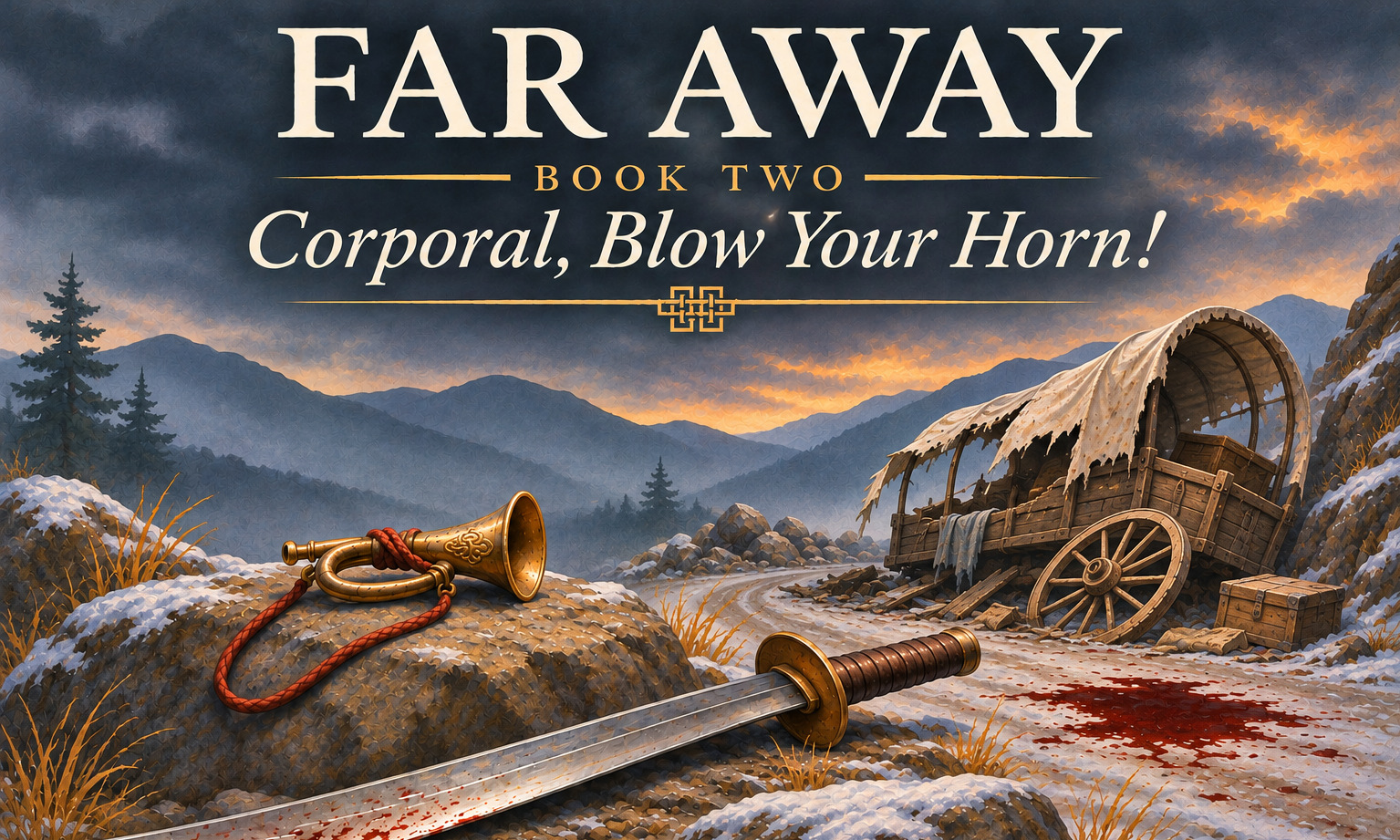
A wealthy merchant makes Darius an offer, and the Five Star caravan reaches a nervous town where something is clearly wrong.
Read Book 1| Read Book 2 Part 1 | Part 2
* * *
One of a Kind
The next afternoon, just after our break for Salat Al-Asr, I was sitting on the ground, saying my dhikr, when Zabit sat cross-legged in front of me. He was a small man, well into his fifties but with a full head of black hair and a thick black beard. One of those men who will never go bald and hardly seem to age.
Keep supporting MuslimMatters for the sake of Allah
Alhamdulillah, we're at over 850 supporters. Help us get to 900 supporters this month. All it takes is a small gift from a reader like you to keep us going, for just $2 / month.
The Prophet (SAW) has taught us the best of deeds are those that done consistently, even if they are small. Click here to support MuslimMatters with a monthly donation of $2 per month. Set it and collect blessings from Allah (swt) for the khayr you're supporting without thinking about it.
“Brother Darius,” he said.
This made me narrow my eyes just a bit. Zabit was a proud and slightly high-strung merchant who was not known for fraternizing with the guards.
I nodded. “Uncle Zabit.”
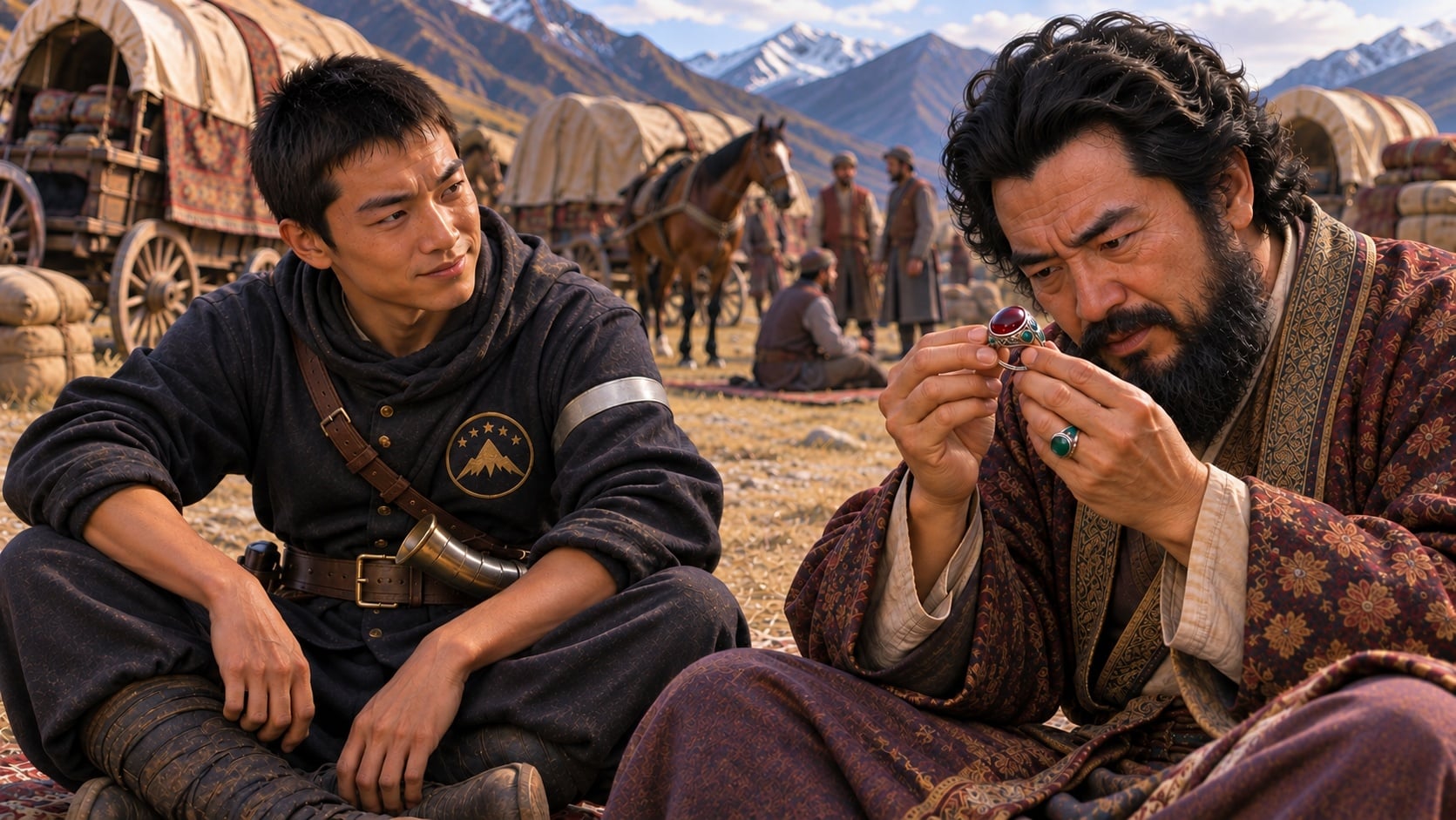
He waved a hand. “Please. Just call me brother. Anyway, remember when we were in Persia and you passed your new ring around among the guards? I never got a good look.”
I chuckled, slipped the ring off my neck and handed it to him. He studied it closely inside and out, turning it one way and the other.
“Extraordinary,” he said, and handed it back. “One of a kind. And the provenance… that’s the real story. I know a few nobles who would give their firstborn children.”
I tucked the ring safely away. “What do you mean?”
“Do you remember what sort of cargo I carried to Persia?”
“Of course. Teapots.” I imitated his high-pitched voice: “My teapots, my teapots!” This memory made me laugh, but Zabit only gave a tight smile.
“Quite right,” he said. “But also jade. I deal in gems as well. Do you know what I’m carrying back?”
I thought about it, then shrugged. “No idea. Emeralds?”
“Good guess. I have Persian velvets and brocades, silver-woven cloth, a variety of unique luxury items, and quite a lot of gems, including Nishapur turquoise, pearls from the Persian Gulf, and some small quantities of rubies, spinels, agates, and yes, emeralds.”
“Wow, ma-shaAllah, good for you Uncle. Are you trying to sell me something?” I grinned. “You might be targeting the wrong market.”
He gave an annoyed cluck of his tongue. “This is serious. I want to buy your ring. I know people who would pay a lot of money for such a unique piece. I will give you an extremely generous price. Enough to make you rich.”
My face went flat. “It’s a personal gift. Not for sale.”
He held up a placating hand. “Perhaps you think I want to cheat you. There’s another route we could take. We sell it together. You get eighty percent of the sale price, and I take twenty as the broker. Fully transparent.”
I’d had enough. “There is no god but Allah,” I said. “Alone without partner. To Him belongs the dominion and all praise; He gives life and causes death; and He has power over all things.”
“What does that mean?” Zabit demanded.
From my sitting position I rolled backward, coming to my feet in a smooth motion. “It means, brother Zabit, that you will have to satisfy yourself with your turquoise, pears and spinoos.”
“Pearls and spinels.”
“Also, your gorgeous beard, mashaAllah.” I winked at him and walked away.
As Old As Humanity
Later that evening, I found Ahmed sitting with his back against a wagon, reading the Quran by the light of the moon. I sat beside him.
“Our caravan is cursed.”
Ahmed laughed. “Why do you say that?”
“Look at everything that’s happened. The Afghanistan raid, the invasion of Herat, the Dzungar raid, and now this horrible thing with Cotan and Shireen.”
Ahmed smiled. “We had nothing to do with the invasion. Wars between nations are as old as humanity itself. As for the raids, it’s robbery on a bigger scale. How many times did people try to rob you in Deep Harbor?”
“Lots,” I admitted grudgingly. “But what about Shireen?”
“That was awful.” He shook his head. “It happens back home too. Men beat their wives or their children. It goes on behind closed doors, and no one talks about it.”
I knew the truth of this statement very well, and could not argue. “So you don’t think we’re cursed?”
“No, we’re blessed.”
I laughed. “You’re dreaming.”
“Am I? Take everything you said and flip it.”
I knew he was serious, so I chewed on my lip and thought. “We survived a major raid… We escaped an invasion just in time. And… I don’t see it with Shireen. What’s the blessing there?”
“We gave her shelter from an injustice she’s been suffering for many years.”
“Okay then.” I jabbed him in the chest with one finger. “What about the jinnis that have been coming out at night and making our horses sick?”
Ahmed gave me an incredulous look. “Are you serious? What jinnis?”
I grinned. “I made that up. I had to get you on something.”
Acrobatics and Opera Tales
We moved on, and I had to admit that in spite of the problems we’d experienced, morale was good. We had survived a serious attack with minimal losses. Our wagons were heavy with valuable goods, and every morning we woke a little closer to home.
One afternoon we made camp early beside a stream, where there was enough grass for the animals and a sheltered place among the rocks for the wagons. I had just finished helping water the horses when I saw Meilin stretching near one of the wagons. When she was done stretching she began shadow boxing. Meilin had a very acrobatic style of fighting, and as I watched she ran three quick steps, threw herself sideways and turned completely upside down. Her legs split above her head, but her hands never touched the ground. She landed lightly on both feet and kept walking.
My eyes widened. I could do a forward somersault. In the tournament in Deep Harbor I had knocked a man senseless with a kick in the middle of a backflip. But whatever Meilin had just done, I had never even tried it.
“Hey Mei-Mei,” I called. “Can you teach me that no-hands cartwheel you just did?”
She glanced my way. “Forget it.”
“Why?”
“For one, no one calls me Mei-Mei unless they want their skull cracked to let in some fresh air. Second, you have a big head.”
“Oh come on. I’m sorry about saying Mei-Mei. And I don’t have a big head. Not even my horse listens to me. Please, Veteran Guard Meilin?”
She taught me, coaching me patiently one step at a time.
“How old were you when you learned?” I asked.
“Six or seven.”
“What was it like growing up in the opera?”
As I practiced, she told me a story.
“Once, when I was little, I forgot my lines. I panicked and tried to run off the stage. I tripped, crashed into a wall and knocked myself unconscious. The audience laughed and cheered. They thought it was part of the show. The other actors too. They kept on performing, stepping over me and around me. I woke up with someone dragging me off the stage as the audience laughed.”
I laughed. “That’s horrible.”
“And you just did an aerial cartwheel.”
“I did?” I blinked. “Huh.”
“Do it again.”
I launched into it, and the world turned over. My feet hit the ground beneath me, and I came out of it perfectly balanced. I thanked Meilin and turned to walk away.
“Hold on,” Meilin said. “I have some news.”
I turned, my stomach already dropping. “What is it now?”
“Gulnur is pregnant.”
I stared at her. “How do you know?”
“Women know these things. We’re throwing a party tonight.”
I grinned. A party! I hadn’t been to a party since the little impromptu birthday party Zihan Ma and Lee Ayi had given me.
The Party
That day, with Belly beneath me and the mountains shining beneath a clear sky, I felt foolish for having decided that the caravan was cursed. Ahmed was right. Blessings poured from heaven like rain, for those with eyes to see.
That evening we ate well. The cooks produced mutton, rice, flatbread and dried fruit. I slipped Belly a dried apricot, which he loved. Shah organized wrestling matches. I tried to enter the wrestling contest but some of the men protested. “No, not Darius! We won’t stand a chance. He’s banned.”
I laughed at this. In reality I would likely have lost. Folk wrestling was about pinning your opponent’s back to the ground. It was a clean sport, with no striking allowed. My father had disdained such contests, saying that they built bad combat habits. My ground-fighting training had been focused on how to recover to my feet as quickly as possible, including by striking vital points, biting, gouging, breaking joints, or drawing a knife and stabbing the enemy. I didn’t know how to fight under their rules. But I was happy to let them think otherwise.
Meilin and Gulnur challenged Weili and Shireen to an archery contest. Gulnur was determined to prove that pregnancy had not transformed her into an instant invalid. She shot standing, then kneeling, then showed off by turning sideways in the saddle to loose over her shoulder. The Parthian Shot again. Over the course of the journey Meilin had become the sharp-tongued auntie that I had never thought I needed, but was quite fond of. I cheered loudly for her and Gulnur. Unfortunately for my team, Weili shot with maddening precision, and Shireen finished the contest by planting an arrow precisely in the bullseye.
Just when I thought the party was over, someone brought out a small drum he’d purchased in Herat, and began to play. Chen leaped up and began a comedic dance that consisted of quick shuffling steps.
“Meilin,” I called out. “Show them what real dancing is.” I had never seen her dance, but she had grown up in the opera, after all.
“Meilin knows how to dance?” someone said.
Meilin stood and began a sinuous, graceful dance that consisted of sweeping circular steps, dramatic twists and bends of the torso, and rapid, enigmatic arm movements. The entire audience fell silent, mesmerized. When she finished and bowed, we broke into applause.
For one evening there was food, laughter and no blood anywhere.
Al-Insan
Ahmed and I sat cross-legged in front of a small fire, a good distance from the wagons. There was snow on the ground, and we sat on three layers of blankets. I had begun an intensive twice weekly Quran study with him, and we were working on Surat Al-Insan.
“Let’s review from the start,” Ahmed said.
I recited. “Hal ataa ‘al al-insani…” My breath steamed visibly into the air with each word. When I reached the end of the ayah, Ahmed said, “Meaning?”
“Has there come upon the human being a period of time when he was nothing to be mentioned?”
“Tafsir?”
“There was a time when we did not exist. This reminds us that we are not the center of existence.”
Ahmed patted my knee. “MashaAllah. And a time will soon come when none of us now living will remain in this world. Me, you, Captain Karim, everyone will be gone.”
“That’s a weird thought.”
“Death is not a mistake, Darius. It is the end Allah appointed for every life in this world. So when someone dies, grieve for them. But never think that because they died, something unnatural happened. No one lives forever.”
“Except you.” I grinned. “You don’t look a day older than when I met you. If a dragon and an acacia tree had a kid, that’s you.”
Ahmed glared. “Are you insulting my parents?”
I paled. “No, I’m sorry, I -”
He laughed. “I’m kidding. And if a tiger and an executioner’s axe had a kid, that’s you. But I will die, and so will you.”
“So you won’t mourn for me?”
He gave me a look that said, Really? Fishing for sympathy? “Are you listening? I just said that when someone dies, you grieve. Of course I’d mourn for you. And more than that. I’d make dua’ for you, and I’d try to be like you.” Seeing my amazed expression, he held up a hand. “Not in everything. I wouldn’t go around dueling people, smacking them and throwing water on them.”
I rolled my eyes at that.
“But,” Ahmed went on, “I would remember the best of your qualities, and I would try to make them a part of my character as well.”
“Like what?”
He waved a hand. “You’re still fishing for compliments. If we’re done composing your death scene, can we move on to the next ayah?”
The Kyrgyz Town
As we continued eastward, we began seeing Kyrgyz herders driving sheep and horses, and travelers coming from the direction of Kashgar, most of them Turkic-speaking Muslims in long coats and fur caps. These travelers were Memdooh’s people, the Uighurs, and he was excited to see them. He would call out to them enthusiastically, and ask for news of his homeland.
Mud-brick farmhouses appeared, followed by villages surrounded by irrigated fields. After so many days of grass, rock and snow, the rows of vegetables looked luxurious.
One afternoon we reached a market town built along the caravan road. Longwei knew more languages than anyone, and had traveled this route before. The town, he said, was called Besh-Badam, and had a thriving marketplace. Karim appointed him, Shah and me to go into town to replenish our supplies of flour, barley, vegetables, lamp oil and other things, and if possible to buy five sheep for slaughter, as the men had been grumbling about the lack of meat.
The place was busy, but there was something wrong. People moved quickly through the streets, heads down, rarely stopping to talk. Men stood in doorways watching strangers pass. The market was open, yet it certainly was not thriving. In fact, the stalls looked half-empty. There were a few sacks of grain, some onions and turnips, bundles of firewood, poor-quality cloth and a scattering of dried fruit, but nothing like the abundance we had seen farther west. Even the livestock pens were nearly bare. There was a dangerous, edgy feel to the place.
I wasn’t worried for our safety. Longwei had spent most of his life on roads like these, and Shah could tear a door off its hinges. Still, I wondered why everyone in Besh-Badam seemed nervous.
We bought flour, barley, onions, lamp oil, dried beans and two sheep. It wasn’t everything Karim had asked for, but it would have to do. The sheep objected loudly as Shah and I wrestled them into the wagon.
“Watch the supplies,” Longwei said.
He strolled toward a rough-looking man standing with his back against a mud-brick wall. The fellow wore a stained sheepskin coat and carried a long knife at his belt. He and Longwei spoke quietly for several minutes. At one point Longwei glanced toward the road, then handed the man something.
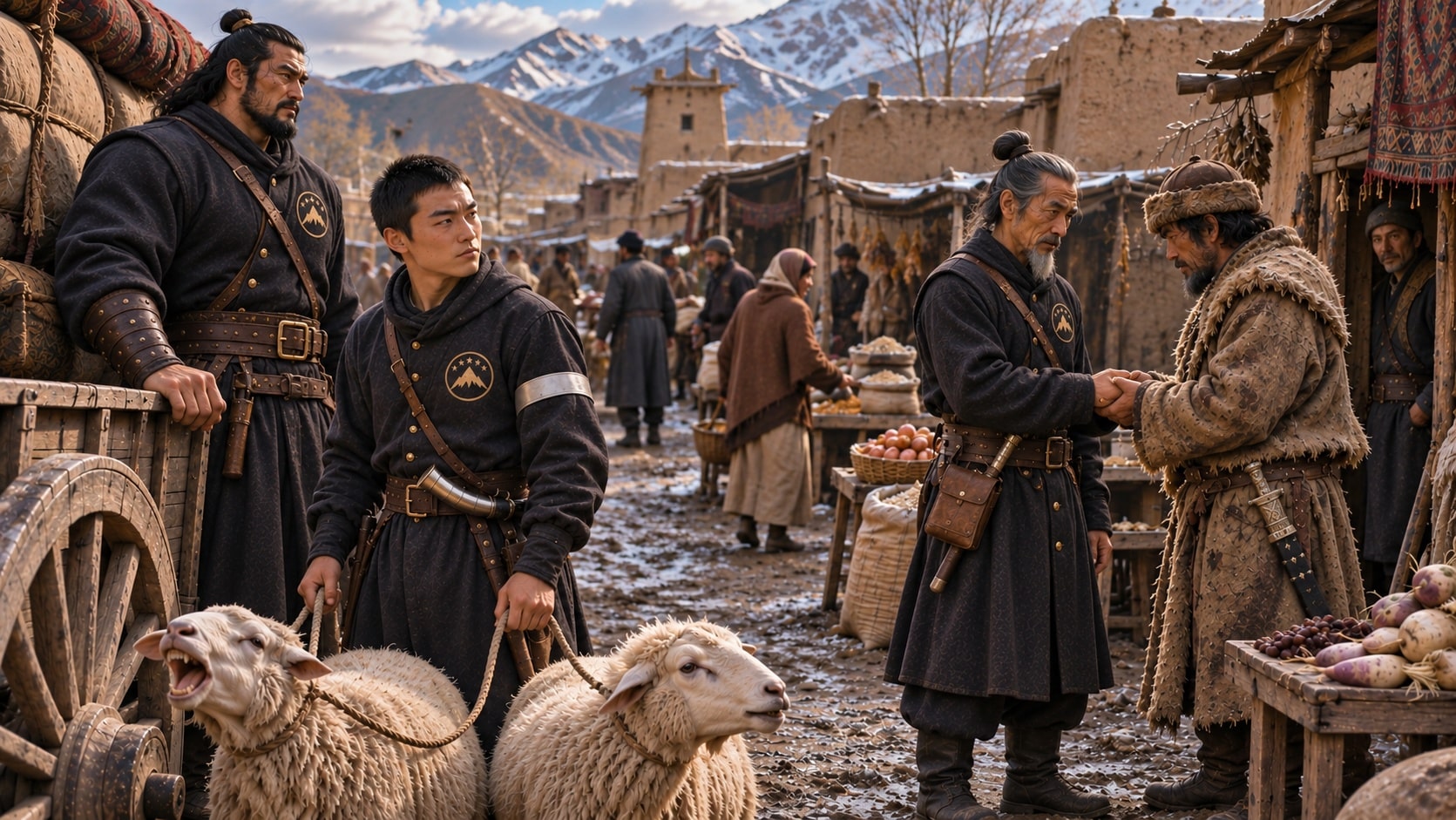
When he returned, Shah asked, “Who was that? He looks shady.”
“A hunter and tracker. I met him once, years ago. He’s no angel, but he has good information. He says raiders have attacked Besh-Badam twice already this year. Last time they killed the mayor and kidnapped a dozen women. That’s why everyone is on edge.”
“What did you give him?” I asked.
Longwei looked at me. “Copper coin. Information isn’t free. He gave me a detailed description of the road ahead. Where the wagon route is bad, where we’ll find water, and which valleys to avoid.”
“Oh.” I nodded approvingly. “That’s good. Well done.”
Longwei gave me an annoyed look. “Thank you, Corporal Lee.”
I ignored the sarcasm. It wasn’t my fault I’d been promoted.
Karim wasn’t happy about the paltry supplies we’d returned with, but the news of raiders concerned him more.
“The tracker says the main road east has been hit several times,” Longwei told him. “Mostly at night. He thinks if we move quickly, keep a strong watch and choose strong defensive positions, we should be all right.”
Karim frowned. “Is there another route?”
Longwei nodded. “There is. An older wagon road through the mountains. Less traveled, so raiders are less likely to watch it. But it’s steep and narrow in places. I’ve taken it before, but I wouldn’t recommend it with fifty wagons. I’d stay on the main road, even if it is dangerous.”
Karim looked toward the mountains. “I know that road. I took it years ago with a smaller caravan.”
“Then you know what it’s like.”
Karim thought for a moment. “We’ll take it.”
Longwei shrugged. “You’re the captain.”
This caught my attention, and I gave Longwei a quizzical look. It was not like him to accept contradiction with such equanimity. Normally he’d grow incensed, and either glare or grumble about his experience not being respected. It was good to see that he was learning to respect the captain’s decisions.
* * *
Come back next week for Part 4 – Now I’m Hui
Reader comments and constructive criticism are important to me, so please comment!
See the Story Index for Wael Abdelgawad’s other stories on this website.

Wael Abdelgawad’s novels – including Pieces of a Dream, The Repeaters and Zaid Karim Private Investigator – are available in ebook and print form on his author page at Amazon.com.
Related:
Searching For Signs of Spring: A Short Story
Keep supporting MuslimMatters for the sake of Allah
Alhamdulillah, we're at over 850 supporters. Help us get to 900 supporters this month. All it takes is a small gift from a reader like you to keep us going, for just $2 / month.
The Prophet (SAW) has taught us the best of deeds are those that done consistently, even if they are small. Click here to support MuslimMatters with a monthly donation of $2 per month. Set it and collect blessings from Allah (swt) for the khayr you're supporting without thinking about it.






Far Away, Book 2: [Part3] – Something Wrong in Besh-Badam

Not So Easy at Suez: The Lustre and Limitations of an Anticolonial Watershed

Parenting: A Work In Progress – A Muslim Mum’s Journey To Overcoming Self-Sabotage And Guilt

Welcome to Islam, Now Shut Up

Javits Frimpong: School Bullying, The Crisis Of Belonging, And The Responsibility Of Muslim Schools
Far Away, Book 2: [Part2] – The Domain of the Dzungars
Far Away, Book 2: [Part3] – Something Wrong in Besh-Badam

Marriage & Money [Part II] – Me Before We: Understanding Our “Financial Personalities” To Improve Our Marriages

Chris Van Hollen: The Pakistan-Born Senator Too Principled For Pakistan’s Powerful

Treating Community WhatsApp Groups As Institutions [Including Free Workbook On How To Build Purposeful, Safe, And Beneficial Groups]

The Best Actions for Eid al-Adha [Imam Dawud Walid]

Coming Full Circle: Who Are You Now? | Night 30 with the Qur’an

Running Away From Who We Are | Night 29 with the Qur’an

Building From the Ground Up: Week 4 Recap | Night 28 with the Qur’an

The Muslim You Are Becoming | Night 27 with the Qur’an
MuslimMatters NewsLetter in Your Inbox

Sign up below to get started
-

 #Culture1 week ago
Far Away, Book 2: [Part2] – The Domain of the Dzungars
-
#Culture1 month ago
Far Away, Book 2: [Part 1] – Meilin’s Tale
-
#Culture1 month ago
[Film Review] Your Mother, Your Mother, Your Mother: A Complex Story Of Faith And Fatherhood
-
#Culture1 month ago
[Podcast] A Light of Her Own: Muslim Womanhood, Seasons of Life, & Female Scholarship