#Life
Marriage & Money [Part II] – Me Before We: Understanding Our “Financial Personalities” To Improve Our Marriages

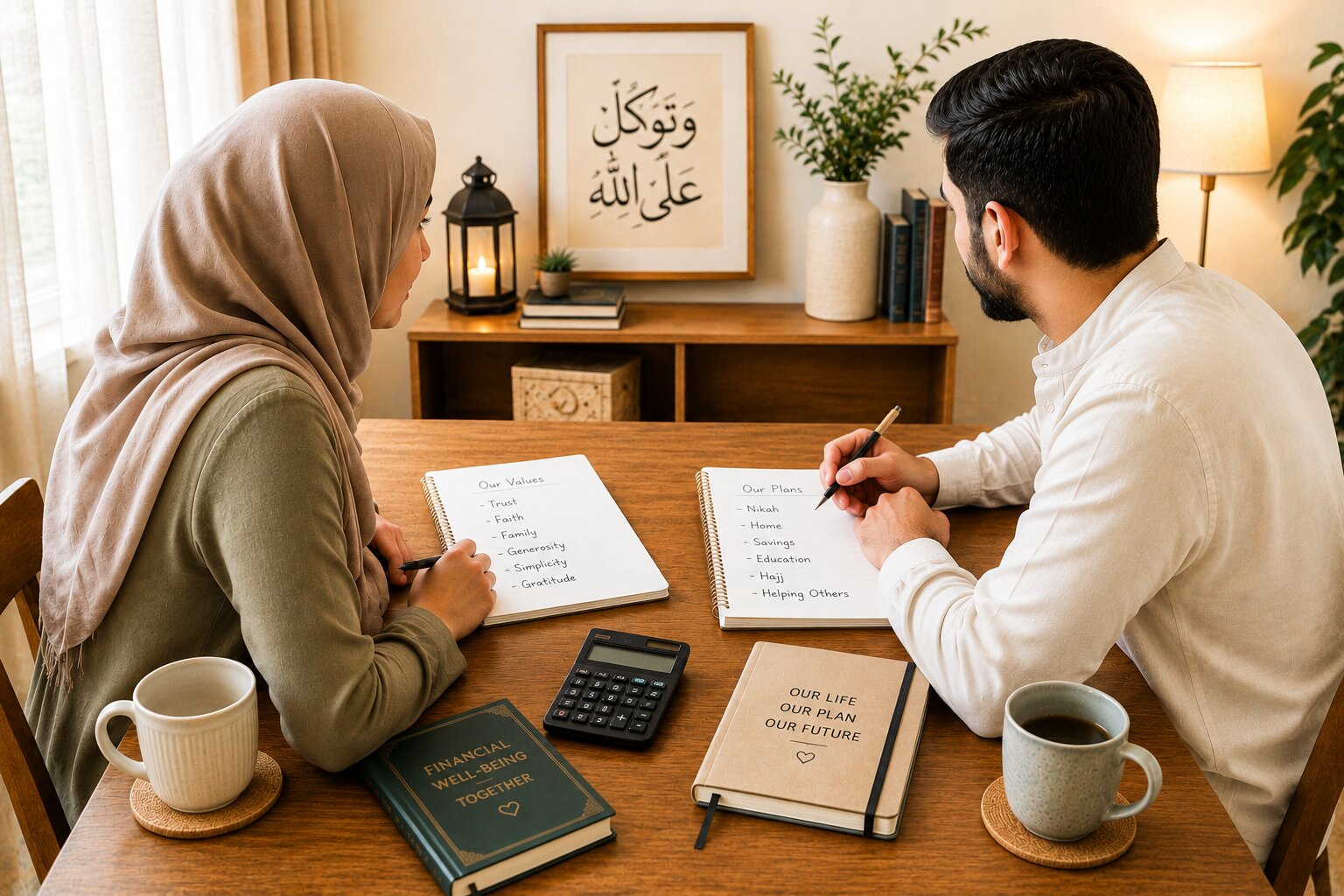
Written by Dr. Mohammed Sinan Siyech and Sannah Khan.
In Part Two of our series, Marriage & Money [read Part One here], we explore our personal money stories and their impact on our relationships, and how the underlying principles of our money stories lie in emotional regulation.
The Divorce Crisis – How Money Plays A Role
Ayesha and Rafique were married for two years before their financial troubles started. A job loss for Ayesha triggered a deep sense of worry, and she began to criticise Rafique for his spending decisions – even on essential items. While Rafique did try to cut down, he was not used to focusing only on essentials and continued to go for his regular outings with his friends and colleagues, spending money on many dinners that could have been saved for home. The combined burden of all these anxieties almost led to them divorcing until they took up therapy together and managed to fix their own internal problems.
Keep supporting MuslimMatters for the sake of Allah
Alhamdulillah, we're at over 850 supporters. Help us get to 900 supporters this month. All it takes is a small gift from a reader like you to keep us going, for just $2 / month.
The Prophet (SAW) has taught us the best of deeds are those that done consistently, even if they are small. Click here to support MuslimMatters with a monthly donation of $2 per month. Set it and collect blessings from Allah (swt) for the khayr you're supporting without thinking about it.
These types of marital disagreements are quite common within several communities (Muslim and non-Muslim), with divorce rates across the world skyrocketing significantly. In many cases, even if money does not lead to divorce and separation, it plays a huge role in making the situation far uglier. Cases of divorcing couples having financial issues when divorcing are a common issue and should not surprise us anymore. In all these cases, the question that arises is: Can we do something to avoid these outcomes that doesn’t only depend on legal procedures? To answer this, we need to focus on understanding our financial personalities.
Types of Financial Personalities
While somewhat reductive in nature, several money experts, such as American Ramit Sethi, classify people’s financial personalities into a typology which includes:
- The Optimiser: the person who is often planning out the best future ahead and working out excellent deals but is often unable to spend money on the present. While great at planning for the future, they can’t spend on current-day experiences, which are as important as financial safety in the future.
- The Worrier: the person who often worries about their financial situation, often leading to crushing paralysis regarding making decisions. They tend to feel a sense of control in worrying about the future, even though it is not productive. They also sabotage their relationships by criticising financial decisions their partners suggest instead of providing any solutions.
- The Dreamer: This person is often coasting through life, going with the flow and planning for the next big goal/break. They love to engage in get-rich schemes, and the majority of the burden is carried by people around them, particularly their spouses.
- The Avoider: This type of personality is often not able to come to terms with their own financial situation and is unable to even check their own bank balance as well. They also don’t do well in disagreements, preferring to get moody and distant instead of engaging with their partners.
None of these personalities are clearly bound into neat boxes, and people often flit between one or the other archetype based on the situation and timing of each person.
Depending on the intensity of how they engage with these attitudes, the impact spills over into other relationships. However, because we spend the most amount of time, physical space and material with our spouses, it is here that the effects are the most acute. Thus, in the case study outlined above, Ayesha was a chronic worrier, where her job loss and mounting bills led to her worrying and taking out her anxiety on Rafique. On the other hand, Rafique’s attitudes were more emblematic of a dreamer, where he was going with the flow and not taking a break to stop and reflect on the change in circumstances. Without addressing these issues, their married life would have only seen resentment, anger, annoyance, and other negative emotions.
Emotional Regulation
Underpinning many of these attitudes towards money is a gap in emotional regulation. One of the Prophet Mohammed’s  greatest, but often under-explored, pieces of advice to us as humans was the regulation of our emotions. His blanket statement that he was sent to perfect human character, as well as the various pieces of advice he gave, such as performing Wudhu (ablution) with water and sitting down/lying down if one is angry, and his own examples of dealing with unpleasant situations (such as stopping the Sahaba from rushing the Bedouin who urinated in the mosque) intelligently, suggests that he was often as involved in teaching us to grow emotionally (as well as spiritually).
The Islamic principles of child rearing, where the first seven years of childhood are for a child to play and be shown love by their parents (often attributed to Ali  and quoted by many Imams and scholars today), are another example of how emotional regulation is instilled into them. Modern-day psychology does talk about this, given its emphasis on the role of early childhood experiences in shaping the brain parts of the child (such as the Amygdala, the frontal lobe, and the Hippocampus – all of which are important in helping us regulate our emotions).

Underpinning many of these attitudes towards money is a gap in emotional regulation.. [PC: Marek Studzinski via unsplash]
One instance of a case I encountered was a person who had a chronic shopping habit to the point where she maxed out her credit cards, and her husband’s too. The irony was that every time she would press the button to pay, her adrenaline would drop and she would regret the purchase. This habit came from her observation of her mother, who was also a shopper – a habit which gave her a sense of familiarity as an adult and therefore a sense of comfort which she leaned into. It was only after interrogating these approaches that she was able to get a handle on these habits better. Needless to say, the excessive spending was causing a strain on her marriage, and no amount of fighting would have sorted out the issue for her. In this case, she was able to identify these habits when attending one of our events on ‘our relationship with money.’
Practical Steps
Each of these personalities has specific prescriptions to help guide them to develop a better relationship with money. Some of the key questions that need to be probed here, which the reader can engage with as an exercise, are as follows:
- What is the script that you were taught when you were a child? This is an important discussion since most people often don’t realise that their attitudes towards money are dictated by what they observed from their parents. For example, if a person had parents who kept repeating the phrase “we don’t have money for that” (when asked to purchase any item), an individual is likely to develop an attitude where they would worry about their financial situation in the future. Unpacking this early exposure to financial ideas helps people understand their current approaches and helps them move past these ideas as well.
- What do you lose when you continue with this path? This is an important question. A lot of people are happy to walk down the same route without making changes, even though they may know that this particular habit or approach is something that is destructive in nature. A thought experiment to show what life might be like in five and maybe ten years would help paint a picture that shakes up most people and corrects their trajectories better.
- How do your habits affect people around you? – particularly your partner or your wedding search situation? This could be a joint or an individual conversation, but it often helps to illuminate the extent of the person’s financial personality flowing into the lives of loved ones. For some people, this is a strong wake-up call.
In addition, we must also deepen our own spiritual connection with money. As noted by financial scholars, money is a trust and a responsibility from Allah  and, depending on how we use it, could serve as either a blessing or a test. Apart from these overall approaches, each type of personality also has specific prescriptions that they can do to sort their own
| Type | Practical Step | Spiritual Step |
| The Optimiser | Look at your spreadsheets and see which of your expenses have given you meaning.
Ensure that you spend at least 2-5% of your monthly income in some form of guilt-free spending. |
Give Sadaqa so that we learn to part with money and provide it to those who need it. This allows an optimiser to look beyond the future tangible value if that money were invested and focus on intangible benefits. |
| The Worrier | Ask yourself what you get out of worrying (sometimes it is a sense of control, sometimes it signals that you care).
Play out your worst-case scenario so you deal with the emotions it brings up. Earmark certain expenses as essential and not for worry so you reduce your own mental load. |
Make Istighfaar and extra du’a (especially in Tahajjud if possible) because Allah will increase us in our rizq. The habit of making du’a gives us a sense of safety, since we leave the outcome (not the effort) to the Master of the Universe. |
| The Dreamer | Generally, the load of correcting a dreamer’s behaviours often falls on people around them. Here, partners have to illustrate the impact and work on solid plans to improve their habits. | Engage in more gratitude, which allows you to be in the present. Often, this aspect of Dhikr helps to ground oneself and increase one’s barakah in rizq too. The Prophet also encouraged others to work for their own income rather than relying on others, so this becomes an important step to engage in. |
| The Avoider | Provide clear expectations, Work on boundaries, and gradually increase responsibilities so as not to overwhelm oneself. | Take accountability with Allah and remember that every penny/dirham will be accounted for in the hereafter |
Conclusion
We will continue to see our marriages being tested significantly within our communities. The modern world, which is guided by neo-liberal ethics, is also economically positioned against individuals. Couples are under immense strain financially due to the declining job market and the increasing cost of living. As elaborated in our previous article and in various polls and surveys, financial expectations and mismatches cause up to half of all recorded divorces in countries like the US and the UK. This is often because people don’t realise the impact of their financial archetypes in creating conflict. These mismatches in financial expectations will only further exacerbate problems for various couples who are just not equipped to deal with being in healthy marriages.
Understanding our ‘money personalities’ is one among the various solutions (albeit an important one) to emotionally regulate better and maintain healthier marriages. Of course, it’s not as simple as just reading a single short article and implementing changes in our lives; however, these do serve as starting points for individuals and couples, and the more important part is to open this conversation for the broader community so we can grapple with these issues better.
Related:
– [Podcast] 50k Mahr, Hiding Money, & Who Pays for the Wedding? | AML Finance
– Meaningful Money: How Financial Literacy Amplifies Your Giving
Keep supporting MuslimMatters for the sake of Allah
Alhamdulillah, we're at over 850 supporters. Help us get to 900 supporters this month. All it takes is a small gift from a reader like you to keep us going, for just $2 / month.
The Prophet (SAW) has taught us the best of deeds are those that done consistently, even if they are small. Click here to support MuslimMatters with a monthly donation of $2 per month. Set it and collect blessings from Allah (swt) for the khayr you're supporting without thinking about it.


Chris Van Hollen: The Pakistan-Born Senator Too Principled for Pakistan’s Powerful

Marriage & Money [Part II] – Me Before We: Understanding Our “Financial Personalities” To Improve Our Marriages

Far Away, Book 2: [Part2] – The Domain of the Dzungars

[Film Review] Your Mother, Your Mother, Your Mother: A Complex Story Of Faith And Fatherhood
Far Away, Book 2: [Part 1] – Meilin’s Tale
Far Away, Book 2: [Part 1] – Meilin’s Tale
Far Away, Book 2: [Part2] – The Domain of the Dzungars

[Podcast] A Light of Her Own: Muslim Womanhood, Seasons of Life, & Female Scholarship
[Film Review] Your Mother, Your Mother, Your Mother: A Complex Story Of Faith And Fatherhood
Chris Van Hollen: The Pakistan-Born Senator Too Principled for Pakistan’s Powerful

The Best Actions for Eid al-Adha [Imam Dawud Walid]

Coming Full Circle: Who Are You Now? | Night 30 with the Qur’an

Running Away From Who We Are | Night 29 with the Qur’an

Building From the Ground Up: Week 4 Recap | Night 28 with the Qur’an

The Muslim You Are Becoming | Night 27 with the Qur’an
-

 #Culture4 weeks ago
Far Away, Book 2: [Part 1] – Meilin’s Tale
-
#Culture2 days ago
Far Away, Book 2: [Part2] – The Domain of the Dzungars
-
#Culture1 month ago
Far Away [Part 31] – Following Your Lead
-
#Culture1 month ago
A Case For Critical Reading As Muslims: Reading ‘The Power of Your Subconscious Mind’ Through An Islamic Lens