
#Islam
15 Things You Didn’t Know About Makkah and the Ka’bah [Part 2]
Explore lesser known facts about Makkah, from the 1979 uprising and global migrant workforce to the loss of historic sites and the miraculous flow of Zamzam.

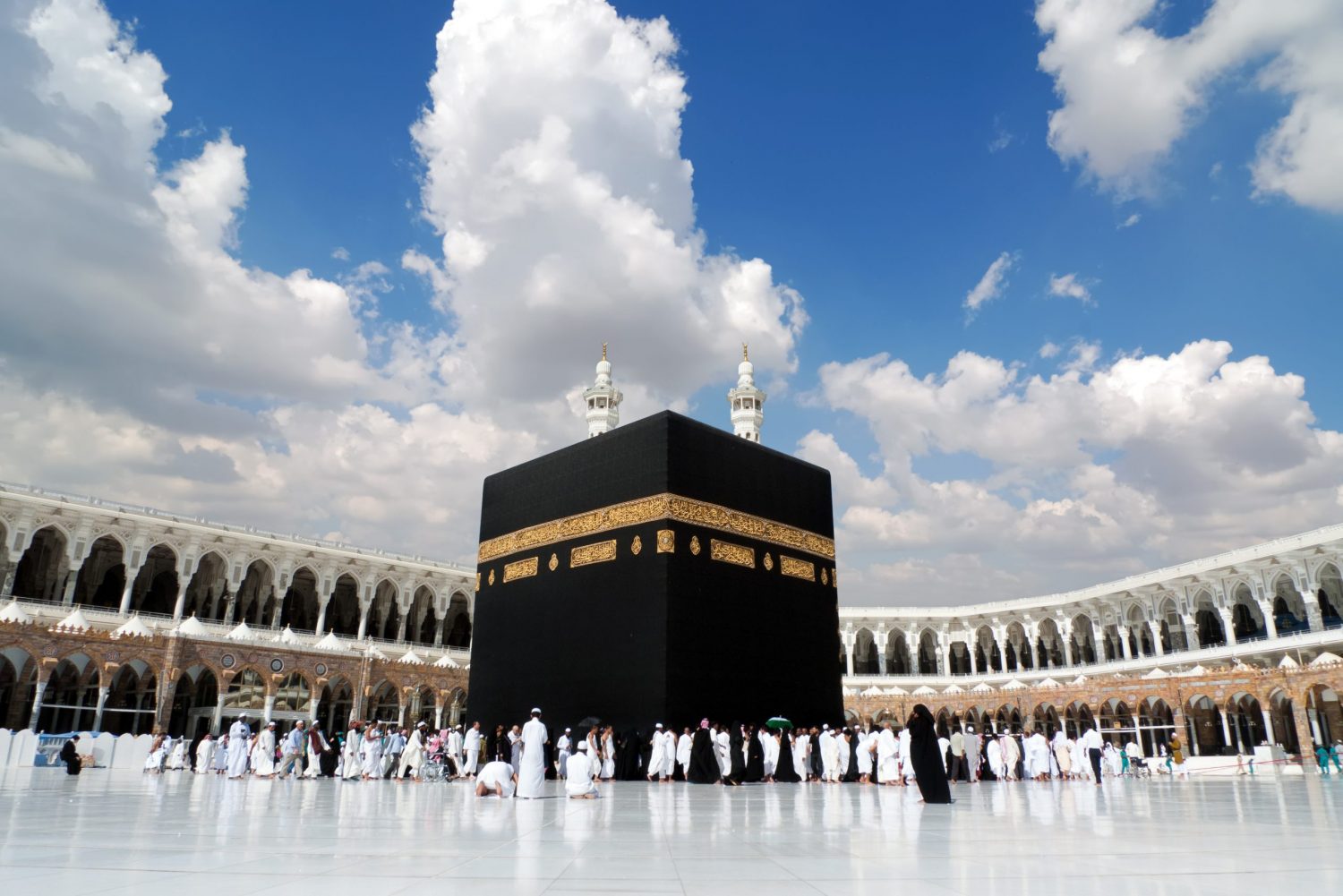
Explore lesser known facts about Makkah, from the 1979 uprising and global migrant workforce to the loss of historic sites and the miraculous flow of Zamzam.
Read Part 1
6. The Ka’bah Was Seized in a Modern Armed Uprising
People sometimes imagine Makkah existing outside of history. It is seen as a place of peace, stability, and timeless ibadah. But Makkah has experienced moments of profound upheaval, including in the modern era.
Keep supporting MuslimMatters for the sake of Allah
Alhamdulillah, we're at over 850 supporters. Help us get to 900 supporters this month. All it takes is a small gift from a reader like you to keep us going, for just $2 / month.
The Prophet (SAW) has taught us the best of deeds are those that done consistently, even if they are small. Click here to support MuslimMatters with a monthly donation of $2 per month. Set it and collect blessings from Allah (swt) for the khayr you're supporting without thinking about it.
I know this from personal experience. I went to ‘Umrah in early 1980, when I was a young teenager, and was stunned to see the minarets of Masjid Al-Haram heavily damaged by artillery fire and bullets. There were bullet holes in the Ka’bah itself, and Zamzam in particular was a mess, with the ground and walls chewed up by weapons fire.
Say what? You haven’t heard about this before? It’s surprising how few Muslims are aware of this incident. It began on the morning of November 20, 1979, the first day of the Islamic year 1400. An armed group of 200 men led by Juhayman al-Otaybi seized Masjid al-Haram. The militants smuggled weapons into the sanctuary, locked the gates, and declared that one of their members was the Mahdi whose coming was predicted by the Prophet Muhammad ﷺ. Thousands of worshippers were trapped inside.
The militants believed that an army would come to defeat the Mahdi, and Allah would cause the earth to open up and swallow them, whereupon the Mahdi would usher in an Islamic golden age.
That is not what happened.
What followed was a tense and violent standoff that lasted for approximately two weeks. Saudi forces initially struggled to retake the masjid. Fighting inside the sacred precinct was unprecedented and deeply shocking to the Muslim world.
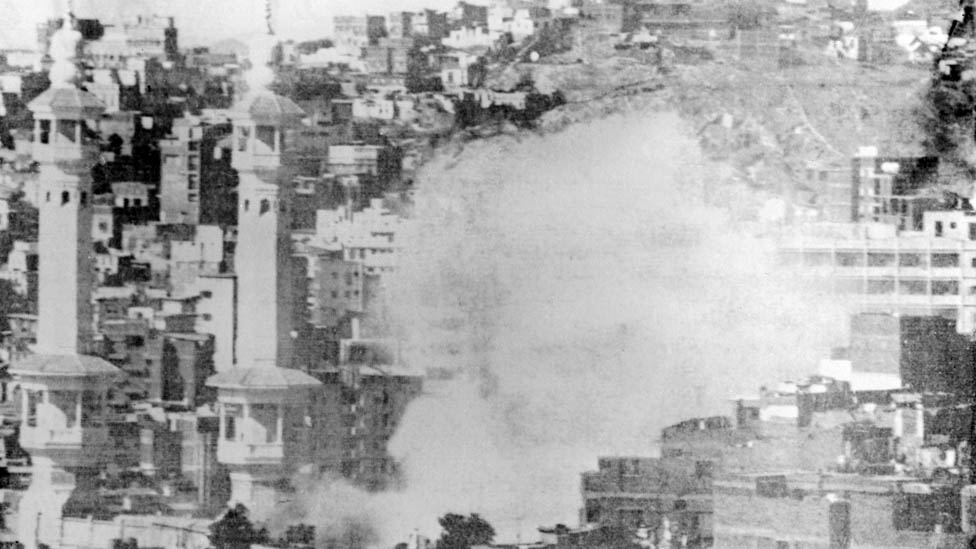
Smoke rises during the battle for Masjid Al-Haram in November 1979.
Eventually, the Saudi authorities regained control. Reports from multiple sources indicate that specialized assistance was brought in, including support from Pakistani forces. There was also controversy surrounding the involvement of French advisors. Because non-Muslims are not permitted to enter the Haram, it was stated that those involved formally converted to Islam before participating, though details vary across accounts.
The rebels made their last stand in Zamzam, and were eventually rooted out. 117 rebels were killed in the battle, 69 were executed, and 19 received jail sentences.
Without diminishing the horror of that event, I will say that although I was surprised to see the damage wrought upon the masjid, that is not what impressed me the most. Rather, I will never forget praying in front of the Ka’bah, seeing knots of Quran students gathered in circles, worshipers praying quietly, cats freely roaming the grounds, and eating the best shawarma sandwich of my life across the street from the masjid.
Across centuries and empires, beyond strife and struggle, the house of Allah still stands. The religion of Allah is still practiced, and people still come from all over the world to perform the rites taught to us by our Prophet ﷺ.
7. Makkah Produces Almost No Food
Makkah has never been a place of agriculture.
In the Qur’an, Prophet Ibrahim makes a dua as he leaves his family in the valley of Makkah:
“Our Lord, I have settled some of my descendants in a valley without cultivation near Your Sacred House…” (14:37)
This is not poetic language. It is a literal description. Makkah is a barren valley, surrounded by rocky hills, with little capacity for farming.
Historically, this shaped everything about the city. The people of Makkah could not rely on agriculture for survival. Instead, they turned to trade. The great caravan journeys of Quraysh, to Yemen in the winter and Syria in the summer, were not simply a means of wealth, but of necessity. Food, goods, and supplies had to be brought in from elsewhere.
Unlike Madinah, which had date groves and agriculture, Makkah depended on what it could import.
In this, very little has changed.
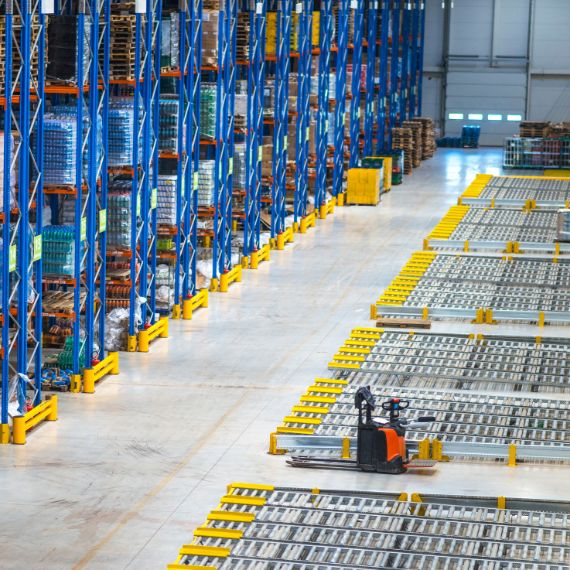
A cold storage food warehouse in Saudi Arabia.
Today, Makkah still produces almost no food of its own. Yet it feeds millions of residents and pilgrims every year. Food arrives constantly, transported across vast distances. Nearly two million tons of rice are imported into Saudi Arabia from South Asia each year, along with meat from Brazil, produce from Egypt and Jordan, grains from the USA and Europe, and so on. During Hajj alone, hundreds of thousands of tons of food are consumed, supplied through a vast global network.
It might seem strange that a barren valley with no natural resources should become the spiritual center of a global religion. Yet that very barrenness protected Makkah historically. Unlike other regions of Arabia, it was not conquered by the Romans or Persians, for why invade a land without resources?
As a result, Islam emerged among a people who were independent, resilient, and unruled by imperial authority. There was no empire to overthrow and no central government to dismantle. When Islam came, it did not replace a system. It built one.
As always, Allah guides events according to a wisdom that we do not see.
8. Makkah Is Overwhelmingly a City of Outsiders
At any given time, 40 to 50 percent of Makkah’s residents are non-citizens.
Every year, that number swells dramatically as millions of pilgrims arrive to perform Hajj and ‘Umrah. But beyond the pilgrims, there is another population that is less visible but just as essential.
Like many global cities that depend on migrant labor, Makkah’s population includes people from a wide range of backgrounds. This includes Indonesian and Malaysian hotel staff, Pakistani and Bangladeshi construction workers, Yemeni and Syrian shopkeepers, Egyptian and Sudanese teachers and administrators, and African and South Asian drivers and service workers.
Some come with professional skills and build stable lives. Others work long hours in low-wage jobs that are essential to the functioning of the city. Construction workers labor in intense heat. Cleaners and maintenance staff work overnight shifts to keep the Haram and surrounding areas spotless. Drivers spend long hours on the road moving pilgrims from place to place.
Many of these laborers live in shared or crowded housing, and their legal status is often tied to their employers, limiting their ability to change jobs or leave the country without permission. Their circumstances are often demanding and even oppressive, to such a degree that human rights organizations have reported on this issue.
These working conditions are common in all the Gulf nations. Without these workers, these oil-rich nations could not survive. Yet is it too much to ask for justice in the holy lands of Islam?
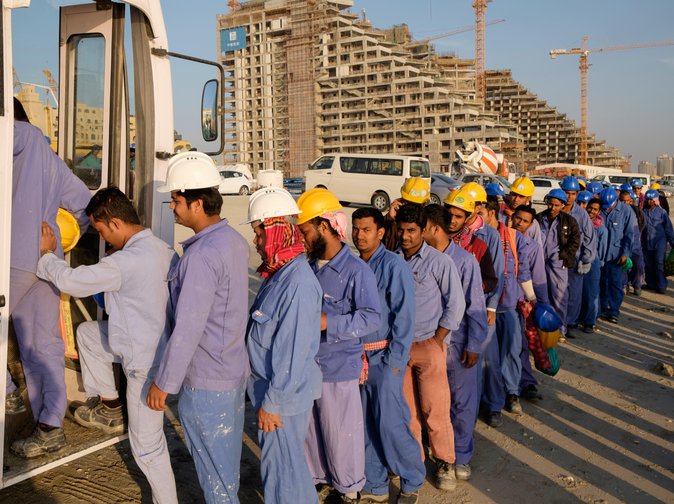
Migrant laborers in Saudi Arabia
Walk through the streets of Makkah and you will hear Urdu, Bahasa Indonesia, Hausa, Turkish, Arabic in many dialects, and dozens of other languages.
In this sense, Makkah is not a typical city. It does not belong to a single people or culture. It is a meeting place of the Ummah.
9. The Expansion of the Haram Has Erased Entire Neighborhoods
Over the past century, the expansion of the Haram and the redevelopment of central Makkah have led to the demolition of entire neighborhoods.
Obviously, as the population grows, the city must grow. However, many historically significant sites associated with the earliest period of Islam have disappeared.
Among the sites that have been lost are the home of Khadijah bint Khuwaylid, where the Prophet ﷺ lived for many years, as well as Dar al-Arqam, one of the earliest places where Islam was taught in secret, which now lies within the expanded structure of Masjid al-Haram. The house associated with Abu Bakr al-Siddiq is also reported to have been built over as part of a hotel development.
Nor is this limited to the earliest Islamic period. The Ajyad Fortress, an Ottoman-era citadel that stood for over two centuries overlooking the Haram, was demolished in 2002 to make way for the Abraj Al Bait complex, whose towers now dominate the skyline above the sanctuary.
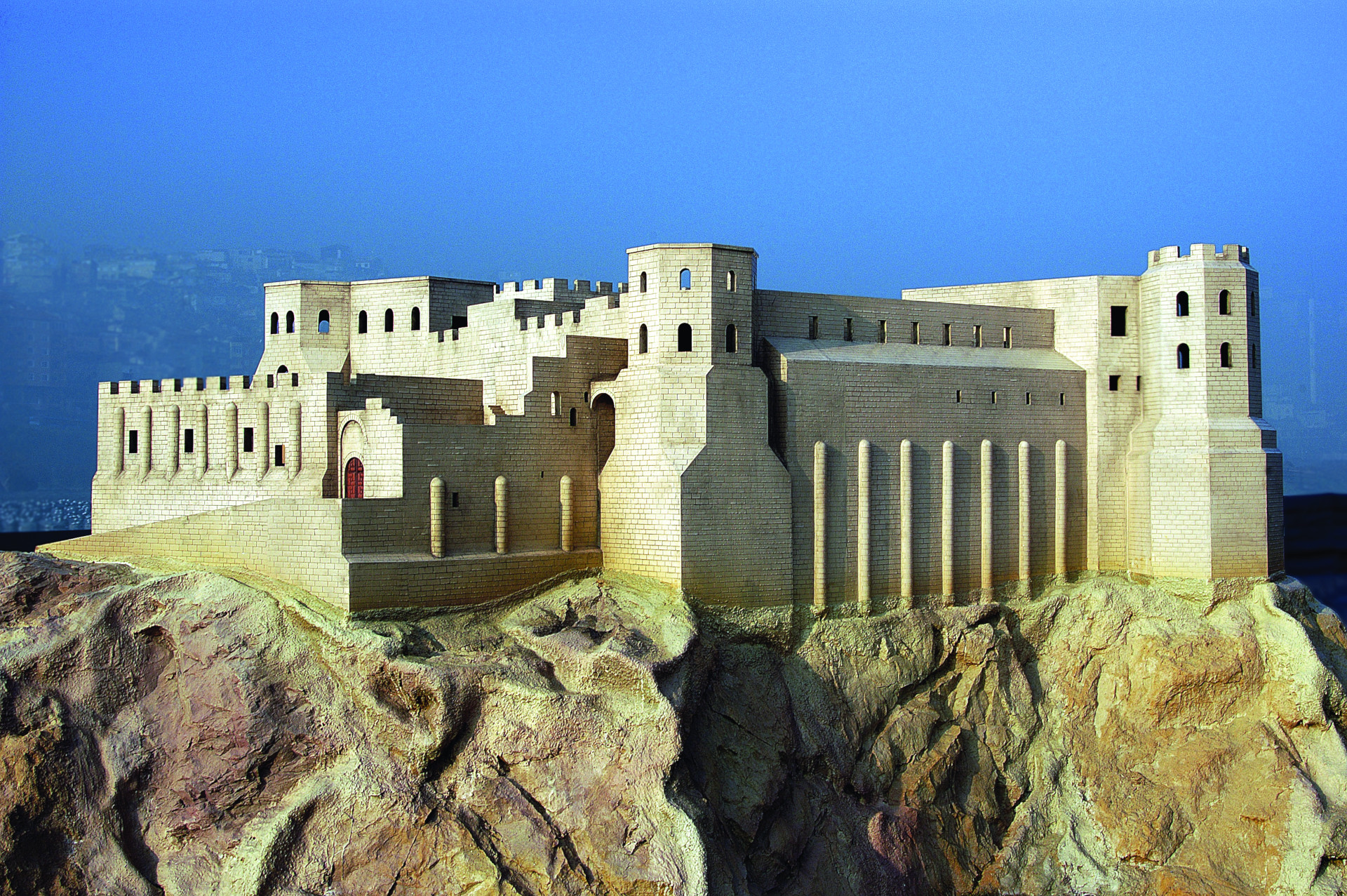
The Ajyad Fortress, built in 1777 by the Ottomans, was demolished in 2002.
Entire districts that once surrounded the Haram have been cleared and replaced with hotels, commercial centers, and infrastructure designed to accommodate the growing number of pilgrims.
The result is that many physical traces of early Islamic history are no longer visible or accessible. Heritage organizations and historians have repeatedly raised concerns about the pace and scale of redevelopment in Makkah, noting that the loss of these sites represents an irreversible break with the physical legacy of early Islam.
This raises an important question. When you visit Makkah, would you rather see the places where the sahabah lived and walked, or rows of generic hotels that could stand in any city?
This does not mean that all traces of early Islamic history have vanished. Important sites such as Jabal al-Nour, where the first revelation descended, and Jabal Thawr, where the Prophet ﷺ and Abu Bakr al-Siddiq (ra) took refuge during the Hijrah, still stand. The plains of Mina, Arafat, and Muzdalifah continue to host the rites of Hajj as they have for centuries. And at the center of it all, the Ka’bah remains, unchanged in its significance, drawing millions of hearts toward it every year.
Even so, what has been lost cannot be replaced. And what remains should remind us of the importance of preserving what we still have.
10. Zamzam: A Well That Has Flowed for Thousands of Years
In a barren valley with no natural rivers or agriculture, one of the most remarkable features of Makkah is a single well that has sustained life for thousands of years.
The well of Zamzam, located within Masjid al-Haram, has flowed continuously since the time of Ibrahim عليه السلام and his son Ismail عليه السلام. According to Islamic tradition, when Hajar was left in the desert with her infant son, she ran desperately between the hills of Safa and Marwah in search of water. In response to her faith and perseverance, Allah caused water to spring forth from the ground beneath Ismail’s feet.
That spring became Zamzam.
To this day, the well continues to produce water at a rate estimated between 11 and 18.5 liters per second. It supplies millions of pilgrims every year, yet it has never run dry.
 Modern studies have found that Zamzam water is naturally filtered through layers of rock and sand, and contains a distinct mineral composition. But beyond the physical explanation lies something greater. For over four thousand years, this well has continued to flow in one of the driest regions on earth, sustaining a city that produces almost no water of its own. Is this anything but a miracle? It is a sign from the signs of Allah, and a blessing to the children of Ibrahim.
The Messenger of Allah ﷺ highlighted Zamzam’s special status. As reported by Ibn Abbas:
“The best water on the face of the earth is Zamzam water. In it is food for nourishment and healing for illness.”
By the way, if you’ve never been to Makkah, you might imagine Zamzam as an old fashioned well with a bucket going up and down. Or a spring, with water pouring from a mountainside. That was what I thought before my first visit as a teenager. That was true in the past, but Zamzam is now controlled through a modern water system. The water is treated using standard methods, then channelled through pipes. But it’s the same blessed water.
In fact, for the believer, Zamzam is more than water. It is a reminder that provision comes from Allah in ways that defy expectation. In a place where survival should have been impossible, Allah placed a source of life that has endured across millennia.
Every cup of Zamzam carries that history.
* * *
Reader comments and constructive criticism are important to me, so please comment!
See the Story Index for Wael Abdelgawad’s other stories on this website.

Wael Abdelgawad’s novels – including Pieces of a Dream, The Repeaters and Zaid Karim Private Investigator – are available in ebook and print form on his author page at Amazon.com.
Related:
Keep supporting MuslimMatters for the sake of Allah
Alhamdulillah, we're at over 850 supporters. Help us get to 900 supporters this month. All it takes is a small gift from a reader like you to keep us going, for just $2 / month.
The Prophet (SAW) has taught us the best of deeds are those that done consistently, even if they are small. Click here to support MuslimMatters with a monthly donation of $2 per month. Set it and collect blessings from Allah (swt) for the khayr you're supporting without thinking about it.




15 Things You Didn’t Know About Makkah and the Ka’bah [Part 2]

Widening Wars Leave the Middle East in Shambles
15 Things You Didn’t Know About Makkah and the Ka’bah [Part 1]

Eid Mubarak from MuslimMatters

Selamat Hari Raya! – Celebrating Eid In Malaysia

[Podcast] Ramadan Is Not For Your Private Spirituality | Dr Farah El-Sharif

She Cried At The Door Of The Masjid: A Case For Children In Mosques

The Trials Playlist: A Chaplain’s Set To Steady Your Heart

[Podcast] Is Your Sadaqah Paying an Influencer Instead of Going to Charity? | Mufti Abdullah Nana & Dr Shafi Lodhi

Every Sin Has a Cure | The Venom and the Serum Series

Coming Full Circle: Who Are You Now? | Night 30 with the Qur’an

Running Away From Who We Are | Night 29 with the Qur’an

Building From the Ground Up: Week 4 Recap | Night 28 with the Qur’an

The Muslim You Are Becoming | Night 27 with the Qur’an

What Will You Leave Behind? Legacy in Islam | Night 25 with the Qur’an
-

 #Current Affairs1 month ago
An Unending Grief: Uyghurs And Ramadan Under Chinese Occupation
-
#Society1 month ago
Where Does Your Dollar Go? – How We Can Avoid Another Beydoun Controversy
-
#Current Affairs4 weeks ago
[Podcast] Ramadan Is Not For Your Private Spirituality | Dr Farah El-Sharif
-
#Islam1 month ago
Who Am I Really? What Surat Al-‘Asr Teaches Muslim Teens About Identity | Night 1 with the Qur’an


