Connect with us

#Current Affairs

Daughter of Which Nation? The Persecution of Asiya Andrabi and India’s Crackdown on Muslims

Published

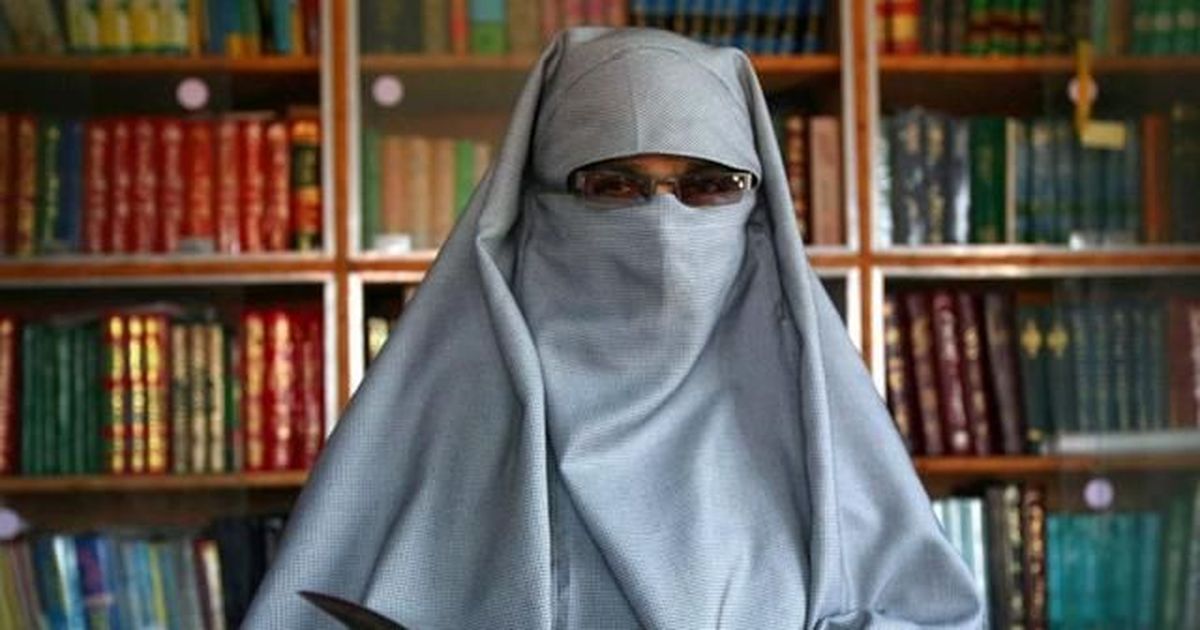
The Indian state’s crackdown on independent Muslim voices continued when a court slapped three life sentences on an Islamic writer and Kashmiri activist, Asiya Andrabi, and two others, for what appears to have been more an attack on ideology rather than any demonstrable crime. Andrabi, who founded the Dukhtaran-i Millat or “Daughters of the Nation” organization, was cleared of terrorism charges but nonetheless punished for what the court deemed to be objectionable ideology and a lack of remorse toward her political beliefs.

Now in her sixties, Andrabi has spent her life in Islamic activism and calling for the end of India’s occupation of Kashmir, which has lasted since the late 1940s and never honoured a promised referendum on the region’s status. Having already spent years in prison earlier in life for her activism, Andrabi’s latest sentence amounts to what her son, Ahmed bin-Qasim, refers to as an effective death sentence.

Ironically even this sentence, by Chanderjit Singh, dismissed a longstanding accusation of the Indian state against Andrabi: that her Dukhtaran organization is the women’s wing of the militant Hizbul-Mujahideen group, which India has banned for “terrorism”. Yet, more troublingly, his case for the harsh sentencing rested on Andrabi’s supposedly radical ideology and in particular her call for Iqamat-i Din, or establishment of the faith. The concept of establishment of faith is a mainstream one in Islam, and one that has been echoed by any number of Muslim thinkers, including Indian Muslim scholars. In practice, this means that the sentence against Andrabi and her two co-defendants – the similarly aged Nahida Nasreen and the disabled Sofi Fahmida – rests on the vilification of a mainstream Islamic concept: this in a country whose Muslim populace is the single largest religious minority in any state worldwide.

Control through Communalism

Keep supporting MuslimMatters for the sake of Allah

Alhamdulillah, we're at over 850 supporters. Help us get to 900 supporters this month. All it takes is a small gift from a reader like you to keep us going, for just $2 / month.

The Prophet (SAW) has taught us the best of deeds are those that done consistently, even if they are small. Click here to support MuslimMatters with a monthly donation of $2 per month. Set it and collect blessings from Allah (swt) for the khayr you're supporting without thinking about it.

The ruling also means that both of Ahmed’s parents are imprisoned on questionable charges. In February 1993, Ahmed’s father Qasim Faktoo, another activist, was jailed for the alleged murder of Kashmiri syndicalist Hriday-Nath Wanchoo despite considerable irregularities in the prosecution.

Ironically Wanchoo had also been a Kashmiri dissident, albeit a leftist who advocated for workers. In fact shortly before his murder both he and Faktoo’s wife Andrabi had been “shadow ministers” in an exile “cabinet” set up by the veteran Kashmiri independence activist Amanullah Khan in the early 1990s; there was no plausible motive for the allegations against Faktoo. However, the Indian state has long accused Kashmir’s Muslims, and Islamic activists in particular, of antagonism toward the region’s Hindu minority and thus framed its crackdown as a protection of Kashmiri Hindus.

During the occupation’s bloodiest years in the early 1990s, the Indian state evicted Kashmiri Pandit Hindus – an ancient elite class – from the region supposedly for their own protection, only to round on Kashmir’s Muslim majority with exceptional brutality including frequent killings, rapes, and expulsions. The portrayal of Kashmir’s Muslims and its Islamic movement as an intolerant tinderbox has scant historical basis, but served to make a virtue of a brutal state crackdown. Accusing a Muslim activist of murdering his Hindu colleague fitted neatly into this paradigm, whereby the Indian state relied on communal division to maintain and justify its occupation, portraying mainstream Islamic views such as Iqamat-i Din as a threat to non-Muslims with no attempt at proof.

Double Standards

This securitized double-standard with Islam has long since extended beyond Kashmir and affected millions of Indian Muslims, particularly under the far-right Hindutva regime of Narendra Modi that has a long record of institutionalizing hostility toward Islam and Muslims. As the independent Kashmir Times noted, the vilification of Iqamat-i Din  also stands in a stark contrast to a 1995 court decision from which, ironically, Hindutva itself benefited. In that case, magistrate Jagdish Verma ruled that Hindutva was not merely a political faction but a societal trend within Hinduism. Here, no such charity is afforded to Islam and concepts such as Iqamat-i Din. In contrast to Muslim and Hindu dissidents in Kashmir, the Indian state has not only tolerated Hindutva but come repeatedly under its control, more so than ever over the past dozen years, despite a demonstrated and established record of violent communalism of the sort never displayed by “terrorists” in Kashmir, let alone civilian activists like Dukhtaran.

The situation in Indian-occupied Kashmir has been particularly galling for decades, and the 2019 annexation of the region by Modi’s regime only served to stifle dissent. However, the flimsy basis on which an Islamic activist in Kashmir can be targeted is another milestone in a persecution that is extending beyond the occupation into the lives and thoughts of Muslims of the Indian mainland: a people who are increasingly disenfranchised from their homeland.

Related:

[Book Review] Hostile Homelands: Drawing Parallels Between Hindutva And Zionism In Historical and Present Day Context

Keep supporting MuslimMatters for the sake of Allah

Alhamdulillah, we're at over 850 supporters. Help us get to 900 supporters this month. All it takes is a small gift from a reader like you to keep us going, for just $2 / month.

The Prophet (SAW) has taught us the best of deeds are those that done consistently, even if they are small. Click here to support MuslimMatters with a monthly donation of $2 per month. Set it and collect blessings from Allah (swt) for the khayr you're supporting without thinking about it.

Ibrahim Moiz is a student of international relations and history. He received his undergraduate degree at the University of Toronto where he also conducted research on conflict in Afghanistan and Pakistan. He has written for both academia and media on politics and political actors in the Muslim world.

Click to comment

Leave a Reply

Your email address will not be published. Required fields are marked *

Trending