
#Current Affairs
Ahmed Al-Ahmed And The Meaning Of Courage
How Ahmed al-Ahmed’s selfless intervention at Bondi Beach exposed the lie of stereotypes and showed the highest expression of Islamic faith in action.

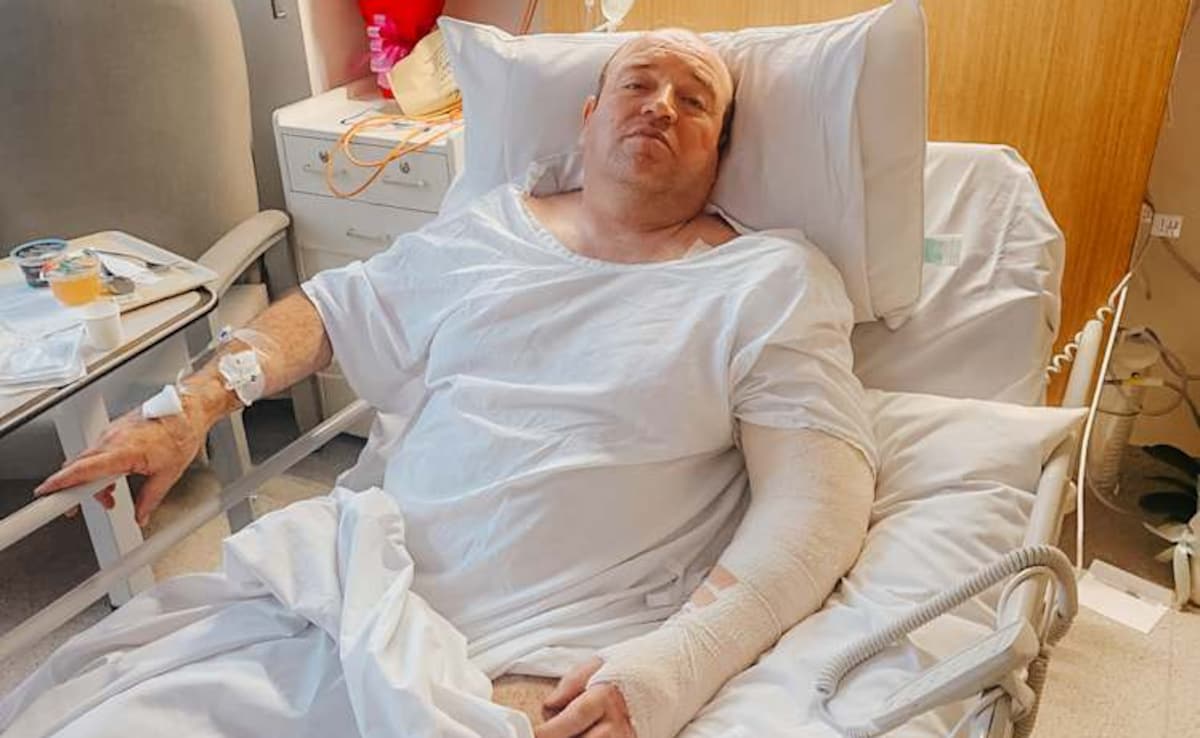
How Ahmed al-Ahmed’s selfless intervention at Bondi Beach exposed the lie of stereotypes and showed the highest expression of Islamic faith in action.
Going Out For Coffee
On the evening of Sunday, December 14, Bondi Beach was crowded in the way only a summer Sunday allows. Thousands of people filled the promenade and shoreline, lingering at the end of the weekend. Among them were hundreds gathered for Chanukah by the Sea, a public celebration marking the beginning of the eight-day Hanukkah festival, held in a small park just off the beachfront.
Ahmed al-Ahmed was there for a far more ordinary reason. He had gone to Bondi with a friend for coffee. A simple plan. An unremarkable outing. Ahmed was not attending the celebration, not looking for spectacle, and certainly not expecting violence.
Keep supporting MuslimMatters for the sake of Allah
Alhamdulillah, we're at over 850 supporters. Help us get to 900 supporters this month. All it takes is a small gift from a reader like you to keep us going, for just $2 / month.
The Prophet (SAW) has taught us the best of deeds are those that done consistently, even if they are small. Click here to support MuslimMatters with a monthly donation of $2 per month. Set it and collect blessings from Allah (swt) for the khayr you're supporting without thinking about it.
Ahmed is 43 years old, a Syrian immigrant from the town of Idlib, who arrived in Australia in 2006. Over nearly two decades, he built a life through patience and work. He became an Australian citizen, opened and ran a small convenience and tobacco store, married, and became the father of two young daughters, aged three and six. His parents, long separated from him by war and displacement, had only recently been able to reunite with him in Sydney.
Shots Across The Sand
Shortly after 6:45 pm, the ordinary rhythm of Bondi Beach shattered.
Witnesses reported that two gunmen opened fire from an elevated footbridge leading toward the beach. Shots echoed across the sand. Video footage later showed people in swimwear sprinting for cover, scattering across open ground with nowhere to hide. Panic spread instantly. Parents grabbed children. Strangers dropped flat. The attack continued for several minutes before police were able to intervene.
Ahmed and his friend arrived to scenes of chaos.
Speaking to Australia’s ABC, Ahmed’s father, Mohamed Fateh al-Ahmed, said his son was shocked by what he saw when they reached the area. Armed men firing into crowds. People lying on the ground. Blood visible on the pavement.
“Their lives were in danger,” his father said. “He noticed one of the armed men at a distance.”
According to the family, Ahmed saw people lying wounded on the ground, some bleeding heavily. At that point, calculation gave way to instinct, and perhaps to training as well, as reports say that Ahmed had been a policeman in his native Syria.
“When he saw people laying on the ground and the blood everywhere,” his father said, “immediately his conscience and his soul compelled him to pounce on one of the terrorists and rid him of his weapon.”
Making A Move
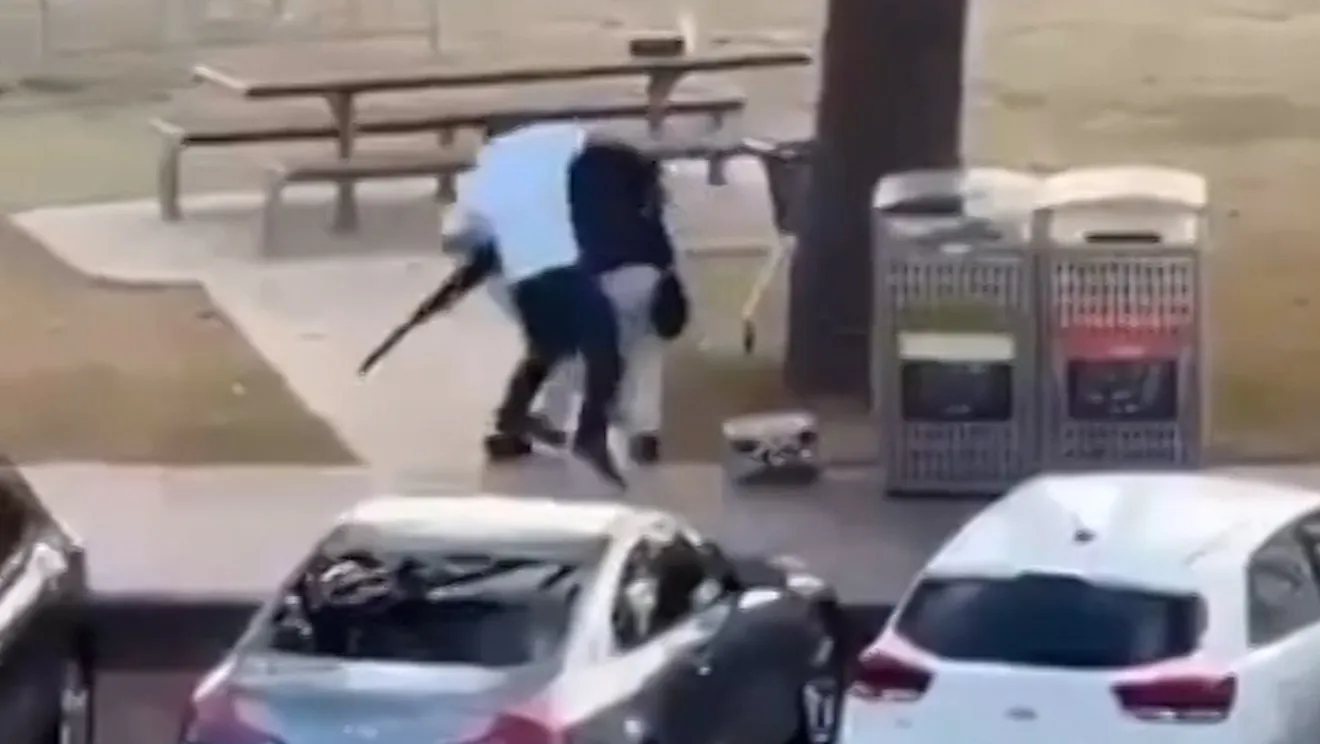
A screenshot shows Ahmed Al-Ahmed wrestling with one of the shooters.
At some point during the attack, Ahmed began sneaking up on one of the gunmen. Reports say that the attacker had momentarily exhausted his ammunition, but I have watched the video several times and there was no indication of that. Rather, it appears that Ahmed crept up between two parked cars, and – as the shooter was still actively firing – charged him from the side.
He charged the attacker unarmed, and wrestled with him for control of the rifle. The shooter fell to the ground, leaving Ahmed in control of the weapon. Again, reports say that during the struggle, Ahmed was shot several times in the shoulder, but I do not see that in the video. Rather, it appears that he was unharmed during the struggle, which leads me to believe that he was then shot by the other attacker, who was still firing from atop a bridge nearby. But this is speculation.
In any case he was shot in the hand and four to five times in the shoulder, with some of the bullets still lodged inside his body, according to his parents. He was rushed to hospital and underwent emergency surgery.
In the hours that followed, family members described the toll the injuries had taken. Jozay, a cousin of Ahmed, said that he was recovering from his first surgery and had two more operations still to come. “He took a lot of medication, he can’t speak well,” Jozay said after leaving the hospital on Monday evening.
Couldn’t Bear To See People Dying
Another cousin, Mustafa al-Asaad, told the Al Araby television network that Ahmed’s intervention was not driven by anger or impulse, but by something deeper.
“When he saw people dying and their families being shot, he couldn’t bear to see people dying,” Mustafa said.
“It was a humanitarian act, more than anything else. It was a matter of conscience. He’s very proud that he saved even one life.”
Mustafa recalled Ahmed explaining the moment in simple terms.
“When he saw this scene, people dying of gunfire, he told me, ‘I couldn’t bear this. God gave me strength. I believe I’m going to stop this person killing people.’”
The attack ended. Many lives were lost, but – without a doubt – many lives were also saved by Ahmed’s heroic actions.
What Would You Do?
It’s easy to call someone a hero after the fact. It is much harder to grasp what such a moment actually demands. Which raises a question that should unsettle us.
What would you do in that situation? What would I do?
I am a trained martial artist. I have spent years in classes gaming out scenarios exactly like this. How to tackle an active shooter, how to control the weapon, how to disable the shooter and create distance. But class training is one thing. Seeing it happen in real life, with the noise of the shots, the screams, the chaos, is something else altogether. I like to believe I would act courageously. I like to believe training and moral conviction would carry me forward. But only Allah knows.
Because this is the reality: if the shooter had spotted Ahmed’s approach – if he’d caught a glimpse out of the corner of his eye – and turned – Ahmed would be dead. He’d be shot dead in the parking lot, leaving his two young daughters without a father. And he undoubtedly knew that. Think about that.
None of us truly knows what choice we will make until we are confronted, face to face, with that level of evil. Training, faith and strength of character all help. But certainty only arrives when fear, instinct, and conscience collide in real time.
Ahmed al-Ahmed does not have to imagine.
When asked about his actions, he expressed no regret. He did not speak of bravery or heroism. I cannot speak to his specific religious convictions, as the reports do not mention this. He might be a Sunni, Shiah or Alawi. He might be practicing or not. But he bears the name of our beloved Prophet (s), and he gave the credit for his actions – as any believer would – to Allah, saying that God granted him courage.
Ahmed’s father emphasized that his son’s decision was not shaped by identity or affiliation.
“When he did what he did, he wasn’t thinking about the background of the people he’s saving, the people dying in the street,” Mohamed Fateh al-Ahmed said. “He doesn’t discriminate between one nationality and another. Especially here in Australia, there’s no difference between one citizen and another.”
A Grim Irony
There is, however, a grim irony that cannot be ignored.
Authorities later confirmed that the attackers were also Muslim immigrants. This fact, widely reported, inevitably stirred anxiety within Muslim communities already accustomed to collective suspicion.
The man that Ahmed wrested with and disarmed was named Sajid Akram. He was 50 years old, originally from India. According to reports, he and his son were inspired by ISIS ideology.
Here, on the same beach, in the same violent moment, stood two radically different representations of what it means to invoke Islam.
On one side, a profound betrayal of faith. A reduction of religion to grievance, rage, and indiscriminate murder. On the other, the apex of faithful action, a man who ran toward gunfire to protect strangers, including members of another religious community, without hesitation and without calculation.
Have we, in recent memory, seen a clearer reminder that no group is monolithic? That no religion, race, or nation can be reduced to its worst representatives? That Islam can be invoked as a pretext for horror, or lived as a shield for others?
Whoever Saves One Life
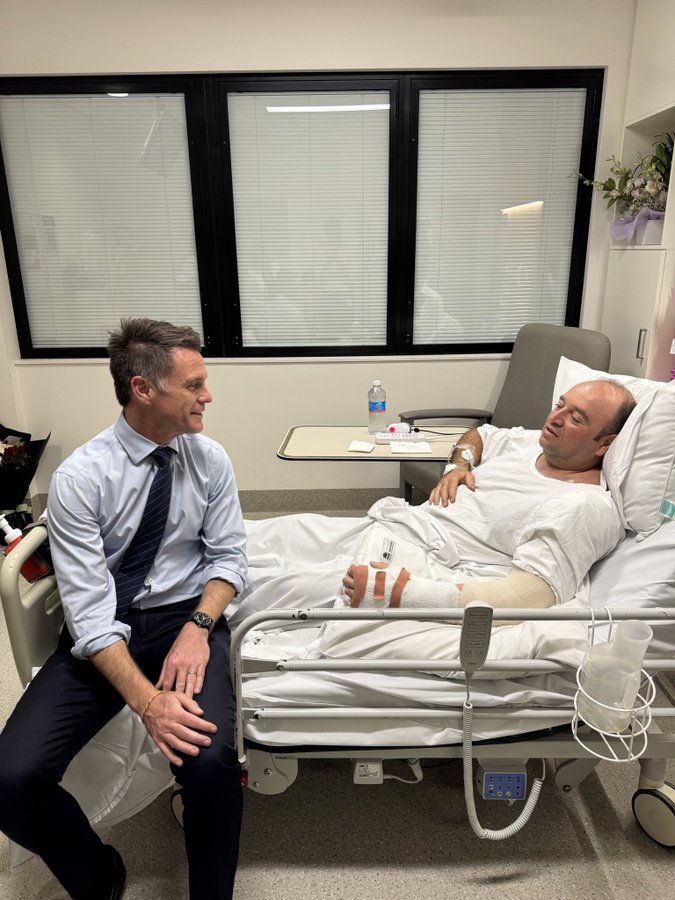
Chris Mims, New South Wales premier, visits with Ahmed Al-Ahmed.
In the days that followed, public gratitude poured in. Political leaders visited Ahmed in hospital. Fundraisers raised extraordinary sums (over a million dollars, it is said) to support his recovery and his family. Officials credited his intervention with saving lives.
For Muslims, the value of a life saved is not dependent on that person’s faith, character, nationality or identity, for Allah tells us in the Quran:
“Whoever saves one life, it is as if he has saved the lives of all humankind.” (Quran 5:32)
This is especially true when you save a stranger. By saving the life of someone you don’t know, you have symbolically saved the life of anyone and everyone. Ahmed Al-Ahmed, therefore, saved my life and yours, as well as that of everyone else in the world.
Let’s Choose Our Own Heroes
This is an age when Western entertainment culture is relentless in shaping our imagination of heroism, trying to force its own imprint onto our brains. The hero is a mythical Norse god wielding lightning, a billionaire playboy in an iron suit, a Superman wrapped in red, white, and blue. These figures are entertaining, but they are not moral templates.
We already have heroes.
At the dawn of Islam, we have the sahabah. Hamzah ibn AbdulMuttalib at Badr. Nusaibah bint Kaab, Musab bin Umair and Talhah bin Ubaidullah at Uhud. Salman al-Farisi, Ali ibn Abi Talib, and Hudhaifah ibn al-Yaman at Khandaq. And any others. Men and women whose courage was inseparable from humility, restraint, and devotion to Allah and His Messenger.
In the modern age, we must choose our heroes as well. Not from movie screens or marketing campaigns, but from real human beings who act rightly when it costs them dearly.
Ahmed al-Ahmed is one such hero. No, I’m not comparing him to the sahabah. But we do not live in the time of the sahabah. We live in an age of runaway technology, overhwelming mass media, and widespread oppression and corruption. We must laud our heroes when they appear.
Ahmed is not a hero because he is flawless. Again, I know little about his personal relgious convictions. He is a hero because, in one decisive moment, he chose other poeople’s lives over his own safety, conscience over calculation, and mercy over self-preservation.
Sources
-
-
ABC News (Australia)
Interviews with Ahmed al-Ahmed’s father Mohamed Fateh al-Ahmed regarding the events at Bondi Beach, Ahmed’s injuries, and his motivations. -
News.com.au
Reporting on Ahmed al-Ahmed’s background, injuries, surgeries, and public response following the Bondi Beach attack. -
NSW Police Force Media Releases
Official statements on the Bondi Beach public place shooting, timeline of events, and police intervention. -
The Guardian (Australia)
Coverage of the Bondi Beach attack, investigation details, and confirmation of the attackers’ identities. -
SBS News (Australia)
Reporting on Ahmed al-Ahmed’s medical condition, recovery, and statements attributed to family members. -
Al Araby Television Network
Interview with Ahmed’s cousin Mustafa al-Asaad describing Ahmed’s actions as a humanitarian act and a matter of conscience.
-
Related:
A War Hero Comes For Taraweeh – The Remarkable Story Of Hajjah Hasna al-Hariri
Keep supporting MuslimMatters for the sake of Allah
Alhamdulillah, we're at over 850 supporters. Help us get to 900 supporters this month. All it takes is a small gift from a reader like you to keep us going, for just $2 / month.
The Prophet (SAW) has taught us the best of deeds are those that done consistently, even if they are small. Click here to support MuslimMatters with a monthly donation of $2 per month. Set it and collect blessings from Allah (swt) for the khayr you're supporting without thinking about it.




15 Things You Didn’t Know About Makkah and the Ka’bah [Part 2]

Widening Wars Leave the Middle East in Shambles
15 Things You Didn’t Know About Makkah and the Ka’bah [Part 1]

Eid Mubarak from MuslimMatters

Selamat Hari Raya! – Celebrating Eid In Malaysia

[Podcast] Ramadan Is Not For Your Private Spirituality | Dr Farah El-Sharif

She Cried At The Door Of The Masjid: A Case For Children In Mosques

The Trials Playlist: A Chaplain’s Set To Steady Your Heart

Every Sin Has a Cure | The Venom and the Serum Series

[Podcast] Is Your Sadaqah Paying an Influencer Instead of Going to Charity? | Mufti Abdullah Nana & Dr Shafi Lodhi

Coming Full Circle: Who Are You Now? | Night 30 with the Qur’an

Running Away From Who We Are | Night 29 with the Qur’an

Building From the Ground Up: Week 4 Recap | Night 28 with the Qur’an

The Muslim You Are Becoming | Night 27 with the Qur’an

What Will You Leave Behind? Legacy in Islam | Night 25 with the Qur’an
-

 #Current Affairs1 month ago
An Unending Grief: Uyghurs And Ramadan Under Chinese Occupation
-
#Society1 month ago
Where Does Your Dollar Go? – How We Can Avoid Another Beydoun Controversy
-
#Current Affairs4 weeks ago
[Podcast] Ramadan Is Not For Your Private Spirituality | Dr Farah El-Sharif
-
#Islam1 month ago
Who Am I Really? What Surat Al-‘Asr Teaches Muslim Teens About Identity | Night 1 with the Qur’an


Amer Rizvi
December 16, 2025 at 9:28 PM
Salaam. I hope this comment finds you well. Thank you for the informative article.
I would like to clarify that Sajid Akram was NOT originally from Pakistan. He was from India and held an Indian passport. This was confirmed by Indian authorities and reported by DAWN (dawn.com), a reputable Pakistani newspaper, acknowledged by the New York Times, the BBC, and Reuters for its reliable reporting.
We praise Allah for the brave actions of Ahmed al-Ahmed and pray for his full and speedy recovery.
While this is rightly a story of heroism, it also shows a more concerning side of our Islamic community in America.
When I taught English at an Islamic (Sunni) school in the richest county in the United States, I observed something striking. In their Qur’an hifz and Seerah classes, taught by a Qur’an hifz teacher and a Shaykh with a PhD, Muslim students appeared quiet, respectful, and disciplined.
However, in my English class, where students were encouraged to think, be creative, and speak freely, I sometimes observed a very different side of their behavior.
Here is part of a story written during Ramadan by an eleven-year-old student, exactly as it was submitted (uncorrected). I share this as an example of what I observed in the classroom:
“He ran to his car, grabbed his blicky, and changed his fit. Then ran back in wearing a hellstar (?) ski-mask, black Nike tech track suit, and black cut (?) Jordan 4’s. He proceeded to shoot up the place with his slime homies. After 15 minutes they ran to the car with the getaway driver inside.
He made it back home at around Sunset so he broke his fast, made wudu, prayed, and ate. He ate fried chicken, watermelon, and Kool aid. He then prayed Isha and went to sleep.”
I grew up in Pakistan in the 1970s as a child, and was unfamiliar with this slang, nor was I exposed to racism. What was troubling was seeing students use violent and offensive racial slang from popular Western culture when given freedom to express themselves, while at the same time showing outward signs of piety.
I reported this immediately to the child’s father, the principal, and the school security officer after reading it.
This does not take away from stories of Muslim heroism, and it does not define all Muslims in America, of course. However, it does raise important questions about moral guidance, identity, and the outside influences shaping Muslim children growing up in Western societies, issues we should address honestly.
GregAbdul
December 17, 2025 at 12:45 PM
Brother we got to quit. This is an immigrant game. Hispanics say “I am from Cuba” so I am not like the bad hispanics. Pakstanis are from the Inidian continent! They are your people, no matter how much you say you hate your blood cousins. The line you are drawing is COLONIAL. “I was not exposed to racism in Pakistan…” is a LIE. Brother pretending perfect and how great you are and your culture only serves shaytan.
Wael Abdelgawad
December 17, 2025 at 3:05 PM
I don’t really get what you’re saying. The article has nothig to do with racism, and the fact that Ahmed Al-Ahmed is Arab and the shooter is Indian is besides the point. The story is about Ahmed’s heroism in stepping up and stopping a massacre, regardless of the shooter’s nationality or religion.
Amer Rizvi
December 17, 2025 at 1:17 PM
This comment contains personal attacks and demeaning language toward entire groups, which crosses the line into harassment and hate speech. Such comments are harmful to community dialogue and should be removed. Quite surprised MuslimMatters.org allows this type of speech!
Amer Rizvi
December 17, 2025 at 1:29 PM
P.S. There IS Palestine.
GregAbdul
December 17, 2025 at 1:56 PM
asking you to stop bragging on you, your culture and your people is an attack? There is NO palestine and this false talk has killed so many Arabs for the racist idea of they will never live with Jews. Fine, but that means they will have to move. TWO options (like Trump and the Black Lady last year)….Either the Arabs learn to live with and integrate with the Jewish government so they are not slaughtered like animals or they need to leave. Arab racism or Pakistani racism does not change the facts on the ground.
Amer Rizvi
December 17, 2025 at 4:41 PM
@Gregabdul Brother, where did I say I hate my “blood cousins”? We have relatives in India, and many Muslims live there.
I brought this up to clarify that the person who did the shooting was originally Indian, not Pakistani. This was important for readers of the article to know.
Also, brother, the first time I experienced racism was in school here in America. I couldn’t understand it. It was hurtful. This is my honest experience.
Thank you for trying to keep it polite :-)
Amer Rizvi
December 17, 2025 at 4:46 PM
@Gregabdul Brother, where did I say I hate my “blood cousins”? We have relatives in India, and many Muslims live there.
I brought this up to clarify that the person who did the shooting was originally Indian, not Pakistani, as mentioned in the article. This was important for readers of the article to know
Also, brother, the first time I experienced racism was in school here in America. I couldn’t understand it. It was hurtful. This is my honest experience.
Thank you for trying to keep it polite :-)
Karim
December 17, 2025 at 5:58 PM
Great article and message! Its always important to highlight such great examples of heroism during tragedy. And the reflection upon what would we do and which examples to follow is an excellent point for us all to reflect on. Thank you and will share!
GregAbdul
December 17, 2025 at 8:02 PM
Thank you. May Allah reward you for your attention. Too often we don’t want things to be about race when they are. Forever the idea of Jews and Arabs sharing a space, the reason Arabs have totally rejected it is because they will be sharing with Jews who are not Arabs.
We have spent 75 years confusing the world. If you ask, non Muslims do NOT know the Shahadah is the core of Islam. I know when I converted and tried to explain to my family, they looked at each other in a pitiful way and then at me and then started talking about a certain Jew they know and love so much.
As I said, we want it to be a coincidence that the bad racist Muslims who do terrorism and do suicide trying to kill Jews, their defenders in America decided to side with the white racist GOP, even though the GOP hates Muslims (outside of Saudi money). The GOP does not even have a policy. Oh! Not whites and not white religion are ruining America. But we have Muslims for Trump or Biden Genocide. They made things WORSE.
We do have many Jew haters in our mosques. It has been nurtured for years. Often Muslims are taught that Jew hating is basic doctrine instead of the Shahadah. Pretending it is not about race is a white or imitation white thing.
67,000 Palestinians have been killed the last two years but the news these days ignores them because of the 15 Jews killed in Australia. That is about race.
GregAbdul
December 17, 2025 at 8:30 PM
Brother Wael, I know only know to be as short as I can so I do not waste your time. In America, in the West, there is a rise in white Christian nationalism. Trump is the leader and savior. Some of us say we are fighting gays and public education and side with OPPRESSORS. Don’t remember the Quran verse that says fight gays or being gay is the worst oppression. We have good and bad Muslims. Good Muslims fight oppression. They do not sneeky stand with white racists hoping anti-Blackness will secure them a place in the white community. Jew hating is about race. Blacks and Jews are historical partners. I hate Bibi, but we need to quit misleading people about Islam. Islam is NOT “Palestine.” Racism inspired the bad Muslims in your article.
Amer Rizvi
December 21, 2025 at 10:09 AM
Salam!
@Gregabdul, I would like to reply to some comments you made, particularly regarding our Palestinian sisters and brothers and about whites in our country. I find these comments stereotypical and offensive.
You state that, “There are Arabs living under Greater Israel who must decide if they live under Jewish rule or LEAVE.” This is how you wrote it, with the word “LEAVE” capitalized. This was so hurtful for me as a Muslim.
The Prophet Muhammad, may Allah bless him and grant him peace, said that the entire Shaam (the Levant, which includes Palestine) is ours. He, may Allah bless him and grant him peace, said in an authentic narration: “O Allah, bless us in OUR Shaam and OUR Yemen.” By “our”, he, May Allah bless him and grant him peace, meant the Muslims.
Further, in an authentic narration, when the Prophet, may Allah bless him and grant him peace, struck a rock before the Battle of the Trench, he, may Allah bless him and grant him peace, saw a light from the rock that illuminated the palaces of Shaam. A similar light, illuminating the palaces of Shaam, was also seen by the Prophet’s, may Allah bless him and grant him peace, mother. Palaces were places from which kings ruled. Scholars have understood this to mean that political authority in Shaam, which includes Palestine, would belong to the Muslims there.
There are many other hadeeth and actions of the Sahaba (Companions), may Allah be pleased with them all, that show the special status of Shaam and its people.
Your statement that the Arabs of Palestine, most of whom are Muslims, should “live under Jewish rule or LEAVE” directly contradicts what the Prophet Muhammad, may Allah bless him and grant him peace, wanted.
Further, your affirmation of a “Greater Israel” aligns precisely with the stated aims of Benjamin Netanyahu, a criminal indicted by the ICC for war crimes and mass murder.
Your statement, “There is NO Palestine,” is false and deeply hurtful to Muslims. You capitalized the word “NO.” This statement denies an entire people their identity, culture, history, and existence. Even some Zionists do not make this claim! Maps predating the creation of Israel labeled the land as Palestine. Coins minted before the creation of Israel bore the name Palestine. Even the soccer team represented the country of Palestine. The fact that Zionists from Europe seized Palestine by force and renamed it Israel does not erase this historical truth.
Further, in response to my comment on Brother Robert McCaw’s op-ed, “What Muslims Will Really Be Talking About Over Halal Turkey This Thanksgiving,” I mentioned that our family would be discussing Palestine and that we were encouraged by the stance of Mayor-elect Zohran Mamdani. You replied, “NO ONE is thinking about ‘Palestine’ except you.” How can anyone say this after witnessing the immense suffering of the Palestinian people, and especially on a day called Thanksgiving?
You also wrote, “Islam is not Palestine.” Palestine was known as Shaam by Prophet Muhammad, may Allah bless him and grant him peace, and Shaam is explicitly mentioned in Islam. The Prophet, may Allah bless him and grant him peace, said in an authentic narration: “O son of Hawala, Allah has guaranteed me the people of Shaam.” This refers to the Muslims of Shaam, which includes the Arab Palestinians.
Other authentic hadith indicate that the people of Shaam will be specially blessed, rightly guided, and supported by Allah. We are commanded to love them. Statements suggesting that Palestinian Muslims living in this land should live under foreign rule or leave stand in opposition to the Sunnah.
Finally, I want to address racially offensive and demeaning remarks you made about white people. You wrote: “You are closet Muslims running after white ilahs. They will never accept you.”
Even more disturbing was your statement: “Stop lying on Islam so you can chase racist white money, walking around with a shaved face like a pig’s behind.” It was troubling that moderators at MuslimMatters.org allowed this kind of language to remain until I complained (Please see my complaint above.) What kind of dawah (religious propagation) is it to antagonize the majority population in our country?
The Prophet Muhammad, may Allah bless him and grant him peace, said: “There is no superiority of a white person over a Black person, nor of a Black person over a white person, except by taqwa.”
To brother Wael, on framing Ahmed Al-Ahmed’s story:
You describe this as a story about Ahmed “stepping up to stop a massacre regardless of the shooter’s nationality or religion.” I see it as a story of a courageous Muslim, Ahmed, attempting to stop a racist, anti-Semitic extremist, intent on murdering people engaged in worshiping God. To me, it is fundamentally a story about moral courage, anti-racism, and opposition to antisemitism.
It also invites reflection within our own communities, including Islamic schools, to ensure that hatred, whether against other Muslim sects or people of different faiths, is addressed early and decisively. Readers should not be faulted for engaging an article from a different analytical angle.
I raised the issue of the shooter’s nationality because you incorrectly misidentified him as Pakistani. This was a problematic mistake made by several media outlets in the immediate aftermath. Correcting this mistake mattered to me, particularly for Pakistani American readers of MuslimMatters.org, out of respect for their community and identity. Given the loss of human life involved, accuracy and careful sourcing are essential.
Thank you!