She didn’t know that the $20 scarf she wrapped around her head that morning would result in a $25,000 lawsuit .
She walked into the job interview for Morningside House of Ellicott City: a confident, well educated professional. Excited, about to graduate from nursing school and after spending years caring for other’s children as a childcare worker, she was starting a new chapter of her life. A heartfelt prayer to Allah mumbled under her breath and she opened the door.
The ad for a Nurse’s Assistant (CNA) in the senior assisted living community had been on several job websites. Her professors recommended the extra experience, so even though she was overqualified she applied for it. She got a same-day interview when she called; a very common practice in the industry.
Keep supporting MuslimMatters for the sake of Allah
Alhamdulillah, we're at over 850 supporters. Help us get to 900 supporters this month. All it takes is a small gift from a reader like you to keep us going, for just $2 / month.
The Prophet (SAW) has taught us the best of deeds are those that done consistently, even if they are small.
Click here to support MuslimMatters with a monthly donation of $2 per month. Set it and collect blessings from Allah (swt) for the khayr you're supporting without thinking about it.
In any job interview what stressful questions do one prepare for? Usually about one’s degree, achievements or experience but certainly not on the applicant’s choice of headgear. This is exactly what Khadijah Salim of Baltimore City, MD endured. “For 15 minutes I was asked over and over again to explain my hijab.” Salim spelled out how she had worked with patients, from the operating room to geriatrics to the psych ward, during her clinical rotations, without any issues.
Morningside will pay $25,000 and furnish other relief to settle a religious discrimination lawsuit filed by the U.S Equal Employment Opportunity Commission (EEOC) in June 2011, according to the agency. The EEOC had charged that Morningside House of Ellicott City denied hire to Salim because she refused to remove her hijab.
The director of health services of this particular facility of Morningside House (a corporation which manages several properties) was the one who conducted the interview. Looking at her up and down, she started her questions based on Khadija’s appearance. Confident in her vibrant fashion sense, that day Khadija had worn pants, a formal shirt and a well-coordinated hijab.
“She said I would scare the patients! I have never scared anyone in my life, do you know how hurtful that is, to think that I would scare someone?” Salim’s voice tightened over the phone. “One of my elderly patients during my rotations thought I was an angel.”
“I showed her how I tied it up around patients, assuring her that it would not be in the way but her demeanor did not change. She even handed my application back to me. We didn’t talk about anything else. She finally just asked me, “Would you be willing to remove it while you are working for the facility?” Said Salim, “as I left she asked me what hours I was willing to work.”
Offended and shocked, Salim says that she couldn’t believe that it was 2010, and in a place with so many Muslims. “I am not sensitive about hijab, I’ve worn it since I was a little girl and have no problems answering genuine questions about hijab,” stressed Salim.
Although she was told she would be contacted if someone were interested in her, she was never contacted, nor was she one of ten CNAs who were hired by Morningside in September 2010.
Salim is no stranger to the civil rights movement, as a young African American Muslimah, it had been a family legacy. She was also very familiar with the work done by CAIR (Council on American Islamic Relations) as she grew up down the street from its co-founder, Nihad Awad.
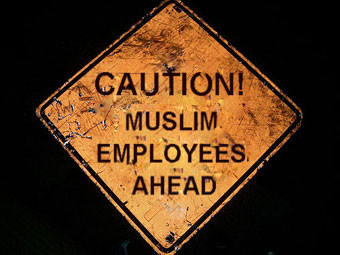
Nationally cases have been filed based on several basis: accommodating prayer times, adjusting work schedules to accommodate Friday prayers, the ‘no pork’ rule and the hijab criteria, etc. Many times the discrimination is subtle quoting customer preferences, companies will relegate visibly Muslim workers to jobs that are lower paid jobs or ‘low- visibility’ jobs.
In California, two similar cases to Salim’s made headlines; the Abercrombie & Fitch cases and the Disneyland lawsuit.
Hani Khan from San Mateo, CA, a 20-year-old college student, is one of three women suing Abercrombie & Fitch for either not hiring, or firing, women wearing headscarves. Samantha Elauf, a 19-year-old student from Oklahoma, filed suit in 2009, and an unnamed 18-year-old woman from Milpitas, CA sued them in 2010.
Imane Boudlal is suing Walt Disney Co. in federal court, saying that she was discriminated against and harassed for her religious beliefs. She also alleges that she unfairly lost her job in 2010 after refusing to remove her hijab at work.
According to the New York Times, although Muslims make up less than 2 percent of the United States population, they accounted for about one-quarter of the 3,386 religious discrimination claims filed with the E.E.O.C. last year.
Locally, 6.8 % of the total US charges for religious discrimination filed by the EEOC has been from the DMV area.
From 2001 to 2008, religious discrimination cases filed with the EEOC have seen a 35 percent increase. According to experts, like Sahar Aziz, Esq., even these numbers are low as many Arabs and South Asians of Islamic heritage refuse to report discrimination because they fear losing jobs in these tough economic times.
In 2009, the EEOC received 1,490 complaints from Muslims, the fifth consecutive year the number of complaints rose. In 2011, the number of cases had reached a staggering 4151.
“The trend could reflect a rise in Islamophobia in the workplace or an increased willingness on the part of Muslims to report discrimination — or both,” stated one observer.
“In this [Salim’s] case, there was no undue hardship to the employer — just an apparent overreaction to a reasonable request because of myths and stereotypes about a religion,” EEOC Regional Attorney Debra M. Lawrence said in the EEOC statement. The EEOC files cases for only 5 percent of the it receives.
“I have been on enough job interviews to know what’s up. Initially, I was not even looking for monetary compensation, I was just asking for an apology and that is why I contacted CAIR. If they don’t even acknowledge their mistake, how are they going to rectify it?” asked Khadijah.
Khadijah was eventually hired by another hospital as an RN.
Under Title VII of the Civil Rights Act of 1964, employers have an obligation to accommodate an employee’s or applicant’s sincerely held religious beliefs unless it creates an undue hardship. In the Salim case, the EEOC filed suit after first attempting to reach a pre-litigation settlement through its conciliation process.
Title VII is a federal law that prohibits employers and other covered entities from discriminating against an employee or job applicant because of the person’s race, color, religion, sex or national origin. The Pregnancy Discrimination Act is incorporated into Title VII. Title VII also protects against retaliation and requires employers to make reasonable accommodations for religion.
Each state also has their own discrimination laws ie. the DC Human Rights Act prohibits employment discrimination on the basis of race, color, religion, national origin. sex, age, marital status, personal appearance, sexual orientation, gender identity or expression, family responsibilities, genetic information, disability, matriculation, or political affiliation.
The Virginia Human Rights Act prohibits discrimination because of race, color, religion, national origin, sex, pregnancy, childbirth or related medical conditions, age, marital status, or disability.
In addition to $25,000 to Salim, the settlement enjoins the senior living home from further discriminating against any individual on the basis of religion, requires religious discrimination training to supervisors, managers and all involved in the hiring process to post a notice stating the company’s commitment to maintaining an environment free of religious discrimination as well as to submit copies of any complaints about religious discrimination to the EEOC for a period of two years.
On their website, Morningside says that that all Morningside managed properties are Equal Opportunity Employers. Efforts to reach Morningside to discuss the implementation of their religious discrimination training were not responded to.
This summer, a Metro employee sued the agency over practices that limited her ability to take off Fridays to attend Jumuah salah. Najmah Rashad is a secretary in the agency’s legal office. Her lawsuit, filed in the District of Columbia, is seeking $400,000. She had offered to work late and come in early on other weekdays in exchange for taking time off on Fridays.
In February 2009, Metro settled a complaint by the U.S. Justice Department that said the transit agency discriminated against at least three women. A Pentecostal Christian woman was not allowed to wear a skirt in accordance to her faith, she was training to become a bus driver. Two Muslim employees were not allowed to wear hijab on the job. Metro agreed to pay all three women, provide religious sensitivity training for all supervisors and managers, plus create a policy accommodating religious practices.
“If you spend most of your interview talking about how you look or your appearance, then you might want to think, is this a fair and just interview?” said Salim. “I recommend the EEOC, they are a very fair organization.”
It is generally illegal for a covered employer to fail or refuse to hire, to fire, or to otherwise discriminate against an applicant or employee with respect to compensation, terms, conditions, or privileges of employment, because of such person’s race, sex, religion, color, national origin, or other protected category. Unless the company can establish “undue hardship,” it is also unlawful for a covered entity to fail to provide a “reasonable accommodation” to an employee or applicant’s religion or disability. It is also illegal to retaliate against someone for exercising rights under employment discrimination laws.
Cases like these take an emotional toll on the victims, as the legal process is long and involvs many meetings and negotiations and can also put the victim in the media spotlight. “It was nerve wrecking. They called me a liar and denied everything,” she stated. “I had whole blog posts on me. It was so hurtful, I just stopped Googling my name.”
Khan, the Muslimah in the Abercrombie & Fitch case, said she received death threats after her story went public.
A look inside the blogosphere finds a common complaint that Muslims as well as followers of other faiths are asking for special privileges. The most resonating response to this accusation is that Christians need to check their privileges, as even though there is separation of church and state in the U.S., the holidays and celebrations are structured around Christian dates. More so as the dominant faith they can practice their beliefs without the fear of be mocked, inhibited or denied opportunities, especially opportunities that they are well qualified for.
Salim felt that people may judge her as a fraud or a troublemaker after this case. “My biggest support was my family and [reminding] myself of what the Sahaba (Companions of the Prophet) went through.” said Salim.
“I had to stand up. How am I going to raise two Muslim daughters to wear the hijab without fear, if I don’t do this?”
written for the The Muslim Link newspaper





![faith is resistance [WANNxMM]](https://c7c8edde.rocketcdn.me/wp-content/uploads/Faith-is-Our-Way-of-Resistance-1-400x240.png)
![faith is resistance [WANNxMM]](https://c7c8edde.rocketcdn.me/wp-content/uploads/Faith-is-Our-Way-of-Resistance-1-80x80.png)


 #Islam3 weeks ago
SK
December 14, 2012 at 9:11 AM
I dont think these lawsuits will have a positive impact. It only antagonizes an employer.
Why not just apply somewhere else and try to educate the employer in a more positive way.
Lawsuits mostly result in polorizing both parties, causing hatred, animosity and anger
.
What about the employer who now has to pay $25,000 because they hurt this woman’s feelings?
mww_m
December 14, 2012 at 6:59 PM
All that is necessary for evil to prevail is for good people to do nothing
Muslim_Always
December 15, 2012 at 9:50 AM
Are you serious? She did the right thing by suing that employer. It is good when Muslims fight until Islam becomes supreme in the land.
moderatebutconservative
December 17, 2012 at 3:32 PM
calm down bro, not so fast. iA one day Islam will be supreme, but it came off really harsh in that comment.
Ali (@Ruh_shu)
June 8, 2013 at 3:36 PM
Yeh.. lets keep that a secret until we get strong.
johnnnyringo
May 5, 2016 at 5:41 PM
Your so stupid , if someone violated your rights you would sue aswell . the employer broke the law . shall we throw all the laws out to for you .
Tarannum
December 14, 2012 at 11:34 AM
ASA,
I think this is an excellent article.
SK: Walking away from wrong being done to us or someone else is not the sunnah of muslims. We are supposed to encourage what is good and stop what is wrong. If injustice is done to 1 person person today, the employer will feel free to do the same or more injustice to 10 others. If all of them are quite about it, then the generation to come will be taught to be subordinate to others.
Thats not who we are and thats certainly not how we want to raise our children. Speak up against injustice whether its done to you or someone else.
Allahu Alam
SK
January 16, 2013 at 9:18 AM
Is a $25,000 lawsuit a just response to having your feelings hurt.
What if you were sued every time you said something harsh, would that be just?
I am asking if the response was proportionate to the harm inflicted?
lias30before30
August 30, 2013 at 12:03 PM
Yes, it was an appropriate response. It is more then just hurting ones feelings. Her rights were violated and I would expect if the discriminated against a Jewish man or a person wearing a cross that they would fight for their rights too.
johnnnyringo
May 5, 2016 at 5:45 PM
SK how did you become such an arsole , did you study for it. If you could read you see that the employer broke the law , the discrimination law , you complete arsole .
Mahmud
December 15, 2012 at 1:14 AM
Assalamualaikum wa rahmatullahi wa barakatuh
Lets put up the lawsuit and demand a public apology.
Then, if that doesn’t work for a while, start demanding money as compensation.
What matters is the akhirah. Let’s show non-Muslims the character our Lord gave to Nabi sallallahualayhiwasalam.
SK
December 18, 2012 at 2:28 AM
Asa
When a wrong was done to the Prophet Muhammad pbuh, how did he respond. With a lawsuit?
It is good to respond with good but is it a proportionate response to and how do you think that employer feels towards Muslims now?
Their r better ways to respond and the example of how the Prophet Muhammad pbuh responded is where web should look.
johnnnyringo
May 5, 2016 at 5:50 PM
SK …….the prophet never had a job in u.s.a. you idiot. the employer broke the law fool . so its okay for everyone else to sue but not muslims . What a sad bitter twisted racist arsole you must be SK.
Abu Sumaiyah
December 18, 2012 at 4:57 AM
I dont believe that discrimination at work is as common as people think. I think that many Muslims have this victim mentality and think that someone’s action are against them because they happen to be Muslim. My wife worked in a Jewish hospital in Toronto for over 5 years and faced only one incident. However, this was from one worker. The hospital management responded by having all employees take a cultural sensative course. Also, my wife has a friedn that used to work for Canadian Pacific Rail. This company actaully had a custom mae uniform for her and made sure that what she served ddint have pork or alcohol. For myself, I never had problems at work with going to pray on Friday or anythig. The reason why I think this si in people’s minds is because thye think everyone is against them. I once wrote a eltter for a brother who wanted a bursary for university. I explained in his letter that he was a Muslim and couldnt take an interest based loan. He got all upset and though the KGB would be after him. Come on were not in the Soviet Union. While many westerners are opposed to Muslims, they are not willing to mes up their company’s standing and repuation, not to mention theit financial wellbeing over a one hour prayer service. I personally know that many Muslims are afraid to say tey are Muslims and ask to go pray. Tne they turn aroun and say oh these dirty non-Muslis. I wanna go to a Muslim country where I can be Muslim. Come on this is a joke. The problem is with many Muslims being afraid to ask. In fcat I worked for some jewish people and they gave me a seperate room to pray in when needed. I never had a problem. This is not to say that it doesnt happen or it wont happen but I just think many thinsg are imaginary, or just a plain misundersatnding. B the way, at least here in Canada, there are bonafide occupation hiring requirements. I think the US has this too, but under a diffretn name. Anyways, a company is allowed to discriminate against hiring someone if hiring that person causes undue hardship. Really a Muslim woman or man has no business working at Ambercrombie and Fitch. Wear the clothes no problem. Woring there is different story. I think ita high tie Muslims stop playing the religon card.
Tara
June 13, 2013 at 1:02 PM
@SK – 1. there is no assurance that anyone would receive $25k
2. This isn’t about “hurt feelings” – it’s about what is right and wrong. We are a country of laws and breaking the law by discriminating against an employee based on their religion is against the law. Therefore, the criminal needs to be brought to a court, tried by a jury of his or her peers, and accept the consequences for their actions.
3. As Tarannum said – the same employer will continue to do the same injustice to others until they are confronted.
Ibrahim
June 16, 2013 at 8:22 AM
To SK,
Hi there! Ibrahim here! Convert of two years and looking forward to my 2nd (and hopefully more successful) Ramadan. I can somewhat understand what you are saying. It often seems that people are sue happy sometimes doesn’t it? Just out to make a quick buck, by taking advantage of something of a small issue. However, I believe there are a number of question one must ask, and answer, before coming to a conclusion…is a head scarf/hijab, a small issue? Was the ‘punishment’ outlandish? How else can we fix an issue that, ideally, should be fixed no matter the size?
Is this a small issue? I would argue that at times people really do seem sue happy over trival issues, but the issue here is that someone was refused employment (very serious considering the state of things the last few years), simply because of their religion and subsequent outward appearance because of it. Modest appearance I might add (something I personally believe is severely lacking in the medical field, e.g., the somewhat seethrough pants and the low cut scub tops). It’s not as if she were walking around in a hijab that said “Convert or burn.” …that’s actually an assumption but I feel confident it’s accurate. ;-)
Was the ‘punishment’ outlandish? Consider for a moment. We are talking about a nursing home. Check these figures if you wish, they are public and easy to access. The average cost of ONE resident in a long-term health care facility (nursing home) in the state of Iowa (which is “cheap”) is $4,905….A MONTH! And this cost would require you to have a roommate. OK…now…18,000 nursing homes nationwide, totally some 1.9 million beds, and an 87% occupancy rate means that your average nursing home has 91.8 residents. However, because it’s easy and doesn’t matter we round that down to 91 residents to a nursing home, paying a whopping $446,355/month, of which this $25k is 5.6%, or less than 2 days (1.76) income.
How else can we even attempt to fix this issue? Nursing homes are a business. Straight up. The employees and such may be there for much nicer reasons, but I assure they are first and foremost a business. If you’re unsure that’s accurate, check out the report by the Federal Health Care Inspectors who last November reported that US nursing homes overbilled Medicare by an estimated 1.5 Billion dollars for treatments patients didn’t need and often never even received. That’s $1,500,000,000.00. A little more than I make a year for sure…and little too much to be an accident I think. Having said this, there are only two things that a business REALLY sees…that’s profit, and loss.
A forced apology is meaningless, especially in a society that by and large doesn’t care anymore about the words, and only cares about the “almighty dollar.” The goal of the lawsuit, in my opinion, is not to change the minds of the ones being sued and to force them to wonder if they are doing something wrong. While that would be wonderful for them to do, it’s not a realistic goal. Rather it’s simply to say “Hey! Whether or not you stand by your decision doesn’t matter, it’s illegal and won’t be tolerated!” $25,000 certainly sounds like a lot to me, as it’s nearly a whole year worth of pay for me. However, in the end I think it’s a perfect amount. Nothing close to sending them into bankruptcy, but enough for that metaphorical slap on the hand, to really wake them up.
I know at first glance we are simply talking about a head scarf, but we’re not talking about someone suing for nearly $3 million dollars because they somehow burned themselves with HOT COFFEE. We’re talking about BASIC fundamental constitutional rights. I truly believe a person is obligated to standing up for themselves and others around when those rights are in violation. After all, if one doesn’t stand up for one’s rights, what use has that person got for that right. Today it’s one person wearing their hijab at work, tomorrow we are outlawing hijab/niqab in any public setting…poor France.
A couple of off-topic words: I worked as a CNA (Certified Nurse Aide) for a couple years at more than 1 facility. Because of the extreme cost and more importantly because they are a loved one I would recommend more than a visit before you decide to put said loved one in a nursing home. Become a CNA, really work in a nursing home and see what it’s like. The way the people are treated…abused…it’s discusting…and even when it’s addressed, and people have been fired (I couldn’t just sit by and watch) it continues…it’s why I eventually left my dream of a career in the medical field, and vowed that I would never allow my parents to live in such a place.
Also, I think the medical field could really learn a thing or two about dressing modestly. One of my first experiences and most vivid memories was in my first week as a CNA. I witnessed with my own eyes a CNA get her scrub top nearly ripped from her body when she leaned over (exposing far more than was appropriate in any setting) an older gentleman who no longer had the ability of self restraint. Emotions were not the only injury that day. Everyone there, said it was the girls fault (including the girl), NOT because of how she dressed, but because she neglected to read the resident’s file which would have told her, male CNA’s only. However, everyone knew he was regularly treated by the women as I was 1 of only 2 male CNA’s in the whole employ of the place, I can say we were simply not able to be available for all things we were needed for. It was general knowledge even by the victimized CNA that as long as nothing was revealed, women were fine in his company. Not to mention he barely acknowledged her existence for the first 10 or 15 minutes she was in there. Needless to say, I don’t recall seeing her in anything less than a sweatshirt for the remainder of my time there.
Student129
December 10, 2013 at 7:33 PM
I am currently finishing up RN school and I can already see the prejudice in people’s eyes in certain health care settings when I go in for my clinical rotations. They make excuses that the head scarf is not “safe”. I personally wear the ninja style head scarf and wear two sizes up in my uniform, with a long sleeve body suit under neath. It is so secure on my head, more-so then those plastic head caps that have to be worn in certain situations. I do fear that this will happen to me once I begin job hunting. I have heard many stories, even by my own mother who was a nurse in the 90’s, of prejudice folk who would say “Don’t bring that Moslem lady in here!”. It is scary, because I have yet to be in such a situation I am not sure how I would react. I would hope that in such a diverse city like my own, there will be more tolerance. But, I must say that I have yet to see a Muslim Nurse with a head scarf, but I have seen a fair share of Jewish women Nurses with their bonnets. It gives me hope.
I have been turned down from many jobs because of my head scarf. Not blatantly, but I always knew that was the only reason why. I would never sew a private company as they hold the right to hire who they wish. After all, it is their business and if they don’t feel comfortable hiring me that is perfectly fine. I have been to many Desi doctors offices where they would never hire anyone other then a Desi. Prejudice? Yes. But it is a private business. A hospital however, something that is publicly funded, like the Courts, I would probably sew for discrimination. However, if I went for an interview at a privately owned business, and they asked me to remove my head scarf, well that would pose a threat to me and I would take action. It’s like going into a law firm and the hiring manager saying I could only work there if I hiked up my skirt….
Fatima Amenda
December 22, 2013 at 7:45 AM
Mash’Allah Sister, as a revert and also a hijabi woman when I began to wear the day I declared my Shahada I would not remove my hijab for any job Insha’Allah and I am happy to know you lodged a complaint about them because people need to be made aware their negative actions must have consequences. CAIR was set up for this purpose so you had every right to make a complaint.
May Allah Subhanahu Wa Ta’ala reward you with peace and prosperity in this life and in the hereafter … ameen
Pingback: Religious Discrimination at Work | islamlife.info