
Uncategorized
Islam, Islaam, or Islām? – The Different Styles of Arabic Romanization

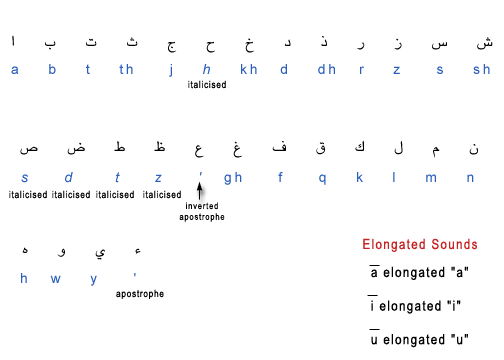 Is it Allah, Allaah, or Allāh? Was he Muhammad, Muhammed, or Muḥammad, (SAW)? Do we follow the religion of Islam, Islaam, or Islām? Where ever you go throughout the English speaking world, you will find variations of Arabic words romanized differently. As a result, different styles and even opinions have formed. Just for fun, let’s take a look at some of them.
The Common Style
This is what you tend to see in basic intro to Islam books. Islam is spelled as, well, Islam! And Muhammad is Muhammad. Ramadan uses a d for ﺽ. From what I can gather, most of the common Islamic terms have been standardized into a set of commonly spelled terms that basic English romanization, such as Fiqh, Deen, Hajj, Shairah, etc.
Keep supporting MuslimMatters for the sake of Allah
Alhamdulillah, we're at over 850 supporters. Help us get to 900 supporters this month. All it takes is a small gift from a reader like you to keep us going, for just $2 / month.
The Prophet (SAW) has taught us the best of deeds are those that done consistently, even if they are small. Click here to support MuslimMatters with a monthly donation of $2 per month. Set it and collect blessings from Allah (swt) for the khayr you're supporting without thinking about it.
The Extended Style
In this style, special attention is paid to letter conflicts. For example, azan is spelled as athan, to make clear that the word has a ذ and not a ز. Many of the letters will have additions or swaps as a shortcut to distinguish the letters. The letter ﺽ is represented by dh and not d, forming Ramadhan. Saqib becomes Thaqib, and so on.
I think this is nice to use, as it gives respect to certain letters in the Arabic language. So if you want to change your Desi given name of Rizwan Kazi to Ridhwan Qadhi, then by all means go ahead! ;)
The Sound It Out Style
You’re all very familiar with this one. This is the one that will type Islaam, or Allaah, or even Aboo Haneefah. This style of romanization tends to come from some groups of Salafis, er, Salafees, and has been typified with that movement quite widely. No where else will you see the use of the word Soofee in such a distinct form.
With some exceptions, I think this style is not needed, really. There’s no need to sound everything out so much, especially since English is a language that doesn’t have a set way of elongating and shortening vowels. One of my maternal uncles always uses the classic example, “vhat is t-o? To. But vhat is g-o? Goo? No, it is go! Vhy is it not goo?!”
Plus adding so many extra vowels makes things look a little unkempt. With few exceptions, end of the day, you don’t always need this style, beekuz noe wun reelee tiepz lyke this eneewayz! Soundeeng out awl uv yoar werdz in letter formatt ken reelee get weerd. Keep dhis in myned dhuh next tyme yoo kaapee payst ay refyootayshun frum dhuh skawlerz!
The Academic Style
Here’s where we get much more formal. In comes a slue of extended English characters with diacritics (the symbols above or under a letter) to establish each Arabic letter as unique from others based on the limitations of the English language. For example, we have d for ﺩ and ḍ for ﺽ. The different there being a small dot that appears under the d to signify that it’s the heavy letter and not the light one, and most Arabic terms are italicized.
They also keep all the letters present, especailly ﻝ in instances of shamsi vs qamari letters. So instead of Usul ad-Deen, you have uṣūl al-dīn, and al-Shāfi‘ī instead of ash-Shafi’i.
This is the type of romanization you see in academic works. Just read any one of Yasir Qadhi’s latest posts on MuslimMatters and see for yourself. The Quran is the Qur’ān, and kalam is not kalaam but rather kalām. Same goes for professional works by Muslim authors and publishers, in books I’ve seen such as Caesarean Moon Births by Hamza Yusuf or Islamic Foundation UK’s newest print of Towards Understanding the Qur’ān, the abridged version of Tahfīm al-Qur’ān by Sayyid Abul A‘lā Mawdūdī (how do you like THAT for romanization!). Non-Muslim academics use this style, too.
It must be noted that the font used can really make a difference in this style. In this standard Arial you are reading in, it gets the job done. However, it doesn’t compare to how it looks in fonts like Garamond, or the new made for diacritics font Gentium (YQ’s choice of font for his Yale works, free to download), which have a special cursive-esque look to them when italicized.
I personally really like this style. It’s very professional looking and gives the Arabic language more respect than others because of its attention to detail and clean, crisp presentation. The only problem is that it’s not very common, as getting all those different diacritics on letters is difficult on a normal keyboard. While I wouldn’t use it in regular chat or Emails, I feel all professional articles, papers, and especially books with Arabic terms should implement this style. To find the characters, hit up http://en.wikipedia.org/wiki/Romanization_of_Arabic.
The 1337 Style
Also known as Arabic chat style, this is what all the brothers and sisters overseas use when typing on forums, chat rooms, or even SMS text messages. It’s like, y3ni, cool, yo. You don’t tend to see much of this in the US or anywhere else in the west. My personal favorite use of this style I’ve seen is the URL for Muhammad Ibrahim Al-Luhaidan’s website, www.al7aidan.com. How sweet of a name is that to have a 7 in your name? He is by far the most 1337 h4xor Qari out there, mashaAllah.
Cultural Differences In Styles
This usually is noticable in but is not limited to names. A person can be named Ahmad or Ahmed, Syed or Sayyid, or choose between Husain or Hussein! Generally you’ll have Egyptians or Arabs using e’s and Desis using a’s in those cases. I think these are really fun to notice, like the time I read Shaykh Ali Guma as “Goomaa”, like a goomba from Super Mario Bros. without the b, only to later find out his name is Jumu‘ah!
Or how some may be named Javad instead of Jawad, or Farhat instead of Farhah. Or how Desis keep the tā marbūtā on words such as salat, zakat, niyyat, Farhat. That ending t sound should be gone, but you should be careful. Especially if you run into a Naigat Aunty…
Conclusion
So what’s the point of listing all these different styles of romanization? To show there’s a vast array of differences in the methods and no one way is truly the correct one. Everyone has their own style of transliterating Arabic into English, and some may be slightly better than others. However, there just shouldn’t be large amount of fuss about them. I’ve had instances of people correcting me about the way I will spell an Arabic word in English from one word to another, and really it’s not such a big deal.
And you know what? If someone tries to convince you that it’s Ramadan and not Ramadhan, or it’s Islaam over Islam, just politely inform them that the real words are رمضان and إسلام above all else before any Englsh derivative!
Wa Allāhu ta’aalaa ‘Alem,
ThāqibṢāb
SaaqibSaab
SaqibSaab
ثاقب صاب :)
Keep supporting MuslimMatters for the sake of Allah
Alhamdulillah, we're at over 850 supporters. Help us get to 900 supporters this month. All it takes is a small gift from a reader like you to keep us going, for just $2 / month.
The Prophet (SAW) has taught us the best of deeds are those that done consistently, even if they are small. Click here to support MuslimMatters with a monthly donation of $2 per month. Set it and collect blessings from Allah (swt) for the khayr you're supporting without thinking about it.


Muslims and the F-Word: Feminism, Dhulm, and Jahiliyyah

Far Away [Part 22] – The Raid

Du’as for Happiness: Finding Joy Through Daily Adhkar

Female Scholarship In Islam: A Living Legacy [Part 1]
Far Away [Part 21] – Opium

The Arithmetic Of Longing: On Loneliness, Desire, And Learning To Want Well

Thinking Long-Term: The Legacy of Yahiya Emerick

The Legacy Of Professor John Esposito: The Scholar Who Refused To Turn Islam Into An Enemy

An Inconvenient American in Syria: The Curious Case of Bilal Abdul-Kareem
Far Away [Part 22] – The Raid

The Best Actions for Eid al-Adha [Imam Dawud Walid]

Coming Full Circle: Who Are You Now? | Night 30 with the Qur’an

Running Away From Who We Are | Night 29 with the Qur’an

Building From the Ground Up: Week 4 Recap | Night 28 with the Qur’an

The Muslim You Are Becoming | Night 27 with the Qur’an
MuslimMatters NewsLetter in Your Inbox

Sign up below to get started
-

 #Life3 weeks ago
The Arithmetic Of Longing: On Loneliness, Desire, And Learning To Want Well
-
 #Culture3 weeks ago
Thinking Long-Term: The Legacy of Yahiya Emerick
-
#Current Affairs3 weeks ago
The Legacy Of Professor John Esposito: The Scholar Who Refused To Turn Islam Into An Enemy
-
#Current Affairs3 weeks ago
An Inconvenient American in Syria: The Curious Case of Bilal Abdul-Kareem


OsmanK
November 7, 2008 at 1:55 AM
nice article about something that not many people probably realize. One that I’ve found used commonly is Ramzan for Ramadan by desis.
btw can someone explain to me how arab 1337 works? Is it the same way as regular 1337?
Siraaj
November 7, 2008 at 3:00 AM
Spelling also tells which (potentially deviant) group you’re a part of ;)
Siraaj
coolguymuslim
November 7, 2008 at 3:36 AM
lol, i liked this post, it was enjoyable and a good break
ibnabeeomar
November 7, 2008 at 3:39 AM
i have to plug yamli.com!! if you don’t know what it is go to
yamli
and then type the following line (don’t copy/paste):
Allahu Akbar
abu abdAllah, the Houstonian
November 7, 2008 at 5:23 AM
bismillah.
i sure hope that was a joke. that’s all we need is people making takfir based on transliteration. as if the world was not messed up enough already.
abu abdAllah, the Houstonian
November 7, 2008 at 5:29 AM
bismillah. nice piece. edit needed?
in the shamsi/qamari illustration above, wouldn’t conserving every letter especially the ﻝ , lead to uṣūl al-dīn?
Musa abu A'isha
November 7, 2008 at 8:26 AM
I started, but did not complete a piece looking at Arabic transliteration – http://muslimspeak.wordpress.com/2008/08/15/arabic-transliteration-so-many-difficulties/
There are so many systems available, and its true that most will convey either level of education, and possibly which ‘group’ they belong to.
I feel most comfortable with the systems used by Sh. Yasir Qadhi and Sh. Al-Jibaly when dealing with large texts. As for anything containing numbers… I can’t bare to see it on my screen!
MR
November 7, 2008 at 9:20 AM
Allah, Islam, Muhammad (saw) 4 lyfe!!!!!
Amatullah
November 7, 2008 at 11:26 AM
Yamli is awesome! I was about to post it as well mashaAllah. The numbers are a bit annoying, because people who don’t know Arabic (and some who do!) will see: a7san, or 3lm, or 9aali7 …what ?! You either know it or you don’t.
If anyone wants a nice Arabic keyboard, download this one: http://zsigri.tripod.com/fontboard/arabic.html
The way it’s set up is that each English letter corresponds (most of the time) to the Arabic letter. s = س، press shift and it becomes ص، r=ر ، b = ب, etc. So you don’t need to memorize the Arabic keys like other keyboards that have letters randomly.
A Sister
November 7, 2008 at 11:29 AM
Interesting post!
So all along we’ve been thinking that the name is ساقب when it really was ثاقب?
I agree that one shouldn’t really fuss about which style is used because ultimately, as you said, the ‘real word’ is in Arabic.
On a different note, I think you’ve done the “sound it out style” – as you called it – injustice. You spoke of the others in a positive light, with some humor – which is great! But this one seemed a lil too much. To me, it is the same as the “academic style”…the only difference is that it is tedious to put dots and dashes all over your ‘everyday writing’…so instead of (ī) – and finding it on the character map or making a shortcut or something – I just write (ee) and so on. This way, you can differenciate between islam (the command form for sa-li-ma, yas-la-mu – though I don’t know in what situation you’d say that to a person), and Islaam (the deen) – if I don’t have my a with a line on top character.
I echo br. abu abdAllah (or Aboo Abdillaah?!!!)
By the way, I personally prefer the academic style in my academic writings/printed material etc., but for everyday writing, I prefer the “sound it out style”, and I wouldn’t want to be “judged” for belonging to any group based on my “sounding out”.
A Sister
November 7, 2008 at 11:34 AM
masha = he walked
Sometimes you DO need the “double letters”.
:)
abu abdAllah, the Houstonian
November 7, 2008 at 12:05 PM
bismillah. where’s nouman? i prefer writing abdAllah because i want to be explicit about Who is the Master.
amad practically always writes “abu abdullah” which is just plain wrong :) if you took nouman’s class, mashaAllah, then just look at the translation “father of (the) slave of Allah.” the word Allah is proper (also singular and male) and mudhaf alayh to “slave,” so the word Allah is jarr. the mudhaf, “slave,” becomes proper (and it happens to be singular and male), but it is also the mudhaf alayh to “abu,” so it becomes jarr, too. (yes, i am counting this comment towards my daily course review time) abu is the mudhaf of abd (and is proper, male, and singular). since there is no reason for abu to be anything but raff, it is raff.
but to me, writing “abu abdillah” or “abu abdillahi” would be unsatisfactory, and “abu abdi Allah” or “abu abdi Allahi” would probably cause even more confusion.
so i just write “abu abdAllah.”
Amatullah
November 7, 2008 at 12:11 PM
The way I see it, pronouncing the letters properly especially when reading Qur’an is way more important than if we spell mashaAllah or maa shaa Allaah. :)
Another thing that is an English phenomenon is abbreviating the salaams or duaas. It took some thought to figure out what was being said when i first saw them used: aswrwb/ASA, JAK/JZK , BAF, iA, sA , aH …..?
abu abdAllah, the Houstonian
November 7, 2008 at 12:21 PM
bismillah. it’s easy not to be consistent in transliteration. just looking at my last post — and this one — i write “bismillah” because i do not want the sound to be mispronounced. but “abdAllah” and “abu abdAllah” for the reasons i discussed previously.
elsewhere i write “alhamdolillah” because one of my favorite shuyukh always changed my “alhamdulillah” until i gave in. but i prefer “abu” to “abo.”
i generally dislike slavish adherence to double-vowelling — but i do it almost anytime i offer the transliteration of a dua (especially one that is not universally known) because i want people to pronounce it correctly and am afraid of a mistake in their worship that i might cause otherwise.
i suppose the line for me is drawn between words/phrases/sentences that i am afraid to find mispronounced, and those that are pretty safe.
thankfully we live in a country where there is no universal constant for how sounds are transliterated. some may find it annoying, but the same people probably get annoyed by “disorder” in many aspects of life.
abu abdAllah, the Houstonian
November 7, 2008 at 1:01 PM
bismillah. wow this thread is getting into my pet peeves. i detest abbreviations of religious speech in letters, brochures, e-mails, or web articles. how perfunctory is JAK/JZK — does that person even care to get back “WE”?
and as for iA, sA, msA, the almost-ubiquitous PBUH, S, or SAW — subhanAllah! people use these abbreviations in their Dawah — what message do abbreviations convey to non-Muslims? “we are bound by ritual to utter a certain expression at this point, but spending time or space on it would be a waste for you and for us”? SAW in particular when it is used by Muslims in writings that will be seen by non-Muslims on college campuses… what is the most popular association with the word SAW in mass media today? subhanAllah. and do people not feel that these abbreviations convey a shallowness of respect for Allah and for the Prophet sull Allaho alayhi wa sallam?
the Prophet sull Allaho alayhi wa sallam was known for prefacing his speeches and writings (note: all of them dictations), eg, “innalhamdolillah, wa nahmaduhu, wa nasteenahu…” (which reminds me — how does one convey the proper respect for Allah through capitalization in transliterations?) these and similar prefaces were of different lengths, depending on the occasion. as short as “bismillah.”
when we write something like bA for bismillah, isn’t that tantamount to suggesting that he sull Allaho alayhi wa sallam might have written the letters ba and alif to abbreviate that expression, too?
even when there are mediums where every character is premium real-estate, like text messages. i prefer to reduce the rest of the content — my words are less important than the word Allah (in mashaAllah for example). if i cannot condense my message, it should not go by text.
ibnabeeomar
November 7, 2008 at 1:40 PM
Just as i was reading this, i had a copy of Sun Tzu’s Art of War sitting on the floor next to me so i could sell it at the used book store. i never got around to reading past the first few pages, but i do remember they struggled with the romanization of chinese characters as well – trying to find something easy that everyone could understand.
here’s some examples of some of their transliteration:
t, as in Tao: without apostrophe, pronounced like d
p, as in ping: without apostrophe, pronounced like b
ch, as in chuang: without apostrophe, pronounced like j
hs, as in hsi: pronounced like sh
j, as in jen: pronounced like r
So the “Chou” Dynasty would properly be the ‘jou’ – ie JOE (literally pronounced) Dynasty.
Regarding arabic romanization, it is important to come up with a standard, because it’s more consistent, professional, and dare i say it can be a point of unity :)
In that vein, i don’t like the 3/7 method of writing things, because it just looks illiterate. and by that, i mean how a 12 year old teen communicates on myspace and text messages lol wth omg u2 l8r. does that look any different from kayfa 7aluk, or 3lm?
I feel that some words which have gained prominence and been “assimilated” should be retained as is. Islam over Islaam. Allah instead of “Allaah”, Aisha instead of Aa’ishah or Aa’eeshah. Hadith over hadeeth. Bukhari over Bukhaaree (that one annoys me the most), Quran instead of koran or Quraan, and so on.
The 3/7 format to me just looks illiterate. it’s like a 12 year old on myspace or txt messaging – omg wth u2 l8r. compare that to kayfa 7aluk, 3lm, etc.
the method using diacritic marks is the most professional, and the most accurate in terms of conveying precisely which letter is used. it’s the easiest way to properly differentiate usage between and alif, hamza, and ‘ayn.
one pet peeve of mine though, is people who mix between the two. i cannot stand books that will write hadith not as:
a) hadith
b) hadeeth
c) ḥadīth
instead they will write: ḥadeeth. this makes no sense to me whatsoever. it is like a desi auntie who speaks half english and half urdu, but can’t settle properly on one.
the diacritic method is best, but the downfall is difficulty of use. the first time i tried it, it took me a while to get the proper fonts, set up all my keyboard shortcuts, etc. for professional papers, books, and print media though, i feel that its the only way to go.
ibnabeeomar
November 7, 2008 at 1:54 PM
abu abdAllah – you might be interested in this. its from mustafa azami’s book on history of the quranic text (good book for route 114 ;))
anyway here’s what he wrote in the intro:
i also remember dr. brown mentioning something similar at ilmsummit.
ibnabeeomar
November 7, 2008 at 2:16 PM
it is funny how transliteration can be a symbol of association as siraaj mentioned. thats why you have “sidi” and “soofee” ;)
the funniest thing is when people actually romanize native english words!! you might see people attributing themselves to where they’re from – i don’t want to pick on my dear brother but imagine:
abu abdAllah, the Houstonian being written as:
aboo abdallaah, the hyoostonee’an
Dawud Israel
November 7, 2008 at 2:17 PM
Hahaha…this stuff is always the butt of my jokes. Good work Saaqib meyn. Actually, this EXACT same topic was why I named my blog Muslimology. You should write something on Urdu since it`s Hindi, Farsi, and Arabic all into one which gets reallll messy! That would be loads of fun. I`ve noticed the English books written by Desi scholars really look fake and “inauthentic” to Western Muslims simply because they use a totally different system of transileration. This is sad because it`s these Desi Hanafi scholars that have kept alive the tradition of writing commentaries and explanations on the books of Hadith, and their understanding of hadith is at such a different level that even Arab bros want to learn Urdu since nothing like that exists in Arabic. This is important because we all hear a hadith…but don`t always understand what it really means.
Anyways, funny how, I was just saying the other day how if you came across the word saalaafees for the first time you would think it is like some sort of dinosaur, saalaafees raptor!!! lol…what was the other one, oh yeah TJ Rex (aka Tablighi Jamat) lol
But I get this all the time when I tell people Israel (the prophet alayhi salam) is mentioned in the Quran- they get all angry saying, it is Isra’il or Izra’il (the angel?) but NEVER Israel. And thats just half the fun! :)
And you know what ticks me off is the SAAWS I used to do. ALWAYS write it out Rasulullah salallahu alayhi wasalam! There are many stories of scholars who used to abbreviate his salallahu alayhi wasalam’s name in their books and the Nabi salallahu alayhi wasalam appeared in their dreams asking them, why they were doing that when it was a means of reward for them? Others would even go longer to Rasulullah salallahu alayhi wasalam taslimeen katheeran katheeran katheera! :D
ibneabeeomar: Man you have NO IDEA how hard Chinese and Japanese transileration is!
Chi Gung becomes Chi Kung, becomes Qi Gong, and then changes all together to something else in japan!
Alhamdulillah, this is one of the few things Orientalists have given Islam :P
spelling_b
November 7, 2008 at 6:03 PM
– I think the ‘Sound It Out Style’ is pretty good. I don’t have time to put in acents on my letters.
– It also one of my pet peaves to see people write arabic words in english incorrectly. I can’t tell what i’m reading. If you ever read a book or publication using ‘Sound It Out Style’ you can almost alwasy get the pronounciation of the word correct.
– this also goes for some of the other styles mentioned. so, salaam > salam. at the very least.
Musa abu A'isha
November 7, 2008 at 8:43 PM
For many it becomes necessity to resort to double letters to represent long vowels as they will not have the time when quickly typing something up to add in all the relevant diacratical marks, hence the ubiquitous use of it over the internet.
On occasion I will use the IPA (International Phonetic Alphabet) which for linguists is handy in that it is a universal system which may be used for any language, however for the average person becomes amazingly confusing.
Ultimately you have to toss up between – Do I want what I am writing to be understood EXACTLY as the word is said in Arabict, or will it suffice to let the reader sort it out..
Most will not have any problem with writing Iman as opposed to ‘Īmān in a short sentence as the word itself is clear enough to be understood. Though I must admit.. Sometimes the pedantic side of me comes out and I just can’t help but insisting on doing things exact, making sure that I convey the proper pronunciation and spelling in whatever I write. It helps those learning Arabic to maintain a proper understanding of correct pronunciation and helps to maintain uniformity and hence a universal understanding.
But hey, if one wants to write 2eeman, feel free to do so.. Just please don’t use these spellings outside of the internet, they really do look awful in academic pieces!
Abu Noor Al-Irlandee
November 7, 2008 at 9:10 PM
My two oldest daughters are named Noor Haleemah and Khadeejah Asmaa so it’s clear what side of the debate I’m on. But I don’t call myself Aboo Noor so you can see I’m not a ‘fundamentalist’ about it.
Like many others I’m sure, I was influenced into adopting this style back in the day from Dr. Bilal Phillips’ Evolution of Fiqh book, I think Dr. Phillips is the original popularizer of this style in our time.
With so much Islamic material now available in the english language and english increasingly becoming a lingua franca for Muslims (not saying that is necessarily a good thing, we should continue to come up with innovative ways to encourage promotion of Arabic as our lingua franca) it is important that transliteration schemes be used and taken seriously so that even people who are not very fluent in Arabic, but who know the alphabet, can easily tell how words are spelled in Arabic that they may be used to reading in Roman script.
Allaah knows best.
A Sister
November 7, 2008 at 9:52 PM
Agreed! :)
By the way, for those who know the Arabic word, it will not matter. Whether we see it written maa shaa Allaah or mashaAllah or mashallah or maashaa2allaah (and arguably mA too, though I detest that!), we will “instantly” recognize it and sound it out “in our heads” the right way. The danger comes when those who are not familiar with the Arabic word and they see it written in a way that doesn’t convey exactly how it is pronounced, and then use it in their acts of worship – just as br. abu abdAllah pointed out:
Br. Musa and Br. Abu Noor also touched on that.
Some words, if mispronounced, change the meaning drastically, and if the reader isn’t familiar with Arabic, he/she will have no “base” to compare things with.
Faraz Omar
November 8, 2008 at 12:31 AM
Last thing one needs to worry about. Yea funny, but of no use, and no benefit of saying what scores over other. If one is using a certain spelling, he may have a (valid) reason for it. English words whose pronunciation is known need not be written that way, and if one doesn;t know they open the dictionary to know it with the phonemes
And another opportunity for Salafi ridiculing or bashing.
If this post was written in an intelligent perspective, it should have been why a single spelling would help, at least for search hits and results over the Internet. But intelligence seems to have left us long ago.
wassalam,
Faraz (spelled out Furaaz)
And a Salafi, because of its pure path, amongst various sects in Islam.
Siraaj
November 8, 2008 at 1:37 AM
I take it you think his transliteration post is off the manhaj of the saved sect?
Siraaj
Yasir Qadhi
November 8, 2008 at 1:46 AM
What… a post on MM on a non-political topic?! What’s MM coming to? :)
To be honest, once you become used to the academic style, you really can’t go back to anything else. Its very precise and does the job amazingly well, and looks professional as well. But there are a few styles within academics as well – for example, do you write the taa marbuta on the end or not (Fatiha or Fatihah), and also with regards to the al of Arabic words.
And, of course, there are some differences between ‘dots’ or ‘curly lines’ or other small details. But the most accepted style is the one that ibnabeeomar mentions, and you’ll see examples in the articles on MM.
Yasir
Faraz Omar
November 8, 2008 at 3:37 AM
Nopes. I think my post clearly says spells are not that important, that’s what it was all about. Its not even an issue. But the author created space to ridicule Salafis, which is not intelligent. Bcuz the focus and core thing about it is wat I highlighted in the end.
Blogger
November 8, 2008 at 3:49 AM
May Allaah ta’ala guide us all!
abu abdAllah, the Houstonian
November 8, 2008 at 5:59 AM
bismillah. so many comments… so little time. again, bismillah. :)
ibnabeeomar at 1:54 pm — i would greatly prefer what is described in that post to abbreviations of alhamdolillah, etc. why i detest the abbreviations has been hashed already, alhamdolillah. strangely enough (and less cogently, too) many people who abbreviate give the same argument as the brothers you cite/refer to.
and again at 2:16 — dude, amad can’t even spell the first part right… and what you describe would happen all the time to someone who has no idea what the word is — another reason i write “the Houstonian.” just to try and clue in the clueless. if i wrote “al Houstonawi” — i’d be getting comments from Allah Knows how many rubes…
israel (or however you want to spell it) at 2:17 pm — shaykh yaser birjas told us in heavenly hues that the orientalists also gave us the first word-indexes for the Qur’an.
shaykh yasir at 1:46 am — you’ve hit on the secret underground message of this thread: “Barack” — look how it’s transliterated! and don’t forget, “Hussein” — he’s not fooling any of us with that spelling… and last but not least the much misunderstood “Obama” — maybe faraz is not in on the secret, but i’m guessing by now that the rest of us are. heh, heh, heh.
generally. i think different systems evolved to deal with the needs of different communities. i am completely (almost) at ease with different transliteration systems.
you know what is funny to me, the fact that there are so many transliterations of English words into urdu and arabic. you know what we call those words? we call them borrowed words. we don’t go around saying the arabs transliterated “dish” — we say they have borrowed the word. none of us (or at least i know i don’t) give a darn whether they spell it with a soft d or a hard d. they can use a hard DH if they want to. if i am sad at over the arabs’ “dish,” it’s that they borrowed the word because satellite TV is now sucking the life out of them, too.
and these words, especially Allah, have become borrowed. we may be annoyed by weird translits of the word Allah because the word itself is so valuable to us (to the non-abbreviators at any rate).
who gets annoyed over any strange spelling of “dish” in arabic? yup, the people trying to sell dishes over there…
that line of reasoning is almost enough to make me want to get annoyed about transliteration of Arabic to English… almost.
Siraaj
November 8, 2008 at 8:34 AM
Really? I’m not that good at reading into people’s hearts and guessing at their intentions myself, I consider myself to be a human being and I tend to think of Allah subhaana wa ta’aala as being the only One who truly knows what’s in our hearts, so I hope you’ll not be offended if I don’t take the same opinion you do ;)
Siraaj
Bint Amina
November 8, 2008 at 3:19 PM
Assalamu Alaikum Wa Rahmatullahi Wa Barakatu
As mentioned by a couple of others – it’s unfortunate that all of the styles were described in a positive manner, while one was specificaly singled out in a negative light, that is, the sound out style.
It seems odd that the conclusion states, that the purpose of the article was”to show there’s a vast array of differences in the methods and no one way is truly the correct one.” And while ‘no one way is truly correct’, one reading the article could gather that one way is seemingly “wrong” – as the author writes of the sound out style:
“I think this style is not needed, really. There’s no need to sound everything out so much, especially since English is a language that doesn’t have a set way of elongating and shortening vowels.”
What’s perhaps more interesting is that the sound out style is on par with the academic style in that they both seek to carry out this very function, that of identifying those vowels that are elongated and those that are shortened – in hopes of conveying to the reader the closest possible representation of the arabic word itself. Why, then, is one (the ‘academic’ style) said to be “very professional looking and gives the Arabic language more respect than others because of its attention to detail and clean, crisp presentation” and the other style “not needed”? Why, then, is one hailed as ‘academic’ and the other ‘unkempt’ – to be followed, even, by an unintelligible sentence, that uses the style, and calls it ‘weird’?
Spellings like Islaam, or Usool AlFiqh, or Tawheed, or Ramadhaan do not – to me at least – look unkempt (nor ‘weird’). Rather, they (to use your words regarding the ‘academic style’) seek to give the Arabic language respect, or give the Arabic language its due, by striving to adhere to the closest representation, and aiding its readers in saying these words correctly (an especially helpful tool for those coming across such words for the first time). So, in this way, and in light of this goal, spelling the word ‘usool’ like so, may achieve something that, say, the spelling of ‘usul’ would not. And Allah knows best.
Furthermore, it seems that the stance on the sound out style, and its negative portrayal, speak more to the group that they are attributed to, than anything else. A thinly veiled criticism, perhaps. I am reminded, too, of other such articles which employ this and would hope that future articles on MM would not follow in this fashion. To give sound naseeha regarding a particular practice is one thing, but to use seemingly unrelated topics as a springboard for gripes on a certain group, which in and of themselves achieve nothing, is quite another.
I am reminded of a beautiful statement by Ibn Taymiyyah, in which he said:
The people of the Sunnah are the most merciful of creation, to the creation.
May Allah ta’ala increase in good akhlaaq, and may we be gentle and merciful unto the people. Ameen.
Wa Salamu Alaikum Wa Rahmatullahi Wa Barakatu
A Sister
November 8, 2008 at 5:05 PM
Well said, sis. Bint Amina.
Abu Ninja
November 8, 2008 at 7:54 PM
Interesting post, however the salafi ‘bashing’ by Dawud Israel and others, really there was no need for it.
However some people tend to use any opportunity to label everyone with the same brush. One can simply read the blog of Dawud Israel for example and clearly see the brother obviously has a serious gripe with those who try to follow the way of the Salaf. An the blog is filled with articles attacking all things salafi, regardless of the severe inaccuracies and baseless assertions.
At the end of the day, may Allah increase us all in ilm, mercy, compassion and guide us all onto the straight path.
Abu Ninja
Amad
November 8, 2008 at 9:15 PM
One of the lessons of blogging (and I am the worst offender of all), is to make sure not to touch any remotely controversial subject, or remotely slight another group, or remotely touch a completely tangential topic… otherwise the entire attention will move from the main subject, the main point, to this small issue.
On the other hand, what’s a post without some controversy…. and I bet more people read this post because of the many comments in it (and again I will use my own example, sorry Saqib :) ) than who would have otherwise.
It’s a difficult, touchy blogging issue in itself :)
Kaltham
November 8, 2008 at 9:59 PM
Assalaamu aleeykum wa rahmatu Allahi wa barakatuh..
Jazaki Allah khair Bint Amina, I couldn’t agree anymore!
Alhamdulilah many of us realize the serious faults that the ‘super’ salafis fall into, but why is there the need to sarcastically bash? Isn’t this the exact attitude we do not like about the ‘super’ salafis? The attitude of ‘oh look how lost and misguided they are and how saved we are’? Someone who is familiar with the extremism the ‘super’ salafis fall into might understand where the author is coming from, however, it still does not justify the manner in which he speaks of them… If someone is totally ignorant of what the term salafi is, he or she will take it be something so evil and negative… they will not realize that salafiyyah is pure and free from the actions of its claimants. What I see is that the MM authors are tolerant and respectful about differences, it would be nice to see this extended to the salaafees.
Fi Amaani’Laah
Siraaj
November 8, 2008 at 10:57 PM
Man, you guys are so sensitive about everything. I consider myself Salafi (not salafee) and this ain’t all that big a deal. Brother said, “I think…” and that’s his personal opinion about word construction – you would think he was dissing Ahlus Sunnah’s aqeedah or something.
Siraaj
AnonyMouse
November 9, 2008 at 12:54 AM
Ummmm, I don’t get what the big deal is… I read the post and found it amusing, not that it picked on “Salafees.” (BTW, I have family members who ascribe to the sound-it-out-style, while I myself am fond of doing a bit of “mix ‘n’ matching.”)
Dawud Israel
November 9, 2008 at 3:33 AM
Alas, Amad- my apologies for attracting this. He’s just here to pick a fight with me, not you or Saqib.
Clearly you still need to learn how to read. Nor do you know anything about what actually happens at my website- we produce dawah material and islamic projects- and out of all that, you look at 2-3 articles on that issue? What about the Bilal Philips material? Or the Khalid Yasin ebook? You think that like you, I would push aside the work these scholars have brought forth, simply because I may disagree on one or two small things?
I discuss this sort of stuff in sociological terms, not prejudiced ones to discuss things in our community- a Salafi bro is a Muslim bro, if he has a sickness, why is it considered harmful to tell him to take some medicine? If there was a “friendlier-term” for Salafi brothers than I would use it- but their isn’t and I pray that your breed of ignorance be a cause of your guidance!
NOW I am going to advise you to look in the mirror.
Be silent. Learn to listen. Do not speak but listen to others for a few days. Contemplate on your own heart and it’s condition and in sha Allah, take upon an evaluation of yourself to yourself and perchance Allah will bring to His truth !
-Edited. No need for personal attacks. We all need to try to be respectful, otherwise advice, no matter how sincere, will simply be disregarded. Maybe you both need to communicate in person, and we can provide email info if you both would like/allow
Dawud Israel
November 9, 2008 at 9:49 AM
You would be better off simply deleting his and mine comments.
I hate even replying to trashy comments like this that lack any real substance.
Abu Ninja
November 9, 2008 at 6:40 PM
I was contemplating on how to reply to the comments made by Dawud Israel, and then decided against replying in the same harsh manner devoid of Islamic adab.
So instead I have simply deiced to quote comments made by Dawud Israel and instead I will let my fellow brothers and sisters make up their own mind and come to their own conclusion, and see who is in the wrong.
Dawud Israel said,
Amatullah
November 9, 2008 at 7:09 PM
إِنَّمَا الْمُؤْمِنُونَ إِخْوَةٌ فَأَصْلِحُوا بَيْنَ أَخَوَيْكُمْ ۚ وَاتَّقُوا اللَّهَ لَعَلَّكُمْ تُرْحَمُونَ
The believers are but brothers, so make settlement between your brothers. And fear Allah that you may receive mercy. (49:10)
Please, can we move past the attacks and finger pointing? It’s really disheartening how the majority of the posts on MM, or the comments, transform into a discussion about this sect, that sect, this group, that group. Every single thing we utter is being recorded and preserved, we should internalize that and think before we speak, or in this case: type. Our mother A’ishah radi Allahu anha told some women who were talking into the night during Hajj in Mina: “give your angels a break.”
Our ummah has bigger problems, we should be focusing on other things, such as this mass hijrah we have made from the Qur’an.
How many of us have memorized the Qur’an? How many of us can understand the Qur’an in its pure form (Arabic)? How many of us pray qiyaam regularly? How many of us have studied the authority of the Sunnah? How many of us know, from beginning to end, the seerah of our beloved Prophet sal Allahu alayhi wa sallam? Stop with the pettiness and use your time with something that will benefit you in this life and the next, inshaAllah. Our graves are ready for our arrival, and that sect or this group won’t be there to help you…you will only have your deeds.
Faraz Omar
November 10, 2008 at 12:27 AM
a’oozu billah. Laa ilaaha illAllah. I live in Saudi Arabia, and I bear witness that the scholars here are far above the false attributions and baseless charges made against them. this blessed country is host to muslims and non-muslims who live here in peace, safety and security.
hardly will you find people and scholars anywhere around the world, the kind you find here alhamdulillah. yea.. good and bad are everywhere, but depends on which area you focus and what you keep sniffing out for.
i thought of responding. But on second thoughts, will it do any good? And to what do I respond? Those comments are broad attacks without proof or any specific detail.
SaqibSaab
November 10, 2008 at 1:45 AM
Wow. When I wrote this post about a month ago, I never thought it’d get so many responses. I didn’t think too many people would pay attention to or care for all this. Apparently not. :) For those of you who got offended from this meant-to-be humorous post, I apologize as that wasn’t the intent.
In any case, didn’t mention this in the actual post, but I actually use all three. I feel they work for case by case scenarios.
Common Style
For general “popular” terms, we should spell them “normally,” like Islam (not Islam or Islām). And if someone puts Ramadan instead of Ramadhan I’m not going to bust a vein.
Sound It Out Style
Names. I really am an advocate for transliterating Arabic names in the “sound-it-out” style. Like I was telling Siraaj just a few hours ago while leaving to go have dinner at Usmania with Shaykh Mohammed Faqih (he’s in town for Route 114), I see nothing wrong with Siraaj instead of Siraj, and even think it may be better. I’ve had some interesting experiences going to 12 years of public school with “Saqib.” Sakeeb, Sockquib, Sacajaweah, Saa.., you name it. Also, I actually spell “assalaamu alaykum” and “wa alaykum assalaam,” in chat. (I don’t do the “salaamz” thing, never did.)
The Academic Style
Like in the article, I feel professional publications and works need to use this. It just looks way more professional and shows more grasp of the English language while maintaining the Arabic that it tries to transliterate. Plus I have to agree with Shaykh Yasir when he said:
I guess that makes you Yāsir Qāḍi from now on.
Your brother in Al-Islām,
ŚṤŜŠṦṠŞṢṨȘS̩áàăắằẵẳâấầẫẩǎåǻäǟãȧqʠíìĭîǐïḯĩįīỉȉȋịḭɨiıḃḅḇƀɓƂƃ
abu abdAllah, the Houstonian
November 10, 2008 at 2:08 AM
bismillah. ya saqib, it’s only been a few years at most since i got used to the way he spells his name now… :)
by the way, our qur’anic sciences class is fantastic, mashaAllah. if you have not taken the class with shaykh yq, you simply must do it as soon as possible…
Musa abu A'isha
November 10, 2008 at 3:41 AM
It would be rather – Yāsir Qāḍī
One of the reminders of why exactness in transliteration and speech is important could be demonstrated in the following mock scenario –
Yasir Qadhi goes to india where he then becomes Yasir Kazi, then to Bangladesh where he is now Yasir Kaji, then to Egypt where he thus becomes Yasir Kagi.
Sure he remained Yasir, but look what happened to the Qadhi!
Its fun to see the variations in speech and it provides lots of study, however it deprives many of us of an easier access to the proper Arabic of the Qur’aan.How many Muslims have never heard of ‘dhikr’ and only know of zikr? Muhammad becomes Mehmet, Maometto, Mahoma or Mà..
Al-Hamdulillaah we have a language which unites us, when we speak it right all goes well.
OsmanK
November 10, 2008 at 3:56 AM
i was always confused about the Muhammad and Mehmet. Just doesnt seem close enough for me to blame spelling.
Abû Mûsâ Al-Ḥabashî
November 10, 2008 at 9:09 AM
A brother I know personally commented on that blog entry of Dawud’s accusing him of baseless accusations and that unless he lived a good portion of his life in Saudi Arabia he should remain silent about issues he clearly has insufficient knowledge of (he used as ‘dalîl’ for his assertion that Saudis suffer from psychological problems, the popularity of the book ‘Don’t be Sad’ for God’s Sake!). He rejected the comment.
SaqibSaab
November 10, 2008 at 2:06 PM
JAK to abu abdAllah, the Houstonian and Musa abu A’isha for the corrections, btw.
Mahin F. Islam
November 10, 2008 at 10:19 PM
Assalaamu alaikum Saqib,
Which style do you think I prefer??? Just guess. :) Insha’Allaah it shouldn’t be too difficult.
abu abdAllah
November 11, 2008 at 12:49 AM
wa eeyak, Saqib. you know, the more i think about it, maybe changing how he spells his name could benefit shaykh yasir in other ways… :)
— abu abdAllah
Faiez
November 11, 2008 at 1:13 AM
What do ulama ikraam say about this?
Qas
November 11, 2008 at 10:46 AM
I never knew there were ulema specialized in the sciences of transliteration…
AbdelRahman
November 12, 2008 at 12:32 AM
I think the Romanization, on a general scale, makes it difficult to understand sometimes, especially with certain words. I think in general mass-media usage, the standard (i.e Islam, Allah, Muhammad, Gulab Jamun) should be used. But when we get to, oh I don’t know, say academic papers for our PhD thesis to be turned in at some Ivy League University on the East Coast with alumni such as George Dubbya, then we can worry about putting marks and dots and stresses over and under the letters.
Farook
November 13, 2008 at 4:05 AM
As’salaamu Alaikum,
Nice topics…
For me personally when doing transliteration of Arabic one should spell the words in the way that it sounds.
This has always been an issue for me…
Lets say Nasara tries to greet you with As’salaamu Alaikum but pronounces the words wrong which changes the words into meaning something else for e.g. “death be upon you” this can easily be done…
The main thing is we need one standard transliteration for all Books I have a problem with the use of the letter Z in place of Th For example, azan and athan, to make clear that the word has a ذ and not a ز.
Lets say for instance someone reverts to “Islaam” and starts to read some transleterationed books and he comes accross azan instead of athan? you get what I’m saying…
Anyway for interest sake I have an interesting blog post up feel free to pop by at…
http://mynewsblogs.24.com/ViewBlog.aspx?blogid=296c3dbd-4dae-4da1-a447-063e277c70a6
From me…
Farook Mohammed aka Al-Faarooq
Wa’salaam
Nidaa
November 22, 2008 at 3:22 PM
Hmm, this post has made everyone conscious of their transliterations, even if they are correct.
Sometimes, those double letters really are needed, as “A Sister” pointed out. I must say, that nobody-pronounces-“go”-like-“goo” was a bad example. People who know English also know that “go” is pronounced “go”, not “goo”. But when you’re transliterating something into English (especially a rich language like Arabic), you have to make the pronunciation clear. If the English-reader doesn’t know Arabic, he would depend on the transliteration. In that case, you wouldn’t want him to pronounce “Allaah” as “Allah”, or “Maashaa-Allaah” as “Masha Allah”. Chances are the reader doesn’t know Arabic, so why assume he would pronounce “Allah” as “Allaah”, just because in his own language (English) he pronounces “car” as “caar”, not “care”?… You get the point.
Nidaa.
ibnabeeomar
January 29, 2009 at 4:24 PM
http://ilovetypography.com/2009/01/24/on-diacritics/
bdr
July 15, 2009 at 6:08 PM
‘Ramadhan’ is never right.
bdr
July 15, 2009 at 6:11 PM
‘Ramadhan’ is never right. Even if you write a whole article about it.
dh= ذ not ض
;)
ibnTaufic the second
November 1, 2009 at 9:40 AM
What fonts were being used in these comments? I was seeing a lot of question marks, like when Shaykh Yasir’s name was being spelled “correctly” I just saw a whole bunch of question marks.
JazakAllaahu Khair