Writing about the literary dimension of the Qur’an for an audience that may or may not have background in Arabic grammar and rhetoric can be rather challenging. I’m going to attempt to navigate around technical lingo as much as possible. Building a basic familiarity with the subject is my goal, not presenting it in a sophisticated fashion.
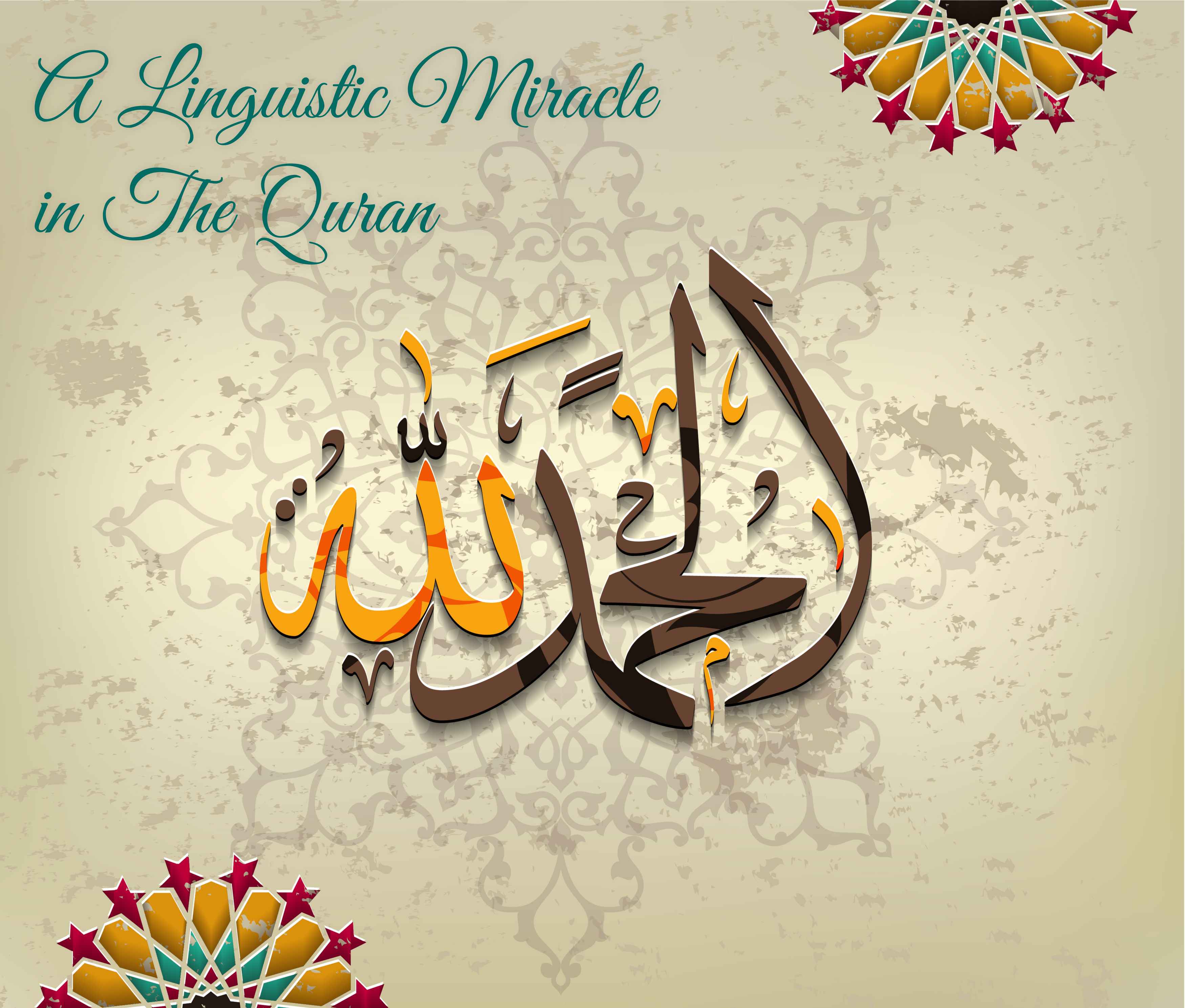
The words AlHamdu Lillah are most commonly uttered from Muslim lips around the world. After the basmalah (the tag name used for BISMILLAHI ALRAHMANI ALRAHEEMI)¸ it is the first statement mentioned in the opening surah, al-Fatiha. One way to explore the beauty, precision , and thought provoking eloquence of the Qur’an’s words is to explore the very choice of each word. Arabic is a rich language full of terms similar in meaning.
Hamd, commonly translated ‘praise,’ has sister terms like shukr, madH and thanaa.
Comparing Madh’, Hamd, and Thanaa’
Keep supporting MuslimMatters for the sake of Allah
Alhamdulillah, we're at over 850 supporters. Help us get to 900 supporters this month. All it takes is a small gift from a reader like you to keep us going, for just $2 / month.
The Prophet (SAW) has taught us the best of deeds are those that done consistently, even if they are small.
Click here to support MuslimMatters with a monthly donation of $2 per month. Set it and collect blessings from Allah (swt) for the khayr you're supporting without thinking about it.
Madh’مَدح : Praise + Mention of noteworthy qualities and actions attributed to someone or something.
By Comparison
Hamdحَمد :Praise + Acknowledgement of noteworthy qualities and actions done out of genuine love, veneration, reverence, gratitude and appreciation.
Madh can be made for the living as well as the non-living, for beings of intellect (humans, angels, jinn) and animals.
Hamd is exclusively directed at the living & intellectual الحي العاقل .
Madh is possible before a noble deed or after (as a result of it). It is therefore possible to make Madh of a person who may not have done anything good and no good deed may ever have been attributed towards him/her.
Hamd can only be made after a noble/ praiseworthy contribution of some sort.
Thanaa’ is a more eloquent, more impressive, more flattering type of MadH.
Conclusion: By using Hamd instead of Madh or Thanaa’
a. we acknowledge Allah as Eternally living
b. we recognize His attributes and decisions as Hamd worthy
c. There is an element of sincerity in our praise of him stemming from love and reverence.
d. we not only praise His incredible being, attributes & works, we appreciate them as favors for which we are grateful
Comparing Hamd with Shukr
Shukr (thanks) is a consequence of whatever good comes to a person from someone else.
Hamd is a consequence of good that whose effects go beyond an individual favor.
Shukr is exclusively related with favors and doesn’t include appreciation or praise of any noteworthy attributes. For instance you don’t thank someone for being smart or wise or athletic.
Hamd is made because of favors and also over noteworthy attributes even if they don’t benefit oneself directly. For example I say Alhamdu Lillah when I hear that my friend passed his midterms or something.
a. Madh is too wide in scope and using it wouldn’t be precise enough.
b. Shukr is too narrow in scope and using it wouldn’t be comprehensive enough.
c. Hamd as opposed to Shukr & Madh also implies a genuine motive.
The Word ALLAH in alhamdulillah
We looked briefly at the choices that would have represented alternatives to the word Hamd in the divinely revealed phrase AlHamdu Lillah. Let us now take a look at the word Allah itself. It is the unique name of our Lord. We learn through His revelation that He possesses and rightfully owns the best Names and Attributes (thank you Sheikh Yasir for your awesome class!). Why is it most appropriate to use His unique Name in this phrase rather than AlRahmaan (the exceedingly merciful), Al Khaaliq (the creator) etc.? Simply because any of these names might imply that His Hamd is associated with that particular power or attribute. By using the word Allah, Hamd is acknowledged for Him independent of any of His attributes, OR for all of them simultaneously!
A Variety of Ways to Make Hamd of Allah
Arabic offers great flexibility in communication. There are varying degrees of emphasis with which a statement can be made. There are multiple options that can be manipulated in sentence structure. Similar statements can be made such as :
أحمدُ اللهَ
“I praise Allah.”
نَحْمَدُ اللهَ
“We praise Allah.”
اِحْمَدُوْا اللهَ
“Praise Allah!”.
1. All of the above are Jumal Fi’liyyah. This sentence structure necessarily implies the occurrence of an act bound by time. Alhamdu Lillah is Jumlah Ismiyyah which, for one, is a far more emphatic form of declaration in Classical Arabic by comparison. Secondly, it implies continuity, stability and permanence. Another unique feature of the Ismiyyah structure is that it communicates a decisive statement.
2. Jumlah Fi’liyyah exclusively attributes an act to a specific subject. In the suggested alternatives above, ‘I’, ‘we’ and ‘you all’ are the specific subjects respectively. الحمد لله , being a Jumlah Ismiyyah, doesn’t identify the subject which makes it a universal declaration. I, we, you, they, people, animals, rocks, trees, rather all of creation can be understood as the subject! There is another beautiful subtlety here. Whether anyone or anything makes حمد of Allah or not, الحمد is still for Allah!
3. The Jumlah Fi’liyyah renditions above are limited by time and applicability. The original statement is timeless and has universal applicability. Through الحمد للهِ the way in which the praise is made is kept unspecified while in the Fi’liyyah format the praise would be by the tongue.
وَإنْ مِنْ شَيْئٍ إلا يُسَبِّحُ بِحَمْدِهِ ولكِنْ لا تَفْقَهُوْنَ تَسْبِيْحَهُمْ
4. In Jumlah Fi’liyyah there is the possibility of doing an act for an object that isn’t worthy of it. For instance, ‘I paid him’. It may be that ‘he’ didn’t deserve to get paid. In Jumlah Ismiyyah the necessary implication that this praise is actually rightfully placed is naturally implied, ALHAMDULILLAH!
5. In saying الحمد لله , we are also acknowledging that حمد is the property of Allah while this is not implied in alternative fi’liyyah renditions. When using the command form, ‘Praise Allah’ instead of Alhamdulillah, there are a number of shortcomings. Firstly, there is the sense that this praise is being asked of the audience. By comparison الحمد لله declares the existence of حمد without dependence on an audience responding to an imperative. The imperative may also imply a response that may or may not be voluntary while Alhamdulillah is an observation of the voluntary praise done by all forms of creation.
Why the ‘Al’ in Alhamdu?
ALHAMDU is definite or proper as I like to call it in my intro course. As Dr. Fadel puts it in his article, the Al serves the meaning
الحمد المعروف بينكم هو لله
The distinguished, universally acknowledge form of Hamd known among you belongs particularly to Allah. The ‘AL’ also serves the implication of ‘istighraq’, a kind of absolute totality (All Hamd is Allah’s). None of these enhancements would come forth in the indefinite version HAMDUN.
Why Not Inna Alhamda Lillah?
Have you ever heard a khateeb say INNAL HAMDA LILLAHI? The word INNA means ‘certainly’ and is used to emphasize a statement. What benefit would there be in NOT emphasizing ALHAMDU LILLAH in the Fatiha? You see, Arabic sentences are divided and categorized from different angles and perspectives. One of these angles is Jumlah Khabriyyah vs. Jumlah Insha ‘iyyah. What this categorization basically means is that statements in the language are either declarative (which can be judged as either true or false) or they are statements communicating an emotion. The latter are a form of subjective communication which don’t necessarily communicate facts, but rather they serve to vocalize feelings and sentiments. When a statement has INNA, it can only serve to be informative and the emotional dimension of it is removed. By not stating the INNA, the phrase retains informative and emotional potential depending on the context. Think of it this way: If a bus whisks by you missing you by half an inch and you say ‘ALHAMDU LILLAH’, you are not really making a statement of fact, rather vocalizing your internal feelings. The emotionally charged dimension of AlHamdulillah is kept intact by not using the INNA.
What About Lillahilhamdu?
In Hajj season we say ALLAHU AKBAR wa LILLAHI ALHAMDU! We reverse ALHAMDU LILLAH with LILLAHI ALHAMDU. This is a form of TAQDEEM in Arabic grammar and serves to color a sentence with a shade of exclusivity, ‘ Hamd belongs ONLY to Allah’. It is appropriate particularly on the occasion of Hajj because that blessed house was misused for Shirk so in response a strong denial of it is implied even when we say LILLAHI ALHAMDU. This TAQDEEM also serves the function of IZAALAT ALSHAK ‘removing doubt’. Why now say it this way in the Fatiha then? The context of the Fatiha is not one that demands the removal of doubt. Also, exclusivity exists in response to a challenge to the original statement. If somebody is attributing Hamd to Allah and other than Him, he or she should be taught that Hamd is ONLY for Allah. The Fatiha is not a response in debate with those who falsely associate with Allah. But we do find LillahilHamdu in the Qur’an. Interestingly, it appears in Al Jathiah: 36
(فلله الحمد رب السموات ورب الأرض رب العالمين) الجاثية (لآية 36)
The context, unlike fatiha is one where disbelievers who credit life and death to other than Allah. Here, the exclusive, emphatic mode of declaration is more befitting so we see LILLAHILHAMDU. The Fatiha declares certain universal truths that are completely in line with the embedded fitrah (natural pre-disposition) you and I are born with. In our fitrah there is no competition between belief and disbelief, tauheed & shirk, iman & kufr. Rather our faith is an unchallenged manifest truth seeded deep within our conscience. In Fatiha, this truth is therefore uttered in a fashion (ALHAMDULILLAH and not LILLAHILHAMDU ) that doesn’t even indicate the existence of an alternate point of view because within our genuine conscience, there isn’t one.







Ahmad AlFarsi
January 7, 2008 at 12:41 PM
mashaAllah, amazing article, ya Ustadh! SubhanAllah, even such a common and familiar phrase to us all is a miracle from the Rabb il-‘aalameen.
ALHAMDULILLAH!
shinga
May 12, 2015 at 2:57 PM
mashallah
it is said very beautifully and it has helped me alot.
Voyageur
January 7, 2008 at 1:58 PM
Allaah yabaraik feekum.
We read Fatihah so many times during the day, but never get tired of it. There’s always something more to discover. SubhanAllaah
restingtraveller
January 8, 2008 at 10:09 AM
Jazakum Allahu khayran ya Ustadh. Alhamdulillah for Bayyinah! InshaAllah I hope and pray you can continue to travel and bless the muslims around the country as you have blessed us.
FearAllah
January 8, 2008 at 10:46 PM
SubhanAllah, very interesting!
The grammatical analysis of the Quran never ceases to amaze me. Each and every word written with a purpose, in a specific context, and can never be replaced by any other word….subhaAllah
And Allah is the Best of Authors!
coolguymuslim
January 9, 2008 at 1:20 AM
subhanallah this is just too awesome
Pingback: “Alhamdulillah” - A Linguistic Miracle of the Quran « Cool Guy Muslim’s Blog
Asma
January 9, 2008 at 3:55 AM
Journey of the soul after death by Navaid Aziz
http://video.google.com/videoplay?docid=-1271703983528881536
shinga
May 12, 2015 at 2:58 PM
jazakallah for the article.
it is fascinating and was wonderful to read. i have really gained more knowledge from it.
Sulayman F
January 10, 2008 at 12:31 AM
Fascinating article, jazakh Allahu khair.
asim
January 10, 2008 at 9:53 PM
Asalaam walaykum Br. Bouman,
I was wondering if you were teaching the arabic 101 class anytime soon anywhere. The website (www.husna.com) is not working for some reason.
jazaak allah, please email me at [email protected]
asim
January 10, 2008 at 9:53 PM
Asalaam walaykum Br. nouman,
I was wondering if you were teaching the arabic 101 class anytime soon anywhere. The website (www.husna.com) is not working for some reason.
jazaak allah, please email me at [email protected]
ibnabeeomar
January 10, 2008 at 9:57 PM
the website is bayyinah.com
Sameena Parvez
January 12, 2008 at 8:29 AM
To PRAISE Allah SWT is our necessity! We PRAISE HIM not only in recognition of His Infinite Excellence but because of our feeling of extreme, genuine love and immense gratitude to HIM for the infinite Blessings HE has lavished on us. WE OUGHT TO ADORE, WORSHIP and OBEY HIM -the ONE and ONLY GOD ALMIGHTY (there is none like unto HIM)
Pingback: muslimmatters.org » Quranic Verbs used for Purification and Exoneration
Pingback: Open Thread Sunday 4/27/2008 | MuslimMatters.org
Sarah H
April 27, 2008 at 4:09 PM
Brother Nouman!
Thanks you for posting such an innovative and interesting look on such a beautiful phrase. Truly, Alhamdulilah!
I especially enjoyed your explaination during class on the same subject. It is another reason to want to learn more and grasp more on the wonderful Arabic language.
I sincerely hope you will come to visit us at the Zubaida Foundation again, even after our classes end. You’ve taught in a new interesting way and the descriptions of the Qu’ranic miracles (and the little jokes too) keep the class exciting!
AbuAbdAllah the Houstonian
May 3, 2008 at 6:02 AM
bismillah. mashaAllah! la quwwata illa billah. it seems every article of yours makes me love you more. with articles that praise Him and describe the beauty of His Speech, i think it’s a safe bet i love you for the sake of Allah. it will be awesome inshaAllah when your courses finally come to Houston — unless it is my tawfiq to attend a class sooner!
Pingback: Open Thread Sunday 5/25/2008 | MuslimMatters.org
tabman
June 22, 2008 at 3:18 PM
I wonder if one word entails this much what the rest of the Quran entails. I can only wonder for now, this makes me think really this book is ocean of knowledge
Pingback: What is Hamd? « Tayyibaat
bz
February 6, 2009 at 1:15 AM
Assalamualikum,
I’d really like if someone could explain to me whats the effect of كن in a sentence. I noticed that through out surah nisa كن is used alot when Allah’s attributes are coupled compared to other surahs such as surah baqarah and imraan.
وَلاَ يَحْسَبَنَّ الَّذِينَ يَبْخَلُونَ بِمَا آتَاهُمُ اللّهُ مِن فَضْلِهِ هُوَ خَيْرًا لَّهُمْ بَلْ هُوَ شَرٌّ لَّهُمْ سَيُطَوَّقُونَ مَا بَخِلُواْ بِهِ يَوْمَ الْقِيَامَةِ وَلِلّهِ مِيرَاثُ السَّمَاوَاتِ وَالأَرْضِ وَاللّهُ بِمَا تَعْمَلُونَ خَبِيرٌ
suraah imraan
يَا أَيُّهَا الَّذِينَ آمَنُواْ إِذَا ضَرَبْتُمْ فِي سَبِيلِ اللّهِ فَتَبَيَّنُواْ وَلاَ تَقُولُواْ لِمَنْ أَلْقَى إِلَيْكُمُ السَّلاَمَ لَسْتَ مُؤْمِنًا تَبْتَغُونَ عَرَضَ الْحَيَاةِ الدُّنْيَا فَعِندَ اللّهِ مَغَانِمُ كَثِيرَةٌ كَذَلِكَ كُنتُم مِّن قَبْلُ فَمَنَّ اللّهُ عَلَيْكُمْ فَتَبَيَّنُواْ إِنَّ اللّهَ كَانَ بِمَا تَعْمَلُونَ خَبِيرًا
suraah nisaa
Pingback: Benefit of Saying Al-Humdullilah « Birkah's Blog
Pingback: Benefit of Saying Al-Humdullilah « Birkah's Blog
Pingback: Need understand with .......
Abdullah Reed
January 9, 2011 at 3:39 AM
Peace be upon you
Thanks for explaining something about ‘Alhamdulillah’. I haven’t gone into it so deeply. I don’t know the Arabic grammar. I tend to use languages more wholistically, and although I love grammar, I can’t always get it quickly. Perhaps one day my Arabic grammar will be better and I will more confidently read this study. Or… could you make it easier?
I have written some bloggings about using English (and any language) as a Muslim, to make your way to Paradise. I would appreciate any comments or suggestions from other Muslims or non-Muslims, if you have time to read them.
The site is http://abdullahreed.wordpress.com.
Abdullah Reed
January 9, 2011 at 3:43 AM
I read it more carefully this time and I appreciate it more. Praise be to Allah forever.
Abudullah
Ashraff
March 7, 2011 at 11:44 PM
My dear brother Nouman.
Jazakallah Khairun for your great discussion. This is going to help me a lot.
nayma
March 8, 2011 at 8:32 AM
Jazak Allahu Khairan Br. Nouman. I’ve used your online classes in so many ways. I’ve used your podcasts on the last Juz at bayyinah.com to make powerpoint presentations for kids at our retreats. We use your Quran weekly youtube videos for our boys’ halaqas. We listen to your grammar classes for our Arabic class!
The benefits have been endless!
There is one thing i’m waiting for though. You mentioned you would continue giving your tafsir classes again after a break. When will you start again??
Looking forward to listening to them.
Pingback: “Alhamdulillah†– A Linguistic Miracle of the Quran by Noman Ali Khan taken from MM
Mehreen
July 24, 2011 at 11:49 AM
SubhanAllah…
asma
October 18, 2012 at 1:37 AM
brother please tell me the plural of word “HAMD”
Omar
February 28, 2013 at 5:42 PM
Good summary of points in Surah Fatiha by Nouman Ali Khan in this lecture: http://muslimmatters.org/2009/11/27/surah-al-fatiha-nouman-ali-khan/
Ali Sayyed
January 12, 2014 at 7:10 AM
howmeny times repeated the word Alhamdulillah in quran? Howmeny chapters starting with word Alhamdulillah in quran?
Pingback: Hamd o Na’at | Paki Orbit
Isa
January 29, 2016 at 2:16 PM
Still an awesome read – alhamdulillah
Shokran Navai
March 9, 2017 at 3:49 AM
Salam alaikum PLEASE can someone help me understand this part as im confused at the part where it says `The distinguished, universally acknowledge form of Hamd known among you belongs particularly to Allah` does this mean for example if we say someone is smart hamd in this case would mean that praise is actually due to allah since he created it to be like that and also other praisworthy things