
Dawah and Interfaith
Niqab (Face-Veil) in the West…

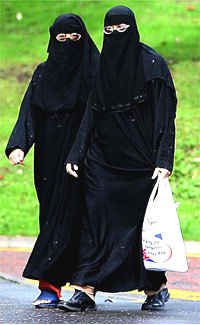 The following article, appended below, (hat-tip to theTranslators) touches on many of the issues that Muslim women face while living in the West. Personally, I find the article very enlightened and very enlightening. In it we see, how the website Islamtoday.com, has transformed its views and opinions on matters that affect Muslims in the West, as opposed to Muslims living in Muslim countries. So, while other fatwa issuers, including some of the most popular ones among the ‘conservative’ Muslims still extend their Saudi or Egyptian experiences to Muslims living under completely different conditions and situations; Islamtoday, under Sh. Salman Oudah’s supervision, is expanding its vision to be more accommodating and more understanding of the realities that Muslims living in non-Muslim countries face in everyday life.
With regards to the veil issue specifically, and other similar issues related to the ‘outward’ practice of Islam, it is probably not a good idea to lump the entire ‘West’ as one monolith community. Rather, the prejudices and biases that a Muslim woman faces in France are not the same as what a Muslim woman faces in the States, which is likely still a little different from what she would face in Australia. Hence, we have to be careful of applying everything that is stated in this article to our situation in the States. As one commentator, ‘Nuqtah’, pointed out on theTranslators entry, USA is probably a beacon of freedom, in terms of the right of a woman to wear the hijab or even the niqab, as opposed to many European countries.
I should add, though, that if anyone thinks that the niqab is not a barrier to everyday dealings right here in the States, and that non-Muslims are completely comfortable with the face-veil; then that too is a naive understanding of the situation. Many people, esp. those who work in the Corporate world, would be quite uncomfortable in taking their niqabi wives to a family event or a company formal dinner. To sit there, trying to explain why your wife has to cover her face, is not usually the conversation you want to be having. Especially at a big company function, where it is practically impossible to explain to every individual why there is “taliban woman doing in our midst”. One may consider these situations to be petty in the big picture. But, that is one example of many similar situations, and they are all additive. My point is that the niqab does pose a social networking challenge for Muslims in the West, which is completely different from Muslims living in Saudi Arabia, for example. Please do understand that I am not trying demean the niqab… I am just trying to portray it from the point of view of an average American, who has never been exposed to a niqab-wearing woman (exposed in terms of friendship or significant interactions).
Keep supporting MuslimMatters for the sake of Allah
Alhamdulillah, we're at over 850 supporters. Help us get to 900 supporters this month. All it takes is a small gift from a reader like you to keep us going, for just $2 / month.
The Prophet (SAW) has taught us the best of deeds are those that done consistently, even if they are small. Click here to support MuslimMatters with a monthly donation of $2 per month. Set it and collect blessings from Allah (swt) for the khayr you're supporting without thinking about it.
Lest, we use the article to somehow denigrate the niqab or our sisters who wear it, let me be clear that I have nothing but respect for them. If there is one truly significant display of one’s commitment to Allah, then the niqab is it. Regardless of whether one believes it is obligatory or not, there is no denying the fact that these sisters have the guts to wear it, solely out of their belief that it is for the sake of Allah. I mean just the hijab is hard enough (read Amal’s story on Austrolabe), let alone something that covers your facial expressions, so you can’t smile to fend off a suspicious look. That is something to be praised, not belittled. And if you don’t think it takes guts, well try it yourself (sorry, guys, I know you can’t try it, but you have to ask a sister who does it to believe it). Furthermore, based on Islamic scholarship, there are really only two ‘authentic’, ‘traditional’ views to the niqab issue: (1) it is obligatory or (2) it is recommended. There is no third, so we should be careful about degrading the niqab because we may be degrading part of our religion. And if you push it too much, you may be facing the wrath of the ‘Ninjabis’ :) .
In the end, I believe, and this is purely my personal opinion… that practically speaking, we are so behind on getting our sisters to wear just the basic hijab, that we really don’t need to push the niqab opinion in the West. The majority opinion seems to be #2, and excuse me for my layman approach here (since I claim to be nothing more). So, under all the circumstances that we find ourselves in, living in the West, do we really need to create more barriers? And is it really something that we have to priotize in our dawah here? The answer is for everyone to ponder over it themselves. After all, ultimately, the matter is between the sister and Allah.
Lifting the Veil – A Consideration of Circumstances
Sheikh Sâmî al-Mâjid, professor at al-Imâm Islamic University, Riyadh
There are Muslim women around the world who have chosen to cover their faces in public. Most of these women sincerely believe that it is their religious obligation to do so. Their decision can be met with resistance, especially in the workplace or when they are engaged in certain public activities. Often those who oppose their wearing the face veil cite practical considerations that they claim make the veil unviable. The women who wear the face veil can find themselves under a lot of stress. They sometimes feel that they have to choose between either functioning normally in society or obeying their Lord.The matter of the woman covering her face has two dimensions. One is the matter of a woman showing her face in public. The other is that of the man looking at a woman’s face. Scholars who discuss this matter might approach it from one of these two angles or both.In brief, we can say the following with certitude:1. It is unlawful for a Muslim man to look lustfully at a woman who is not his wife, regardless of who the woman is or how she is dressed. If a man deliberately does so, then he is sinning.2. It is unlawful for a Muslim woman to present herself in any way with the deliberate intention of inciting the sexual desire of any man besides her husband. If she does so, then she is sinning.3. The matter of covering the face is something about which there is legitimate scholarly disagreement. The majority of scholars hold the view that it is not obligatory for the woman to cover her face, though many of these scholars consider it obligatory in cases where sexual temptation is feared. However, there are others who consider it obligatory for women in general, and they have evidence to support their opinion. Their view is to be respected. Likewise, a Muslim who holds either view on the matter has a right to do so and this also should be respected.A Muslim who does not consider the face veil to be obligatory should not dismiss or belittle the needs of those who do. Likewise, a Muslim who advocates covering the face has no right to look down upon those who do not.The Degree of Seriousness
Though some scholars are of the view that a woman must cover her face when she can be seen by unrelated men, their opinion is based upon an interpretation of the evidence. There is no direct, unambiguous statement on the matter.
When a matter in Islamic Law is of great importance, there is always unambiguous and direct textual evidence about it. This is the case for rulings like the prohibition of polytheism, adultery, and theft. It is also the case for the prohibition of a man and woman being alone together. This is why all scholars agree on these matters.
The prohibition against a woman showing her face in public, on the other hand, is based on indirect evidence.
For instance, they cite the verse: “They should draw their head coverings over their bosoms” [Sûrah al-Nûr: 31]
Those who say a woman must cover her face use this verse to argue that if Allah orders a woman to draw her head covering over her bosom, it means implicitly that she will be covering her face.
Other scholars counter that the same effect can be achieved by wrapping the head covering around the face and allowing it to drape over the bosom. This is, indeed, what we see most women doing.
Therefore, we must realize that if the ruling on covering of the face had been a grave and serious matter, Allah would have addressed it with a direct and unambiguous statement.
We are certainly not saying that the scholars who regard covering the face to be obligatory are wrong. In fact, the author of this article considers them to be in the right. However, even if we accept that they are right, the matter is not as serious as other matters of Islamic Law which are established by decisive texts.
Relaxing the Veil
We now will examine more closely the statements of those scholars who claim that it is obligatory for a woman to cover her face in public. When we read the statements of the jurists who held this view – among the most vociferous in this matter being Ahmad b. Hanbal – we see that all of them allowed women to show their faces for a legitimate need. In brief, they allowed the woman to show her face in any case where the positive identity of the woman is needed and likewise, they permitted men to look at the face of the woman in order to make that positive identification.
Ibn Qudâmah, a leading Hanbalî jurist and proponent of covering the face, says the following in al-Mughnî (9/498):
A male witness may see the face of the woman he is to be a witness for…
If a man engages in business with a woman, either buying and selling or entering into a rental agreement, then he has a right to see her face… It is related from Ahmad b. Hanbal that that he disliked his doing so if the woman in question is young, but not if she were old. It is likely that he meant that he disliked it for someone who feared temptation and in cases where it is not necessary for him to transact with her. As for when there is a need and where there is no fear of overt sexual arousal, there is no objection.
Dr. Muhammad b. Sâlih al-Duhaym, the presiding judge at the Layth District Courthouse in Saudi Arabia, is a contemporary scholar who regards covering the face to be obligatory. He issued the following ruling:
If a woman is living in a country, or in a time, or under circumstances where she cannot cover her face and hands – whether the reasons are societal, political, or related to public safety – and if she might face difficulty or might lose out on a greater good, then it is permitted for her to uncover her face and hands.
Many Hanafî jurists hold the view that a man can look at woman’s face as long as his doing so does not incite sexual desire. If it does incite such desire in him, then he is prohibited from looking at her face. Nevertheless, in cases where there is a compelling need for him to see her face, then he may look at it, even if he feels desire.
The eminent Hanafî scholar, `Alâ al-Dîn al-Samarqandî, writes in Tuhfah al-Fuqahâ’ (3/334):
If there is a necessity, then there is no objection to the man looking at her face, even if he feels desire. This is the case for the judge or the witness. They can look upon her face in the dispensation of justice or when carrying out the function of acting as a witness.
Likewise, he can do so if he is intent on marriage, since the purpose is not to indulge his sexual desires. This is because of what is related from the Prophet (peace be upon him) that he said to al-Mughîrah b. Shu`bah: “If you would take a look at her, it is better for fostering harmony between you.”
We can see that the scholars who held that view that the face veil is obligatory all agreed that it can be removed when there is a need to do so. There are many cases where a positive identification is needed. This is the case when a person is giving testimony or being testified about in a court of law, or when a man needs to be a witness for the woman in some matter, or in business where a positive identification is needed – for instance at a bank – or when being questioned by law enforcement officials or when acting in the capacity of a law enforcement official. A modern but equally valid example would be when a woman goes to the polls to cast her vote in an election.
Necessities and Needs
Scholars of Islamic Law make a distinction between matters that are prohibited for their inherent evil and matters that are prohibited only because they have the potential to lead up to the perpetration of an inherent evil. For instance, murder, fornication, and drug abuse are prohibited in their own right. By contrast, a woman showing her face in public is prohibited – by the scholars who regard it as prohibited – because of the temptation that it might cause and that might lead to the sin of fornication or adultery. The woman is not required to veil her face for the mere sake of covering it.
This is an important distinction in Islamic Law. Things that are prohibited in their own right cannot be permitted except in cases of dire necessity (darûrah). For instance, a person may not drink wine. However, if that person is choking on something and can only find wine to save himself, he may drink it out of necessity. By contrast, things that are prohibited only because they can lead to other unlawful activities are allowed for any valid need (hâjah).
Ibn al-Qayyim explains this principle in I`lâm al-Muwaqqi`în:
Prohibitions regarding the means to wrongdoing are not like things that are prohibited for their own sake. Prohibitions regarding the means to wrongdoing will be lifted for a valid need (hâjah). As for things that are prohibited for their own sake, their prohibition is not lifted except in cases of dire necessity (darûrah).
We have already seen in the statements of scholars who considered the covering of the face to be obligatory, many cases where they allowed a woman to show her face for a valid need.
In societies where there is no public segregation between the sexes, there are many situations where a face veil is impractical and poses hardship on women, especially in professional fields. This is the case where a woman is a teacher who needs to interact affectively with her students. It is also the case where female students are in a school with male teachers or classmates. It places great difficulties upon a teacher who has to manage a full classroom if he or she cannot see the faces of all of the students. Indeed, it is often difficult enough under normal circumstances.
People living in such environments cannot compare their circumstances with those of people living in societies like Saudi Arabia where schools and banks are segregated. We can see that the reason why there is segregation in banks in Saudi Arabia – as opposed to the general Saudi marketplace – is chiefly because of the impracticality of accommodating the covering of the face while carrying out banking transactions.
Therefore, the needs of teachers, students, and other people in the public sphere are legitimate needs which are recognized and accommodated by Islamic Law. In mixed societies, these needs have to be accounted for. Women who believe that covering the face is obligatory under ideal circumstances may relax the face veil in consideration of these legitimate needs.
It is important for Muslims living in non-Muslim countries to be aware of these matters. Muslims have a right to petition for their legitimate religious rights. Part of this means knowing what those rights are and what is reasonable to demand. In many non-Muslim countries, the government and the people are willing to accommodate the needs of the Muslims. When Muslims demand to be accommodated by non-Muslim countries under circumstances which Islamic Law itself deems exceptional and where Islamic Law makes concessions, this leads to unnecessary tensions between the communities which might lead to a souring of relations between them.
On a more general note, we must take time to consider the effect that the face veil has on relations between Muslims and non-Muslims in countries where Muslims are a small minority. For non-Muslims, covering the face can be a scary matter, and something that they have a difficult time accommodating. It is not the same as when a Muslim woman wears a head scarf, and should not be compared with it, since the visibility of the face is a great comfort to people who are not used to the veil and since the evidence for covering the head is far clearer in Islamic Law. The obligation of covering of the head is a matter of consensus (ijmâ`). The matter of covering the face is not.
Therefore, the need for harmonious relations between Muslims and non-Muslims must be weighed against the benefits of a woman in that society covering her face under various circumstances. Muslims need to ask themselves: Will covering her face achieve the desired benefit of limiting sexual temptation in the society in which she lives and with respect to the people with whom she interacts? Will it produce negative consequences for her or for the society as a whole that outweigh those benefits? These are matters that the Muslims who live in such countries need to determine for themselves coolly and objectively.
Courtesy www.islamtoday.com
Keep supporting MuslimMatters for the sake of Allah
Alhamdulillah, we're at over 850 supporters. Help us get to 900 supporters this month. All it takes is a small gift from a reader like you to keep us going, for just $2 / month.
The Prophet (SAW) has taught us the best of deeds are those that done consistently, even if they are small. Click here to support MuslimMatters with a monthly donation of $2 per month. Set it and collect blessings from Allah (swt) for the khayr you're supporting without thinking about it.






Beyond Repression: Muslim Sexuality On Campus

Bismillah, The Beast [Part II] – A Short Story

Zionist Instigators Storm Los Angeles Campus

Quranic Verses For Steadfastness For The Valiant Protestors On Campus

Callous Campus Crackdowns On Pro-Palestinian Protesters Grip The United States

IOK Ramadan: They Were Not Created Without Purpose | Keys To The Divine Compass [Ep23]
IOK Ramadan: Do Not Despair of Allah’s Mercy | Keys To The Divine Compass [Ep24]

Foreign Affairs Official Resigns Over Gaza Genocide
Callous Campus Crackdowns On Pro-Palestinian Protesters Grip The United States
Zionist Instigators Storm Los Angeles Campus

IOK Ramadan: The Importance of Spiritual Purification | Keys To The Divine Compass [Ep30]
IOK Ramadan: The Power of Prayer | Keys To The Divine Compass [Ep29]
IOK Ramadan: The Weight of the Qur’an | Keys To The Divine Compass [Ep28]
IOK Ramadan: Families of Faith | Keys To The Divine Compass [Ep27]
IOK Ramadan: Humility in Front of the Messenger | Keys To The Divine Compass [Ep26]
-

 #Islam1 month ago
IOK Ramadan: 7 Qualities of Highly Effective Believers | Keys To The Divine Compass [Ep18]
-
#Islam1 month ago
IOK Ramadan: Choose Wisely | Keys To The Divine Compass [Ep15]
-
#Islam4 weeks ago
IOK Ramadan: They Were Not Created Without Purpose | Keys To The Divine Compass [Ep23]
-
#Islam1 month ago
IOK Ramadan: Making Time for Allāh at Night | Keys To The Divine Compass [Ep21]

sister
May 7, 2007 at 5:31 PM
don’t why but i think it’s in islam to cover the face then why so big issue it’s a women’s choice!
Amad
May 7, 2007 at 7:08 PM
It’s a sister’s choice… but those choices are/should be based on knowledge of the deen. That knowledge comes via our scholars and our shayookh… so it is imperative that all viewpoints are available for our sisters to make the decision that is right for them…. wallahualam.
Anon.
May 7, 2007 at 7:20 PM
With all due respect to the aforementioned shuyukh, the concept of Necessity (Darurah) in Islamic Law has been flagrantly abused by some scholars, especially with regards to Muslims living in the West. For example, they tell us that to purchase a house is fine if it necessarily involves riba-based transactions occuring over a prolonged period of time (Mortgages). What about renting accommodation? These people need to be reminded of their duties to us as laypeople.
2ndly; yes, the Islam Today site has done much good work, but it has a tendency towards exaggeration. It recently had an article promoting mass democracy, and other such rubbish. These people can’t even tell us what democracy is, and yet they pass fatawa on us as if Allah made it wajib on us. These scholars are seriously abusing the public trust, and we should always remind them whenever they seem to be pandering to popular opinion, rather than doing their job. Rant over.
Amad
May 7, 2007 at 10:28 PM
Anon.: We will not allow discussion and bad-mouthing of other websites, and especially our scholars. Before you talk about how these scholars have ‘abusing’ the public trust; you need to consider what you have done for your religion. Future comments such as these will be deleted and may risk. Please respect our house-rules.
Hassan
May 7, 2007 at 11:15 PM
Salaam. I recently finished the whole series of life of Abu Bakr (RA) by sheikh Anwar Al-Awkli. I am completely confused now. I do not know which scholar to trust or not (not issue on niqaab, but on another sensitive issue), it seems there are 2 parallel universe in which scholars live. For those who have listened to CD set please advice.
sincethestorm
May 8, 2007 at 1:11 AM
I respect what you say Br. Amad about listening to our sheikh. But the problem is which one? If you pick one, their views change. Some become more practical and some more radical. Then there are some who blindly follow sheikhs without using their minds. There is a degree of variation of opinion by sheikhs over time, even you have to admit this! So, you’re back to the same vicious cycle, deciphering among the multitudes of opinions.
————————————————
Just an aside, I find all this debate over niqab over kill. The order of importance of deeds in the Quran is clear. We never hear about duties towards our parents, manners…and of course the five pillairs. I hear from so many parents that the youth are gaining ilm but there’s no change in the behavior. Yet, we never hear it discussed. For some reason, theres so much focus on external deeds but the deeds that are noteworthy and most beloved are never discussed. I find all this focus on this issue ridiculious.
Nuqtah
May 8, 2007 at 4:35 AM
assalamu alaikum,
With all due respect, and keeping within the boundaries of ‘respectability’, I’m leaning more towards what the commenter “anon.” said.
The concept of ‘necessity’ seems to have been misapplied (if not butchered).
In my knowledge, the only reason that I’ve heard from traditionalist scholars allowing the uncovering of face in west, is for the sake of da’wah only. I’ve never heard or read them say that it should be taken off for the sake of integration or supposed hardship etc…
However I could be wrong. Even if I’m wrong, I’ve never heard scholars consciously or actively imply that sisters should opt for hijaab over niqab. (And this is what aforementioned article seems to be saying).
I think the idea of ‘hardship’ has been over exaggerated. In fact, this article could be counter-productive within the ‘muslim community’. It could be used ‘against’ sisters who strive to wear niqaab, and uphold it as being an obligation or something that should be done.
Some one could just come and along say; ‘ see even your own scholars are saying that it’s better that you don’t wear niqab, you’re just being an “extremist”.’
Furthermore, the situation is not so alarming that sisters should have to take off their niqaabs (atleast in North America).
I think it could have been worded better. The shaykh should have stayed neutral whether the sisters should opt for hijab or niqab.
Having said that, I do applaud the shaykh for actually bringing up this issue. So, now it’s open for debate. Perhaps the feedback that is being given would give our scholars in east and general masses an even better picture.
May Allah reward the shaykh, i’m sure his efforts are sincere.
Amad
May 8, 2007 at 7:06 AM
Sincethestorm: The way I see it, this issue of ikhtilaf is so evenly divided, with strong fatawas from both sides of the aisle (for instance Sh. Albani considering it recommended, and Sh. Ibn Uthaymeen/Sh. Bin Baz obligatory) that a sister should do what she is comfortable in doing, based on her understanding of the evidences and her sitation. As laymen, as long as a person follows the scholar that he or she trust, then the burden is lifted. If she wants to be closer in taqwa, then wear the niqab. If she feels its an over-burden and could have negative consequences wherever she is, then she should act accordingly.
I emphasize, as I mentioned in the post, the situation in France for instance is radically different. In situations where this is possibility of harm and social castigation, then it is probably better not to… wallahualam.
Nuqtah, since we are not in the scholarly positions that these ulemah are in, we are not in a position to criticize their intentions. We can disagree with their premises, but we have to do so, understanding that they are doing ijtihad, and Allah rewards every true intentioned ijtihad, even if it is wrong. As for hardships, let’s ask the sisters who wear niqab how hard it is, honestly speaking… perhaps it isn’t, and all the power to them then.
Nuqtah
May 8, 2007 at 7:39 AM
I made it clear that I’m not doubting the intentions. However, remember a scholar’s view should be based also on acute awareness of ground reality. The fact of the matter is that the ‘shaykh’ doesn’t live in the west, and isn’t the best person to refer to when it comes to ‘islamic discourse in the west’. Hence, in my personal opinion his conclusions were a bit too vague or generalized.
He discusses it from a pretty much Hanbali perspective, quoting Ibn Qudammah (ra) and Imam Ahmad (ra).
Hanbali madhhab is the only madhhab that considers that actual face `awrah. So, for the face to be allowed to be uncover, the necessity has to be really “extreme”, in the literal sense of the word “extreme”. And that is surely not the situation in North America, or even in Great Britian for most part.
Just because Islam comes under more and more criticism doesn’t mean we start to compromise our principles, as some one have done. (Without naming anyone) We now seems organizations that were once beacons of ‘the dawah’ are now organizing events with total free-mixing (unrelated men and women sitting on the same table)…
So being wishy-washy and actually taking legitimate concerns into consideration are two different scenarios, which have a very very thin line dividing them….
…so wAllahu a’alam but the shaykh could have been more specific, as his article makes more sense in a European context. Or, he could have elaborated more…
Nuqtah
May 8, 2007 at 7:55 AM
oops too many typos in the last comment…sorry I am half asleep, please overlook the typos :(
Amad
May 8, 2007 at 8:54 AM
salam Nuqtah: your half-asleep comments made me fully awake…
First of all, do you know if the Shaykh in question (Sh Sami alMajid) ever lived in the West, or how much did he study issues surrounding Muslims in the West? It is one thing to be living in a Muslim country and giving fatwas without a proper evaluation of what is going on in the non-Muslim country; yet it is altogether different if the person takes the time to research issues properly and meticulously. Just as we don’t have to live in France to gather some opinions and thoughts on the French situation if we take the time to do proper research; similarly, we cannot place the burden of Shayookh to live in the West in order to derive opinions on the matter.
Of course, as Sh. Yasir pointed out in the ‘Muslims in the West’ lecture, it would be preferred if we had our own people of knowledge move up the ranks and evaluate our situation from our midst, but until that happens we have to look for scholars who seem to have a pretty good idea of what is going on.
On the issue of niqab especially, there is so much evidence on both sides of the aisle, such that it spans different methodologies and thoughts. That is what the author seems to be stressing… that in the issue of clear ikhtilaaf, where the society is also making it difficult, we should be lax on the rukhsah.
I should add that my wife wears it, even though I may lean the other way, because ultimately it is the sister’s decision one way or the other. Let the sister read all the evidences and proofs, let her evaluate her own strengths and weaknesses, her own battles in her society and community; then she can do what she believes she is able to. Because Allah does not burden a soul beyond what it can handle.
Nuqtah
May 8, 2007 at 9:04 AM
I see what you are saying. So as a concluding remarks, all I have to say is;
I’m sure the shaykh (hafidhahu Allah) has researched the matter as is clear from his acute understanding. Nonetheless, his conclusion isn’t meticulous enough.
And Allah knows best.
Have a good day :)
Wassalamu alaikum.
Anon.
May 8, 2007 at 11:45 AM
Sorry about that Amad. When I talked about scholars ‘abusing the public trust’ I honestly didn’t intend the author of that particular article. I was talking in general, simply saying that we should remind our scholars when they forget. I revere the ulema, brother, but when they are obviously wong, shouldn’t we correct them? And by obviously, I don’t mean some subtle fiqhi issue that I am not qualified to discuss, I mean general issues, like macroevolution, for instance. Declaring something halal is no light matter; I’m just saying that the scholars should err on the side of caution. After all, it’s our Hereafter we’re talking about…
Suhail
May 8, 2007 at 12:54 PM
Assalaam Alykum,
For a layman to comment on a fatwa doesnt make any sense since we dont have any base in usul al fiqh. The duty of a layman is to ask a qualified mufti and follow him. How to choose a qualified mufti is what you need to do. You know who is speaking the truth. The mufti may error with his ijtihad but thats not for a layman to decide. Just ask the mufti and follow him.
There is a nice article by Ibn Taymiyyah about this. I will post the link once i find it.
Jazakallah Khair
Suhail
Ruth Nasrullah
May 8, 2007 at 2:14 PM
Returning to the subject of niqab in the west…
Asalaamu alaikum.
From a dawah perspective, I think we should be just as supportive of niqab as hijab in terms of trying to educate people and not changing our Islamic values and habits to suit society.
I think that part of the choice a niqab-wearing woman in the US makes is to either exclude herself from or make it very difficult to participate in a number of activities that women here naturally are part of. That doesn’t make it wrong, of course, and as you note, Br. Amad, it’s totally a sister’s choice. I personally don’t think I could do the activities I’m involved in while wearing niqab. But if I felt niqab was essential to my spirituality, I would be willing to give up those activities for the sake of taqwa. It would be a small sacrifice if I was donning niqab for the right reasons.
Maybe my points are obvious. I’m curious to hear niqabis’ description of their experience in the west/US, not so much from a scholarly standpoint but from their personal experience.
AnonyMouse
May 8, 2007 at 2:19 PM
My mom wears the niqaab, and has been for the 12 years we’ve been here in Canada – and subhan’Allah, I don’t think it’s presented any problems at all.
Sure, we’ll get the odd nasty comment, but on the whole people are generally respectful of her. At first they might make assumptions about her, but as soon as she starts talking they get over that pretty fast… hah, she speaks English better than most Canadians do! :P
Wearing the niqaab doesn’t hinder her from going about normal activities; nor does it present obstacles when interacting with non-Muslims.
Like I said, they may assume things about her in the beginning, but once they ‘get to know her’ (although that doesn’t really feel like the right phrase to use, but whatever) then it really doesn’t matter much.
So yah… not my personal experience, but close enough…
restingtraveller
May 8, 2007 at 5:00 PM
16 comments and no niqaabi yet :-)
Amad
May 8, 2007 at 10:10 PM
Will the real Niqabis please stand up now?
sequoia
May 9, 2007 at 12:27 PM
My fear about the niqabi, is that there is eventually going to “concern” that it will cause a security issue. We have already seen the groundwork laid for this, as talks about “terrorists” hiding under the niqabi have been scattered through news stories (I believe some of the 7/7 guys escaped England through this). I think while this is a legitimate issue for concern, it will be used by the Islamaphobes to further divide us.
(I remeber the first time seeing the niqabi, when i was younger did scare me. But I think because it did remind me of bad ninjas that i used to watch movies about. Luckily my “fear” of this clothing is gone…..but not so much for the ninjas
amatulwahhaab
May 9, 2007 at 12:51 PM
i started wearing the niqaab for a while but my husband told me to stop due to the situation here. we live in the uk, and there are many cases of niqaabis being abused verbally and almoust attacked! i understand how some people feel, like anon and nuqtah, but then again it really is hard for some sisters here. there was a case of a normal hijaabi in scotland being abused by four teenagers! what then if she was a niqaabi?
sequoia
May 9, 2007 at 1:32 PM
This will be a defining civil rights movement. Amatulwahhaab, unfortuately there will always be people abused for being different and is clearly horrible. It has happened to you in the UK as a Muslim and has happened to me, a Christian in Muslim countries for wearing a cross. But Muslims should be proud and feel free to express themselves religiously. To me, the acceptence of others is a long difficult journey, but one that must be undertaken for the future of all of us. The Civil Rights movement in America is the closest parrale I can think of. Things didn’t really start to change in people’s hearts until Martin Luther King Jr. and others walked with class and made people realize that we were all humans and deserved respect. Sounds simple, to look at each other as equals, but us humans are tribal by nature defining ourselves by country, religion, race, football team, ect. I believe woman should not feel threatend to wear the niqaabi, nor do I feel they should feel threatened by wearing a mini-skirt (I know I am in the minority on this issue :) ). This is an issue for all of us, muslims and non-muslims alike and one we must face togther. i look forward to the day where my niqaabi half-sisters feel feel free and unashamed to wear it throughout the streets of the world. I also lok forward to the day when all religious minorities can feel comfortable worshipping in any country in the world. We have a lot of work to do, but it is worth it
nuqtah
May 10, 2007 at 2:01 AM
Sister amatulwahhab i see your point. But your ogic could be reversed. Since people even take an issue with just hijaab, why not strive to wear niqab? They dislike it either way.
nuqtah
May 10, 2007 at 2:01 AM
logic*
Muslim Apple
May 10, 2007 at 3:12 AM
Asalamu alaykum,
I’ve always found the preoccupation with, emphasis on, and discussion of hijab and niqab without much consideration of the burden and difficulty it places on sisters by brothers that go around dressed in a manner that makes them indistinguishable from non-Muslims to be strange.
isramiraj
May 10, 2007 at 7:34 AM
Asslamalaikum,
I feel it’s a woman’s choice but it should not be pushed. Personally after going to Saudi a few times, I think the author has missed some gross societal ills and on the verge of perverted behavior in Saudi. This article is not western propaganda either, http://news.bbc.co.uk/go/pr/fr/-/1/hi/world/middle_east/6592123.stm.
There are other ills witch are not worthy mentioning and behavior of Saudis in neighboring countries or west, not to mention the car accident death rate is much higher than the US or other european countries (where alcohol is daily drink) and it is not related to Alchohol (the car accident deaths in Saudi Arabia). So personally I believe it can go the other way too much segregation can lead to pervasiveness (just an observation and opinion). In the west, personally I very much respect and have deep admiration for sisters who wear the niqab. However, I feel it is causes isolation and black is often synonymous with witchcraft in the west. It is very difficult to get an impression or interaction with someone, especially in the west without facial expressions or actually most of the world. Recently I attended an infectious disease conference in Saudi with men and women (from various arab countries). We were in the same room and only one observed niqaab the rest hijab. Most of the questions and comments/interactions were coming from women, it was a great atmosphere for learning and I could honestly say no man was flirting (even we went to formal business dinner afterwards) with the women, it was very professional. There should be a maturity and professional level. In Oman (muscat) when I visited niqaab is rare and the women and men are open with each other. The women treated me not as a stranger or alien but were very natural. I think it is important to be natural and not treat the other in a unnatural way. We learned alot, some.
These are just my observations and I respect a sister’s decision.
nuqtah
May 10, 2007 at 8:17 AM
wa alaikumussalaam,
So muslimapple you have a realistic solution to how we can decrease this disparity?
Perhaps make hijaab more accomodating, you know like shedding the jilbab, who needs it anyways? heh.
Amatullah
May 10, 2007 at 8:55 AM
Nuqtah…that’s definately not what she meant.
From one extreme to the other, subhanAllah.
Amad
May 10, 2007 at 9:50 AM
ASA, woah there Nuqtah… you assume too much sometimes bro.
Muslimapple made a similar point to what I wrote in the main post… that as guys we cannot really completely understand the hardships associated with this. So, we should be careful in making judgments. Of course, we cannot compromise in the minimums as set by Allah, on which there is no ikhtilaf (like the hijab itself), but we should be more lax in our approach when it comes to matters of ikhtilaaf while considering our sisters’ situations. wallahualam.
Umm Reem
May 10, 2007 at 11:43 AM
So y’all wanted a ‘niqaabis’ comment! :)
I myself never judged the proofs between niqab being ‘wajib’ or ‘mustahab’ (never felt the need for it). When I started wearing it, I didn’t believe it was fard. However, what I experienced with it was definitely much more uplifting then without it. First and foremost the feeling of dressing like the beloved female companions (may Allah be pleased with them all). We may never be able to be like them, at the least we can ‘dress’ like them!
Face, after all is the center of beauty and attraction and with it being covered, there is not much to attract attention and this in itself becomes a protection (but I guess now it attracts other type of attraction!)
In any case, for some of us it is easy to wear niqab for some it is hard yet for others it is impossible! As for me, personally, I haven’t had any difficulties that I start thinking of taking it off, walhamdullilah. It hasn’t taken anything away from me, in terms of my daily activities or Islamic activities and it will be very hard for me to believe that niqab can be a barrier for ‘Islamic’ activities!
As for other stuff, I went to college wearing niqab, but that was 10 years ago and things have definitely changed now. I do other stuff now, grocery, mall, bank, mechanics, and sometimes mountain hiking, horseback riding, jet skiing etc. But of course none of this is ‘professional’.
I do get comments/looks but I guess I’ve just gotten used to them. The most difficult thing for me is to go somewhere with lots of kids because it really does scare them. They are so honest that they can’t hide their fear, some of them start crying. If there are no men around, I do lift my niqab and give them a smile…it calms them down!
I’ve also gotten ‘positive’ comments like, ‘we are so proud of you’, or ‘we support you’ or ‘we are so sorry for what our govt. is doing to your people’ and the one I like most is, ‘oh I wish I could dress like you’!!
The only time when I ever feel somewhat close to difficulty with it is when I have a lot of family over and for days I have to go around the house with my niqab, sometimes it becomes irritating. However, that is also where I feel the most need of niqab. It keeps a certain distance and keeps others from becoming too ‘friendly’, certain family members who would never fully grasp the concept of mahram/non-mahram otherwise.
So, maybe personally I cannot relate to the article much. It hasn’t caused any such difficulty for me that I can justify removing it. But it doesn’t mean that it hasn’t for others. I am sure there are many parts of US and the world where niqab is practically impossible to wear. And may Allah ease the situation for those sisters.
Abu Bakr
May 10, 2007 at 12:33 PM
My comment is just directed towards something that Br. Amad mentioned iin the original post. I would just like to say, I have the utmost respect for Sh. Salman al-Awdan and for the many other scholars who participate in his website, but I think you were mistaken in assuming that this particular article represents sort of an “official” stance of all of IslamToday and the scholars who participate in it.
This is simply just not true. I appreciate their website for their willingness to allow different scholars to come and express their viewpoints on matters. This is, in my view, one of its great facets (in English, you only get a fraction of the material that there is in the Arabic site, unfortunately). In fact, you will also find articles expressing the exact opposite stance on the issue of the woman’s awrah (not addressed to the issue of women in the west). For example:
http://www.islamtoday.net/questions/show_articles_content.cfm?id=71&catid=73&artid=4107
http://www.islamtoday.net/questions/show_articles_content.cfm?id=71&catid=73&artid=3993
These are two articles by Lutf Allah Khawjah, a professor at Umm al-Quraa. One is entitled “The Conclusive Evidence of the Verse of Jilbab that Covering the Face is Obligatory.” The other is entitled “The Conclusive Evidence of the Verse of Hijab that Covering the Face is Obligatory.” One of them is an analysis of the verse from Surat al-Ahzab and the other an analysis of the verse from Surat al-Nur.
He is a fairly regular contributor to IslamToday as he has around 20 articles and about five, six fatwas on their website.
"UnderCover" Muslimah
May 10, 2007 at 12:41 PM
isramiraj said: “It is very difficult to get an impression or interaction with someone, especially in the west without facial expressions or actually most of the world. ”
i would like to totally disagree with this. Its quite the opposite in a digitally enhanced world, where most talking has been transfered from face to face talking to cell phones and Chat Rooms.
Also if you know many niqaabis, you will know that you can read peoples expressions and emotions from their eyes. My friends can tell when im laughing, when im tired, when im stressed, and anything of the like, just by looking at my eyes.
Amad
May 10, 2007 at 1:41 PM
salam Br. Abu Bakr, jak for the clarification. I did not assume that Islamtoday would have just this one position on it, but I did appreciate the fact that they are expressing more viewpoints. Also, I did see a level of maturity in the article with regards to living conditions in the West, which sometimes one does not find in the fatwas from the Muslim lands… wallahualam.
Sr. Undercover, you mentioned that your “friends” can recognize your emotions/expressions from your eyes. And being a husband of one who wears it, I can do the same. But, the average person, who is not used to reading emotions with just the eyes, may not be that good at it. Also, if you are not used to it, it is difficult for the average person to disregard this ‘barrier’, let alone become good at reading expressions / emotions.
I suggest that we ask our non-Muslim colleagues and friends and see what they have to say… and here I am talking about the ‘tolerant, open-minded’ ones… any takers?
Umm Reem
May 10, 2007 at 2:10 PM
When I am outside and I give smile to someone, most of the time they smile back (unless they are those weirdo types who just roll their eyes and turn their face away), so I suppose they somehow figure out that I smiled!
nuqtah
May 10, 2007 at 2:53 PM
Br. Amad: It’s called *sarcasm*. : )
AnonyMouse
May 10, 2007 at 2:58 PM
Umm Reem, my mom does the exact same thing!!!!
The funny thing is, kids seem to be more receptive to her than their parents or other adults are… if my mom smiles a kid, the kid will be able to tell and will (usually) smile back and/ or even wave… of course, then they turn around go, “Mommy, why is that lady wearing a mask? Why is she dressed like that? Why, Mommy?”
Whereupon ‘Mommy’ turns bright red and mutters something incomprehensible and bundles the child off…
sequoia
May 10, 2007 at 3:57 PM
Well first communication with strangers can be akward no matter who the people are. Should i smile? Am I being too friendly? Am I rude for not asking too many questions? Does she want to talk with me or is she just being nice? Now usually it is easier to tell by a persons facial expression if they just want you to leave them alone….but herein lies the dilema I have found with the niqabbi. Should I talk alot? Is it inapporpriate to talk with her? Will she think i am being rude if I don’t talk? I wonder if she has any good shwarma recipes?….. these are usually the thoughts I have. I love talking with new people and hearing about their lives, but this is a scoail situation where i think we all need more practice on
Muslim Apple
May 10, 2007 at 6:26 PM
I think men that want to increase their creditability in their criticism of women’s dress that does not conform to the image they have of a properly dressed Muslim woman or when extolling the virtues and benefits of wanting women to dress in a manner than resembles early Arabia should also dress in the manner of the men of early Arabia with full izars and turbans.
How common it is to see men dressed in a manner indistinguishable from the non-Muslims or like they just got out of bed or the gym or as Suhaib Webb says “looking like Shrek” while their female family members are in an over the head Saudi abaya and niqab.
It seems that so much of the discussion and perception of what is proper Islamic dress is focused on resembling Arabs while ignoring the many diverse cultures that inform the lives of the vast majority of Muslims.
nuqtah
May 10, 2007 at 7:22 PM
And we are enlightened by the modern, civilized and educated muslim women. We are forever indebted.
The fact is that niqaab was not just common to arabia. In fact arab women never wore niqaabs until Prophet (saw) order them to do so.
So to claim that it is something ‘arabian’ is non sensical. Although it did become part of islamic culture over the centuries. Your distaste more than just too obvious.
If you have a problem with ‘backward’ islamic dresscode, atleast come up with better reasons from a fiqhi point. Rather than parrot off what your ‘enlightened’ progressive buddies feed you.
Oh and I’ve seen niqaab being worn in various different distinct styles depending on culural and geographical location. For instance, afghaan ‘burqa’ isn’t anything like the way niqaab’s worn in Saudia. Each are quite indiginous. Your preposterous hypothesis is debunked from this perspective.
In short, just like niqaab’s varying style differ from place to place, so do men’s dresses. It’s not something ‘early arabian’ at all. Niqaab did not exist among arab tribes before islam.
Thank you and try again.
Amad
May 10, 2007 at 10:44 PM
ASA, I don’t believe that Muslimapple meant the niqab with her ‘cultural’ slant. I think she was referring to the jilbab (??).
There is a valid point, though, to be considered. Islam has established rules and regulations for a Muslim’s clothing, men and women. As long as the woman’s dress-code fits these general guidelines, it does not necessarily have to be a certain ensemble or the other. So, a lose skirt and a lose long shirt may be an acceptable alternative to the jilbab; as long as it meets the requirements of looseness to cover shape, non-sheer, etc. Would you agree with that?
And brothers and sisters, can we be a little less edgy in our writings. A little honey will only enrich your points, not take away from it.
nuqtah
May 11, 2007 at 2:50 AM
[quote]
So, a lose skirt and a lose long shirt may be an acceptable alternative to the jilbab; as long as it meets the requirements of looseness to cover shape, non-sheer, etc. Would you agree with that?[/quote]
An honest question: Would you have believed or said this 8-10 years ago?
Muslim Apple
May 11, 2007 at 6:17 AM
I am not opposed to niqab or jilbab as I wear jilbab and hijab myself and have often supported on my blog the right of sisters to wear niqab if they choose to do so.
My objection is to brothers (key word brothers) that go around indistinguishable from the non-Muslims and have little concept of the issues or difficulties encountered by sisters that choose to cover all the while trying to force them into clothing choices which have flexibility within an Islamic framework.
I’d like to see some brothers encouraged to spend a week going around performing their daily activities in an izar and turban.
Muslim Apple
May 11, 2007 at 6:33 AM
Among the things some of us modern educated Muslim women have learned is that there is a difference between being a male and being a man and sarcasm and bad manners is not from the sunnah of the Prophet sal Allahu alayhi wa sallam and just tends to be a reflection of a weakness of eman. I’m available at my blog if anyone would like to continue the discussion with me on these points.
Amad
May 11, 2007 at 9:41 AM
Nuqtah:
We don’t have to go that far back… even a few years ago I may not have agreed with what I stated. At that time, I would also probably have considered you as having ‘imperfect’ beliefs and ‘not-good-enough-manhaj’ and taken them as prime reasons for believing that you and many other brothers are ‘dangerous’ to Islam. So, yes, things have changed. Views have matured. And alhamdulillah I believe for the better. Our Aqeedah hasn’t changed. Our goals haven’t changed. Just our understanding of Fiqh of minorities has adjusted, and our understanding of priorities in deen has adjusted, and our understanding of Muslim brotherhood has adjusted.
By the way, is there anything wrong in what I stated, and I ask this sincerely? If all the rules and regulations of the hijab are applied, wouldn’t what I stated be acceptable? Is there a specific requirement for the jilbaab for instance as in the garb context?
Hassan
May 11, 2007 at 11:05 AM
Muslim apple, I do not understand why you want men to wear arab traditional clothes, when its not ordered for them to do so (as opposed to hijab or niqab for women). By the way many brothers keep beards, and are brown enough to be target of sting operations. (the other post). I have not seen any woman (alhamdulillah) that is being taken to jail here. When it comes to men, when they get in trouble for being muslim, its usually big. Plus do not forget most of men have to go through airports, specially who are frequent flyers. I know quite a few muslim brothers (despite being US citizen) have to stay 6 hours at airport when they return from overseas. And while they travel within country, they get “special protocol” as well. I am not sure why this issue is being turned to man vs woman. And if islam practicing brothers tell/encourage muslim women to observe islam, I do not see why women should tell back brothers to observe something that is not part of islam. If they tell them to keep beard, that would make sense.
By the way, I feel islam of women is more good dawah then islam of men, in west specially. Reason is, that most westners think islam allows men to force hijab on women, so when they see women covering up in west (where the men cant force, if they do woman can easily call 911), so they get shocked.
Judge Dredd
May 11, 2007 at 11:21 AM
Having grown up in the West, I am not really comfortable with the Niqba. I don’t know if that is because I haven’t come accross it to often in my life or have an uderlying bigotry. Nevertheless, that is my opinion if ever I had a right to have one, and must state that I don’t mind or even think I have a right to mind if someone wants to wear one.
I do feel it is the right of the woman to decide if she wants to wear it or not.
For men and non-muslims to steer this debate is a gross injustice.
The niqba does not break any Islamic rules. So it should be up to the woman.
To impose it is just like those who would want to impose Islam on a non-muslim. It is wrong.
If men and non-muslims could mind their own business in this respect, maybe we would get to an equilibrium quickly.
Somehow though it has become a mantle for Islam – not because the muslims wanted it to be but it has been the darling of the irresponsible MEDIA day in day out. Now it is the subject of legal battles going on everywhere in the West. There was even an “enlightered” Imam in Oxford,UK who reportedly funded a local school to fight the rights of a girl who wanted to wear it in school. The girl lost the case. The Imam, Dr Hagey is proudly carrying on fighting the right not to wear the Niqab. This is how muslims are being dragged in and doing the dirty work of the media. This kind of rubbish is going to continue because Jack Straw, UK labour MP knew it would be devisive for muslims.
To use a divisive tool to divide the muslims is exactly what they want to do.
I cringe though at the thought of the use of the Niqba in defining my rights as a muslim in the West.
marshmallow
May 11, 2007 at 3:45 PM
Assalamu alaykum,
I am a ‘niqabi’ as we have been labelled, and have worn it for about 12 years. Now and before we suffer from abuse, but it has altered slightly. Whereas before abuse would come from people uneducated about islam and dress code, or, basically they would have over reacted, like crossing over the road when seeing me to avoid me, or laughing at me pointing. Now the abuse is more on a sinster level, where the abuser knows what they are doing, and wants to hurt or annoy. However, what has happened now is that rarely you get someone reacting out of ignorance, due to us plastered all over the media. Wearing the niqab is not easy, but neither is hijab, nor fasting, or praying 5 times a day. Islam isnt meant to be a picnic, we are working for a bigger reward. The scholars have defined the niqab as either obligitory or recommended(some say highly recommended), so whichever way, reward is there. I think that muslims are in trials all over the world so a little hardship over a small piece of material is not going to break me inshallah.
SmallBunny
January 29, 2011 at 10:07 AM
MashaAllah!
Just keep asking yourself `will this action of mine please Allah` If yes than go on! Don`t you think that Allah will be pleased with someone who strives in HIs cause and tries to fashion themselves after the Sahabiyaat
nuqtah
May 11, 2007 at 4:10 PM
Yep, and as an individual intellectually subservient to euro-centrism, I also know that it is ‘sunnah’ for me to question the tradition, the corpus of islamic law, and mock the scholars. So, to even consider such backward and narrow minded individuals telling me what to do or wear, is abasement of my enlightened existence. I must only agree with those scholars who say what I want to hear. Hence, I must conclude that all muslims are backward except my civilized self, and my educated progressive buddies. *rolls eyes*
Br. Amad: So what you’re essentially saying is that you ‘changed’ your ‘principles’ ?
Regarding your jilbaab question. In Qur’an there’s mention of an ‘outer garment’, which a muslimah is to wear on top of what she’s wearing as clothing.
Ruth Nasrullah
May 11, 2007 at 4:41 PM
Asalaamu alaikum, Nuqtah. I certainly respect your knowledge, but you share it in a very unfriendly way. Your derisive tone not only makes the blog unpleasant, but it makes me question your integrity.
I’ve read Muslim Apple’s blog and she doesn’t strike me as “progressive.” I regret that you feel it necessary to treat her with sarcasm and no apparent willingness to appreciate her comments or respond to them respectfully.
Abu Bakr
May 11, 2007 at 5:29 PM
Personally, even though I am of the view that Niqab is fard, I understand where sister MuslimApple is coming from as sometimes the same self-righteous brothers who will presume to lecture (and even berate) Muslim women themselves have little idea of what pressures they face or must go through. Sometimes these same brothers will be wearing the tightest of pants and if they even have a beard, itll be a tiny thin line or a fashionable little goatee.
This sort of thing does smack of hypocrisy, so I don’t really find Sr. MuslimApple’s comments to be necessarily offensive.
Even if one does not agree with what the other party is saying, even if you have 100% certainty that they are wrong, give them the benefit of the doubt. Perhaps they have just misunderstood. Perhaps you have not understood the real meanings of their words.
Amad
May 11, 2007 at 5:31 PM
The principles haven’t changed… the approach has… there is a big difference. I don’t think you would have really liked the old ‘me’ too much ;)
Abu Bakr
May 11, 2007 at 5:32 PM
“By the way, is there anything wrong in what I stated, and I ask this sincerely? If all the rules and regulations of the hijab are applied, wouldn’t what I stated be acceptable? Is there a specific requirement for the jilbaab for instance as in the garb context?”
I don’t personally agree because I don’t think that a long blouse and long skirt would meet the requirements of the hijab with respect to hiding the shape of a lady’s body.
It could be conceivable if it is worn with the very large khimars (headscarves) which come down well past the waist, but generally I don’t think it is. And Allah knows best
nuqtah
May 11, 2007 at 6:12 PM
wa alaikumussalaam,
a) I don’t have any knowledge, and I don’t claim to be knowledgeable.
b) If my tone is ‘derisive’, i’m not the first one to leave such a comment. There are plenty of other derisive and sarcastic comments. So, why not police all of them?
c) Give me one good reason to question my integrity, other than the fact that I think different from you?
d) ‘Progressive’ is not a label. It’s a mindset, a way of thinking. You could masquerade as a traditionalist, salafi, al-maghrib groupie or whatever, you could still have a ‘proggie’ mentality.
And btw, I comment here because I’m free to do so. If there’s a problem with me doing so, lemme know.
Ahmad AlFarsi
May 11, 2007 at 6:13 PM
Assalaamu alaykum,
There was some discussion about the jilbab…
Isn’t there ijma’ on Jilbab (the outer garment/cloak that a sister wears over her normal clothes) being fard?
The sister from muhajabah.com details the fardness of Jilbab on her website.
http://www.muhajabah.com/jilbab.htm
Wassalaam,
Ahmad
nuqtah
May 11, 2007 at 6:16 PM
Br. Amad: How can approach change without making some sort of compromise in Principles? After all an approach is based on a set of Principles.
Ahmad AlFarsi
May 11, 2007 at 6:18 PM
Assalaamu alaykum,
I also remember Sh. Yasir Qadhi saying at TDC 2005 that a loose shirt and a skirt does not meet the requirements of hijab. He specifically said that an overcloak (jilbab) is necessary to meet the requirements of hijab.
Wassalaam
P.S. That was the ‘old’ YQ, let’s ask the new one ;) JK! -Amad
AnonyMouse
May 11, 2007 at 6:22 PM
Bro Nuqtah, I think approach CAN change without compromising principles.
For example, say that one believes that niqaab is fardh.
On one hand, they can take a very harsh approach towards non-niqaabis and constantly berate them, saying things like, “How can you deny this fardh?! You’re a huge sinner! You’re the cause of so much fitnah!” etc.
On the other hand, one can still believe in the fardh of the niqaab WITHOUT taking this approach to non-niqaabis; rather we try to be more understanding and courteous, e.g. “Sister, I hope you don’t mind me telling you this, but I do think that you should be wearing the niqaab…” and presenting proofs for it, etc.
Personally, I think there are waaaaaay to many sisters out there who are having trouble with wearing just the khimaar and/or ‘abaayah/jilbaab, let alone the niqaab… so we should be trying very hard to support these sisters and encourage them in taking the steps to wearing khimaar/ jilbaab first before trying to make them wear the niqaab…
Amad
May 11, 2007 at 6:28 PM
asa, Br. Abu Bakr/Ahmad: jak for the clarification. Would the ‘traditional-Arab’ jilbab only count as meeting requirements of the ‘outer garment’ or would a long coat do the trick? The link from muhajabah was pretty good mashallah.
Br. Nuqtah: this post isn’t about “Amad in the West”… so let’s not personalize it too much. Approach and principles are two different things… you can approach the same principle differently. So, your goal may be to do dawah, for instance, to a set of people and the principle would be to give them the correct info. about Islam. The approach to the dawah can vary. Hope that clarifies. If it doesn’t, email me.
As for ‘derisive’ and ‘sarcastic’ comments, then let me say that as a team, we like to give full benefit of doubt and light nudges… if people don’t get the point, we are clearer. Eventually, it can lead to deletion/editing as we have done in the past.
I am sure you like to control your blog the way you want to. So, we wish for this blog to be ‘easygoing’, ‘friendly’, and full of mercy and benefit of doubt to each other. Feel free to point out other comments that demonstrate ‘bad faith’ and inshallah we will look into that. There is no reason to pick on you, other than what you provided in your comments here. I know that is not your ‘usual’ self; so we want to happy nuqtah back again. FULL STOP! Here is what one of the editors said about sarcasm, a style that in my mind is the scourge of good blogging: “The dismissive sarcasm is just a tool to oversimplify the argument and place everyone else in a neat little box”.
As for progressives, let’s leave that definition to the people it belongs. We will be hurting ourselves by extending it to people who would like the conditions in the West to be taken into account for rulings that apply to them. This is not progressivism, rather it is rational and only fair. As long as the usool are not being compromised (like rejecting hadith, ijma’, scholars, etc.), its all good. It will be good inshallah if YQ can write something about fiqh of minorities… I will suggest it to him.
w/s
nuqtah
May 11, 2007 at 6:35 PM
Anonymouse: What Br. Amad and I are discussing isn’t limited to just the niqaab issue.
We are talking about a set approach based on set principles, and it encompasses all that we do. Or, atleast I am.
And just in case you failed to grasp what is being said; no one is looking down upon hijaab(is), but trying to reason with those who have a problem with niqaab.
Amad
May 11, 2007 at 6:38 PM
Though Nuqtah…. Sr. Anonymouse’s comment is credible in terms of priorities. There is a sea of sisters without basic hijab… and an ocean without basic Islam…
nuqtah
May 11, 2007 at 6:41 PM
“The dismissive sarcasm is just a tool to oversimplify the argument and place everyone else in a neat little box”.
Lol! This is true. I’ll be honest, there are people you can’t reason with, so gotta use some sarcasm just to get a kick out of it. :p
Anyway, I’m going to leave it at this. As I don’t think we’re on the same page due to various reasons. Let’s agree to disagree.
Ahmad AlFarsi
May 11, 2007 at 6:41 PM
Assalaamu alaykum,
I thought I remembered one shaykh (was it Sh. Yasir Qadhi?) saying that if a sister wore a long raincoat or something like that it MIGHT be able to do the trick… given it covers the entire body (obviously we don’t mean the face here)… after all, isn’t such a coat, by definition an ‘outer garment’?
so such a ‘raincoat’ jilbab may be trendier and cause the sister to look less ‘foreign’… but it sure sounds extremely uncomfortable to be walking around in a heavy raincoat… esp this time of the year… which is why I think our sisters who wear jilbab prefer the abayah even though it looks foreign…
ME
September 23, 2010 at 1:51 PM
yes i too went to that talk and yasir qadhi had said theres no reason why women should wear the black arab style hijab, and hijab can be a full length coat!!! I WAS THERE AND HEARD IT MYSELF.
nuqtah
May 11, 2007 at 6:43 PM
Ok just for the record: I am fine with hijaab. I only feel a need to response when people start talking trash about niqab, jilbab etc by calling them ‘old arabian outdated costumes’.
abu ameerah
May 11, 2007 at 9:45 PM
WOWEE – WOW!
Niqab is one heck of an emotional issue…
Let’s ask the “Sheikh” about this matter…
http://golmal.pickledpolitics.com/wp-content/uploads/2006/08/hisham.jpg
Can’t you just feel the love?!
Ibrahim
May 11, 2007 at 9:46 PM
Salamalikum,
These comments could have been quite beneficial if people had not jump to conclusions too quickly.
I might not be the most suitable person to talk about niqab in the west because I wasn’t born and brought up there. but, let me say that there is a sea of evidence on niqab being not an obligation (as many people have noted). People might want to read this book by Shaykh al-Albani: Jilbaab al-Mar’ah al-Muslimah, which also includes radd against the other opinion in very detail.
So, people shouldn’t jump to conclusions if something seems different to them. However, having said that, I do agree to certain degree with what Anon had said. I compeletly see and share the fears that let Anon and nuqtah to say what they said. There has been a trend especially in the west to use the fiqhi usul of dharurh, which leads to odd fatawa about riba, etc. And, this is a very ligitimate fear. I mean, remember the hadith of Saheeh Muslim—the knowledge will be raised in later times by Allah with the removing of scholars of knowledge (parapharasing). Am I saying that time is today? It seems so, but no I’m not saying that. Am I saying the contemporary scholars quoted in the article are without knowledge? No, by Allah, of course not. But, I’m saying that, as Rasoolullah (saw) have said, that each passing era is more fitna-filled (parapharasing). So, it is important to look at methodologies that lead to fatawa where there is great ikhtilaf. And, I think this is what some people here are trying to say. They fear what lies in the future and what compromises might still be made using certain rules.
Lastly, there is always those who say that women can stay at home (not work) if there is no financial emergency. But, I see that doesn’t solve the issue for those who are forced to work and those who have to go out and buy gorceries (which all have to do).
On the side, nuqtah, can you provide some email contact here or on your blog, if you don’t mind.
Abu Bakr
May 11, 2007 at 11:03 PM
“I might not be the most suitable person to talk about niqab in the west because I wasn’t born and brought up there. but, let me say that there is a sea of evidence on niqab being not an obligation (as many people have noted). People might want to read this book by Shaykh al-Albani: Jilbaab al-Mar’ah al-Muslimah, which also includes radd against the other opinion in very detail.”
I have read it many times, as well as his other book al-Radd al-Mufhim. I agree that Sh. al-Albani makes very strong arguments and I was in my earliest days as a student convinced of them, but I later changed my view. It is not my intent to force my opinion on you, but just do not rush to conclusions without having heard both sides.
Irrespective of my personal view on the matter, as a pragmatic approach to making Da’wah, and commanding the good and forbidding the evil, I think it is unwise to push an issue like this, especially in our Muslim community here in the West when there are bigger issues to be dealt with and when many sisters struggle just to wear basic hijab that any scholar would agree to be the bare minimum.
I heard a lecture once by Sh. Salah al-Sawi in which he stated that since we are in a land where tabarruj is widespread, we cannot very well expect that everyone will overnight start wearing the full hijab. That does not mean that we cannot try to decrease it and to improve the dress of the women. (He was not speaking about that issue only, but other evils as well.) His general point was that if you cannot eliminate an evil completely, it does not mean that you shouldnt try and decrease it as much as you are able.
Amad, as far as I can tell, with any type of overcoat that is full length, it could in theory work depending on the side of the headpiece that the lady was wearing, otherwise, odds are that shape of the top half of the body would be revealed.
Also on this matter, I recall now hearing a tape (or reading its transcipt) in which Sh. al-Albani was asked a question about wearing skirts but with a very long khimar, the ones that come down well past the waist, and he said it was permissible.
Abu Bakr
May 11, 2007 at 11:04 PM
Also, I think if you try to avoid black generally, the average Americans will not feel so uneasy.
Amad
May 11, 2007 at 11:09 PM
Jak akhi Abu Bakr… your last comment about avoiding black is very pertinent. Since the color itself has a huge image problem and there is nothing Islamically preferring it over other colors, that is definitely one area we can make a small difference by avoiding black…. great point.
nuqtah
May 12, 2007 at 1:25 AM
Abu Bakr; I pretty much agree with what you said.
Br. Ibrahim: Try leaving a comment insha Allah (on my blog)
Yusuf Smith
May 12, 2007 at 2:11 PM
As-Salaamu ‘alaikum,
A few months ago, I had a correspondence with a woman in Ottawa who has worn the niqab most of the time since she was 17. She gives an interesting account:
An Insider’s View on Niqab
Hannah
May 19, 2007 at 10:45 AM
as salaamu alaikum warahmatullah
I wear niqaab and I’m from Texas and I go to high school and everything. As long as a woman is strong in her deen then it’s not extremely difficult in the case of wearing it to school. but everyone is different I guess. Allahu a’lim.
I thought this was a really good article masha’allah. And I believe that niqaab is optional except in cases of temptation, in which it becoming obligatory.
wa alaikum as’salaam
khawla hurayrah
May 19, 2007 at 8:54 PM
Assalamu’alaikum
wow! I have not been on mm for so long and so much… being said already.
Without adding more, I just need to mention what I have noticed living in the West. Masha’Allah, there are many sisters who are trying to adhere to the veil, however, I don’t see the point when they simply break other ruling by driving and traveling alone with small children BUT NO male relatives. I am not talking about short trip to the stores but across countries and continents?
Umm ul-Layth
May 29, 2007 at 6:42 AM
Very interesting thread.
My view/experiences as a niqaabi:
I grew up in the States and am now living in Madinah, walhamdulillaah, so it was interesting for me to see the differences in being a niqaabi in both countries.
I started niqab about a year ago, in the states, walhamdulillaah. I’m not sure if consider it fard or recommended-haven’t read up on the issue =)
I started about a year after I got married, HOWEVER, my husband is not why I wear it (though, of course, pleasing him by wearing it is a motivational factor).
I grew up in a community that was pretty strong mashaa Allah, and had a lot of niqaabis. I was always attracted to the niqab, wished to wear it but didn’t for various reasons (not sure if I could ‘handle’ it, family objections, etc).
I feel like the niqab helps me guard my modesty. It’s like a constant reminder for me about how to act, a reminder of how the female companions used to carry themselves. It also reminded me that, whether I liked it or not, I was representing Islam, Muslim women, niqaabis, etc. So I found myself trying harder to be a better person.
Alhamdulillaah, wearing it has not been too difficult. Of course, it’s not easy, not in the States. But still. I realized that almost all of the opposition I get is from *MUSLIMS*. Yes, muslims.
Often, Muslims (generally elder ‘aunties’ and ‘uncles’) come up to me and demand, “Why did you start wearing niqab?” “Why do you have that thing on your face??” “Sigh…did your husband make you wear that?” (shake head)
Now, I always expected these types of questions from non Muslims, so I was quite surprised. Once I explained that I wore because I WANTED to wear it, etc., they would try to convince me that it’s not fard (which I never said it was), it’s not a good idea in this day and age, it’s bad da’wah, and you can’t possibly give people a good opinion on Islam while wearing it.
These conversations always frustrated me, because of ALL people, you would think Muslims would be more understanding of my RIGHT to wear niqab. Instead they act as if I am some extremist “wahhabi” bent on making the Deen difficult. What’s it to them if I wear niqab??? I’m not telling them to do it!
As for the non Muslims, they have a variety of reactions. Many stare (which I don’t really mind. I know I look weird to them); some do it rudely, some out of curiosity. Very rarely do I get rude comments. On the other hand, I found many people are extra friendly, as if to show that they’re not prejudice, and to make up for the ignorant people who are rude. I find niqab has been great in dawah, in that when people see I am friendly, know English fluently (=P), and do not seem in the least bit oppressed, they seem intrigued. I am often able to get people to open up and ask questions about Islam, why I wear the niqab, etc.
This is not to say wearing Niqab is easy in the States. Far from it. First of all, I have a bit of an attitude, so when I get those rare comments, or evil stares, I find myself getting ready to flip out on the person. Sometimes I do, other times I manage to control my temper. Second of all, it’s not always easy to have to deal with the stares and then on top of that have to deal with Muslims discouraging you from wearing it. But I attribute non of this to the Niqab. I attribute it to my weakness in Eemaan. I constantly remind myself of the Hadeeth, “Islam began as something strange and will once again become something strange. So Toobah is for the Strangers.”
I have a high respect for woman who wear it to college, or to the work place, for that truly takes strength.
This is not to say,
Interesting reactions from Non-Muslims:
When it comes to kids, alhamdulillaah, they don’t seem to scared, just curious =). I remember being at the mall one time, drinking something under my niqab, and this little boy stared at me wide-eyed for a minute and exclaimed to his dad: “Daddy! That woman has no mouth!, She has no face or anything!” I nearly choked on my drink laughing. Meanwhile the father explained that I indeed did have face, I was just covering it.
Another time, a little saw me standing in line at the store, gave me a big grin and shouted “HI!” with a wave. I was taken aback, because it was really unexpected. I grinned back (though she couldn’t technically see it) and waved. She came over and started talking to me like I was her best friend.
I was with my sister in law, shopping yet again. I was wearing niqab, she was wearing hijab and jilbab. An old white lady stood in front of us in line, looked at my sister in law and said, “You are just BEAUTIFUL!” Then she turned to me with a reproachful look on her face, saying, “And you, why are you covering yourself up like that??”
=)
Umm Layth
May 29, 2007 at 11:17 AM
Lol! I came to check the updates on the blog and I saw an Ummul Layth on this thread and just had to read it!
You took the words right out of my mouth ukhti. I get the most problems from Muslims as well. It has never hindered da`wah and I believe it is pathetic to abandon a possible (and I say possible for others, because for myself I am certain of its requirement) obligation for ‘da`wah’. And for anyone who says it hinders da`wah… you wear it for one day and see how many people it opens the doors to. Of course, you may get the evil looks and those who won’t bother even speaking to you but that is upon them, not upon you. Insha’Allaah on the day of Judgement, Allaah will reward you.
MuslimObserver
July 13, 2007 at 2:46 AM
assalamu alaikum,
I hope this reaches everyone in the highest of faith and happiness. I am the average muslim brother who isnt married but is around a large muslim community and with it many niqaabis, masha’Allah. I think that the major issue with this issue is that we ourselves don’t propogate our values and beliefs enough to the non-muslims. If the community around is educated enough insha’Allah they will become more accepting and more welcoming. I know that here in Houston, Tx we have open houses quite often and we invite the non-muslim community and showcase what our Muslim community is all about. We show them educational videos and let the the two communities interact and get a feel for each other.
On another note, i think that we as the Men of our community and brothers/fathers/husbands to the Women of this community should learn to be more supportive of our Women. Sometimes i think that we leave our Women out on an Island of their own and left to fend for themselves.
If your a man question yourself what do i do to make the life of a female member of my family or community a little bit easier out there.
Muslimah
October 16, 2015 at 1:37 PM
How refreshing,
Mashallah brother, you made my day!!! and i think you have made such an obvious point that is all to often neglected, in the UK i am unaware of a single instance in which fathers/brothers/uncles etc support their women financially, in order to facilitate them to obey they lord, women are forced to go out and fend for themselves, and then get berated by ‘some’ brothers for not adhering to the much debated Niqaab….
where is the common sense…??????
God bless you brother and your justice.
Syeda Ghazi
April 5, 2008 at 9:52 AM
Asalamu Alaikum…
i myself have been intruged by Niqab since ive met many niqaabi sisters with great stories and wonderful personalities!
I hope to start the face-viel for the pleasure of Allah Almighty but obviously Shaytaan whispers all these doubts into my mind.
The thing is if u fight jihaad against your inner.self( nafs) then Allah (S) will send protection to u since your following him and giving up something dear (face)..
Insh-Allah i will persevere in Canada & stand strong!
Peace out
~Oum Abdurrahman~
May 4, 2008 at 8:39 AM
As-salaamoulaikoum wa RahmtAllah,
I enjoy reading this thread alhamdulilah. I have learned a lot of perspectives so far.
The truth is this. One cannot judge someone because they are a niqaabi , or a hijaabi. We can’t always tell the circumstances of the sister. Eman cannot be decided by whether a sister wears niqaab or not.
When I made hijrah from Houston to Jordan, I was alone. I moved here to Jordan for the sake of Allah. My view on the niqaab issue has developed into a broader perspective since then.
I felt that in Houston there was always the underlying danger of being attacked, or mugged, because I was alone after being divorced. So I felt very vunerable, so I took it upon me to always walk “like a man”, and always walk with wide steps, being constantly aware of my surroundings at all times. Alhamdulilah I survived and nothing ever happened to me, even when I would make it a point to go at night for grocery shopping, in order to avoid the heat and the crowds. I would just take my kids, and put my trust in Allah that nothing would happen to me in the fairly lit parking lots. But that was a very challenging and scary lifestyle, and I made a point to remarry. Although it meant losing my two beloved children, I followed through, and traveled alone to Jordan.
On my way up here, some things happened, good things actually. I went wearing my face veil and abaya. I put in my heart that Allah would protect me and cast fear in the hearts of those who might have had enmity towards me. So Alhamdulilah I got to Frankfurt, and I had a thirteen hour lay- over, so I quickly looked for the masallah, to seek refuge there till my flight time arrived.
All of sudden this Khaliji sister walked in. She saw me, and I saw her, we said salam and she assumed I was from Saudi because of my accent in Arabic. After I told her I was a new muslim American from Houston, she was shocked totally.
My niqaab had snapped when I was sleeping there, and so I asked her if she had a closed pin. And she gave me one and then she asked if I needed anything. She happened to be not from Kuwait but she was Emirati. I told her a kind “no, Alhamdulilah I’m okay.” But in truth I was in great need after all those taxi rides took my money. We said our salaams, and she left. Soon suprisingly after about 15 minutes, she came back and gave me 100 Euros for the sake of Allah and asked me to make du’ah for her. I was so thankful to Allah for the help, and quickly prayed two raka’at.
I got some odd and fearful looks from the Frankfurt Airport guards, but once they saw my passport and heard me speak English, they left me alone. I travelled back to my country about 2 and half years ago, and I did not wear my niqaab then, because I felt that the situation was not safe for me, since I had to travel alone.
After what happened in Amman, and how the hotels were destroyed by the suicide bomber from Iraq, things have changed totally here in Jordan. When I was at the main Army Hospital in Amman, the undercover police quickly came after my husband and I, because we were standing next a window over looking the entrance of the hospital. There werea lot of secret police hidden around us, they heard us talking English, and so they raided us and took us to the secret police. They accused us of being foreign terrorists. I was appauled and surprised. But the military later appologized as they were only caring out orders.
Then after that I tried to get a job, in a town where perhaps 25% of the ladies wear niqaab. I was turned down because I wore niqaab. The employer assumed I was not suitable for the job because of my clothes. I took the matter to the Royal Court. Alhamdulilah things got resolved, however they could not help me because by policy they do not interfere with private sector companies. While I was at the Royal Court, the secretary commented to me and said, “One should cover their eyes or not wear niqaab at all.” So that like kind of made me ponder. I’m not sure what the ijtihaad is for that. However I certainly could not cover my eyes.
The society sometimes has led people to make wrong assumptions of niqaabis. People sometimes make terrible allegations that they are hiding themselves for sinful purposes to not be recognized by relatives, in order to go meet men in secret. Or they are accused of being members of an extreme politcal sect. If I were to wear that pull over abaya, I’d automatically be assumed as being from Iraq, and that is not a good thing here in Jordan, because of the politcal and security situation at this time.
So since then I had to remove my niqaab, but I did it for the sake of Allah only, and not for any other reason, insha’allah. I just believe it’s safer without it. Especially travelling, and because I have to the military hospital and what not, it’s just safer. And after having wore it for 8 years, I was sad that those rewards are not there, however, at the same time, I can feel a little bit more comfortable feeling safe. However I only commanded respect when I did wear it. I honestly believe one can be close to Allah without the niqaab. However the niqaab helps to bring one closer to Allah. There are also so many other things also that can bring one closer to Allah, da’wah, dhikr, sadaqa in secret, ikhlaas, Qur’an, Allah made our religion easy alhamdulilah. Wa Allahu ‘Alem.
These days I choose to wear the abaya and hijaab in the summers, and the jilbab in the cold winter, as I believe that the niqaab is a well- rewarded sunnah. So insha’Allah I am not sinning by removing it. However I do have the intention to wear it again insha’Allah. I honestly think that it is a personal decision as to how one wishes to wear their hijaab. However my Qur’an teacher, once said in a lecture, that imagine dieing in what you are wearing, would you feel comfortable standing before Allah in what you are wearing today?
Mr GQ
May 5, 2008 at 10:02 PM
I believe many women who say niqaab is optional hold that opinion because it is the easy way out.
~Oum Abdurrahman~
May 7, 2008 at 3:00 PM
I believe that it is unjust for one to hold that opinion about even one muslim sister, because only Allah knows best of one’s true intentions. When one reads deep into the knowledge and evidences behind both sides, and when one studies the ijtihaad that shyookh make when advising the different situations, then one can see how the mercy of Allah surrounds this very huge issue. Alhamdulilah.
Siraaj Muhammad
May 7, 2008 at 3:42 PM
Or they may never have seen the evidences that say it’s waajib.
Or they may be following al-Albaani’s opinion on it being mustahabb.
Or they could be following the majority of scholars on the issue.
Or they may have looked through and compared evidences and come to the conclusion that it’s not waajib.
There could be other reasons, but without empirical evidence, the best we can say is, Allah subhaana wa ta’aala knows best.
Siraaj
Peter
February 24, 2009 at 12:07 AM
[quote]
… So personally I believe it can go the other way too much segregation can lead to pervasiveness (just an observation and opinion). In the west, personally I very much respect and have deep admiration for sisters who wear the niqab. However, I feel it is causes isolation and black is often synonymous with witchcraft in the west. It is very difficult to get an impression or interaction with someone, especially in the west without facial expressions or actually most of the world.
…
[/quote]
Well, as non-muslim male I´m only in the situation of an observer. From this point I wouldn´t agree completely with isramiraj. At first it´s great to to in consideraation, where people are living. Social contacts are in big cities less common than in small villages, so the segregation is less effecting and also pressure by neighbors and pedestrians to do or not to do anything is in bigger city not so a important issue. At the other hand, almost here around the color black isn´t synonymous with witchcraft, but it is the fashion color historical worn by people being in mourning. Thats why completely black doesn´t provoke positive feelings, people may be more cmfy if the niqabi chooses a more friendly color.
Peter
Margaret
July 3, 2009 at 1:41 PM
I’m glad that I read this article and most of the comments (even though some were hard to follow). I always wondered if woman clothed from head to toe out of abuse or religion reasons. The world is full of un-educated people (like myself), and just plain mean, hurtful and fearfull people. No one, no matter what walk of life or religious background should have to walk in fear. The business or beauty in a woman’s words should be all that matter, you cannot look into someone’s face and detect truth or deceit (if only it were that easy). Do not change because the world wants you to change, yet your safety and the safety of your family must weigh heavily. I cannot possibly imagine what that must feel like to those sisters that are going through tough times. I can only pray for your safety and for those that you come into contact with.
May we all walk in peace.
Umm Safwaan
January 9, 2013 at 10:20 AM
Alhamdulilah, glad to come across this post, though late, as I have struggled with this issue. I have always admired niqab, even before I had any knowledge of it. I always viewed it as a better form of modesty when in close contact with men. I didn’t have the strength to wear it years ago but recently have donned the niqab with a sense of it being a practice that will better help MY deen as well as help me give dawah. If someone goes home after seeing me out and looks up anything on Islam, then I hope and pray and do believe Allah will reward me. So it is a way to increase my good deeds inshaAllah. The main issues I have and that I decided I will be flexible with are: going to banks, government offices, and parks or other outings with my children. If I know I’ll be asked for ID then before entering the bank for example, I remove my niqab as I feel it’s wiser here in the US and better than going inside and playing peek-a-boo with a male teller. Or if I’m at a park with my children and no men are around, I remove it in order to enjoy my time more with my family. And there are examples of the Sahabiyat RA doing likewise. My biggest challenge has been my non Muslim family and their discomfort of being out in public with me. But inshaAllah this will.decrease invitations to events that are questionable anyway:) they know my position and now know how to filter what to invite me to. In all, I feel wearing niqab aids me in sincerity and consistency while out. And for this reason I hope to remain steadfast in wearing it. It is a personal matter for every woman who chooses to wear it and I believe it’s a means to gain nearness to Allah. And that’s what we as believers seek here on earth.
Umm Safwaan
January 9, 2013 at 10:28 AM
…I also agree that wearing all black is spooky especially in the US. It is not a requirement of hijab as one can easily research and it’s just not practical in the summer. If a sister prefers this, ok. But I hope those who feel obligated to wear all black do more homework and learn about the colors the Sahabiyat wore. We have to be balanced and take the middle path. But in a time of extremes I know this is a challenge.
Muslimah
October 16, 2015 at 1:15 PM
Asalam walakum brothers and sisters,
I don’t agree with the other commentator that this article has been exaggerated in the slightest, Muslim women wearing the Niqaab have even been murdered here in the UK, in fact 60% percent of Islamaphobic attacks on Muslims in the uk are carried out on Muslim women, the more violent cases being against Niqaab wearing women, according to Tell Mama, an organisation that records and monitors islamaphobia.
Furthermore if a sister chooses to wear the Niqaab in the UK, she would also choose to forego mainstream education, employment , any form of social activity and in most cases marriage, and this is the reality…..
For the majority of sisters here in the UK, the Hijaab alone presents us with great difficulty, i have personally faced much persecution over it,
for a lot of us sisters, the Niqaab isn’t a choice, is not even an option, and too those brothers who want to Judge us on our iman, or berate us sisters for not wearing niqaab, shame on you, walk a mile in our shoes.