#Culture
Far Away, Book 2: [Part2] – The Domain of the Dzungars
As Dzungar raiders strike the caravan, Cotan and Shireen go too far; later, a terrible secret is revealed.


As Dzungar raiders strike the caravan, Cotan and Shireen go too far; later, a terrible secret is revealed.
Read Book 1
Read Book 2 Part 1
* * *
The Dzungars
Weeks passed. We made good time, crossing the vast distances of Central Asia without incident. We passed by Bukhara with its bustling markets and learned men, then Samarkand, whose blue-tiled buildings always inspired me and made me feel that we human beings, and especially we Muslims, could accomplish deeds beyond imagining.
Keep supporting MuslimMatters for the sake of Allah
Alhamdulillah, we're at over 850 supporters. Help us get to 900 supporters this month. All it takes is a small gift from a reader like you to keep us going, for just $2 / month.
The Prophet (SAW) has taught us the best of deeds are those that done consistently, even if they are small. Click here to support MuslimMatters with a monthly donation of $2 per month. Set it and collect blessings from Allah (swt) for the khayr you're supporting without thinking about it.
At Khujand we crossed the broad Syr Darya, then descended into the Ferghana Valley, where villages and orchards filled every patch of good earth. After so much traveling through dry country, the valley appeared ridiculously fertile. There were fields of wheat and millet, orchards heavy with fruit, and markets overflowing with food. Karim sent Longwei and me into the market, and we filled an entire wagon with supplies.
Longwei and I had reached a detente. We were no longer friends. He didn’t tell me tall tales, or speculate on the value of my ring. But he was polite, as I was with him. It was enough.
Weili had requested to be allowed to apprentice part-time with Hakim Yusuf, and the captain had agreed. She could often be seen in Yusuf’s wagon, learning the names of medicines, and helping to treat minor issues like a broken finger, foot fungus, a sore tooth, saddle sores, a snake bite and so on. Seeing this, my feelings were mixed. On the one hand, I was happy for Weili. On the other hand, I was jealous. That was supposed to have been my role, but I had not stepped up.
The Lake
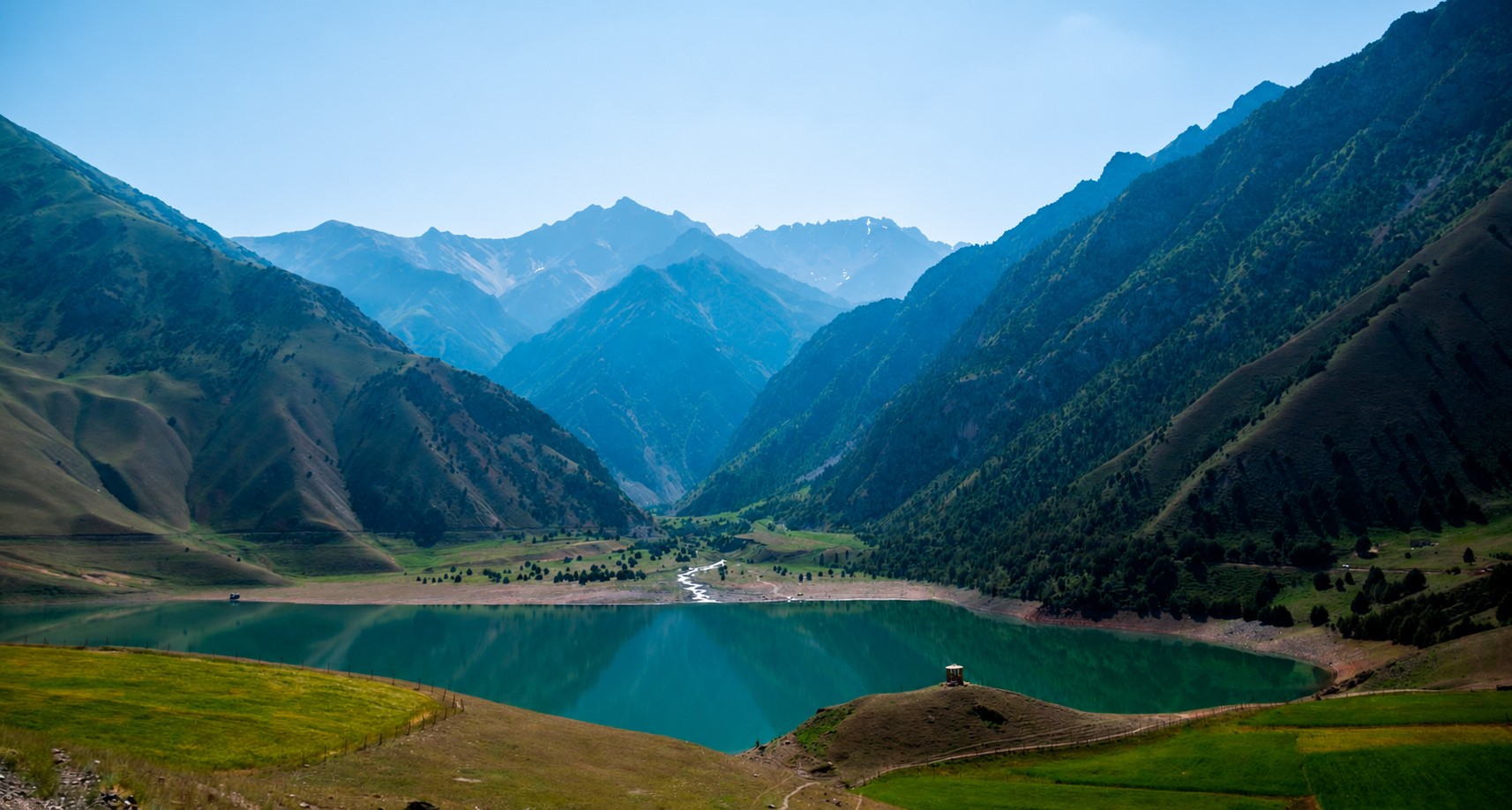
We came to a lake that shone like polished steel in the afternoon sunlight. One of its fingers came to within a stone’s throw of the road. Captain Karim called a halt, and we led the horses and mules down to drink. After so many days of dusty roads, it was a welcome opportunity to rest.
The lake lay in a shallow valley, surrounded by green hills. At the far end, a stand of trees grew along the shore, and beyond these rose mountains whose distant peaks were capped with snow.
The animals drank greedily. Men filled their waterskins, washed their faces, or stretched out on the grass to rest. I was sitting beside Memdooh and Chen, eating a pear, when Khizr the Handsome walked past us toward the lake. He stopped at the water’s edge, took off his boots, and began removing his clothes.
“What are you doing?” Memdooh asked.
“Going for a swim.”
“Are you crazy? That water is freezing!”
Khizr laughed, stripped down to his underdrawers, and plunged into the lake. He disappeared beneath the surface, then emerged some distance from shore, whooping and shaking water from his hair. He began swimming with long, powerful strokes, moving through the water as naturally as a fish.
“Look at that,” Chen said admiringly. “He swims like an otter.”
Memdooh shook his head. “SubhanAllah. This guy has everything. He’s handsome as a prince. He can fight, he can swim, and wherever we go, women throw themselves at him. Fathers practically beg him to marry their daughters. And he already has two wives!”
It was irritating, I had to admit. I was almost seventeen years old, and had lately begun noticing women in a way I never had before. I would like to get married one day, but I had no idea who or how. And here was this fellow, who already had two wives, and couldn’t beat the women off with a stick. Some men just had it all.
Soon a small crowd had gathered to watch Khizr, including the women of our caravan. Meilin came first, followed by Weili, Shireen and Nasra.
Khizr was now swimming toward us. As he approached the shallows, he stood up, water running down his chest and arms. He was lean and muscular, though not bulky, with broad shoulders and a narrow waist.
“Well, well,” Meilin said appreciatively. “Would you look at that.”
Shireen nodded. “Strong, but not too much muscle.”
“Not a hair on his chest,” Meilin observed. “I like that.”
“I don’t,” Weili said. “A man ought to have hair on his chest.”
I shot her a glance, but she was watching Khizr. I’d never heard her say anything about hairy chests before. I didn’t have a hairy chest. Had Arslan had a hairy chest? I didn’t think so.
Nasra shook her head. “You women have no shame. He’s practically naked.”
“I don’t see you looking away,” Shireen observed.
“Well, I am now.” Nasra walked away, but I noticed that she was smiling.
I stood and brushed the grass from my trousers. “Ladies, this isn’t appropriate. Give the man some privacy.”
Meilin gave me a wicked smile. “Don’t be jealous, Darius. You’re a cutie too.”
The women burst into laughter.
I stalked away, found Belly grazing beside one of the wagons, and led him along the shore, away from the caravan. We rounded a wooded point that jutted into the lake, and came to a sheltered cove with a little pebbled beach.
I removed Belly’s saddle and bridle and led him into the shallows to drink. Then I rolled up my trousers, waded in beside him and began washing his dusty coat. He stood perfectly still, his lower lip hanging loose in pleasure.
“I don’t even know what those ladies see in him,” I told Belly. “His calves are as skinny as a chicken’s. Did you notice that?”
Belly regarded me solemnly, chewing a mouthful of grass.
The lake looked inviting. My father had taught me to swim in a river near our farm. And there were no ladies here to watch me, which was just how I liked it. I didn’t need to show off for anyone, unlike stupid Khizr.
I stripped down to my underdrawers, stood on a rock and dove into a deep part of the lake.
“AAAAAAH!” The water felt colder than snow. It sucked the air out of my lungs, and almost immediately my head began to ring.
Behind me came a wild, panicked whinny as Belly galloped into the lake. He’d heard my scream and he thought I was in trouble.
“Belly! No!”
He was already swimming toward me, his muzzle thrust high above the water. I swam to meet him, caught his mane, and we swam together back to the beach.
Belly shook himself out. I was shivering badly. He pressed his head against my chest.
“You ridiculous beast,” I whispered. “I’m all right.”
Belly gave me a wet lick across the face.
I rubbed his forehead. “You’re a good boy. Let’s not tell anyone about this, okay? And this doesn’t count as saving my life. I was perfectly fine. The count is still three.”
Seventeenth Birthday Come and Gone
We left the rich farmland of the Ferghana Valley behind and began climbing into the mountains toward Kashgar. At first the change was gradual. The fields grew smaller and villages farther apart. Orchards disappeared. The road climbed through rolling grasslands where sheep and shaggy cattle grazed beneath an enormous blue sky. Autumn was waning, and the weather turned cold. Snow-covered mountains rose ahead of us, seeming impossibly distant at first, then growing larger every day. Ay, the mountains. SubhanAllah. I was not eager to cross them again. It had been a kind of torture last time.
I knew that I had been born in late summer, when the cicadas were loud, and that Zihan Ma had declared my birthday to henceforth be on the 15th day of the eighth month. That season was past, which meant my seventeenth birthday had come and gone. I pointed to my cheek and told Belly to give me a kiss, and he gave me a wet lick. That was my birthday gift. But hey, I couldn’t complain. I wore a prince’s ring and a corporal’s horn, and I owned a shiny new bow.
My beard had begun to grow, though it was still a bit scraggly. And I had to see the company tailor twice to lengthen my trousers and expand my jacket’s shoulders.
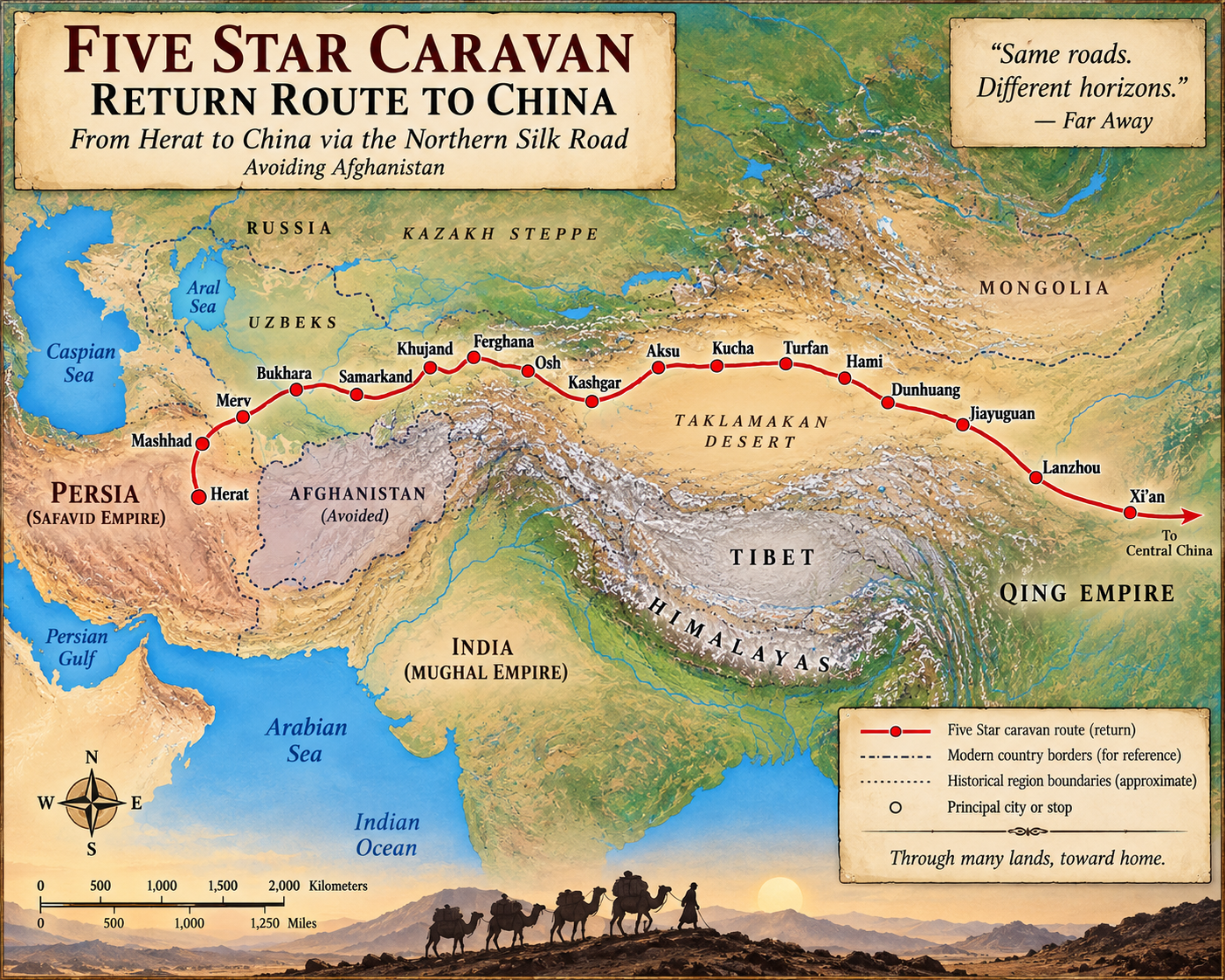
Every night I draped a blanket over Belly, and huddled within my bedroll. Some nights I slept with my dao on my back, some not, but no matter what I always had my Samarkand Leaf – the gorgeous leaf-shaped dagger I’d purchased on the first pass through Samarkand – on my hip. Beyond Osh, the road narrowed as it climbed. Sometimes we traveled beside fast-running streams fed by snowmelt, their water so clear that every stone on the bottom was visible.
The country was beautiful, but Karim warned us not to become careless. We were approaching lands where borders meant little. Muslim Kyrgyz herders lived throughout the mountains, but farther north and east lay the domains of the Dzungars, a powerful Mongol people who followed a different religion. Their warriors sometimes ranged far from their own territory, and a caravan like ours was a great prize.
Picking Up the Pace
Karim increased the watches and ordered the guards to keep their weapons close. Shields were brought out and distributed. That in itself told me how serious the threat was, as the shields were heavy and burdensome, and we did not normally carry them.
One night, Karim called a meeting. “We are more than a third of the way home,” he announced.
A cheer went up at that.
“There are rumors of great unrest in this region. Be vigilant. Carry your shield at all times. Have it next to you when you sleep. Do not wander from your post. We’re going to increase our pace. Keep your horses watered, fed and cared for. We will sleep in shifts. Gambling and liquor are prohibited for now. Corporal Ahmed?”
Ahmed stood up. “Nothing will befall you except what Allah has decreed. Place your trust in Him, for He is the best in Whom to trust.”
That night I fed Belly well and gave him two apples for dessert. “We’re picking up the pace,” I told him. I rubbed his forehead and scratched under his chin. “Think your little legs can keep up?”
He turned to me and licked me.
“Ugh,” I complained. “Your tongue is like willow bark.”
I slept with my sword on my back, and my shield atop me.
The Attack
One afternoon, the road carried us through a wide mountain valley bordered by rocky hills. There were no trees except for a few scrubby growths clinging to the slopes. The land was mostly grass and stone, yellow-green beneath the afternoon sun. A stream twisted along the bottom of the valley, sometimes approaching the road and sometimes wandering away.
I was riding near the middle of the caravan when Bao’s horn sounded behind us. Two short blasts and a longer one: Attack at the rear.
I wheeled Belly around and kicked him into a gallop.
Other guards were already moving. Men shouted warnings from wagon to wagon. Drivers snapped their reins, trying to close the gaps between vehicles. Merchants who had been walking beside their wagons scrambled aboard or ducked beneath them.
I heard the thunder of horses, and saw a cloud of dust rising beyond the final wagons.
Riders burst from the dust cloud, perhaps thirty. I had never seen men like them before. Most were broad-faced, with dark hair worn beneath fur-edged caps or simple helmets. Their clothing was made for riding in cold weather: long scarlet coats belted at the waist, loose trousers and heavy boots. Every man carried a bow, and some wore peaked helmets and armor made of overlapping plates. Bright red strips of cloth fluttered from belts, sleeves and horse tack. They were like a red wave coming down off the mountain.
They rode compact, powerful horses and handled them beautifully, guiding them with their knees while they shot. Quivers and bow cases hung from their belts. Some carried long spears, and curved swords hung from the hips of others.
“Dzungars!” someone shouted.
An arrow struck the side of a wagon with a hard thunk. A horse screamed and reared.
“Raise shields!” I shouted. “Close the wagons! Archers, fire from cover!”
The Dzungars swept toward the rear of the caravan without slowing. They did not charge directly into us, but divided smoothly into two groups, riding along either side of the road and loosing arrows as they passed.
Memdooh and others of our archers answered.
A Dzungar raider pitched backward from his saddle. Another horse stumbled, throwing its rider into the dust. I reached the rear wagons just as Longwei came galloping from the opposite direction.
“Protect the horses!” he shouted. “They value horses more than anything!”
I understood immediately. We always had more horses than we needed, in case we lost some to sickness, heat or cold, or injury. The extra horses generally pulled the rear wagons in teams of six or eight, and were regularly rotated. The Dzungars wanted to create confusion and take our horses. Not all of them, just the ones at the rear.
A dozen Dzungars swept past the last wagon. Several fired arrows while others began cutting the horses loose.
I shouted commands, rallying our forces to protect the horses. One Dzungar leaned low from his saddle and slashed at a harness. I chopped off his hand, and he screamed and rode off. I parried another man’s spear with my dao, then – knowing that I could kill the man – chose instead to strike him on the side of the head with the flat of the blade, knocking him out.
Ardeshir was terrified. I could see it in his face. The first time a Dzungar horseman came charging toward him, he froze. I shouted his name, and he seemed to wake from a dream. After that, something changed. He was still afraid, but he did his job. When two raiders tried to get between the wagons, Ardeshir planted himself in the gap and swung his sword wildly, refusing to give way.
As for Shireen and Cotan, they fought like jinnis. Shireen’s bow was a part of her body. She nocked, drew and loosed with astonishing speed. When a Dzungar charged her on horseback, she waited until he was almost upon her, leaned to the side to avoid his sword, and sent an arrow up beneath his arm as he passed. Bow and arrow as close-range fighting tools – I’d never seen that before.
Her brother Cotan struck with his whole body, smashing aside lighter weapons with that enormous sword, and battering men down.
The Massacre
As our reinforcements poured in from up the column, the Dzungars sounded a cow horn and began to flee. There was no question of pursuing them. They had failed to take even a single horse. We let them go.
Except… As one Dzungar scrambled up the rocky slope, an arrow struck him between the shoulder blades, and he pitched forward.
I looked around, saw the Kurdish woman sighting on another fleeing man. “Shireen!” I shouted. “Stop!”
Too late. A second man was running farther up the hill, empty-handed. She sent an arrow into his back as well. Then a third and a fourth.
I dashed toward her and tackled her, taking her to the ground hard. “Stop!” I shouted in Persian. She struggled out from under me, her face filled with rage. For a moment I thought she would attack me.
A cry made me turn.
One of the Dzungars that Cotan had knocked from his horse was crawling along the road. Blood covered one side of his body, and one leg dragged uselessly behind him. His sword lay several paces away. Cotan walked toward him and lifted the great sword.
“No!” Staff Sergeant Bao shouted, but the blade came down, splitting the man’s head like a ripe watermelon and splashing blood across the road. Cotan then turned his attention to the man I’d knocked out – who was just beginning to regain consciousness – and with a single, crushing blow, separated the man’s head from his body.
I looked away, but not quickly enough.
An instant later, Bao was on Cotan, the point of his sword at the Kurd’s throat. Cotan, seemingly baffled, dropped his own sword and stepped back. Bao picked it up and stepped back.
Am I a Pagan?
It was a scene of devastation. Dzungar bodies littered the road and hillside. It looked like a massacre. One of our own was dead – one of the non-Muslim guards who had bet on what I would say. Others were injured, including Ardeshir, whose arm had been slashed, though he bore it stoically. One of our horses was wounded, and one was dead. Hakim Yusuf was already hard at work tending to the wounded, with Weili helping him. Her hands were quick and sure. She had a talent for this.
My eyes flicked toward the men Cotan had savaged. I thought I might vomit.
“What happened here?” The Captain strode toward us with Ahmed at his side. Captain Karim’s sword was still drawn, and there was blood on his sleeve. “Corporal Lee, report!”
“We repelled the attackers, thanks in part to Longwei’s insight that they were after the horses.” I gestured to Shireen and Cotan. “But these two killed wounded and fleeing men.”
Karim looked first at the bodies on the hillside, then at the gruesome remains of the men on the ground. He looked at Cotan. “Your work?”
Cotan nodded, a proud expression on his face.
“Were they fighting when you killed them?”
Cotan looked toward the body. “They attack us,” he said in Chinese.
Yusuf’s language lessons paying off, I thought bitterly.
“Were they fighting?” Karim insisted.
Cotan shrugged. “No.”
The captain’s face darkened. He pointed to the dead on the hillside. “And those?”
Shireen followed his gesture. “They were escaping.”
Cotan shook his head. “Captain, what is problem? They are pagans.”
Bao stepped forward to within an arm’s length of Cotan. “PAGANS?” he bellowed. His face was as red as the coats of the dead Dzungars. “Pagans? They are Buddhists like me. Am I a pagan? Will you murder me in my sleep?” He pointed to our dead guard. “He was a so-called pagan. Are you holy warriors or Five Star guards?”
Bao turned to the captain with wide eyes, spittle flecking his chin. I had never seen him like this. “Captain, I want these two bound and held for judgment for murder. I swear by the Buddha, I want their heads in a basket.”
Karim’s eyes wandered over the scene. After a long moment, he turned to me. “Corporal Lee, disarm Cotan and Shireen and place them under guard. Bind their hands. The rest of you, get out there and collect arrows. Ours or theirs, I don’t care. If it’s not damaged, pick it up. Hustle!”
Men scurried to obey his orders.
I motioned to two guards and stepped toward the brother and sister to take away their weapons and bind their hands. Cotan, who no longer possessed his sword, reached down to his ankle, pulled up his trousers leg and drew a long dagger I hadn’t known he possessed. He fell back, taking a defensive posture. His sister said, “No, Cotan!” but he ignored her. I motioned to the two guards to deal with Shireen. Then I drew my dao and took up a fighting stance facing Cotan, with the sword held diagonally before me. I thought Karim might tell me to stand down, but he did not.
“Do you remember our duel?” I asked Cotan. “You should know that I am as good with the sword as with my fists. Maybe better.”
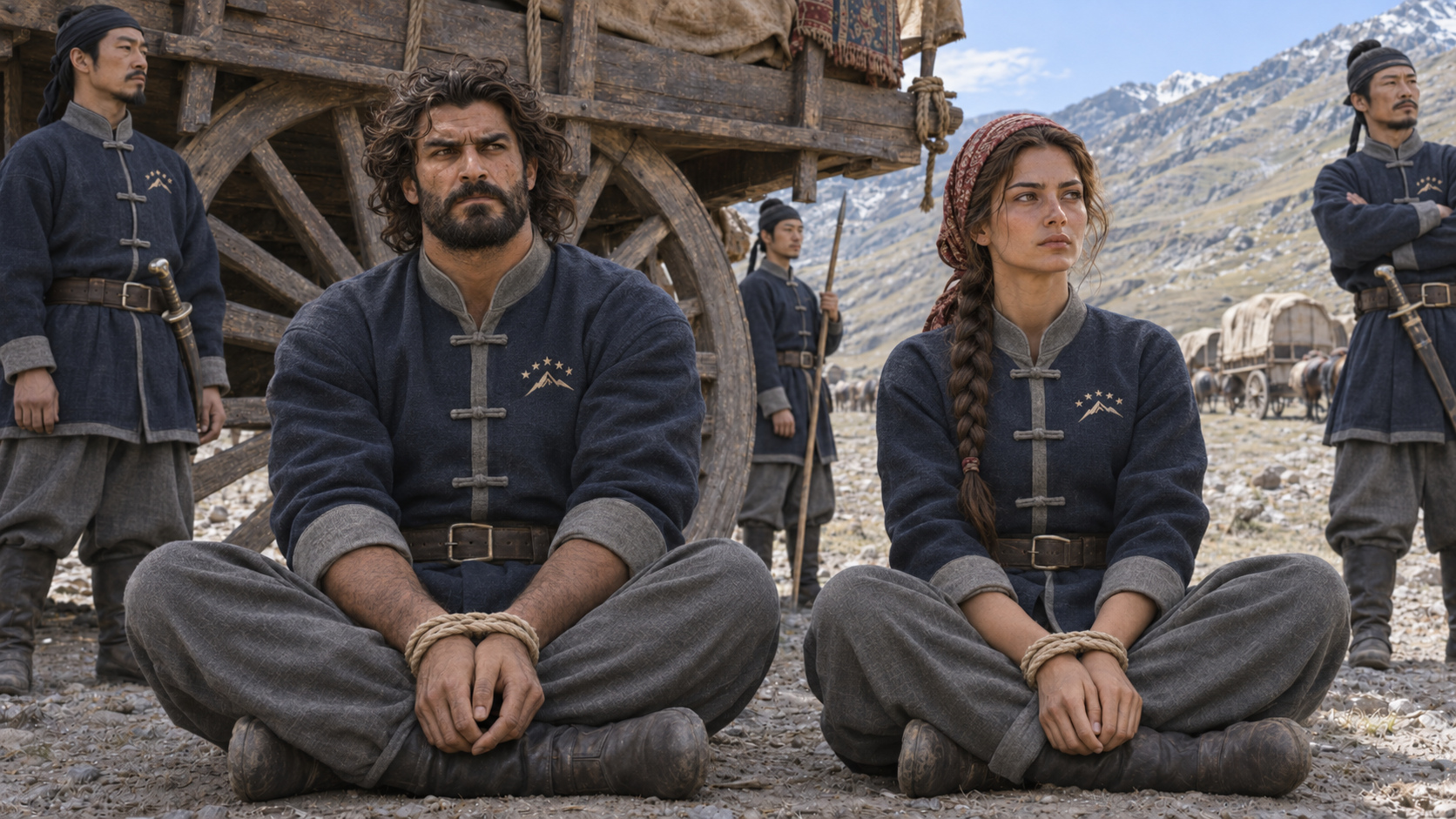
Apparently he believed me, because he threw his weapon down and surrendered, and we bound his hands. The captain had them sit, side by side, with guards around them.
“Meilin!” Karim called, and she came running. Karim pressed a hand into his own face for a minute, then looked up. His gaze was not angry, but resigned. He pointed to the dead Dzungars whose bodies littered the road and hillside. “Gather some men. Pile these bodies up, scavenge some scrubwood and broken timber, and use lamp oil to ignite it. Burn the bodies thoroughly. Do you have a problem with that, Staff Sergeant Bao?”
Bao shook his head. “No, sir. Cremation is a long-established custom in Buddhism.”
“Good. Get it done.”
Judgment
Karim held a meeting with Ahmed, Bao and me. Nodding toward Cotan and Shireen, he said, “I’ve never faced this particular situation before. Murder, yes. I have had an instance where a drunk guard killed another. But this was a battle. It’s not the same.”
“Captain,” Bao said insistently. “Once the Dzungars fled or fell wounded, there was no battle. It’s murder. Those two are savages. Cotan even lifted a dagger against Darius. It’s intolerable.”
Karim looked to Ahmed, who said, “Exile them. Fire them both and send them away.”
“Darius?” Karim asked.
I chewed on my lip. “Staff Sergeant Bao said something back in Herat. At the time I didn’t understand, but now I do. He said, like the sun and the moon, the truth cannot stay hidden. We’ve seen the truth of who Shireen and Cotan are. But what’s the rest of it?”
Karim studied me. “What do you mean?”
“I mean, I hate what they did, but why are they like this? My father was a robber, a thief and a drunkard when I was young. But after he returned from prison he became a farmer. He hugged me for the first time in my life, and I was so messed up that it frightened me.” Gazing backward in time, remembering how I was then, I added, “I changed too.”
Karim nodded slowly and walked back to where Cotan and Shireen sat in the shade of a wagon, their backs against the wheel, and men standing guard over them.
“Stand up,” he commanded, and they did.
Karim gestured to the dead. “Why?”
Cotan’s jaw tightened, and for an instant I thought he was going to argue. Instead he lowered his chin. “Captain. Shireen and I did serve as mercenaries for Ottomans. We fight the Europeans on the western, how do you say, where the nations meet? There is no mercy there, no quarter. You fight until one side is dead or run where cannot reach. They do with us, and we do with them. This is what we know. Caravan life -” He gestured to the long line of wagons – “is new for us. Maybe you do differently. We are sorry. We can learn.”
Karim watched them. Behind us, Yusuf and Weili were still busy with the wounded. Other guards were taking the Dzungar weapons, securing their horses – we’d captured eight good horses – and piling up the dead bodies. A frigid wind came through the mountain pass, tugging at our clothing.
“We fought them,” Karim said at last, “because they attacked us. Not because they are pagans. When someone attacks the caravan, you fight. But when a man throws away his weapon, you let him run. When a wounded man lies helpless, you do not slaughter him like a sheep. We are not assassins. If you don’t understand this, then pack your things and leave this instant. I will pay you the wages you have earned, and you go your way.”
“No, Captain,” Shireen said. “We will adapt to your way. Is not right, brother?”
Cotan nodded. “We adapt.”
Karim’s anger did not disappear. “Then adapt quickly.”
“Captain!” Bao said loudly. “This is unacceptable.”
The captain turned to him. “I hate what they did. But these lands are more dangerous than I expected. We need fighting men and women. Cotan and Shireen have been warned. If it happens again, the consequences will be severe.”
Bao’s jaw tightened. “I protest this decision.”
“Noted.”
The dead guard’s body was loaded into a wagon – we would bury him later – and the guards had collected all the weapons and fallen arrows. The dead Dzungars had been set on fire, and the smoke billowed from the gruesome pyre, thick and black.
“Mount up and move out!” Karim called. He blew three short blasts on the horn, and we were underway as if nothing had happened.
A little later, Ahmed pulled up alongside me on his horse. “You predicted it. During the evaluations you called them maniacs.”
I chewed my lip. “Do you think we’re making a mistake by keeping them on?”
Ahmed stroked his beard. “Ask me in a month.”
Memdooh rode up alongside us. “Are you guys talking about the arrows thing?”
I frowned. “What arrows thing?”
“I’m a senior guard, and Karim had me out there collecting arrows like a servant. It’s not right.”
Ahmed snorted. “What are you, Longwei junior now? Are you better than the Prophet?”
“What?”
“When he was a teenager, during the Fijar wars, he gathered arrows for his uncles.”
That shut Memdooh up.
The Officers’ Meeting
That evening, after we had put several miles between ourselves and the site of the Dzungar attack, and after we had buried our dead companion and his Buddhist co-religionists had prayed for him, Captain Karim summoned his officers. Rather than meeting in camp, he led us into a small stand of trees beside a stream, a good distance away from the caravan. Staff Sergeant Bao, Sergeant Yusuf, Corporal Ahmed and I followed him until the sounds of the caravan faded behind us.
“We’re making some changes,” Karim said. “The last two attacks have hit us at the rear. Tomorrow we’ll rearrange the wagons. Food, clothing, blankets and other supplies that can be replaced will go toward the back. The more valuable cargo will be moved toward the center.”
We all nodded. It seemed sensible.
“There’s something else. I’m moving the treasury.”
“What treasury?” I asked.
Ahmed looked at me. “The one that pays your wages and buys our supplies.”
“Oh.” I had never really wondered where the money came from. But now that I thought about it, I said, “Was it in the food wagon?”
Karim looked at me sharply. “How did you know that?”
“Once, when I got paid, one of the coins had a grain of millet stuck to it.”
Karim shook his head. “We’ll have to be more careful. We’re moving the treasury to wagon twenty, the Rug House. Underneath the Persian rugs. Nobody will know except the men standing here and the two merchants responsible for that wagon. They’re men I trust.”
“Why?” I asked. “Do you think someone will try to steal it?”
“No. But there’s no point taking chances.”
Just then I heard something in the woods behind us. A faint rustling, followed by what sounded like the snap of a twig.
“Excuse me,” I said.
I drew my dao and moved quietly toward the sound. The trees were dark, and the moonlight barely reached the ground. I crept forward, listening. Suddenly something enormous burst from a branch directly above my head.
“AH!”
An owl flapped away through the branches, hooting indignantly.
Heavy footsteps came my way, breaking branches. My fellow officers appeared, weapons drawn.
“What is it?” Karim said. “We heard you shout.”
“An owl,” I replied sheepishly.
Ahmed gave me a serious look. “You should have snatched him up and recruited him too, Darius. He can look in every direction at once.”
Guarding Without Guarding
The country east of the Dzungar attack remained open and mountainous, with long valleys of yellow-green grass lying between bare slopes of stone. Frigid streams descended from the heights, sometimes following the road for miles before disappearing behind ridges. Settlements were few, and on some days we saw no one except distant herders and their flocks.
Sadly, there were no orchards from which I could pluck fruits as treats for Belly. And my pistachio cache was long gone.
As a corporal, I had been placed in charge of the middle third of the caravan, which meant wagons 18 to 35. Corporal Ahmed had the rear third of the train, Captain Karim typically rode up front, and Staff Sergeant Bao was a roaming supervisor, moving up and down the caravan as he wished. All four of us carried horns, and any of us had the authority to stop the entire caravan with a single short blast. But in reality that was a heavy responsibility.
Being in charge of the middle section meant the Rug House was within my purview. That wagon was guarded by Memdooh and Nasra, the little knife-wielding hijabi. I was constantly aware of the hidden treasury within it. It was weird. The whole point was that the location of the treasury was secret, so I was supposed to guard it without obviously guarding it. I sighed. Being an officer was not easy.
In theory, every wagon had one guard assigned to it, except for the new recruits, who each partnered with a veteran guard. In practice, men drifted forward or backward to talk with friends, sometimes leaving three guards riding together while the next two wagons had nobody. It had always been like that, and I tolerated it as long as everyone remained alert.
I usually rode beside wagon 25, the medical wagon, which was what I was doing now. Periodically I would pass up and down the middle section of the caravan. I liked being near Hakim Yusuf, even when we went hours without speaking. I camped beside the medical wagon at night, and napped beneath it when we stopped for breaks. It had become my home on the road.
I needed the naps. I’d been sleeping poorly, dreaming of Cotan standing over the wounded men, his sword rising and falling. In one dream the wounded men had become talking sheep and he was butchering them as they pleaded for their lives. Another time they tried to crawl away and he hacked off their limbs one by one until they slithered on their bellies like snakes.
I decided to devote more of my evenings to memorizing the Quran. I would give my mind something better to hold on to.
There Are Angels
As I was thinking about these things, Meilin – who was assigned to wagon 15, ten wagons ahead of me – rode back to see me. Her horse was a Nanfan, a mountain breed well suited to high altitudes, and it loved these mountains. It was a gray mare, with a thick neck and broad chest, and was slightly taller than Belly. Meilin called it Nanei. The horse nuzzled Belly’s face and broke into a short, exuberant run, and Belly ran to keep up. I didn’t mind. Let him have his fun.
“It’s a good day, right?” Meilin said.
I shot her a glance. “Seriously? After what happened?”
She clucked her tongue. “That was bad indeed. But we’re alive, and the sun is shining.”
“I guess. Can you tell me more about the opera?”
“Like what?”
“Like, who raised you? You were a little kid, you couldn’t have survived alone.”
Meilin smiled. “There was an older woman named Ya Wen. Short, white-haired, but a very powerful performer. Tremendous voice. She took me in, fed me, taught me to read and write. In every respect she was like my grandmother. But she passed away when I was eleven, and that’s when the opera owner married me. I still think about Ya Wen. She loved goat kidney soup and made it almost every day.”
“Ugh,” I said.
Meilin laughed. “Ugh is right. She was constantly saying, ‘eat your kidneys!’ Which always made me laugh. I’d pretend to try to bite my own kidneys. The world is not an evil place, Darius. There are good people. There are angels.”
“Do you believe in angels? Aren’t you Buddhist?”
“My parents were Confucianists. But they gave me away.” Her lips were tight and her nostrils flared. “So what was the point of all their talk about family duty and proper conduct? What garbage.”
I should have left it alone, but I couldn’t help asking, “Why did they give you away?”
“Drought. The crop failed. They couldn’t feed us all.”
“Yeah.” I chewed my lip. “I’ve been through that too.”
“Well aren’t we a pair of cracked eggs?”
I shook my head. “I’m not. And I don’t think you are.”
Meilin gave me a sideways glance. “You aren’t, are you? Naive at times, yes. Lonely maybe. Hungry for love. But you’re not broken.”
I scowled. “Get the hell out. I’m not hungry for love.”
Meilin laughed. “I didn’t answer your angels question. You know what I believe in? I believe in good people. I look at you, Ahmed and Hakim Yusuf, and you are some of the best people I have known.”
With that, she turned her horse around and returned to her station.
A Terrified Scream
Over the following days, we kept the fast pace. Hakim Yusuf’s wagon was busy as he and Weili tended to the wounded, including Ardeshir, whose wound was serious, though he would not lose the arm. A horse stepped in a deep hole and broke its leg. We were forced to kill it and eat it, which was sad but necessary. Shireen appeared with a split lip, and when questioned by the captain, made an excuse. I continued teaching the recruits combat skills once a week, and continued training on my own as well.
Ahmed’s “ask me in a month” turned out to be premonitory. Late one frosty night, almost a month to the day after the Dzungar raid, I lay huddled in my bedroll beneath the medical wagon, trying to stay warm. I had just managed to fall asleep, and was in the midst of a dream about a kind woman in a warm bakery giving me a delicious treat, when I was awakened by the sound of a terrified scream.
“Dzungars!” someone shouted.
I came awake with my heart pounding. A horn sounded in the darkness – a short, strangled blast that broke off abruptly. I rolled from beneath the wagon, snatched up my sword and shield and ran toward the source of the scream.
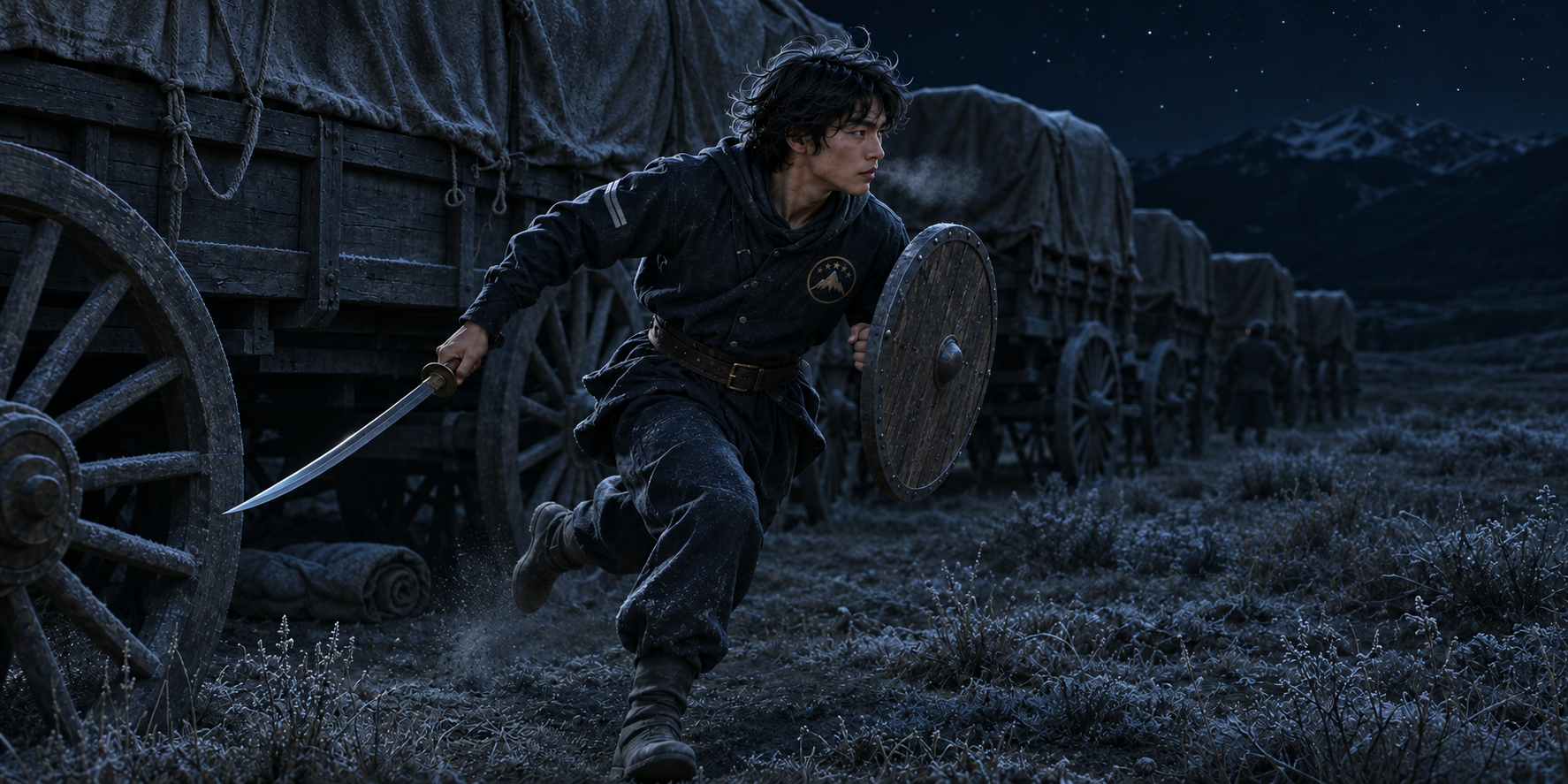
All around me the camp was erupting. Men stumbled from beneath wagons and out of tents, grabbing weapons. Someone shouted, “Where?” Bao yelled for the archers. A horse began whinnying wildly.
I heard a man cry out, followed by the heavy sound of something striking flesh. I ran between two wagons and came to an abrupt halt, shocked by the sight before me.
Cotan, the big Kurdish killer, lay on the ground, rolling one way and the other, arms shielding his face, as Chen – little Chen, the dancer, the fisherman – beat him savagely with a tree branch.
Nearby, Shireen lay on her back, unmoving. Even in the dark I could see her discolored face, and the blood running from her nose. Chen had gone insane. Maybe he was so angry about what these two had done to the Dzungars, he couldn’t control himself.
Cotan rolled onto his hands and knees, and Chen brought the branch crashing down onto the man’s back. Cotan cried out and collapsed. Chen lifted the branch again, and it looked like he would bring it down on Cotan’s head this time.
I dropped my sword and shield and ran at Chen.
He must have heard me coming, because he half turned, but I tackled him around the waist and drove him to the ground, the branch flying from his hands.
Look What He Did
Chen struggled beneath me. “Get off, Darius! I’ll kill him!”
I caught his wrists and pinned them to the ground. Cotan must have gotten in some good blows, because Chen had a black eye, a swollen bruise on his scalp, and blood trickling from his mouth.
“Have you gone mad?” I demanded. “Why do you want to kill them?”
“It’s not me who’s mad, you fool!” Spit flew from his mouth. “Him! Cotan! He beats her. Look what he did to her.”
“What?”
“Look!”
I took a closer look at Shireen. She lay on the ground perhaps ten paces away. Her hair had come loose and hung wildly around her face. One eye was swollen almost shut. Blood covered her nose and mouth, and bruises were already rising across her cheek. She made a low moaning sound.
My gaze traveled from her to Cotan, and back to Chen. “Cotan did that?”
“Who do you think?” Chen snapped.
By then guards were pouring in from every direction, swords drawn and shields raised. Ahmed arrived among them with his horn still in one hand and his sword in the other.
“Where are the Dzungars?” he demanded.
“My God,” someone said. “Look at the woman.”
I was still holding Chen in place when Karim showed up. “Corporal Lee,” he said firmly. “What’s going on?”
“I’m not sure, Captain. I found Chen beating Cotan with a tree branch. He was close to killing him. He claims Cotan beat Shireen.”
Someone helped Shireen up and gave her some water. Unable to stand, she crawled forward. I thought she was going to her brother, but she bypassed him and came to where I had Chen pinned. “Chen,” she said, weeping. She stroked his bruised face. “Sweet Chen. Darius, please, let him go. He saved me.”
That was when I understood. The occasional bruises on her cheek, the split lips, her lame excuses about falling from her horse or walking into a wagon in the dark. Her brother had been beating her all along.
I released Chen and rolled off.
Cotan was sitting up now, glaring at everyone around him, blood dripping from his beard. Hakim Yusuf came running up, shouting for everyone to make room.
I Stay
By morning, Hakim Yusuf had patched up all three of them and made sure they spent the rest of the night far apart. Shireen was taken into Kuangren and Gulnur’s wagon, with Weili attending to her. Cotan lay under guard in the medical wagon, and Chen, who had gotten off the lightest, was put in one of the merchant wagons to sleep.
After breakfast, the three were brought before the Captain and assembled guards. They sat on upturned crates several paces apart. Chen and Cotan looked bad, but Shireen looked like she’d died and returned. Both eyes were bruised, one nearly closed. Her lips were split and swollen, and one side of her face had turned a deep purple. She held herself carefully, as if even breathing hurt.
Karim stood before Cotan. “I’m done with you.”
Cotan looked up.
“I don’t care how good a fighter you are. You bring chaos like a desert storm brings sand. No more. You are fired. You have one hour to pack up and leave. I will pay you everything you are owed.”
Cotan’s expression hardened, but he said nothing.
Karim turned to Chen. “I never expected this from you. If one guard was abusing another, you should have reported it. Instead you nearly killed a man.”
“He deserved it,” Chen muttered.
Karim stepped closer. “Do you want to join him? Don’t think you are safe because you’re Chinese.” He made an angry gesture. “In fact, you just made up my mind for me. You are hereby exiled from -”
“No, Captain, please!” Chen fell to his knees. “I’m sorry. I’ll never do it again.”
Karim took a deep breath and blew it out. He rubbed the side of his head, then said, “You are docked two weeks’ pay. And for the next month, you’re on manure duty. Every horse, every day. I don’t want to see so much as a spot of manure on a wagon wheel.”
Chen said nothing, and Karim turned to Shireen. His voice softened. “You are blameless. In fact, you came to harm on my watch.” He bowed his head slightly. “I offer you my apologies. Five Star will compensate you for your suffering.”
Shireen looked up at him, surprised.
Cotan suddenly stood, held out a hand to his sister, and spoke to her in Kurdish.
She stared at his big, calloused hand, then slowly shook her head and replied in Chinese. “No this time, brother.”
Cotan’s hand fell. “What?”
“I stay.”
Cotan’s hard expression crumbled. He looked lost as he spoke to Shireen in a pleading voice.
The sister stood, straightened up painfully, turned away from her brother, and spoke without looking at him. “Goodbye, Cotan.” Then she walked away.
Within fifteen minutes, Cotan was gone.
Later I found Longwei sitting uncharacteristically alone beside a fire, tossing twigs into it and watching them burn. “What did Cotan say to Shireen?” I asked, for if anyone could understand Kurdish it would be him.
He glanced at me, then tossed another twig into the fire. “He said that the two of them have always been together, the Kurdish lightning and thunder, and he doesn’t know what to do without her.” His words were bitter, and I wondered if he was talking about more than just Cotan and Shireen.
* * *
Come back next week for Part 3 – Something Wrong in Besh-Badam
Reader comments and constructive criticism are important to me, so please comment!
See the Story Index for Wael Abdelgawad’s other stories on this website.

Wael Abdelgawad’s novels – including Pieces of a Dream, The Repeaters and Zaid Karim Private Investigator – are available in ebook and print form on his author page at Amazon.com.
Related:
Searching For Signs of Spring: A Short Story
Keep supporting MuslimMatters for the sake of Allah
Alhamdulillah, we're at over 850 supporters. Help us get to 900 supporters this month. All it takes is a small gift from a reader like you to keep us going, for just $2 / month.
The Prophet (SAW) has taught us the best of deeds are those that done consistently, even if they are small. Click here to support MuslimMatters with a monthly donation of $2 per month. Set it and collect blessings from Allah (swt) for the khayr you're supporting without thinking about it.


Far Away, Book 2: [Part2] – The Domain of the Dzungars

[Film Review] Your Mother, Your Mother, Your Mother: A Complex Story Of Faith And Fatherhood

Far Away, Book 2: [Part 1] – Meilin’s Tale

[Podcast] A Light of Her Own: Muslim Womanhood, Seasons of Life, & Female Scholarship

School Counseling Grounded In The Qur’an And Sunnah: A Framework Of 10 Prophetic Traits
Far Away, Book 2: [Part 1] – Meilin’s Tale
Far Away, Book 2: [Part2] – The Domain of the Dzungars
[Podcast] A Light of Her Own: Muslim Womanhood, Seasons of Life, & Female Scholarship
School Counseling Grounded In The Qur’an And Sunnah: A Framework Of 10 Prophetic Traits
[Film Review] Your Mother, Your Mother, Your Mother: A Complex Story Of Faith And Fatherhood

The Best Actions for Eid al-Adha [Imam Dawud Walid]

Coming Full Circle: Who Are You Now? | Night 30 with the Qur’an

Running Away From Who We Are | Night 29 with the Qur’an

Building From the Ground Up: Week 4 Recap | Night 28 with the Qur’an

The Muslim You Are Becoming | Night 27 with the Qur’an
-

 #Culture4 weeks ago
Far Away, Book 2: [Part 1] – Meilin’s Tale
-
#Culture1 month ago
Far Away [Part 31] – Following Your Lead
-
#Culture1 month ago
A Case For Critical Reading As Muslims: Reading ‘The Power of Your Subconscious Mind’ Through An Islamic Lens
-
#Islam1 month ago
When A Place Teaches You What Softness Is Not