
#Culture
Far Away [Part 8] – Refugees At The Gate
Darius continues training Lee Ayi in martial arts, and the first refugees appear at the gate.

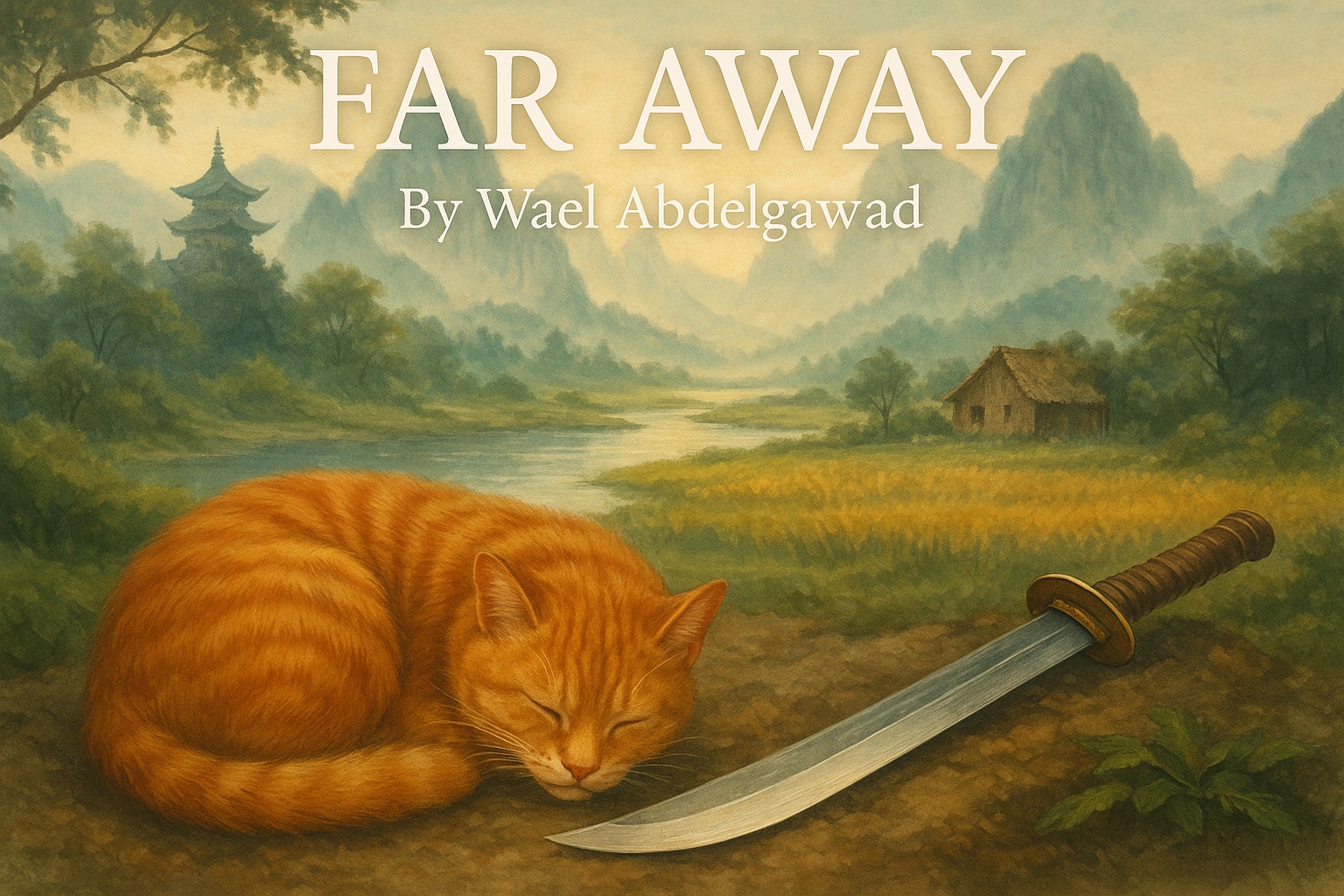
Darius continues his training with Lee Ayi, and the first refugees appear at the gate.
Read Part 1 | Part 2 | Part 3 | Part 4 | Part 5 | Part 6 | Part 7
* * *
A Fast Learner
Keep supporting MuslimMatters for the sake of Allah
Alhamdulillah, we're at over 850 supporters. Help us get to 900 supporters this month. All it takes is a small gift from a reader like you to keep us going, for just $2 / month.
The Prophet (SAW) has taught us the best of deeds are those that done consistently, even if they are small. Click here to support MuslimMatters with a monthly donation of $2 per month. Set it and collect blessings from Allah (swt) for the khayr you're supporting without thinking about it.
I had never in my life been a student of anything except the fighting arts, but now I studied medicine, math, writing, and deen all at once. I proved to be a fast learner. At times I felt as if there were a thousand different thoughts in my head, chasing each other in a mad game of tag. The only thing that gave me some trouble was the Arabic pronunciation of the words in the salat and the Quran. Haaris corrected me patiently, repeating the words until my tongue began to obey.
At night I slept without my dao, as I had promised myself I would.
On Fridays, Ma Shushu continued to leave me behind. One week he said my shoulder was not ready. Another week the road was too rough. Another time he went alone, saying the market would be crowded. The excuses grew thinner, but I did not press. For me to accuse him of lying would be impossible. I would never be able to get the words out of my mouth.
On those Fridays, after the house emptied, Lee Ayi brought out the wooden dao.
At first she asked me only to watch. Then to correct her stance. Then her footwork. Slowly, carefully, I taught her what I could. How to root her weight. How not to rush the transitions between movements. How to insert rapid, subtle strikes between the bigger movements, so that no motion was wasted.
Then we would put down the dao and spar empty-handed. My father used to go nearly full force in such sparring sessions, leaving me with black eyes, bruised ribs, and on one occasion a fractured hand. But between me and Lee Ayi the goal was to lightly kick or slap the opponent. Obviously I went easy on her, but not too easy. When she left an opening I would slap her shoulder, kick her leg, or kick her lightly in the belly. She never complained. In fact, she learned eagerly, with a seriousness that surprised me.
The only moments in which I felt my heart crack open to admit sunshine and air, came during salat. In Allah, I found a friend who would not abandon me, betray me or die. He saw all that I had hidden. There was no pretense with Allah. No hypocrisy. How could there be? With Allah I could be me, and as long as I kept my faith and committed no evil, I was accepted and respected. Perhaps my understanding was flawed. Perhaps my idea of Allah was still immature. In any case, the salat brought me comfort and reassurance.
This weekly training was my secret with Lee Ayi. I enjoyed it, but I dreaded the day Ma Shushu would discover it.
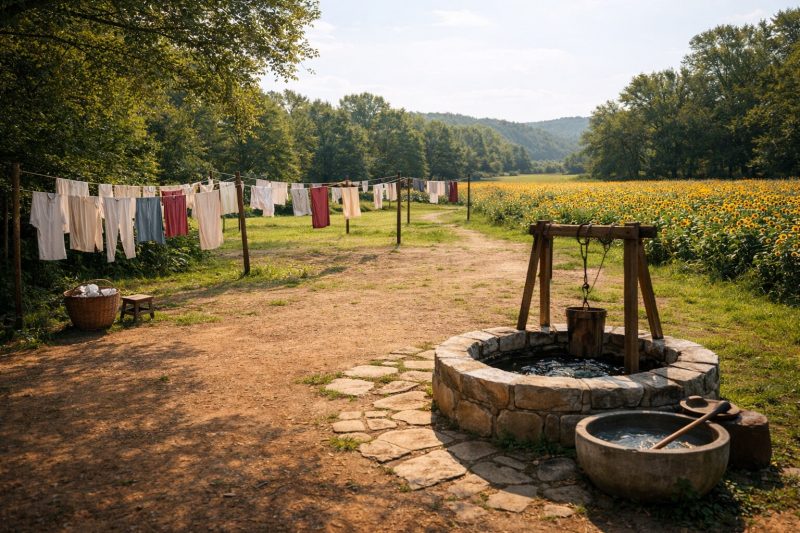
After training we would sit on the edge of the wall, wash ourselves from the basin, and talk.
Thirty Three Generations
The Friday after her revelation about Jun De, I asked her about it.
“You mentioned that he drowned,” I said, “It sounded like there was foul play involved.”
She looked up sharply, startled. “What? No, nothing like that. La ilaha il-Allah. Only that Jun De’s passing leads to another subject.”
I waited, taking another scoop of cool water in my hand and splashing it on my face. I tasted my own sweat as it washed across my lips.
“Five Animals has been in the Lee family for thirty-three generations, according to my father. Maybe more. For boys, it was required. For girls, optional.”
You learned it.”
She grimaced. “Not very well, as you know. And just for fun. It fascinated me. But you see, the eldest son has always been expected to inherit Five Animals, master it and pass it on. When Jun De passed away, Allah have mercy on him, that obThe Friday after her revelation about Jun De, I asked her about it.
“You mentioned that he drowned,” I said. “It sounded like there was foul play involved.”
She looked up sharply, startled. “What? No, nothing like that. La ilaha il-Allah. Only that Jun De’s passing leads to another subject.”
I waited, taking another scoop of cool water in my hand and splashing it on my face. I tasted my own sweat as it washed across my lips.
“Five Animals has been in the Lee family for thirty-three generations, according to my father. Maybe more. For boys, it was required. For girls, optional.”
“You learned it.”
She grimaced. “Not very well, as you know. And just for fun. It fascinated me. But you see, the eldest son has always been expected to inherit Five Animals, master it, and pass it on. When Jun De passed away, Allah have mercy on him, that obligation fell to Yong. My father trained him hard, and he believed Yong was one of the best in many generations. Precise, flowing, yet brutal when it mattered. My father used to say that Yong would become one of the top martial arts masters in our province, maybe the empire.”
She put her hands on her knees and sighed.
“Sending Yong away broke my father’s heart. But he could not tolerate disrespect. Not in the house, nor in the art. There is no one else now.” She studied a line of ants dragging a dead beetle across the ground. “I am not a master, and I cannot teach Haaris anyway because Husband does not approve.”
She glanced at me briefly, then away.
“The line ends with you.”
I felt the words settle like a heavy pack loaded onto my shoulders, but before I could speak she added calmly, “I just thought you should know.”
“But I cannot train openly. You just said that Ma Shushu does not approve.”
“Yes, and I love him. He is a great man, and I would never undermine him.” Looking around, no doubt realizing the falseness of her words when we had just finished a training session, she threw up her arms. “I don’t know.” And she walked away.
What Still Exists
The next Friday we had finished our training session and were again drawing water from the well, but with the pail this time, hauling it inside to use for washing floors and hands, and for cooking. I hauled and she poured.
“Your grandmother is still alive,” Lee Ayi said.
I nearly spilled the water. “What? You said she died.”
“No, I never said that. But you’re right, your maternal grandmother is dead. Your mother’s side of the family all have poor longevity, for some reason. But I’m talking about your paternal grandmother. My mother. After my father died, she remarried. Another Hui man. A good one, or so it seems from the outside. I visit her every year at Eid ul-Adha. It’s hard to get away from the farm.”
“Where is she?”
“In a city to the north, called Deep Harbor. A half-day’s journey on horseback.” She wiped her hands on her apron. “Her husband is wealthy. She lives well and occupies herself with buying art and sponsoring artists. It’s a different kind of life.”
I swallowed. “Does she know about me?”
Lee Ayi considered this. “She knows Yong had a son. She does not know where you are.”
She carried the bucket inside and returned with it empty.
“I am not telling you this to confuse you or tear you in different directions. I am only telling you what still exists.”
Hoop and Stick
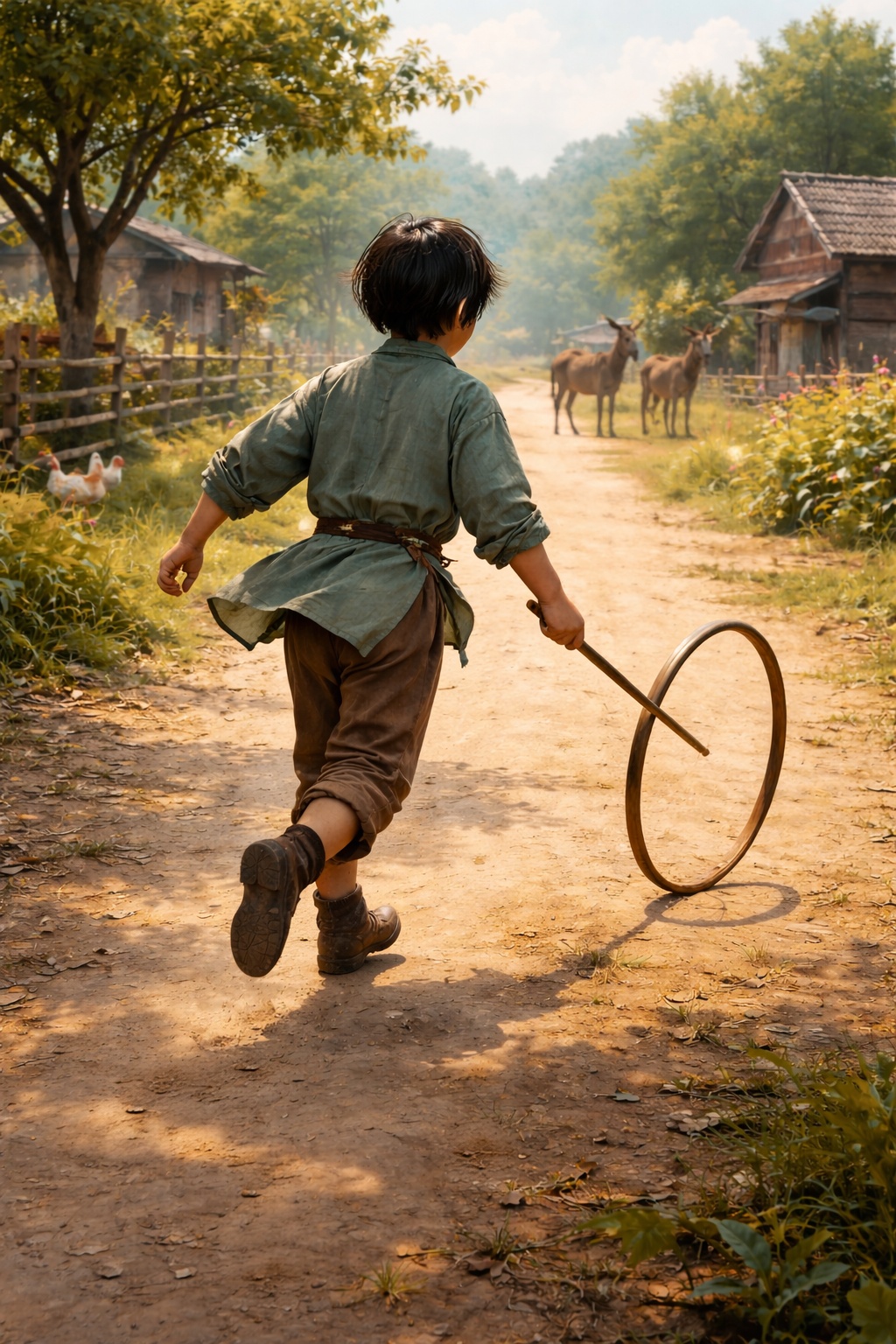
One workday afternoon, when Haaris and I had finished our work early as usual and Ma Shushu had no patients, I sat on the wall beside the front gate, watching Haaris play stick and hoop. He had a wooden hoop he had made by curving a slender bamboo shoot and binding the ends together. He would roll it along, using the stick to keep it moving.
There were many other games he liked, including games played with cards, goat’s bones, and on a wooden board with round stones. His knowledge of games seemed almost as extensive as my knowledge of martial arts. More than anything else I had experienced, learning these games made me realize how abnormal my childhood had been, for Haaris seemed to think that every child must know these games, while I knew none of them.
Well, almost none. Sometimes, when the day’s work had been heavy and he was tired, Haaris liked to set the wooden milk pail on top of a stack of firewood. Then we would sit some distance away and take turns throwing pebbles at it, trying to hit it. This was actually something I had done before to pass the time when I was bored, but I had not realized it was a game.
Anyway, that day Haaris was doing very well with the hoop, running at full speed just to keep up with it, and I was watching with a smile, when movement from the road caught my eye. I turned my head and saw a woman with a small boy. They were walking up the road, hand in hand, barefoot. Their clothing was caked with dust, and the child looked painfully thin. The woman’s head hung down. She and the boy walked right past me.
People certainly traveled this road at times. The farm laborers came on foot, and the landowners traveled on horseback or mule back. There were also sometimes tinkers, merchants and even once a small caravan, on their way to Deep Harbor, the city in the north where my paternal grandmother supposedly lived.
These two, however, looked as if they didn’t know where they were going, or why, or what they would do when they got there. They looked hungry, exhausted and on their final steps.
I called out, “Auntie, where are you going?”
The woman did not stop, but the child turned. I waved to him. He tugged on his mother’s hand but she kept walking and nearly pulled the boy off his feet.
Refugees
I leaped from the wall down onto the road and ran after them, dust rising from my shoes in little clouds. Catching up quickly, I stopped before the woman. Bowing slightly, I said, “Auntie, can you wait a moment?”
She stopped and lifted her face to mine. Her eyes were sunken. If they had been fireplaces, I would have said the fire was down to a single spark.
“We have not bothered you,” she said pleadingly. “And we are not thieves. Let us pass.”
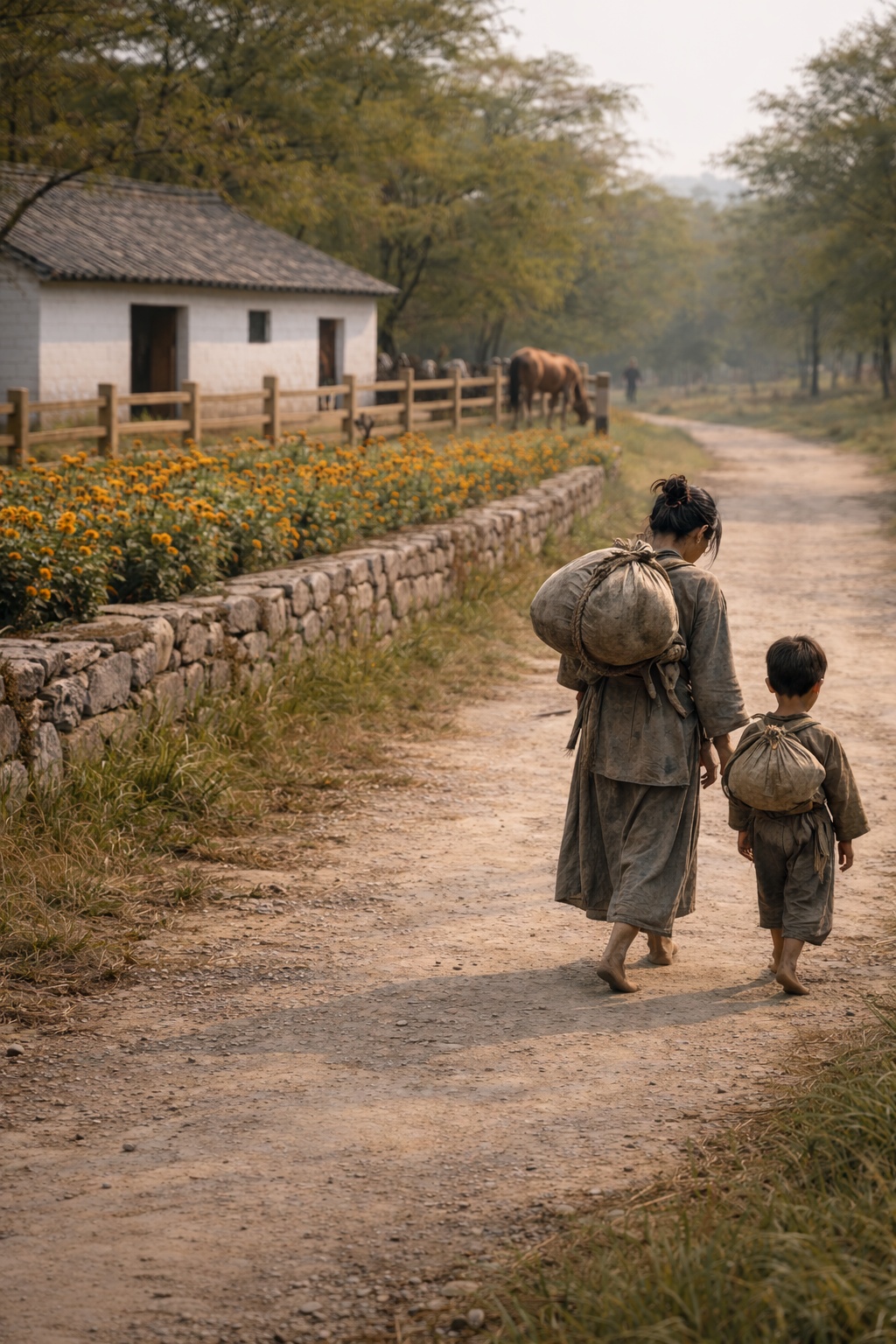
I made a gesture with my palms for her to be calm. “I live on the farm you just passed. Why don’t you walk back to the gate and I’ll bring you water and food?”
She gazed into my eyes for a long moment, then said, “Thank you, kind sir.”
This almost made me smile, her calling me sir. Me, an uncouth, good-for-nothing kid with little schooling and no greater talent than hurting people.
Walking back to the gate I asked where she was going.
“North, that is all. We were driven from our home in the south by the invaders. We have been walking a long time.”
When we reached the gate I said, “Wait here. Do not leave.”
I ran back to the house with Haaris at my heels. “What happened?” he asked. “Where did you go?”
I found my uncle treating an elderly man with a wound on the side of his head. “Ma Shushu,” I said quietly. “Sorry to bother you. There is a woman and child at the gate. They are refugees, in bad condition. I offered food and water.”
He glanced at me, distracted. “Yes, fine. Tell your aunt to care for them.”
Provisions and News
I found Lee Ayi cutting vegetables. She set aside her work and walked quickly to the gate, with Haaris and I hustling along beside her. Taking the woman’s hand, she led the refugees to the well, where she sat them down on the edge. Under my aunt’s direction, I used a washcloth to wash the boy’s face, hands and feet, while she did the same for the mother. Haaris found an extra pair of Lee Ayi’s shoes for the woman, and an old pair of his own shoes for the boy.
By the time Asr arrived, the woman and child had eaten their fill of curried rice with eggs, shallots and garlic, and filled their water gourds. Haaris even gave the boy an old shuttlecock he’d made out of tree resin and twine. The woman and child rose to leave.
“No,” Lee Ayi said. “It will be dark in a few hours. You will sleep in the barn tonight, eat breakfast in the morning, and we will give you provisions for the road.”
The woman looked doubtful. “You… you will not lock us in?”
Lee Ayi frowned. “Of course not.” She lifted her hands helplessly. “We offer you assistance, that is all. You are free to leave if you prefer.”
The woman broke down. She fell to the ground and prostrated to Lee Ayi, weeping. The boy hugged her, confused.
“Astaghfirullah.” Lee Ayi picked the woman up and helped her stand. “Never prostrate to another human being. Only to Allah Almighty.”
“You -” The woman’s breath caught as she tried to stifle her sobs. “You are Hui?”
“Yes. We are Muslim.”
“Then we too wish to be Muslim.”
That evening the refugees ate dinner in the house with us, though the woman was clearly uncomfortable, and kept apologizing for her tattered and stained clothing. Ma Shushu led her through the shahadah, then gave her the name of the Imam in Deep Harbor.
“I must tell you something,” the woman said. Her tone until now had been grateful and timid. But now she sat up assertively. “More are coming behind me. The war is coming near. Everything south of Three Gorges is lost to the invaders. You must build your wall higher, and make your gate secure. Not all refugees are honest, and there are highwaymen on the road. People are being captured and enslaved, or simply robbed and killed. You are good people. Prepare yourselves, for trouble is at the gate.”
In the morning Lee Ayi gave them generous provisions and extra suits of clothing and they left.
Haaris and I worked mostly in silence that day. My hands twitched every now and then, seeking the comfort of the dao. I felt jumpy, and caught myself grinding my teeth.
Later I asked Lee Ayi why she had been so generous with the woman and child. “I can understand giving a stranger a bite of food to eat,” I said. “Others have done the same with me. But you gave her so much. You don’t even know her.”
“She is my sister,” Lee Ayi said simply.
I froze. “What do you mean? I didn’t know you had a sister.” I was thinking that if that woman was truly my aunt, how could we let her go out on the road like that?
Lee Ayi smiled. “All Muslims are brothers and sisters. We are one body, one Ummah. If one of us is in pain, we are all in pain.”
This was a very strange concept to me. Revolutionary, even. I would have to think about it. I merely nodded and went on my way.
Lantern Light and Music
The Lee family surprised me that evening with something new. That evening, after the gates were secured and the animals settled, we all sat together on the floor of the main room.
The lamps were lit early. Outside, the air had grown cool, and the safflower fields were dark, the bees long gone. Inside, the lantern light softened the walls and made the low ceiling seem closer, as if the house were leaning in.
Lee Ayi brought out an instrument I had not seen before. Its body was long and narrow, the wood polished smooth by long handling. She sat cross-legged and adjusted the strings with quick, practiced turns, plucking each one and listening carefully. The sounds were low at first, almost tentative, then steadier, fuller, as if the instrument were waking.
Once, when I went looking for my father in town, I found him passed out on the floor of a saloon while a man played a crude song for coins, his voice loud and uneven, the notes slurred together with laughter and drink. I remembered the smell of alcohol, the shouting, the way the sound pressed in from all sides without shape or purpose. That was the extent of my experience with music.
This was different.
Lee Ayi touched the strings, and the sound rose cleanly from the wood, as if something living had been coaxed out of it. A piece of carved wood, a few taut strings, and her hands, and yet the room changed.
Haaris fetched a small drum and settled opposite her, tapping it once with his fingers, then again, testing the sound. He grinned at me and rolled his shoulders as if preparing for something important.
Ma Shushu cleared his throat and sat back against the wall, his legs stretched out, his hands resting loosely on his knees. When Lee Ayi began to play in earnest, he closed his eyes.
The melody was simple and familiar to them. It rose and fell without hurry. Haaris found the rhythm easily, his hands slapping the drumhead with uneven enthusiasm, sometimes early, sometimes late, but never losing the pulse entirely.
Then Ma Shushu began to sing.
The song was light, almost silly. It told the story of a man who wanted an easy way out of his troubles. Each time he thought he had found one, it led him into worse difficulty. He borrowed money and lost it. He sold his stubborn donkey and bought a horse that ran way. He found a purse in the street and was accused of theft. Each verse ended with the same amused refrain, and each time Haaris struck the drum a little louder, laughing before he could stop himself.
Lee Ayi smiled as she played, shaking her head once or twice at the foolishness of the man in the song. Ma Shushu sang without strain, his voice steady and unpretentious, more storyteller than singer.
I sat with my back against the wall, listening. The only things more lovely than this that I had heard in my life were the purring of Far Away when he slept beside me in bed, and Ma Shushu’s voice as he recited the Quran. The latter especially – Ma Shushu’s deep voice as he sang the melody of the Quran – was the single most beautiful and peaceful thing I had ever heard in my life. The music, while pleasant, was a distant second.
When the song ended, Haaris bowed dramatically, nearly tipping over.
“That is enough noise for one night,” he said. “Tomorrow comes early.”
A Trickle Becomes a Stream
As the days passed and the weather grew colder, more refugees began to appear. A trickle became a stream. Old men leaning on sticks. Women with infants bound to their chests, their faces gray with exhaustion. Families, and even small groups, all going north, fleeing the evil in the south. They moved quietly, conserving breath, as if speaking too much might cost them something they could not afford to lose.
Sometimes they called out from the gate.
“Water.”
“Food.”
“Medicine, if you have it.”
Ma Shushu never turned anyone away. He sent Haaris to fetch water, milk, cheese or bread; or a blanket from the storage room. Once he treated a man’s infected foot at the gate, kneeling in the dust as calmly as if he were in the treatment room.
Lee Ayi, who had been so generous with that first refugee woman and child, began to express worry. The pantry was running low, and there were no more spare blankets or clothing to give away.
That evening I was returning a basket to the kitchen when I heard Lee Ayi and Ma Shushu arguing quietly. I paused without meaning to, standing just outside the doorway.
“We cannot go on like this,” Lee Ayi said. Her voice was low, controlled. “We have little left to give. Winter is coming.”
“They are desperate,” Ma Shushu replied. “They are an amanah from Allah.”
“But are they our amanah? We are not the nation, we are not the emperor or the governor or the mayor. We are just a family with a farm and mouths to feed.”
I slipped away, troubled. The question of providing for the refugees was overshadowed the very next day, however, when a band of six rough and dangerous looking men entered the gate without permission and marched right up to the door.
* * *
Read Part 9 – Crane Dances In The River
Reader comments and constructive criticism are important to me, so please comment!
See the Story Index for Wael Abdelgawad’s other stories on this website.

Wael Abdelgawad’s novels – including Pieces of a Dream, The Repeaters and Zaid Karim Private Investigator – are available in ebook and print form on his author page at Amazon.com.
Related:
Keep supporting MuslimMatters for the sake of Allah
Alhamdulillah, we're at over 850 supporters. Help us get to 900 supporters this month. All it takes is a small gift from a reader like you to keep us going, for just $2 / month.
The Prophet (SAW) has taught us the best of deeds are those that done consistently, even if they are small. Click here to support MuslimMatters with a monthly donation of $2 per month. Set it and collect blessings from Allah (swt) for the khayr you're supporting without thinking about it.




15 Things You Didn’t Know About Makkah and the Ka’bah [Part 3]

Beyond Ramadan: Connecting to Allah Through His Beautiful and Majestic Names
15 Things You Didn’t Know About Makkah and the Ka’bah [Part 2]

Widening Wars Leave the Middle East in Shambles
15 Things You Didn’t Know About Makkah and the Ka’bah [Part 1]

The Trials Playlist: A Chaplain’s Set To Steady Your Heart

[Podcast] Is Your Sadaqah Paying an Influencer Instead of Going to Charity? | Mufti Abdullah Nana & Dr Shafi Lodhi

When The Qunoot Becomes Politics: Religious Theater in Saudi Arabia

The Weight Of Fear And The Will To Survive: Fasting In Times Of War

AL-AQSA IS CLOSED

Coming Full Circle: Who Are You Now? | Night 30 with the Qur’an

Running Away From Who We Are | Night 29 with the Qur’an

Building From the Ground Up: Week 4 Recap | Night 28 with the Qur’an

The Muslim You Are Becoming | Night 27 with the Qur’an

What Will You Leave Behind? Legacy in Islam | Night 25 with the Qur’an
-

 #Current Affairs1 month ago
[Podcast] Ramadan Is Not For Your Private Spirituality | Dr Farah El-Sharif
-
#Society1 month ago
She Cried At The Door Of The Masjid: A Case For Children In Mosques
-
#Islam4 weeks ago
The Trials Playlist: A Chaplain’s Set To Steady Your Heart
-
#Culture4 weeks ago
[Podcast] Is Your Sadaqah Paying an Influencer Instead of Going to Charity? | Mufti Abdullah Nana & Dr Shafi Lodhi



Kathleen
February 8, 2026 at 11:34 PM
The refugees at the gate felt painfully real, especially the woman asking if she would be locked in. It says so much about what people have already been through before they even arrive. Her converting to Islam on the spot seemed rather sudden, but I can understand if she was caught up in the emotion of the moment.
I love the quiet domestic details, the training with Lee Ayi, and then that conversation about the Thirty Three Generations. Poor Darius, always inheriting things he didn’t ask for.
It’s very beautiful how he considers Allah his only true friend. SubhanAllah. That’s genuinely thought provoking and makes me think about my salat in a new way.
Tawfiq
February 10, 2026 at 8:46 PM
The part where the woman asked if they were going to be locked in made me think that she’s been through some scary stuff already. And there are still people in the world who go through that, with like human trafficing and all that. Its sad. Also the part about the martial arts being passed down for thirty three generations was intense. Like, Darius didn’t ask for that, but it’s still on him somehow. Seems unfair. The music scene was chill. Peaceful, like a break. But that last bit about the six men showing up was ominoooooooos. Waiting for next week insha-Allah.
Leanna
February 14, 2026 at 10:54 AM
I like Darius and I love that he’s finding a friend in Allah, سبحانه وتعالى. I love his strength and intelligence. I look forward to reading about Darius embracing his true self versus the person created by a cruel father. The ending was ominous but not unexpected. Darius has to show off his skills at some point!
Karim
March 25, 2026 at 7:25 AM
The family scene is the epitome of what Darius has been needing and searching for! Especially as they have helped him connect with Allah (SWT) and Islam. Darius has finally found something worth fighting for. And it looks like he may have to soon.