#Society
Ramadan, Disability, And Emergency Preparedness: How The Month Of Mercy Can Prepare Us Before Communal Calamity
As a person born with a muscular physical disability, who now uses a wheelchair, I naturally hoped that all of our masajid would be accessible.

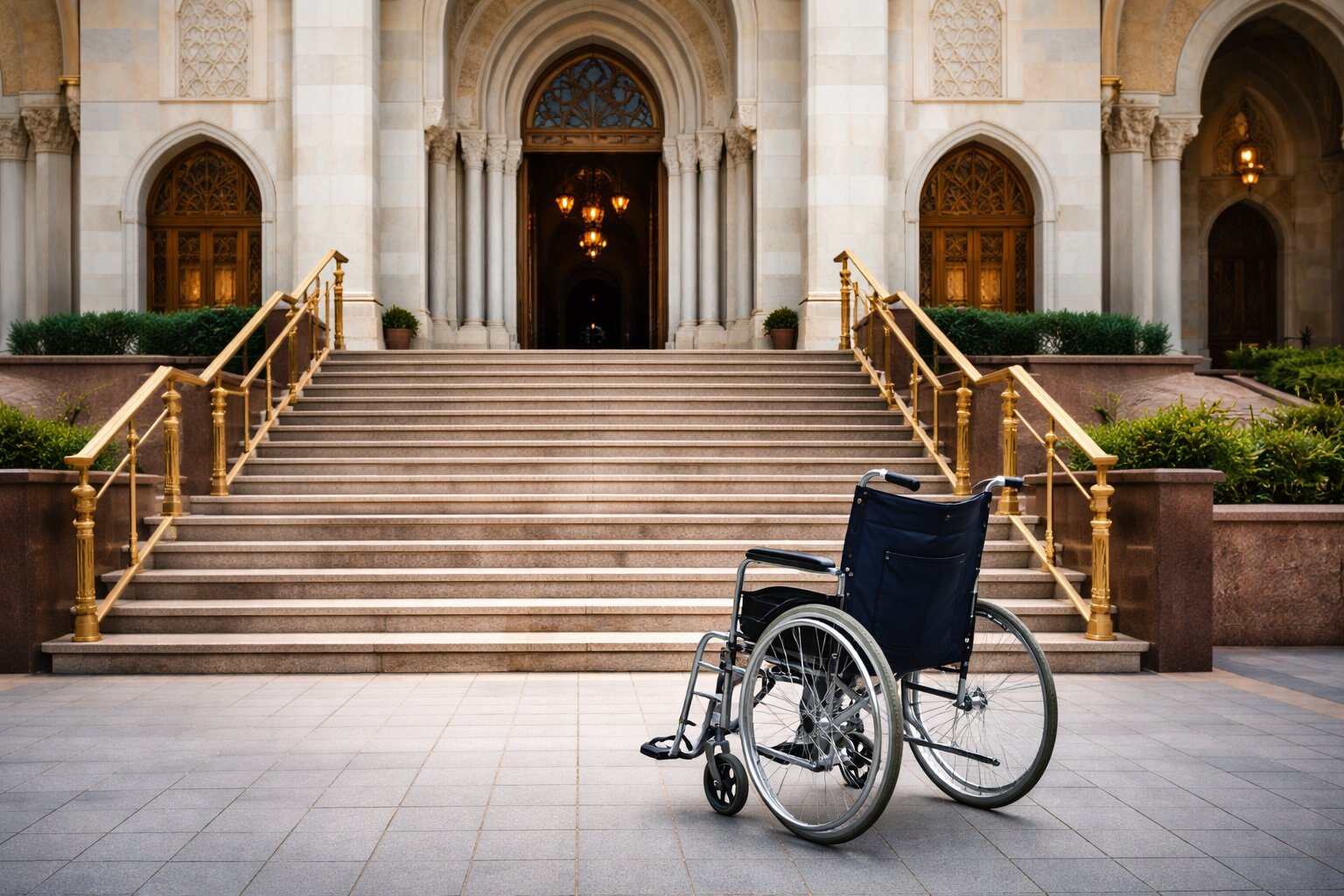
As a person born with a muscular physical disability, who now uses a wheelchair, I naturally hoped that all of our masajid would be accessible. The access to elevators instead of needing to climb a flight of stairs. This need for accessibility grew even more after witnessing my parents age, because it was the norm for my father to carry me up while my mother carried the wheelchair, but now it was increasingly getting difficult for them.
I unexpectedly got married, but out of shyness, I never wanted my husband to carry me publicly. The only way to climb a flight of stairs, in this scenario, was to have at least three men carry me when seated on the wheelchair, while having another person carry my other belongings. I coincidentally have two younger brothers, so they usually assist my husband when carrying me. This made me think of my privilege, which increasingly caused unsettlement over the lack of accessibility within the Masjid.
I had the privilege of not only getting married as a sister with a disability—which is sadly still rare and a topic of taboo—but also had the privilege of having more mahrams around me to help out. There was sometimes the Masjid staff uncle to help out, too, and we would accept his help whenever either of my brothers could not be present. I, however, still had the privilege of my family—especially my father—being relatively known within the Hong Kong Muslim community, which made it easier to ask for help. I recognized that this might not be the case for everyone and, therefore, did not feel comfortable accepting that our masjid was not fully accessible.
The lack of accessibility in my eyes meant that many navigating accessibility barriers are not welcomed to attend communal events. This lack of accommodation occurred even more during the month of Ramadan, because of the increased number of crowds, resulting in increased safety hazards for even trying to be lifted up the stairs.
I felt a tremendous amount of guilt for not being able to solve the accessibility barriers. This guilt increased even more as an author and disability advocate, who was also aware of the scarcity of land in Hong Kong. I understood the complexity of trying to improve accommodations within old buildings. The awareness that there were many who cared—including some in the position of authority—but they just genuinely did not know how to find solutions.
My thoughts on the lack of accessibility, due to stairs, were suddenly challenged during the November 2025 Tai Po fires in Hong Kong that killed 161 people. Residents within the Tai Po building complex were left carrying those with mobility barriers down the stairs as an act of mercy in its most urgent form. Our community was not prepared for such a dire calamity to hit, but as a larger society, we were more unprepared for effective strategies to help those with mobility barriers down the stairs, let alone in a state of emergency.
What do we do when our staircases are suddenly packed with panicked crowds because the building we are in—and surrounding buildings—are engulfed in flames?
How can we function and think in such a state?
Who are amongst those who have a higher risk of not being able to escape?
Do we choose to just save our own lives, or do we also try to save the lives of those with mobility barriers?
There was a sudden realization that stairs are not necessarily barriers at all times. Stairs can be forms of escape and the route to safety, especially when it is more unsafe to use the elevator. We will always need stairs within buildings despite other forms of accessibility. We would always need to be trained to get down the stairs even before a calamity hits.
Our city was in agony and grieving.
People with disabilities—which included me—felt this extra layer of grief because we understood how much our community needed to be prepared not only in a time of calamity but in everyday life.
Our communities have a long way to go.
I could not help but think about Ramadan after the Tai Po fires, because Ramadan is a time when our Masjid is most crowded, and when Muslims are usually in a state of panic for not wanting to miss iftaar and taraweeh prayers. Before, I thought of avoiding the Masjid during Ramadan, just to not get in the way, but now, I think Ramadan is the best time to be present, in order to train our community for emergency preparedness. I think this even more after reflecting on the purpose behind the month of Ramadan as a month of mercy and communal unity.
Here are ways in which Ramadan, as a month of mercy can prepare us before communal calamity:
1. Acts of Mercy as a Form of Worship
Ramadan is not just a month for fasting because not everyone can fast. Ramadan is a month of mercy for us to remember Allah  and also our most vulnerable. Recognize that some may not have food, or that there are community members going through calamity, and needing support. Embodying mercy is encouraged, especially as an act of worship. It should, therefore, come naturally to offer help if noticing that anyone is struggling, including with accessibility.

“Mercy can be shown by prioritizing accessibility and working together to find solutions.” [PC: Clyde He (unsplash)]
Keep supporting MuslimMatters for the sake of Allah
Alhamdulillah, we're at over 850 supporters. Help us get to 900 supporters this month. All it takes is a small gift from a reader like you to keep us going, for just $2 / month.
The Prophet (SAW) has taught us the best of deeds are those that done consistently, even if they are small. Click here to support MuslimMatters with a monthly donation of $2 per month. Set it and collect blessings from Allah (swt) for the khayr you're supporting without thinking about it.
“And cooperate in righteousness and piety”[Surah Al-Ma’idah: 5;2]
Why wait for an emergency to cooperate together as a community? Ramadan is the best time to learn what cooperation is, what it looks like in action, and acts of righteousness that increase one in piety.
We have lost the essence of Ramadan if we see a mother struggling to carry a stroller but choose to ignore her by rushing for taraweeh. It is a missed opportunity for righteousness and acting consciously. Piety requires us to act consciously, so the conscious effort to act with mercy inadvertently ends up as a form of worship, too.
2. Discipline from Ramadan to Communal Responsibility
Praying the five daily prayers—as well as taraweeh—and fasting from dawn to dusk trains individuals in patience, discipline, and time awareness. These are qualities that we need in emergency preparedness. Emergency preparedness trains the community in social responsibility and cooperation, but we should not wait for a calamity to occur to develop these skills. Ramadan is there, rather, to help us develop these skills, as it is designed for us to take more social responsibility through donations and awareness of poverty. It is designed for us to cooperate in sighting the moon to decide when Ramadan begins as well as ends. Ramadan additionally facilitates us to come together to arrange and distribute food. Manage crowds gathered in one place so that everyone can pray on time and then leave with safety, too.
The discipline that we are trained to achieve during Ramadan needs to be translated more into communal responsibility in everyday life in order to prepare for emergencies. This can only occur if we know how Ramadan is training us. A lot of us are being trained without being aware of being trained. This is the missing link. Training needs to be highlighted as a form of discipline, so we can realize that it is not only helping us prepare for Ramadan, but also for emergency preparedness as a community.
A way to discipline our community further during Ramadan is to see how crowds within our Masajid can be mobilized for awareness campaigns and evacuation drills. Just as fasting heightens our awareness of hunger, preparedness heightens our awareness of vulnerability. Ramadan is not only about abstaining from food and drink—it is about feeding mercy into action by ensuring no one is left behind.
3. Ramadan Emphasizes that We are All Vulnerable and How Every Life Matters
The food we have is because of Allah . Our ability to eat is because of Allah . It is not for us to decide whose life is more valuable. Ramadan rather makes it clear that all lives are valuable and that we are all equally vulnerable before Him.
People with disabilities, and our elderly, were not the only ones vulnerable within the Tai Po fires. Every human being—and pet—present was vulnerable. The degree of vulnerability one faces may differ, but when calamity hits, this is not usually the focus. The focus usually is saving lives and getting out of a difficult situation.
The mindset that we have towards others during a calamity is a mindset necessary to keep throughout the year. Saving lives or making the lives of those around us better needs to be our general priority, even before calamity hits. Our priority must always be getting anyone out of difficulty—out of empathy—due to considering the life of someone generally valuable.
“Whoever saves one life, it is as if he has saved all of humanity” [Surah Al-Ma’idah; 5:32]
This mindset of valuing each life—regardless of background—can be more easily cultivated during Ramadan. This cultivation will prepare us not to think twice about whether or not to save someone during an emergency.
The Masjid that I go to may have stairs, but it also has an emergency door exit, which makes it clear that advocating for emergency preparedness through training the community needs to be a focus. Recently, a group of us has started a branch under our Masjid’s committee, called Rise with Mercy. It is hoped to eventually address the topic of accessibility—including during the month of Ramadan—to train our community towards preparedness in emergencies.
If we truly consider Ramadan a month of mercy, all of us need to commit towards making our Masajid places of safety and preparedness, so that as a community we are unified and trained before any calamity.
Related:
– [Podcast] Muslims and Disability: A Way Forward | Sa’diyyah Nesar
Keep supporting MuslimMatters for the sake of Allah
Alhamdulillah, we're at over 850 supporters. Help us get to 900 supporters this month. All it takes is a small gift from a reader like you to keep us going, for just $2 / month.
The Prophet (SAW) has taught us the best of deeds are those that done consistently, even if they are small. Click here to support MuslimMatters with a monthly donation of $2 per month. Set it and collect blessings from Allah (swt) for the khayr you're supporting without thinking about it.





Far Away [Part 22] – The Raid

Muslims and the F-Word: Feminism, Dhulm, and Jahiliyyah

Du’as for Happiness: Finding Joy Through Daily Adhkar

Female Scholarship In Islam: A Living Legacy [Part 1]
Far Away [Part 21] – Opium

The Arithmetic Of Longing: On Loneliness, Desire, And Learning To Want Well

Thinking Long-Term: The Legacy of Yahiya Emerick

The Legacy Of Professor John Esposito: The Scholar Who Refused To Turn Islam Into An Enemy

An Inconvenient American in Syria: The Curious Case of Bilal Abdul-Kareem
Far Away [Part 22] – The Raid

The Best Actions for Eid al-Adha [Imam Dawud Walid]

Coming Full Circle: Who Are You Now? | Night 30 with the Qur’an

Running Away From Who We Are | Night 29 with the Qur’an

Building From the Ground Up: Week 4 Recap | Night 28 with the Qur’an

The Muslim You Are Becoming | Night 27 with the Qur’an
-

 #Life2 weeks ago
The Arithmetic Of Longing: On Loneliness, Desire, And Learning To Want Well
-
 #Culture3 weeks ago
Thinking Long-Term: The Legacy of Yahiya Emerick
-
#Current Affairs3 weeks ago
The Legacy Of Professor John Esposito: The Scholar Who Refused To Turn Islam Into An Enemy
-
#Current Affairs3 weeks ago
An Inconvenient American in Syria: The Curious Case of Bilal Abdul-Kareem