
#Culture
Far Away [Part 7] – Divine Wisdom
As Darius learns Ma Shushu’s medicine, seeing a dying child takes his mind back to his own dark past.

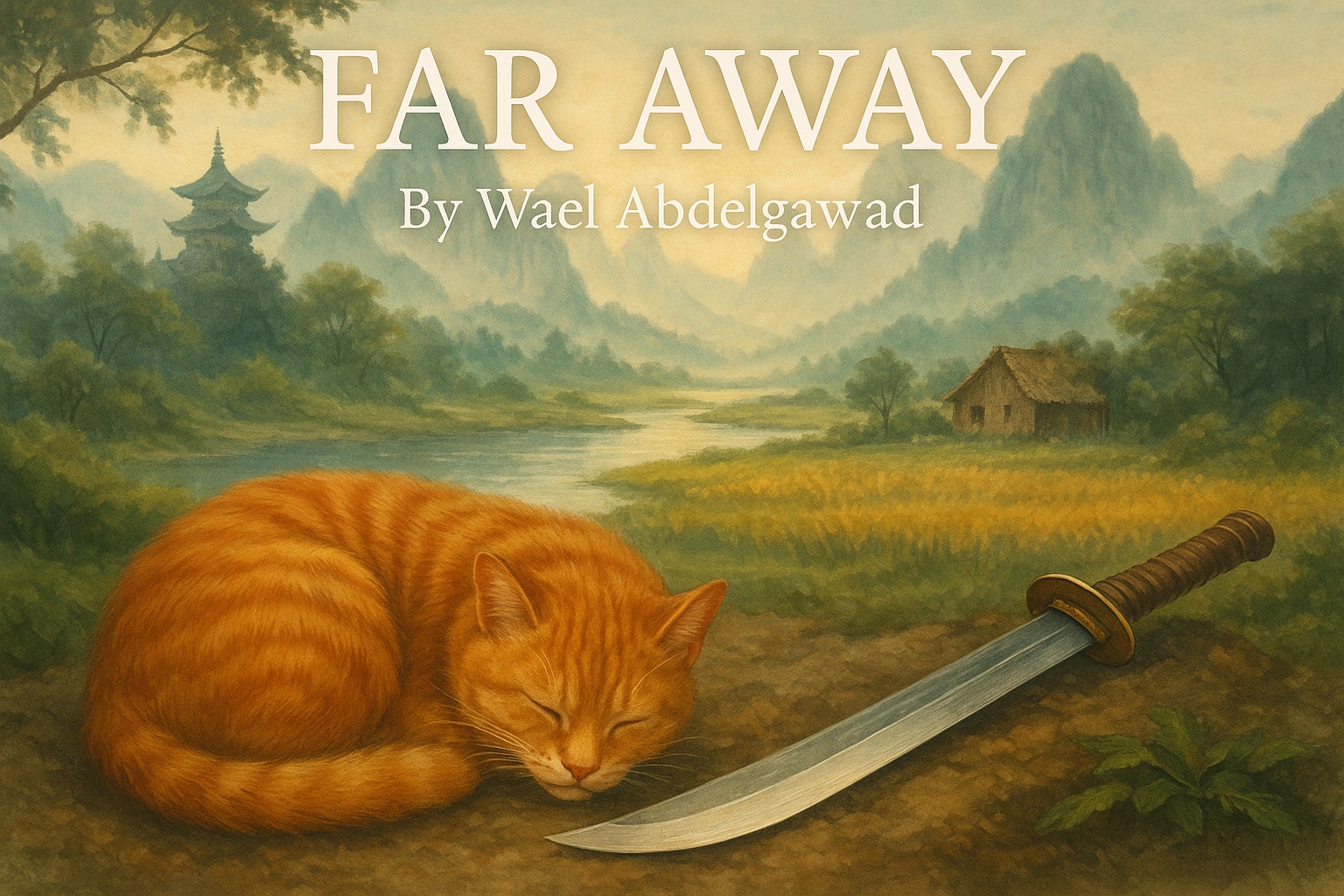
As Darius learns Ma Shushu’s medicine, seeing a dying child forces him to confront his own dark past.
Read Part 1 | Part 2 | Part 3 | Part 4 | Part 5 | Part 6
* * *
Acupuncture
Keep supporting MuslimMatters for the sake of Allah
Alhamdulillah, we're at over 850 supporters. Help us get to 900 supporters this month. All it takes is a small gift from a reader like you to keep us going, for just $2 / month.
The Prophet (SAW) has taught us the best of deeds are those that done consistently, even if they are small. Click here to support MuslimMatters with a monthly donation of $2 per month. Set it and collect blessings from Allah (swt) for the khayr you're supporting without thinking about it.
The treatment room – the same room where I had first awakened after arriving here – was dimmer than the rest of the house, the shutters drawn halfway. Scrolls of neat black characters hung on the walls, and bundles of dried herbs dangled from the rafters, scenting the air with bitterness and earth. The padded table sat in the middle of the room, covered in a clean cloth. A small brazier glowed in one corner, and beside it the candle flame flickered.
“Your pain is behind the eye?” Ma Shushu asked the man.
“Yes,” the man whispered. “Behind the eye, into the neck. Always drumming in my head.”
“Hm.” My uncle’s voice was thoughtful but not sympathetic. “You drink wine. You stay up at night, worrying about profit and loss. You shout at your workers. Your liver is hot, your blood rises to your head.”
The man grimaced. “If you cure it, I will pay anything.”
“You will pay what is fair.” Ma Shushu took another needle, passed it briefly through the candle flame, then cooled it with a puff of breath. His hands were sure and unhurried. “And you will follow my advice.”
He pressed a fingertip gently along the man’s brow, then found a spot at the temple. With a tiny, precise movement, he slid the needle in. The man’s fingers twitched, but he did not cry out.
“If you tense, the qi will knot,” my uncle said. “Breathe slowly. In… and out.” He demonstrated, his own belly rising and falling in time with his words. “Tell me when the drum in your head changes.”
He moved smoothly around the table, balanced and focused. He placed needles at the back of the skull, the base of the neck, and the web between thumb and forefinger. Each insertion was as smooth as a well-executed strike. No wasted motion, no hesitation.
I found myself mapping his movements onto my father’s lessons. The lines of the man’s body were like the meridians in Five Animals forms – paths along which force flowed. These same points were striking targets or pain points in combat. Yet here the force was not a blow, but something invisible within the flesh. I did not understand it, but I could see that there was a system, as strict and exact as any martial form.
“Now?” Ma Shushu asked.
The man swallowed. His face had relaxed a little. “The drum is… softer,” he said. “Farther away.”
“Good.” Another needle. “And now?”
The man’s shoulders sagged. “The pain is gone,” he said, sounding surprised and very relieved.
Divine Wisdom
“Your body wishes to be well, but you poison it daily,” Ma Shushu told the man.
Haaris stood beside me, as silent as I was, though I saw his eyes shine with pride. He had seen this many times before.
Ma Shushu checked the needles, then stepped back. “You will lie like this for a while. When you rise, do so slowly. You will drink no more wine, is that clear? You come from an honored Hui family. You know drinking wine is against our faith, and your pain is proof of the wisdom of Allah’s prohibitions, though Allah’s commands need no proof. Everything that Allah commands is Divine wisdom for our benefit, not for Him. Allah the Most High is independent of all needs and wants. You could drink yourself into the grave, and it would not harm Allah in the least. It’s for you, do you understand?” Ma Shushu punctuated this last comment with a gentle finger tap to the man’s forehead.
“Yes, honorable sir,” the man said.
“You will go to bed early,” Ma Shushu went on. “Tomorrow you will not drink wine. Instead, walk in the fresh air. Send your workers home an hour before Maghreb. They have rights upon you, and if you do not treat them fairly, you will answer to Allah on Yawm Al-Qiyamah.”
“Yes, yes,” the man murmured. His voice was drowsy. “Whatever you say, Master Ma.”
Work for the Mind
My uncle extinguished the candle flame with a pinch of wetted fingers, then turned to us. “Haaris, watch him. If he tries to roll over, stop him. Darius, come with me.”
I followed him into the main room. He closed the door to the treatment room halfway, leaving it open enough that Haaris could call out if needed.
“How much did you understand?”
“A little,” I admitted. “You followed the meridian lines inside his body. Like forms that exist under the skin.”
He regarded me sharply. “How do you know about meridian lines?”
In reality, my father had taught me the meridian lines in order to be more precise in striking. These were the points where strikes and gouges could elicit maximum pain or even cause crippling injury. Stabbing the junction between the front shoulder and chest muscle, for example, or up into the armpit. Punching the solar plexus, or a knife hand chop into the philtrum, which was the groove between the upper lip and the base of the nose. But all I said to Ma Shushu was, “My father taught me.”
My uncle grunted, and I had the feeling he was surprised that my father knew the meridians, but he did not say so. “In this house,” he said, “there is work for the hands, the spirit and the mind. Your hands are capable, I have seen that. Now we must train the other two.”
I bowed my head slightly. “Yes, Ma Shushu.”
He clapped his hands once, lightly. “We will pray, then you may rest for an hour. After that, we will continue your studies.” A faint smile touched his mouth. “Do not worry. Needles will not be involved.”
I almost smiled back, but caught myself. I was not yet ready to feel that light. Still, as I returned to bed to nap, I felt some of the weight of the day lifting from my shoulders. There were problems to be solved, secrets to be kept, and personalities to be learned. This was all more than I was used to. But I would figure it out. I had to.
Independent of All Needs
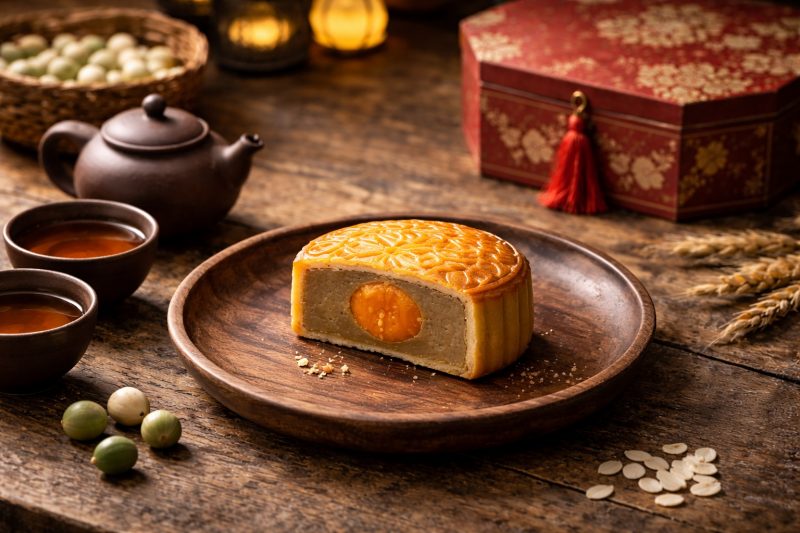 That night after supper, I shared the moon cake with Haaris. He told me he’d already had one in town, but I shared it anyway. He was very happy, and told me a funny story about something that had happened in town. A black horse had come charging through the main street, riderless, and a woman – a milk-seller – fainted with fright. Zihan Ma revived her, and the first thing she said upon waking was, “Don’t let my husband know about us!”
I was scandalized, but I chuckled. I knew from experience that when a person fell unconscious and revived, they might not know where they were, and might even remember having dreams, even if only a few seconds had passed. It was very strange.
Lying in bed that night, my mind drifted to Ma Shushu’s words to the wine-drinking merchant. I had always wondered at the foolishness of the villagers who left offerings of food in front of the statue, only to watch the food rot. What was the point? Yet Ma Shushu said that Allah is independent of all needs and wants. It means, I thought, that our worship is not about Allah’s ego. Our prayer is a way of lifting us out of the misery of this world. I might have contemplated this further, but sleep overtook me.
A Restless Boy
The next day after Fajr prayer Ma Shushu declared that I would join Haaris in the farm work.
“Husband,” Lee Ayi said. “Let him work with me a little longer. I have a lot of work this week, and he’s been very helpful. Besides, I want to get to know him a bit more.”
She spoke this lie very naturally, and Ma Shushu clearly suspected nothing, as he replied, “Certainly, if you wish.”
So I did housework with Lee Ayi for a handful of days, until my shoulder was healed.
One day, we were folding laundry together, standing at the low table by the window. The cloth was warm from the sun, faintly smelling of soap and air.
Lee Ayi shook one tunic out and said, almost idly, “We were not farmers, you know.”
I looked up. “Who?”
“The Lee family.” She smoothed the sleeve flat. “We lived in the city. Your grandfather was a clerk for a trading house when he was young. Later, he kept accounts for the mosque. People trusted him with money. Our family was respected.”
She folded with quick, precise movements.
“Yong was restless even as a boy. Always running ahead, climbing walls, getting in fights.”
I nodded. “That sounds like him.”
She gave a short huff. “He was brilliant, but difficult. My father would correct him, and Yong would listen, but only once. If the correction came twice, he would bristle.”
She stacked the folded cloth neatly.
“He was good at martial arts very early. Better than Jun De ever was.”
I hesitated. “Jun De?”
“Our older brother.” She did not look at me. “He drowned in the river when Yong and I were still young.”
I waited, but she did not elaborate.
Games and Races
When my shoulder was healed, I went out to work in the fields with Haaris.
Haaris worked hard, never complaining, singing to himself as he hauled water or guided the animals. He knew every task by heart. I was bigger and stronger than he was, and once I learned the rhythm of the work, we moved quickly. The fences were repaired, the firewood stacked, the pens cleaned. By the time the sun stood directly overhead, much of what normally took until Asr was already done.
Haaris was delighted. He taught me jianzi, where we took turns kicking a small shuttlecock made of copper coins wrapped in twine, with chicken feathers sticking out of it. The idea was to balance it on one foot and kick it up in place, and keep catching it on the foot. Haaris excelled at it, but the first time I tried it I sent it almost onto the roof of the barn, which made Haaris cackle like a chicken.

Another day, he challenged me to a race to the gate and back. I indulged him and let him win, but he knew what I’d done and stuck his tongue out at me, saying, “Boo!” At times, I found Haaris’s innocence difficult to relate to, but on the whole, he was a sweet boy, unfailingly polite and respectful. And handsome too. He had wide set black eyes and straight black hair that fell to just below his ears. His father was quite dark, and his mother very pale, and Haaris landed in the middle, which gave him a healthy glow.
When he wanted to run off to play tag with the donkeys and feed them oranges, that was too much. I left him to his games and went into the house to watch Ma Shushu work.
Patients Rich and Poor
People came for treatment in a steady stream. Many were of the laboring class: farmers with hands split open from winter soil and cracked wooden plows; muleteers whose backs were knotted hard from sleeping on the ground beside the road; old women with knees swollen like gourds from decades of squatting in the fields; children burning with fever, their mothers’ faces pinched with fear; a charcoal burner coughing black dust into a rag; a silk porter with rope scars cut deep into his shoulders; and others of this kind.
These people brought payment in the form of goods: a basket of eggs, a large bundle of bok choy or daikon radish; or, in one case, a young pig, which Ma Shushu refused, explaining to the man that we did not eat pork. I saw the man return a week later with coins, after selling the pig, I supposed. Often the payment was insufficient, but Ma Shushu treated them all, turning no one away.
This was balanced out by occasional patients from the upper classes: merchants with delicate mustaches and jade rings; the wife of an official carried in on sedan chairs, veiled and silent, suffering from lingering weakness after childbirth; a young scholar with ink-stained fingers and eyes red from studying by oil lamp, tormented by headaches before his examinations; an elderly, heavyset matron attended by two servants, her pulse thin and fluttering from years of rich food and little movement; and once, discreetly at dusk, a high-ranking government official accompanied by two guards. This last one insisted the gate be closed, not wanting anyone to know he was ill.
These people paid in gold, and Ma Shushu spared no expense in their treatment, often using rare and expensive medicines.
Every now and then, there was a patient whom Ma Shushu admitted he could not cure. In these cases, he gave them medicine to relieve pain and alleviate symptoms temporarily. One case that stuck with me was that of a child who was perhaps six or seven years old, carried in by his mother because he no longer had the strength to walk.
He was terribly pale, his skin almost translucent, with faint bruises blooming along his arms and legs, though his mother swore he had not fallen or been struck. His belly was distended, his limbs thin, and his gums bled when Ma Shushu examined his mouth. He tired quickly, and when he smiled, it was with a terrible effort. His mother said he had once been lively, always running, always climbing, but now he slept most of the day and woke drenched in sweat, complaining that his bones hurt deep inside.
Ma Shushu listened, felt the child’s pulse for a long time, and examined his tongue. His face grew grave. He asked gentle questions, then took the mother into another room and spoke to her privately. I followed, standing beside the wall, listening.
“This illness is in the blood itself,” Ma Shushu said softly. “It is like rot in the roots of a tree. I can ease his pain, but that is all. He is dying.”
The mother bowed until her forehead touched the floor, not weeping, only breathing in short, broken gasps. Ma Shushu helped her up and pressed medicine into her hands, refusing payment. He spoke to her quietly about keeping the boy comfortable, about rest and cool water, about praying for patience and mercy.
After they left, the room felt heavy, as if the air itself had thickened. I had seen death before, but this was different. He was just a little boy, and there was no enemy to fight, no mistake to correct, no injustice to rage against. That night, long after the lamps were out, I lay awake thinking of the boy’s smile, and about the fact that even the greatest skill had limits.
Hope and Happiness
The next day, during Islamic studies lessons, sitting cross-legged on the floor with Haaris beside me, I asked Ma Shushu about the boy.
His solemn eyes flicked to mine. “He is very ill. It’s a blood-borne disease that strikes children. I have seen it before. I do not know what causes it.”
“I heard what you said to the mom. It doesn’t seem fair. You taught me that Allah has a plan for everyone, and that our lives have meaning. Why then take away a life so young?”
Ma Shushu rubbed his chin, chewing on one lip. “Part of imaan is to believe in Al-Qadar, Divine destiny, the good and the bad of it. Everyone dies, but why do some die young or suffer? This is the point at which human knowledge fails, and faith steps in. Our own Prophet Muhammad, sal-Allahu alayhi wa sallam, lost more than one child. One of them was Ibrahim, his beloved little son, who became ill when he was eighteen months old. The Prophet  held him in his arms as he was ill, kissing him and smelling him. Then, as Ibrahim was breathing his last breaths, the Prophet began to weep silently. AbdurRahman ibn Awf said, ‘Even you, O Messenger of Allah?’ He meant that the Prophet had prohibited wailing and crying excessively over the dead. The Prophet said, ‘O son of Awf, this is mercy.’ Then, the Prophet wept some more, saying, ‘Verily, the eyes shed tears, and the heart is grieved, yet we will not say anything but what pleases our Lord. We are saddened by your departure, O Ibrahim!’”
“He was the Seal of the Prophets,” Ma Shushu went on. “The highest of humanity. Yet even he had to watch his son die. We cannot understand this, but we don’t allow it to affect our faith in Allah. Does that make sense?”
I nodded. I hadn’t really expected any other answer, and Ma Shushu’s words were profound.
“Do you want to ask something else?”
“My life has been difficult, did you know that?” I blurted out these words. I had never spoken of personal subjects to Ma Shushu, never opened up to him before.
“I have gathered that, yes.”
“My mother’s life was sad, and she died painfully. There were times, after my mother died, that I wished I could die as well, to be with her. I would have been jealous of that boy. I would have wanted to take his disease and die instead of him.”
“I’m very sorry. We didn’t know about your situation.”
Haaris often fidgeted during these lessons, but he had gone very still beside me, and I could feel the weight of his gaze upon me.
“I don’t feel that way anymore,” I went on, looking Ma Shushu in the eye. “If I had died, I would not have seen how my father changed before he died. And I would not have met you, and Lee Ayi, and my brother Haaris.”
I had meant to say my cousin, but for some reason my tongue said, my brother. When I said these words, Haaris burst into tears and threw himself upon me, hugging me. I lost my balance and tipped over. I laughed, but I held him to me and patted his back until his father helped him up.
Ma Shushu sat beside me and put a hand on my shoulder. “Darius. You say your mother’s life was sad, but I am very sure that there was something in her life that gave her hope and happiness. That something was you.”
* * *
Read Part 8 – Refugees At The Gate
Reader comments and constructive criticism are important to me, so please comment!
See the Story Index for Wael Abdelgawad’s other stories on this website.

Wael Abdelgawad’s novels – including Pieces of a Dream, The Repeaters and Zaid Karim Private Investigator – are available in ebook and print form on his author page at Amazon.com.
Related:
Keep supporting MuslimMatters for the sake of Allah
Alhamdulillah, we're at over 850 supporters. Help us get to 900 supporters this month. All it takes is a small gift from a reader like you to keep us going, for just $2 / month.
The Prophet (SAW) has taught us the best of deeds are those that done consistently, even if they are small. Click here to support MuslimMatters with a monthly donation of $2 per month. Set it and collect blessings from Allah (swt) for the khayr you're supporting without thinking about it.



15 Things You Didn’t Know About Makkah and the Ka’bah [Part 2]

Widening Wars Leave the Middle East in Shambles
15 Things You Didn’t Know About Makkah and the Ka’bah [Part 1]

Eid Mubarak from MuslimMatters

Selamat Hari Raya! – Celebrating Eid In Malaysia

She Cried At The Door Of The Masjid: A Case For Children In Mosques

The Trials Playlist: A Chaplain’s Set To Steady Your Heart

Every Sin Has a Cure | The Venom and the Serum Series

[Podcast] Is Your Sadaqah Paying an Influencer Instead of Going to Charity? | Mufti Abdullah Nana & Dr Shafi Lodhi

Accessibility As Mercy: How Laylatul Qadr Guides Towards Disability Justice

Coming Full Circle: Who Are You Now? | Night 30 with the Qur’an

Running Away From Who We Are | Night 29 with the Qur’an

Building From the Ground Up: Week 4 Recap | Night 28 with the Qur’an

The Muslim You Are Becoming | Night 27 with the Qur’an

What Will You Leave Behind? Legacy in Islam | Night 25 with the Qur’an
-

 #Current Affairs1 month ago
[Podcast] Ramadan Is Not For Your Private Spirituality | Dr Farah El-Sharif
-
#Society3 weeks ago
She Cried At The Door Of The Masjid: A Case For Children In Mosques
-
#Current Affairs1 month ago
Op-Ed: Can Zakat Be Used For Political Campaigning? An Argument In Favor
-
#Society1 month ago
Ramadan, Disability, And Emergency Preparedness: How The Month Of Mercy Can Prepare Us Before Communal Calamity


Kathleen
February 2, 2026 at 1:36 PM
Wow, there’s a lot here. Masha-Allah. The acupuncture scene was meticulously done, and the glimpse into the patients really hit hard, especially the contrast between the poor and the rich. The spiritual commentary and the reminder of the death of the Prophet’s son Ibrahim was very sad.
Yet for me, the heart of the chapter, even though it was only a few paragraphs, was Darius and Haaris playing together. I don’t know, I just found it very sweet. Haaris reminds me of someone I know. Hard working, polite, and basically happy. Very different from Darius. I like that Darius indulges him, to a degree.
My gut says we’re in the calm before the storm. Anyone else feel that?
Anyway, I’m still with you! Alhamdulillah.
Wael Abdelgawad
February 5, 2026 at 12:42 PM
Kathleen, thanks for the comment. Haaris is, in fact, a real person, and is just as I have described him.
Tawfiq
February 3, 2026 at 3:03 PM
I started reading your stuff with Day of the Dogs, tho I skipped Moonshhot. I don’t usually read historical stuff, but I’m really into this story because Darius is basically my age. It honestly makes me realize how easy everything is for me. Like, I complain about dumb stuff and this kid is just trying to survive and do the right thing!
The part where they’re playing that jianzi game or whatever was funny, because its basically hackysack. It’s kind of wild that kids were playing the same game hundreds of years ago, except with copper coins!!! Ouch.
The training parts are intense too! I can’t imagine dealing with that and still having to work all day. Makes me think a lot, alhamdulillah. Specially with Ramadan coming.
Wael Abdelgawad
February 5, 2026 at 12:43 PM
Tawfiq, I’m glad you could relate to part of the story. You’re right, our lives today are easy and blessed compared to many other people.
RA
February 3, 2026 at 4:22 PM
This was written so well! I have to say it’s my favorite part so far. I’m excited to see how the story will develop and how Darius will grow and change
Wael Abdelgawad
February 5, 2026 at 12:47 PM
Thanks, RA. I too feel like the story is maturing and becoming deeper as it goes, inshaAllah.
Leanna
February 5, 2026 at 4:17 PM
Another great installment, so beautifully written. I especially love that Islam and Allah swt is shared along with encouragement. I look forward to the next installment and as someone said, I’m sure this is the quiet before the storm.
umm_ismael
February 7, 2026 at 3:57 AM
BarakAllahufeekum ❤️ so many times during this novel I have had tears in my eyes… it is beautiful and totally different from anything you have written before. The islamic wisdom comes through like gems unforced. Like you yourself relaying them to your own self during hardship and pain. Allah Knows best This needs to be in bookform and sold far and wide
Wael Abdelgawad
February 8, 2026 at 4:05 PM
Thank you so much umm ismael for your lovely comment.
Karim
March 25, 2026 at 7:04 AM
Mashaa Allah, such another brilliant and well-written chapter. I agree completely with the comment about that this really should be in book form. I knew I’d enjoy it but I didn’t expect to love it and be intrigued with it at this level; it has quickly become amongst my favorites. I don’t think you realize the gem this really is!