
#Current Affairs
Iron Principle Under Pressure: A Profile Of Naledi Pandor

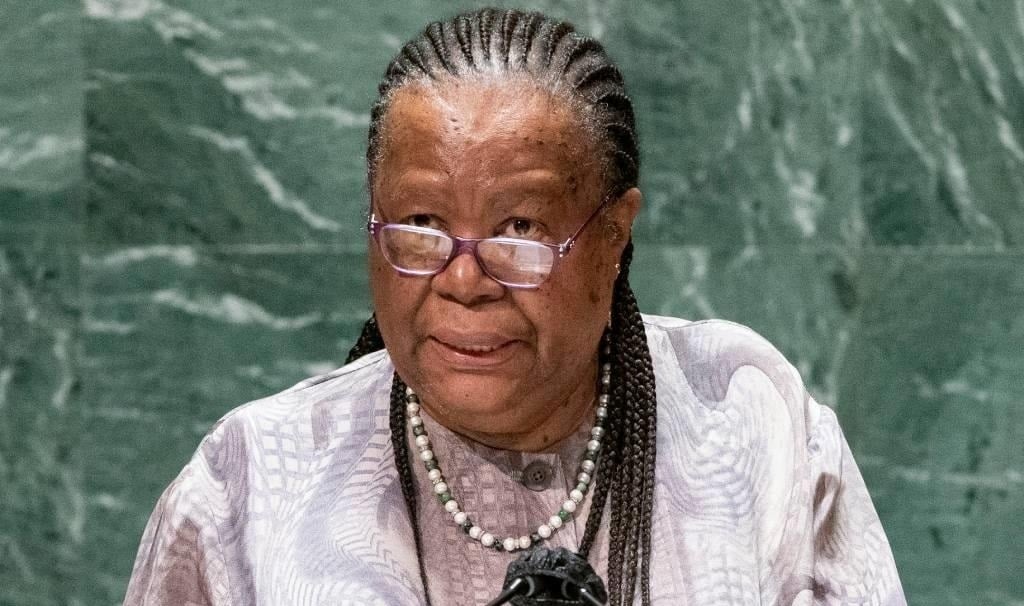
The principal role for which Naledi Pandor of South Africa is known is politics, but her principal interest lies in education. During the final year of her career in 2024, the septuagenarian foreign minister of South Africa gave an education in principled politics with perhaps the most concrete step of any government minister against Israel’s assault on Palestine when she took them to an international court for genocide.
There were personal costs to pay, of course, given the ferocity of Zionist propaganda that has accompanied the genocide. Most recently, in November 202,5 her visa to the United States was revoked in an extraordinarily petty move, which was nonetheless celebrated by Zionist organizations, many of which had spent months attacking both South Africa in general and her in particular for having had the temerity to challenge their bloody assault on Palestine.
But for Pandor, the vindication of being on the right side of history was well worth it. Speaking at Ottawa during a whirlwind trip through Canada just days before the cancellation of her visa, she described the feeling when, after months of personal attacks, professional snubs, and outright mistreatment by both local rivals and foreign peers, her case was found to have been valid all along: “Thanks be to Allah, it’s a wonderful feeling.”
Keep supporting MuslimMatters for the sake of Allah
Alhamdulillah, we're at over 850 supporters. Help us get to 900 supporters this month. All it takes is a small gift from a reader like you to keep us going, for just $2 / month.
The Prophet (SAW) has taught us the best of deeds are those that done consistently, even if they are small. Click here to support MuslimMatters with a monthly donation of $2 per month. Set it and collect blessings from Allah (swt) for the khayr you're supporting without thinking about it.
Not that there was any let-up in the urgency of the Palestinian cause, of course. With the genocide still afoot, she emphasized the importance of civil society and mass, organized international solidarity. Palestine’s plight required, she said, that its supporters “build a united global front” in support. This front can not afford parochialism, sectarianism, tribalism, and hatred.
Background
Pandor grew up amid the downtrodden black majority in apartheid South Africa in a family with both educational and political roots. Her grandfather, Zachariah Matthews, was a professor renowned throughout Africa, who was exiled from his homeland after opposing apartheid in 1956 and became a diplomat for the newly independent Botswana before he passed away. Though he was also exiled, Zachariah’s son Joseph Matthews, Pandor’s father, ended up taking a different route: after apartheid ended, he left his father’s party, though he served a few years as minister in charge of police in a subsequent coalition cabinet. By contrast, Pandor, like her grandfather, spent her political career in the African National Congress, which has ruled South Africa for the past three decades.
The African Congress’s rise to power in 1994 came at the end of several generations’ worth of struggle, where they were the main, banned party representing South Africa’s downtrodden majority against the apartheid regime. Their leader, Nelson Mandela, is renowned in anticolonial circles for, among other things, his unfettered solidarity with Palestine, famously remarking, “We know too well that our freedom is incomplete without the freedom of the Palestinians.” It was this internationalist solidarity that Pandor inherited; speaking at an event arranged by the Justice for All organization, she emphasized the need for human dignity and freedom across borders – highlighting, along with Palestine, the cases of Rohingya, Uyghurs, and Kashmiris as oppressed people deprived of their rights.
From South African Apartheid to Israeli Genocide
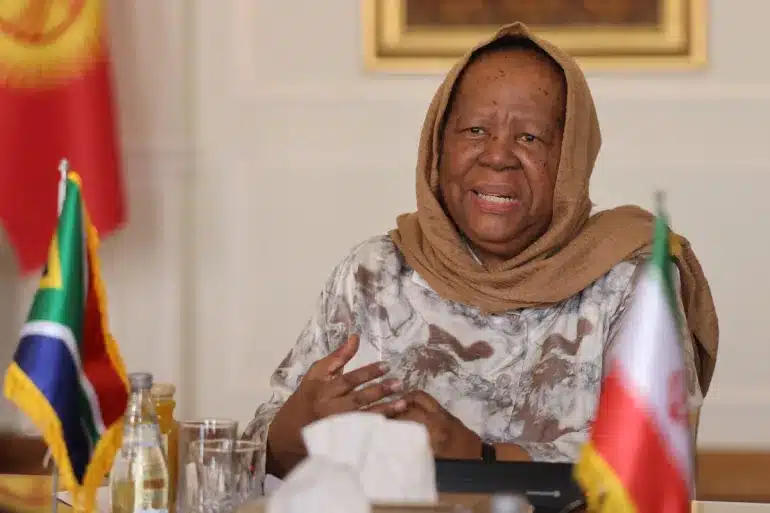
“Pandor stressed the importance of civil society as nimbler, more flexible form of activism than reliance on officialdom” [PC: Al Jazeera]
But Pandor also emphasized certain key differences. In South Africa’s minority rule, the majority workers in unions were able to organize and protest on account of their importance to the South African economy, thus pressuring the same apartheid regime that deprived them. This is not applicable to Palestine, especially under the current genocide, where the role of international solidarity becomes that much more important.
Pandor stressed the importance of civil society as nimbler, more flexible form of activism than reliance on officialdom: civil society can also afford to stick to its principles in ways that officialdom may not. In taking political stances on principle, she remarked, “For some of us, we are there for freedom, for others we are there for the selfie – and actions will tell which one [is which].”
As an experienced diplomat, she lamented the limitations of even multilateral international bodies and particularly urged the reform of United Nations institutions to break free of the control of the major powers: “It is tragic that the body we rely on for peace and security,” she said, was dominated by five member states more responsible between them for global insecurity and war than the others put together.
The role of principled activism was therefore paramount for Pandor, who quoted Mandela’s advice to youth: “Be a person who makes trouble, but make good trouble.”
South Africa’s Fight for Justice, Home and Abroad
Fighting for a just cause dovetailed neatly with Pandor’s understanding of Islam, to which she converted earlier in life. The African Congress had a considerable amount of support among South Africa’s Muslim minorities, many of whom had been engaged in the campaign against apartheid. For Pandor, faith in Allah enabled her to withstand frequent barbed attacks from political opponents. These could go from sweeping bigotry, as evidenced by much of the attacks on South Africa’s current government in recent years, to the pettily personal: she drily recounted how rivals attacked a slight British inflection in her accent, having studied and taught in Britain in her youth.
Education was Pandor’s first job, and after a stint leading South Africa’s equivalent of a senate, the first woman to do so, she held a number of ministries largely related to educational advancement. She also served a brief stint as interior minister, and ended her ministerial career with five years as South Africa’s foreign minister. As a veteran politician well-versed in the cut and thrust of power, her initiative in a principled cause meant that much more. So too did her emphasis on the importance of civil society, something located well outside the realm of the corridors of power.
Since it threw off apartheid in the 1990s, South Africa has generally been seen as a leader on the African continent and is often catalogued among rising states in the international system. With that system having long been dominated by first colonial, and then Cold War superpowers’ competition, Pandor emphasized the importance of this moment in history: when these “Global Northern” powers, who have dominated international relations for centuries, are in flux. It was a huge opportunity, she said, for the “Global South” to reconfigure international relations to a more equitable keel.
It was only a few days later, after her trip to Canada, that Pandor found that her visa to travel to the United States had been revoked. This stemmed partly from a general hostility toward South Africa by the United States, especially during Donald Trump’s current reign, where far-right activists regularly and speciously claim that Pretoria’s anti-apartheid measures discriminate against the white minority.
This reached such a stage that Trump personally berated South African leader Cyril Ramaphosa for this fictitious oppression and offered asylum to white South Africans fleeing the country, a ludicrous proposition that even baffled many of its intended beneficiaries. And it also stemmed from a linked Zionist campaign against South Africa, which is accused of being in cahoots with Hamas to malign the Israeli state. Pandor, the highest-profile Muslim minister, a black veteran of the anti-apartheid movement, and the lady who took Israel to court, was a central target.
Throughout it all, the South African has kept a dry wit, a stiff upper lip, and an iron will. “Remain engaged until freedom is won,” she said at Ottawa. “That is all.”
Related:
– Who’s Afraid Of Dr Naledi Pandor? – Zionist Panic and a Visa Revoked
– When News Becomes Propaganda: Gaza, Genocide, And The Media
Keep supporting MuslimMatters for the sake of Allah
Alhamdulillah, we're at over 850 supporters. Help us get to 900 supporters this month. All it takes is a small gift from a reader like you to keep us going, for just $2 / month.
The Prophet (SAW) has taught us the best of deeds are those that done consistently, even if they are small. Click here to support MuslimMatters with a monthly donation of $2 per month. Set it and collect blessings from Allah (swt) for the khayr you're supporting without thinking about it.




Long War without End: A Quarter-Century since the War on Terror

[Podcast] 50k Mahr, Hiding Money, & Who Pays for the Wedding? | AML Finance

What The Makkah Agreement Is Missing

Far Away [Part 26] – Shaytan Is A Liar

From a Syrian Prison to the UN: The Case of Bilal Abdul Kareem
Far Away [Part 26] – Shaytan Is A Liar
Far Away [Part 25] – To Save A Prince
Far Away [Part 24] – The Whipping

When The Bed Walked Away [Part 2] – Primordial Muck
When The Bed Walked Away [Part 1]

The Best Actions for Eid al-Adha [Imam Dawud Walid]

Coming Full Circle: Who Are You Now? | Night 30 with the Qur’an

Running Away From Who We Are | Night 29 with the Qur’an

Building From the Ground Up: Week 4 Recap | Night 28 with the Qur’an

The Muslim You Are Becoming | Night 27 with the Qur’an
MuslimMatters NewsLetter in Your Inbox

Sign up below to get started

