
#Life
The Hunger Crisis: Reflections Of An American Muslim


From October 1, 2025, to November 12, 2025, the United States government was “shut down” due to legislative disputes over the contents of a spending bill. This shutdown meant that thousands of non-essential federal employees were furloughed, and thousands more were required to work without knowing when their next paycheck would come.
Government shutdowns, while uncommon, have occurred numerous times in the past.1“Funding Gaps and Shutdowns in the Federal Government”. https://history.house.gov/Institution/Shutdown/Government-Shutdowns/ However, not only was this most recent 43-day shutdown the longest in American history, but it was also the first time the Supplemental Nutrition Assistance Program (SNAP) was suspended over a lack of allotted funding. SNAP benefits provide monthly food assistance to roughly 42 million Americans, or 12% of the population; 70% of SNAP recipients are children, seniors, and people with disabilities.2“Explainer: Understanding the SNAP program–and what cuts to these benefits may mean”. https://www.hks.harvard.edu/faculty-research/policy-topics/social-policy/explainer-understanding-snap-program-and-what-cuts What people expected, and feared, became true once the shutdown dragged into November: people would not be receiving their SNAP benefits, it was unclear when (or if) they would receive them again, and they were now left scrambling to find food assistance elsewhere. Some states pledged to cover people’s SNAP benefits for the month of November, but this was only meant to be a temporary, partial fix.
With the end of the government shutdown, SNAP benefits have been restored, and SNAP will be funded through the end of the fiscal year in September 2026.3Desilver, Drew. “What the data says about food stamps in the U.S.” https://www.pewresearch.org/short-reads/2025/11/14/what-the-data-says-about-food-stamps-in-the-us/ While the immediate crisis has subsided, a greater, longer-term crisis still looms. Food continues to grow more expensive, while wages remain stagnant. The One Big Beautiful Bill Act that was signed into law in July 2025 will cut the SNAP budget by 20% over the next ten years, in addition to placing stricter work requirements on recipients.4Explainer: Understanding the SNAP program–and what cuts to these benefits may mean”. https://www.hks.harvard.edu/faculty-research/policy-topics/social-policy/explainer-understanding-snap-program-and-what-cuts A vicious cycle is thus created where more people will end up needing help affording food, while access to help is made increasingly difficult for fewer benefits. Compounding this crisis, and one of the primary reasons for the shutdown, is the astronomical cost of healthcare in this country that regularly forces people to choose between seeking medical care and paying for other basic living expenses.
Keep supporting MuslimMatters for the sake of Allah
Alhamdulillah, we're at over 850 supporters. Help us get to 900 supporters this month. All it takes is a small gift from a reader like you to keep us going, for just $2 / month.
The Prophet (SAW) has taught us the best of deeds are those that done consistently, even if they are small. Click here to support MuslimMatters with a monthly donation of $2 per month. Set it and collect blessings from Allah (swt) for the khayr you're supporting without thinking about it.
I do not want to mince words or downplay this plight: I believe this is a moral failing of our government leaders. In a nation as wealthy and full of resources as the United States, there is no acceptable justification for why food insecurity is so widespread. Our government spends billions of our tax dollars each year on military operations around the world that cause, at minimum, societal and economic destabilization, and, at worst, genocide. Corporations and the richest Americans get tax breaks, while millions more must scrape by on their minimum wage paycheck or meager social security/disability payments. The scale of injustice being seen here is massive and dire, and it should disturb anyone who is paying attention and has a conscience.
As I spend time reflecting on this as a Muslim, I remember the many times in the Qur’an where Allah  has urged the believers to feed those who are hungry. The two passages that have always stood out to me most regarding our duties to give come from Surah al-Balad and Surah al-Ma’un:
“If only they had attempted the challenging path! And what will make you realize what the challenging path is? It is to free a slave, or to give food in times of famine to an orphaned relative or to a poor person in distress, and–above all–to be one of those who have faith and urge each other to perseverance and urge each other to compassion. These are the people of the right.” [Surah al-Balad, 90; 10-18]
“Have you seen the one who denies the (final) Judgment? That is the one who repulses the orphan, and does not encourage the feeding of the poor. So woe to those (hypocrites) who pray yet are unmindful of their prayers; those who (only) show off, and refuse to give (even the simplest) aid.” [Surah al-Ma’un, 107; 1-7]
The message Allah shows us here is very clear: giving food to needy people is morally good, even in times of difficulty, and denying food to needy people is morally wrong. The verses of al-Ma’un in particular illustrate the hypocrisy of those who may follow the “letter of the law” (through outward acts of piety like salah) but disregard the “spirit of the law” by ignoring Allah’s Command to care for those who are vulnerable. Throughout the Qur’an, Allah frequently pairs “belief” together with “righteous deeds,” illustrating that our deen requires both from us in order to have sound faith. With these imperatives, it is our Islamic duty to address these issues to the best of our ability.
There is an oft-cited hadith from Sahih Muslim where our Prophet ﷺ says,
“Whoever among you sees an evil action, let him change it with his hand [by taking action]; if he cannot, then with his tongue [by speaking out]; and if he cannot, then with his heart [by at least hating it and believing that it is wrong], and that is the weakest of faith.”
This is frequently used as a rallying call to action amongst Muslims, especially in situations where people may feel that there is little that they personally can do due to a lack of power or physical distance (for example, the genocides in Gaza and Sudan). In the case of the American hunger crisis, however, we are in a position to counter these evil actions (purposeful, artificial shortages of food resources) with our hands, tongues, and hearts.
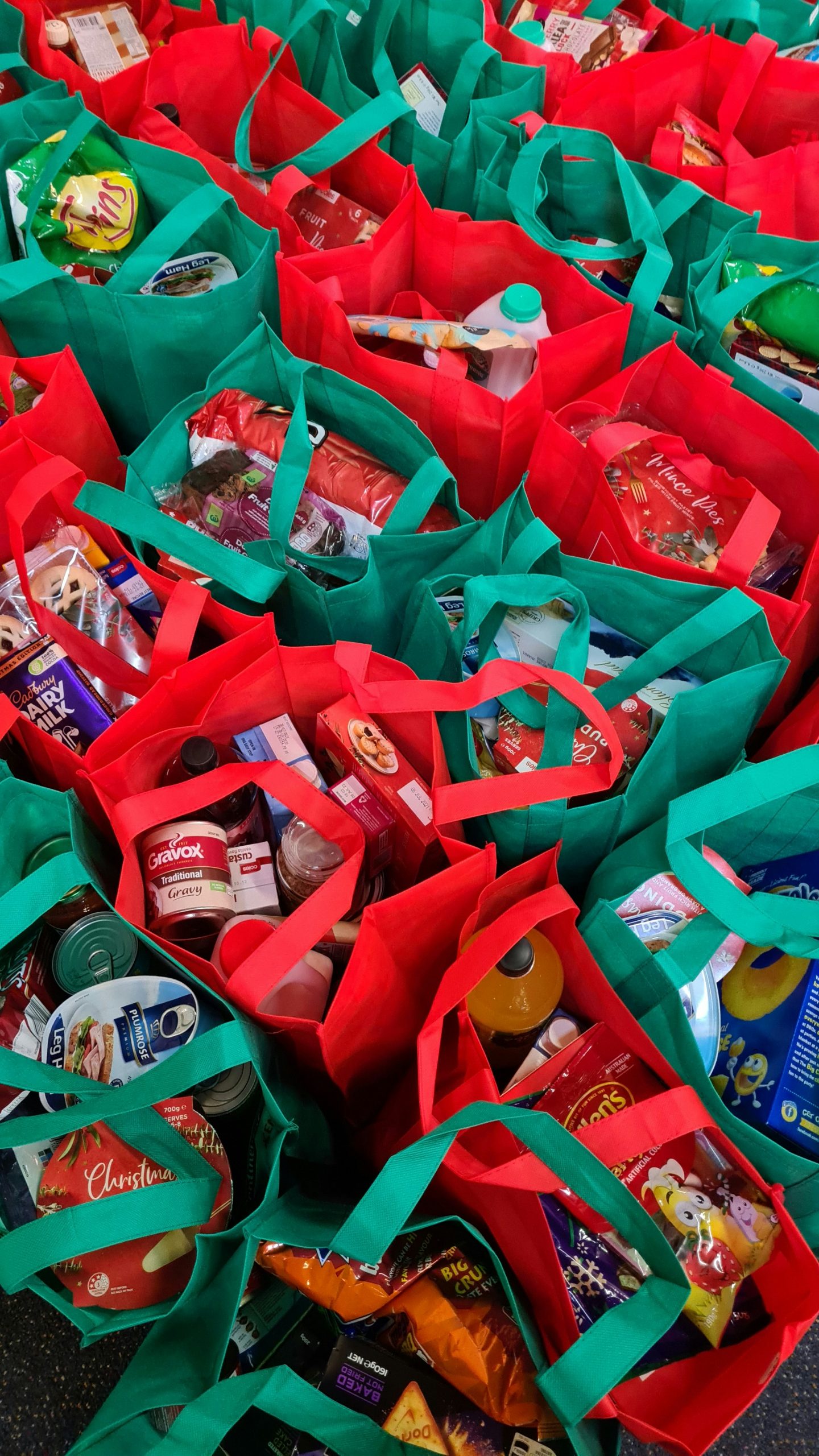
– With our hands: The most direct way we can help our neighbors who are hungry is, unsurprisingly, to provide them with food or money for food. There are many ways this can be done, and some ways may be more beneficial to certain people than others. For example, in my local Buy Nothing group on Facebook, people regularly request and offer groceries and meals. Because this group has a large user base, requests for food are generally met quickly and abundantly.
“The most direct way we can help our neighbors who are hungry is, unsurprisingly, to provide them with food or money for food.” [PC: Nico Smit (unsplash)]
Alhamdulillah, Muslims have already been demonstrating a commitment to serve our neighbors. At the small Islamic school my daughter attends, one parent’s suggestion to provide food assistance to students and their families led to a fundraising campaign that has collected $1,300 for groceries. In a now viral TikTok series, a woman named Nikalie Monroe filmed herself cold-calling dozens of houses of worship requesting baby formula. She did not need the formula, but she wanted to conduct a “social experiment” to see how receptive religious institutions would be to people directly asking for assistance. Most of the churches she contacted either denied the request or directed her to different organizations, but a few places, including The Islamic Center of Charlotte in Charlotte, North Carolina, offered to help her get formula with no questions asked. Touched by this masjid’s generosity and quick response, donations have been pouring in, which the masjid says it will use to fund a food drive. These are beautiful examples of Allah’s Words being put into action, and illustrate how one kind act can birth even more goodness. Allah says in Surah al-Baqarah: “The example of those who spend their wealth in the cause of Allah is that of a grain that sprouts into seven ears, each bearing one hundred grains. And Allah multiplies to whoever He wills. For Allah is All-Bountiful, All-Knowing.” [2;261]
– With our tongues: This is where our recent experience with Palestine/Sudan activism will be useful. Get involved with advocacy groups that work towards policies that fight hunger and systemically address poverty and the massive income inequality in the United States. This can be on a national, state, or local level. For example, you could start or join a campaign for your local school district to provide universal free breakfast and lunch for its students, so no child will ever have to worry about skipping meals at school or having lunch debt.
Write and deliver a khutbah or bayan/khatirah about what the Qur’an and sunnah say about helping our hungry neighbors. If you’re a parent, talk with your children about hunger and how widespread it is, as well as what Allah has asked us to do to address it.
– With our hearts: Du’a and taqwa are our greatest tools. Make heartfelt du’a asking Ar-Razzaq, the Provider, to bless us all with His Rizq (provisions). Ask Allah to help us in helping others, and that we may be agents for what is right. Remember how Allah has warned us against oppressing others, and ask Him to keep us from being among the wrongdoers and those who cause harm.
Pray that the hearts of those in power are opened and guided to the Truth, and that they use their power to enjoin goodness and justice for people, especially those who are vulnerable and marginalized.
We may not be able to solve problems like hunger alone, but inshaAllah each step we take to help our neighbors means one less person goes to bed hungry. May Allah bless and help those who are struggling in body, mind, and spirit, and guide us to always do what is pleasing to Him. Ameen!
Related:
– When The Powerful Eat Full And The Poor Go Hungry
– The Architecture of Withholding: When Charity Becomes Control
Keep supporting MuslimMatters for the sake of Allah
Alhamdulillah, we're at over 850 supporters. Help us get to 900 supporters this month. All it takes is a small gift from a reader like you to keep us going, for just $2 / month.
The Prophet (SAW) has taught us the best of deeds are those that done consistently, even if they are small. Click here to support MuslimMatters with a monthly donation of $2 per month. Set it and collect blessings from Allah (swt) for the khayr you're supporting without thinking about it.



Far Away [Part 27] – The Prince’s Ring

[Podcast] Faith, Motherhood, and the Call to Gaza | Dr. Samaiya Mushtaq

Long War Without End: A Quarter-Century Since The War On Terror

[Podcast] 50k Mahr, Hiding Money, & Who Pays for the Wedding? | AML Finance

What The Makkah Agreement Is Missing
Far Away [Part 26] – Shaytan Is A Liar
Far Away [Part 25] – To Save A Prince

When The Bed Walked Away [Part 2] – Primordial Muck
When The Bed Walked Away [Part 1]

The Woman Who Was Heard Above the Seven Heavens

The Best Actions for Eid al-Adha [Imam Dawud Walid]

Coming Full Circle: Who Are You Now? | Night 30 with the Qur’an

Running Away From Who We Are | Night 29 with the Qur’an

Building From the Ground Up: Week 4 Recap | Night 28 with the Qur’an



GregAbdul
December 1, 2025 at 10:27 AM
Okay…being even-handed “both parties. The GOP says you must work before you eat. For able-bodied young people or people who are not old or infirm, that’s fine. But we have single mothers. We have elderly isolated people in the US who have been abandoned by their children (the American Way). There are ALREADY filters in place to make sure the wrong people don’t get assistance. So when the GOP FIGHTS AGAINST FOOD ASSISTANCE….they are targeting the defenseless. Hegseth is killing people in international waters who are defenseless. So Muslims for Trump are AGAINST the basic teachings of Islam. Some of you guys have been so cute with “both sides.” Pretending somehow it’s your duty to fight gay people. You can hate Blacks Jews and Gays till hell freezes over, THEM SAME WHITE RACIST HATE YOU. Both sides is what causes the problem. American immigrant Muslims need to quit chasing white racist money and follow the Quran and Sunnah instead.
Wael Abdelgawad
December 1, 2025 at 10:54 AM
You’re attacking a straw man.