[This narrative scene is excerpted from The Interrogation Vault trilogy. Set within a digital simulation of the three-year boycott of the Banu Hashim (7th–10th year of the Prophetic mission), the story follows a protagonist and an extraterrestrial visitor as they analyze the logistical warfare of the Quraysh. Together, they explore the transition of Islam from a private belief to a sociopolitical movement, and why the elite of Makkah responded not with arguments, but with the cruelty of a total economic siege.]
***
The chamber opened into silence.
Keep supporting MuslimMatters for the sake of Allah
Alhamdulillah, we're at over 850 supporters. Help us get to 900 supporters this month. All it takes is a small gift from a reader like you to keep us going, for just $2 / month.
The Prophet (SAW) has taught us the best of deeds are those that done consistently, even if they are small.
Click here to support MuslimMatters with a monthly donation of $2 per month. Set it and collect blessings from Allah (swt) for the khayr you're supporting without thinking about it.
But it was not the silence of peace.
It was the silence of desperation.
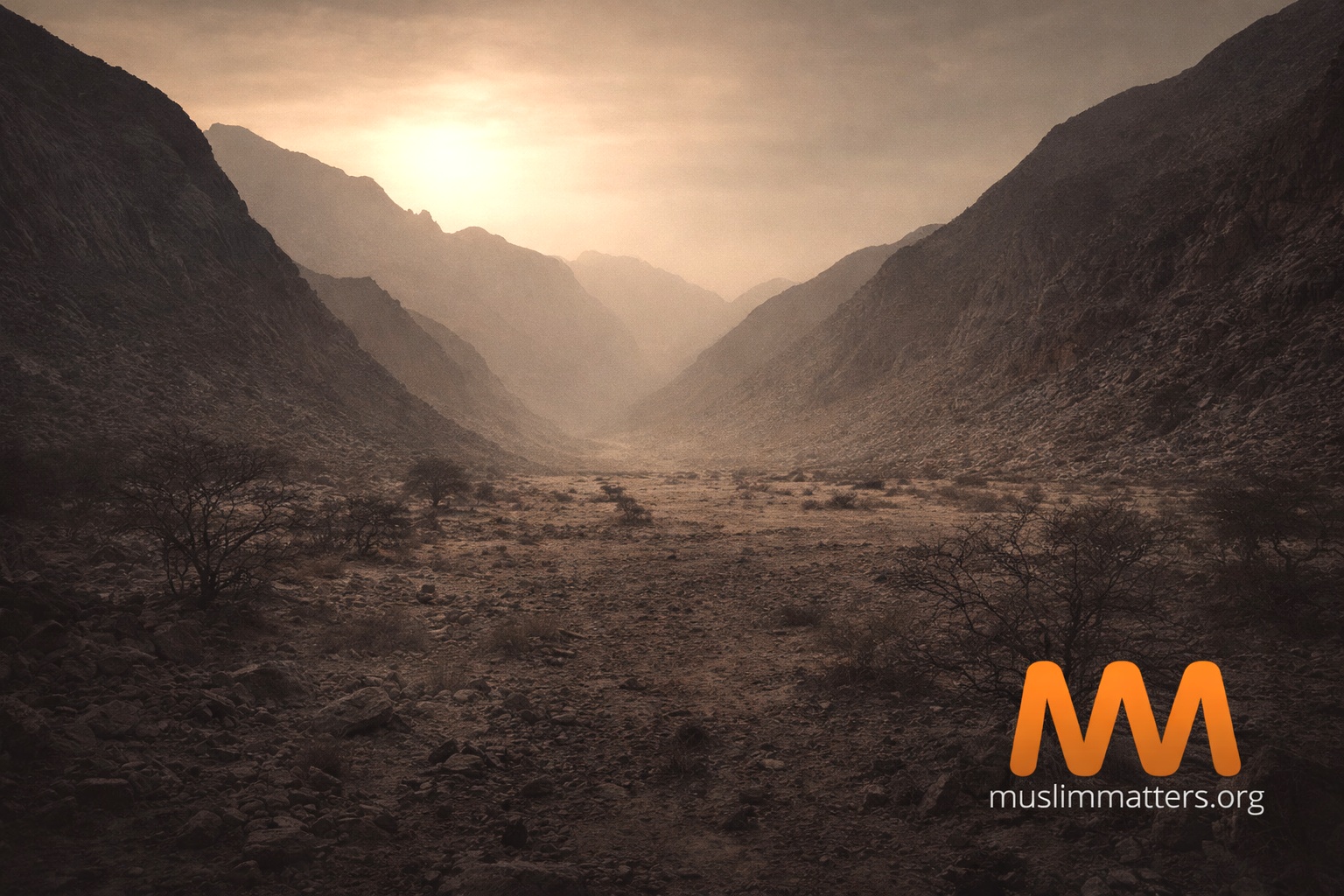
The simulation placed us on the outskirts of Makkah, in a dry valley encased by rocks and sorrow. No birds sang. No children played. Dust settled over thorny trees stripped of bark.
“Welcome,” the alien said, “to the Valley of Shi‘b Abī Ṭālib.”
The heat pressed against my skin. I heard coughing—dry, aching. Then the slow shuffle of feet. An old man clutched his stomach. A mother tried to nurse, but her milk had vanished days ago. A child with hollow eyes and cracked lips chewed on a strip of leather that had been boiled soft just to be edible.
I looked away.
“Why are you showing me this?”
“Because Quraysh didn’t respond with philosophy,” the alien said. “They responded with siege.”
He lifted his hand, and a scroll materialized in the air: brittle parchment nailed to the wall of the Ka‘bah. Its letters glowed in red, like they’d been written in blood:
No trade. No marriage. No protection. Until they hand over Muhammad.
“This,” he said, “was the first full-scale sanctions document in Islamic history. Sealed by twenty-five signatures of Makkah’s elite.”
He turned to me.
“Is this how you treat someone simply preaching in private?”
I hesitated.
“They hated his message. That’s all.”
The alien shook his head. “Hatred alone doesn’t explain a three-year logistical blockade. They didn’t just attack him; they attacked the system that protected him.”
He walked through the simulation—past a young girl digging for roots with trembling fingers.
“If they hated his message,” he said, “they could have ignored him. But Quraysh didn’t just attack him. They punished his tribe. Even those who didn’t follow him.”
He waved his hand again.
I saw Abu Talib. Gray-bearded, noble, exhausted. Sitting beside the Prophet ﷺ, shielding him with nothing but loyalty. Not faith. Not belief.
Just blood.
“This was the Prophet’s ﷺ defensive strategy,” the alien noted. “Utilizing the ‘Asabiyyah’—the tribal honor—of his kin to create a physical buffer that the Quraysh couldn’t cross without starting a civil war. The Siege was the Quraysh’s attempt to break that buffer. They turned his kin into hostages because they saw not just a preacher, but a leader building a structure.”
“But why did they turn his kin into hostages?” I interrupted.
The alien took a deep breath and said:
“Because they saw not just a preacher, but a leader rising. Because Islam was already becoming power.”
I swallowed, watching Sa‘d ibn Abi Waqqas hand a small fig to an orphan.
“You think Islam was only spiritual at this stage?” the alien asked.
“Yes,” I said quietly. “Isn’t that what we’re taught? That the Prophet ﷺ had no power in Makkah. That he was waiting. Patient. Powerless.”
The alien tilted his head.
“Waiting is not the same as being inactive. And power is not only military. Influence. Organization. Unity. That’s power. Quraysh understood. Why else the boycott?”
He pulled another thread of the simulation.
I saw the men of Quraysh again—meeting in a darkened hall, whispering, calculating.
“If we cut them off completely,” one said, “they’ll fold. Hunger breaks even the proud.”
“But the children…”
“Their children will become ours once Muhammad is gone.”
The hologram faded.
I was trembling.
“This is cruelty,” I said.
“This is politics,” he replied. “This is what tyrants do when their control is threatened.”
He looked at me.
“Modern minds often imagine Islam began politically in Madinah. But that’s because they don’t understand what politics actually is.”
“Which is?”
“Power. Systems. Influence. Decisions that affect lives. Quraysh recognized the political implications of the Prophet’s ﷺ message long before the Muslims did.”
He turned back to the valley.
“And so, they waged war. Not with swords—but with hunger. Isolation. Humiliation.”
We heard a scream.
A mother had fainted.
And then, finally, the scroll in the Ka‘bah cracked—eaten by termites, as history records. Its injustice devoured from within.
The siege lifted.
But the scars remained.
The simulation dimmed.
“Three years,” the alien said. “Three years of collective punishment. Children starved. Marriages broken. And all for what?”
He looked at me.
“Still think Islam was just a private belief?”
I stared at the fading valley, haunted.
“Private beliefs don’t provoke sanctions,” he said. “But movements? Movements change history. And history resists.”
The chamber went black.
I didn’t speak.
Not because I agreed.
But because I couldn’t deny what I had seen.
***
Related:
– Fifteen Years in the Shadows: The Strategic Brilliance of the Hijrah to Abyssinia
– The Hijra: Lessons From The First Muslim Migration For Today







 #Current Affairs1 month ago