
Development
The Weight Of Fear And The Will To Survive: Fasting In Times Of War

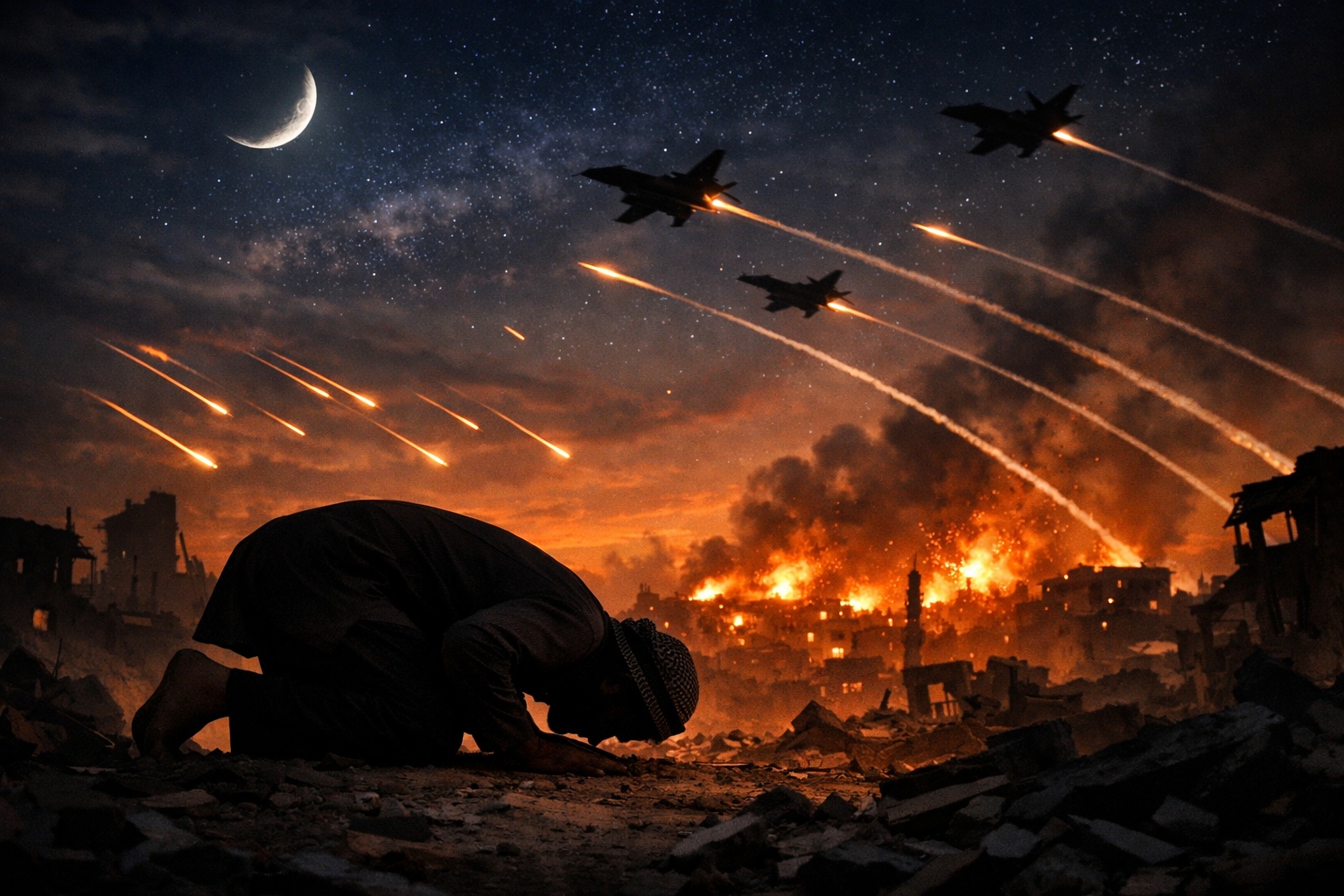
Today, as the world observes the final days of the holy month of Ramadan, the skies over parts of the Middle East are filled not with the calm of night prayers, but with the sound of drones and fighter aircraft.
Missiles streak across the darkness while families below search for safety. For millions of civilians -from Gaza to Lebanon to Iran- war is no longer distant news. It is the terrifying reality of daily life. War does not only destroy cities, but long before buildings collapse, the human mind begins to fracture under the constant weight of fear, uncertainty, and grief. Across several Muslim lands today, ordinary people wake each morning under the shadow of conflict, unsure whether the next hour will bring safety or devastation.
For civilians, war is not an event. It becomes a condition of life.
Physical and Psychological Suffering
Keep supporting MuslimMatters for the sake of Allah
Alhamdulillah, we're at over 850 supporters. Help us get to 900 supporters this month. All it takes is a small gift from a reader like you to keep us going, for just $2 / month.
The Prophet (SAW) has taught us the best of deeds are those that done consistently, even if they are small. Click here to support MuslimMatters with a monthly donation of $2 per month. Set it and collect blessings from Allah (swt) for the khayr you're supporting without thinking about it.
In Gaza, families have endured years of bombardment and siege. Entire neighborhoods have been reduced to rubble, hospitals overwhelmed, and children buried beneath the debris of homes that once sheltered them. To say that Gaza has faced continuous devastation for years is not an exaggeration—it is the painful reality of a population that has lived under repeated waves of destruction. Now the violence has expanded beyond Gaza. Iran, too, has faced intense military attacks by the joint operation of Israel and America, with airstrikes reported to have killed large numbers of civilians, including children. Such developments have further deepened the atmosphere of fear across the region. When powerful military forces engage in conflict with devastating weapons, it is often ordinary people who suffer the heaviest consequences. Yet, behind the geopolitical narratives lies a deeper story: the psychological suffering of the people.
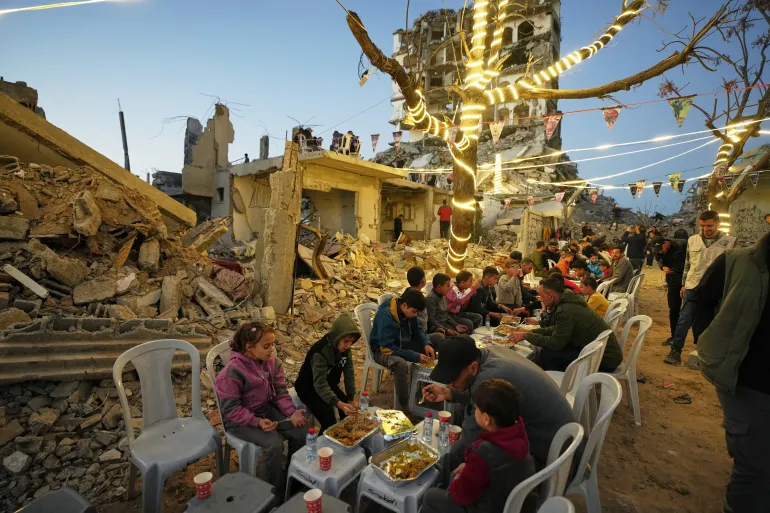
Palestinians gather for iftar, the fast-breaking meal during the Muslim holy month of Ramadan, in the rubble of destroyed buildings in Gaza City on February 22, 2026 .Jehad Alshrafi/AP Photo.
When bombs fall repeatedly, fear becomes normalized. Children learn to distinguish the sound of drones before they recognize the sound of birds. Mothers sleep lightly, listening for explosions instead of lullabies. Fathers carry the silent anxiety of protecting their families in circumstances beyond their control. Now imagine enduring this during Ramadan; the month meant for mercy, reflection, and spiritual peace. Even in war-torn homes and refugee camps, people still fast. They gather what little food they have for iftar. They raise their hands in prayer under skies filled with the sound of warplanes. In such moments, faith becomes more than ritual. It becomes psychological survival.
The Qur’an acknowledges that believers will face trials:
“And We will surely test you with something of fear and hunger and a loss of wealth and lives and fruits, but give good tidings to the patient.” [Surah Al-Baqarah 2:155]
For people living in war zones, these words are not theoretical—they are a lived reality.
Wanted: Guardians of the Ummah
Another reality that weighs heavily on the minds of many Muslims today is the question of leadership. Deep within the hearts of every Muslim today burns a quiet but powerful longing: the wish to witness leadership that reflects the courage, justice, and moral accountability once embodied by figures like Umar ibn al-Khattab  . Islamic history remembers leaders like him not merely as rulers but as guardians of justice and protectors of the vulnerable. He was known for his deep sense of accountability, famously fearing that he would be questioned before Allah
  even if a mule stumbled on a neglected road under his rule.
As ordinary people watch the suffering of fellow Muslims across the world, they often feel a fire of frustration and grief, wondering what it would mean to have leaders who place the dignity, protection, and unity of the Ummah above political interests and personal gain. It is this longing for principled leadership that continues to echo in the minds of muslims, reminding them that true leadership in Islam was never merely about power—it was about responsibility before Allah and service to humanity.
As conflict spreads across the Middle East, this painful thought continues to surface in conversations across the Muslim world. One striking reality during these crises has been the unity among ordinary Muslims. Sunni and Shia communities alike mourn the victims, pray for the oppressed, and express solidarity with those suffering. In moments of tragedy, the pain of the Ummah transcends sectarian boundaries.
Faith: Outliving Wars
But despite the bombs, despite the fear, and despite the uncertainty, the people continue to endure. They fast even when food is scarce. They pray even when mosques are damaged.
They hold onto faith even when surrounded by ruins. The Qur’an reminds believers:
“Do not think that Allah is unaware of what the oppressors do. He only delays them until a Day when eyes will stare in horror.” [Surah Ibrahim 14:42]
In the end, the story of war is often written in numbers—casualties, airstrikes, and destroyed buildings. But the true story lies in the unseen battles within human hearts. It is the mother who calms her frightened child while explosions echo outside. It is the father who stands in prayer despite the uncertainty of tomorrow. It is the believer who continues to fast in Ramadan even when surrounded by rubble. These quiet acts of faith reveal a truth that no bomb can erase: power may dominate the skies, but faith continues to live in the hearts of the oppressed. And as history has shown time and again, it is often this faith—patient, resilient, and unbroken—that ultimately outlives the wars themselves.
Related:
– Iranian Leader Khamenei Slain As War Brings Mayhem To The Gulf
– We Are Not Numbers x MuslimMatters – Ramadan While Under Attack In Gaza
Keep supporting MuslimMatters for the sake of Allah
Alhamdulillah, we're at over 850 supporters. Help us get to 900 supporters this month. All it takes is a small gift from a reader like you to keep us going, for just $2 / month.
The Prophet (SAW) has taught us the best of deeds are those that done consistently, even if they are small. Click here to support MuslimMatters with a monthly donation of $2 per month. Set it and collect blessings from Allah (swt) for the khayr you're supporting without thinking about it.



The Weight Of Fear And The Will To Survive: Fasting In Times Of War

Ramadan In India’s Capital: A Photo Essay

The Pilgrim [Part 2]: Things To Give – A Ramadan Story

Taqwa: The Foundation | 30 Nights with the Qur’an

Speaking to Allah in the Last 10 Nights: Du’a for Our Children | Part 2

30 Nights with the Qur’an: A Ramadan Series for Muslim Teens

Where Does Your Dollar Go? – How We Can Avoid Another Beydoun Controversy

An Unending Grief: Uyghurs And Ramadan Under Chinese Occupation

[Podcast] Ramadan Is Not For Your Private Spirituality | Dr Farah El-Sharif

Who Am I Really? What Surat Al-‘Asr Teaches Muslim Teens About Identity | Night 1 with the Qur’an

What Will You Leave Behind? Legacy in Islam | Night 25 with the Qur’an

The Why Behind Our Actions | Night 24 with the Qur’an

Your Place in the Ummah | Night 23 with the Qur’an

What’s My Purpose? | Night 22 with the Qur’an

Doubt, Depression, Grief, Shame, Addiction: Week 3 Recap | Night 21 with the Qur’an
-
 #Islam4 weeks ago
30 Nights with the Qur’an: A Ramadan Series for Muslim Teens
-
 #Society3 weeks ago
Where Does Your Dollar Go? – How We Can Avoid Another Beydoun Controversy
-
 #Current Affairs3 weeks ago
An Unending Grief: Uyghurs And Ramadan Under Chinese Occupation
-

 #Islam1 month ago
[Podcast] Guardians of the Tradition: Muslim Women & Islamic Education | Anse Tamara Gray