
#Culture
Green March In The Sands Of The Blue Sultan: Morocco And The Conflict Over The Western Sahara

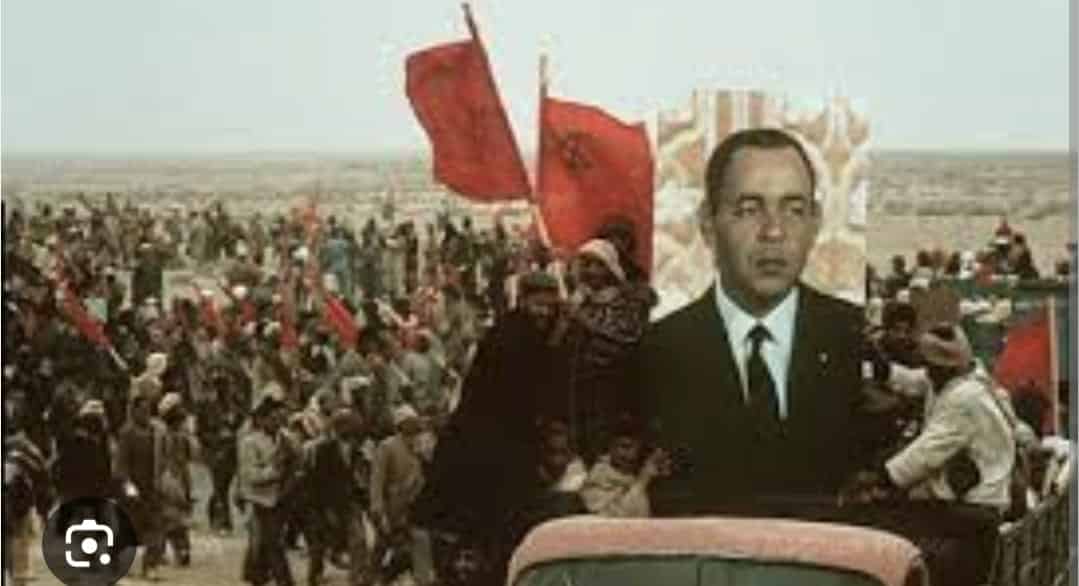
At first sight, the western strip of the Sahara, yawning south of such famed Moroccan cities as Marrakech and Fez, and separating the Mauritanian desert from the Atlantic coast, might not seem an obvious site for regional competition. In fact, the Western Sahara, with its large phosphate reserves and its blue-hued stones, has been the main prize in a decades-long conflict that drew in the region’s major players with continuing repercussions today. This article will trace the background of the dispute up to a seminal moment: the “Green March” of November 1975, an extraordinary coup-de-main by Morocco’s monarchy that split the region with Mauritania and led to a conflict with Algeria and the Sahraoui Polisario Front that has yet to entirely ebb fifty years later.
Background
For centuries, Morocco was the premier power of the Islamic West, or Maghrib as the region was called at the time. Since local clans of the Amazigh or Berber ethnic group welcomed Idris bin Abdullah, a descendant of Ali bin Abi Talib fleeing the nascent Abbasids, a continuity has bound this western edge of the Muslim world, whose authority at its peak extended north across the Mediterranean and south into the Sahara. Nor was the trajectory of power one-way: a thousand years ago, a confederation of austere Sahraoui Islamic warriors, the Murabitoun, advanced north from the desert, taking over Morocco and entering Andalus to confront a Christian resurgence. We need not trace the trajectory of every faction that ruled Morocco to realize a close link between the regions around modern Morocco, a constant reference point for Moroccan nationalists.
Yet though its sultans, including the Alaoui dynasty that has ruled since the mid-1600s, frequently claimed a caliphal title as Emirul-Mouminin, they were not unchallenged among the Muslims of the West: to their east, the Ottoman sultanate arrived as far as Algeria through links with seafaring corsairs, and to the south they competed with such West African sultanates as the Songhai. Cycles of competition and coexistence marked Morocco’s relations with her neighbours.
Keep supporting MuslimMatters for the sake of Allah
Alhamdulillah, we're at over 850 supporters. Help us get to 900 supporters this month. All it takes is a small gift from a reader like you to keep us going, for just $2 / month.
The Prophet (SAW) has taught us the best of deeds are those that done consistently, even if they are small. Click here to support MuslimMatters with a monthly donation of $2 per month. Set it and collect blessings from Allah (swt) for the khayr you're supporting without thinking about it.
In the colonial heyday of the nineteenth century, as France in particular swallowed up much of northwest Africa, Morocco’s position became both more critical to the Muslims of the West as well as more delicate. A sultan such as Abderrahmane bin Hisham (1822-59) could wield influence with largely autonomous religious leaders, such as his neighbour Abdelkader bin Mohieddin, who fought against the brutal French subjugation of Algeria; yet bruising encounters with the French army persuaded him not to overextend himself.
Hoping to modernize, the sultans of the late 1800s entered a pattern of negotiation, debt, and eventually a soft subjugation to the European power that had contemporary echoes in Istanbul and Cairo. If this was uncomfortable for Muslim rulers, its effect on them was scant compared to the periphery of their realms, where jihad and raids were repeatedly launched by clansmen and Sufi adventurers: often officially in defence of the Moroccan realm and with links but little long-term support from the sultanate.
Watering Eyes Amid Colonization
Such a Sufi leader was the fighting scholar Mustafa “Maelainain”, or “Water of the Eyes”, who preached among the Sahraoui clans in the far south. A prolific writer and occasional tutor of Moroccan elites, he nonetheless had considerable autonomy in what is now the Western Sahara and dealt with other local principalities such as the small Mauritanian sultanate of Adrar. Maelainain tutored both the Moroccan prince Abdelhafiz bin Hassan, a great-grandson of Abderrahmane, and Adrar sultan Sidahmed Ould-Aida, and acted in effect as a frontier warrior for both realms against France. Maelainain was already nearly seventy years of age when he began raids on French garrisons, building the town of Smara as a base for a relatively sophisticated force. He had some help from the sultanate as well as from France’s rivals, like Spain and especially Germany.
In 1906, colonial competition led to a division of privileges in Morocco, to which Sultan Abdelaziz bin Hassan, a great-grandson of Abderrahmane, unilaterally agreed. This dismayed many Muslims, including Maelainain, whom French propaganda portrayed as an ingrate and rebel. It was, however, urban Muslim opposition in northern Morocco that ousted Abdelaziz and installed his brother Abdelhafiz, unprecedentedly pledging loyalty on the condition that he use his position to wage jihad against the colonialists. Instead, once established, Abdelhafiz brutally purged his supporters.
Maelainain also broke with precedent by leading an army from the south into the Moroccan heartland in order to salvage the sultanate’s independence. Abdelhafiz made no move as his former tutor was defeated and repulsed south to his stronghold, Tiznit. The sultan even enlisted the aid of French soldiers to crack down on his own protesting subjects.
This in turn sparked an international crisis, Germany objecting to France’s direct involvement, and raised the colonial stakes higher for France. Both Maelainain’s former students, Ould-Aida in Adrar and Abdelhafiz in Morocco, gave way in 1912: Ould-Aida was forced to yield his realm and join the French army, and Abdelhafiz was forced first to sign away independence in favour of a protectorate and then to abdicate anyway. With Maelainain having passed away, his son Ahmed Hibatullah now took up the banner and announced himself sultan of Morocco. Known thus as the Blue Sultan, he made it as far as Marrakech before he was defeated in battle against the French army.
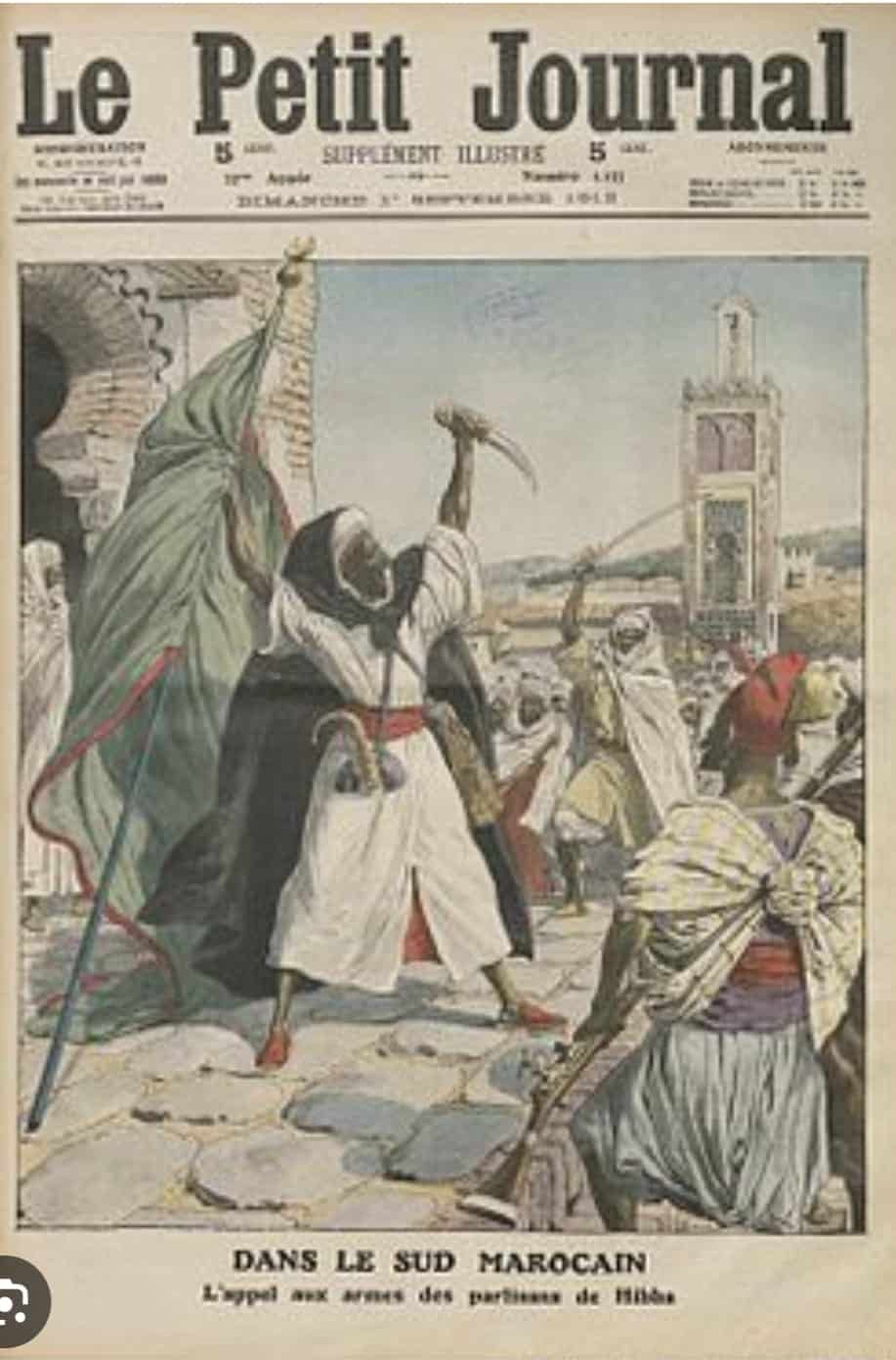
French newspaper from 1912 reporting on the “Blue Sultan” Ahmed Hibatullah’s campaign from the south.
Led by wily viceroy Hubert Lyautey, France employed a strategy of colonization in Morocco different from its summary wreckage of Algeria. The Moroccan elite of the time was coopted rather than crushed, symbolism around the monarchy was enhanced even as its power was stripped away, and this ensured a breathing space: unlike Algeria, where Arabic language and Islamic leadership had been systematically crushed, Morocco experienced a “soft colonization” that nonetheless deeply impacted the way its elites saw the world.
Spain Enters The Fray
The next major anticolonial resistance took place not against France but against Spain in the 1920s, in the Rif region of northern Morocco rather than the south. Like Maelainain, its leader, Mohamed Abdelkerim, had respected Islamic stock and managed an impressively organized army of clansmen, who spectacularly humiliated the Spanish army at Anoual in 1921. It took a major French intrusion to oust and exile him five years later, and French encouragement for Spain to turn to the Western Sahara in the far south, to which it had first laid claim in 1884 but would only manage to occupy fifty years later.
Sahraoui clans put up long-running resistance, often led by Maelainain’s family: his sons, Mohamed Laghdaf and Murabbih Rebbouh, and nephews, Mohamed Mamoun and Takiullah Ouadjaha, led resistance alongside preachers like Mokhtar Ould-Boukhari and commanders such as Aissawi Tibari, who led dozens of raids totalling thousands of miles across the desert. Even Sidahmed Ould-Aida, the ousted Adrar ruler, deserted the French ranks and joined the resistance, where he was killed. Nonetheless, by summer 1934, a joint French-Spanish campaign had secured the region; such leaders as Laghdaf and Mamoun preferred to deal with the Spanish rather than the dreaded French army. Spain was further weakened by a major civil war in which the eventually triumphant right wing of the army, led by Francisco Franco, fired the first shots by seizing garrisons in colonial Morocco.
French-ruled Morocco eventually saw a separate civil resistance, epitomized by the Istiqlal party led by Allal Fassi, largely based in the cities among ascendant intellectuals. This symbolically claimed loyalty to the Moroccan monarchy, and called for independence from colonial rule to rule over a “Greater” Morocco comprising the sultanate’s entire older realms. Mohammad V bin Yusuf, nephew to Abdelaziz and Abdelhafiz, was a particular pole of attraction, as he began to show more assertiveness during the Second World War when France, and indirectly its colonies, were overrun by Germany.
Independence And Its Limitations
No longer the imposing phantom of the past nor minded to reform itself, the 1950s French empire faced varying levels of opposition throughout North Africa. In Algeria, this featured a vicious war; in Tunisia involved unionist protest and smaller peasant revolt; and in Morocco, a mixture of both protest and revolt. France briefly stripped Mohammad of the Moroccan crown, but protests forced them to restore him, and he declared independence in 1956. Morocco supported the anti-French insurgency in Algeria and was keen to engage Mauritanian dissidents against France, such as Hurma Ould-Babana, who announced loyalty to Rabat.
At first supported by Morocco, Sahraoui insurgents led by Benhamou Mesfioui also overran much of the Western Sahara and besieged Spanish garrisons in 1957-58. But when Spain agreed to withdraw if Morocco took responsibility. The Moroccan government’s role transformed to that of controlling rather than supporting the revolt, preferring to engage with Madrid. Mohammad’s son and future successor Hassan II led the Moroccan army into the region to restore the situation, helped by friendly chieftains such as Khatri Ould-Joumani; to the dismay of such Moroccan expansionists as Fassi, Hassan II would ally strongly with Spain. In the Rif region, Rabat also crushed a revolt that aimed, among other things, to bring back Abdelkerim, the still widely influential scourge of the Spaniards.
Succeeding the throne, Hassan II spent the 1960s in hostility with newly independent Mauritania, which he saw as a French puppet and refused to recognize until 1969. However, relations were also tense with Algeria, which had wrenched independence through war but retained economic links with France as well as conceding the French government a small foothold in its deep south. After border skirmishes, a pattern emerged whereby Algeria, soon under military rule, and Morocco would house one another’s dissidents, who in the Moroccan case were largely leftists.
Spain had set up a regional assembly in the Western Sahara, which largely incorporated local chieftains and had limited influence. This was insufficient to stop protests in the Western Sahara, whose most notable leader, Mohamed Bassiri, disappeared. Though the Western Sahara is often treated as a case of opposite societies between Sahraouis and Moroccans, the situation was much more complicated, and many Sahraoui activists maintained at least a hopeful attachment to a Morocco whose government was, however, unwilling to risk its Spanish alliance, no matter how much Moroccan nationalists wanted.
Take the case of Khalili Reguibi, who had fought Spain in the 1950s and then joined the Moroccan army; he remained loyal to Morocco, but his frustrated son, Mohamed Abdelaziz, joined the Polisario Front, a leftist group that led an insurgency against Spain. This was less bizarre than it seems now: at the time, Moroccan nationalists could agree with Sahraoui nationalists that Rabat should help evict the Spanish colony; unfortunately, Fassi regretfully informed Sahraoui contacts, there was scant prospect. As late as October 1974, even Algeria, Hassan’s rival, informed the United Nations that the Western Sahara should join Morocco, and even Polisario originally requested the monarchy’s support. However, perhaps in part because of the longstanding negative experience with Rabat, a United Nations survey found widespread support for independence rather than joining Morocco.
The Green March And Its Discontents
Not until Spain’s impending withdrawal, in the last days of Franco’s rule, did Hassan stir into a flurry of action. He sent his prime minister, Ahmed Othmane, to Madrid to hammer out a joint administration of the Western Sahara with Carlos Arias-Navarros and Hamdi Ould-Meknes, the foreign ministers of Spain and Mauritania: this was to be an interim affair before a referendum. But in a spectacular fait-accompli, half a million Moroccans, unarmed and bearing only the Quran and the Moroccan flag, marched south into the Sahara with chants of takbir. This meticulously organized Green March, a scene to gladden the heart of any Moroccan patriot, was organized and led in person by Hassan II himself, flanked by Othmane and security boss Ahmed Dlimi, and widely applauded across the Moroccan political spectrum.
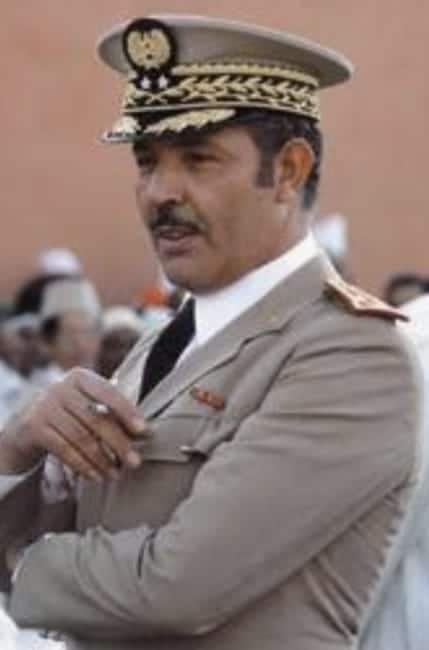
Ahmed Dlimi
This was in direct contrast to the reception in the Western Sahara. The Sahraoui assembly, led by chieftains such as Baba Ould-Hassina and Ould-Joumani, objected and even threatened to join Polisario to expel the Moroccan intrusion. Yet in an example of how quickly chiefly opinions could adjust to circumstances, two-thirds of the assembly joined Morocco over the winter while Dlimi followed up the Green March by imposing army garrisons. Though Sahraouis would be much better-placed in Moroccan officialdom than under Spain, thousands left the area, many decamping to the Algerian border town Tindouf, which became a de facto headquarters for Polisario’s “shadow government” led by Lamine Ould-Ahmed.
While Morocco and its junior partner Mauritania set about arranging administration, with Hassan’s chamberlain Ahmed Bensouda as governor-general for the Moroccan sector and Abdullah Ould-Cheikh his Mauritanian counterpart, Algeria supported Polisario. Not only Algerian dictator Houari Boumediene but also his leading lieutenants – future ruler Abdelkader Bouteflika, prime minister Moussa Abdelghani, and party chief Salah Yahiaoui – were intimately involved in support for the Polisario Front. The Algerian army clashed directly with its Moroccan counterpart over the winter, but Mauritania was an easier and softer target for Polisario. In summer 1976, its chief Ouali Sayed led a devastating raid into the heart of the Mauritanian capital Nouakchott; though he was slain, a line of lieutenants, including his brother Bechir, Abdelaziz, Brahim Ghali, Sidahmed Battal, Ayoub Lahbib, and Brahim Hakim, would lead Polisario either on the battlefield or in international diplomacy.
Throughout the next fifteen years, the Western Saharan war had major regional and international repercussions: it cemented a simmering rivalry between Algeria and Morocco, helped bring down a Mauritanian government or two, and played into the Cold War with Morocco firmly in the Western camp. Though a ceasefire held for nearly thirty years, during which time such Polisario leaders as Hakim and Lahbib joined Morocco, the conflict has flared up again in the 2020s.
Conclusion: A Split In The Islamic West
So what are we to make of the Western Saharan conflict? Comparisons often made by left-leaning critics with Israel’s occupation of Palestine are plainly absurd: at no stage did Morocco descend to the level of viciousness, ethnic cleansing, or systematic massacres periodically on display by Israel, and there are undeniable historical, religious, cultural, and social links between Moroccans and Sahraouis that are plainly not true of Israelis and Palestinians. From the nineteenth-century desert mujahids to as late as the 1970s, Sahraoui leaders and groups often identified with Morocco, so much so that in 1912 the Blue Sultan set out to take the entire country and liberate it from France. Until the 1970s, Morocco’s own abstinence from reciprocating this solidarity owed more to an attempt to balance France out, if through an unpopular alliance with Spain, than any lack of public sympathy.
On the other hand, the Moroccan government itself has a record of using and discarding the region to Rabat’s convenience, whether in the days of Abdelaziz and Abdelhafiz or Hassan II. The harsher Moroccan tactics, such as Dlimi’s construction of a major “sand wall” in the early 1980s, resemble colonial tactics, even if comparisons with Israel are ridiculous. Moroccan protests that Polisario is simply a tool of the Algerian junta ignore its own militarized treatment. And the tensions accruing from a decades-long conflict have polarized the people of the Islamic Maghrib, foremost of the Western Sahara itself.
Related:
– From Algeria to Palestine: Commemorating Eighty Years Of Resistance And International Solidarity
Keep supporting MuslimMatters for the sake of Allah
Alhamdulillah, we're at over 850 supporters. Help us get to 900 supporters this month. All it takes is a small gift from a reader like you to keep us going, for just $2 / month.
The Prophet (SAW) has taught us the best of deeds are those that done consistently, even if they are small. Click here to support MuslimMatters with a monthly donation of $2 per month. Set it and collect blessings from Allah (swt) for the khayr you're supporting without thinking about it.




Widening Wars Leave the Middle East in Shambles

15 Things You Didn’t Know About Makkah and the Ka’bah [Part 1]

Eid Mubarak from MuslimMatters

Selamat Hari Raya! – Celebrating Eid In Malaysia

AL-AQSA IS CLOSED

[Podcast] Ramadan Is Not For Your Private Spirituality | Dr Farah El-Sharif

She Cried At The Door Of The Masjid: A Case For Children In Mosques

I Can’t Stop Thinking About Someone | Night 10 with the Qur’an

The Trials Playlist: A Chaplain’s Set To Steady Your Heart

Every Sin Has a Cure | The Venom and the Serum Series

Coming Full Circle: Who Are You Now? | Night 30 with the Qur’an

Running Away From Who We Are | Night 29 with the Qur’an

Building From the Ground Up: Week 4 Recap | Night 28 with the Qur’an

The Muslim You Are Becoming | Night 27 with the Qur’an

What Will You Leave Behind? Legacy in Islam | Night 25 with the Qur’an
MuslimMatters NewsLetter in Your Inbox

Sign up below to get started
-

 #Islam1 month ago
30 Nights with the Qur’an: A Ramadan Series for Muslim Teens
-
#Current Affairs1 month ago
An Unending Grief: Uyghurs And Ramadan Under Chinese Occupation
-
#Society1 month ago
Where Does Your Dollar Go? – How We Can Avoid Another Beydoun Controversy
-
#Current Affairs4 weeks ago
[Podcast] Ramadan Is Not For Your Private Spirituality | Dr Farah El-Sharif


