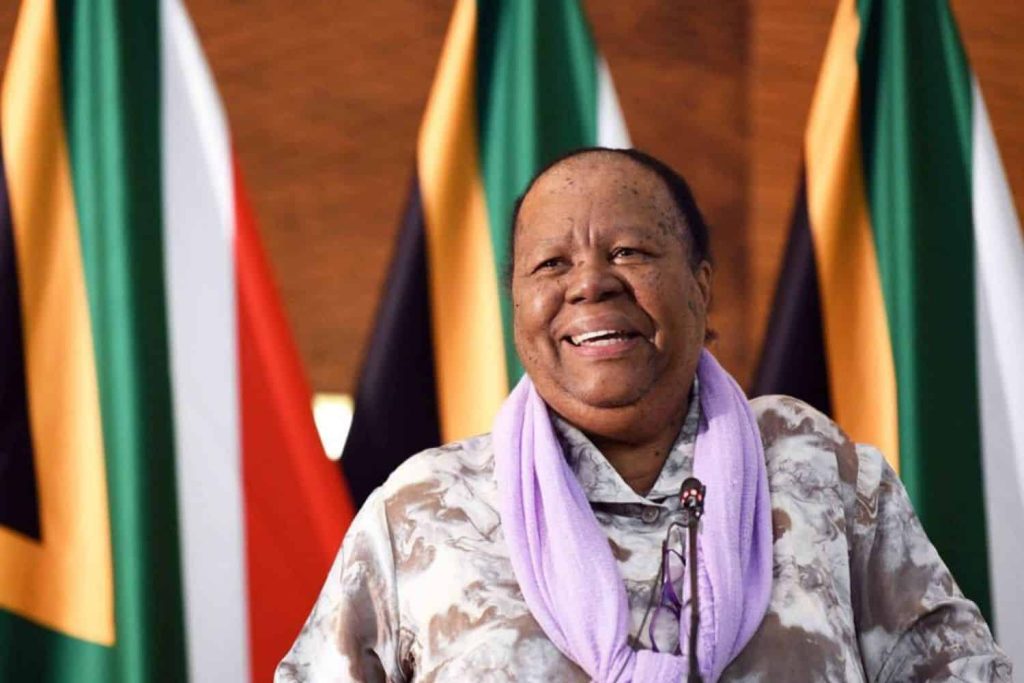
There are occasions when state power reveals its insecurities with embarrassing transparency. The United States’ revocation of Dr. Naledi Pandor’s visa — executed without reason, without process, and without even the courtesy of bureaucratic finesse — is one such moment. It is not a matter of administrative procedure. It is a symptom. A tremor of anxiety running through a violent Zionist project confronted by a woman whose authority is rooted not in might but in moral clarity.
Pandor, a former Minister of International Relations, a distinguished academic, and one of the most respected voices in the global struggle for Palestinian liberation, is hardly the kind of figure whose movements need to be policed. She commands no militias, stirs no insurrections, and threatens no borders. Her influence derives from something far more subversive: coherence, principle, and the audacity to insist that international law should apply universally rather than selectively.
Her central “offense,” of course, was South Africa’s decision — under her stewardship — to bring a genocide case against Israel before the International Court of Justice. It was a move that shook the architecture of impunity, interrupting a decades-long assumption that Western-backed states remain immune to the world’s highest judicial mechanisms. The ICJ case galvanized the Global South and infuriated those invested in shielding Israel from accountability. Once South Africa shattered the taboo, global dialogue shifted, and Pandor became both symbol and strategist of this recalibration.
Keep supporting MuslimMatters for the sake of Allah
Alhamdulillah, we're at over 850 supporters. Help us get to 900 supporters this month. All it takes is a small gift from a reader like you to keep us going, for just $2 / month.
The Prophet (SAW) has taught us the best of deeds are those that done consistently, even if they are small.
Click here to support MuslimMatters with a monthly donation of $2 per month. Set it and collect blessings from Allah (swt) for the khayr you're supporting without thinking about it.
Against this background, the visa revocation appears not as an isolated gesture but as part of a broader retaliatory pattern. From Trump’s bizarre political fantasies of a “white genocide” in South Africa, to the discourteous treatment of South Africa’s president during an official visit, to the refusal to receive its ambassador — each episode signals a punitive attitude toward a country that dared to challenge Zionist prerogatives.
Hence, the targeting of Dr. Pandor is not merely administrative mischief. It is a deliberate effort to punish a Global South diplomat who refused to genuflect before power.
The Threat Dr. Pamdor Represents
What, then, makes Pandor such a threat to Zionist power and imperial elites?
It is not merely her criticism of Israel. That alone, while provocative to some, would not have triggered such a response. The deeper threat lies in her refusal to compartmentalize global injustices, and her ability to narrate oppression as a structural, interconnected phenomenon rather than a series of discrete events.
During her recent engagements in the US, in city after city, Pandor spoke with piercing clarity about how the logic of domination in Gaza mirrors forms of dominance elsewhere. Her critique was global, mapping relationships of power that stretch from the Middle East to Africa to South Asia. This is where imperial elites feel uneasy: when the oppressed begin to see their struggles as shared, and when voices like Dr. Pandor help articulate the architecture of empire.
Her comments on Pakistan — careful and measured — highlighted the country’s political pliancy to imperial and Zionist interests. Pakistani-American audiences understood these references immediately, given the widespread repression of dissent in their homeland.
Without naming individuals, she alluded to a political figure widely admired and widely punished, whose pursuit of justice has made him intolerable to Pakistan’s power elite. The audience required no elaboration. The injustice is too stark.
Her comments struck a deep chord because they reflected a broader truth: that oppression does not respect borders, and that regimes aligned with empire frequently adopt the methods of empire. Pandor’s critique was not aimed at personalities but at structures — at the machinery of domination that sacrifices justice to the appetites of global power.
Dr. Pandor’s American hosts — Muslim communities, activists, human rights organizations — deserve credit for extending her platforms across the country, often to overflowing crowds. Their instinct to invite her, to engage with her, and to honor her moral leadership reflects a recognition of her stature in the global struggle for justice. The fact that these communities saw in her a defender of humanity and a champion of Palestine speaks well of their political sensibilities.
Zionist Panic and the Visa That Exposed It
This is what Zionist and Western supremacists cannot tolerate: clarity of analysis, breadth of moral vision, and the ability to illuminate connections across continents. A figure like Pandor cannot be allowed to circulate too freely within the public square because her presence has catalytic potential. She reframes debates. She humanizes victims. She speaks in the language of law rather than the language of propaganda. And she exposes the hypocrisy of invoking human rights selectively while violating them systematically.
By revoking her visa, fanatical Zionists attempted to place a boundary around her influence. Yet the attempt has only drawn more attention to her work and to the anxieties that drove this petty act of reprisal.
The message is unmistakable: the world’s most powerful elites are afraid of a woman whose only weapons are truth and integrity.
And that fear, ironically, magnifies her authority.
The Moment and the Movement
Dr. Pandor does not require rescuing. Her legitimacy rests on foundations far sturdier than any visa stamp. Whether she sets foot in the United States again is immaterial to her global stature. Her influence is already transnational, already expansive, already woven into the moral fabric of contemporary struggles for liberation.
But her treatment by American rulers matters for a different reason: it reveals the boundaries that Zionism attempts to impose on dissent, and the lengths to which it will go to punish those who challenge its preferred narrative. In this sense, defending Pandor is not a personal obligation; it is a political one. It is a refusal to normalize retaliation disguised as procedure.
Let us therefore take three truths forward:
First, Dr. Naledi Pandor remains one of the clearest moral compasses in global politics.
Second, her analysis of oppression — whether in Gaza or the Congo – remains indispensable.
Third, her visa revocation is not a reflection of her weakness, but of Zionist fear and panic.
The real question now is not who fears Dr. Pandor.
We know that answer.
The real question — the one that determines the future of solidarity — is: Who among us is prepared to stop fearing the Zionists that fear her?








 #Current Affairs1 month ago


Amer Rizvi
December 4, 2025 at 12:02 PM
“Who among us is prepared to stop fearing the Zionists that fear her?”
Good question, Professor Junaid!
When I was in college, I was the Khateeb of our MSA. I used to regularly go over to the Hillel (a Zionist student organization) table outside the student center and debate the Zionist students who manned it. I also used to write anti-Zionist essays in my English composition classes. I took a course called “The People and Cultures of the Middle East”, taught by a wonderful Arab professor, to learn more about the Palestinian people. My kindly advisor and mentor at college, who was Jewish, was himself anti-Zionist.
Zionists will band together and attack you if you challenge their racist ideology. That is how they operate. I used to have over 6,000 followers on LinkedIn and was a “Superconnector,” may Allah be praised. I wrote education-related articles using LinkedIn’s article submission feature and posted numerous teaching materials for the benefit of other educators.
On one occasion, I replied to a comment on LinkedIn by a Zionist from the UK. I pointed out the secret collaboration between the NAZIs and the Zionists to expel Jews from Germany and their affinity for each other. I pointed out how the Zionists actually hate Judaism.
The next day, I found my LinkedIn account blocked. Apparently, Zionist users on LinkedIn banded together and mass-reported my account.
I complained to LinkedIn, but they refused to reinstate my account even though I was a premium LinkedIn member. I lost years of education-related content that I posted on that platform, including my connections with thousands of fellow educators. I was also unable to showcase all my work using LinkedIn to prospective employers.
I was not discouraged :-) I signed a petition on Change.org to end LinkedIn’s systemic censorship of pro-Palestinian accounts.
I frequently went to foxnews.com, too, to post my anti-Zionist comments.
I wish Muslims, particularly our scholars and those in positions of authority, would do more to challenge the Zionist narrative on the American public stage. We really need more Mamdanis to spread the truth in our country about how racist Zionism really is!