
Uncategorized
How to Memorize the Quran Part III | Shaykh Umar Badahdah

How to Memorize the Qurʾān | Shaykh Umar Badahdah Part I Part II
Translated by Ammar AlShukry
An abridged translation of the work of Shaykh Umar Badahdah: Part III
Keep supporting MuslimMatters for the sake of Allah
Alhamdulillah, we're at over 850 supporters. Help us get to 900 supporters this month. All it takes is a small gift from a reader like you to keep us going, for just $2 / month.
The Prophet (SAW) has taught us the best of deeds are those that done consistently, even if they are small. Click here to support MuslimMatters with a monthly donation of $2 per month. Set it and collect blessings from Allah (swt) for the khayr you're supporting without thinking about it.
II. Memorizing
III. Revising
IV. Tying It All Together
V. Differences
IV. Tying It All Together and Being Aware of Resembling Verses
Allāh says:
ٱللَّهُ نَزَّلَ أَحۡسَنَ ٱلۡحَدِيثِ كِتَـٰبً۬ا مُّتَشَـٰبِهً۬ا
Allāh has sent down the best statement, a Book (this Qurʾān), its parts resembling each other
[Sūrat’l-Zumar: 23]
There are many verses in the Qurʾān that resemble one another yet have slight differences, and the one who is memorizing must find a way to be able to differentiate when a similar verse appears in another place. There is no real method on how to remember which verse goes where, but it is up to every person to come up with any means that will enable them to get it right.
Though there is no single method on how to differentiate between resembling verses, there are a number of things one might pay attention to that are of benefit.
Of them are:
1) Knowing the exceptional cases – This is where a verse that is repeated one time in the Qurʾān in one way and numerous times in another. If you pay attention to the singular case and memorize it then you will know that every other case is going to be contrary to that.
Ex: Allāh says:
وَمَا أُهِلَّ بِهِ لِغَيْرِ اللَّهِ
This is the case in Sūrat’l-Baqarah, but in Sūrat’l-Mā’idah, Sūrat’l-An‘ām and Sūrat’l-Naḥl the verse appears as:
وَمَا أُهِلَّ لِغَيْرِ اللَّهِ

Therefore, keeping this exception in mind will help you in deciphering which āyah to read and when.
2) Knowing how to distinguish between resembling verses – Scholars have written books just on this matter where they brought forth different āyat that seemed similar and illustrated how they were different. It helps also to understand the meaning intended behind the verses as that will also allow you to comprehend why this word was used in this verse and why another was used in a verse that is otherwise the same. An example of this is in Sūrah Āle-‘Imrān where Allāh, when discussing the story of Zakariyya ‘alayhi’l-salām and his wife having a child in their old age, says:
قَالَ كَذَلِكَ اللَّهُ يَفْعَلُ مَا يَشَاءُ
Allāh doeth what He will.
When Allāh subḥānahu wa ta‘āla gives Maryam ‘alayhi’l-salām the same news of a child in the same sūrah, Allāh subḥānahu wa ta‘āla says:
كَذَلِكِ اللَّهُ يَخْلُقُ مَا يَشَاءُ
Allāh createth what He will
Why is one “Allāh does what He wills” and the other “Allāh creates what He wills”? Because in Zakariyya’s case, the two components needed for the child were present, a man and woman. With regard to Maryam’s case it was that of a woman without a husband, so here Allāh subḥānahu wa ta‘āla said “He createth what He will”. Understanding the verses also helps with differentiation.
3) Understanding the meanings and contemplating over them
a) If one knows the themes that are discussed in the Sūrah and the sequence of those themes, then this is something that will aid them a lot in their ḥifẓ. For example, in Sūrat’l-Ra‘d Allāh discusses first the signs that are in the heavens then the signs that are on the earth, and then He discussed the stance that the disbelievers took with regards to those signs, and then mentions His Knowledge. So if you are able to know the different parts of the sūrah and their sequence, then that can only aid you.
b) Some of the sūrahs have long stories in them like Sūrah Yūsuf, and if you know the story then you should be able to get the sequence correct. Also, in some sūrahs a lot of prophets are mentioned – for example in Sūrat’l-‘Arāf , try to write down the order of the prophets in the surah so that when you are done with a prophet’s story you are able to remember which one is coming up next.
c) Also knowing the juz and its quarters, knowing where one juz ends and the next begins, where the hizb begins and where it ends, is very important. You can paint for each part of the juz a picture like, for example, in the first juz of Sūrat’l-Baqarah the first quarter has the story of Ādam ‘alayhi’l-salām and the angels, the second quarter has the story of the Children of Israel and the Pharaoh, the third has the story of the cow, so for every quarter you have a picture that come forth in your mind. This technique is something that is a little tedious but it becomes easier with practice.
4) A general method of connecting verses – tying verses together by the method of memorization mentioned earlier.
V. DIFFERENCES
There is no doubt that people surpass each other with regards to the ability to memorize and availability of time. The principles that have already been mentioned are universal, they can be implemented by the young and old, student and working alike. However, some of the differences need to be elaborated on, and from them are:
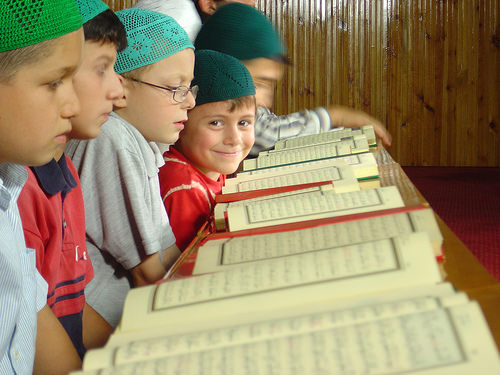 1) Age – memorize while you are young if you can, and if you are older, then try to make up for it in your children so that you might benefit from them, inshā’Allāh. Memorizing with regards to children is free from problems such as resembling verses and things of that nature as they memorize without needing to understand. They don’t have to contemplate the meanings of verses or understand them, and their memorization is strong.
2) Time and Distractions – choose the time that is most free from two things:
a) Free from distractions – meaning that you don’t turn away from the ḥifẓ to anything else
b) That the time itself is purely for the memorization of the Qurʾān – turn off your phone or don’t answer it, don’t use that time for eating, do not use it for anything other than your goal of ḥifẓ. The best time for each person will be dependent on their schedule, and Allāh knows best about the circumstances of the people, but the best times seem to be two: after fajr and before going to sleep. These are the two most peaceful times of a person’s day.
3) Schedule – Make memorizing the Qurʾān part of your daily routine. Just like it is impossible for you to go a day without praying your five prayers, without eating, and without sleeping, make memorizing the Qurʾān, even if it is only a small portion, part of your daily schedule.
Success Stories: From the Past and Present
From the Past:
Al-Dhahabi mentioned in Ma’rifatul Qura’ Al-Kibar, that one of the qura had memorized the Qurʾān when he was five years old and completed all of the recitations of the Qurʾān when he was ten.
From the Present:
Sheikh Al-Dosary said about himself, “I memorized the Qurʾān in two months. I secluded myself from the people and locked myself in my office and did not go out except for the ṣalāh.”
A story from Shaykh Badahdah:
“I remember a story that I will conclude this lesson with. I will tell it to you now, about a man that I know, and he is still amongst us. He is a youth who is originally from Sudan. His father was studying in the U.S. and this brother was born there, so he was deserving of American citizenship. He studied university in the U.S. and received his Masters in Engineering and also entered a PhD program. Once, he was in the masjid or Islamic center that one of our brothers, who lives with us in this area, participates in. This brother had memorized most of the Qurʾān and had good tajwīd and a beautiful recitation. He used to lead them in prayer and he caught the Sudanese brother’s attention. The brother said that he never heard the likeness of this good and sweet (recitation of the imām). ‘So when I asked,’ said the Sudanese brother, ‘they told me that he had memorized twenty or twenty five, so I thought, “I am a Muslim and I did not memorize the Qurʾān, nor did I learn its recitation,” so I committed to memorizing it.’ So what did this man do? He stopped his education and took a vacation, and came to the Kingdom (of Saudi Arabia), free to spend his time memorizing. He came saying that he wanted to memorize and to learn some of the matters with regards to Ḥadīth and some of the Islamic Sciences. He was sent to me by that brother who is our neighbor and I found him to have a serious concern and a high commitment.
He then went to Makkah to the Masjid’l-Ḥarām and got organized with some teachers who helped him so that he completed the memorization of the Qurʾān in 100 days, in Makkah. Most of his time was spent on ḥifẓ. After this, the Sudanese brother came back here and requested a teacher so that he may revise and recite the complete Qurʾān 10 or 20 times. I sent him to a halaqah of one of the outstanding teachers and I sent him to another teacher for tajwīd . Now he is committed to those classes, not missing a single day. He did not come except for this matter, and he does not use his time except for this matter, and he did not pause his education except for this matter. So it is all about the intention and the commitment inshā’Allāh, and Allāh is the one who blesses, helps and gives success.”
Keep supporting MuslimMatters for the sake of Allah
Alhamdulillah, we're at over 850 supporters. Help us get to 900 supporters this month. All it takes is a small gift from a reader like you to keep us going, for just $2 / month.
The Prophet (SAW) has taught us the best of deeds are those that done consistently, even if they are small. Click here to support MuslimMatters with a monthly donation of $2 per month. Set it and collect blessings from Allah (swt) for the khayr you're supporting without thinking about it.




Israel Seeks Escalation For Latitude – The Regional “Conflict” Widens

Post-Ramadan Reflections From A Mother Of Littles

[Podcast] Palestine in Our Hearts: Eid al-Fitr 1445 AH

Foreign Affairs Official Resigns Over Gaza Genocide

A Ramadan Quran Journal: A MuslimMatters Series – [Juz 30] Solace For The Sincere And Vulnerable

IOK Ramadan: 7 Qualities of Highly Effective Believers | Keys To The Divine Compass [Ep18]
IOK Ramadan: Choose Wisely | Keys To The Divine Compass [Ep15]
IOK Ramadan: Making Time for Allāh at Night | Keys To The Divine Compass [Ep21]
IOK Ramadan: Appreciating the Prophet ﷺ | Keys To The Divine Compass [Ep22]
IOK Ramadan: They Were Not Created Without Purpose | Keys To The Divine Compass [Ep23]

IOK Ramadan: The Importance of Spiritual Purification | Keys To The Divine Compass [Ep30]
IOK Ramadan: The Power of Prayer | Keys To The Divine Compass [Ep29]
IOK Ramadan: The Weight of the Qur’an | Keys To The Divine Compass [Ep28]
IOK Ramadan: Families of Faith | Keys To The Divine Compass [Ep27]
IOK Ramadan: Humility in Front of the Messenger | Keys To The Divine Compass [Ep26]
-

 #Islam3 weeks ago
IOK Ramadan: 7 Qualities of Highly Effective Believers | Keys To The Divine Compass [Ep18]
-
#Islam3 weeks ago
IOK Ramadan: Choose Wisely | Keys To The Divine Compass [Ep15]
-
#Islam2 weeks ago
IOK Ramadan: Making Time for Allāh at Night | Keys To The Divine Compass [Ep21]
-
#Islam2 weeks ago
IOK Ramadan: Appreciating the Prophet ﷺ | Keys To The Divine Compass [Ep22]
Zaufishan
August 30, 2011 at 12:33 AM
Jazakallah khayr, I’ve forwarded each post for sharing with students.
Great effort and a valuable resource.
The Eco Muslim
Jassim
August 30, 2011 at 6:53 AM
This is Great, May Allah Bless each one of us!
uzair
August 30, 2011 at 10:00 PM
As salam o allaiqum sir please add audio mp3 quran reciters to your site
http://jumbofiles.com/user/amel_soname
this is the link of complete audio quran
http://www.filejumbo.com/Download/DCE44B6CC1D882EB
jazakallah
tariq
October 5, 2011 at 7:46 AM
salam
I did my hifiz at the age of 10 then I forgot it completely at the age of 20 never revised it . now I am 30 yrs old & very ashamed that Allah gifted me with hifiz & i was so careless, so I have again joined a hafiz classes from the same teacher I told him that I forgot quran completely and I want to learn it again , He told me two thing one is commitment second is revision so now i am going to mosque daily and i have by the grace of allah completed first sapara . so anyone who is interested in hifiz please revise it revise it revise it again & again .
articles by you guys are really very helpful.
May allah bless you .
S
October 5, 2011 at 9:47 AM
Subhanallah very true. I also completed my hifz at the age of 15 and after that got busy with studies and didn’t go back to revise my hifz.. At the age of 21, Alhamdulillah, I found a local mosque where I went to revise my Qur’an as I’d forgotten 2/3 of it. Alhamdulillah I have completed my hifz revision now, but lesson learned.. it requires revision every day.. So that a hafiz basically completes the full khatam of the Qu’ran in 1 wee, by reading 1 manzil every day… Only when the hafiz can confidently do this is he/she going to be satisfied with their hifz revision. Another thing that helps is to read extra nawafil during the day/at night and reading a/several juz in the nawafil.. This is also good practise for the hafiz leading taraweeh during Ramadhan. It is not easy.. going back to do your hifz revision at an older age… as you have more responsibilities, work and family commitments, etc as compared to when you first did your hifz at a younger more innocent age, and some people don’t even get the chance to revisit their hifz later or find a hifz teacher to go to.. So remember, InshaAllah revision and commitment to your hifz everyday is the key to your hifz being successful and beneficial to you.
tariq
October 6, 2011 at 1:44 AM
salam
yes very true , i would say my wife plays a very important role in sending me back to mosque & revise my Hifiz although its difficult but I am committed & I pray to Allah Please help me out this time I will not be careless inshallah.
Revision Revision is everything .
Rayhaanah
October 5, 2011 at 11:56 PM
mashaa Allah! An insightful & informative read! As a hifdh teacher for women, it is always a concern thats students commit to the review process as they do to the actual memorisation. May Allah make us of those who love the Qur’aan & live by its profound Message, ameen.
JazaakAllahu Khayran for the article.
Pingback: How to Memorize the Quran | Shaykh Umar Badahdah | MuslimMatters.org