
Politics
A Historic Day for Tunisia | President Ben Ali Ousted

Friday, January 14th will remain as a historic day for Tunisia. A day oppressed Tunisians were only dreaming about, a day when the unthinkable happened. After 23 years of a iron-fisted rule on the country, the president Zine Al-Abidine Ben Ali left the country and his power behind him.
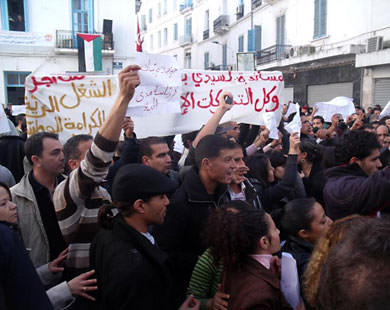 It all started on December 19, 2010 in Sidi Bouzid, a city 150 miles south of the capital Tunis, where the police opened fire on civilians protesting against unemployment. A week earlier, Mohammed Bouazizi, an unemployed young graduate set himself on fire and later died. He was protesting against the confiscation by the authorities of fruit and vegetables that he was selling in the street without a license. Since then, several thousand Tunisians have decided that it was time to show how angry they are about unemployment, corruption, lack of freedom and rising prices of food and fuel. After violent marches all over the country, the protests finally reached Tunis where an emergency curfew was put in place. In few days, security forces killed between 20 and 50 people and as a result, the government sacked the interior minister and said it would investigate allegations police used excessive force. U.N. High Commissioner for Human Rights Navi Pillay said the deaths were “a result of some excessive measures used, such as snipers (and) the indiscriminate killing of peaceful protesters.” Despite the promise to not to seek a sixth term in office 2014, thousands of people continued to take the streets of Tunis to demand the immediate resignation of the president. Ben Ali, the once mighty president had to face the reality that he couldn’t regain control of the country and decided to flee. Recent reports attest that he found refuge in Saudi Arabia after France refused to welcome its once former protégé on its own soil.
Some analysts have described the speed and the success of the uprising as a result of a tacit agreement amongst different spheres of the society, from the opposition groups, the Islamists to the Communists, as well as by the labour unions, that it was time to turn the page on this brutal regime. They were the instrumental forces who helped spread the protests to all major parts of the country, including the influential north.
Keep supporting MuslimMatters for the sake of Allah
Alhamdulillah, we're at over 850 supporters. Help us get to 900 supporters this month. All it takes is a small gift from a reader like you to keep us going, for just $2 / month.
The Prophet (SAW) has taught us the best of deeds are those that done consistently, even if they are small. Click here to support MuslimMatters with a monthly donation of $2 per month. Set it and collect blessings from Allah (swt) for the khayr you're supporting without thinking about it.
Few weeks before the first incident, the Guardian released a classified cable obtained by Wikileaks where the American ambassador explained what the problem in Tunisia seems to be: “President Ben Ali is aging, his regime is sclerotic and there is no clear successor. Many Tunisians are frustrated by the lack of political freedom and angered by First Family corruption, high unemployment and regional inequities.” The cables show how Ben Ali’s family entourage is seen as a “quasi Mafia” because of its “organized corruption.” As an example, they quote the example of the hated president’s wife, Leila Ben Ali who was given a parcel of land for free. The land was developed, a school was built by the state, and later sold to private investors, reaping nothing but pure profit for Laila Ben Ali. The son-in-law of the president bought a 17% stake in a bank prior to its privatization and sold his share later pocketing a generous profit. Another son-in-law expropriated land from the state to build a mansion, officially for the benefit of a state water company.
 Despite all these widely known facts, Western democracies have turned a blind eye and shown little or no interest at all to help the oppressed population. On the contrary, they have portrayed the police state regime as a model to be followed, where liberties were evolving and as true ally in fight against terrorism (understand against Islamists).
When Habib Bourguiba took power in 1957 after gaining independence from France, the president followed the steps of Ataturk in Turkey and tried as hard as he could to secularize the country. He reformed the laws and education system and incorporated Western principles wherever it was possible. He went as far as banning the headscarf for women. As John Esposito, a professor of International Affairs and Islamic Studies at Georgetown University puts it: “For Bourguiba, Islam represented the past; the west was Tunisia’s only hope for a modern future.”
His successor, Ben Ali, who took over from Bourguiba after a coup d’état in 1987, continued the policy of secularism so dear to Western nations. The Tunisian government restricted the wearing of headscarves (hijab) in government offices and discouraged women from wearing them on public streets and public gatherings, and decried hijab as a “garment of foreign origin having a partisan connotation.” There also frequent reports that police sometimes harassed or detained men with beards whom the government suspected because of their “Islamic” appearance and sometimes compelled them to shave off their beards. In 2006, the Tunisian president declared that he would “fight” the hijab, which he referred to as “ethnic clothing.”
Now that the dictator has been ousted, people are excited and hopeful for better times. I still remember a very popular Tunisian imam in France who once told me with tears in his eyes that he hasn’t seen his mother for more than 20 years. He will frequently call her but could not go back because of the fear of being arrested and tortured, just like so many others who have disappeared and who have paid a heavy price for just being Muslim or seeking justice. The Prophet (sal Allahu ‘alaihi wa sallam) said: “Be afraid of the curse of an oppressed person as there is no screen between his invocation and Allah.” (reported by Bukhari) Let’s pray that Tunisia will now find a just ruler who will take the country towards an enlightened era of peace, freedom and justice.
Keep supporting MuslimMatters for the sake of Allah
Alhamdulillah, we're at over 850 supporters. Help us get to 900 supporters this month. All it takes is a small gift from a reader like you to keep us going, for just $2 / month.
The Prophet (SAW) has taught us the best of deeds are those that done consistently, even if they are small. Click here to support MuslimMatters with a monthly donation of $2 per month. Set it and collect blessings from Allah (swt) for the khayr you're supporting without thinking about it.


Far Away [Part 15] – Caravan Guard

Eid al-Adh’ha 1447 AH

Arafah: The Door That Opens Once a Year

The Muslim Soldier From Ellis Boulevard Who Never Came Home

The Best Actions for Eid al-Adha [Imam Dawud Walid]

The APA Gave Him A Human Rights Award. Then They Cut His Microphone For Talking About Gaza.

Not Everyone Goes To Hajj…But Everyone Is Called: Gaza, Gratitude, And Dhul Hijjah
The Muslim Soldier From Ellis Boulevard Who Never Came Home

From The MuslimMatters Bookshelf: Puberty Books For Girls

Stoning The Jamarat: Naming The True Enemy
The Best Actions for Eid al-Adha [Imam Dawud Walid]

Coming Full Circle: Who Are You Now? | Night 30 with the Qur’an

Running Away From Who We Are | Night 29 with the Qur’an

Building From the Ground Up: Week 4 Recap | Night 28 with the Qur’an

The Muslim You Are Becoming | Night 27 with the Qur’an
MuslimMatters NewsLetter in Your Inbox

Sign up below to get started
-

 #Current Affairs1 month ago
Op-Ed: Javed Ghamidi And The Theology Of Managed Defeat
-
#Current Affairs3 weeks ago
The APA Gave Him A Human Rights Award. Then They Cut His Microphone For Talking About Gaza.
-
#Islam1 month ago
From The Chaplain’s Desk: From Madinah To Our Campuses, Reviving A Quran-Centered Culture
-
#Islam3 weeks ago
Not Everyone Goes To Hajj…But Everyone Is Called: Gaza, Gratitude, And Dhul Hijjah


Ify Okoye
January 15, 2011 at 2:54 PM
It’s good to see dictatorial strongmen ousted by popular resistance. I hope his ouster proves beneficial to Tunisia in the long-term and for the entire region of Africa and the Middle East.
It’s amazing to me how Saudi Arabia has for years continued to accept one exiled dictator after another.
Uthman
January 15, 2011 at 3:00 PM
A few years ago, while attending an Al-Maghrib class the Shaykh mentioned that in Tunisia a few decades ago Habib Bourguiba banned the headscarf and banned Ramadhan.
The story goes like this:
Habib Bourguiba, the late President of Tunisia, once argued in 1961 (1381 Muslim Calendar) that “fasting” during Ramadan should not be observed for it reduces productivity. He then appeared on television with his cabinet, eating and drinking during Ramadan. Bourguiba then asked the Grand Mufti of Tunisia, Sheikh Altaher Ibn Ashoor (Arabic: الشيخ الطاهر بن عاشور‎), to issue a fatwa accommodating the desires of the state.
The Grand Mufti of Tunisia went on television and addressed the audience and read sura Al-Baqara:183 (2:183) :
O you who believe! Observing the fasting is prescribed for you as it was prescribed for those before you, that you may become the pious.
Then issued a fatwa that not observing Ramadan is a sin and whoever doesn’t observe the fasting has knowingly rejected his well-known religious duty forcibly and added that fasting does not reduce productivity.
I found this story here and copied it from here. http://en.wikipedia.org/wiki/Mufti
Ify Okoye
January 15, 2011 at 4:18 PM
Masha’Allah tabarak’Allah, what an inspirational story of standing up for one’s principles and speaking truth to power despite the fear of harm to yourself. Thanks for sharing!
Nadim
January 16, 2011 at 2:32 AM
If I remember correctly, when the sheikh said something like “Allah said the truth and Bourguiba is a liar”, the broadcast ended and we never heard of him again.
Uthman
January 16, 2011 at 6:54 AM
@ Nadim yes from what I was told in the Al Maghrib by the Shaykh that he said: “sadaqAllah u wa sadaqa rasuluhu صلى الله عليه وسلم, wa kadhaba Bourguiba”
Amad
January 16, 2011 at 2:52 AM
I couldn’t find the story at the link
Uthman
January 16, 2011 at 6:47 AM
Br Amad its in the link under the authority of the mufti.
Starlight
January 16, 2011 at 3:24 AM
MashaAllah!
I wish everyone of us could stand up this way.
JazakAllah for sharing.
aminiesta
January 15, 2011 at 5:33 PM
I hope this wave will come to Egypt and all Islamic country,because what the muslims don’t have today is a freedom in their nations.If they have it I’m hundred percent more than sure that they will leading this world again and make it better place and brought peace to all universe..
Ramadan
January 15, 2011 at 6:24 PM
Pious leaders are chosen by pious people, lets hope that inshallah the state of Islam in Tunisia will be better after this dictator.
Mantiki
January 15, 2011 at 8:55 PM
Ameen aminiesta. By all accounts, Egypt has a harsh government.
No government has the right to rule forever. If they cannot be removed by election and they are wicked or performing poorly, they deserve to be thrown out. I prefer secular democracy but I would support a democratically elected Islamic government ANYWHERE. As long as they did not abolish the democratic process that saw their election of course.
Mirza Shahebaz Baig
January 15, 2011 at 11:20 PM
Egypt used to be the political, cultural and military leader of the Arab world; now it bears less weight than Qatar. Most Egyptians are hungry and over a third are illiterate. Mubarak’s regime is a willing tool of Zionism and imperialism, a besieger of Palestinians. wallahu ‘alam.
Hassan
January 15, 2011 at 6:26 PM
Hmm, so now muslimmatters is supporting rising against the ruler? The article by Dr. Ali (hafidullah) seemed to suggest otherwise.
Uncle Tom
January 15, 2011 at 8:03 PM
LOL !
I don’t get what this article has to do with “Muslim matters” anyways…
ivoryTower
January 15, 2011 at 8:43 PM
Rising against the ruler is only prohibited in you-know-where
Ify Okoye
January 15, 2011 at 10:00 PM
There’s a difference, which some fail to grasp that the opinions expressed by individuals, even if those individuals are associated with MM, do not become the “official” position of MM or reflect the views of each person at MM, at all. This is a group blog, we publish a variety of viewpoints, it’s not a fatwa bank or fiqh council.
HadithCheck
January 19, 2011 at 12:13 AM
Sister Ify,
I don’t think this is the issue here, but rather it is that some of us hope that at least when it comes to a major issue such as this one, that all the people at MM are together in following the opinions held by the scholars of Ahl Al-Sunnah, and that none of them ventures with his/her own thoughts and opinions in this matter without referring it back to our well known scholars, lest they end up adopting the opinion of the khawaarij or even one that resembles it, without them even realizing it. It is because we know good of our brothers and sisters, and hope for them to continue to be upon good, is why we caution them from such matters and urge them to refer things back to the scholars, especially since this is a major issue and not a minor one. Ever since the time of the khawaarij, the scholars of Ahl Al-Sunnah have termed this ideology of rebelling against the rulers, criticizing them publicly, and enticing the people to fight against them as the “innovation of the khawaarij”, and they declared them and whoever falls into this innovation of theirs to be from this deviant sect and not from Ahl Al-Sunnah, which means that this is a major deviation in basic creed if the scholars considered it to be from the major innovations along with the innovations of Raafidah, Qadariyyah, etc.. and they based such a severe ruling about it. It is because of our concern for our brothers and sisters whom we believe and hope that they are from Ahl Al-Sunnah that we don’t even want to see them fall into an opinion which even slightly resembles that of the khawaarij.
Hassan
January 19, 2011 at 11:12 AM
Jazak-Allah khyran. I agree for such sensitive issues, Scholars should be writing about those.
Ify Okoye
January 19, 2011 at 11:31 AM
HadithCheck, in general, the viewpoints expressed on MM by our writers or guest contributors are the personal opinions of each individual writer who has at least some grounding in what we would consider an orthodox framework. We rarely all agree or disagree on any given issue so the views expressed by a writer are neither attributable to everyone associated with MM nor indicative of an official stance by MM. You can find people of knowledge on either side of the issue supporting or not the actions of the Tunisian people.
HadithCheck
January 19, 2011 at 6:19 PM
Sister Ify, I know that every individual is only representative of his/her own opinions and views, and does not represent MM as a whole. I think this point has been made very clear many times.
My point is that a major issue such as this one should be referred back to the scholars of Ahl Al-Sunnah, all of whom agree that it is not permissible to rebel against the rulers, criticize them publicly, and entice the people to fight against them. Yes, perhaps some Shuyookh hold otherwise, but as I have been trying to point out that this is a major deviation away from the sunnah, and anyone who does hold this to be permissible is following the footsteps of the khawaarij.
That is why I urge all the brothers and sisters to stick to our well known scholars and not fall for this innovation which some people (who claim knowledge) are preaching!
Ify Okoye
January 19, 2011 at 6:35 PM
HadithCheck – I and others disagree. The world is not always so black and white, even the term “well-known” scholars is largely a myth propagated by people who adhere to a specific ideology that concurs with those they hold in esteem. Unable to admit or accept valid difference of opinion, anyone who disagrees is then seen as deviating from the “well-known” and correct path. The argument is familiar yet it does not convince. All the best to you.
HadithCheck
January 19, 2011 at 7:58 PM
Sister Ify, this is not a valid difference of opinion in any way! This issue is a black and white one! It has always been used ever since the time of the khawaarij to differentiate between Ahl Al-Sunnah and Ahl Al-Bid’ah! Forget about what you say is a myth, can you provide me with any proof from the Quran or authentic sunnah to support your claim that this is something permissible??
Ify Okoye
January 19, 2011 at 9:03 PM
HadithCheck, by the way, mind if I ask what’s your real name? Read some of the links referenced here in the comments, where other learned people have disagreed with the “well-known” interpretation you’ve espoused. It’s not important to me whether or not you agree with the differing interpretations, you have a view, you’ve made it known, others have their view, they’ve made it known as for me I’m done with the largely useless online or in-person arguments about theoretical concepts in the religion especially with anonymous people. Life is too rich to be wasted in such matters, which seem more about ego than truth and bring about no benefit. (Disclaimer: In the last part, I’m speaking in generalities, those words are not directly addressed to you HadithCheck as I believe from what I’ve seen that you are sincere and mean well in these frequent online discussions you do across various platforms, although on a separate note, I would submit for your consideration that using your real name lends creditability to your argument especially online where falsity and fake names proliferate).
And I believe that’s my last comment here as I won’t really be checking this post afterward. I already feel bad about the wastage of time replying here today when I could have been doing something more beneficial with my time. If anyone would like to reach me or would like me to see some other discussion points, I’m generally available at my personal blog, through email or the comments, insha’Allah. No guarantee that I’ll continue engage but at least that I’ll see it there.
Amad
January 15, 2011 at 11:58 PM
I don’t know what the Islamic ruling on such events is, but I seem to remember something about one day of anarchy worse than years of dictatorship or something like that… anyone recall that saying (athar or something)?
Its a scary situation in Tunisia… I hope Allah replaces it with something better, but I do wonder about the harm vs. benefits of such an overthrow. wallahualam
HadithCheck
January 18, 2011 at 11:32 PM
Brother Amad, the statement you are referring to goes something like this: 60 years under the rule of an oppressive ruler is better than one night without a ruler.
It is not a hadith, but perhaps it is a statement of some of the salaf. Ibn Taymiyyah mentioned this statement in one of the chapters of his fatawa when commenting about weighing the harms versus benefits.
Nadim
January 16, 2011 at 2:22 AM
Salam alaykum Hassan, I am wondering where you get the idea from the article that I was for or against rising against the ruler? And by the way, I only represent myself, not MM
Hassan
January 16, 2011 at 4:18 PM
By the fact that article is quite rejoicing on what has happened (and did not see any disclaimers or recommendations of better way of handling things). Also there is now another article on it by different author almost on same lines (infact goes further saying, this event would shake other regimes in middle east).
Mind you I am not agreeing or disagreeing. I am just curious if this event meet the criteria set by scholars of the muslimmatters
Yahya Ibrahim
January 20, 2011 at 8:12 PM
Bismillah,
Th articles written by Dr. Ali are very relevant to this discussion.
The path and methodology that has been adopted by Ahlus Sunnah past and present is that of Tasfiya and taribyia. Cleansing our beliefs and relationship with Allah and strengthening our faith with diligent practice to attain a lofty position with Allah. That manifests success in the dunya and the next life.
Governments and regimes come and go, within a lifetime or longer. Allah (swt) describes the encounter of Ibrahim (sal) with a tyrant by saying, “Allah provided him (the Tyrant) with the power rule.” Allah is the Desposer of all affairs.
Am I happy to see this tyrant dethroned? Of course, as are all people who have heard of his oppression.
Does his removal have anything to do with Islam and the Truth becoming manifest…doubtful.
In his place another shall sit. Only time will tell how he or she will govern. That is never the point of contention for the believer. Sahaaba and the righteous were governed by Tyrants.
Imam Ahmed would be abused and heckled, beaten and tortured. Yet, he would address the people by stating that the Imam is not to be challenged by the public.
A change of government was necessary but the manner of doing it was not right and we do not yet know how this will turn out and I fear that it will not be good. The copy-cat self-immolations in Egypt and Algeria are just one sign of the evil of this incorrect methodology and how the people in these places are so desperate for change that they will commit major sins in order to achieve it.
If no other harm comes from this “revolution”, it is harm enough that people have turned away from looking to Allah and remembering their responsibility to Him and that He is the source of help – not other countries, not the media, not self-immolation, etc. People don’t want to hear that right now.
These points have been stated before by people far more knowledgeable than anyone on this blog.
A clear statement against Khooroj (revolution) is my understanding of this matter. That is in terms of premeditated collusion. Public vigilantism and wanton anarchy and destruction is sinful.
I pray for my brothers and sisters for good in this dunya and akhira.
Finally, I urge myself and you to focus on our families and neighbours. To look our personal relationship with Allah and that of our family condition. Sometimes we get so involved in what is abroad of us…that we forget the ground we are standing upon and the condition we find ourself in.
Wa Allahu a’laam
yahya Ibrahim
http://www.facebook.com/yahya.adel.ibrahim
Hassan
January 21, 2011 at 3:55 AM
Jazaka-Allah khyran shaykh for clarification.
Nabi
January 15, 2011 at 9:30 PM
-Removed. Pls don’t paste irrelevant links. That is considered spamming. Future spamming can lead to banning.
Gragn Ahmed
January 15, 2011 at 9:52 PM
Yes, Ben Ali was a number one enemy of Muslims. But, why Saudi hosts such criminal. I hope he will be brought back and will face justice. It is okay to take government money( tax payers money) but is okay to kill an innocent woman with hijab or a man with a beard???? What kind of religion is that?
I hope Allah will bring such people in the hands of those bitter about their actions against their religion.
In Ethiopia, a christian leader does not care if a mosque is burnt or hijab is banned. A lot of Ethiopian Muslims are suffering in the hands of copts. Sometimes, so called muslim leaders are even worse? So, we will never get freedom in the hands of Ethiopian copts that are supported by West??? even though we are majority. Please help Ethiopian Muslims.
ahlam
January 16, 2011 at 7:42 AM
I remember i was once in addis ababa and the sound of the adhan at fajr was being confused with some really loud ‘mumblings’. I was told it was coming from some churches.It was annoying as I couldn’t tell was it the adhan or some christian ”adhan”?And since when did christians pray at the same time and compete? Can you clarify?
May Allah rectify the affairs of your Muslims and give them strength.
Mirza Shahebaz Baig
January 15, 2011 at 11:18 PM
the American position has changed from ‘we’re not taking sides’ to applauding ‘the courage and dignity of the Tunisian people.’ And, in a twinkling, the media has discovered that Ben Ali was a corrupt dictator. A new story is being scribbled out, to adapt to events. That’s what you call a fait accompli. And, for once, it was the Arab people who did the deed. This is what victory looks like. walhamdulillah ‘ala kulli haal
Emir Eslah
January 16, 2011 at 3:36 AM
May ALLAH SWT bless the Islamist …
Subekti Mardjono
January 16, 2011 at 4:03 AM
Allahu Akbar !! Allahu Akbar !!
Junaid
January 16, 2011 at 4:29 AM
Two Questions.
1.
“Despite all these widely known facts, Western democracies have turned a blind eye and shown little or no interest at all to help the oppressed population. ”
What was the expectation? this turning towards the ‘west’ has become the bane of “Nation of Islam” from the past few centuries.
2.
Too much celebration too soon IMHO, in that part of the world where one kook changed to another kook, what to expect is another kook (kook= my coined term for a Kleptomaniac crookish dictator who likes to steal from his own), and what I see is one has already placed himself in that position.
And yes, Wallahu’alam
Mohammad
January 16, 2011 at 5:43 AM
the problem is not just the individuals that you mentioned, the problem is the system which these dictators are trying to implement at the behest of their western masters. they are trying to implement secularism over a muslim population who has an aqeedah from which emanates the system of khilafah, hence the next ruler must implement that system otherwise we will come back to this junction in another 30 years.
Mantiki
January 16, 2011 at 7:22 PM
It’s not secularism that is the problem. Corruption is the problem. To a degree, it is a natural extention of tribalism which teaches you to look after your family and friends or those who can slip you a bribe. This is the opposite of Islam. Corruption is poison! It even leads to high fatalities in earthquakes – see http://www.sciencedaily.com/releases/2011/01/110112132415.htm
Western governments of course have a long history of supporting corrupt governments in order to buy stability for the purposes of commercial exploitation. But Communist governments do this also. The trick is to throw of the yoke of colonialism and dictatorship by adopting democratic processes. Let the people regularly vote to toss out the corrupt and under-performing. Democracies don’t need to exclude Islamic government!
Look at Australia – founded barely more than 200 years ago as a convict dumping ground, we took that shameful heritage to build a land of relative equality and mateship. Despite being regularly trashed by bushfires and floods (check out Brisbane today), we jump in and help each other out rather than sit around complaining about our fate.
The separation of power we inherited from Britain is also important, You can’t let Government control everything! You need to have Government, Justice and Enforcement systems completely independent to avoid concentration and entrenchment of power.
Its not perfect and its not foolproof but its the best system available and can also work with Islam.
Pingback: “Tunisian President Zine el-Abidine Ben Ali and his family’s ‘Mafia rule’ [-Does that sound like the Hun's "family of the thieves of the Khmer nation"?]” and related posts | topsaladrecipes.com
ahlam
January 16, 2011 at 8:00 AM
Its almost the same story that everytime a coup takes place another one happens a few years down the line. It just seems that when you take something by force for greed and otherwise,you can look in the mirror and say goodbye leaving behind a power vacuum that gets filled with other power-hungry individuals/
forces who may not have the peoples’ best interest in mind! At the moment looters and thieves are taking advantage of the security vacuum….a bit like Iraq when saddam fell.
Me
January 16, 2011 at 11:14 AM
Assalaamu alaikum,
When we have corrupt leaders there is no one to blame except our ownsleves. Had we been righteous people who firmly held on to the Quran and Sunnah Allah would give us rulers of the same level of eman.
وَعَدَ اللَّه٠الَّذÙينَ آمَنÙوا Ù…ÙنكÙمْ وَعَمÙÙ„Ùوا الصَّالÙØَات٠لَيَسْتَخْلÙÙَنَّهÙمْ ÙÙÙŠ الْأَرْض٠كَمَا اسْتَخْلَÙÙŽ الَّذÙينَ Ù…ÙÙ† قَبْلÙÙ‡Ùمْ ÙˆÙŽÙ„ÙŽÙŠÙمَكّÙنَنَّ Ù„ÙŽÙ‡Ùمْ دÙينَهÙم٠الَّذÙÙŠ ارْتَضَىٰ Ù„ÙŽÙ‡Ùمْ ÙˆÙŽÙ„ÙŽÙŠÙبَدّÙلَنَّهÙÙ… مّÙÙ† بَعْد٠خَوْÙÙÙ‡Ùمْ أَمْنًا Ûš
يَعْبÙدÙونَنÙÙŠ لَا ÙŠÙشْرÙÙƒÙونَ بÙÙŠ شَيْئًا Ûš ÙˆÙŽÙ…ÙŽÙ† ÙƒÙŽÙَرَ بَعْدَ ذَٰلÙÙƒÙŽ ÙÙŽØ£ÙولَٰئÙÙƒÙŽ Ù‡Ùم٠الْÙَاسÙÙ‚Ùونَ
“Allah has promised those who have believed among you and done righteous deeds that He will surely grant them succession [to authority] upon the earth just as He granted it to those before them and that He will surely establish for them [therein] their religion which He has preferred for them and that He will surely substitute for them, after their fear, security, [for] they worship Me, not associating anything with Me. But whoever disbelieves after that – then those are the defiantly disobedient.” (24:55)
One of the Muslim rulers of the past once heard the people talking about him so he gathered the people and told them that if you want your rulers to be like Abu Bakr, Umar and Uthman, and Ali, then be like the Sahaabah who were under the rule of these four Caliphs (may Allah be pleased with them all).
May Allah guide the ummah. ameen.
Taufique Aziz
January 16, 2011 at 2:40 PM
Assalamualaikum,
@ME
Couldn’t agree with you more!
As Muslims we should all know that rising up against the government/leaders is not something that was prescribed by the Prophet sallallaahu ‘alayhi wa sallam. We had in history leaders like Hajjaaj who even killed the Companions…yet the other Companions didn’t go and make underground clans and plans to over throw him.
Removing an evil with another evil does not make it good. Such a coup always cause violent riots…and who suffers for all this…innocent civilians. They were oppressed (tortured & lack of freedom) by the leader and now will be oppressed (injuries, killings, etc) by the wise men who planned the rebellion. How can Muslims sleep at night with the blood of innocent people in their hands?
Didn’t Allah say:
Ø¥Ùنَّ اللَّهَ لَا ÙŠÙغَيّÙر٠مَا بÙقَوْم٠Øَتَّىٰ ÙŠÙغَيّÙرÙوا مَا بÙØ£ÙŽÙ†ÙÙسÙÙ‡Ùمْ
…indeed, Allah will not change the condition of a people until they change what is in themselves… [13:11]
It’s like when Bill Clinton was caught committing adultery…nearly 70% of married Americans commit adultery…and Clinton was just one of those people not someone from a different planet. And these leaders are from us…how much better will they be than us? So we shouldn’t constantly keep pointing the fingers “oh it’s leader so n so’s fault”…the leaders are just a few when compared to the general Muslims numbering in the billions. A few leaders didn’t bring us to this state…we’re all equally responsible for it.
Mantiki
January 16, 2011 at 10:51 PM
“Nearly 70% of married Americans commit adultery”. LOL Taufique. A quick search shows the stats are more like 22 percent of men and 14 percent of women admitted to having sexual relations outside their marriage sometime in their past. 90 percent of Americans believe adultery is morally wrong. Perhaps it might be that 50 percent of divorces involve adultery.
Anyway, though I always deplore violence, often the violence and mayhem come from the heavy-handed police or army response to a peaceful demonstration. The power of passive resistence is formidible – Ghandhi toppled the British rule in India, Cory Aquino toppled Marcos’ dictatorship in the Philipines, Khomeini ousted the Shah of Iran and the Soviet and Eastern European communists crumbled when faced with the sheer numbers of people who peacefully but firmly refused to be trodden on.
The words “Allah will not change the condition of a people until they change what is in themselves”, are wise indeed. “Violence begets violence”. “He who lives by the sword dies by the sword”. “As ye sow, so shall ye reap”. etc etc.
But remember another saying, “The Lord helps those who help themselves”.
suhail
January 19, 2011 at 10:07 AM
Are you for real? There have been many uprising in the Islamic history. Do not twist the words of the salaf to your own liking. There were companions who rebelled like Abdullah Ibn Zubayr and there are other from the tabieen who rebelled against Hajjaj. May be you should check your history before talking about it.
Rulers are to be obeyed until they stay true to the shariah and the laws of Allah. There is no perpetual alligence to the ruler. This is just a new invention of the madkhalis.
HadithCheck
January 19, 2011 at 7:04 PM
Brother Suhail, instead of making accusations, you should have provided proof. You mention instances of uprising in the Islamic history. My question to you is since when are the actions of people (aside from the Prophet peace be upon him) used as proof and evidence for legal rulings regarding our deen?? Our deen is based on Quran and authentic sunnah, so please provide proof from them that rebelling against the Muslim ruler is permissible.
Hassan
January 16, 2011 at 5:22 PM
Seems quite chaotic situation in Tunisia
http://www.csmonitor.com/World/Middle-East/2011/0116/In-shell-shocked-Tunisia-armed-groups-now-patrol-the-streets
Nadim as non-representative of muslimmatters, what is your personal view of uprising that happened? Is it something you support.
For scholars of muslimmatters, what should we do/feel about it?
Nadim
January 16, 2011 at 6:22 PM
If you ask me if I am happy that a tyrant who used to oppress, humiliate and torture Muslims is no more in power, yes I am. About the way it happened, I am not in a position to give a lesson to the Tunisians how they should have reacted. We know it started with this man who set himself on fire and committed suicide, which is clearly haraam. As for the legal ruling on the protest, let’s ask our scholars.
W’allahu ‘alem
ivoryTower
January 16, 2011 at 7:51 PM
Yes, the people of Tunisia are eagerly awaiting the ruling from the scholars of USA to decide upon their next course of action. Anyone who is close to the scholars please urge them to issue a fatwa as soon as possible.
(sarcasm intended)
Hazara
January 18, 2011 at 12:04 PM
And I’m sure Tunisians need the sentiment of a group of religious Muslims living in the West who would prefer an oppressive theocracy similar to the Taliban to take hold in Tunisia.
Who are we kidding here? Most people here support dictatorship as long as Shariah is conveyed, and yet here they are living in the West at the same time crying about the lack of freedom. Laughable.
People here view the Taliban as a model for what Muslim nations should follow for crying out loud. Can anyone take them seriously?
Mantiki
January 18, 2011 at 6:39 PM
True Hazara!
so many voices urging restraint and caution, referring to the hadiths, deferring to the sheiks. Allah says obey your ruler and will change him if He judges it best etc.
I bet if a group of women hating Taliban, or sour faced black turbaned Shia seized power, suddenly THAT would be seen as “Allah’s will”.
No wonder these countries are such a mess. The only time people come out to cheer and party in the streets is if a rocket slams into Israel or a plane into an American building. But when an opportunity arises to toss out some tin-pot dictator, everyone turns their palms up to the empty sky and says, “leave it to Allah”.
Amad
January 18, 2011 at 11:11 PM
Your last warning. If you don’t stop mis-characterizing MM, our readers with baseless, ridiculous assertions, you will be banned. Our record on extremism of all kinds is clear and we’ll not have a newbie who wants to sound cute try to spread baseless assertions.
HadithCheck
January 18, 2011 at 11:58 PM
Brother Nadim,
Regarding the legal ruling on protests in general is that they are not from Islam and they are not permissible. This is what the scholars have said, including but not limited to: Al-Albani, Uthaymeen, Bin Baaz, Al-Waadi’ee, Al-Fawzaan, Al-Huwayni, and many others.
Nadim
January 19, 2011 at 6:45 PM
@HadithCheck: every situation is unique and you can’t apply the same ruling for every case. I also don’t believe you and I should give our own conclusion as we are not mujtahid
HadithCheck
January 19, 2011 at 9:12 PM
Brother Nadim, yes every issue is unique, but the ruling on protests is that they are not allowed. This ruling does not change and is a general one.
Don’t believe me, but if you can understand Arabic watch these videos:
Sheikh Rislan mentioned what several of the scholars say regarding the permissibility of protests, including Bin Baaz, Uthaymeen, and others:
http://www.youtube.com/watch?v=0AylGdjXSjw
http://www.youtube.com/watch?v=_hjT2KtYX14&feature=related
http://www.youtube.com/watch?v=9Kp_i0ZJg_k&feature=related
http://www.youtube.com/watch?v=O2eNX2USjto&feature=related
http://www.youtube.com/watch?v=x6Iv3Qovp_8&feature=related
And if you want more I am sure you can find them by running an online search.
Nadim
January 19, 2011 at 10:45 PM
Akhi, please put this discussion on the side for a moment and try to understand your statement. Are you now giving a fatwa? More than that, you have reached your conclusion and are now trying to enforce it on every body. Be careful! Don’t think you have all the answers and don’t force people to agree with you, otherwise it might become a way for your nafs to get victory over an argument, which can lead to arrogance. Let’s end this discussion and let’s ask our scholars about this specific issue even if you think the rulings apply for all the situations at all times.
HadithCheck
January 19, 2011 at 10:59 PM
May Allah forgive you brother, where did you see me give a fatwa?! Or is relating the fatawa of the scholars automatically makes them my own fatwas?!
I am not trying to enforce anything on anyone. Some people asked about the ruling of such actions in Islam, and I merely conveyed what the scholars have said. But instead, you don’t believe me and you accuse me of issuing fatwas! Indeed may Allah forgive you akhi.
Nadim
January 20, 2011 at 1:04 AM
Can you quote an opinion about the events in Tunisia from a trustworthy scholar? You need to understand that you can’t apply a ruling to all the situations the same way.
Amad
January 19, 2011 at 11:17 PM
Why not find out what Tunisian scholars are saying? After all, they are the ones who lived under oppression.
HadithCheck
January 20, 2011 at 12:08 AM
Better yet, were there any of the Tunisian scholars who called for this revolution or participated in it?
Amad
January 20, 2011 at 8:20 AM
It doesn’t work this way. All matters outside religious ones– you have to find proof for them being haram… otherwise the status quo is halal
Massoud V.
January 17, 2011 at 12:45 AM
من أراد أن ÙŠÙ†ØµØ Ù„Ø°ÙŠ سلطان Ùلا يبده علانية ولكن يأخذ بيده Ùيخلوا به Ùإن قبل منه Ùذاك وإلا كان قد أدى الذي عليه
The Prophet (peace be upon him) said, “Whoever wants to advise the ruler (Sultan) he should not do so in public, but rather he should take him by his hand and go with him in private (to advise him). If he accepts it from him then that is what is wanted, and if not, then indeed he has done what is obligatory upon him.”
It is recorded by Ahamd in Al-Musnad and Ibn Abi ‘Asim in As-Sunnah. Classed as Sahih by Al-Albani in Dhilal Ul-Jannah, #1096.
Øدثنا عبد الله بن Ø£Øمد بن بشير بن ذكوان الدمشقي قال : Øدثنا الوليد بن مسلم قال Øدثنا عبد الله بن العلاء Ù€ يعني ابن زبر Ù€ قال : Øدثني ÙŠØيى بن أبي المطاع قال : سمعت العرباض ابن سارية يقول قام Ùينا رسول الله صلى الله عليه Ùˆ سلم ذات يوم Ùوعظنا موعظة بليغة وجلت منها القلوب وذرÙت منها العيون Ùقيل : يا رسول الله وعظتنا موعظة مودع Ùاعهد إلينا بعهد Ùقال : عليكم بتقوى الله والسمع والطاعة وإن عبدا Øبشيا وسترون من بعدي اختلاÙا شديدا Ùعليكم بسنتي وسنة الخلÙاء الراشدين المهديين عضوا عليها بالنواجذ وإياكم والأمور المØدثات Ùإن كل بدعة ضلالة
Yahya bin Abi Muta’ said: “I heard ‘Irbad bin Sariyah say: ‘One day, the Messenger of Allah (peace be upon him) stood up among us and delivered a deeply moving speech to us that melted our hearts and caused our eyes to overflow with tears. It was said to him: ‘Oh Messenger of Allah, you have delivered a speech of farewell, so enjoin something upon us.’ He said: ‘I urge you to fear Allah, and to listen and obey, even if (your leader) is an Abyssinian slave. After I am gone, you will see great conflict. I urge you to adhere to my Sunnah and the path of the Rightly-Guided Caliphs, and cling stubbornly to it. And beware of newly-invented matters, for every innovation is a going astray.’’ â€
It is recorded in Sunan Ibn Majah [(Darussalam Publishers 2007, translated by Nasiruddin Al-Khattab and edited by Abu Khaliyl) vol. 1, p. 99-100, Hadith #42; Classed as Hasan by Hafiz Abu Tahir Zubair Ali Za’I and Sahih by Sheikh Al-Albani.]
Brother Abu Khaliyl commented on this Hadith:
“Anybody among the Muslims that is put in authority among you is to be obeyed . . . The belief of Ahlus As-Sunnah, the majority, it is reported from Imam Ahmad and many others is that any Muslim . . . who conquers the land . . . and he takes the position to be Imam of the people, then is the Imam of the people . . . is to be given Bay’ah (pledge of allegiance) That means any man who is Muslim who takes over land of the Muslims. It does not matter how he got there . . . If he is in power and he has the army and he has the police force and he sets up the courts and so forth then he is known to be the person who has the authority in the land if he is Muslim. This is the belief of the majority of Ahlus-Sunnah. (This is) not the Imam at the Masjid of America or the Imam of the UK in the Masjid whose authority is (only) at the door . . .â€
Al-Hasan Al-Basri said:
“By Allah, when people, when tested by way of their ruler, remain patient, it will not be long before Allah removes their distress. However, if they rush to the sword, they would be submiited to it; and by Allah, they would not then find one good day.”
He then recited the Verse:
“And thus your Lord’s good promise unto the children of Israel was fulfilled in result of their patience in adversity . . .” (Al-A’raf 7:137)
Sheikh Al-Albani said:
“And the way to salvation is not, as some people imagine, in rising with arms against the ruler, and conducting military coups. In addition to being among the contemporary Bid’ahs (innovations), such actions disregard the texts of Islam . . .”
And Allah has said:
“Verily, Allah does not change a people’s condition unless they change what is in themselves.” (Ar-Rad 13:11)
And Allah knows best.
Mantiki
January 17, 2011 at 2:47 PM
Massoud V
I’m all for looking at history and holy books for wisdom, but people are equiped with intelligence to make rational decisions in the present as well so Muslims should not use the Hadiths to build a prison around their thoughts.
The other thing is that sitting around waiting for Allah to change and evil ruler can often take many years and usually, the replacement is another evil person groomed by the first.
Allah works through people, so if you tell people to do nothing, then Allah will do nothing.
suhail
January 19, 2011 at 10:10 AM
So the question arises? Was Ben Ali the dictator a muslim. Please elaborate.
HadithCheck
January 19, 2011 at 6:55 PM
Brother, I don’t know what benefit comes from even bringing up such a question.
First and foremost, this issue is not for the general people to decide as this is a very dangerous issue, and this should be left for the qualified scholars only .
Furthermore, even if he was clearly declared by all the scholars to be a disbeliever, the scholars still have to weigh the harms versus benefits of trying to take over power.
I think the harms of what happened are becoming clearer and clearer every day to everyone.
Umar
January 19, 2011 at 8:17 PM
HadithCheck, could you clarify: what if the leader murdered an innocent person or committed adultery with 4 witnesses? Would the leader then be subjected to capital punishment and through that process be removed from power?
HadithCheck
January 19, 2011 at 9:18 PM
Brother Umar,
In Islam, whose responsibility and obligation is it to establish the laws and carry out the punishment? Is it up to the people to carry out the punishment on those who break the law, or is it the responsibility of the ruler himself?? If you answer this question correctly, you will know the answer to your question!
online backup dc area
January 17, 2011 at 7:29 AM
These North African countries are long overdue for the establishment of proper elections, not rigged elections, new parliamentary selection, the right of every human being living under a democratic regime.
malcolm
January 17, 2011 at 9:08 AM
Thank God this happened!! We can’t wait for the rest of the Arab World to oust their corrupt, greedy, selfish, evil rulers. Soon the Egyptians need to oust Mubarak, followed by Libyans ousting THE WACKO, Gulf ousting their long robbed leaders,etc…. About time these Tunisian men took action. The whole world is watching which one will be next
Massoud V.
January 17, 2011 at 10:49 AM
I think the sentiments expressed here (that the whole of the Arab world should overthrow their leaders) in the comments are just not appropropiate, because Islam does not allow the public criticism of the rular, let alone overthrowing him. It is absolutely an innovation without any basis whatsover.
You will see throughout history that such overthrowing merely creates more turmoil and evil in a state . . .
Al-Hasan Al-Basri said:
“By Allah, when people, when tested by way of their ruler, remain patient, it will not be long before Allah removes their distress. However, if they rush to the sword, they would be submiited to it; and by Allah, they would not then find one good day.â€
He then recited the Verse:
“And thus your Lord’s good promise unto the children of Israel was fulfilled in result of their patience in adversity . . .†(Al-A’raf 7:137)
Sheikh Al-Albani said:
“And the way to salvation is not, as some people imagine, in rising with arms against the ruler, and conducting military coups. In addition to being among the contemporary Bid’ahs (innovations), such actions disregard the texts of Islam . . .â€
And Allah knows best.
Hassan
January 17, 2011 at 12:46 PM
Another interesting point is that for some countries that they want people to overthrow government, the citizens (majority) are quite happy with their leaders.
Its just that people not belonging to those countries for some reason want to overthrow their government.
Faraz
January 17, 2011 at 2:17 PM
I think one caveat not being mentioned here along with quoting that it is haraam to rebel against the ruler is that of Open Kufr of the ruler which may make it permissible.
Of course, the good and the bad of the outcome has to be judged and all that which can only be done by proper leaders… and perhaps none of us is in a position to actually make a decisive statement.
So let’s just make du’a for our Muslim brothers and sisters in Tunisia… May Allah bless them with good leaders who will be just, responsible and God-fearing. aameen.
F
January 18, 2011 at 10:23 AM
The caveat is not something scholars have a consensus on. Certain schools of thought promote that opinion. What’s more moderate and realistic is the opinion that either is permissible but the scholars and the leaders need to weigh the good and the harms of their actions before moving forward.
Sometimes the chaos that results from revolution leads to much worse condition than before. Other times the chaos is still not as horrendous as what the overthrown government was doing to its own citizens.
No black or white on such a complex issue.
Mansoor Ansari
January 17, 2011 at 4:17 PM
From AlAzhar Scholars: Ousting of Tunisian president permissible in Islam
http://www.almasryalyoum.com/en/news/al-azhar-scholars-ousting-tunisian-president-permissible
I thought it was weird since they don’t have the same position when it comes to Egyptian president.
Massoud V.
January 17, 2011 at 4:20 PM
The bigger problem is that a lot of people are using this event as a “spark” to motivate the people of other countries to do the same to their rulers.
Mantiki
January 17, 2011 at 7:41 PM
This is not necessarily a problem. The people of Eastern Europe are arguably better off after a similar wave of protests allowed them to ditch their communist dictatorships. A shame that the process stopped when China showed the power of the State was not prepared to surrender, and Western moral support died in its cowardly tracks.
In the absence of genuine democracy (fair elections), the people have no alternative but to demonstrate and agitate. All governments become corrupt over time. Even in democracies, the longer a party remains in power, they begin to see themselves as the naturally entitled rulers and become more arrogant and less mindful of their people. When change finally comes through the ballot box, everyone is relieved! For religious autocrats, it is worse because they believe they are put there by Allah even if they come to power by their own coup or revolution.
Chris Taus
January 18, 2011 at 1:48 AM
“Earlier today in a separate meeting with Foreign Minister Ben Yahia, I expressed our appreciatiÂon for the tireless efforts of President Ben Ali of Tunisia in advancing the peace process. Now by establishiÂng these new ties with Israel, Tunisia has once again demonstratÂed its commitment to the peace process. The foreign minister and I also discussed threats against Tunisia. I told him that the United States would take such threats very seriously, and that we are committed to a stable and secure Tunisia (TranslatiÂon: dictatorshÂip).”
Hazara
January 18, 2011 at 12:02 PM
So how many of you prefer Tunisia to be similar to Afghanistan under the Taliban? It seems like a lot of people here embrace oppression as long as their version of Islam is supported. People here supporting the human rights of Tunisians is laughable given how many people here believe the Taliban were pure.
Sabour Al-Kandari
January 18, 2011 at 9:18 PM
Two questions:
What country do you currently live in?
Would you prefer that country to be violently invaded?
Amad
January 18, 2011 at 11:09 PM
As part of our support for oppressive policies, we also put all trolls into our spam box. Would you like that company or would you prefer to change your tune and be less judgmental?
ahlam
January 19, 2011 at 2:22 PM
LOL
amina
January 18, 2011 at 2:24 PM
he was no Sultan to be obeyed and respected:
http://yvonneridley.org/yvonne-ridley/articles/torture-tyrants-and-tunisia-4.html
HadithCheck
January 18, 2011 at 11:33 PM
As for revolting against the Muslim ruler, then this is not permissible in Islam. As some of the brothers (may Allah reward them) already provided the proof and showed that Ahl Al-Sunnah Wal-Jama’ah are agreed that rebelling against the Muslim ruler is not permissible, and whoever says otherwise is following in the footsteps of the deviant khawaarij, even if he/she is not from them, so I ask my dear brothers and sisters to be careful not to follow their steps, and to control their emotions and guard their tongues especially from enticing the people of other countries to rebel against their rulers. The fitna that is happening in Tunisia is dangerous enough, let alone to have the same thing happen all across the Muslim and Arab world.
Of course, any Muslim is happy if a corrupt and oppressive ruler is removed and replaced with a righteous and just ruler instead, but we must realistically assess the whole situation because things are not as simple as that.
If we try to weigh the harms versus benefits of what happened, it will be clear that no significant benefit has come out of this, especially for the Tunisian people!
The benefit in this case is known to everyone and has already come to pass, and that is the removal of a corrupt and oppressive ruler. But as for the harms, then we have only seen some of them and we are not able to identify at this moment whether the harms were less than the benefits, because the door to this fitna is still open, and I hope that it hasn’t been completely broken though. The harms coming from this are still ongoing and increasing every day, and I ask Allah to help our Tunisian brothers and sisters out and establish for them a righteous ruler very soon. What is currently happening in Tunisia is very scary and we should all keep our Tunisian brothers and sisters in our Du’a. How many times did it happen in history when the ruler is ousted then chaos, fighting, and bloodshed among many other harms and corruption take place. And what happened in Somalia in 1991 when the ruler was ousted, the whole country fell into anarchy, war, chaos, and a lot of killing and bloodshed… many harms which still persist until this day are clear proof of the harms of rebelling against the ruler. Look at Iraq and what is still happening until today. Things under the rule of Saddam might have been bad, but even until this day things are still much worse than they ever were under his rule.
What many of us still don’t realize is that our condition won’t change until we change ourselves, and that means not until we are better Muslims and practice our deen and go back to the pure teachings of Islam will our current condition ever change. Did we establish those requirements before we dream of having a righteous ruler? When many of those people who were involved in the rebellion in Tunisia aren’t any better than the ousted president, then why do we expect any good to come out of this? Do we really think that the numerous groups, factions, and political parties in Tunisia- many of which are secular groups and individuals who are even more corrupt- are now going to agree on one new ruler? Do we really think that a righteous ruler is going to replace the corrupt one over night, even though the people are still the same! The fighting and disagreement between these groups is going to produce much more harm than many would have thought. The bloodshed and killing thus far might not be the only harms that are possibly yet to come as a result of this fitna.
I urge everyone to not be hasty in declaring this to be such a great thing for the people of Tunisia, and to control their tongues and emotions and not entice the people of other countries to rebel against their own governments and rulers, because the harms that will result from such a thing are much greater than any imagined or hoped benefit, especially since at this point in time we don’t even know the final outcome of what happened in Tunisia! So guard your tongues my dear brothers and sisters from delving into this fitna, and make du’a and ask Allah to make things easy for our Tunisian brothers and sisters and to alleviate their current situation and grant them a righteous and just ruler.
Mansoor Ansari
January 19, 2011 at 11:44 AM
brother,
what’s ur opinion of this position from AlAzhar Scholars:
Ousting of Tunisian president permissible in Islam
http://www.almasryalyoum.com/en/news/al-azhar-scholars-ousting-tunisian-president-permissible
Mantiki
January 19, 2011 at 6:00 PM
I like the position in your link Mansoor. How good it would be to have more rulers like Omar!
While it is good to see these Islamic scholars support the overthrow of corrupt rulers, it would be good to see a broader approach to assessment from those on the sidelines. In other words, not only looking at Islamic history from the 1300s but the historical consequences of revolution in the last 200 years, the modern drivers of revolution and social change (eg resources and changing environment, ideologies, alliances, politics etc).
Morally, it’s up to the people to throw off oppression. Historically, assistance from outsiders usually comes with strings (usually shackles) attached. The history of revolutions can be studied for possible consequences (eg Bolshevik, Chinese Cultural, Iranian, Phillipine etc.
There is no need for revolution in democracies because the opportunity for change is provided regularly. Democracies don’t tend to go to war against each other. Unfortunately, they remain vulnerable to going to war against non-democracies but only after their leaders first find good reason, or manufacture deception. And then they they pay the price when found out.
Mansoor Ansari
January 20, 2011 at 8:43 AM
I do agree with most of what u said except…
1) Democracies don’t go to war against each other
– India & Pakistan have fought 3 wars since their independence.
2) And then they they pay the price when found out.
– What price is USA & their allies paying for what they did in Iraq? They r still roaming around freely, if it was Iran who had attacked Iraq instead of US, we would placing more sanctions & dragging Iran thru UN & International courts right now.
Mantiki
January 20, 2011 at 3:17 PM
Good points Mansoor. I stopped short in my first point and used “tend” because I had in the back of my mind that there would be some instances and you picked up a major one.
I stick by my second point which was that the “leaders” pay rather than the country. But even so, actions do have consequences. For the USA, the deception of Bush resulted in a humiliating electoral defeat for the Republicans, while for the USA, it becomes impoverished by diverting its financial, productive and intellectual resources for military purposes.
While the Democrats now seem likely to lose their gains because of the continuing failure of the economy, George Bush remains a figure of shame and embarrassment by and large. That he hasn’t been called to account for his crimes against humanity does point to the imperfection of democracies. However while he remains a wealthy man, he doesn’t own a string of palaces as do corrupt leaders of dictatorships. And he no longer has political power and is subjected to ongoing criticism in the media. Freedom of speech is a precious value in democracy.
Mansoor Ansari
January 20, 2011 at 4:01 PM
Mantiki,
thanks for the reply…
chemaatah
January 19, 2011 at 1:30 PM
At what point in time though are a people allowed to say enough is enough then, if ever? Theoretically, would it have been impermissible to rebel against the Third Reich? Against Khmer Rouge? What about when the ends justify the means? Then is it permissible?
HadithCheck
January 19, 2011 at 7:53 PM
Brother Mansoor, the Azhar shuyookh which said that this was permissible are clearly wrong. Keep in mind that this is not what all the scholars at Azhar said, and that not all the Tunisian people participated in what happened.
Sister (?) chemaatah, the ends never justify the means in Islam. Only Allah knows what things will develop as a result of what happened. Somalia and Iraq are perfect examples of what harms can come out of ousting the ruler. People should be patient and try to do their best to adhere to the teachings of Islam, and Allah has promised those who do so that He shall help them out and give them victory.
Justice is always coming, but people are usually not patient enough to wait for it to come.
Amad
January 19, 2011 at 11:16 PM
That’s an amazing and I daresay arrogant statement to make.
HadithCheck
January 20, 2011 at 12:07 AM
Why? Is it because they are known shuyookh from Azhar? or is it because I am not a famous sheikh myself? Why can’t I say that they are wrong? Or are they infallible and never make any mistakes?
Amad
January 20, 2011 at 8:24 AM
In what position are you to make the judgement that they are “clearly wrong”. A better and humbler approach would be, “Based on my own research, I believe that they are incorrect, but I could be wrong”.
To give a sweeping indictment of Azhar scholars, esp. if one is not a scholar himself, is indeed perplexing.
Abu
January 20, 2011 at 1:40 AM
May Allaah keep us steadfast.
When the ruler does not fulfill what he has pledged to do in his election platform, the people have the right to disobey him her and if corruption becomes widespread, disobedience to the ruler becomes an obligation, he added.
I wonder if the same Azhar scholars will say the same for Egypt.
Hassan
January 20, 2011 at 8:10 AM
Please read http://muslimmatters.org/2010/12/01/saving-our-youth-from-the-disease-of-radicalism/
From the article and comments of scholars of site, it seems ( I can be wrong in understanding), doing anything against US government is wrong despite all issues. And the actions against them are condemned. Because they go against the law of the land and more importantly laws of islam.
So how now going against the leader of a muslim country, and its laws of the land is “gray area”?
I can think of few reasons how these two can be different, but the previous article (Dr. Alis) did not mention what can be done under what circumstances.
For example, no doubt America may be 10 times better than Tunisia in freedom of people and economy (the reason the young guy lit himself was job). Secondly US allows protests, but does not allow violence. I am sure like Tunisia it would not allow overthrow of government. But in US you have way of changing government every 4 years, while in Tunisia perhaps this was the only way.
But on the other side, the people who call for things against US and its interests and government, say so because US is involved in many more muslim countries and causing violence and killing, unlike Tunisian president.
So what is the criteria? Is overthrowing of government and working against government ok if it does not involve violence? (remember Tunisian revolt started by a haraam act of suicide). Or laws of the land must be obeyed all time regardless of the ruler and the country.
HadithCheck
January 19, 2011 at 12:25 AM
For those who are wondering why Saudi would host this man, I won’t go into details about this, but here is an interesting aspect to reflect upon: This man who restricted Muslims- such as the sisters who wear niqaab or hijab- from freely practicing their deen when he was in power back in Tunisia, that same man did not find any country to host him except one where his own wife and daughters will have to wear the hijab and niqaab in accordance with the rules and regulations that are implemented by those in power there. Now the man will be surrounded by Muslim women wearing hijab and niqaab everywhere around him.
Ify Okoye
January 19, 2011 at 12:28 AM
Perhaps, it’s a mercy and a chance to repent as so many of the deposed Muslim despots tend to find their refuge in the land of the haramain.
suhail
January 19, 2011 at 10:14 AM
Man you guys can justify anything that Saudi does. It is amazing that they always host these dictators who slaughter muslims without any iota of sadness in there heart. Ben Ali was an open enemy of Allah and his Prophet(SAW) and here we have Saudi hosting him. Amazing eh?
chemaatah
January 19, 2011 at 12:53 PM
I agree. Who cares what anyone in Ben Ali’s family will be forced to wear, anywhere? Ben Ali’s responsible for a lot of Tunisians’ deaths, and responsible for a whole lot of Tunisians’ pain, suffering, and unjustified imprisonment. Those who were made to suffer under his hand are entitled to justice. They are entitled to justice in this world and the next. Those who make a mockery of Allah’s law and prescribed justice in this world deserve our contempt and derision such as what Saudi Arabia is doing by providing this poor excuse of a man a haven from justice. And it’s not anyone’s place who has not suffered under the leadership of Ben Ali to tell Tunisians that they should feel adequate justice is being served because his family might have to follow a dress code now, that’s not of their making.
Coming on the heels of Saudi Arabia giving Idi Amin refuge until he died 7 or 8 years ago (Idi Amin!!!!), Ben Ali’s escape from justice is yet another nauseating pill to have to swallow. His chances to repent to Allah and reflect on his bad deeds in this world are not lessened if he is also made to face justice here.
HadithCheck
January 19, 2011 at 6:09 PM
Brother Suhail, I don’t know how you thought that anyone was justifying what Saudi does, not that we would need to. Everyone shall be brought to account in front of Allah on the day of judgment and will be held responsible for what they have done. I don’t know why you think it is up to me to justify to you the actions of the Saudi government.
Regardless of what you and I might think of this, there is nothing impermissible that Saudi did by hosting this man. It is established in the authentic sunnah that Umm Haani’ put a kaafir under her protection on the day of the Conquest of Makkah so that he would not be killed, and the Prophet (peace and blessings of Allah be upon him) said to her: “We grant protection to the one to whom you granted protection, O Umm Haani’.†Narrated by al-Bukhari (3171) and Muslim (336).
She interceded for that kaafir so that he would not be killed, and the Prophet (peace and blessings of Allah be upon him) approved of it.
Even if the man was an oppressive ruler, that doesn’t mean he automatically becomes a kaafir. And even if he was a kaafir, it would still be permissible to intercede and grant him protection, as established in the authentic sunnah mentioned above.
So there is nothing impermissible on Saudi’s part to grant this man protection, especially if they believe that there is benefit in doing so. Whether there is any benefit in them doing so is up to them to decide and this is the responsibility of the ruler, not me nor you.
This hadith stated above as well as other authentic ones establish the permissibility of such an action, so even if this isn’t according to our liking, any objection we might have should be based on shar’i evidence from the Quran and authentic sunnah only rather than based on our own emotions or personal preferences.
Mantiki
January 19, 2011 at 9:12 PM
Now you are talking HadithCheck in looking at more recent history. But the problems you refer to in Iraq from the overthrow of Sadam were the result of the wrongful actions of the USA rather than the failure of his own people to rise up. Furthermore Sadam himself was clever, cruel and miscalculating. Clever in his attempt to overun Kuwait, and miscalculating that the USA would applaud his actions in doing so. Cruel in his treatment of minorities – though it should be said, most of the minorities were trying to oust him.
The means does not justify the ends whether Islamic or not. In this (Tunisian) case, the means was relatively non-violent – the violence coming from heavy handed security. However we will have to wait and see whether the result will be a freer society or whether a secular dictator who is cosy with the West, or will be replaced by an Islamic dictator or Iranian style Islamic democracy which limits the opposition and vets government candidates.
Does anyone have a view on the way things are shaping up – or is this straying too much from the permitted subject matter? I’d hate to end up in Amad’s naughty corner with the trolls (shivers) :-)
Mantiki
January 20, 2011 at 3:50 AM
Saudi Arabia is a complex example of pragmatism, miscalculation and self interest of the House of Saud.
The Saud family sacrificed honour to ally themselves with the USA in exchange for wealth and security. They granted political power to Islamic fundamentalists in exchange for internal stability. The fundamentalists on one side and USA on the other are always calling the shots and calling in obligations. At least with Wiki-leaks we see what the USA leadership think!
In Australia, we raise livestock on farms larger than small countries. To separate and control the stock we have barbed wire fences. We have a saying coined by a late “redneck” State Premier: “You can’t walk down a barbed wire fence with a leg on each side. The Saudi family these days include a few sensible and intelligent people, but they are walking down that fence and will suffer the consequences.
Mansoor Ansari
January 20, 2011 at 4:03 PM
I think do say in hopes that when they will overthrown they too will get shelter somewhr.
chemaatah
January 19, 2011 at 1:01 PM
I don’t find that interesting in the least. It’s insulting. Insulting to every Tunisian tortured in prison, or murdered by their corrupt government. It sounds like you’re trivializing their pain, suffering, and entitlement to justice. I don’t think that is what you mean to do, but that’s how it comes across.
HadithCheck
January 19, 2011 at 6:30 PM
chemaatah, good thing you are neither a Tunisian who was “tortured in prison, or murdered by their corrupt government,” nor are you a representative of the Tunisian people who were “tortured in prison, or murdered by their corrupt government.”
Abu Noor Al-Irlandee
January 19, 2011 at 12:04 PM
Tariq Ramadan:
HadithCheck
January 19, 2011 at 6:33 PM
Words of ignorance that call people to follow the footsteps of the khawaarij rather than follow the sunnah of their Prophet peace be upon him!
Amad
January 19, 2011 at 10:24 PM
Its getting rather annoying that all words that don’t agree with your silo of understanding are ignorant, while urs are the final truth
HadithCheck
January 19, 2011 at 10:52 PM
Brother Amad, under the “scholars” tab here on MM, there are 8 different Shuyookh listed Alhamdulillah. I challenge you to send to all of them the following words and ask them what do they think about such a statement:
What good is it if we study history in books and learn who the khawaarij were and what they did if we do not use that knowledge to identify that same deviant ideology when it comes up in a context relevant to our world today?
As a side note, I am not talking about Tariq Ramadan here, but rather about the statement which he made.
Amad
January 19, 2011 at 11:14 PM
My suggestion is that you stick to the good job you are doing, of verifying statements and ahadith, than to try to get into the area of opinion policing. You will start losing the faith of people in the service you provide when you make such strong and persistent arguments on an issue that is indeed gray.
I can tell you that we know explicitly from one of the 8 students of knowledge (the rest haven’t commented) that there is no clear black and white ruling on the issue. So there you go, your entire premise of this being a closed fiqhi issue, based on the Saudi silo that you depend on, is faulty..
Listen to what the esteemed Dr. Bin Bayyah (someone who all 8 of MM SofK respect and admire) said:
HadithCheck
January 20, 2011 at 12:03 AM
Brother Amad, rebelling against the ruler and fighting him is an issue of Aqeedah, not one of fiqh. The issue of protests might be an issue of fiqh, but rebelling against the Muslim ruler has always been a clear sign of the khawaarij.
Sheikh Al-Albani (not a Saudi) and his students in Jordan hold the same opinion that it is not permissible to rebel against the Muslim ruler.
Sheikh Huwaini and Sheikh Rislan, both of whom are Egyptian scholars, hold the same opinion that rebelling against the Muslim ruler is not permissible.
I don’t see how the statement which you quoted addresses the issue of rebelling against the ruler.
Furthermore, it really saddens me to see you call some of our greatest scholars a “Saudi silo”.
Even if we were to say that what is happening currently in Tunisia is gray because we still don’t know the final outcome and the end result, but enticing the people of other countries to also rebel against their rulers is clearly wrong, I have no doubt about that at all.
That same ideology that encourages the people to rebel against their rulers is also one that is responsible for the Takfeer that some people preach, and it is also responsible for the violence and terrorism which is done in the name of Islam. All these are products of this same deviant ideology.
It might seem like “opinion policing” to some, but the reason why I am persistent regarding this matter is because it is a very important matter in Aqeedah, and because some don’t have the proper understanding of this issue, many problems have come up as a result of that.
Amad
January 20, 2011 at 8:28 AM
Yes, indeed, the group of scholars you think are imperfect are from the same silo of thought. And while they were among the stars of this ummah, they are not free from imperfection and also they are not around to judge the exact situation. You cannot cut and paste their fatwas upon every situation.
Even if they all were around and agreed upon it, against it, that still would not discount the fact that many other scholars from different schools of thoughts disagreed with them.
We have had enough of scholar myopia… its okay for you to firmly believe that “your” scholars are correct, but expand your heart to see that others have scholars who they believe are also correct.
Amad
January 20, 2011 at 8:32 AM
You may be surprised to know that there are differences in opinion even on matters of aqeedah… even though I am going to investigate into this claim you are making, because this is not the first time that you have made blanket claims and treated them like gospel.
The appropriate action for you that is enough is to make your case and do your part. It is not your job to make people believe a certain way.
As I said, focus on the niche that you have created for yourself. Giving Islamic opinions on as complex matters as Tunisia is not domain, despite how much you want to simplify it.
Hassan
January 20, 2011 at 8:48 AM
Would you apply the same and follow on issues related to J-word and T-word? Do you have expanded heart to see the point of view of someone from yemen?
ahlam
January 19, 2011 at 3:22 PM
In the news: 10 cases of copycat self-immolating attempts have been reported in the Arab world, outside parliaments, presidential palaces etc., leading to one man’s death in Egypt.
http://www.kuwaittimes.net/read_news.php?newsid=NzEwNDY0MTA0
A woman,the sixth of eight,to set herself on fire in Algeria:
http://www.zawya.com/story.cfm/sidANA20110119T095938ZNKC99
HadithCheck
January 19, 2011 at 6:22 PM
The Prophet (peace and blessings of Allah be upon him) said: “Whoever starts a good thing in Islam, and others do likewise after him, there will be written for him a reward like that of those who followed him, without it detracting in the least from their reward. And whoever starts a bad thing in Islam, and others do likewise after him, there will be written for him a burden of sin like that of those who followed him, without it detracting in the least from their burden.” (Muslim)
Mantiki
January 19, 2011 at 11:29 PM
Events are moving fast! There are some really worthwhile articles at the Al-Jazeerah website. The interim Government looks to be democratic but protestors continue to identify many of its members with the previous government. There are 2 issues here. The first points to instability – historically similar protests against the Czar of Russia resulted in a very democratic interim government but its moderate nature and slow pace of reform did not satisfy those revolutionaries hungry for complete change. The second issue is drawing on the Iraqi experience, if you exclude those from the previous government and bureaucracy / military from having a voice in the new Government – they simply become the new dispossesed, angry and subversive opposition.
The wave of unrest does seem to be fanning out across the Arab world. It is possible to stop it as China did, but that is up to the strength of will of the people. I hope MM readers can contribute to keeping the change positive in some small measure.
Mantiki
January 20, 2011 at 3:30 AM
I am much heartened by the diversity of opinions here. I may seem like a troll to some but the range of topics on MM and views of contributors is enlightening and stimulating. The debate between HadithCheck and Amad is a distilled example of that between reason and faith. Both are important and I admire the two Brothers in their different roles.
The events in Tunisia may spark yet another revolutionary unforseen turning point in world affairs or may fizzle out. What a terrific example it would be if it lead to independent democratic Islamic governments that could thumb their noses at Western culture and needs, while giving a unique example of freedom and tolerance.
Western paranoia about Islam would evaporate and the cry of Allah is greatest would inspire hope rather than fear across the West.
Mantiki
January 20, 2011 at 4:11 PM
While disagreeing with just about everything HadithCheck says, I support his right to make his points in the way he sees fit even if it seems arrogant.
However Amed raises an important issue in relation to what is the “correct” view and what should or should not be “enforced”. Imagine a theocratic Islamic Government where HadithCheck is a powerful committee member responsible for national affairs. Its easy to see how this would lead to a number of people on MM (Muslims of faith let alone kaffirs like me), being branded wrong, heretical and promoting harram etc on any number of issues. An autocratic regime could have you flogged or imprisoned for daring to question (the HadithCheck version of) Allah’s rules.
This is why I support secular democracy – which in Islamic countries would support religious freedom and Islamic values and allow Islamic political parties.
Pingback: Use Your Mind – You Don’t Need a Fatwa for Everything « Ify Okoye
Umar
January 20, 2011 at 7:48 PM
Is it permissible to rebel against the ruler?
There are people who think that because some of the rulers commit acts of kufr and sin, we are obliged to rebel against them and attempt to change things even if that results in harming the Muslims in that country, at a time when there are many problems in the Muslim world. What is your opinion?
Praise be to Allaah.Â
The basic comprehensive principle of sharee’ah is that it is not permitted to remove an evil by means of a greater evil; evil must be warded off by that which will remove it or reduce it. Warding off evil by means of a greater evil is not permitted according to the scholarly consensus (ijmaa’) of the Muslims. If this group which wants to get rid of this ruler who is openly committing kufr is able to do so, and can bring in a good and righteous leader without that leading to greater trouble for the Muslims or a greater evil than the evil of this ruler, then that is OK. But if rebellion would result in greater trouble and lead to chaos, oppression and the assassination of people who do not deserve to be assassinated, and other forms of major evil, then that is not permitted. Rather it is essential to be patient and to hear and obey in matters of good, and to offer sincere advice to the authorities, and to pray that they may be guided to good, and to strive to reduce evil and increase good. This is the correct way which should be followed, because that is in the general interests of the Muslims, and because it will reduce evil and increase good, and because this will keep the peace and protect the Muslims from a greater evil.
Majmoo’ Fataawa wa Maqaalaat Mutanawwi’ah li Samaahat al-Shaykh al-‘Allaamah ‘Abd al-‘Azeez ibn ‘Abd-Allaah ibn Baaz (may Allaah have mercy on him), vol. 8, p. 202
I’m no expert so I searched that on islamqa. ^^
Ironically, despite all this debate over whether or not/under what circumstances can a person rebel, who is to say Tunisia will be in a better state after the cameramen go home? It could all return to how it was previously only this haram habit of burning yourself to get attention will be made popular. I remember some Tamil Tiger man had done this two years ago, and Tamils were holding his picture up as though he was some kind of hero.
May I suggest/request the MM writers to do an article on suicide?
Umar
January 20, 2011 at 7:55 PM
Is it obligatory to obey a ruler who does not rule according to the Book of Allaah and the Sunnah of His Messenger (blessings and peace of Allaah be upon him)?.
Praise be to Allaah.
The ruler who does not rule according to the Book of Allaah and the Sunnah of His Messenger should be obeyed in matters that do not involve disobedience towards Allaah and His Messenger, and it is not obligatory to fight him because of that; rather it is not permissible to do so unless he reaches the level of kufr, in which case it becomes obligatory to oppose him and he has no right to be obeyed by the Muslims.Â
Ruling according to anything other than that which is in the Book of Allaah and the Sunnah of His Messenger reaches the level of kufr when two conditions are met:
1.    When he knows the ruling of Allaah and His Messenger; if he is unaware of it, then he does not commit kufr by going against it.
2.    When what makes him rule by something other than that which Allaah has revealed is the belief that it is a ruling that is not suitable for our time and that something else is more suitable than it and more beneficial for people.Â
If these two conditions are met, then ruling by something other than that which Allaah has revealed constitutes kufr which puts a person beyond the pale of Islam, because Allaah says (interpretation of the meaning): “And whosoever does not judge by what Allaah has revealed, such are the Kaafiroon (i.e. disbelievers)†[al-Maa’idah 5:44]. The authority of the ruler becomes invalid and he has no right to be obeyed by the people; it becomes obligatory to fight him and remove him from power.Â
But if he rules by something other than that which Allaah has revealed whilst believing that ruling by that – i.e. that which Allaah has revealed — is what is obligatory, and that it is more suitable for the people, but he goes against it because of some whims and desires on his part or because he wants to wrong the people under his rule, then he is not a kaafir; rather he is a faasiq (evildoer) or a zaalim (wrongdoer). His authority remains, and obeying him in matters that do not involve disobedience to Allaah and His Messenger is obligatory, and it is not permissible to fight him or remove him from power by force or to rebel against him, because the Prophet (blessings and peace of Allaah be upon him) forbade rebelling against rulers unless we see blatant kufr for which we have proof from Allaah. End quote.Â
Majmoo’ Fataawa Ibn ‘Uthaymeen (2/118)
abdi-kareem
January 29, 2011 at 3:03 PM
May Allah Reward the Brothers ( i.e Massoud V.) who are establishing and holding on to the way of the Salaf.
We hear and obey those in authority and the authentic hadith are numerous. the prophet (saws) said “After me you will see rulers not giving you your right (but you should give them their right) and be patient till you meet me.”[Bukhari]
And people should remember ‘knowledge precedes action and speech’ so know where the Salaf stood on these matters…
O